- Physics Lab Equipment
- Chemistry Lab Equipment
- Biology Lab Equipment
- Anatomical Lab Equipment
- Learning
- Educational Lab Equipment
- Magnets
- Agriculture
- Astronomy
- Earth Science
- Geography Lab Equipment
- Safety Lab Coat
- Laboratory
- Meteorological
- Electricity & Magnetism
- Heat
- School Lab Equipment
- Lab Glassware
- Science Lab Equipment
- Tvet Lab Equipment
- Robotics Kits Supplier and Manufacturer for Schools India
- Math Lab Equipment Manufacturers and Exporters in Ambala
- STEM Kits Manufacturers and Supplier India
- Engineering Lab Equipment
- Hospital Lab Equipment
- Water, Sanitation & Hygiene Supplies
- Cold Chain, Solar & Communication Equipment
- Nutrition
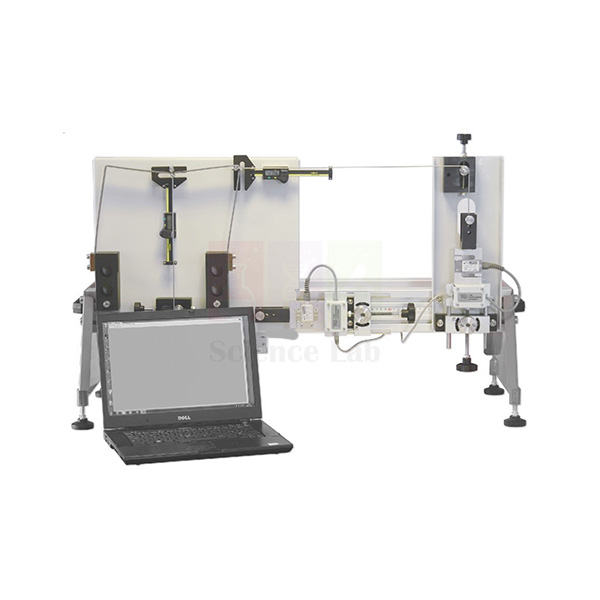
Plastic Bending of Portals
Plastic Bending of Portals (Product Code: SLE/EG/26) is a structural experiment in which a specimen portal frame is loaded beyond its elastic limit until plastic hinges form and it collapses. Load cells apply and measure vertical, horizontal or combined loads through cables held at 90 degrees to the portal, while precision indicators track how the frame deforms. The apparatus shows how a building can yield yet still carry load long enough for people to leave safely. It is manufactured by Jain Scientific Equipments Pvt Ltd (ScienceLab), Ambala, an engineering lab equipment manufacturer supplying civil and structural engineering departments.
Key Details
| Parameter | Detail |
|---|---|
| Type | Plastic collapse experiment for portal frames |
| Specimen mounting | Portal frame fitted to fixing blocks that simulate fixed foundations |
| Load application | Load cells apply and measure the load through cables at 90 degrees to the portal, preserving load direction as the portal deforms |
| Load cases | Vertical, horizontal or combined loads |
| Deformation measurement | Precision indicators |
| Behaviour studied | Elastic region, plastic region with permanent deformation, formation of plastic hinges and plastic collapse |
| Analysis outcome | Interaction between vertical and horizontal loads and an interaction diagram to predict the failure mode |
Typical Use
Before loading, students predict the collapse loads for the chosen load case using textbook plastic analysis, identifying where hinges should form in a fixed-base portal. They then increase load through the cable-and-load-cell system, recording force and deformation. The response starts out linear, then flattens as the first hinge forms and the frame begins to deform permanently, until a mechanism develops and the portal can take no more load. Because the cables stay at 90 degrees to the portal, the load direction is preserved even as the frame sways, so the measured collapse load can be compared fairly with prediction.
Repeating the test with vertical only, horizontal only and combined loads lets the class plot an interaction diagram and see which failure mode governs for each combination. This builds real understanding of ductility and reserve strength, and why designers value them. The rig is well suited to final-year undergraduate and postgraduate structures work and to technical institutes teaching limit-state concepts.
Manufacturer
ScienceLab is the trading name of Jain Scientific Equipments Private Limited (CIN U29309HR2020PTC087597), an Ambala, Haryana company. Its apparatus is made at the licensed factory at 449, HSIIDC Industrial Area, Saha, Ambala (Factory Licence AMB-ONLINE-CHD-J-414). Read more on our company profile.
Related Laboratory Equipment
Experiments and tools that build on the same plastic-analysis topic:
- Plastic Bending Of Beams — introduces hinge formation and shape factor on single beams before moving to frames
- Bending Moments In A Portal Frame — covers the elastic bending moment distribution in a portal
- Frame Deflections And Reactions — measures sway and base reactions of frames within the elastic range
- Caliper Vernier (Metal) — for measuring the specimen cross-section used in plastic moment calculations
Our General Products category holds the full structures range.
Frequently Asked Questions
Why are the loads applied through cables?
Each load cell pulls through a cable held at 90 degrees to the portal, which keeps the load direction constant as the frame deforms and sways.
Can a specimen portal be reused?
Once taken into the plastic region it is permanently deformed, so each specimen serves one collapse test. Ask us about spare specimen portals when you order.
Which load combinations can be tested?
Vertical, horizontal or combined loads, allowing students to build an interaction diagram and predict the failure mode.
What load capacity and specimen material are used?
These values are not included in our current product description. Please contact us for the technical sheet.
Is a calibration certificate available for the load cells?
Availability should be discussed with us at the enquiry stage.
What should a university purchase enquiry include?
The number of rigs, spare specimens required, delivery location and any tender reference. Warranty terms are given with the quotation.
Do you export this apparatus?
Yes, it is supplied to institutions in India and international markets.
Request a Quote
For a price on Plastic Bending of Portals and spare specimens, reach us through the contact page or add the item to the enquiry cart.
Last updated: 24 September 2026