- Physics Lab Equipment
- Chemistry Lab Equipment
- Biology Lab Equipment
- Anatomical Lab Equipment
- Learning
- Educational Lab Equipment
- Magnets
- Agriculture
- Astronomy
- Earth Science
- Geography Lab Equipment
- Safety Lab Coat
- Laboratory
- Meteorological
- Electricity & Magnetism
- Heat
- School Lab Equipment
- Lab Glassware
- Science Lab Equipment
- Tvet Lab Equipment
- Robotics Kits Supplier and Manufacturer for Schools India
- Math Lab Equipment Manufacturers and Exporters in Ambala
- STEM Kits Manufacturers and Supplier India
- Engineering Lab Equipment
- Hospital Lab Equipment
- Water, Sanitation & Hygiene Supplies
- Cold Chain, Solar & Communication Equipment
- Nutrition
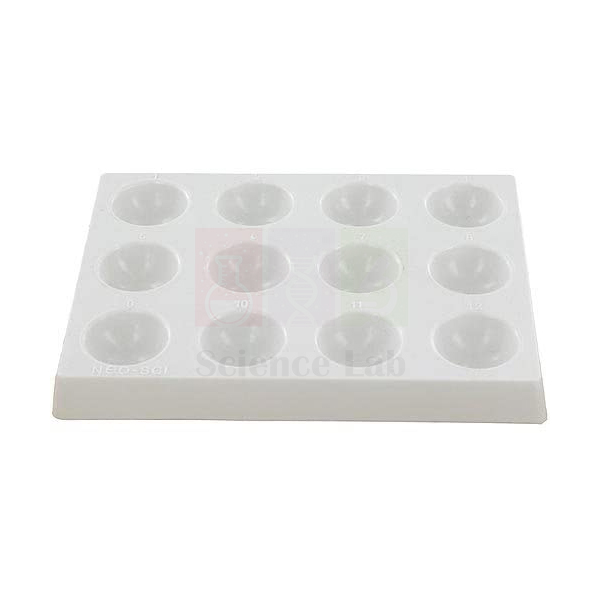
Polypropylene Tiles
Polypropylene Tiles (Product Code: SLE/P/18) are white spotting tiles used to carry out drop-scale colour tests and small reactions side by side in school and college chemistry and biology laboratories. Each tile measures 118 × 93 × 11 mm and has 12 cavities of 22 mm diameter, so a dozen samples or reagent combinations can be compared at once. They are made by Jain Scientific Equipments Pvt Ltd (ScienceLab), an OEM lab equipment manufacturer, at its own factory in Ambala, India.
Specifications
| Parameter | Detail |
|---|---|
| Type | Spotting tile with cavities |
| Material | Polypropylene |
| Colour | White |
| Number of cavities | 12 |
| Cavity diameter | 22 mm |
| Overall size | 118 × 93 × 11 mm |
| Product code | SLE/P/18 |
| Manufacturer | Jain Scientific Equipments Pvt Ltd (ScienceLab) — OEM |
| Country of origin | India (made in Ambala, Haryana) |
What Are Polypropylene Spotting Tiles Used For?
A white spotting tile makes small colour changes easy to see. Students place a few drops of a test solution in each cavity and add an indicator or reagent, for example to test for starch with iodine, to compare the pH of household liquids with universal indicator, or to preview the end-point colour of a titration before the full run. Twelve cavities let a whole series of samples or concentrations be laid out in order, so results can be read and recorded at a glance.
Polypropylene tiles are lighter than ceramic spotting tiles and less likely to chip when handled by students. Rinse the cavities with water straight after use so coloured residues do not stain, and dry the tile before storing it. They make a compact addition to any chemistry teaching kit for schools in India.
OEM Manufacturer
Jain Scientific Equipments Private Limited, trading as ScienceLab, manufactures these polypropylene tiles as the OEM (original equipment manufacturer) at its own licensed factory at Saha, Ambala, Haryana, India. Because the tiles come straight from the maker, schools, colleges, dealers and importers can order classroom quantities and repeat batches without a middleman. Details on the company are on the ScienceLab profile.
Related Scientific Lab Plasticware
Drop tests on a spotting tile usually need these companion items:
- Dropping Bottle — holds the reagents that are dropped into each cavity.
- Azlon Dispensing Bottle — dispenses indicators a drop at a time.
- Universal pH Indicator — a common reagent for colour tests on the tile.
- Stirring Rod, Polypropylene — mixes the drops inside each cavity.
Browse the whole Scientific Lab Plasticware category for more bench items.
Frequently Asked Questions
How many cavities does the Polypropylene Tile have?
Each Polypropylene Tile (SLE/P/18) has 12 cavities, each 22 mm in diameter, set in a white tile measuring 118 × 93 × 11 mm. This lets students run a dozen drop tests side by side and compare colours directly.
Why are the Polypropylene Tiles white?
The Polypropylene Tiles are white because a white background shows faint colour changes clearly, such as the blue-black of starch with iodine or the shades of universal indicator. This makes results easier to read and record accurately.
Can the Polypropylene Tiles be heated?
No heat rating is given for the Polypropylene Tiles (SLE/P/18), so use them for room-temperature drop tests only and keep them away from burners and hot plates. For reactions that need heating, use a test tube or an evaporating dish instead.
How should polypropylene spotting tiles be cleaned?
Rinse the Polypropylene Tiles with water straight after use, using a soft brush or cloth for any residue, and let them dry before storage. Prompt rinsing stops coloured indicators and iodine from staining the white polypropylene surface.
Who manufactures the Polypropylene Tiles SLE/P/18?
Jain Scientific Equipments Pvt Ltd, trading as ScienceLab, manufactures the Polypropylene Tiles (SLE/P/18) as the OEM at its own licensed factory in Saha, Ambala, Haryana, India, supplying schools, colleges, dealers and importers directly.
What does a quotation for spotting tiles need?
A quotation for the Polypropylene Tiles (SLE/P/18) needs the number of tiles, the delivery location and any dropper bottles or indicators you want on the same order. Send the details through the enquiry cart or the contact page.
Request a Quote
Add the Polypropylene Tiles to the enquiry cart or send the number of tiles you need via the contact page; the quotation will come direct from ScienceLab as the manufacturer.
Last updated: 24 September 2026