- Physics Lab Equipment
- Chemistry Lab Equipment
- Biology Lab Equipment
- Anatomical Lab Equipment
- Learning
- Educational Lab Equipment
- Magnets
- Agriculture
- Astronomy
- Earth Science
- Geography Lab Equipment
- Safety Lab Coat
- Laboratory
- Meteorological
- Electricity & Magnetism
- Heat
- School Lab Equipment
- Lab Glassware
- Science Lab Equipment
- Tvet Lab Equipment
- Robotics Kits Supplier and Manufacturer for Schools India
- Math Lab Equipment Manufacturers and Exporters in Ambala
- STEM Kits Manufacturers and Supplier India
- Engineering Lab Equipment
- Hospital Lab Equipment
- Water, Sanitation & Hygiene Supplies
- Cold Chain, Solar & Communication Equipment
- Nutrition
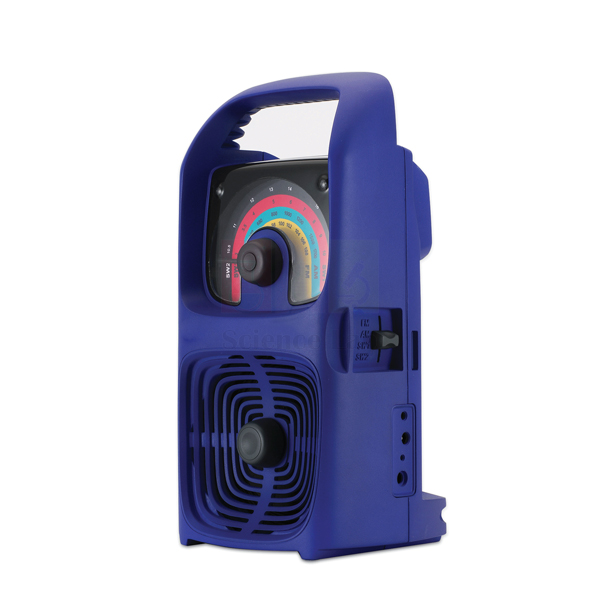
Radio, Multiband, Solar, Wind-up
Radio, Multiband, Solar, Wind-up (Product Code: SLE/CS/06) is a portable AM/FM/SW1/SW2 radio that runs from a rechargeable NiMH battery charged either by its built-in winding handle or by a detachable solar panel, so it keeps working where mains power or dry cells are hard to get. Schools, learning centres and field programmes use it to receive educational broadcasts, news and announcements. It is supplied by Jain Scientific Equipments Pvt Ltd (ScienceLab), Ambala, India, as part of its educational science equipments and classroom supply range.
Specifications
| Parameter | Detail |
|---|---|
| Bands | AM, FM, SW1, SW2 |
| FM | 88-108 MHz |
| MW | 520-1700 kHz |
| SW1 | 3-10 MHz |
| SW2 | 10-18 MHz |
| Tuning display | Clear, easily read digital/dial frequency window showing the frequency scale and four bands; band selector switch |
| Speaker | Mono speaker giving clear, audible sound |
| Controls | Combined volume and on/off switch |
| Battery | Nickel Metal Hydride (NiMH), 1800 mAh |
| Wind-up charging | Strong, non-detachable hard plastic winding arm, housed within the body when not in use; recharges when wound in either direction |
| Listening time | No less than 30 minutes after 60 seconds of winding (at a set listening level) |
| Solar charging | Detachable solar panel that fits into the radio body with easy holding devices; approx. 2.5 m lead |
| Casing | Robust plastic with thick outer casing; able to withstand a drop of one metre onto a hard surface |
| Carrying | Ergonomic carrying handle |
| Documentation | Clear instructions in English with illustrations |
Typical Use
In classrooms without reliable electricity, a teacher can tune to a scheduled educational programme on FM, MW or shortwave and play it to the whole group through the mono speaker. The solar panel’s long lead means it can sit in direct sun outside a window or on a roof edge while the class listens indoors or in shade, and a minute of winding gives at least half an hour of listening when the sun is not available. The same radio serves community centres and relief sites for news, weather and public announcements.
The radio is also a handy teaching object: students can see solar and muscle energy converted to electrical energy, stored in a battery and turned into sound, which ties in well with a solar energy science kit in India’s upper-primary and middle-school science lessons. Fold the winding arm back into the body after use, keep the panel clean and free of scratches, and store the set in a dry place between sessions.
Supplier
ScienceLab, the trading name of Jain Scientific Equipments Private Limited in Ambala, Haryana, supplies this radio alongside the student kits, storage boxes and teaching aids used in schools and education programmes. To learn more about the company, visit the ScienceLab profile page.
Related Classroom Student Products
These items are often ordered with the radio for the same learning setting:
- Radio, Multiband, Solar, Wind-up, MP3 — a related model for buyers who also want MP3 playback.
- Box, Metal, Lockable, for Storage — keeps the radio secure and dry between lessons.
- School-in-a-bag Kit,40 Student,1 Teacher — classroom materials for the same off-grid learning spaces.
- Blackboard, Double-sided, 1160 x 760 mm — for noting key points from a radio lesson.
Browse the Classroom Student category for more.
Frequently Asked Questions
Which frequencies does it receive?
FM 88-108 MHz, MW 520-1700 kHz, SW1 3-10 MHz and SW2 10-18 MHz, selected with a band switch.
How is the battery charged?
The 1800 mAh NiMH battery is charged by turning the built-in winding handle in either direction or by connecting the detachable solar panel.
How long will it play after winding?
Winding for 60 seconds gives no less than 30 minutes of listening at a set volume level; higher volume shortens this.
Can the solar panel stay outside while we listen indoors?
Yes. The panel has a lead of approx. 2.5 m, so it can be placed in the sun while listeners stay indoors or in shade.
How rugged is it?
It has a thick, robust plastic casing designed to survive a one-metre drop onto a hard surface, and the winding arm folds into the body for protection.
What documentation and warranty come with it?
Illustrated instructions in English are supplied. Warranty terms are confirmed in the quotation; ask us through the contact page.
Can you supply programme or export quantities?
Yes. ScienceLab supplies India and international markets; include quantity and destination in your enquiry.
Request a Quote
To request a price for the solar wind-up radio, write through the contact page or add it to the enquiry cart.
Last updated: 24 September 2026