- Physics Lab Equipment
- Chemistry Lab Equipment
- Biology Lab Equipment
- Anatomical Lab Equipment
- Learning
- Educational Lab Equipment
- Magnets
- Agriculture
- Astronomy
- Earth Science
- Geography Lab Equipment
- Safety Lab Coat
- Laboratory
- Meteorological
- Electricity & Magnetism
- Heat
- School Lab Equipment
- Lab Glassware
- Science Lab Equipment
- Tvet Lab Equipment
- Robotics Kits Supplier and Manufacturer for Schools India
- Math Lab Equipment Manufacturers and Exporters in Ambala
- STEM Kits Manufacturers and Supplier India
- Engineering Lab Equipment
- Hospital Lab Equipment
- Water, Sanitation & Hygiene Supplies
- Cold Chain, Solar & Communication Equipment
- Nutrition
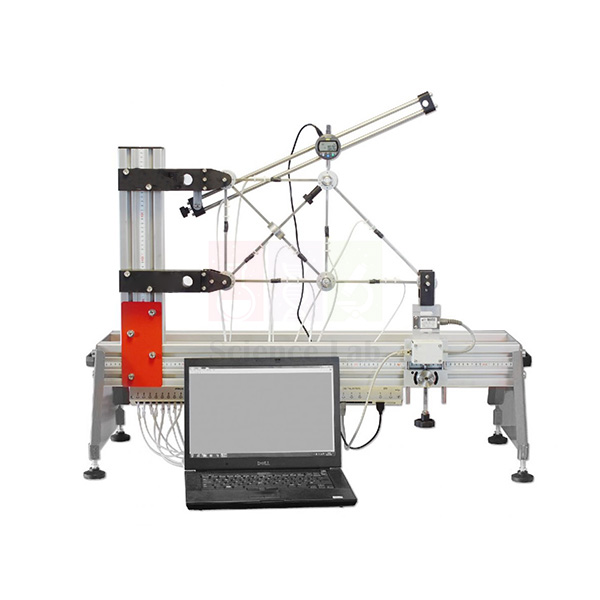
Redundant Truss Next Generation Structures
Redundant Truss Next Generation Structures (Product Code: SLE/EG/04) is a truss experiment used to compare a statically determinate frame with a statically indeterminate one in university and engineering college structures labs. Strain gauges on every member, a precision deflection indicator and an extra ‘redundant’ member engaged by a thumbscrew let students test both cases on the same frame. It is manufactured by Jain Scientific Equipments Pvt Ltd (ScienceLab), an OEM manufacturer, at its own factory in Ambala, India, as engineering educational equipment for structural analysis courses.
Key Details
| Parameter | Detail |
|---|---|
| Type | Redundant truss experiment (determinate and statically indeterminate cases) |
| Supports | Two: one allows rotation only; the other allows rotation and translation |
| Load application | Hand-operated load cell assembly that applies and measures the load at the free-end Joint Boss |
| Member force measurement | Strain gauges on each truss member |
| Deflection measurement | Precision indicator measuring the framework deflection |
| Redundant member | Extra member engaged and disengaged with a simple thumbscrew |
| Data connection | Strain gauges connect to a strain gauge amplifier, which connects to the interface hub of the Structures Platform for computer display and data acquisition |
| Analysis | Textbook truss equations for the determinate case; a more advanced method such as the strain-energy method for the indeterminate case |
| Product code | SLE/EG/04 |
| Manufacturer | Jain Scientific Equipments Pvt Ltd (ScienceLab) — OEM |
| Country of origin | India (made in Ambala, Haryana) |
What Is the Redundant Truss Used For?
The practical runs in two halves. With the redundant member disengaged, the frame is statically determinate: students apply load at the Joint Boss with the hand-operated load cell, read the strain in each member and convert it to member force, then check the values against a method-of-joints calculation. They also note the deflection on the precision indicator. This first half confirms the reliability of the textbook equations and the accuracy of the experimental results.
Turning the thumbscrew then brings the extra member into action and the same loads are repeated. Now the forces can no longer be found from equilibrium alone, so students predict them with the strain-energy method and compare deflection for both cases, seeing how the redundant member shares load and stiffens the frame. For colleges buying engineering lab equipment in India, it bridges determinate and indeterminate structures in one bench-top module.
What to Specify When Ordering
- Whether you already have the Structures Platform, whose interface hub is needed for computer display and data acquisition (it is a separate item).
- Whether the strain gauge amplifier should be quoted with the truss — we will confirm exactly what your order includes.
- The computer you will use for display and logging through the Structures Platform.
- The number of truss units and any other structures modules to be quoted together.
OEM Manufacturer
Jain Scientific Equipments Private Limited, trading as ScienceLab, is the OEM (original equipment manufacturer) of this redundant truss and produces it at its own licensed factory at Saha, Ambala, Haryana, India. Universities and colleges building a structures laboratory can buy it factory-direct alongside the rest of the range, and questions about the frame, load cell assembly or replacement parts go straight to the people who build it — ask us. Company details are on our company profile.
Related Laboratory Equipment
Items used with, or studied alongside, this truss module:
- Structures Platform — houses the interface hub through which the strain readings reach a computer.
- Continuous and Indeterminate Beams — the same determinate-to-indeterminate idea applied to beams.
- Two Pinned Arch — another structure where a measured reaction is compared with theory.
- Bending Stress In a Beam — practises strain-gauge measurement on a simpler member.
For more structures apparatus, open our General Products listing.
Frequently Asked Questions
What makes the truss ‘redundant’?
The Redundant Truss Next Generation Structures frame has an extra member that a simple thumbscrew engages. With it engaged, the frame becomes statically indeterminate, so member forces can no longer be found from equilibrium alone and need a method such as strain energy.
How are member forces measured?
Each member of the Redundant Truss Next Generation Structures carries strain gauges. Their signals pass to a strain gauge amplifier, which connects to the interface hub of the Structures Platform for computer display and data acquisition.
Does it need the Structures Platform?
Yes, for computer display and data acquisition. The Redundant Truss Next Generation Structures connects through a strain gauge amplifier to the Structures Platform interface hub, and the platform is listed as a separate item.
Is the strain gauge amplifier included?
The current Redundant Truss Next Generation Structures listing does not confirm whether the strain gauge amplifier is included. Please contact us before ordering and we will state exactly which parts your quotation covers.
What is the load capacity of the load cell?
The load capacity of the hand-operated load cell assembly on the Redundant Truss Next Generation Structures is not stated in our current text. Ask us through the contact page for the datasheet of the unit you are quoted.
Who manufactures the Redundant Truss Next Generation Structures?
The Redundant Truss Next Generation Structures is manufactured by Jain Scientific Equipments Pvt Ltd (ScienceLab), the OEM, at its own licensed factory at Saha, Ambala, Haryana, India. Quotations for single modules or a full structures laboratory come directly from the manufacturer.
Can you quote for a full structures laboratory?
Yes. Send the list of structures modules, including the Redundant Truss Next Generation Structures and the Structures Platform, with quantities and your delivery location in India or international markets, and we will prepare one quotation.
Request a Quote
Pricing for this redundant truss comes direct from the manufacturer: use our contact page, or add it to your enquiry cart together with the Structures Platform.
Last updated: 24 September 2026