- Physics Lab Equipment
- Chemistry Lab Equipment
- Biology Lab Equipment
- Anatomical Lab Equipment
- Learning
- Educational Lab Equipment
- Magnets
- Agriculture
- Astronomy
- Earth Science
- Geography Lab Equipment
- Safety Lab Coat
- Laboratory
- Meteorological
- Electricity & Magnetism
- Heat
- School Lab Equipment
- Lab Glassware
- Science Lab Equipment
- Tvet Lab Equipment
- Robotics Kits Supplier and Manufacturer for Schools India
- Math Lab Equipment Manufacturers and Exporters in Ambala
- STEM Kits Manufacturers and Supplier India
- Engineering Lab Equipment
- Hospital Lab Equipment
- Water, Sanitation & Hygiene Supplies
- Cold Chain, Solar & Communication Equipment
- Nutrition
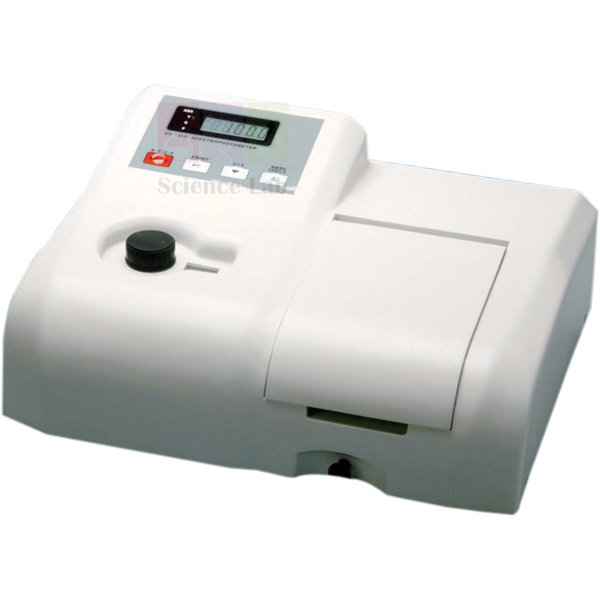
Single Beam Microprocessor UV-VIS Spectrophotometer
Single Beam Microprocessor UV-VIS Spectrophotometer (Product Code: SLE/LI/07) is a benchtop optical instrument used to measure the absorbance, percentage transmission and concentration of solutions from 195 to 1000 nm in college, research and quality-control laboratories. Chemistry, biochemistry and pharmacy departments rely on it for quantitative analysis, and it pairs a tungsten halogen lamp with a deuterium lamp so both the ultraviolet and visible regions are covered. This UV visible spectrophotometer is supplied by Jain Scientific Equipments Pvt Ltd (ScienceLab), Ambala, a laboratory equipment supplier in India.
Specifications
| Parameter | Detail |
|---|---|
| Wavelength range | 195 to 1000 nm |
| Measurement modes | Absorbance, % transmission and automatic concentration |
| Wavelength selection | Manual wavelength calibration and selection |
| Light sources | Tungsten halogen lamp and deuterium (D2) lamp |
| Optics | Complete mirror optics with a 1200 grooves/mm grating |
| Spectral bandwidth | 2 nm |
| Wavelength accuracy | ± 0.5 nm |
| Wavelength repeatability | ± 0.3 nm |
| Resolution | 0.1 nm |
| Photometric range | %T: 0 to 100%; Abs: 0 to 1.999; Conc.: 0 to 1999; K-factor: 0 to 1999 |
| Photometric accuracy | ± 0.005 Abs at 1.0 Abs; a second figure of ± 0.010 Abs is also listed — confirm its reference point with your quotation |
| Stray light | Less than 0.1% Abs at 320 nm |
| Readability | ± 1 count |
| Detector | Wide-range silicon photodiode |
| Sample holder | 4-position adjustable holder with selector control, for 10 mm path length cuvettes |
| Cuvettes provided | Set of 2 quartz and 4 glass cuvettes |
| Display | Single-line LCD |
| Keyboard | 4 keys, soft-touch membrane type |
| Interfaces | RS-232C serial interface; printer interface |
| Software | Included |
| Power | 230 V ± 10%, 50 Hz AC |
| Dimensions (L x B x H) | 420 x 350 x 240 mm (approx.) |
| Weight | 10 kg (approx.) |
| Product code | SLE/LI/07 |
| Supplied by | Jain Scientific Equipments Pvt Ltd (ScienceLab), Ambala, India |
What Is the UV-VIS Spectrophotometer Used For?
The UV-VIS spectrophotometer is used for Beer-Lambert law experiments, building calibration curves and estimating the concentration of coloured or UV-absorbing compounds. Typical teaching work includes absorbance of biomolecules in the ultraviolet region, dye and colour analysis in the visible region, and reaction kinetics followed as a change in absorbance over time. The concentration and K-factor modes let students read results directly once a standard has been measured.
Use the quartz cuvettes for readings in the ultraviolet range, because ordinary glass absorbs UV light; the glass cuvettes suit visible-range work. Let the lamps warm up, zero the instrument with a solvent blank, and wipe the cuvette faces with lint-free tissue before every reading. The RS-232C port and included software allow readings to be transferred to a computer, which helps analytical lab instruments fit into record-keeping routines.
What to Specify When Ordering
- The mains supply at your site — the listed unit runs on 230 V ± 10%, 50 Hz AC.
- Whether you need spare cuvettes in addition to the supplied set of 2 quartz and 4 glass cuvettes.
- Whether a printer or computer connection is planned, so the RS-232C and printer interfaces can be discussed.
- Quantity per laboratory and the delivery city or country.
Supplier
Jain Scientific Equipments Private Limited trades under the ScienceLab name and supplies this spectrophotometer from Ambala, Haryana, to schools, colleges, research institutes, dealers and importers. Analytical instruments like this one can be added to the same order as other teaching-lab items, so a department deals with a single supplier for its bench equipment. Read more about the company on our company profile.
Related Laboratory Instruments
These items support photometric analysis and sample preparation alongside the spectrophotometer:
- Digital Photo Colorimeter 5 Filters — a filter-based option for visible-range colour measurements in school labs.
- Ultra Violet/Visible (UV/VIS) Spectrophotometer — another UV-VIS model to compare before ordering.
- Volumetric Flask — for making up standard solutions for calibration curves.
- Bottle Top Dispenser — repeat dispensing of solvent or reagent when many samples are prepared.
See the full Laboratory Instruments range for more bench instruments.
Frequently Asked Questions
What is the wavelength range of the Single Beam Microprocessor UV-VIS Spectrophotometer?
The Single Beam Microprocessor UV-VIS Spectrophotometer covers 195 to 1000 nm using a tungsten halogen lamp and a deuterium lamp. It offers a 2 nm spectral bandwidth, 0.1 nm resolution and ± 0.5 nm wavelength accuracy for both ultraviolet and visible measurements.
Which cuvettes come with the UV-VIS spectrophotometer?
The Single Beam Microprocessor UV-VIS Spectrophotometer is provided with a set of 2 quartz and 4 glass cuvettes for a 10 mm path length. The 4-position sample holder takes these cuvettes; use the quartz ones for ultraviolet readings. Ask us if extra cuvettes should be quoted.
Can this spectrophotometer be connected to a computer or printer?
Yes. The Single Beam Microprocessor UV-VIS Spectrophotometer has an RS-232C serial interface and a printer interface, and software is included. Mention your computer set-up when you request a quotation so the connection requirements can be discussed before dispatch.
Who supplies the Single Beam Microprocessor UV-VIS Spectrophotometer?
The Single Beam Microprocessor UV-VIS Spectrophotometer is supplied by Jain Scientific Equipments Pvt Ltd (ScienceLab), Ambala, Haryana, India. The company supplies laboratory instruments to schools, colleges, institutions, dealers and importers in India and international markets.
Is a calibration certificate available with the spectrophotometer?
Calibration-certificate availability for the Single Beam Microprocessor UV-VIS Spectrophotometer should be discussed with us before ordering. The instrument itself provides manual wavelength calibration, and we will confirm what documentation accompanies the unit you are quoted. Please ask through our contact page.
What power supply and bench space does the UV-VIS spectrophotometer need?
The Single Beam Microprocessor UV-VIS Spectrophotometer runs on 230 V ± 10%, 50 Hz AC. It measures about 420 x 350 x 240 mm and weighs approximately 10 kg, so a standard laboratory bench close to a mains socket is sufficient.
What should a quotation request for this spectrophotometer include?
A quotation request for the Single Beam Microprocessor UV-VIS Spectrophotometer should state the quantity, delivery city or country, any spare cuvettes needed and whether the instrument is for a teaching, research or industrial laboratory. Send these details through our contact page for a quick reply.
Request a Quote
For a quotation on the Single Beam Microprocessor UV-VIS Spectrophotometer, send your quantity and delivery location through our contact page, or add it to the enquiry cart together with the other laboratory instruments you need.
Last updated: 24 September 2026