- Physics Lab Equipment
- Chemistry Lab Equipment
- Biology Lab Equipment
- Anatomical Lab Equipment
- Learning
- Educational Lab Equipment
- Magnets
- Agriculture
- Astronomy
- Earth Science
- Geography Lab Equipment
- Safety Lab Coat
- Laboratory
- Meteorological
- Electricity & Magnetism
- Heat
- School Lab Equipment
- Lab Glassware
- Science Lab Equipment
- Tvet Lab Equipment
- Robotics Kits Supplier and Manufacturer for Schools India
- Math Lab Equipment Manufacturers and Exporters in Ambala
- STEM Kits Manufacturers and Supplier India
- Engineering Lab Equipment
- Hospital Lab Equipment
- Water, Sanitation & Hygiene Supplies
- Cold Chain, Solar & Communication Equipment
- Nutrition
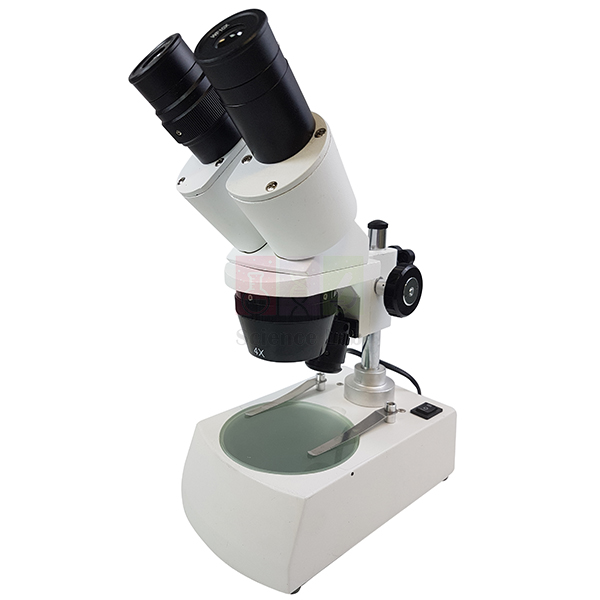
Stereo Binocular Microscope
Stereo Binocular Microscope (Product Code: SLE/M/06) is a low-power stereo microscope used to view whole, three-dimensional specimens such as insects, flowers, seeds, rocks and dissections at 20x and 40x in school, college and field-study labs. It pairs WF10x eyepieces with 2x and 4x objectives and lights the specimen from above and below with 1 W LED lamps. This stereo microscope for schools in India and overseas is supplied by Jain Scientific Equipments Pvt Ltd (ScienceLab), Ambala, India.
Specifications
| Parameter | Detail |
|---|---|
| Type | Stereo binocular microscope |
| Magnification | 20x to 40x |
| Eyepieces | WF10x |
| Objectives | 2x, 4x |
| Illumination | Top and bottom light, 1 W LED lamp |
| Working distance | 57 mm |
| Coarse adjustment range | 40 mm |
| Working stage | 90 mm frosted glass |
| Product code | SLE/M/06 |
| Supplied by | Jain Scientific Equipments Pvt Ltd (ScienceLab), Ambala, India |
What Is the Stereo Microscope Used For?
A stereo microscope shows an upright, three-dimensional view of objects too thick for a slide, so no specimen preparation is needed. Typical classroom tasks include sorting soil invertebrates, studying the mouthparts and legs of insects, examining flower parts and seed coats, checking mineral grains, and guiding fine work during a dissection. At 20x a whole specimen fits in view; switching to 40x reveals surface texture and small structures.
Use the top light for opaque objects such as beetles or rock chips, and the bottom light shining through the frosted glass stage for thin, translucent material like leaf fragments or small aquatic animals in a dish. The 57 mm working distance leaves room for forceps and mounted needles under the objectives, and the 40 mm coarse adjustment range accommodates specimens of different heights.
Supplier
Jain Scientific Equipments Private Limited, known by its trading name ScienceLab, supplies this stereo binocular microscope from Ambala, Haryana, alongside dissection tools and slide-based microscopes. Schools, colleges, agricultural and forestry training centres, dealers and importers in India and international markets can combine it with the rest of a biology lab list. Details about the company are on the ScienceLab company profile.
Related Laboratory Equipment
Tools that pair well with a stereo microscope:
- Dissection Pan, Pad & Cover — a working surface for dissections viewed under the microscope
- Forceps (Tweezers) — position small specimens on the stage
- Micrometer Disc Reticle — eyepiece scale for sizing specimens (confirm fit with us)
- Binocular Stereo Microscope, 40x — an alternative stereo model with cordless LED lighting
More stereo and compound models are in the Microscope category.
Frequently Asked Questions
What magnification does the Stereo Binocular Microscope provide?
The Stereo Binocular Microscope provides 20x and 40x. Its WF10x eyepieces combine with 2x and 4x objectives, giving low-power, three-dimensional views of whole specimens rather than the high magnification of a compound slide microscope.
How is the Stereo Binocular Microscope different from a compound microscope?
The Stereo Binocular Microscope gives an upright 3D image of solid objects at low power, with space to work under the lens. A compound microscope reaches higher magnifications but needs thin specimens mounted on glass slides.
What lighting does the Stereo Binocular Microscope have?
The Stereo Binocular Microscope has top and bottom illumination using 1 W LED lamps. Top light suits opaque specimens, while bottom light passes through the 90 mm frosted glass stage for translucent material.
How much working space is there under the Stereo Binocular Microscope?
The Stereo Binocular Microscope has a 57 mm working distance and a 40 mm coarse adjustment range. That leaves room for forceps or dissecting needles and allows specimens of varying thickness to be brought into focus.
Who supplies the Stereo Binocular Microscope?
The Stereo Binocular Microscope is supplied by Jain Scientific Equipments Pvt Ltd (ScienceLab), Ambala, Haryana, India. It is dispatched to schools, colleges, training institutes, dealers and importers in India and international markets.
What should I mention when requesting a quote for the Stereo Binocular Microscope?
For the Stereo Binocular Microscope, mention the number of units, your delivery location and mains supply, and any dissection tools or reticles you need. We will then prepare a single, complete quotation for your lab.
Request a Quote
Enquire about the Stereo Binocular Microscope through the contact page, or add it to the enquiry cart with dissection equipment for your biology or field-study lab.
Last updated: 24 September 2026