- Physics Lab Equipment
- Chemistry Lab Equipment
- Biology Lab Equipment
- Anatomical Lab Equipment
- Learning
- Educational Lab Equipment
- Magnets
- Agriculture
- Astronomy
- Earth Science
- Geography Lab Equipment
- Safety Lab Coat
- Laboratory
- Meteorological
- Electricity & Magnetism
- Heat
- School Lab Equipment
- Lab Glassware
- Science Lab Equipment
- Tvet Lab Equipment
- Robotics Kits Supplier and Manufacturer for Schools India
- Math Lab Equipment Manufacturers and Exporters in Ambala
- STEM Kits Manufacturers and Supplier India
- Engineering Lab Equipment
- Hospital Lab Equipment
- Water, Sanitation & Hygiene Supplies
- Cold Chain, Solar & Communication Equipment
- Nutrition
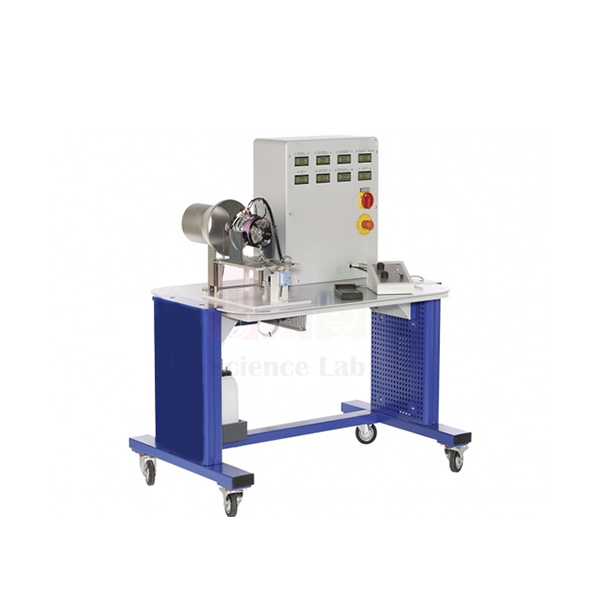
Turbojet Engine Test Bench
Turbojet Engine Test Bench (Product Code: SLE/MCE/56) is a gas turbine jet engine rig used to demonstrate thrust generation and measure the operating behaviour of a small turbojet in aeronautical, mechanical and thermal engineering laboratories. Its engine delivers a maximum thrust of 82 N at 117,000 rpm, while the bench measures pressures, temperatures, speed, fuel consumption and force. It is supplied by Jain Scientific Equipments Pvt Ltd (ScienceLab), Ambala, India.
Specifications
| Parameter | Detail |
|---|---|
| Maximum thrust | 82 N at 117,000 rpm |
| Speed range | 35,000–117,000 rpm |
| Exhaust gas temperature | 610 °C |
| Starting system | Electric starter |
| Fuel | Kerosene or petroleum, with turbine oil |
| Fuel tank | 1 tank, 5 L |
| Fuel consumption | Max. 22 L/h at full load |
| Sound level at 1 m | Max. 130 dB(A) |
| Differential pressure measurement | 0–150 mbar |
| Combustion chamber pressure | 0–2.5 bar |
| Temperature measurement | 2 × 0–1200 °C and 1 × 0–400 °C |
| Speed measurement | 0–120,000 rpm |
| Fuel consumption measurement | 0–25 L/h |
| Force measurement | 0 to ±200 N |
| Power supply versions | 230 V, 50 Hz, 1 phase; 230 V, 60 Hz, 1 phase; 120 V, 60 Hz, 1 phase |
| Dimensions | 1200 × 900 × 330 mm |
| Weight | 120 kg (approx.) |
| Product code | SLE/MCE/56 |
| Supplied by | Jain Scientific Equipments Pvt Ltd (ScienceLab), Ambala, India |
What Is the Turbojet Engine Test Bench Used For?
Students start the engine with the electric starter, run it across its 35,000–117,000 rpm speed range and record thrust, combustion chamber pressure, exhaust gas temperature and fuel flow at each setting. From these readings they can plot thrust against speed, work out thrust-specific fuel consumption and relate the results to the Brayton cycle taught in thermodynamics and propulsion courses.
Because the sound level at 1 m can reach 130 dB(A), the bench should run in a dedicated test room, with hearing protection for everyone present and fuel kept away from hot parts. It gives aerospace and mechanical departments sourcing engineering lab equipment in India a compact way to put a real jet engine in front of students.
What to Specify When Ordering
- The power supply version: 230 V 50 Hz, 230 V 60 Hz or 120 V 60 Hz, single phase.
- Which fuel you will use locally — kerosene or petroleum, with turbine oil.
- The test room or space where the 1200 × 900 × 330 mm bench will run.
- The number of benches and the delivery destination.
Supplier
ScienceLab is the trading name of Jain Scientific Equipments Private Limited, Ambala, Haryana, India, which supplies the Turbojet Engine Test Bench to universities, engineering colleges, dealers and importers in India and international markets. Questions about set-up, spares or repeat orders are answered by the same team that prepares your quotation — simply ask us. See the ScienceLab profile for company details.
Related Automotive Training Equipment
These items help students build up to, and compare against, the turbojet.
- Two Shaft Gas Turbine — another gas turbine trainer for comparing turbine configurations.
- Hero Engine — a simple classroom demonstration of reaction propulsion before students meet the real turbojet.
- Four Stroke Four Cylinder Petrol Engine Test Bench — contrasts continuous combustion with a reciprocating engine’s performance.
See more in Automotive Training Equipment and Aerodynamics Lab Equipment.
Frequently Asked Questions
What thrust does the Turbojet Engine Test Bench produce?
The Turbojet Engine Test Bench engine produces a maximum thrust of 82 N at 117,000 rpm, with an operating speed range of 35,000 to 117,000 rpm. The force measuring range of the bench is 0 to ±200 N.
What fuel does the Turbojet Engine Test Bench use?
The Turbojet Engine Test Bench runs on kerosene or petroleum with turbine oil, carried in a 5 L tank. Fuel consumption reaches a maximum of 22 L/h at full load, and the bench measures consumption over 0–25 L/h.
What does the Turbojet Engine Test Bench measure?
The Turbojet Engine Test Bench measures differential pressure (0–150 mbar), combustion chamber pressure (0–2.5 bar), temperature at three points (two over 0–1200 °C, one over 0–400 °C), speed up to 120,000 rpm, fuel consumption and thrust force.
How loud is the Turbojet Engine Test Bench?
The Turbojet Engine Test Bench reaches a sound level of up to 130 dB(A) at 1 m distance. Run it in a separate test room, keep observers at a distance and make sure everyone nearby wears suitable hearing protection.
Which power supplies are available for the turbojet bench?
The Turbojet Engine Test Bench is listed in three power supply versions: 230 V 50 Hz, 230 V 60 Hz and 120 V 60 Hz, all single phase. State the version that matches your laboratory mains when you request a quotation.
Who supplies the Turbojet Engine Test Bench?
Jain Scientific Equipments Pvt Ltd (ScienceLab), based in Ambala, Haryana, India, supplies the Turbojet Engine Test Bench to universities, engineering colleges, dealers and importers. Enquiries about spares, set-up or repeat orders for the bench can be sent through the contact page.
Is a calibration certificate available for the turbojet bench?
A calibration certificate is not listed as standard for the Turbojet Engine Test Bench’s pressure, temperature, speed or force measurement. If your institution needs one, please discuss the requirement with us through the contact page before ordering.
Request a Quote
Send your enquiry for the Turbojet Engine Test Bench (SLE/MCE/56) through the contact page, or add it to the enquiry cart stating the power supply version you need. Quotations are issued directly by Jain Scientific Equipments Pvt Ltd (ScienceLab).
Last updated: 24 September 2026