- Physics Lab Equipment
- Chemistry Lab Equipment
- Biology Lab Equipment
- Anatomical Lab Equipment
- Learning
- Educational Lab Equipment
- Magnets
- Agriculture
- Astronomy
- Earth Science
- Geography Lab Equipment
- Safety Lab Coat
- Laboratory
- Meteorological
- Electricity & Magnetism
- Heat
- School Lab Equipment
- Lab Glassware
- Science Lab Equipment
- Tvet Lab Equipment
- Robotics Kits Supplier and Manufacturer for Schools India
- Math Lab Equipment Manufacturers and Exporters in Ambala
- STEM Kits Manufacturers and Supplier India
- Engineering Lab Equipment
- Hospital Lab Equipment
- Water, Sanitation & Hygiene Supplies
- Cold Chain, Solar & Communication Equipment
- Nutrition
Automotive Training Equipment is the hands-on side of automobile engineering and motor-mechanic courses: sectioned and working trainers, test engines and fault-diagnosis simulators on which students learn how vehicle systems work and are serviced. Jain Scientific Equipments Pvt Ltd (ScienceLab), Ambala makes most trainers, models and simulators at its own licensed factory and supplies the rest, such as 4-stroke test engines, gas turbines and excavator simulators, for ITIs, polytechnics and TVET centres. It spans engines, power trains, clutches, brakes, steering, heavy-equipment electrics and EV energy management.
What Does the Automotive Training Equipment Range Include?
| Topic | What it covers | Example products |
|---|---|---|
| Engine testing | Education-adapted engines that couple to a dynamometer test set, a two-shaft gas turbine and engine test accessories | 4 Stroke Petrol Engine, 4 Stroke Diesel Engine, Two Shaft Gas Turbine, Exhaust Gas Calori meter, Manual Volumetric Fuel Gauge |
| Fuel injection and engine management | Diesel VE and inline pump systems and multi-point injection engine management | Diesel Fuel Injection System VE pump, Diesel Fuel Injection System Inline Pump, Engine management system (MPI) |
| Power train and transmission | SOHC power train, FF automatic transmission and differential models | Automotive Power Train Training Equipment SOHC Gasoline, FF Auto Transmission 6 Steps, Tractor Differential Gear Model |
| Clutch, brakes and steering | Mechanical and hydraulic clutch trainers, trailer air brake systems and power steering | Clutch Structure Trainer Mechanical Manual, Trailer Type Air Brake System Training Equipment, Power Steering Gear |
| Fault diagnosis | Diesel and LPI engine simulators for tracing faults | Diesel Engine Fault Diagnosis Training Equipment Auto Fault, LPI Engine Fault Diagnosis Training Equipment Auto Fault |
| Heavy equipment | Electric circuit simulators for construction and yard machines, and a yard tractor fault system | Wheel Loaders Electric Circuit Training Simulator, Large Yard Tractor Engine Fault Diagnosis System |
Featured Automotive Training Equipment
| Product | Product Code | Typical Use |
|---|---|---|
| Automotive Power Train Training Equipment DOHC Gasoline | SLE/ATE/01 | Sectioned, motor-driven DOHC engine with manual transmission, clutch and brakes |
| CRDI (Common Rail Direct Injector) System | SLE/ATE/19 | Explaining the common rail fuel pump and injector with a colour-coded sectioned nozzle |
| Automotive Engine Fault Diagnosis Simulator Auto Fault | SLE/ATE/13 | Diagnosing faults on a mobile gasoline engine with automatic transmission |
| Clutch Structure Trainer Hydraulics | SLE/ATE/05 | Showing how pedal effort becomes hydraulic force that releases the clutch |
| Trailer Air Brake Training Equipment | SLE/ATE/10 | Operating, inspecting and maintaining a working truck air brake and ABS circuit |
| Electric Vehicle Energy Management Training Equipment | SLE/ATE/30 | Following energy flow through six EV operating conditions on a panel trainer |
| Excavator VR Simulator | SLE/ATE/29 | Operator practice in driving and digging before using a real excavator |
OEM Manufacturing & Supply
Automotive Training Equipment is a mixed range. ScienceLab (Jain Scientific Equipments Private Limited) is the OEM for most of it, made at its own licensed factory at 449, HSIIDC Industrial Area, Saha, Ambala, Haryana: system trainers from power train, transmission and fuel injection to clutch, brake and steering, cut-section and working models, differential models, engine and motorcycle test benches, exhaust gas calorimeters, the fuel gauge, petrol, diesel and LPI fault simulators, wheel loader and forklift circuit simulators and the EV trainer. The 4-stroke petrol and diesel test engines, the two-shaft gas turbine, the turbojet engine test bench, the two CRDI diesel engine stands, the excavator circuit and VR simulators and the large yard tractor fault diagnosis system are supplied. The company is a registered MSME (Udyam UDYAM-HR-01-0003714) and ships export orders under Importer-Exporter Code AAECJ8618A issued by the DGFT. Both made and supplied units are quoted to ITIs, polytechnics, colleges, dealers, tender buyers and importers in India and international markets.
Related Ranges
- Engineering Lab Equipment — the parent range for engineering-college, polytechnic, ITI and TVET labs.
- Theory of Machines — governors, cams, gears and vibration apparatus behind vehicle mechanisms.
- Fluid Mechanics — pumps, compressors and turbines for mechanical courses.
- Workshop Machine Tools — lathes, milling, drilling and grinding machines for the mechanical workshop.
- Tvet Lab Equipment — an overview of trainers and test rigs for vocational workshops in automotive, mechanical, civil and electrical trades.
Frequently Asked Questions
What does the Automotive Training Equipment range include?
The Automotive Training Equipment range includes test engines, fuel injection and engine management trainers, power train and differential units, clutch, brake and steering trainers, fault-diagnosis simulators, heavy-equipment circuit simulators, an excavator VR simulator and an EV trainer.
Is Automotive Training Equipment suitable for ITI and polytechnic courses?
Yes. Automotive Training Equipment is built for ITIs, polytechnics, automobile engineering departments and TVET centres, where sectioned units explain how a system works and working simulators let trainees practise inspection, maintenance and fault diagnosis on real components.
Who makes and supplies the Automotive Training Equipment range?
The Automotive Training Equipment range is mostly manufactured by Jain Scientific Equipments Private Limited (ScienceLab) at its licensed factory in Saha, Ambala, including the trainers, models and fault simulators; the 4-stroke test engines, gas turbine units, CRDI engine stands and excavator simulators are supplied by the same company.
What should an automotive lab quotation request include?
A quotation request for Automotive Training Equipment should list product codes (SLE/ATE, SLE/MCE and SLE/EE series), quantities, the course or trade level, whether test engines need a dynamometer test set, the delivery destination and any tender or export requirements.
Request a Quote or Catalogue
Send your automobile lab list through the contact page or the shopping cart to receive a quotation or catalogue.
Last updated: 24 September 2026
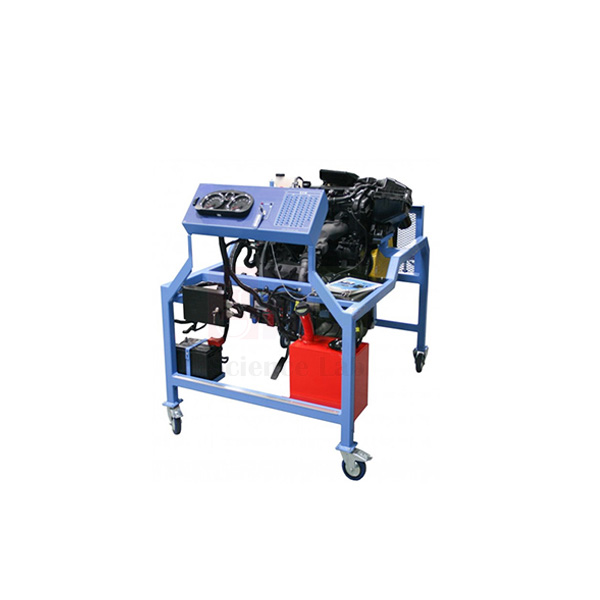
Four Stroke Four Cylinder Petrol Engine Test Bench
Four Stroke Four Cylinder Petrol Engine Test Bench (Product Code: SLE/MCE/53) is an engine test rig used to measure the torque, power, fuel consumption and efficiency of a running multi-cylinder petrol engine in automotive and mechanical engineering laboratories. Built on a welded mobile frame, it carries a 1086 cc, water-cooled MPFI engine rated at 63 BHP and coupled to a brake load unit. The bench is made by Jain Scientific Equipments Pvt Ltd (ScienceLab), an OEM manufacturer, at its own factory in Ambala, India.
Specifications
| Parameter | Detail |
|---|---|
| Engine | Branded petrol engine, MPFI version |
| Working cycle | Four-stroke, spark ignition |
| Number of cylinders | Four |
| Capacity | 1086 cc |
| Bore × stroke | 66 mm × 77 mm |
| Maximum power | 63 BHP at 5500 rpm |
| Maximum torque | 89 Nm at 3000 rpm |
| Cooling | Water-cooled, closed cooling water circuit |
| Starting | Self-start |
| Fuel / engine oil | Petrol / SAE 5W-30 |
| Battery and alternator | Battery 12 V, 45 A; alternator 12 V, 45 A |
| Power supply | 230 V, 50 Hz, single phase |
| Load connection | Engine fastened to the load unit; brake driven through a rotationally elastic coupling with jointed shaft |
| Frame | Solid welded frame on rollers; engine flexibly mounted |
| Guarding | Perforated plates over hot surfaces and rotating parts |
| Experiments | Torque and power curves, specific fuel consumption, overall engine efficiency |
| Product code | SLE/MCE/53 |
| Manufacturer | Jain Scientific Equipments Pvt Ltd (ScienceLab) — OEM |
| Country of origin | India (made in Ambala, Haryana) |
What Is the Petrol Engine Test Bench Used For?
In a performance practical, students run the engine at a series of speeds and loads, note the torque absorbed by the brake and the fuel used over a timed interval, and plot torque and power curves against engine speed. From the same readings they work out specific fuel consumption and overall engine efficiency, linking classroom thermodynamics to a real four-cylinder MPFI engine.
Because the whole rig rolls on its welded frame, it can be moved to a well-ventilated bay or exhaust extraction point before each session. The perforated guards let students watch the running engine while hot and rotating parts stay covered; even so, keep loose clothing away and let the cooling circuit cool before touching it. The bench fits vocational training lab equipment programmes, diploma automotive courses and degree-level IC engine laboratories.
What to Specify When Ordering
- Your laboratory mains supply (the bench is listed for 230 V, 50 Hz, single phase).
- Whether you also want exhaust heat measurement or separate fuel measuring equipment for heat-balance work.
- The number of benches and the delivery location, in India or abroad.
OEM Manufacturer
Jain Scientific Equipments Private Limited, which trades as ScienceLab, is the OEM (original equipment manufacturer) of this petrol engine test bench. The rig is built at the company’s licensed factory at Saha, Ambala, Haryana, India, around a branded MPFI petrol engine, so buyers deal with the maker of the bench rather than a trading intermediary. ScienceLab is a registered MSME manufacturer (Udyam UDYAM-HR-01-0003714) and ships export orders under Importer-Exporter Code AAECJ8618A issued by DGFT. Read more on the ScienceLab profile page.
Related Automotive Training Equipment
Pair the test bench with these items to extend engine testing and teaching.
- Exhaust Gas Calorimeter — measures the heat carried away in the exhaust for a full engine heat balance.
- Manual Volumetric Fuel Gauge — times a measured volume of fuel during consumption tests.
- Engine management system (MPI) — teaches the multi-point injection electronics used on this type of engine.
- Cut Section Model Of Four Stroke Petrol Engine — shows the internal parts students cannot see on the running engine.
See the full range of Automotive Training Equipment.
Frequently Asked Questions
What can be measured on the Four Stroke Four Cylinder Petrol Engine Test Bench?
The Four Stroke Four Cylinder Petrol Engine Test Bench is designed for plotting torque and power curves, determining specific fuel consumption and working out overall engine efficiency. These are the core performance tests in an IC engine laboratory course.
What engine is fitted to the petrol engine test bench?
The Four Stroke Four Cylinder Petrol Engine Test Bench uses a branded four-cylinder, four-stroke petrol engine in MPFI version, with 1086 cc capacity, 66 mm bore and 77 mm stroke. It is water-cooled with spark ignition and self-start, rated at 63 BHP at 5500 rpm.
What power supply does the Four Stroke Four Cylinder Petrol Engine Test Bench need?
The Four Stroke Four Cylinder Petrol Engine Test Bench is listed for a 230 V, 50 Hz, single-phase supply. If your laboratory uses a different mains supply, tell us when you request a quotation so the requirement can be confirmed before you order.
Can the Four Stroke Four Cylinder Petrol Engine Test Bench be moved?
Yes. The Four Stroke Four Cylinder Petrol Engine Test Bench is carried on a solid welded frame on rollers, with the engine flexibly mounted, so the whole setup can be moved within the lab, for example to a ventilated area for running.
Who manufactures the Four Stroke Four Cylinder Petrol Engine Test Bench?
Jain Scientific Equipments Pvt Ltd (ScienceLab) is the OEM of the Four Stroke Four Cylinder Petrol Engine Test Bench and builds it at its own licensed factory in Saha, Ambala, Haryana, India. The engine fitted to the bench is a branded MPFI unit.
Is a calibration certificate supplied with the test bench?
A calibration certificate is not listed as standard for the Four Stroke Four Cylinder Petrol Engine Test Bench. If your institution requires one for the measuring instruments, please discuss it with us through the contact page before placing the order.
What details does a quotation for the test bench need?
For a quotation on the Four Stroke Four Cylinder Petrol Engine Test Bench, send the quantity, the delivery location in India or abroad, your mains supply and any accessories you want, such as an exhaust gas calorimeter. Quotes come directly from the manufacturer.
Request a Quote
Ask for a quotation on the Four Stroke Four Cylinder Petrol Engine Test Bench (SLE/MCE/53) through our contact page, or add it to the enquiry cart with other lab items. Your quote comes straight from the manufacturer in Ambala, with no trading intermediary in between.
Last updated: 24 September 2026
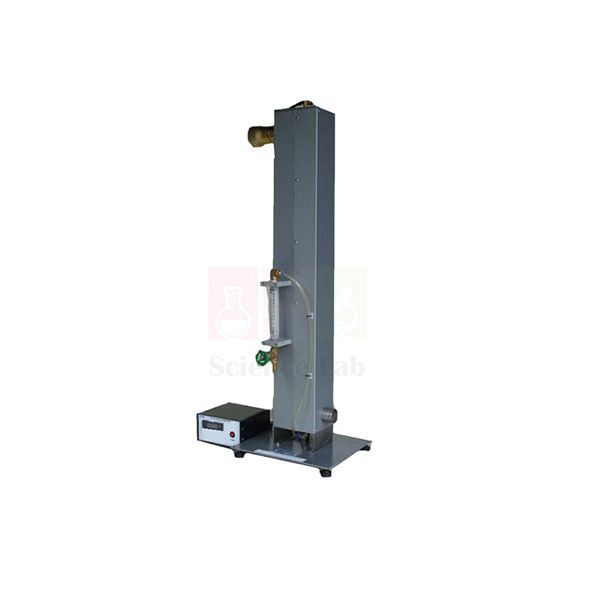
Exhaust Gas Calorimeter
Exhaust Gas Calorimeter (Product Code: SLE/MCE/54) is a counter-flow heat exchanger used to determine how much heat leaves an internal combustion engine in its exhaust gas, in thermal engineering and automotive laboratories. Connected to a test engine by an exhaust gas hose, it passes the hot gas through a finned pipe heat exchanger in an insulated stainless steel tank and shows four temperatures and the water flow on digital displays. It is made by Jain Scientific Equipments Pvt Ltd (ScienceLab), an OEM manufacturer, at its own factory in Ambala, India.
Specifications
| Parameter | Detail |
|---|---|
| Purpose | Calorimetric analysis of exhaust gases from internal combustion engines; heat content of exhaust from test engines |
| Heat exchanger | Counter-flow, finned pipe type |
| Calorimeter body | Insulated tank, stainless steel |
| Heat exchange area, exhaust gas side | 0.944 m² |
| Heat exchange area, water side | 0.141 m² |
| Exhaust gas temperature | 2 × 0–600 °C |
| Cooling water temperature | 2 × 0–200 °C |
| Water flow rate | 0–160 L/h (flow meter) |
| Instrumentation | 4 temperature sensors, flow meter, measuring amplifier with digital displays |
| Engine connection | Exhaust gas hose |
| Power supply | 230 V, 50 Hz, single phase |
| Dimensions | 600 × 600 × 1300 mm |
| Weight | 103 kg (approx.) |
| Product code | SLE/MCE/54 |
| Manufacturer | Jain Scientific Equipments Pvt Ltd (ScienceLab) — OEM |
| Country of origin | India (made in Ambala, Haryana) |
What Is the Exhaust Gas Calorimeter Used For?
In an engine heat-balance experiment, the calorimeter is connected to the exhaust of a running test engine while cooling water flows through the exchanger in the opposite direction. Students record the exhaust temperatures in and out, the water inlet and outlet temperatures and the water flow rate, then calculate the heat taken up by the water and estimate the heat carried off by the exhaust. That figure completes the energy balance alongside brake power, cooling-water heat and fuel energy.
It is typically chosen by mechanical and automotive engineering departments that already run an engine test bench and want lab equipment for technical institutes that covers thermal analysis as well as performance. Tip: start the water flow before the exhaust is routed through the exchanger and keep it steady while readings settle, so the outlet water stays within its 0–200 °C measuring range.
What to Specify When Ordering
- The test engine the calorimeter will be connected to, so the exhaust hose connection can be discussed.
- Your mains supply (the unit is listed for 230 V, 50 Hz, single phase).
- Floor space near the engine for a 600 × 600 × 1300 mm unit of about 103 kg.
- Quantity and delivery location.
OEM Manufacturer
The Exhaust Gas Calorimeter is an OEM product of Jain Scientific Equipments Private Limited, the company behind the ScienceLab name. It is made at the company’s own licensed factory at Saha, Ambala, Haryana, India, which means one supplier can quote both the calorimeter and the engine bench it serves. Technical questions, repeat orders and replacement parts are answered by the manufacturer itself, so ask us rather than a reseller. Company background is on the ScienceLab profile.
Related Automotive Training Equipment
These items supply the exhaust gas or complete the engine energy balance.
- Four Stroke Four Cylinder Petrol Engine Test Bench — a multi-cylinder engine to supply exhaust gas for the heat balance.
- 4 Stroke Diesel Engine — for comparing diesel exhaust heat with petrol results.
- 4 Stroke Petrol Engine — another test engine for heat-balance practicals.
- Manual Volumetric Fuel Gauge — measures the fuel input side of the energy balance.
Browse all Automotive Training Equipment or the Thermodynamics & Heat Transfer Lab Equipment range.
Frequently Asked Questions
What does the Exhaust Gas Calorimeter measure?
The Exhaust Gas Calorimeter determines the amount of heat contained in the exhaust gas from a test engine. It uses four temperature sensors, two on the exhaust gas and two on the cooling water, plus a flow meter, with readings shown on digital displays.
What are the measuring ranges of the Exhaust Gas Calorimeter?
The Exhaust Gas Calorimeter measures exhaust gas temperature at two points over 0–600 °C, cooling water temperature at two points over 0–200 °C, and water flow over 0–160 L/h, which covers typical engine-lab heat-balance experiments.
Which engines can be connected to the Exhaust Gas Calorimeter?
The Exhaust Gas Calorimeter is intended for calorimetric analysis of exhaust gases from internal combustion engines and connects through an exhaust gas hose. Tell us which test engine you have so the hose connection can be confirmed before we quote.
How large is the Exhaust Gas Calorimeter?
The Exhaust Gas Calorimeter measures 600 × 600 × 1300 mm and weighs about 103 kg. It runs on a 230 V, 50 Hz, single-phase supply, so plan a floor position close to both the engine exhaust and a mains socket.
Who manufactures the Exhaust Gas Calorimeter?
Jain Scientific Equipments Pvt Ltd (ScienceLab) manufactures the Exhaust Gas Calorimeter as the OEM at its own licensed factory in Saha, Ambala, Haryana, India. Repeat orders, spare parts and technical questions are handled directly by the manufacturer.
Is a calibration certificate available for the calorimeter sensors?
A calibration certificate for the Exhaust Gas Calorimeter’s temperature sensors or flow meter is not listed as standard. If your laboratory needs one, please discuss it with us through the contact page before ordering.
Can the Exhaust Gas Calorimeter be exported?
Yes, ScienceLab supplies the Exhaust Gas Calorimeter to engineering institutions in India and international markets. Share your quantity, destination and mains supply details with us to receive a quotation direct from the manufacturer.
Request a Quote
For a quotation on the Exhaust Gas Calorimeter (SLE/MCE/54), write to us via the contact page or place it in the enquiry cart together with your engine test equipment. The quote is issued directly by the manufacturer.
Last updated: 24 September 2026
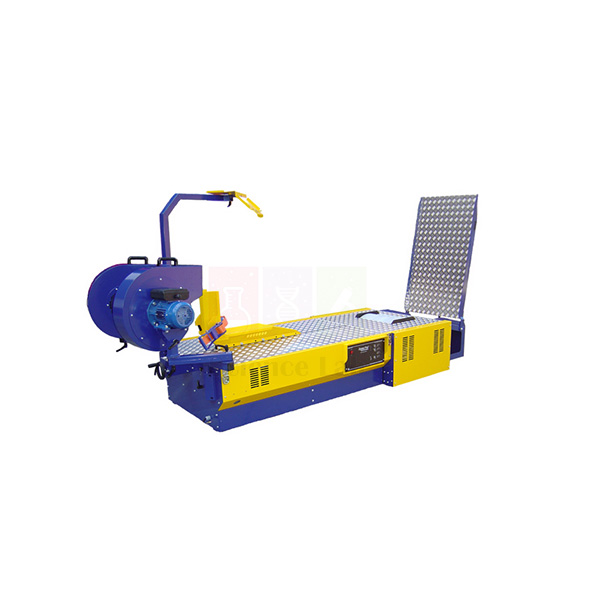
Motor Cycle Dynamometer Test Bench
Motor Cycle Dynamometer Test Bench (Product Code: SLE/MCE/55) is a roller-type chassis test bench used to run and test a complete motorcycle in place, under controlled conditions, in automotive workshops and two-wheeler training labs. Built on a monobloc 3 mm steel chassis with a chequer plate deck, it has a pneumatic automatic wheel clamp that lets one person load a bike without straps. It is made by Jain Scientific Equipments Pvt Ltd (ScienceLab), an OEM manufacturer, at its own factory in Ambala, India.
Specifications
| Parameter | Detail |
|---|---|
| Chassis | Monobloc chassis in 3 mm steel with chequer plate deck |
| Roller | Non-slip chrome roller with groove for alignment check, with safety brake |
| Wheel clamp | Pneumatic automatic wheel clamp; no straps required; one-person loading |
| Frame alignment check | Possible with the automatic wheel clamp and grooved roller together |
| Sensors | Wheel speed sensor and roller speed sensor |
| Access ramp | Integral folding ramp that doubles as a safety barrier |
| Cooling | Engine cooling fans and rear tyre cooling fan; fan outlets for engine and exhaust pipes, rear tyre, motorcycle brake and silencers |
| Exhaust extraction | Exhaust gas extraction fan; cover plates for exhaust extraction inlets |
| Fan housing | All cooling and extraction fans housed within the chassis |
| Electric starter control | Optional |
| Test scope | Application-specific tests, from individual engine unit tests to vehicle tests |
| Dimensions | 1600 × 900 × 1200 mm |
| Weight | 280 kg (approx.) |
| Product code | SLE/MCE/55 |
| Manufacturer | Jain Scientific Equipments Pvt Ltd (ScienceLab) — OEM |
| Country of origin | India (made in Ambala, Haryana) |
What Is the Motorcycle Dynamometer Test Bench Used For?
The motorcycle is wheeled up the folding ramp, the pneumatic clamp holds it in position and the driven wheel turns the chrome roller, so the engine can be run through its gears while the machine stays in place. Wheel and roller speed sensors let instructors compare the two speeds, while the built-in fans cool the engine, rear tyre and brake during longer runs and draw exhaust away from the silencers.
Tests range from checking a single engine unit to complete vehicle tests, and the grooved roller with the automatic clamp can also be used for a frame alignment check. The bench serves two-wheeler service training, diploma automotive courses and other technical educational equipment programmes. Tip: raise the folding ramp into its barrier position and connect the exhaust extraction before starting the engine.
What to Specify When Ordering
- Whether you want the optional electric starter control.
- How compressed air will be provided for the pneumatic wheel clamp — ask us to confirm the requirement.
- Floor space for a 1600 × 900 × 1200 mm bench of about 280 kg, plus room to lower the ramp.
- The types of motorcycles your trainees will test.
OEM Manufacturer
ScienceLab, the trading name of Jain Scientific Equipments Private Limited, is the OEM (original equipment manufacturer) of the Motor Cycle Dynamometer Test Bench. The bench is produced at the company’s own licensed factory at Saha, Ambala, Haryana, India, and supplied factory-direct to training institutes, colleges, dealers and importers. If a fan, sensor or other part ever needs replacing, the request goes to the same manufacturer that built the bench — just ask us. Learn more on the ScienceLab company profile.
Related Automotive Training Equipment
These items support engine teaching and testing alongside the roller bench.
- Four Stroke Four Cylinder Petrol Engine Test Bench — engine-only performance testing on a stationary rig.
- Cut Section Model Of Four Stroke Petrol Engine — shows the inside of a small petrol engine before trainees run one on the rollers.
- Automotive Engine Fault Diagnosis Simulator Auto Fault — builds diagnostic skills to pair with running tests.
- Manual Volumetric Fuel Gauge — measures fuel used during a test run.
Explore the complete Automotive Training Equipment category.
Frequently Asked Questions
How is a motorcycle secured on the Motor Cycle Dynamometer Test Bench?
The Motor Cycle Dynamometer Test Bench holds the motorcycle with a pneumatic automatic wheel clamp, so no straps are required and one person can load the bike. The clamp works with the grooved chrome roller, which also allows a frame alignment check.
What is included as standard with the Motor Cycle Dynamometer Test Bench?
The standard Motor Cycle Dynamometer Test Bench includes an exhaust gas extraction fan, a rear tyre cooling fan, engine cooling fans, the access ramp and the pneumatic automatic wheel clamp. All cooling and extraction fans are housed within the chassis for a clean installation.
Which sensors are fitted to the motorcycle dynamometer?
The Motor Cycle Dynamometer Test Bench is fitted with a wheel speed sensor and a roller speed sensor. Further measuring or display equipment is not listed, so please ask us to confirm the instrumentation you need when you request a quotation.
How much space does the Motor Cycle Dynamometer Test Bench need?
The Motor Cycle Dynamometer Test Bench measures 1600 × 900 × 1200 mm and weighs about 280 kg, and you also need room to lower the folding access ramp. Choose a ventilated area where the extracted exhaust can be led outside.
Is electric starter control available on the dynamometer bench?
Electric starter control is an option on the Motor Cycle Dynamometer Test Bench. State whether you need it when you request a quotation, so it can be included in the offer you receive from the manufacturer.
Who manufactures the Motor Cycle Dynamometer Test Bench?
Jain Scientific Equipments Pvt Ltd (ScienceLab) is the OEM of the Motor Cycle Dynamometer Test Bench, which is built at the company’s own licensed factory at Saha, Ambala, Haryana, India. Enquiries, repeat orders and spare parts are handled by the manufacturer directly.
Can the Motor Cycle Dynamometer Test Bench be supplied abroad?
Yes, ScienceLab supplies the Motor Cycle Dynamometer Test Bench to training institutions and dealers in India and international markets. Send us the quantity, the destination and whether you need the optional electric starter control to receive a quotation.
Request a Quote
To get a quotation for the Motor Cycle Dynamometer Test Bench (SLE/MCE/55), contact us through the contact page or add the bench to the enquiry cart. You will receive the quotation directly from the manufacturer in Ambala.
Last updated: 24 September 2026
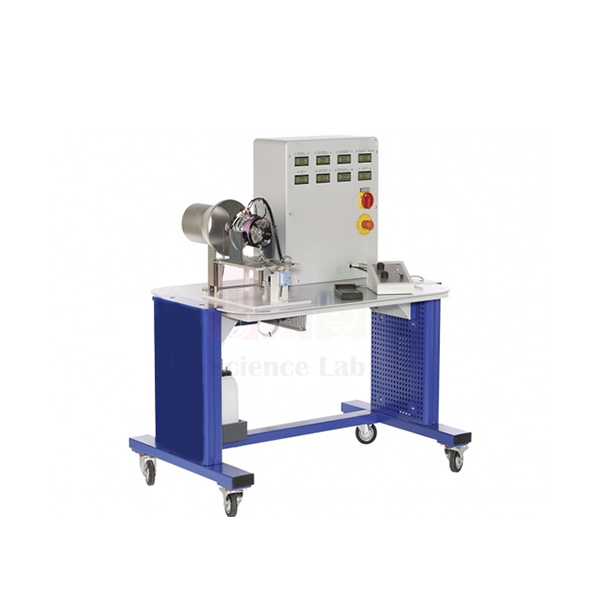
Turbojet Engine Test Bench
Turbojet Engine Test Bench (Product Code: SLE/MCE/56) is a gas turbine jet engine rig used to demonstrate thrust generation and measure the operating behaviour of a small turbojet in aeronautical, mechanical and thermal engineering laboratories. Its engine delivers a maximum thrust of 82 N at 117,000 rpm, while the bench measures pressures, temperatures, speed, fuel consumption and force. It is supplied by Jain Scientific Equipments Pvt Ltd (ScienceLab), Ambala, India.
Specifications
| Parameter | Detail |
|---|---|
| Maximum thrust | 82 N at 117,000 rpm |
| Speed range | 35,000–117,000 rpm |
| Exhaust gas temperature | 610 °C |
| Starting system | Electric starter |
| Fuel | Kerosene or petroleum, with turbine oil |
| Fuel tank | 1 tank, 5 L |
| Fuel consumption | Max. 22 L/h at full load |
| Sound level at 1 m | Max. 130 dB(A) |
| Differential pressure measurement | 0–150 mbar |
| Combustion chamber pressure | 0–2.5 bar |
| Temperature measurement | 2 × 0–1200 °C and 1 × 0–400 °C |
| Speed measurement | 0–120,000 rpm |
| Fuel consumption measurement | 0–25 L/h |
| Force measurement | 0 to ±200 N |
| Power supply versions | 230 V, 50 Hz, 1 phase; 230 V, 60 Hz, 1 phase; 120 V, 60 Hz, 1 phase |
| Dimensions | 1200 × 900 × 330 mm |
| Weight | 120 kg (approx.) |
| Product code | SLE/MCE/56 |
| Supplied by | Jain Scientific Equipments Pvt Ltd (ScienceLab), Ambala, India |
What Is the Turbojet Engine Test Bench Used For?
Students start the engine with the electric starter, run it across its 35,000–117,000 rpm speed range and record thrust, combustion chamber pressure, exhaust gas temperature and fuel flow at each setting. From these readings they can plot thrust against speed, work out thrust-specific fuel consumption and relate the results to the Brayton cycle taught in thermodynamics and propulsion courses.
Because the sound level at 1 m can reach 130 dB(A), the bench should run in a dedicated test room, with hearing protection for everyone present and fuel kept away from hot parts. It gives aerospace and mechanical departments sourcing engineering lab equipment in India a compact way to put a real jet engine in front of students.
What to Specify When Ordering
- The power supply version: 230 V 50 Hz, 230 V 60 Hz or 120 V 60 Hz, single phase.
- Which fuel you will use locally — kerosene or petroleum, with turbine oil.
- The test room or space where the 1200 × 900 × 330 mm bench will run.
- The number of benches and the delivery destination.
Supplier
ScienceLab is the trading name of Jain Scientific Equipments Private Limited, Ambala, Haryana, India, which supplies the Turbojet Engine Test Bench to universities, engineering colleges, dealers and importers in India and international markets. Questions about set-up, spares or repeat orders are answered by the same team that prepares your quotation — simply ask us. See the ScienceLab profile for company details.
Related Automotive Training Equipment
These items help students build up to, and compare against, the turbojet.
- Two Shaft Gas Turbine — another gas turbine trainer for comparing turbine configurations.
- Hero Engine — a simple classroom demonstration of reaction propulsion before students meet the real turbojet.
- Four Stroke Four Cylinder Petrol Engine Test Bench — contrasts continuous combustion with a reciprocating engine’s performance.
See more in Automotive Training Equipment and Aerodynamics Lab Equipment.
Frequently Asked Questions
What thrust does the Turbojet Engine Test Bench produce?
The Turbojet Engine Test Bench engine produces a maximum thrust of 82 N at 117,000 rpm, with an operating speed range of 35,000 to 117,000 rpm. The force measuring range of the bench is 0 to ±200 N.
What fuel does the Turbojet Engine Test Bench use?
The Turbojet Engine Test Bench runs on kerosene or petroleum with turbine oil, carried in a 5 L tank. Fuel consumption reaches a maximum of 22 L/h at full load, and the bench measures consumption over 0–25 L/h.
What does the Turbojet Engine Test Bench measure?
The Turbojet Engine Test Bench measures differential pressure (0–150 mbar), combustion chamber pressure (0–2.5 bar), temperature at three points (two over 0–1200 °C, one over 0–400 °C), speed up to 120,000 rpm, fuel consumption and thrust force.
How loud is the Turbojet Engine Test Bench?
The Turbojet Engine Test Bench reaches a sound level of up to 130 dB(A) at 1 m distance. Run it in a separate test room, keep observers at a distance and make sure everyone nearby wears suitable hearing protection.
Which power supplies are available for the turbojet bench?
The Turbojet Engine Test Bench is listed in three power supply versions: 230 V 50 Hz, 230 V 60 Hz and 120 V 60 Hz, all single phase. State the version that matches your laboratory mains when you request a quotation.
Who supplies the Turbojet Engine Test Bench?
Jain Scientific Equipments Pvt Ltd (ScienceLab), based in Ambala, Haryana, India, supplies the Turbojet Engine Test Bench to universities, engineering colleges, dealers and importers. Enquiries about spares, set-up or repeat orders for the bench can be sent through the contact page.
Is a calibration certificate available for the turbojet bench?
A calibration certificate is not listed as standard for the Turbojet Engine Test Bench’s pressure, temperature, speed or force measurement. If your institution needs one, please discuss the requirement with us through the contact page before ordering.
Request a Quote
Send your enquiry for the Turbojet Engine Test Bench (SLE/MCE/56) through the contact page, or add it to the enquiry cart stating the power supply version you need. Quotations are issued directly by Jain Scientific Equipments Pvt Ltd (ScienceLab).
Last updated: 24 September 2026
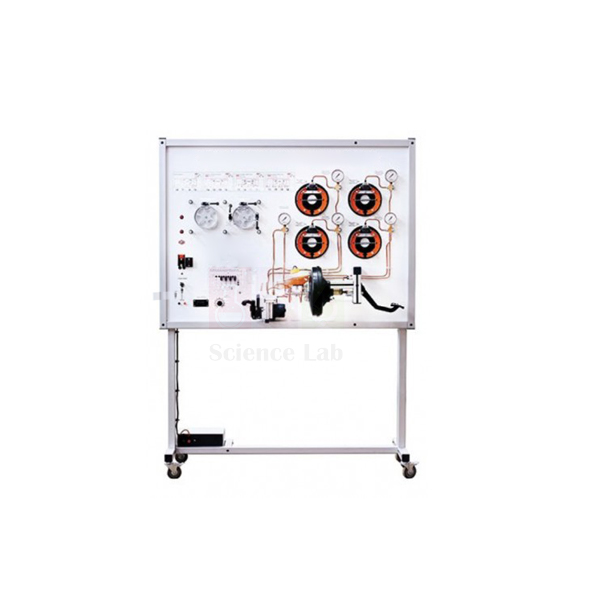
ABS Braking System Training Board Simulator
ABS Braking System Training Board Simulator (Product Code: SLE/MCE/60) is a training board used to teach the layout and working of an anti-lock braking system (ABS) in automotive training workshops and engineering classrooms. Instructors in ITI, diploma and degree automotive courses use it to explain how ABS keeps wheels from locking under hard braking, and its detailed specification is confirmed with each quotation. It is made by Jain Scientific Equipments Pvt Ltd (ScienceLab), an OEM manufacturer, at its own factory in Ambala, India.
Key Details
| Parameter | Detail |
|---|---|
| Product type | Training board simulator |
| System covered | ABS (anti-lock braking system) |
| Intended use | Teaching and demonstration in automotive training |
| Technical specification | Confirmed on request with your quotation |
| Product code | SLE/MCE/60 |
| Manufacturer | Jain Scientific Equipments Pvt Ltd (ScienceLab) — OEM |
| Country of origin | India (made in Ambala, Haryana) |
What Is the ABS Braking System Training Board Used For?
An anti-lock braking system watches the speed of each wheel and, when one begins to lock during hard braking, rapidly reduces and restores the brake pressure to that wheel so the driver keeps steering control. Studying ABS on a training board lets students follow this sequence of wheel-speed sensing, control-unit decision and pressure modulation without working under a vehicle.
Training boards of this kind are used in motor vehicle courses to connect conventional brake hydraulics with vehicle electronics and fault diagnosis. For colleges and ITIs sourcing lab equipment for technical institutes, it is a natural next step after a basic hydraulic brake model. Because configurations vary, ask us for the current specification sheet before you finalise an order.
OEM Manufacturer
ScienceLab is the brand of Jain Scientific Equipments Private Limited, the OEM (original equipment manufacturer) of the ABS Braking System Training Board Simulator. The board is made at the company’s own licensed factory at Saha, Ambala, Haryana, India, and the specification you receive with a quotation comes from the manufacturer itself rather than a reseller. Repeat orders and replacement parts are handled the same way, so please ask us. Company details are on the ScienceLab profile.
Related Automotive Training Equipment
These trainers cover the braking and electronics topics taught around ABS.
- Working Model Of Hydraulic Braking System — the conventional hydraulic brakes that ABS builds on.
- Trailer Air Brake Training Equipment — air-brake systems used on heavy vehicles.
- Automotive Engine Fault Diagnosis Simulator Auto Fault — further practice in vehicle electronic fault diagnosis.
- Engine management system (MPI) — another electronic control system found in modern vehicles.
View all Automotive Training Equipment.
Frequently Asked Questions
What is the ABS Braking System Training Board Simulator used for?
The ABS Braking System Training Board Simulator is used to teach how an anti-lock braking system works, so students can study ABS operation and layout on a board rather than under a vehicle. It suits automotive training workshops and engineering classrooms.
What specifications does the ABS Braking System Training Board Simulator have?
Detailed specifications of the ABS Braking System Training Board Simulator, such as dimensions, weight, power supply and the components fitted, are confirmed with each quotation. Please send your requirements through the contact page and we will share the current specification.
Who is the ABS training board suitable for?
The ABS Braking System Training Board Simulator suits instructors and students in automotive and mechanical engineering courses, vocational training centres and vehicle service training, where anti-lock braking is taught alongside conventional hydraulic brakes.
Who manufactures the ABS Braking System Training Board Simulator?
Jain Scientific Equipments Pvt Ltd (ScienceLab) is the OEM of the ABS Braking System Training Board Simulator and makes it at its own licensed factory at Saha, Ambala, Haryana, India. Quotations and repeat orders are handled directly by the manufacturer.
Is a calibration certificate available for the ABS training board?
A calibration certificate is not listed for the ABS Braking System Training Board Simulator. If your institution requires one for any measuring instruments on the board, please discuss this with us through the contact page before you order.
What does a quotation for the ABS training board need?
A quotation for the ABS Braking System Training Board Simulator needs the quantity, the delivery location in India or abroad, your mains supply and the syllabus topics the board should cover, so the specification we offer matches your course.
Request a Quote
Request the current specification and a quotation for the ABS Braking System Training Board Simulator (SLE/MCE/60) through the contact page, or add it to the enquiry cart. Both come directly from the manufacturer, Jain Scientific Equipments Pvt Ltd (ScienceLab).
Last updated: 24 September 2026
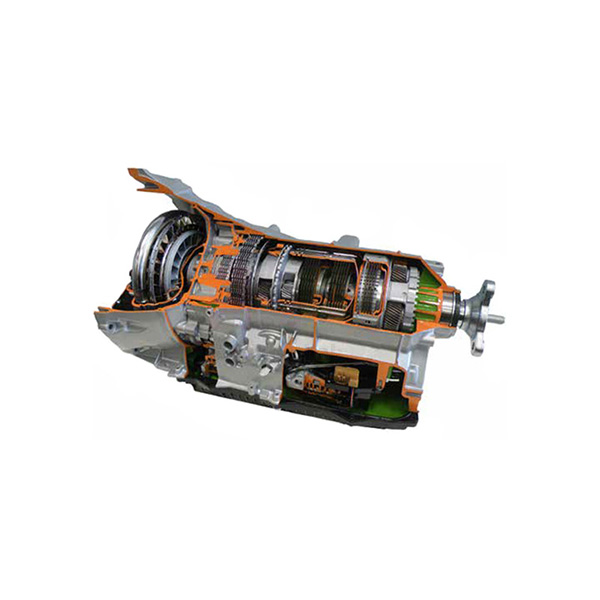
Cut Model Of Automatic Transmission System
Cut Model Of Automatic Transmission System (Product Code: SLE/MCE/61) is a sectioned teaching model used to show how a hydraulic automatic transmission shifts gears, in automotive engineering classrooms and workshops. Made from a full-size original car automatic transmission, it is cut open to reveal the torque converter, planetary gear set, clutches, bands and control valves, and is turned by a hand crank. It is made by Jain Scientific Equipments Pvt Ltd (ScienceLab), an OEM manufacturer, at its own factory in Ambala, India.
Specifications
| Parameter | Detail |
|---|---|
| Base unit | Full-size original automatic transmission of a car (a previously used unit), sectioned for teaching |
| Transmission type | Hydraulic automatic |
| Parts shown | Hydraulic torque converter, planetary gear set, multiple-plate clutches, bands, control valves; hydraulic and lubricating oil paths |
| Gear change | Epicyclic, 5 forward speeds plus reverse |
| Sectioning | Cut to show the internal gear mechanism for forward and reverse speeds |
| Operation | Manual, by hand crank applied on the torque converter |
| Finish | Colour-coded parts; imported colour paint with Miracle gloss coating; many parts chromium plated and galvanized; hardware and gears electroplated |
| Mounting | Tubular frame stand with wheels |
| Dimensions | 750 × 550 × 700 mm (approx.) |
| Weight | 110 kg (approx.) |
| Product code | SLE/MCE/61 |
| Manufacturer | Jain Scientific Equipments Pvt Ltd (ScienceLab) — OEM |
| Country of origin | India (made in Ambala, Haryana) |
What Is the Automatic Transmission Cut Model Used For?
Turning the hand crank on the torque converter lets the instructor show, step by step, how oil in the converter carries the drive, how the planetary gear set produces different ratios, and how clutches and bands hold or release gear members to give each of the five forward speeds and reverse. Colour-coding helps students tell the converter, gear train and valve body apart at a glance.
The model suits automobile engineering degrees, diploma courses and TVET lab equipment set-ups where automatic shifting must be explained clearly without a running vehicle. Tip: turn the crank slowly when demonstrating a shift, and move the 110 kg model on its wheeled stand rather than lifting it.
OEM Manufacturer
Jain Scientific Equipments Private Limited (CIN U29309HR2020PTC087597), known to customers as ScienceLab, is the OEM (original equipment manufacturer) of this automatic transmission cut model. The model is prepared at the company’s licensed factory at 449, HSIIDC Industrial Area, Saha, Ambala, Haryana (Factory Licence AMB-ONLINE-CHD-J-414), and supplied factory-direct to institutions, dealers and importers. Repeat orders and any replacement parts are handled by the manufacturer, so ask us directly. Read more on the ScienceLab profile.
Related Automotive Training Equipment
These models and trainers cover the other parts of a vehicle drivetrain.
- Cut Model Of Planetary Gear System — isolates the planetary gear set that gives the automatic its ratios.
- FF Auto Transmission Stand Type — a stand-mounted automatic transmission trainer for further practice.
- Vehicle Transmission 5 Speed Manual Gearbox — compares automatic shifting with manual gear selection.
- Clutch Structure Trainer Hydraulics — explains hydraulic clutch operation in more detail.
Browse the full Automotive Training Equipment category.
Frequently Asked Questions
What parts can students see in the Cut Model Of Automatic Transmission System?
The Cut Model Of Automatic Transmission System shows the hydraulic torque converter, planetary gear set, multiple-plate clutches, bands and control valves. It is sectioned to reveal the gear mechanism for forward and reverse speeds, with colours used to separate the parts.
How is the automatic transmission cut model operated?
The Cut Model Of Automatic Transmission System is operated manually by a hand crank applied on the torque converter, so the instructor can turn the mechanism slowly and stop at any point to explain each gear change.
Is the Cut Model Of Automatic Transmission System made from a real transmission?
Yes, the Cut Model Of Automatic Transmission System is made from a full-size original automatic transmission of a car, a previously used unit, which is sectioned, painted and plated for teaching. Its epicyclic gear change has five forward speeds plus reverse.
How big and heavy is the Cut Model Of Automatic Transmission System?
The Cut Model Of Automatic Transmission System measures about 750 × 550 × 700 mm and weighs about 110 kg. It is mounted on a tubular frame stand with wheels, so it can be moved between the classroom and the workshop.
Who manufactures the Cut Model Of Automatic Transmission System?
Jain Scientific Equipments Pvt Ltd (ScienceLab) manufactures the Cut Model Of Automatic Transmission System as the OEM at its own licensed factory in Saha, Ambala, Haryana, India. Quotations and repeat orders come directly from the manufacturer.
Can the automatic transmission model be supplied to overseas institutions?
Yes, ScienceLab supplies the Cut Model Of Automatic Transmission System to institutions and dealers in India and international markets. Send your quantity and delivery destination through the contact page to receive a quotation.
Request a Quote
For the Cut Model Of Automatic Transmission System (SLE/MCE/61), request a quotation on our contact page or add it to the enquiry cart. Every quotation is prepared directly by the manufacturer in Ambala.
Last updated: 24 September 2026
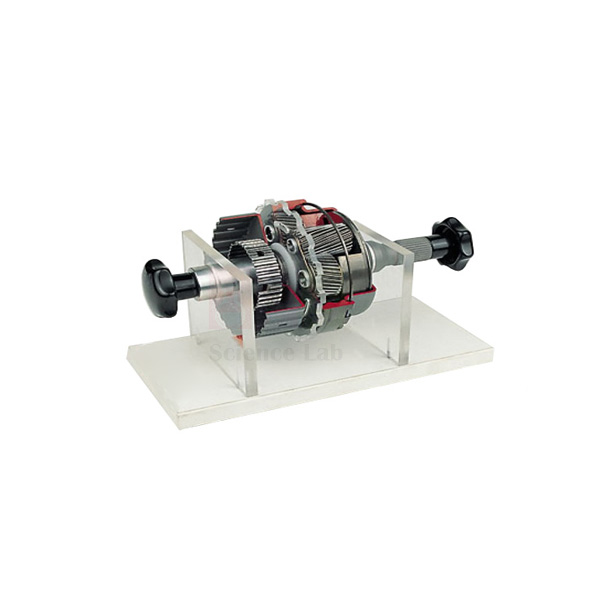
Cut Model Of Planetary Gear System
Cut Model Of Planetary Gear System (Product Code: SLE/MCE/62) is a hand-operated cutaway model used to demonstrate how a sun gear, planet gears, planet carrier and ring gear work together, in machine design and automotive classrooms. Built from original components that keep their full mechanical function, it lets students make the sun gear, carrier or ring gear the driving, driven or fixed member. It is made by Jain Scientific Equipments Pvt Ltd (ScienceLab), an OEM manufacturer, at its own factory in Ambala, India.
Specifications
| Parameter | Detail |
|---|---|
| Gear type | Planetary gear drive |
| Members | Central sun gear; multiple planet gears on a planet carrier; internally toothed ring gear |
| Configurations | Sun gear, planet carrier and ring gear may each be driving, driven or fixed |
| Load sharing | Torque and power distributed among several planet gears |
| Construction | Cutaway of original components; active parts clearly visible; full mechanical functionality kept |
| Mounting | Securely mounted on a base plate with carrying handles |
| Operation | By hand |
| Applications illustrated | Automotive construction and shipbuilding |
| Dimensions | 450 × 400 × 300 mm (approx.) |
| Weight | 10 kg (approx.) |
| Product code | SLE/MCE/62 |
| Manufacturer | Jain Scientific Equipments Pvt Ltd (ScienceLab) — OEM |
| Country of origin | India (made in Ambala, Haryana) |
What Is the Planetary Gear Cut Model Used For?
By holding one member still and turning another by hand, students see how a single gear set can give a speed reduction, an overdrive or a reversal. Fixing the ring gear and driving the sun gear, for instance, makes the carrier turn slowly in the same direction, while holding the carrier makes the ring gear run backwards — the principle behind automatic gearboxes and marine drives.
It supports theory of machines and automobile engineering practicals on gear ratios and load sharing, and it sits well alongside other engineering lab equipment in India’s polytechnics and colleges. At about 10 kg with carrying handles, one person can take it from the store to any classroom.
OEM Manufacturer
This planetary gear cut model is an OEM product of Jain Scientific Equipments Private Limited, which trades as ScienceLab. It is made at the company’s own licensed factory at Saha, Ambala, Haryana, India, and dispatched factory-direct to schools, colleges, training institutes, dealers and importers. Because the manufacturer handles quotations and repeat orders itself, you can add matching gear models to the same order — just ask us. Visit the ScienceLab profile for more about the company.
Related Automotive Training Equipment
These models extend the lesson from one gear set to complete drivetrains.
- Cut Model Of Automatic Transmission System — shows planetary gear sets at work inside a complete automatic gearbox.
- Gear Train Model — compares simple and compound gear trains with the planetary arrangement.
- Internal Gear Pinion Drive — studies the internal-tooth meshing used by the ring gear.
- Differential Gear — another drivetrain gear arrangement that divides torque between wheels.
See all Automotive Training Equipment and the Theory of Machines range.
Frequently Asked Questions
What does the Cut Model Of Planetary Gear System demonstrate?
The Cut Model Of Planetary Gear System demonstrates a planetary gear drive in which several planet gears on a carrier revolve around a central sun gear and mesh with an internally toothed ring gear, sharing torque and power between them.
Can different gear combinations be set on the planetary gear model?
Yes. On the Cut Model Of Planetary Gear System, the sun gear, planet carrier and ring gear may each be used as the driving, driven or fixed member, so students can compare output speed and direction for every combination.
How is the Cut Model Of Planetary Gear System powered?
The Cut Model Of Planetary Gear System is powered by hand. Its cutaway original components keep full mechanical function, so the gears can be turned and observed directly while the active parts remain clearly visible.
How portable is the Cut Model Of Planetary Gear System?
The Cut Model Of Planetary Gear System measures about 450 × 400 × 300 mm and weighs about 10 kg. It is securely mounted on a base plate with handles, so one person can carry it between classroom and laboratory.
Who manufactures the Cut Model Of Planetary Gear System?
Jain Scientific Equipments Pvt Ltd (ScienceLab) is the OEM of the Cut Model Of Planetary Gear System and makes it at its own licensed factory at Saha, Ambala, Haryana, India, supplying it factory-direct to schools, colleges and dealers.
What should a quotation request for the planetary gear model include?
A quotation request for the Cut Model Of Planetary Gear System should state the number of models, the delivery location in India or abroad and any related gear models you want for the same lab, so the manufacturer can quote them together.
Request a Quote
Ask for a quotation on the Cut Model Of Planetary Gear System (SLE/MCE/62) through the contact page or collect it with other models in the enquiry cart. The manufacturer replies with the quotation directly.
Last updated: 24 September 2026
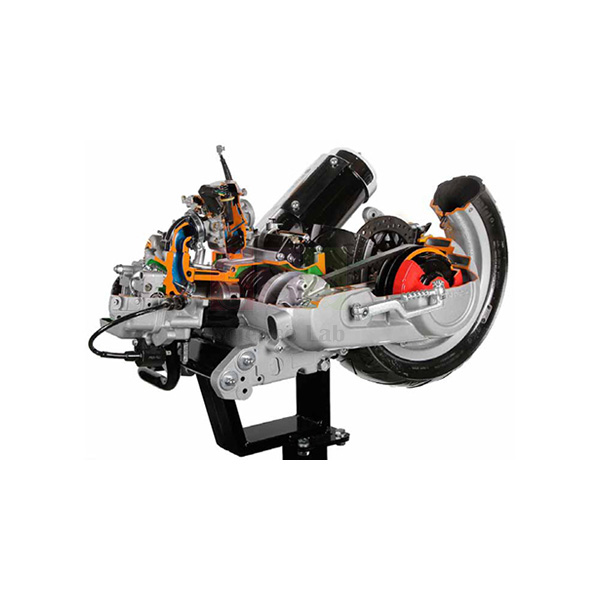
Cut Section Model Of Four Stroke Petrol Engine
Cut Section Model Of Four Stroke Petrol Engine (Product Code: SLE/MCE/63) is a sectioned real engine used to show the internal parts and working cycle of a petrol engine in automotive and mechanical engineering classrooms. Based on an actual 160 cc, 6 HP engine with its flywheel on a sturdy iron frame, it is turned by a crank handle so students can follow the moving parts through all four strokes. It is made by Jain Scientific Equipments Pvt Ltd (ScienceLab), an OEM manufacturer, at its own factory in Ambala, India.
Specifications
| Parameter | Detail |
|---|---|
| Engine | Actual four-stroke petrol engine, cut-sectioned for training |
| Displacement | 160 cc |
| Power | 6 HP |
| Operation | Manual, through a crank handle |
| Flywheel | Provided |
| Mounting | Sturdy iron frame, on base |
| Colour coding | Parts, cross-sections, lubricating circuits, fuel system and cooling system painted in different colours |
| Construction | Specially made dissectible for demonstration |
| Supplied with | Key card and literature on the working of the engine |
| Dimensions | 500 × 500 × 600 mm |
| Weight | 35 kg (approx.) |
| Product code | SLE/MCE/63 |
| Manufacturer | Jain Scientific Equipments Pvt Ltd (ScienceLab) — OEM |
| Country of origin | India (made in Ambala, Haryana) |
What Is the Petrol Engine Cut Section Model Used For?
Turning the crank slowly takes the class through the intake, compression, power and exhaust strokes while the cut-outs show the piston, valves and crankshaft moving together. The colour-coded lubricating, fuel and cooling systems let students trace each circuit, and because the model is dissectible, the instructor can remove parts to show them one at a time.
The key card identifies each component and the supplied literature explains the engine’s working, which helps students revise after the lesson. It is a staple of technical educational equipment for motor mechanic trades, polytechnics, engineering colleges and senior school technology streams. Keep it covered between classes so dust stays out of the sectioned parts.
OEM Manufacturer
Jain Scientific Equipments Private Limited, trading as ScienceLab, is the OEM (original equipment manufacturer) that prepares this cut section petrol engine for teaching. The work is carried out at the company’s own licensed factory at Saha, Ambala, Haryana, India, and the finished model goes factory-direct to schools, ITIs, colleges, dealers and importers. When a school needs a second model or a replacement key card, the request is handled by the manufacturer itself — please ask us. More on the ScienceLab profile.
Related Automotive Training Equipment
These engines and models build on what students learn from the petrol engine section.
- Section Model Of Four-Stroke Diesel Engine — compares compression ignition with this spark-ignition engine.
- 4 Stroke Petrol Engine — a petrol engine for practical work after the sectioned demonstration.
- Four Stroke Four Cylinder Petrol Engine Test Bench — moves on to multi-cylinder performance testing.
- Wankel Engine Model — contrasts the reciprocating piston with a rotary engine.
Find more in Automotive Training Equipment.
Frequently Asked Questions
What engine is used in the Cut Section Model Of Four Stroke Petrol Engine?
The Cut Section Model Of Four Stroke Petrol Engine is an actual cut section engine of 160 cc displacement and 6 HP power, fitted with its flywheel and mounted on a sturdy iron frame for classroom demonstration.
How is the petrol engine cut section model operated?
The Cut Section Model Of Four Stroke Petrol Engine is operated manually through a crank handle. Turning it slowly lets students follow the piston, crankshaft and valve movement through each of the four strokes of the cycle.
What comes with the Cut Section Model Of Four Stroke Petrol Engine?
The Cut Section Model Of Four Stroke Petrol Engine is supplied with a key card and literature explaining the working of the engine. The key card helps students identify each colour-coded part and system shown in the cut sections.
Can the petrol engine model be taken apart?
Yes, the Cut Section Model Of Four Stroke Petrol Engine is specially made dissectible for demonstration purposes, so instructors can show individual parts as well as the sectioned engine as a whole during lessons on engine construction.
Who manufactures the Cut Section Model Of Four Stroke Petrol Engine?
Jain Scientific Equipments Pvt Ltd (ScienceLab) is the OEM of the Cut Section Model Of Four Stroke Petrol Engine, preparing it at its own licensed factory at Saha, Ambala, Haryana, India. Orders and quotations are handled by the manufacturer directly.
How much space does the petrol engine cut section model need?
The Cut Section Model Of Four Stroke Petrol Engine measures 500 × 500 × 600 mm and weighs about 35 kg, so it fits on a sturdy classroom table or workshop bench for group demonstrations.
Request a Quote
To order the Cut Section Model Of Four Stroke Petrol Engine (SLE/MCE/63), use the contact page or add it to the enquiry cart with your other engine models. The quotation is sent to you directly by the manufacturer.
Last updated: 24 September 2026
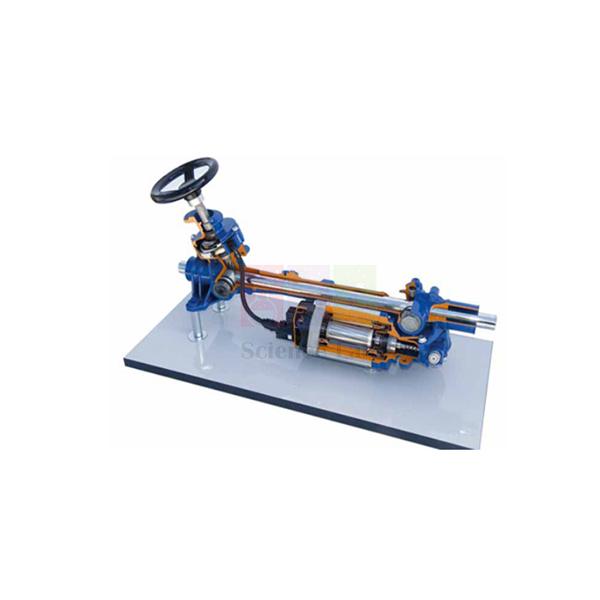
Cut Model Of Rack And Pinion Steering
Cut Model Of Rack And Pinion Steering (Product Code: SLE/MCE/64) is a sectioned steering-system model used to show how turning the steering is converted into side-to-side movement of the rack, in automotive training classrooms and workshops. Besides the rack type steering box, it carries a hydraulic pump, an oil tank with filter and connecting pipes, so the power-assist circuit can be traced as well. It is made by Jain Scientific Equipments Pvt Ltd (ScienceLab), an OEM manufacturer, at its own factory in Ambala, India.
Specifications
| Parameter | Detail |
|---|---|
| Steering type | Rack and pinion, rack type steering box |
| Hydraulic components | Hydraulic pump; oil tank with relevant filter; connecting pipes |
| Operation | Manual, by crank handle |
| Mounting | Tubular frame, on base |
| Finish | Imported colour paint with Miracle coating for gloss and shine; hardware and gears electroplated |
| Dimensions | 1000 × 600 × 550 mm |
| Weight | 25 kg (approx.) |
| Product code | SLE/MCE/64 |
| Manufacturer | Jain Scientific Equipments Pvt Ltd (ScienceLab) — OEM |
| Country of origin | India (made in Ambala, Haryana) |
What Is the Rack and Pinion Steering Model Used For?
When the crank is turned, the pinion rolls along the toothed rack and slides it sideways — the same motion that pushes the tie rods and swings the front wheels of a car. The hydraulic pump, oil tank and pipes show students where the power-assist fluid circulates, which prepares them for inspecting and fault-finding on real steering systems.
The model fits motor vehicle mechanic trades, diploma and degree automobile courses, and any institute building a chassis section with lab equipment for technical institutes. At about 25 kg and 1000 mm long, it can stand on a bench facing the class so everyone sees the rack move.
OEM Manufacturer
The Cut Model Of Rack And Pinion Steering is made by ScienceLab — the trading name of Jain Scientific Equipments Private Limited — as the OEM (original equipment manufacturer). Production takes place at the company’s own licensed factory at Saha, Ambala, Haryana, India, so your enquiry reaches the maker directly instead of passing through a trader. Institutions, dealers and importers can place repeat orders or ask about replacement parts with the same team. Company information is on the ScienceLab profile.
Related Automotive Training Equipment
These chassis and drivetrain trainers complete the steering lesson.
- Power Steering Gear — a further steering gear trainer for comparing power steering designs.
- Working Model Of Hydraulic Braking System — another chassis system built on hydraulic principles.
- Differential Gear — explains how wheels turn at different speeds when the vehicle is steered round a bend.
- Vehicle Transmission 5 Speed Manual Gearbox — completes the drivetrain section of the lab.
More models are listed under Automotive Training Equipment.
Frequently Asked Questions
What does the Cut Model Of Rack And Pinion Steering include?
The Cut Model Of Rack And Pinion Steering includes a rack type steering box, a hydraulic pump, an oil tank with its filter and connecting pipes, all mounted on a tubular frame so the mechanical and hydraulic parts can be studied together.
How is the rack and pinion steering model operated?
The Cut Model Of Rack And Pinion Steering is operated manually with a crank handle. Turning the handle moves the pinion along the rack, so students can watch rotary input become the linear movement that steers the wheels.
What finish does the Cut Model Of Rack And Pinion Steering have?
The Cut Model Of Rack And Pinion Steering is finished in imported colour paint with a Miracle coating for gloss and shine, and its hardware and gears are electroplated. The colours help students separate components during demonstrations.
What are the size and weight of the steering cut model?
The Cut Model Of Rack And Pinion Steering measures 1000 × 600 × 550 mm and weighs about 25 kg. It stands on a base, so it can be placed on a bench or table in a classroom or workshop.
Who manufactures the Cut Model Of Rack And Pinion Steering?
Jain Scientific Equipments Pvt Ltd (ScienceLab) is the OEM of the Cut Model Of Rack And Pinion Steering and makes it at its own licensed factory at Saha, Ambala, Haryana, India. Spare-part and repeat-order enquiries go directly to the manufacturer.
Is the Cut Model Of Rack And Pinion Steering available for export orders?
Yes, the Cut Model Of Rack And Pinion Steering is supplied to institutions, dealers and importers in India and international markets. Share quantities and the destination through the contact page for a quotation from the manufacturer.
Request a Quote
Get a quotation for the Cut Model Of Rack And Pinion Steering (SLE/MCE/64) by writing to us on the contact page, or add it to the enquiry cart. Quotes are prepared by the manufacturer itself in Ambala.
Last updated: 24 September 2026
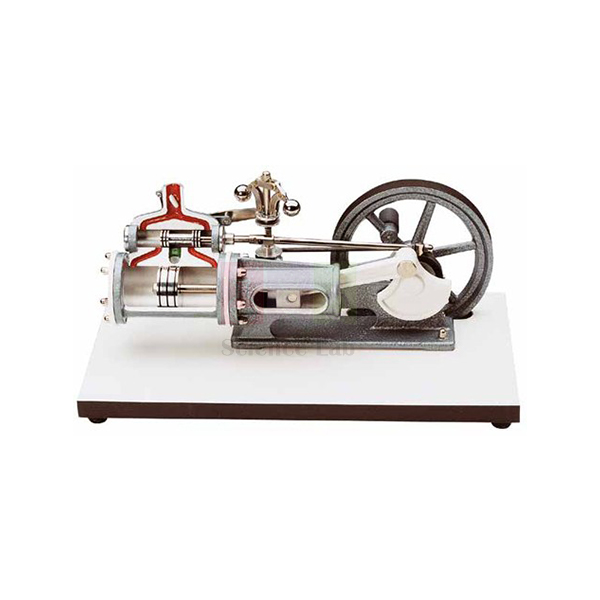
Steam Engine Model
Steam Engine Model (Product Code: SLE/MCE/65) is a sectioned demonstration model used to show the internal structure and operating principle of a reciprocating steam engine in physics and engineering classrooms. Its metal cylinder is cut open and covered with a clear plate, so students can watch the piston and slide valve move while the link motion and reversing method operate. It is made by Jain Scientific Equipments Pvt Ltd (ScienceLab), an OEM manufacturer, at its own factory in Ambala, India.
Specifications
| Parameter | Detail |
|---|---|
| Type | Cutaway classroom model of a working steam engine |
| Cylinder | Metal cylinder, cross-section cut, covered with a clear plate to show the piston |
| Working parts | Piston and slide valve both move; link motion and reversing method operate |
| Wheel movement | Light enough to demonstrate even by blowing air |
| Finish | Parts and cross-sections painted in different colours; many parts chromium-plated and galvanized for longer life |
| Dimensions | 450 × 350 × 300 mm (approx.) |
| Weight | 9 kg (approx.) |
| Product code | SLE/MCE/65 |
| Manufacturer | Jain Scientific Equipments Pvt Ltd (ScienceLab) — OEM |
| Country of origin | India (made in Ambala, Haryana) |
What Is the Steam Engine Model Used For?
Teachers use the model to explain how the slide valve admits steam first to one side of the piston and then the other, producing a back-and-forth motion that the connecting rod and wheel turn into rotation. Moving the link motion shows how the valve timing is shifted to reverse the engine, the same method once used on steam locomotives.
The wheel runs so freely that a gentle breath of air sets it turning, which makes it a memorable demonstration model for the physics lab when heat engines and energy conversion are introduced. In engineering thermodynamics it gives students a clear picture of the earliest practical heat engine before they study modern IC engines and turbines.
OEM Manufacturer
ScienceLab, the trading name of Jain Scientific Equipments Private Limited, is the OEM (original equipment manufacturer) of this Steam Engine Model and makes it at its own licensed factory at Saha, Ambala, Haryana, India. The company is registered as an MSME with manufacturing as its major activity (Udyam UDYAM-HR-01-0003714) and ships overseas orders under Importer-Exporter Code AAECJ8618A from DGFT. Schools, colleges, dealers and importers receive models factory-direct, and repeat orders are handled by the manufacturer. See the ScienceLab company profile.
Related Automotive Training Equipment
These items continue the story of steam and other heat engines.
- Thermal Power Plant with Steam Engine Trainer — takes the steam engine principle into a complete power-plant trainer.
- Saturated Steam The Marcet Boiler — studies the pressure and temperature of the steam that drives such engines.
- Stirling Engine — another external-combustion heat engine for comparison.
- Hand-Powered Engine Models — further hand-turned models of engine cycles.
Browse Automotive Training Equipment and Thermodynamics & Heat Transfer Lab Equipment.
Frequently Asked Questions
What parts of the Steam Engine Model move?
On the Steam Engine Model, the piston and slide valve both move, and the link motion and reversing method operate, so students can see the complete valve gear of a working steam engine and how its direction of rotation is changed.
Can students see inside the cylinder of the Steam Engine Model?
Yes. The Steam Engine Model has a metal cylinder that is cross-section cut and covered with a clear plate, so the movement of the piston inside the cylinder stays visible while the wheel turns.
How is the Steam Engine Model set in motion for a demonstration?
The Steam Engine Model’s wheel moves so lightly that it can be demonstrated even by blowing air, so a teacher can start it with a gentle air stream or a slight push while students watch the piston and slide valve.
How big is the Steam Engine Model?
The Steam Engine Model measures about 450 × 350 × 300 mm and weighs about 9 kg, a convenient size for a teacher’s desk and easy to carry from one classroom to another.
Who manufactures the Steam Engine Model?
Jain Scientific Equipments Pvt Ltd (ScienceLab) manufactures the Steam Engine Model as the OEM at its own licensed factory at Saha, Ambala, Haryana, India, and supplies it factory-direct to schools, colleges, dealers and importers.
How durable is the Steam Engine Model?
Many parts of the Steam Engine Model are chromium-plated and galvanized for a longer life, and the sections are painted in different colours. Wiping it with a dry cloth and storing it covered keeps the finish clean between lessons.
Request a Quote
Request a quotation for the Steam Engine Model (SLE/MCE/65) through the contact page or by adding it to the enquiry cart. You will hear back directly from the manufacturer, Jain Scientific Equipments Pvt Ltd (ScienceLab).
Last updated: 24 September 2026
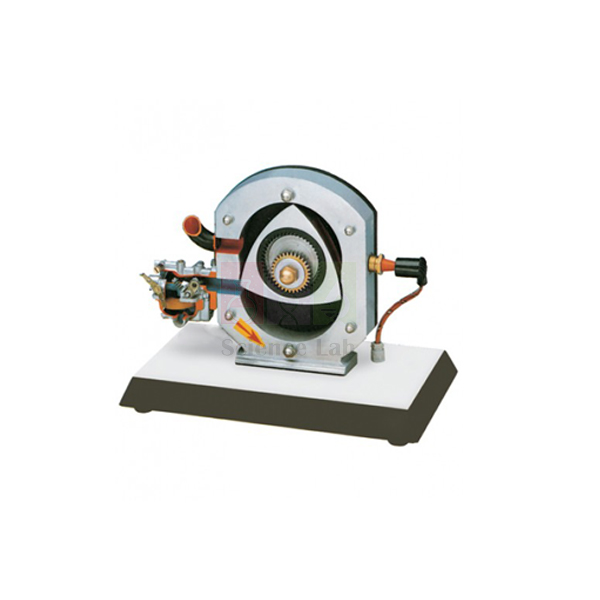
Wankel Engine Model
Wankel Engine Model (Product Code: SLE/MCE/66) is a sectioned rotary-engine model used to show how a triangular rotor produces the working phases inside a stator, in automotive and mechanical engineering lessons. Turned by a crank handle, the light metal model has a small bulb that lights up at the compression phase to simulate gas ignition. It is made by Jain Scientific Equipments Pvt Ltd (ScienceLab), an OEM manufacturer, at its own factory in Ambala, India.
Specifications
| Parameter | Detail |
|---|---|
| Engine type | Wankel (rotary) engine, cut-away for training |
| Rotor | Triangular piston operated by the driving shaft, rotating inside the stator and clearly showing the different phases |
| Ignition simulation | Small bulb lights up at the compression phase |
| Construction | Light metal; various parts cross-sectioned to show internal operation |
| Colour coding | Parts, cross sections and fuel system painted in different colours |
| Operation | Manual, by crank handle |
| Mounting | On a base with wheel |
| Dimensions | 350 × 400 × 300 mm |
| Weight | 7 kg (approx.) |
| Product code | SLE/MCE/66 |
| Manufacturer | Jain Scientific Equipments Pvt Ltd (ScienceLab) — OEM |
| Country of origin | India (made in Ambala, Haryana) |
What Is the Wankel Engine Model Used For?
As the crank turns, each flank of the triangular rotor sweeps round the stator and students can watch the chamber between rotor and housing grow and shrink through intake, compression, power and exhaust — with no up-and-down piston or poppet valves. The bulb lights at the compression phase, marking the point where a spark would fire the mixture.
Setting this model beside a reciprocating engine section helps students see why rotary engines are compact and smooth, and where their sealing challenges lie. Being light metal and only about 7 kg, it is easy to pass round a small group, making it useful technical educational equipment for engine theory classes.
OEM Manufacturer
Jain Scientific Equipments Private Limited, operating under the ScienceLab name, is the OEM (original equipment manufacturer) of the Wankel Engine Model. Each model is made at the company’s own licensed factory at Saha, Ambala, Haryana, India, and sold factory-direct, so colleges, training centres, dealers and importers get quotations straight from the maker. Additional units for a class set, or a replacement part, can be requested from the same manufacturer — ask us. More background is on the ScienceLab profile.
Related Automotive Training Equipment
Compare the rotary engine with these reciprocating and early heat-engine models.
- Cut Section Model Of Four Stroke Petrol Engine — the reciprocating spark-ignition engine for side-by-side comparison.
- Section Model Of Four-Stroke Diesel Engine — shows compression ignition in a piston engine.
- Steam Engine Model — traces heat engines back to the reciprocating steam engine.
- Hand-Powered Engine Models — more hand-turned models for engine-cycle lessons.
View the complete Automotive Training Equipment range.
Frequently Asked Questions
How does the Wankel Engine Model show the engine cycle?
The Wankel Engine Model shows the cycle through a triangular rotor, operated by the driving shaft, that rotates inside the stator. As the crank handle is turned, the sectioned housing clearly shows the different phases taking place in the chambers around the rotor.
Does the Wankel Engine Model show ignition?
Yes. On the Wankel Engine Model, a small bulb lights up during the compression phase to simulate gas ignition, helping students link the rotor position to the moment the mixture would be fired.
How is the Wankel Engine Model operated?
The Wankel Engine Model is operated manually by a crank handle. The instructor can turn it slowly, pause at each phase and point out the rotor, the chambers and the colour-coded fuel system parts.
What is the Wankel Engine Model made of, and how big is it?
The Wankel Engine Model is of light metal construction, mounted on a base, and measures 350 × 400 × 300 mm with a weight of about 7 kg, so it is easy to carry to any classroom.
Who manufactures the Wankel Engine Model?
Jain Scientific Equipments Pvt Ltd (ScienceLab) is the OEM of the Wankel Engine Model, making it at its own licensed factory at Saha, Ambala, Haryana, India. Quotations and any spare-part requests are handled directly by the manufacturer.
What should I include when requesting a quotation for the Wankel Engine Model?
When requesting a quotation for the Wankel Engine Model, include the number of models, your delivery location in India or abroad and any other engine models you want for the same course, so they can be quoted together.
Request a Quote
Enquire about the Wankel Engine Model (SLE/MCE/66) on the contact page, or place it in the enquiry cart alongside other engine models. The manufacturer sends the quotation to you directly.
Last updated: 24 September 2026
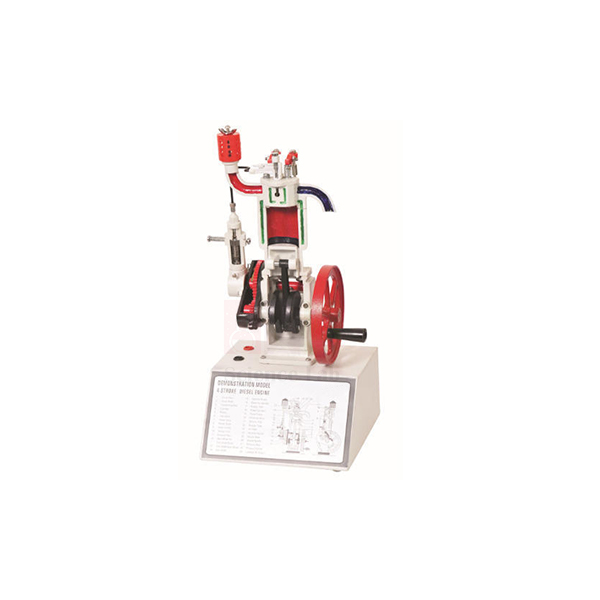
Section Model Of Four-Stroke Diesel Engine
Section Model Of Four-Stroke Diesel Engine (Product Code: SLE/MCE/67) is a sectioned training model used to explain the construction and working cycle of an indirect-injection diesel engine in automotive and mechanical engineering classes. Its internal surfaces are colour-coded for air, fuel and gas mixture, and exhaust gas, while a 3-volt bulb glows at the firing point of the cycle. It is made by Jain Scientific Equipments Pvt Ltd (ScienceLab), an OEM manufacturer, at its own factory in Ambala, India.
Specifications
| Parameter | Detail |
|---|---|
| Engine type | Four-stroke diesel, indirect injection, sectioned for training |
| Displacement | 100 cc |
| Power | 6 HP |
| Injection system | Injection pump, injector, pre-chamber, preheating glow plug |
| Fuel system details | Cam-operated jerk pump and manually operated air inlet diaphragm injection nozzle and starting valve |
| Valve train | Camshaft in the crankcase, overhead valves |
| Other parts shown | Rpm regulator, oil pump, air filter, silencer, tank, cooling system, distribution circuit |
| Firing indication | 3-volt bulb glows at the correct point in the cycle through an electrical contact system in the model |
| Colour coding | Internal surfaces coloured for air, fuel and gas mixture, and exhaust gas; parts, lubricating circuits, fuel and cooling systems painted in different colours |
| Dimensions | 500 × 500 × 650 mm |
| Weight | 25 kg (approx.) |
| Product code | SLE/MCE/67 |
| Manufacturer | Jain Scientific Equipments Pvt Ltd (ScienceLab) — OEM |
| Country of origin | India (made in Ambala, Haryana) |
What Is the Diesel Engine Section Model Used For?
The model shows why a diesel needs no spark: only air is drawn in and squeezed until it is hot enough to ignite fuel sprayed into the pre-chamber, with the glow plug helping on cold starts. As the crankshaft is rotated, the coloured surfaces show which gas fills the cylinder at each stroke and the bulb marks the instant combustion begins.
Instructors use it to walk through the injection pump, injector and pre-chamber in sequence before students work on real fuel systems. It suits diesel mechanic trades, automobile diploma courses and engineering colleges setting up lab equipment for technical institutes. Tip: explain the petrol cycle first, then use this section to highlight what changes in a compression-ignition engine.
OEM Manufacturer
This diesel engine section model is an OEM product of ScienceLab, which is how Jain Scientific Equipments Private Limited trades. The model is prepared at the company’s own licensed factory at Saha, Ambala, Haryana, India, and supplied factory-direct to institutes, dealers and importers without a trading layer in between. For a replacement bulb or other part, or to repeat an order, contact the manufacturer directly — ask us. Find out more on the ScienceLab profile.
Related Automotive Training Equipment
Use these alongside the section model to cover diesel engines in depth.
- Cut Section Model Of Four Stroke Petrol Engine — the spark-ignition engine to compare against.
- 4 Stroke Diesel Engine — a diesel engine for practical work after the sectioned demonstration.
- Diesel Fuel Injection System Inline Pump — a detailed study of the in-line injection pump.
- Diesel Fuel Injection System VE pump — covers the distributor-type injection pump.
See all Automotive Training Equipment.
Frequently Asked Questions
What type of diesel engine does the Section Model Of Four-Stroke Diesel Engine show?
The Section Model Of Four-Stroke Diesel Engine shows an indirect-injection four-stroke diesel engine of 100 cc and 6 HP, complete with injection pump, injector, pre-chamber, preheating glow plug, cooling system and distribution circuit, sectioned for training.
How does the diesel engine section model show the firing point?
The Section Model Of Four-Stroke Diesel Engine uses a 3-volt bulb that glows at the correct point in the cycle, switched by an electrical contact system inside the model, so students can see exactly when combustion begins.
What do the colours on the Section Model Of Four-Stroke Diesel Engine mean?
On the Section Model Of Four-Stroke Diesel Engine, internal surfaces are finished in different colours to indicate air, the fuel and gas mixture, and exhaust gas, while parts, lubricating circuits, fuel and cooling systems are also painted distinctly.
What valve arrangement does the Section Model Of Four-Stroke Diesel Engine have?
The Section Model Of Four-Stroke Diesel Engine has its camshaft in the crankcase and overhead valves, and also shows the rpm regulator, oil pump, air filter, silencer and tank alongside the fuel injection system.
Who manufactures the Section Model Of Four-Stroke Diesel Engine?
Jain Scientific Equipments Pvt Ltd (ScienceLab) is the OEM of the Section Model Of Four-Stroke Diesel Engine, which it prepares at its own licensed factory at Saha, Ambala, Haryana, India. Quotations and repeat orders come straight from the manufacturer.
How big is the diesel engine section model?
The Section Model Of Four-Stroke Diesel Engine measures 500 × 500 × 650 mm and weighs about 25 kg, compact enough to stand on a lecture-room table where a whole group can see the coloured sections.
Request a Quote
For a quotation on the Section Model Of Four-Stroke Diesel Engine (SLE/MCE/67), contact us through the contact page or use the enquiry cart. The manufacturer prepares and sends the quotation itself.
Last updated: 24 September 2026
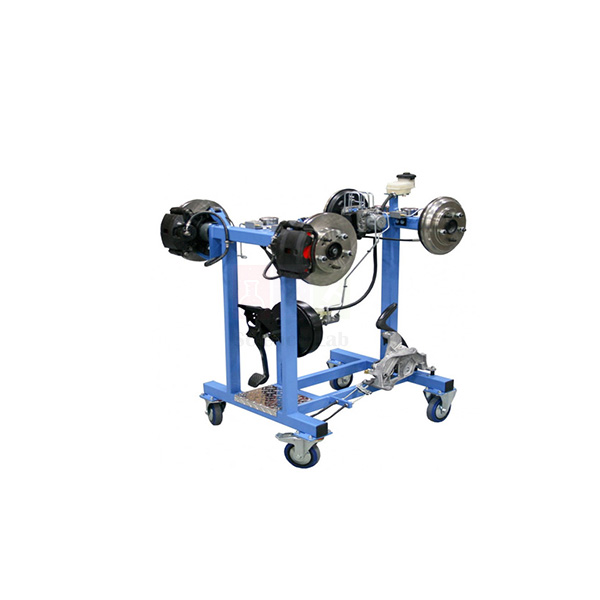
Working Model Of Hydraulic Braking System
Working Model Of Hydraulic Braking System (Product Code: SLE/MCE/68) is a functional brake trainer used to demonstrate a complete four-wheel hydraulic braking system in automotive classrooms and service-training workshops. Built from real automotive disc and drum brake components on a heavy-duty metal stand with casters, it has a pressure gauge at each wheel showing the actual braking pressure. It is made by Jain Scientific Equipments Pvt Ltd (ScienceLab), an OEM manufacturer, at its own factory in Ambala, India.
Specifications
| Parameter | Detail |
|---|---|
| System | Fully functional four-wheel hydraulic braking system, disc and drum |
| Components | Real automotive components: all hydraulic components, brake pedal, power brake booster, parking brake pedal and parking brake components |
| Parking brake | Fully functional parking brake system |
| Pressure indication | Hydraulic pressure gauge at each wheel showing actual braking pressure |
| Access | Easy access to all brake components without the confines of a real vehicle |
| Stand | Heavy-duty metal stand with casters for easy transport |
| Dimensions | 1000 × 800 × 1200 mm |
| Weight | 140 kg (approx.) |
| Product code | SLE/MCE/68 |
| Manufacturer | Jain Scientific Equipments Pvt Ltd (ScienceLab) — OEM |
| Country of origin | India (made in Ambala, Haryana) |
What Is the Hydraulic Braking System Model Used For?
When a student presses the brake pedal, the power brake booster adds to the effort, fluid pressure travels through the lines, and the four gauges show the pressure reaching each disc or drum brake. The parking brake pedal can be applied separately to show how the mechanical parking system holds the wheels independently of the hydraulics.
Because every component can be reached on the open stand, the trainer doubles as a practice rig for brake repair and service procedures such as inspection, adjustment and bleeding. It is a practical choice of vocational training lab equipment for motor vehicle trades, diploma courses and automobile engineering departments.
OEM Manufacturer
ScienceLab is the trading name of Jain Scientific Equipments Private Limited, the OEM (original equipment manufacturer) of the Working Model Of Hydraulic Braking System. The trainer is assembled at the company’s own licensed factory at Saha, Ambala, Haryana, India, using real automotive brake components, and supplied factory-direct to institutions, dealers and importers. Brake parts that wear with repeated practice can be requested from the manufacturer, which also handles repeat orders — ask us. Company details: ScienceLab profile.
Related Automotive Training Equipment
These trainers extend the brake lesson to other systems on the vehicle.
- ABS Braking System Training Board Simulator — the next step, from conventional to anti-lock braking.
- Trailer Air Brake Training Equipment — air brakes used on heavy vehicles and trailers.
- Clutch Structure Trainer Hydraulics — another hydraulically operated vehicle system.
- Cut Model Of Rack And Pinion Steering — completes the chassis systems section.
Browse the Automotive Training Equipment category for more.
Frequently Asked Questions
What does the Working Model Of Hydraulic Braking System include?
The Working Model Of Hydraulic Braking System includes real automotive components: all hydraulic components, disc and drum brakes, the brake pedal, parking brake pedal and parking brake components, a power brake booster and a hydraulic pressure gauge at each wheel.
Is the hydraulic braking model fully functional?
Yes. The Working Model Of Hydraulic Braking System demonstrates the full functionality of a four-wheel hydraulic brake system, including a fully functional parking brake, so students can operate the pedals and watch the brakes respond.
What do the pressure gauges on the Working Model Of Hydraulic Braking System show?
The pressure gauges on the Working Model Of Hydraulic Braking System show the actual braking pressure at each of the four wheels, letting students compare pedal effort with the hydraulic pressure delivered to every brake.
Can the Working Model Of Hydraulic Braking System be moved?
Yes. The Working Model Of Hydraulic Braking System stands on a heavy-duty metal stand with casters for easy transport. It measures 1000 × 800 × 1200 mm and weighs about 140 kg, so check doorway widths along the route.
Who manufactures the Working Model Of Hydraulic Braking System?
Jain Scientific Equipments Pvt Ltd (ScienceLab) is the OEM of the Working Model Of Hydraulic Braking System and builds it at its own licensed factory in Saha, Ambala, Haryana, India, supplying it direct to institutions and dealers.
Can the hydraulic brake trainer be used for service training?
Yes. Besides classroom demonstration, the Working Model Of Hydraulic Braking System serves as educational equipment for brake system repair and service procedures, because every brake component is easy to reach without the confines of a real vehicle.
Request a Quote
Send a quotation request for the Working Model Of Hydraulic Braking System (SLE/MCE/68) via the contact page, or add the trainer to the enquiry cart. The quotation comes directly from the manufacturer in Ambala.
Last updated: 24 September 2026
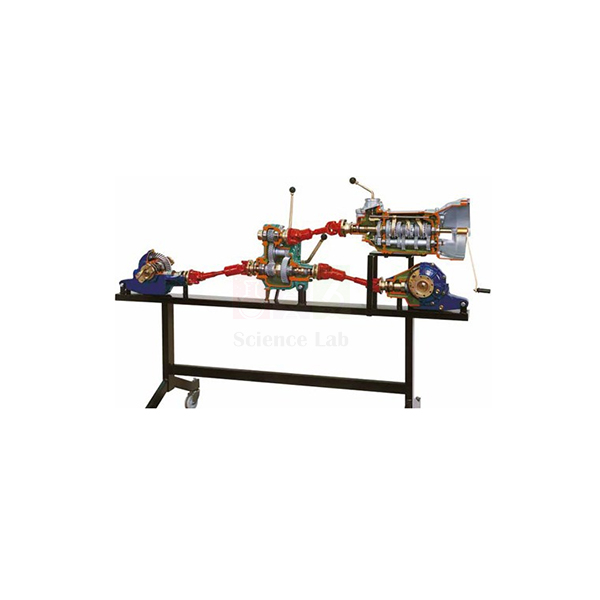
Vehicle Transmission 5 Speed Manual Gearbox
Vehicle Transmission 5 Speed Manual Gearbox (Product Code: SLE/MCE/69) is a real cutaway drivetrain model used to show how a manual gearbox, reduction gear and differentials deliver controlled power to the wheels, in automotive engineering training. Its sectioned parts — a gearbox with 5 speeds and reverse, a 2-speed reduction gear, drive shafts with universal joints and self-locking hypoid differentials — are connected so they work together under manual operation. It is made by Jain Scientific Equipments Pvt Ltd (ScienceLab), an OEM manufacturer, at its own factory in Ambala, India.
Specifications
| Parameter | Detail |
|---|---|
| Gearbox | 5 speeds and reverse |
| Reduction gear | 2-speed |
| Drive shafts | With universal joints |
| Differentials | Self-locking hypoid |
| Control | Movement restorer with front-wheel-drive manual control |
| Operation | Manual |
| Construction | Accurate real cutaway parts, connected together to show their operation |
| Finish | Parts and cross-sections painted in different colours |
| Dimensions | 800 × 300 × 1100 mm (approx.) |
| Weight | 225 kg |
| Product code | SLE/MCE/69 |
| Manufacturer | Jain Scientific Equipments Pvt Ltd (ScienceLab) — OEM |
| Country of origin | India (made in Ambala, Haryana) |
What Is the 5 Speed Manual Gearbox Model Used For?
A transmission provides controlled application of engine power, and this model lets students see how. As each gear is selected and the drivetrain is turned by hand, they watch which gear pair carries the drive and follow the power onward through the reduction gear, drive shafts and universal joints to the hypoid differentials.
It serves as a visual aid for mechanical and automotive subjects and as equipment for repair and service training, which makes it a core item of engineering lab equipment in India’s automobile departments and training centres. At 225 kg, it should be given a permanent place in the workshop, with suitable handling equipment used whenever it has to be moved.
OEM Manufacturer
Jain Scientific Equipments Private Limited, trading as ScienceLab, is the OEM (original equipment manufacturer) of the Vehicle Transmission 5 Speed Manual Gearbox and prepares it at its own licensed factory at Saha, Ambala, Haryana, India. For institutional and tender buyers who need vendor registration details, the company’s identifiers are GSTIN 06AAECJ8618A1ZT and LEI 3358004HRD1JIVXKYX49. Quotations, repeat orders and replacement parts are handled by the manufacturer itself. Read more on the ScienceLab profile.
Related Automotive Training Equipment
These items cover the rest of the manual drivetrain and its alternatives.
- Clutch Structure Trainer Mechanical Manual — the clutch that connects the engine to a manual gearbox.
- Differential Gear — a dedicated model for studying the differential in detail.
- Cut Model Of Automatic Transmission System — compares manual gear selection with automatic shifting.
- Gear Train Model — the gear-ratio basics behind every gearbox.
Explore more Automotive Training Equipment.
Frequently Asked Questions
What does the Vehicle Transmission 5 Speed Manual Gearbox model include?
The Vehicle Transmission 5 Speed Manual Gearbox includes a gearbox with 5 speeds and reverse, a 2-speed reduction gear, drive shafts with universal joints, self-locking hypoid differentials and a movement restorer with front-wheel-drive manual control, all as real cutaway parts.
Is the Vehicle Transmission 5 Speed Manual Gearbox made from real parts?
Yes. The parts of the Vehicle Transmission 5 Speed Manual Gearbox are supplied as accurate real cutaways, connected together so their operation is shown in an easy, immediately understandable way, and painted in different colours for clarity.
How is the manual gearbox model operated?
The Vehicle Transmission 5 Speed Manual Gearbox is operated manually, so the instructor can select each gear and turn the drivetrain at teaching speed while students follow the power path from gearbox to differentials.
How heavy is the Vehicle Transmission 5 Speed Manual Gearbox?
The Vehicle Transmission 5 Speed Manual Gearbox weighs 225 kg and measures about 800 × 300 × 1100 mm. Plan a permanent position in the workshop and use suitable handling equipment when it has to be moved.
Who manufactures the Vehicle Transmission 5 Speed Manual Gearbox?
Jain Scientific Equipments Pvt Ltd (ScienceLab) is the OEM of the Vehicle Transmission 5 Speed Manual Gearbox and makes it at its own licensed factory at Saha, Ambala, Haryana, India. Quotations come directly from the manufacturer.
Can the Vehicle Transmission 5 Speed Manual Gearbox be shipped overseas?
Yes, ScienceLab supplies the Vehicle Transmission 5 Speed Manual Gearbox to institutions, dealers and importers in India and international markets. Send the quantity and destination through the contact page for a quotation.
Request a Quote
To receive a quotation for the Vehicle Transmission 5 Speed Manual Gearbox (SLE/MCE/69), write to us on the contact page or add it to the enquiry cart. The manufacturer quotes you directly, including for tender enquiries.
Last updated: 24 September 2026
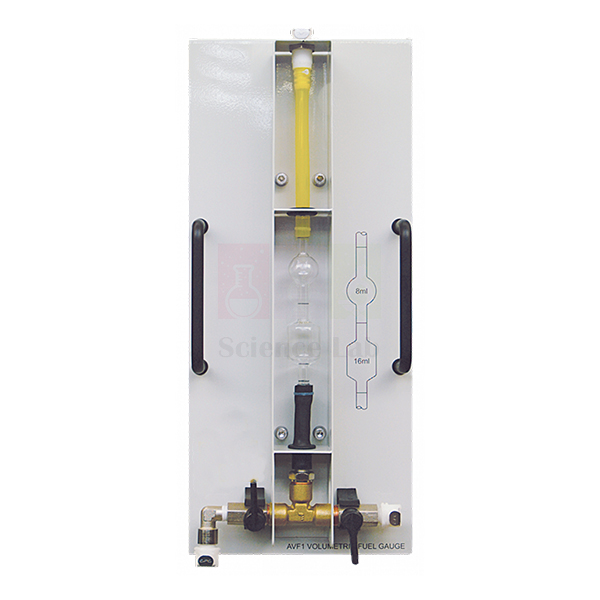
Manual Volumetric Fuel Gauge
Manual Volumetric Fuel Gauge (Product Code: SLE/EE/01) is a pipette-type fuel meter used to measure how much fuel an engine consumes during bench tests in engineering and automotive laboratories. Students time the engine as it draws a set volume from a precision-calibrated two-bulb pipette, then calculate the fuel flow rate for petrol or diesel engines. It is made by Jain Scientific Equipments Pvt Ltd (ScienceLab), an OEM and engineering lab equipment manufacturer, at its own factory in Ambala, India.
Key Details
| Parameter | Detail |
|---|---|
| Measuring element | Precision-calibrated two-bulb pipette |
| Flow control | Control valves, including a valve that cuts off the tank supply so the engine draws fuel from the pipette only |
| Filling | Fuel enters the pipette from the fuel tank |
| Installation | Mounts on the instrumentation frame of the engine test set and connects between the fuel tank and the engine under test |
| Couplings | Self-sealing couplings for quick connection and disconnection with minimum loss or spillage of fuel |
| Suitable fuels | Petrol or diesel |
| Measurement method | Time taken to consume a set volume of fuel, from which the fuel flow rate is calculated |
| Product code | SLE/EE/01 |
| Manufacturer | Jain Scientific Equipments Pvt Ltd (ScienceLab) — OEM |
| Country of origin | India (made in Ambala, Haryana) |
What Is the Manual Volumetric Fuel Gauge Used For?
The gauge is the fuel-consumption instrument of an engine test bench. With the engine held at a steady speed and load, the student closes the tank valve so the engine runs from the pipette alone, then times how long it takes to use the marked volume. Dividing that volume by the elapsed time gives the volumetric fuel flow rate, the starting point for specific fuel consumption, brake thermal efficiency and energy-balance calculations.
Because every reading is taken by eye and stopwatch, the principle stays visible to learners instead of being hidden inside a sensor, which makes it a sound choice among lab equipments for technical institutes running IC engine practicals. Take several timings at each load point and average them, and reopen the tank valve between readings so the pipette refills before the next measurement.
What to Specify When Ordering
- Which engines the gauge will serve – it suits both petrol and diesel
- The engine test set it will mount on, since it fits the instrumentation frame between tank and engine
- Whether you also need matching engines such as the 4 Stroke Petrol Engine or 4 Stroke Diesel Engine
- How many test benches you are equipping
OEM Manufacturer
ScienceLab is the trading name of Jain Scientific Equipments Private Limited, the OEM (original equipment manufacturer) behind this fuel gauge. The gauge is made and assembled at the company's own licensed factory at Saha, Ambala, Haryana, and supplied factory-direct to engineering colleges, polytechnics, training institutes, dealers and importers rather than through a trader.
Because the manufacturer handles your order itself, questions about replacement pipettes, valves or couplings go straight to the people who build the unit – just ask us. More about the company is on our company profile.
Related Automotive Training Equipment
The fuel gauge works alongside the engines and measuring accessories of an engine test bench:
- 4 Stroke Petrol Engine — a test engine whose fuel use this gauge can time
- 4 Stroke Diesel Engine — compression-ignition engine for comparing diesel consumption
- Exhaust Gas Calori meter — measures the heat leaving in the exhaust to complete an engine energy balance
- Stopwatch, Digital — for timing the pipette volume if the bench has no timer of its own
- Four Stroke Four Cylinder Petrol Engine Test Bench — a complete multi-cylinder bench for fuel-consumption and power studies
Browse the full range of engine, transmission and braking trainers in Automotive Training Equipment.
Frequently Asked Questions
What does the Manual Volumetric Fuel Gauge measure?
The Manual Volumetric Fuel Gauge measures an engine's fuel consumption by timing how long the engine takes to use a set volume of fuel from its calibrated two-bulb pipette. From that time and volume, students calculate the fuel flow rate used in efficiency and specific fuel consumption work.
Can the Manual Volumetric Fuel Gauge be used with diesel engines?
Yes. The Manual Volumetric Fuel Gauge is suitable for petrol or diesel, so one gauge can serve both spark-ignition and compression-ignition engines on the same test set. Drain the pipette when changing fuels so that readings are not affected by a mixture of the two.
How is the Manual Volumetric Fuel Gauge connected to the engine?
The Manual Volumetric Fuel Gauge mounts on the instrumentation frame of the test set and connects between the fuel tank and the engine under test. Self-sealing couplings let staff connect and disconnect it quickly with minimum loss or spillage of fuel.
Is a stopwatch included with the Manual Volumetric Fuel Gauge?
A timer is not listed as part of the Manual Volumetric Fuel Gauge, so plan to use a stopwatch or the timing facility of your bench. If you would like a stopwatch quoted with the gauge, mention it in your enquiry on our contact page.
Who manufactures the Manual Volumetric Fuel Gauge?
The Manual Volumetric Fuel Gauge is manufactured by Jain Scientific Equipments Pvt Ltd (ScienceLab) as the OEM, at its own factory in Saha, Ambala, Haryana, India. Orders, spares queries and repeat supplies are handled directly by the manufacturer rather than through a trading intermediary.
Is a calibration certificate available for the Manual Volumetric Fuel Gauge?
The pipette of the Manual Volumetric Fuel Gauge is precision calibrated, but certificate availability should be discussed with us before ordering. Tell us in your enquiry if your institution needs a calibration certificate so we can confirm what accompanies the quotation.
What details should a quotation request for the Manual Volumetric Fuel Gauge include?
A quotation request for the Manual Volumetric Fuel Gauge should state the quantity, the engine or test set it will be used with, whether matching engines are also needed, and the delivery destination in India or abroad, so we can quote the complete fuel-measurement setup.
Request a Quote
To order the Manual Volumetric Fuel Gauge, send your requirement through our contact page or add it to the enquiry cart. Quotations come direct from the manufacturer, for engineering institutions in India and international markets.
Last updated: 24 September 2026
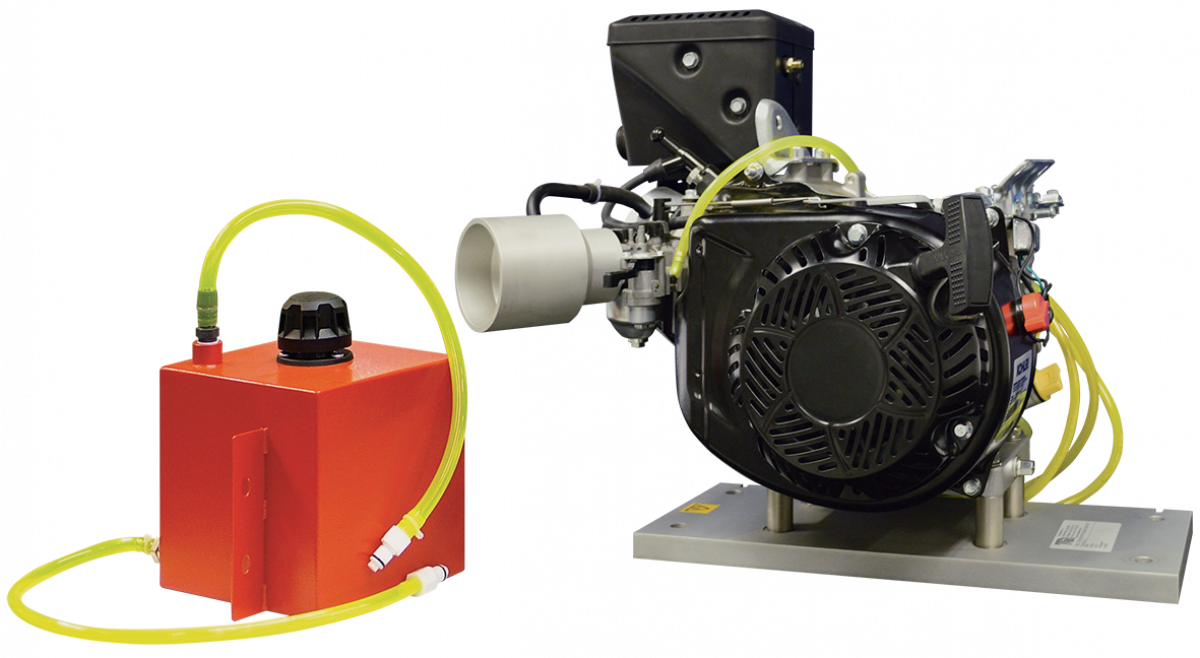
4 Stroke Petrol Engine
4 Stroke Petrol Engine (Product Code: SLE/EE/02) is a spark-ignition engine adapted for education, used for performance testing and demonstrations on a dynamometer test set in engineering laboratories. Colleges building IC engine practicals value that it arrives with an exhaust thermocouple, a half-coupling for the dynamometer and all essential hoses and fittings, on a precision bed plate. It is supplied by Jain Scientific Equipments Pvt Ltd (ScienceLab), Ambala, India, which provides engineering lab equipment in India and international markets.
Key Details
| Parameter | Detail |
|---|---|
| Engine type | Four-stroke petrol engine adapted specially for laboratory testing and demonstrations |
| Included fittings | Exhaust thermocouple; half-coupling to link to the test set dynamometer; all essential hoses and fittings |
| Mounting | Sturdy precision bed plate with dowels and slots that align and locate it accurately with the dynamometer test set |
| Engine changeover | Bed plate location minimises the time spent replacing one engine with another |
| Fuel connections | Couplings for quick connection and disconnection with minimum loss or spillage of fuel |
| Fuel tank | Removable for filling or for storage in a fuel locker; removal also prevents unauthorised use |
| Product code | SLE/EE/02 |
| Supplied by | Jain Scientific Equipments Pvt Ltd (ScienceLab), Ambala, India |
What Is the 4 Stroke Petrol Engine Used For?
On a dynamometer test set the engine is run across a range of speeds and loads so that students can plot torque, brake power, fuel consumption and efficiency for a spark-ignition engine. The exhaust thermocouple adds exhaust temperature to each set of readings, which supports heat-balance work when combined with fuel-flow and exhaust-heat measurements.
Because the bed plate is located by dowels and slots, a laboratory can exchange this engine for another one built for the same test set with little set-up time and compare petrol and diesel behaviour in one course. For engineering educational equipments in India that will be used by many batches of students, the removable tank is a practical safety feature: take it off after class and keep it in a fuel locker so the engine cannot be run unsupervised.
What to Specify When Ordering
- The dynamometer test set the engine will mount on
- Whether you need the Manual Volumetric Fuel Gauge and Exhaust Gas Calori meter for full heat-balance tests
- The engine make, model and rating offered – these are confirmed in the quotation
- Number of engines required
Supplier
ScienceLab is the trading name of Jain Scientific Equipments Private Limited, based in Ambala, Haryana. The company supplies this education-adapted petrol engine to engineering colleges, polytechnics, skill-training centres, dealers and importers, and can include the test-set accessories that go with it on the same quotation.
Ask us for the make and rating of the engine offered, and for any spares you may need later. The company's background and registrations are summarised on our company profile.
Related Automotive Training Equipment
These items complete a petrol engine practical, from understanding the engine to measuring its performance:
- Manual Volumetric Fuel Gauge — times fuel use for consumption and efficiency results
- Exhaust Gas Calori meter — measures heat carried away in the exhaust gases
- 4 Stroke Diesel Engine — companion engine for a diesel comparison on the same test set
- Cut Section Model Of Four Stroke Petrol Engine — shows the internal parts and the four-stroke cycle before live testing
- Automotive Engine Fault Diagnosis Simulator Auto Fault — for moving from performance testing to fault-finding practice
More engine and vehicle-systems trainers are listed under Automotive Training Equipment.
Frequently Asked Questions
What is included with the 4 Stroke Petrol Engine?
The 4 Stroke Petrol Engine includes an exhaust thermocouple, a half-coupling to link it to the test set dynamometer, and all essential hoses and fittings, mounted on a precision bed plate. The dynamometer test set is a separate item, so confirm your requirement for it when you enquire.
Why is the fuel tank of the 4 Stroke Petrol Engine removable?
The fuel tank of the 4 Stroke Petrol Engine can be removed for filling or for storage in a fuel locker when the engine is not in use. Taking the tank away also prevents unauthorised use, which helps laboratories manage safety between supervised sessions.
How is the 4 Stroke Petrol Engine changed over on the test set?
The 4 Stroke Petrol Engine sits on a sturdy precision bed plate whose dowels and slots align and locate it accurately with the dynamometer test set. This minimises the time spent replacing one engine with another, and its couplings disconnect quickly with minimum fuel spillage.
Can the 4 Stroke Petrol Engine be used for exhaust temperature measurements?
Yes. The 4 Stroke Petrol Engine includes an exhaust thermocouple, so exhaust temperature can be recorded during each test. Paired with an exhaust gas calorimeter and a fuel gauge, it supports heat-balance experiments that show where the energy in the fuel goes.
Who supplies the 4 Stroke Petrol Engine?
The 4 Stroke Petrol Engine is supplied by Jain Scientific Equipments Pvt Ltd (ScienceLab), Ambala, Haryana, India. The engine make, model and rating offered are confirmed at the time of quotation, so ask us for these details before placing an order.
What should I send to get a quotation for the 4 Stroke Petrol Engine?
For a quotation on the 4 Stroke Petrol Engine, send the quantity, the test set it will run on, accessories needed such as a fuel gauge or exhaust calorimeter, and the delivery location. We supply institutions in India and international markets.
Request a Quote
Send your requirement for the 4 Stroke Petrol Engine through our contact page, or add it to the enquiry cart with any test-set accessories, and we will reply with availability and a detailed quotation.
Last updated: 24 September 2026
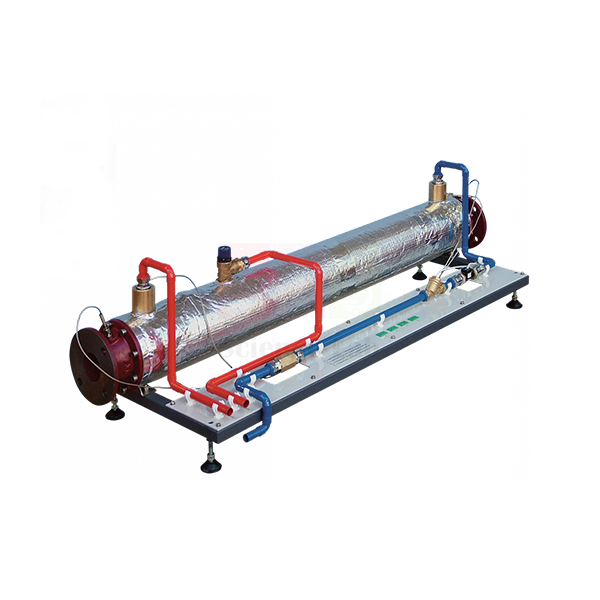
Exhaust Gas Calori meter
Exhaust Gas Calori meter (Product Code: SLE/EE/03) is a gas-to-water heat exchanger used to measure the heat carried away in engine exhaust gases during IC engine tests in engineering laboratories. Exhaust flows through its multi-tube bundle inside a cooling-water jacket, and thermocouples with a four-channel digital display give the temperatures and flow needed for an engine heat balance. It is made by Jain Scientific Equipments Pvt Ltd (ScienceLab), an OEM and technical educational equipment manufacturer, at its own factory in Ambala, India.
Specifications
| Parameter | Detail |
|---|---|
| Heat exchanger | Gas-to-water shell and multi-tube heat exchanger on a sturdy base plate |
| Gas path | Exhaust gases from the test engine on the test set flow through the tubes |
| Cooling water | A jacket of constantly flowing cooling water surrounds the tubes |
| Flow measurement | Turbine flow meter measuring the cooling-water flow rate |
| Water flow control | Control valve; hand-operated valve mounted on the control console of the test set |
| Temperature sensing | Thermocouples measuring gas and water temperatures at inlet and outlet |
| Display | Digital four-channel temperature and flow display unit, mounted on the instrumentation rail of the test set console frame |
| Safety | Pressure-relief valve in case insufficient cooling water is flowing |
| Product code | SLE/EE/03 |
| Manufacturer | Jain Scientific Equipments Pvt Ltd (ScienceLab) — OEM |
| Country of origin | India (made in Ambala, Haryana) |
What Is the Exhaust Gas Calorimeter Used For?
In an engine heat-balance experiment, the energy in the fuel is divided between brake power, heat to the engine cooling water, heat carried out in the exhaust and other losses. This calorimeter quantifies the exhaust share: the heat picked up by the cooling water equals its mass flow rate multiplied by its specific heat and temperature rise, while the fall in gas temperature across the exchanger shows how much exhaust energy was recovered.
Establish a steady cooling-water flow with the console valve before the engine is started, and never pass exhaust through the exchanger without water – the pressure-relief valve is a safeguard, not a control. Take readings once all four channels have settled. For colleges setting up a calorimeter lab in India around a single engine test set, this unit adds the thermal measurement that completes the practical.
What to Specify When Ordering
- The engine test set and console it will be fitted to (display on the instrumentation rail, valve on the control console)
- The engines to be tested, such as the 4 Stroke Petrol Engine or 4 Stroke Diesel Engine
- Whether a Manual Volumetric Fuel Gauge is also needed for complete heat-balance data
- The cooling-water supply available in your laboratory, so we can advise on connections
OEM Manufacturer
This calorimeter is an original product of ScienceLab, the trading name of Jain Scientific Equipments Private Limited (CIN U29309HR2020PTC087597). As the OEM, the company manufactures it at its licensed factory at 449, HSIIDC Industrial Area, Saha, Ambala (Factory Licence AMB-ONLINE-CHD-J-414).
Engineering colleges, polytechnics, dealers and importers buy it factory-direct, and requests for replacement thermocouples, valves or display units go to the same manufacturer – ask us about availability. The company profile gives more background.
Related Automotive Training Equipment
A complete engine heat-balance practical usually combines the calorimeter with these items:
- Manual Volumetric Fuel Gauge — measures fuel input, the other side of the heat balance
- 4 Stroke Petrol Engine — petrol test engine whose exhaust the calorimeter can analyse
- 4 Stroke Diesel Engine — diesel test engine for comparing exhaust heat losses
- Exhaust Gas Calorimeter — a separately listed exhaust calorimeter in the same range – compare both before ordering
- Shell and Tube Heat Exchanger — a heat-transfer trainer for studying the exchanger principle itself
See all engine-testing and vehicle trainers in Automotive Training Equipment.
Frequently Asked Questions
How does the Exhaust Gas Calori meter measure exhaust heat?
The Exhaust Gas Calori meter passes engine exhaust through tubes surrounded by a jacket of flowing cooling water. Heat content is assessed from the cooling-water flow rate, measured by a turbine flow meter, and the water and gas temperatures recorded by thermocouples at inlet and outlet.
What instrumentation comes with the Exhaust Gas Calori meter?
The Exhaust Gas Calori meter includes thermocouples at the gas and water inlets and outlets, a turbine flow meter and a digital four-channel temperature and flow display unit. The display mounts on the instrumentation rail of the test set console frame for easy monitoring.
Is the Exhaust Gas Calori meter protected if cooling water fails?
Yes, the Exhaust Gas Calori meter has a pressure-relief valve in case insufficient cooling water is flowing. Students should still set and check the water flow with the hand-operated console valve before running the engine, because the relief valve is a safeguard rather than a substitute.
Which engines can be tested with the Exhaust Gas Calori meter?
The Exhaust Gas Calori meter analyses exhaust gases from the test engine mounted on the test set, so it is used with engines that set accepts, such as a four-stroke petrol or diesel engine. Share your engine details with us to confirm the connection arrangement.
Who manufactures the Exhaust Gas Calori meter?
The Exhaust Gas Calori meter is manufactured by Jain Scientific Equipments Pvt Ltd (ScienceLab), the OEM, at its licensed factory in Saha, Ambala, Haryana, India. Institutions and dealers buy it factory-direct, and repeat orders or spare-part requests go straight to the manufacturer.
Can a calibration certificate be supplied with the Exhaust Gas Calori meter?
Calibration certificate availability for the thermocouples and flow meter of the Exhaust Gas Calori meter should be discussed with us before ordering. Mention the requirement in your enquiry so the quotation states exactly what documentation will accompany the unit.
What information do you need to quote the Exhaust Gas Calori meter?
To quote the Exhaust Gas Calori meter we need the quantity, the engine test set and engines it will serve, companion items such as a fuel gauge, and the delivery destination. Quotations are prepared for institutions in India and international markets.
Request a Quote
For a quotation on the Exhaust Gas Calori meter, write to us via the contact page or place it in the enquiry cart. You deal directly with the manufacturer, whether the unit is for one laboratory or a multi-campus order.
Last updated: 24 September 2026
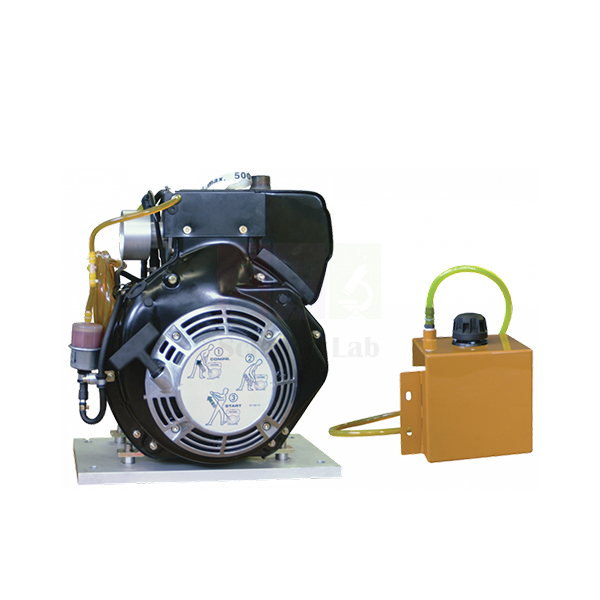
4 Stroke Diesel Engine
4 Stroke Diesel Engine (Product Code: SLE/EE/04) is a compression-ignition test engine used to study diesel performance and combustion on a dynamometer test set in engineering laboratories. Its modified cylinder head and crank accept a cylinder head pressure transducer and crank angle encoder, so an engine cycle analyser can extend the experiments. It is supplied by Jain Scientific Equipments Pvt Ltd (ScienceLab), Ambala, India, to colleges sourcing lab equipments for technical institutes.
Key Details
| Parameter | Detail |
|---|---|
| Engine type | Four-stroke diesel engine for laboratory testing |
| Modifications | Modified cylinder head and crank |
| Instrumentation provision | Allows use with the Cylinder Head Pressure Transducer and the Crank Angle Encoder |
| Extended experiments | Transducer and encoder can connect to the Engine Cycle Analyser |
| Mounting | Sturdy precision bed plate with dowels and slots that align and locate it accurately with the dynamometer test set |
| Engine changeover | Bed plate location minimises the time spent replacing one engine with another |
| Product code | SLE/EE/04 |
| Supplied by | Jain Scientific Equipments Pvt Ltd (ScienceLab), Ambala, India |
What Is the 4 Stroke Diesel Engine Used For?
Mounted on the dynamometer test set, the engine lets students measure torque, speed and fuel consumption for a compression-ignition engine and set the results beside those of a petrol engine. The modified head and crank take the work further: with a pressure transducer in the cylinder head and an encoder on the crank, a cycle analyser can build pressure–crank-angle and pressure–volume diagrams, from which indicated power, ignition delay and peak cylinder pressure are studied.
Plan the course in two stages – performance tests first, then combustion analysis once the transducer and encoder are fitted. Mechanical and automobile departments building engineering lab equipment India-wide often run this engine and a petrol engine on one test set, using the located bed plate to change between them.
What to Specify When Ordering
- The dynamometer test set the engine will mount on
- Whether the Cylinder Head Pressure Transducer, Crank Angle Encoder and Engine Cycle Analyser should be quoted with it
- The engine make, model and rating offered – confirmed in the quotation
- Companion measuring items such as a fuel gauge and exhaust gas calorimeter
Supplier
Jain Scientific Equipments Private Limited trades as ScienceLab and supplies this diesel test engine from Ambala, Haryana, to universities, polytechnics, vocational centres, dealers and importers.
When you enquire, we confirm the engine specification offered and which combustion-analysis accessories can be quoted alongside it, so the purchase matches your experiment plan. You can read about the company on our company profile.
Related Automotive Training Equipment
Pair the diesel engine with these items to cover diesel theory, fuel systems and performance measurement:
- 4 Stroke Petrol Engine — petrol counterpart for side-by-side comparison on the same test set
- Section Model Of Four-Stroke Diesel Engine — sectioned model to explain the internals before running tests
- Diesel Fuel Injection System Inline Pump — trainer covering the diesel fuel-injection side
- Manual Volumetric Fuel Gauge — measures diesel consumption during load tests
- Exhaust Gas Calori meter — quantifies exhaust heat loss for a heat balance
Explore further engine, transmission and diagnosis trainers in Automotive Training Equipment.
Frequently Asked Questions
What makes the 4 Stroke Diesel Engine suitable for combustion analysis?
The 4 Stroke Diesel Engine has a modified cylinder head and crank that allow use with a Cylinder Head Pressure Transducer and a Crank Angle Encoder. Connected to an Engine Cycle Analyser, these extend the experiments beyond basic performance testing into in-cylinder pressure studies.
Are the pressure transducer and crank angle encoder included with the 4 Stroke Diesel Engine?
The listing for the 4 Stroke Diesel Engine describes modifications that allow a pressure transducer and crank angle encoder to be used, but does not state that they are included. Ask us to confirm whether they, and the Engine Cycle Analyser, can be quoted with the engine.
How does the 4 Stroke Diesel Engine mount on the test set?
The 4 Stroke Diesel Engine is mounted on a sturdy precision bed plate with dowels and slots that align and locate it accurately with the dynamometer test set. This keeps the time needed to replace one engine with another to a minimum during practical sessions.
Can the 4 Stroke Diesel Engine be compared with a petrol engine on the same rig?
Yes, the 4 Stroke Diesel Engine locates on the dynamometer test set through its bed plate, so it can be exchanged with another engine built for that set, such as a four-stroke petrol engine. Confirm compatibility with your existing test set when you enquire.
Who supplies the 4 Stroke Diesel Engine?
Jain Scientific Equipments Pvt Ltd (ScienceLab) of Ambala, Haryana, India supplies the 4 Stroke Diesel Engine to engineering institutions. Because this page does not name the base engine, request its make, model and power rating in writing with your quotation.
What information helps us quote the 4 Stroke Diesel Engine?
To quote the 4 Stroke Diesel Engine accurately, we need the number of engines, details of the dynamometer test set you have or plan to buy, whether combustion-analysis accessories are required, and the city or port of delivery.
Request a Quote
Request a quotation for the 4 Stroke Diesel Engine through our contact page, or collect it with related items in the enquiry cart and submit them together for one consolidated reply.
Last updated: 24 September 2026
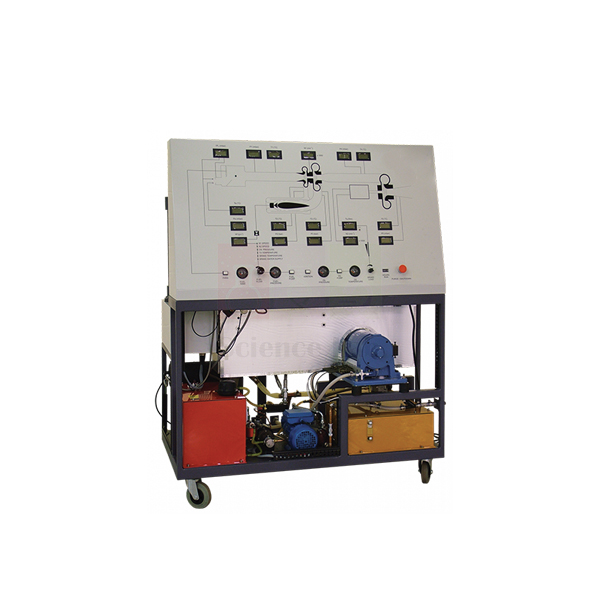
Two Shaft Gas Turbine
Two Shaft Gas Turbine (Product Code: SLE/EE/05) is a self-contained, fully instrumented educational gas turbine used to demonstrate and test the gas turbine cycle in engineering laboratories. Its steel frame carries a gas generator, a separate power turbine, combustion chamber, oil and fuel tanks, pumps and guards, run from a labelled control panel with a mimic diagram. It is supplied by Jain Scientific Equipments Pvt Ltd (ScienceLab), Ambala, India, as part of its range of TVET lab equipment.
Key Details
| Parameter | Detail |
|---|---|
| Type | Self-contained, fully instrumented educational two-shaft gas turbine |
| Frame | Steel frame holding the gas generator, power turbine, combustion chamber, oil and fuel tanks, pumps, ancillaries and guards |
| Air path | Calibrated nozzle and air box, then compressor, then combustion chamber |
| Fuel system | Pump transfers fuel from the fuel tank to spray through a special nozzle into the combustion chamber |
| Ignition | High-energy spark ignites the air and fuel mixture, which flows to the gas generator turbine |
| Combustion chamber | Designed for good combustion, low pressure loss and good flame stability over a wide range of conditions |
| Speed control | Fuel flow control valve on the instrumentation and control panel regulates turbine speed; the design reduces the possibility of overspeed |
| Control panel | Clearly labelled, with schematic mimic diagram, instrument displays, controls and warning lights |
| Product code | SLE/EE/05 |
| Supplied by | Jain Scientific Equipments Pvt Ltd (ScienceLab), Ambala, India |
What Is the Two Shaft Gas Turbine Used For?
The trainer brings the Brayton (Joule) cycle into the laboratory. Students follow the air from the calibrated nozzle, which allows the air flow to be determined, through compression, combustion and expansion, and see how a two-shaft layout divides the work: the gas generator turbine drives the compressor, while the free power turbine on its own shaft delivers the useful output.
Typical sessions cover the start-up and shutdown sequence, the effect of fuel flow on speed, and recording the panel readings at several fuel settings to study how output and efficiency change. Always follow the start-up order shown on the mimic panel and keep the guards in place. Among engineering educational equipments in India, it lets one laboratory introduce the turbine principles behind aircraft, marine and power-generation engines.
Supplier
ScienceLab, the trading name of Jain Scientific Equipments Private Limited of Ambala, Haryana, India, supplies this gas turbine trainer to engineering colleges, research institutions, dealers and importers.
Questions about operation, spares or repeat orders can be sent directly to the company – ask us for details. Find out more on our company profile.
Related Automotive Training Equipment
These trainers extend a gas turbine course into compression, jet propulsion and engine comparison:
- Turbojet Engine Test Bench — a jet-propulsion engine bench for comparing gas turbine layouts
- Rotary Air Compressor Test Bench — studies the compression stage on its own
- Four Stroke Four Cylinder Petrol Engine Test Bench — reciprocating engine for comparing turbine and piston-engine performance
- Temperature Measurement and Calibration Apparatus — teaches the temperature-measurement methods used in engine testing
The trainer is listed in Automotive Training Equipment; related heat-engine and heat-transfer trainers are in Thermodynamics & Heat Transfer Lab Equipment.
Frequently Asked Questions
What are the main parts of the Two Shaft Gas Turbine?
The Two Shaft Gas Turbine has a steel frame carrying a gas generator, a power turbine, a combustion chamber, oil and fuel tanks, pumps, ancillaries and guards. A clearly labelled instrumentation and control panel with a mimic diagram holds the displays, controls and warning lights.
How is the speed of the Two Shaft Gas Turbine controlled?
The speed of the Two Shaft Gas Turbine is regulated by a fuel flow control valve on the instrumentation and control panel. The design reduces the possibility of overspeed, and warning lights on the panel help students and staff monitor operation.
How is the fuel ignited in the Two Shaft Gas Turbine?
In the Two Shaft Gas Turbine, a pump transfers fuel from the tank to spray through a special nozzle into the combustion chamber, where a high-energy spark ignites the air and fuel mixture. The hot gases then flow on to the gas generator turbine.
Which fuel does the Two Shaft Gas Turbine use?
The fuel type for the Two Shaft Gas Turbine is not stated on this page. Ask us through the contact page, together with details of the services available in your laboratory, so that the quotation confirms the fuel and the installation arrangements.
Who supplies the Two Shaft Gas Turbine?
Jain Scientific Equipments Pvt Ltd (ScienceLab), Ambala, Haryana, India, supplies the Two Shaft Gas Turbine to engineering colleges, research institutions, dealers and importers. Quotations, repeat orders and spares enquiries for the trainer are handled directly by the company.
How do I request a quotation for the Two Shaft Gas Turbine?
To request a quotation for the Two Shaft Gas Turbine, state the quantity, the institution and delivery destination, the experiments you plan to run, and any documentation you need, such as a calibration certificate, whose availability should be discussed with us.
Request a Quote
To receive a quotation for the Two Shaft Gas Turbine, contact us through the contact page or add it to your enquiry cart. We quote directly to institutions in India and international markets.
Last updated: 24 September 2026
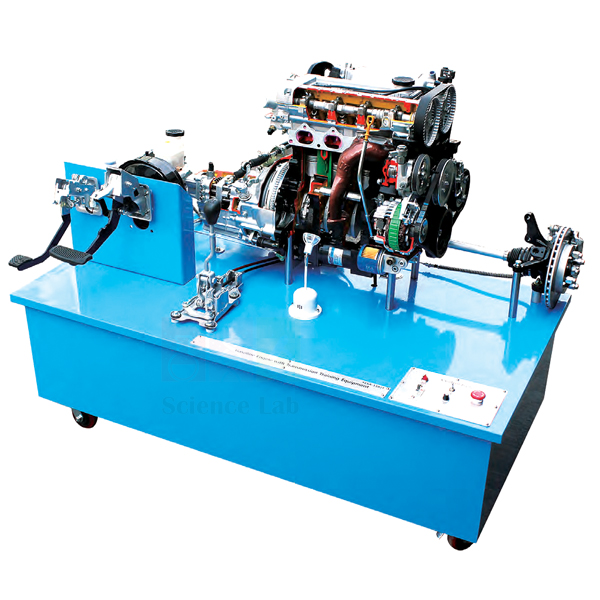
Automotive Power Train Training Equipment DOHC Gasoline
Automotive Power Train Training Equipment DOHC Gasoline (Product Code: SLE/ATE/01) is a sectioned, motor-driven power train trainer used to teach how a DOHC four-cylinder gasoline engine, FF manual transmission, clutch and brakes work together — engineering lab equipment in India for automobile, polytechnic and ITI courses. An educational model of the 1,800~2,000cc class, it lets students change gears as on a real vehicle while watching the cut internals. Its training stand and controls are made by Jain Scientific Equipments Pvt Ltd (ScienceLab), an OEM manufacturer, at its own factory in Ambala, India; the DOHC engine and transmission assemblies themselves are sourced production units, not made in Ambala.
Specifications
| Parameter | Detail |
|---|---|
| Engine | DOHC engine assembly, 4 cylinders (educational model for 1,800~2,000cc gasoline engine) |
| Transmission | FF-type manual, 5 forward and 1 reverse |
| Other assemblies | Clutch, brake system, drive shaft to the wheels |
| Drive motor | AC 220 V / 180 W |
| Controls and protection | Engine speed controller, emergency switch, safety fuse, light |
| Frame | Steel frame with heat-treatment painting |
| Wheels | 4 wheels with brakes |
| Sectioning | Precisely cut; each incised section painted a different colour, with brake structure and engine parts painted specifically |
| Weight | Approx. 250 kg |
| Size | Approx. 1,600 × 1,000 × 1,200 mm |
| Engine / assembly | Sourced production unit (as listed) |
| Product code | SLE/ATE/01 |
| Manufacturer | Jain Scientific Equipments Pvt Ltd (ScienceLab) — OEM |
| Country of origin | India (trainer built in Ambala, Haryana) |
Training contents covered on the unit:
- Replacing brake oil and removing air from the brake system
- Removing and refitting the cylinder head
- Replacing the timing belt and other belts, with belt tension adjustment
- Replacing brake disc and pads
- Removing and refitting the generator and starter motor
What Is the DOHC Power Train Trainer Used For?
Instructors use the trainer to explain the structure and operating principle of an FF manual transmission alongside the gasoline engine that drives it. Gear changes are made just as on a real vehicle, while the cut sections reveal the moving internals and the drive shaft shows the resulting wheel movement. On a DOHC engine, two overhead camshafts per cylinder head operate the intake and exhaust valves separately, so the exposed valve train and timing belt make a natural starting point for lessons on valve timing before students move on to the belt replacement exercise.
Workshop sessions usually rotate small groups through the five service tasks, which suits vocational training labs where each learner must practise hands-on procedures. Keep the emergency switch within reach of the instructor whenever the drive motor is running.
OEM Manufacturer
ScienceLab — the trading name of Jain Scientific Equipments Private Limited — is the OEM (original equipment manufacturer) of this DOHC power train trainer's training stand and control system, which are built at the company's own licensed factory at Saha, Ambala, Haryana, India. The DOHC engine and manual transmission assemblies mounted on the stand are sourced production units, not made in Ambala. The finished trainer is supplied factory-direct to engineering colleges, polytechnics, ITIs, dealers and importers, and every quotation comes straight from ScienceLab — ask us about spare parts or repeat orders. See the company profile.
Related Automotive Training Equipment
Trainers that extend the same power train syllabus:
- Automotive Power Train Training Equipment SOHC Gasoline — the single-camshaft counterpart for comparing valve-train layouts
- Clutch Structure Trainer Hydraulic Manual — a close-up study of the flywheel, pressure board and hydraulic clutch actuation
- Differential Gear — shows how driving torque is shared between the wheels after the gearbox
- Engine management system (MPI) — a stand for studying gasoline multipoint injection
- Automotive Engine Fault Diagnosis Simulator Auto Fault — a running gasoline engine stand for fault-finding once structure is understood
The complete line-up is in the Automotive Training Equipment category.
Frequently Asked Questions
Which engine does the Automotive Power Train Training Equipment DOHC Gasoline represent?
The Automotive Power Train Training Equipment DOHC Gasoline uses a DOHC four-cylinder engine assembly and is built as an educational model for the 1,800~2,000cc gasoline engine class, coupled to an FF-type manual transmission with 5 forward gears and 1 reverse.
How is movement produced on the DOHC gasoline power train trainer?
Movement on the DOHC gasoline power train trainer (SLE/ATE/01) comes from an AC 220 V / 180 W motor controlled by an engine speed controller, so internal engine movement and wheel rotation can be shown without running the engine on fuel.
What practical tasks can students carry out on the DOHC power train trainer?
Students using the Automotive Power Train Training Equipment DOHC Gasoline can practise brake oil replacement and air removal, cylinder head removal and refitting, timing belt and other belt replacement with tension adjustment, brake disc and pad replacement, and generator and starter motor removal and refitting.
How much floor space does the DOHC power train trainer need?
The DOHC gasoline power train trainer measures approximately 1,600 × 1,000 × 1,200 mm and weighs about 250 kg, so plan extra working room around it for student groups and a 220 V AC supply for its drive motor.
What safety provisions are fitted to the DOHC gasoline power train trainer?
The DOHC gasoline power train trainer is fitted with an emergency switch, a safety fuse and a light, mounted on a steel frame with heat-treatment painting that stands on four wheels with brakes. Keep the emergency switch within the instructor’s reach whenever the motor runs.
Who manufactures the Automotive Power Train Training Equipment DOHC Gasoline?
The training stand and control system of the Automotive Power Train Training Equipment DOHC Gasoline are manufactured by Jain Scientific Equipments Private Limited (ScienceLab) as the OEM, at its own licensed factory at Saha, Ambala, Haryana, India. The DOHC engine and transmission assemblies themselves are sourced production units, not made in Ambala.
What should an institutional quotation request for the DOHC power train trainer contain?
A quotation request for the DOHC gasoline power train trainer should state product code SLE/ATE/01, the quantity, the delivery address with site access details for a heavy unit, and any tender or vendor documents your institution needs. Documentation and warranty terms are confirmed in the quotation.
Request a Quote
For a quotation on the DOHC gasoline power train trainer, contact us through the contact page or add it to the enquiry cart. Quotes come direct from the manufacturer, for institutions across India and international markets.
Last updated: 24 September 2026
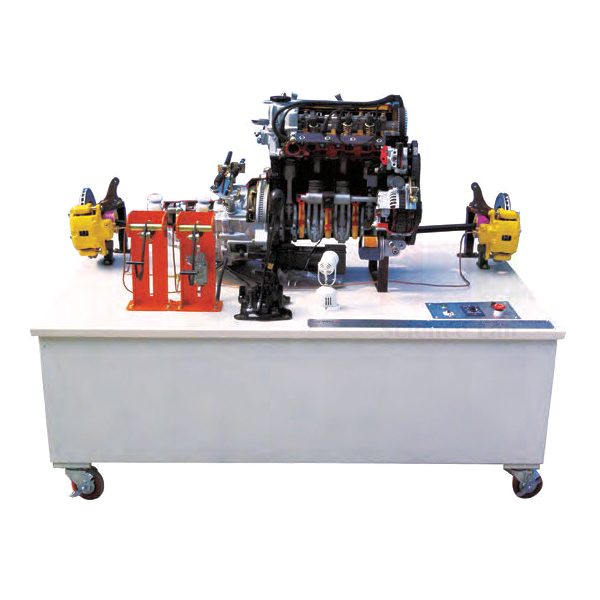
Automotive Power Train Training Equipment SOHC Gasoline
Automotive Power Train Training Equipment SOHC Gasoline (Product Code: SLE/ATE/02) is a cut-open engine and transmission rig used to demonstrate an SOHC four-cylinder gasoline power train, from camshaft to drive shaft, in automobile workshops. As TVET lab equipment for engine and brake servicing courses, it offers a simpler single-camshaft valve train and a compact 1,200 × 1,000 × 1,200 mm frame on wheels with brake lock. Its training stand and controls are built by Jain Scientific Equipments Pvt Ltd (ScienceLab), an OEM manufacturer, at its own factory in Ambala, India, around SOHC engine and transmission assemblies that are sourced production units, not made in Ambala.
Specifications
| Parameter | Detail |
|---|---|
| Engine | SOHC engine assembly, 4 cylinders |
| Engine class represented | 1,800~2,000cc gasoline |
| Transmission | FF-type manual, 5-speed forward and 1-speed reverse |
| Further composition | Clutch, brake system, AC 220 V / 180 W motor, engine speed controller, emergency switch, safety fuse, light |
| Frame | Steel frame with heat-treatment painting |
| Mobility | 4 wheels with brake lock |
| Finish | Incised sections painted in different colours; brake structure and engine parts painted specifically |
| Weight | Approx. 250 kg |
| Size | Approx. 1,200 × 1,000 × 1,200 mm |
| Engine / assembly | Sourced production unit (as listed) |
| Product code | SLE/ATE/02 |
| Manufacturer | Jain Scientific Equipments Pvt Ltd (ScienceLab) — OEM |
| Country of origin | India (trainer built in Ambala, Haryana) |
Practical exercises the unit supports:
- Brake oil change and bleeding of air from the lines
- Detaching and re-attaching the cylinder head
- Timing belt and auxiliary belt replacement, and belt tension control
- Brake disc and pad renewal
- Detaching and re-attaching the generator and starter motor
What Is the SOHC Power Train Trainer Used For?
In a single overhead camshaft engine, one camshaft in the cylinder head operates both the intake and exhaust valves, which gives students a simpler valve train to trace before they meet twin-cam designs. With the motor running slowly under the speed controller, the class can follow the camshaft, pistons and crankshaft through the cut sections, then shift through the gears as on a real car and watch the drive shaft turn the wheels.
Because the rig stands on lockable wheels, it can be rolled into a teaching bay for theory and then locked in position for service practice. Automobile engineering diploma programmes can schedule the brake bleeding and disc-and-pad exercises back to back, since both work on the same brake system fitted to the rig.
OEM Manufacturer
ScienceLab is the OEM (original equipment manufacturer) of the training stand and control system of the SOHC power train trainer, which are made at the company's own licensed factory at Saha, Ambala, Haryana, India, rather than bought in from a trader. The SOHC engine and manual transmission assemblies it carries are sourced production units and are not made in Ambala. Engineering colleges, polytechnics, TVET centres, dealers and importers receive quotations for the complete trainer straight from ScienceLab, and spares or repeat orders are handled by the same team — just ask us.
ScienceLab is the trading name of Jain Scientific Equipments Private Limited (CIN U29309HR2020PTC087597), which builds the trainer's stand at its licensed factory at 449, HSIIDC Industrial Area, Saha, Ambala (Factory Licence AMB-ONLINE-CHD-J-414). More background is on the company profile.
Related Automotive Training Equipment
Units that pair well with this trainer in an automobile lab:
- Automotive Power Train Training Equipment DOHC Gasoline — the twin-camshaft version for side-by-side valve-train comparison
- Clutch Structure Trainer Mechanical Manual — a bench-size unit for studying clutch engagement by hand
- Differential Gear — continues the power path from gearbox to wheels
- Engine management system (MPI) — covers petrol fuel injection, which the mechanical trainer does not
Explore the Automotive Training Equipment category for the full range.
Frequently Asked Questions
How is the SOHC gasoline power train trainer different from the DOHC trainer?
The Automotive Power Train Training Equipment SOHC Gasoline uses a single overhead camshaft four-cylinder engine and a more compact frame of about 1,200 × 1,000 × 1,200 mm. Institutes that teach both valve-train designs can compare it with the DOHC version.
Can the SOHC power train trainer be fixed in place during practicals?
Yes. The SOHC gasoline power train trainer stands on 4 wheels with brake lock, so the roughly 250 kg rig can be rolled into a teaching bay and then held securely while students work on the brakes, belts and cylinder head.
What gearbox does the SOHC gasoline power train trainer have?
The SOHC gasoline power train trainer has an FF-type manual transmission with 5 forward speeds and 1 reverse. Gears are changed just as on a real vehicle, and the drive shaft shows the resulting wheel movement.
What electrical supply does the SOHC power train trainer require?
The SOHC gasoline power train trainer needs a 220 V AC supply for its 180 W drive motor and engine speed controller. A safety fuse and an emergency switch are built in, together with a light.
Who manufactures the Automotive Power Train Training Equipment SOHC Gasoline?
ScienceLab, the trading name of Jain Scientific Equipments Private Limited, is the OEM that builds the training stand and controls of the Automotive Power Train Training Equipment SOHC Gasoline at its own licensed factory at Saha, Ambala, Haryana, India. The SOHC engine and transmission assemblies mounted on it are sourced production units, not made in Ambala.
Is a calibration certificate relevant for the SOHC power train trainer?
No measuring instruments are listed on the SOHC gasoline power train trainer, so calibration does not normally apply. If your tender asks for any certificate, discuss the requirement with us through the contact page before ordering so we can confirm what is possible.
How is the SOHC gasoline power train trainer delivered?
At approximately 250 kg, the SOHC gasoline power train trainer is shipped as freight. Share your site address, access route and unloading arrangements so packing and delivery can be planned for destinations within India or for export.
Request a Quote
Request a quotation for the SOHC gasoline power train trainer through our contact page, or add it to the enquiry cart with other automobile lab items. The quotation comes direct from the manufacturer.
Last updated: 24 September 2026
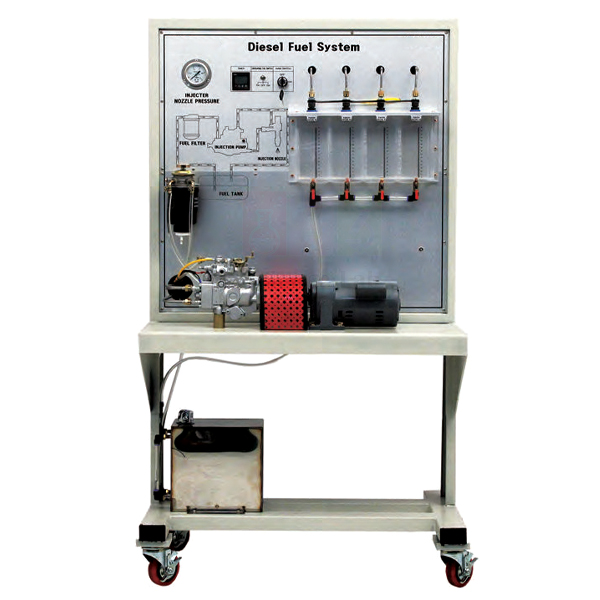
Diesel Fuel Injection System VE pump
Diesel Fuel Injection System VE pump (Product Code: SLE/ATE/03) is a motor-driven training bench used to measure fuel injection against pump RPM and explain the diesel fuel system in automobile engineering laboratories. A single-phase ½ HP motor turns the VE injection pump, with a timer for timed test runs, making it practical engineering educational equipment in India for diesel mechanic and polytechnic courses. It is made by Jain Scientific Equipments Pvt Ltd (ScienceLab), an OEM manufacturer, at its own factory in Ambala, India.
Specifications
| Parameter | Detail |
|---|---|
| Injection pump | VE pump |
| Drive | Single-phase ½ HP motor |
| Timing | Timer |
| Function | Pump operated by the motor; fuel injection measured in accordance with RPM |
| Weight | Approx. 100 kg |
| Size | Approx. 600 × 400 × 1,200 mm |
| Product code | SLE/ATE/03 |
| Manufacturer | Jain Scientific Equipments Pvt Ltd (ScienceLab) — OEM |
| Country of origin | India (made in Ambala, Haryana) |
Training contents:
- Checking the condition of the injection pump
- Operating the single-phase ½ HP drive motor
- Oil flow measurement
- Measuring injection according to RPM
- Checking injector condition
- Study of VE pump injection
What Is the VE Pump Diesel Injection Trainer Used For?
A VE pump is a distributor-type rotary injection pump, in which a single pumping element meters and delivers fuel to every cylinder in turn. On this bench the motor spins the pump at a chosen speed while the timer marks the length of each test run, so a group can record how much fuel is delivered at different RPM and plot the relationship. The same session can include oil flow measurement and a check of injector condition, giving learners a complete picture of how the pump and injectors work together.
The bench bridges theory lectures on diesel combustion and hands-on fuel system servicing. Keep the work area well ventilated, wipe up any spilt test fluid immediately, and switch off the motor before touching pump connections.
OEM Manufacturer
Jain Scientific Equipments Private Limited, which trades as ScienceLab, is the OEM (original equipment manufacturer) of the Diesel Fuel Injection System VE pump bench. The bench is made and assembled at the company’s own licensed factory at Saha, Ambala, Haryana, India, and supplied factory-direct to training institutes, colleges, dealers and importers. Quotations come straight from the manufacturer, and you can ask us about spare parts or repeat orders at any time. Learn more on our company profile.
Related Automotive Training Equipment
Other diesel fuel system trainers used in the same module:
- Diesel Fuel Injection System Inline Pump — the inline pump design, for comparing the two pump layouts
- CRDI (Common Rail Direct Injector) System — a sectioned CRDI fuel pump and injector nozzle for modern common-rail lessons
- Diesel Engine Fault Diagnosis Training Equipment Auto Fault — a running diesel engine for diagnosing faults in a complete system
- CRDI Diesel Engine Stand, Motor Type — a cutaway CRDI diesel engine showing where the fuel system fits
See every trainer in the Automotive Training Equipment category.
Frequently Asked Questions
What can students measure on the Diesel Fuel Injection System VE pump?
On the Diesel Fuel Injection System VE pump bench, students measure fuel injection in relation to pump RPM, carry out oil flow measurement, and check the condition of both the injection pump and the injectors as part of a VE pump injection study.
How is the pump on the Diesel Fuel Injection System VE pump driven?
The VE injection pump on the Diesel Fuel Injection System VE pump trainer is driven by a single-phase ½ HP electric motor, so the bench runs from a single-phase supply rather than needing a running diesel engine.
What is the timer on the VE pump diesel injection trainer used for?
The timer on the Diesel Fuel Injection System VE pump bench lets each test run last a set time, so fuel delivered at different RPM can be collected and compared on an equal basis.
Which test fluid should be used in the Diesel Fuel Injection System VE pump?
The recommended test fluid and filling details for the Diesel Fuel Injection System VE pump are confirmed with the supply rather than listed here. Ask us through the contact page if you need them before installation or for your lab safety file.
How much space does the Diesel Fuel Injection System VE pump take up?
The Diesel Fuel Injection System VE pump bench occupies approximately 600 × 400 × 1,200 mm and weighs about 100 kg. Allow working clearance around it for a small group, plus a single-phase power point for the motor.
Who manufactures the Diesel Fuel Injection System VE pump trainer?
The Diesel Fuel Injection System VE pump trainer is manufactured by Jain Scientific Equipments Private Limited (ScienceLab) as the OEM, at its own licensed factory at Saha, Ambala, Haryana, India. Warranty terms, spare parts and repeat orders are arranged directly with the manufacturer through the quotation.
Do you supply the Diesel Fuel Injection System VE pump to training institutes abroad?
Yes. The Diesel Fuel Injection System VE pump is supplied to training institutes, colleges and distributors in India and international markets. Include your destination, quantity and product code SLE/ATE/03 in the enquiry to receive a quotation.
Request a Quote
Get a quotation for the Diesel Fuel Injection System VE pump from our contact page, or add it to the enquiry cart with the rest of your diesel lab equipment. Quotes are issued direct by the manufacturer.
Last updated: 24 September 2026
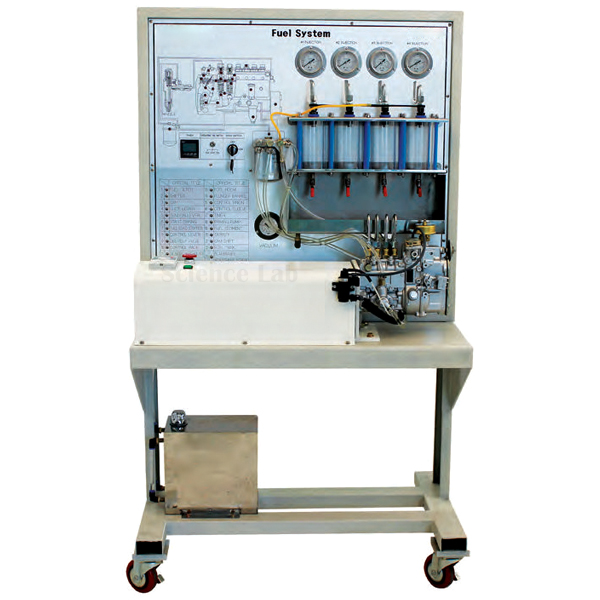
Diesel Fuel Injection System Inline Pump
Diesel Fuel Injection System Inline Pump (Product Code: SLE/ATE/04) is an inverter-controlled training bench used to run an inline diesel injection pump and measure injection according to RPM in automobile and diesel mechanic workshops. Four fuel pressure gauges and a timer let learners compare pressure, delivery and injection patterns at different speeds — practical technical educational equipment for polytechnic and vocational courses. It is made by Jain Scientific Equipments Pvt Ltd (ScienceLab), an OEM manufacturer, at its own factory in Ambala, India.
Specifications
| Parameter | Detail |
|---|---|
| Pump type | Inline injection pump |
| Drive motor | Single-phase ½ HP |
| Speed control | Inverter |
| Instrumentation | 4 fuel pressure gauges, timer |
| Operation | Pump operated by the motor; fuel injection measured in accordance with RPM |
| Weight | Approx. 100 kg |
| Size | Approx. 600 × 400 × 1,200 mm |
| Product code | SLE/ATE/04 |
| Manufacturer | Jain Scientific Equipments Pvt Ltd (ScienceLab) — OEM |
| Country of origin | India (made in Ambala, Haryana) |
Training contents:
- Checking injection pump status
- Operating the single-phase ½ HP motor
- Measuring injection according to RPM
- Checking injector status
- Measuring fuel flux and injection patterns
- General fuel injection training
What Is the Inline Pump Diesel Injection Trainer Used For?
In an inline pump, a separate pumping element for each cylinder sits in a row inside one housing and is driven by the pump’s own camshaft. On this bench the instructor sets a speed with the inverter, runs the pump for a timed interval and has students read the four pressure gauges while they collect and compare the delivered fuel. Repeating the run at several speeds shows clearly how delivery and pressure change with RPM, and watching the injection pattern helps learners recognise a healthy spray from a faulty one.
The bench works well straight after a VE pump exercise, so that learners can compare an inline design with a distributor pump. Before each session check the fuel lines and gauge connections for leaks, and isolate the motor supply before any adjustment.
OEM Manufacturer
As the OEM (original equipment manufacturer), ScienceLab — the trading name of Jain Scientific Equipments Private Limited — builds the Diesel Fuel Injection System Inline Pump bench at its own licensed factory at Saha, Ambala, Haryana, India. Because the bench is made and assembled by the manufacturer rather than sourced through a trader, training institutes, dealers and importers get quotations, spare-part answers and repeat supply from one source; just ask us. Background is on the company profile.
Related Automotive Training Equipment
Trainers that complete a diesel fuel system course:
- Diesel Fuel Injection System VE pump — a distributor-type pump bench for comparison with the inline design
- CRDI (Common Rail Direct Injector) System — introduces common-rail injection with a sectioned pump and nozzle
- CRDI Diesel Engine SANTAFE D Engine, Stand — a sectioned diesel engine on a stand to show the complete engine
- Diesel Engine Fault Diagnosis Training Equipment Auto Fault — moves students on to diagnosing a running diesel engine
Browse the Automotive Training Equipment category for more.
Frequently Asked Questions
How does the Inline Pump trainer differ from the VE pump bench?
The Diesel Fuel Injection System Inline Pump uses an inline pump with one pumping element per cylinder arranged in a row, whereas a VE pump meters all cylinders from a single distributor element. Having both benches lets students compare the two designs.
How is pump speed controlled on the Diesel Fuel Injection System Inline Pump?
Pump speed on the Diesel Fuel Injection System Inline Pump is set by an inverter that varies the speed of the single-phase ½ HP drive motor, so the instructor can repeat measurements at several RPM settings in one session.
What are the four pressure gauges on the Inline Pump trainer for?
The four fuel pressure gauges on the Diesel Fuel Injection System Inline Pump display fuel pressure during each run, so students can relate the readings to pump speed, delivered quantity and injection behaviour.
Can injection patterns be observed on the Diesel Fuel Injection System Inline Pump?
Yes. Measuring fuel flux and injection patterns is part of the listed training contents of the Diesel Fuel Injection System Inline Pump, alongside checking pump and injector status and measuring injection according to RPM.
Who manufactures the Diesel Fuel Injection System Inline Pump trainer?
Jain Scientific Equipments Private Limited, trading as ScienceLab, manufactures the Diesel Fuel Injection System Inline Pump trainer as its OEM at the company’s own licensed factory at Saha, Ambala, Haryana, India, and supplies it factory-direct to institutes, dealers and importers.
Is a calibration certificate available for the gauges on the Inline Pump trainer?
Calibration certificate availability for the pressure gauges on the Diesel Fuel Injection System Inline Pump should be discussed with us before you place the order. Use the contact page and we will confirm what documentation can be provided.
What should we prepare to install the Diesel Fuel Injection System Inline Pump?
To install the Diesel Fuel Injection System Inline Pump, prepare a floor area of about 600 × 400 mm plus working clearance, a single-phase power point, and handling for a bench of roughly 100 kg and approximately 1,200 mm height.
Request a Quote
Ask for pricing on the Diesel Fuel Injection System Inline Pump via our contact page, or add it to the enquiry cart. Quotations come direct from the manufacturer, for delivery across India and to international markets.
Last updated: 24 September 2026
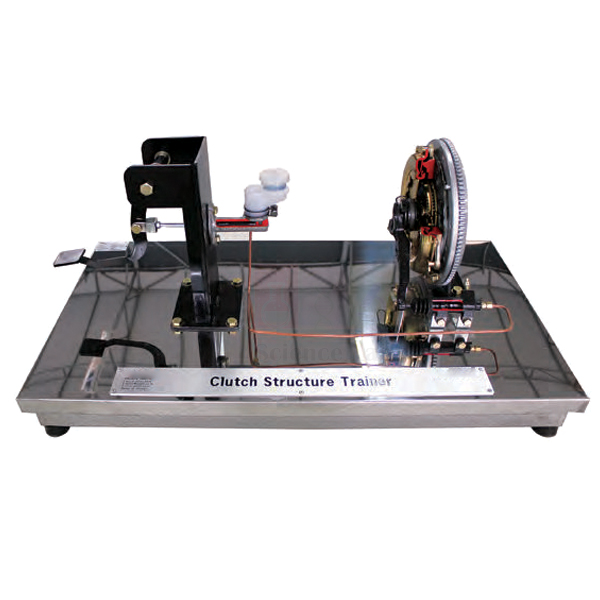
Clutch Structure Trainer Hydraulics
Clutch Structure Trainer Hydraulics (Product Code: SLE/ATE/05) is a compact sectioned teaching unit used to explain how the hydraulic clutch inside a manual-transmission vehicle works, in automobile engineering classrooms and workshops. Built from a clutch pressing board, clutch pedal and clutch cylinder with colour-coded cut sections, the unit of approximately 20 kg is bench-top engineering lab equipment for ITIs and colleges. It is made by Jain Scientific Equipments Pvt Ltd (ScienceLab), an OEM manufacturer, at its own factory in Ambala, India.
Specifications
| Parameter | Detail |
|---|---|
| Type | Education unit of hydraulic clutch structure inside manual transmission |
| Composition | Clutch pressing board, clutch pedal, clutch cylinder |
| Sectioning | Each incised section painted in a different colour |
| Finish | Vehicle paint used for painting and coating |
| Weight | Approx. 20 kg |
| Size | Approx. 400 × 300 × 300 mm |
| Product code | SLE/ATE/05 |
| Manufacturer | Jain Scientific Equipments Pvt Ltd (ScienceLab) — OEM |
| Country of origin | India (made in Ambala, Haryana) |
What Is the Hydraulic Clutch Cutaway Trainer Used For?
A hydraulic clutch replaces the cable of a mechanical system with fluid pressure: pressing the pedal pushes fluid through the clutch cylinder system, and that pressure acts to lift the clamping force of the pressing board so the engine and gearbox separate. With the cut sections colour-coded, students can point to each component as the instructor presses the pedal, making the operating principle much easier to grasp than from diagrams alone.
At roughly 20 kg and 400 × 300 × 300 mm, the unit can be placed on a normal classroom table and passed between groups, so it is a practical choice for TVET and automobile diploma labs that need several teaching stations. Wipe the painted surfaces with a dry cloth after handling to keep the colour coding clear.
OEM Manufacturer
The Clutch Structure Trainer Hydraulics is built by its OEM (original equipment manufacturer), Jain Scientific Equipments Private Limited, which trades as ScienceLab. Each unit is made and assembled at the company’s own licensed factory at Saha, Ambala, Haryana, India, and supplied factory-direct to ITIs, colleges, dealers and importers who need several teaching stations. For repeat orders or replacement parts, ask us — the manufacturer handles them itself. Visit the company profile for details.
Related Automotive Training Equipment
Other units for a clutch and transmission module:
- Clutch Structure Trainer Hydraulic Manual — a larger hydraulic clutch unit including a flywheel for fuller assembly study
- Clutch Structure Trainer Mechanical Manual — the mechanical counterpart for comparing actuation methods
- Automotive Power Train Training Equipment DOHC Gasoline — shows the clutch working within a complete engine and gearbox
- FF Auto Transmission Stand Type — a torque-converter automatic for contrasting with a friction clutch
Find more in the Automotive Training Equipment category.
Frequently Asked Questions
Which parts are included in the Clutch Structure Trainer Hydraulics?
The Clutch Structure Trainer Hydraulics consists of a clutch pressing board, a clutch pedal and a clutch cylinder, mounted as one sectioned teaching unit with each incised section painted in a different colour for easy identification.
Is the Clutch Structure Trainer Hydraulics filled with hydraulic fluid?
Whether the Clutch Structure Trainer Hydraulics is supplied filled or as a dry sectioned model is not stated in the current listing. Confirm this through the contact page if your lesson plan needs working fluid in the clutch cylinder.
How does the Clutch Structure Trainer Hydraulics compare with the Hydraulic Manual trainer?
The Clutch Structure Trainer Hydraulics is the more compact bench model, about 400 × 300 × 300 mm and 20 kg, focused on the pedal, cylinder and pressing board. For a larger assembly with a flywheel, see the Clutch Structure Trainer Hydraulic Manual.
How durable is the finish of the Clutch Structure Trainer Hydraulics?
The Clutch Structure Trainer Hydraulics is painted and coated with vehicle paint, which suits regular classroom handling. Wipe the surfaces with a dry cloth after lessons to keep the colour-coded sections clear and easy to identify.
Who manufactures the Clutch Structure Trainer Hydraulics?
The Clutch Structure Trainer Hydraulics is manufactured by Jain Scientific Equipments Private Limited (ScienceLab) as the OEM, at its own licensed factory at Saha, Ambala, Haryana, India. Institutes buying several units for group work order directly from the manufacturer.
What warranty is given with the Clutch Structure Trainer Hydraulics?
Warranty terms for the Clutch Structure Trainer Hydraulics are set out in the quotation rather than on this page. Request them when you enquire through the contact page, quoting product code SLE/ATE/05.
Can several Clutch Structure Trainer Hydraulics units be supplied for group work?
Yes. Several Clutch Structure Trainer Hydraulics units can be quoted together for parallel teaching stations, and bulk and export orders are supplied to institutions and distributors in India and international markets.
Request a Quote
For a price on the Clutch Structure Trainer Hydraulics, message us through the contact page or add it to the enquiry cart. You will receive the quotation direct from the manufacturer.
Last updated: 24 September 2026
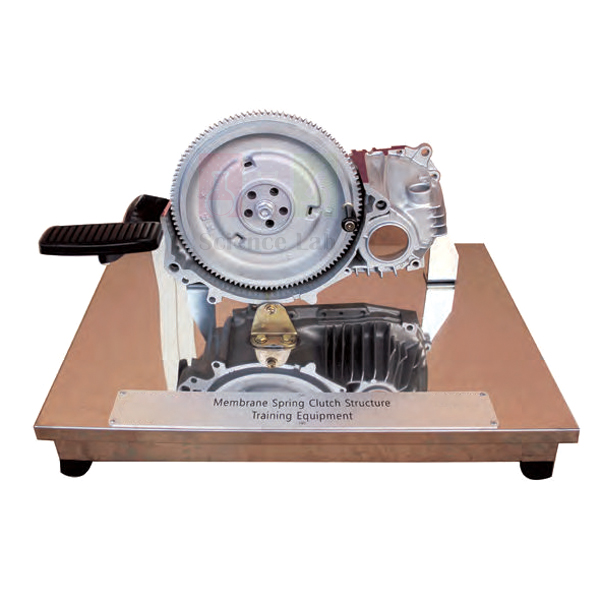
Clutch Structure Trainer Mechanical Manual
Clutch Structure Trainer Mechanical Manual (Product Code: SLE/ATE/06) is a hand-operated, sectioned education unit used to teach the operating principle of a mechanical clutch in motor vehicle and automobile engineering training. Learners work the pedal themselves and watch the real movement through colour-painted cut sections, making it hands-on technical educational equipment for vocational workshops. It is made by Jain Scientific Equipments Pvt Ltd (ScienceLab), an OEM manufacturer, at its own factory in Ambala, India.
Specifications
| Parameter | Detail |
|---|---|
| Type | Education unit of mechanical clutch structure |
| Operation | Manual — real movement operated directly by hand |
| Composition (as listed) | Clutch pressing board, clutch pedal, clutch cylinder |
| Sectioning | Each incised section painted in a different colour |
| Weight | Approx. 20 kg |
| Size | Approx. 400 × 300 × 300 mm |
| Product code | SLE/ATE/06 |
| Manufacturer | Jain Scientific Equipments Pvt Ltd (ScienceLab) — OEM |
| Country of origin | India (made in Ambala, Haryana) |
What Is the Mechanical Clutch Trainer Used For?
In a mechanical clutch, pedal travel reaches the release mechanism through mechanical linkage rather than fluid pressure. Because this trainer is worked directly by hand, each student can press the pedal slowly, stop at any point and see how far the pressing board moves away before the drive is fully disengaged. That tactile, stop-and-look approach helps learners understand free play, engagement point and full release — ideas they later need when adjusting a clutch on a real vehicle.
Many workshops set it beside a hydraulic clutch trainer so the class can compare both actuation methods in one session. For a vocational training lab, its small footprint means it can be stored on a shelf and brought out only when the clutch module is taught.
OEM Manufacturer
Jain Scientific Equipments Private Limited, better known by its trade name ScienceLab, is the OEM (original equipment manufacturer) of the Clutch Structure Trainer Mechanical Manual. The trainer is made and assembled at the company’s own licensed factory at Saha, Ambala, Haryana, India, so colleges, training institutes, dealers and importers buy it directly from the people who build it. Ask us for a factory-direct quotation, repeat units or replacement parts. Our company profile has more.
Related Automotive Training Equipment
Trainers commonly paired with a mechanical clutch unit:
- Clutch Structure Trainer Hydraulics — the hydraulic equivalent for a direct comparison of actuation
- Clutch Structure Trainer Hydraulic Manual — a hand-operated hydraulic unit that adds a flywheel to the demonstration
- Automotive Power Train Training Equipment SOHC Gasoline — places the clutch between an engine model and gearbox
- Differential Gear — the next stage of the drive line after the clutch and gearbox
See all units in the Automotive Training Equipment category.
Frequently Asked Questions
Can students operate the Clutch Structure Trainer Mechanical Manual themselves?
Yes. The Clutch Structure Trainer Mechanical Manual is designed so the real movement is operated directly by hand, letting each learner press the pedal, pause at any point and see how the clutch engages and releases.
Does the Clutch Structure Trainer Mechanical Manual need an electrical supply?
No power supply is listed for the Clutch Structure Trainer Mechanical Manual; it is worked manually by hand. That means it can be used on any classroom table or workshop bench without a socket nearby.
What components does the Clutch Structure Trainer Mechanical Manual contain?
The listing gives the composition of the Clutch Structure Trainer Mechanical Manual as a clutch pressing board, clutch pedal and clutch cylinder. If you need a detailed parts list for a tender, request it through the contact page.
Should we buy the mechanical or the hydraulic clutch trainer?
Choose the Clutch Structure Trainer Mechanical Manual if your syllabus covers linkage-operated clutches; syllabi covering both clutch types benefit from pairing it with a hydraulic trainer. If only one type is taught, pick the one used on the vehicles your learners will service.
How big and heavy is the Clutch Structure Trainer Mechanical Manual?
The Clutch Structure Trainer Mechanical Manual measures approximately 400 × 300 × 300 mm and weighs about 20 kg, so two people can move it easily between the store and the teaching bench.
Who manufactures the Clutch Structure Trainer Mechanical Manual?
ScienceLab, the trading name of Jain Scientific Equipments Private Limited, manufactures the Clutch Structure Trainer Mechanical Manual as the OEM at its own licensed factory at Saha, Ambala, Haryana, India. Quotations and repeat orders come directly from the manufacturer.
What should a quotation request for the Clutch Structure Trainer Mechanical Manual include?
A quotation request for the Clutch Structure Trainer Mechanical Manual should include product code SLE/ATE/06, the quantity, the delivery location, and whether you are also ordering hydraulic clutch trainers, so everything can be quoted and packed together.
Request a Quote
Send an enquiry for the Clutch Structure Trainer Mechanical Manual through our contact page, or add it to the enquiry cart. Quotes come direct from the manufacturer for buyers in India and international markets.
Last updated: 24 September 2026
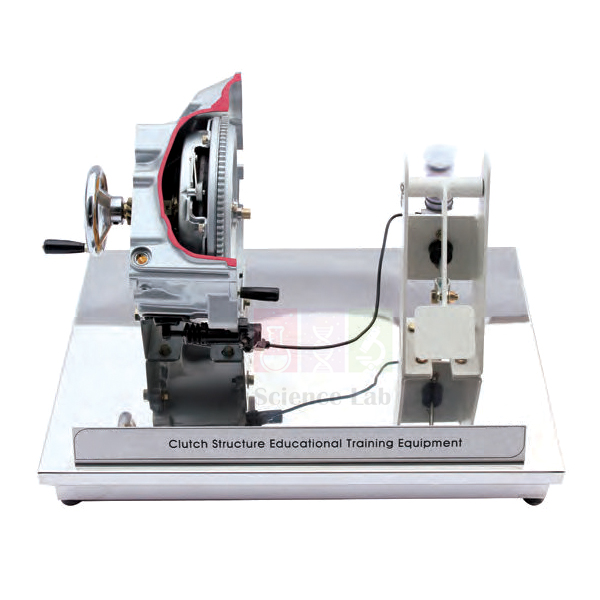
Clutch Structure Trainer Hydraulic Manual
Clutch Structure Trainer Hydraulic Manual (Product Code: SLE/ATE/07) is a hand-operated education unit used to show the hydraulic clutch of a manual-transmission vehicle, laid out from pedal to flywheel, as TVET lab equipment for automobile and ITI workshops. Its fly wheel, clutch pressure board, clutch pedal, master cylinder and operating cylinder are cut open in contrasting colours, so students follow the release sequence as they move the pedal. It is made by Jain Scientific Equipments Pvt Ltd (ScienceLab), an OEM manufacturer, at its own factory in Ambala, India.
Specifications
| Parameter | Detail |
|---|---|
| Type | Education unit of hydraulic clutch structure in manual transmission |
| Composition | Fly wheel, clutch pressure board, clutch pedal, operating cylinder, clutch master cylinder |
| Operation | Real movement operated directly by hand |
| Sectioning | Each incised section painted in a different colour |
| Weight | Approx. 25 kg |
| Size | Approx. 600 × 400 × 400 mm |
| Product code | SLE/ATE/07 |
| Manufacturer | Jain Scientific Equipments Pvt Ltd (ScienceLab) — OEM |
| Country of origin | India (made in Ambala, Haryana) |
What Is the Hydraulic Clutch Trainer with Flywheel Used For?
The lesson normally begins at the pedal: pressing it moves the piston in the clutch master cylinder, the resulting fluid pressure travels to the operating cylinder, and that cylinder acts on the release side of the clutch pressure board so it stops clamping against the fly wheel. With the flywheel included, learners can see exactly which surfaces are pressed together when the clutch is engaged and how they separate on release — the root of topics such as clutch slip and wear.
Instructors often ask students to trace the sequence with the pedal held at different positions, then relate what they saw to bleeding and adjusting a hydraulic clutch on a vehicle. The 600 × 400 × 400 mm unit sits comfortably on a workshop bench for small-group teaching.
OEM Manufacturer
Jain Scientific Equipments Private Limited, trading as ScienceLab, is the OEM (original equipment manufacturer) of the Clutch Structure Trainer Hydraulic Manual and makes it at its own licensed factory at Saha, Ambala, Haryana, India. Automobile colleges, ITIs, dealers and importers therefore buy factory-direct, with repeat orders and replacement parts handled by the manufacturer — ask us for either.
Purchase departments completing supplier forms can use the company’s GST registration, GSTIN 06AAECJ8618A1ZT, and its global Legal Entity Identifier, LEI 3358004HRD1JIVXKYX49. Further background is on the company profile.
Related Automotive Training Equipment
Complementary trainers for the drive-line syllabus:
- Clutch Structure Trainer Hydraulics — a smaller hydraulic clutch unit for additional group stations
- Clutch Structure Trainer Mechanical Manual — lets learners contrast linkage-operated and fluid-operated release
- CRDI Diesel Engine Power Train System F/R Type — a diesel manual-transmission power train showing the clutch in context
- Differential Gear — follows the torque on from gearbox to axle
The full range is in the Automotive Training Equipment category.
Frequently Asked Questions
Which hydraulic components are on the Clutch Structure Trainer Hydraulic Manual?
The Clutch Structure Trainer Hydraulic Manual carries a clutch master cylinder and an operating cylinder, together with the clutch pedal, clutch pressure board and fly wheel, so the whole path from pedal effort to clutch release can be traced.
Why does the Clutch Structure Trainer Hydraulic Manual include a flywheel?
The flywheel on the Clutch Structure Trainer Hydraulic Manual is the surface the clutch clamps against, so including it shows the full engagement and release action rather than only the hydraulic actuation side of the clutch.
Is the Clutch Structure Trainer Hydraulic Manual operated by hand or by motor?
The Clutch Structure Trainer Hydraulic Manual is operated by hand: the real movement is worked directly through the pedal, and no drive motor is listed, so no electrical supply is listed for it either.
What space and handling does the Clutch Structure Trainer Hydraulic Manual need?
The Clutch Structure Trainer Hydraulic Manual needs about 600 × 400 × 400 mm of bench space and, at roughly 25 kg, is best lifted by two people when moving it between the store and the workshop.
Who manufactures the Clutch Structure Trainer Hydraulic Manual?
The Clutch Structure Trainer Hydraulic Manual is manufactured by Jain Scientific Equipments Private Limited (ScienceLab) as the OEM, at its own licensed factory at Saha, Ambala, Haryana, India. Quotations, repeat orders and replacement parts are handled by the manufacturer directly.
What after-sales support comes with the Clutch Structure Trainer Hydraulic Manual?
Warranty and support terms for the Clutch Structure Trainer Hydraulic Manual are confirmed in the quotation rather than published here. Ask for them when you send your enquiry through the contact page, quoting product code SLE/ATE/07.
Do you ship the Clutch Structure Trainer Hydraulic Manual outside India?
Yes. The Clutch Structure Trainer Hydraulic Manual is supplied to institutions, dealers and importers in India and international markets. Share the destination and quantity so packing and delivery can be included in the manufacturer’s quotation.
Request a Quote
To receive a quotation for the Clutch Structure Trainer Hydraulic Manual, write to us via the contact page or add it to the enquiry cart with any other automotive trainers you need. The quotation comes direct from the manufacturer.
Last updated: 24 September 2026
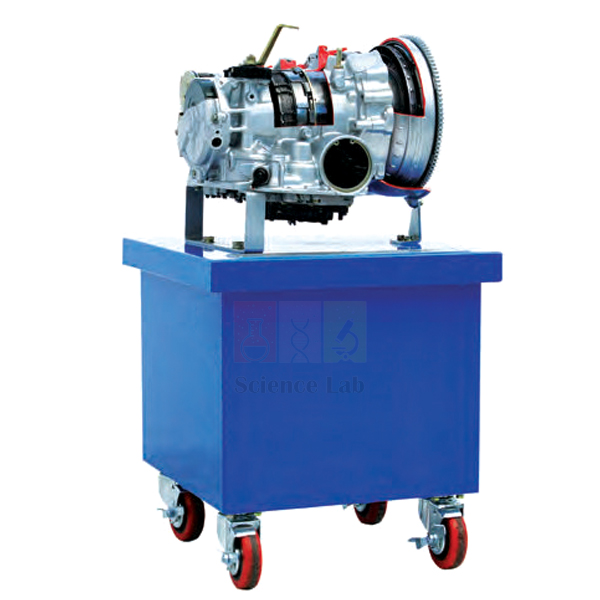
FF Auto Transmission Stand Type
FF Auto Transmission Stand Type (Product Code: SLE/ATE/08) is a sectioned FF automatic transmission and torque converter on a mobile steel stand, used to teach automatic gearbox structure in automobile engineering courses. With 4 forward speeds and 1 reverse, a cut-open torque converter and 4-inch urethane castor wheels, the unit of approximately 60 kg is engineering lab equipment in India that one institute can share between classrooms. It is made by Jain Scientific Equipments Pvt Ltd (ScienceLab), an OEM manufacturer, at its own factory in Ambala, India.
Specifications
| Parameter | Detail |
|---|---|
| Composition | FF automatic transmission, torque converter |
| Gears | 4-speed forward, 1-speed reverse |
| Torque converter | Incised (cut open) for structure education |
| Stand | Steel stand, 4 wheel caster with 4-inch urethane wheels for easy moving |
| Finish | Vehicle paint for painting and coating; each incised section painted a different colour |
| Weight | Approx. 60 kg |
| Size | Approx. 800 × 600 × 1,000 mm |
| Product code | SLE/ATE/08 |
| Manufacturer | Jain Scientific Equipments Pvt Ltd (ScienceLab) — OEM |
| Country of origin | India (made in Ambala, Haryana) |
What Is the FF Automatic Transmission Stand Used For?
The cut-open torque converter is usually the first stop: students identify the impeller driven by the engine, the turbine that drives the gearbox and the stator between them, and learn how this fluid coupling lets the car stand still in gear and multiplies torque when pulling away. The lesson then moves into the gear train, where the colour coding helps separate the parts that give the four forward ratios and reverse.
Because the unit sits on its own steel stand with urethane castors, it can be wheeled from store to classroom without lifting. That mobility suits institutes that share one automatic transmission trainer between several classes or buildings.
OEM Manufacturer
ScienceLab is the brand of Jain Scientific Equipments Private Limited, the OEM (original equipment manufacturer) of the FF Auto Transmission Stand Type. The stand is made and assembled at the company’s own licensed factory at Saha, Ambala, Haryana, India, and reaches engineering colleges, polytechnics, dealers and importers factory-direct rather than through a trader. Replacement castors, other parts and repeat orders can be requested from the manufacturer itself — ask us. See the company profile for more.
Related Automotive Training Equipment
Trainers that build on an automatic transmission lesson:
- FF Auto Transmission 6 Steps — a front-wheel 6-step automatic to set beside this 4-speed unit
- CRDI Diesel Engine Power Train System Automatic Transmission — shows an automatic gearbox working within a complete diesel power train
- Differential Gear — explains how torque leaving the transmission is divided between the wheels
- Clutch Structure Trainer Hydraulics — a friction clutch unit to contrast with the torque converter
Explore the Automotive Training Equipment category for other drive-line trainers.
Frequently Asked Questions
How many gears does the FF Auto Transmission Stand Type have?
The FF Auto Transmission Stand Type has an FF automatic transmission with four forward speeds and one reverse, sectioned so students can trace the parts that produce each ratio alongside the incised torque converter.
What does FF mean on the FF Auto Transmission Stand Type?
FF on the FF Auto Transmission Stand Type refers to the front-engine, front-wheel-drive vehicle layout for which this automatic transmission and torque converter are designed, the arrangement found on many passenger cars.
Can the inside of the torque converter be seen on the FF Auto Transmission Stand Type?
Yes. The torque converter on the FF Auto Transmission Stand Type is incised, so students can see the impeller, turbine and stator and learn how fluid coupling transfers drive before moving on to the gear train.
How easy is the FF Auto Transmission Stand Type to move?
The FF Auto Transmission Stand Type sits on a steel stand with four castors fitted with 4-inch urethane wheels, so the unit of approximately 60 kg can be rolled across a smooth floor between store and classroom rather than carried.
Is the FF Auto Transmission Stand Type motor-driven?
No drive motor is listed for the FF Auto Transmission Stand Type; it is a sectioned structure trainer. If you need a powered demonstration of an automatic gearbox, tell us on the contact page and we will advise on options.
Who manufactures the FF Auto Transmission Stand Type?
The FF Auto Transmission Stand Type is manufactured by Jain Scientific Equipments Private Limited, trading as ScienceLab, as the OEM at its own licensed factory at Saha, Ambala, Haryana, India. Colleges and dealers receive quotations directly from the manufacturer.
What should we include when requesting a quotation for the FF Auto Transmission Stand Type?
A quotation request for the FF Auto Transmission Stand Type should give product code SLE/ATE/08, the number of units, the delivery location, and whether it should be quoted with the 6-step version or other drive-line trainers. Export supply is available.
Request a Quote
Request a price for the FF Auto Transmission Stand Type through our contact page, or add it to the enquiry cart. Quotations come direct from the manufacturer.
Last updated: 24 September 2026
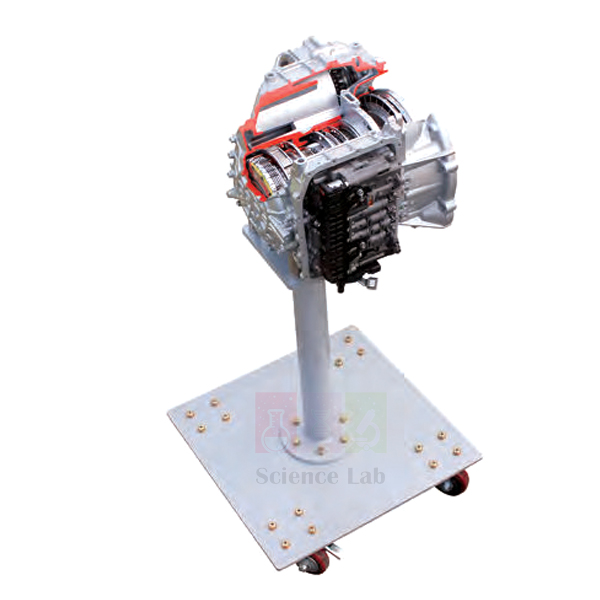
FF Auto Transmission 6 Steps
FF Auto Transmission 6 Steps (Product Code: SLE/ATE/09) is a sectioned training stand used to teach how a front-wheel 6-step automatic transmission and its torque converter transmit engine power, in automobile engineering classrooms and workshops. Its incised torque converter sections are painted in contrasting colours, and the steel stand rolls on 4-inch urethane wheels so it can be turned towards each group. It is made by Jain Scientific Equipments Pvt Ltd (ScienceLab), an OEM manufacturer of engineering lab equipment in India, at its own factory in Ambala.
Specifications
| Parameter | Detail |
|---|---|
| Composition | Front-wheel 6-step automatic transmission, torque converter |
| Torque converter | Incised sections, each painted a different colour for teaching clarity |
| Stand | Steel stand with 4 wheel castors; 4-inch urethane wheels for comfortable moving |
| Finish | Vehicle paint used for painting and coating |
| Weight | Approx. 60 kg |
| Size | Approx. 600 × 600 × 1,100 mm |
| Product code | SLE/ATE/09 |
| Manufacturer | Jain Scientific Equipments Pvt Ltd (ScienceLab) — OEM |
| Country of origin | India (made in Ambala, Haryana) |
What Is the FF 6-Step Automatic Transmission Trainer Used For?
The stand is used to explain what an automatic transmission does and how power travels from the engine, through the torque converter, into a front-wheel-drive gearbox. Instructors usually begin with the colour-coded torque converter, showing how engine torque passes through fluid to the transmission input before any ratio is engaged. They then relate the multi-step gear train to the way a modern automatic keeps the engine in its useful speed range as the vehicle accelerates.
With a footprint of about 600 × 600 mm and urethane castors, the unit moves easily between the lecture room and a crowded workshop aisle. Automobile departments equipping lab equipment for technical institutes can set it beside the stand-type FF automatic so students can compare two transmission designs during power transmission practicals.
OEM Manufacturer
Jain Scientific Equipments Private Limited trades as ScienceLab and is the OEM (original equipment manufacturer) of the FF Auto Transmission 6 Steps. The stand is made and assembled at the company's own licensed factory at Saha, Ambala, Haryana, India, rather than being sourced from a trader.
Engineering colleges, ITIs, dealers and importers buy it factory-direct, and questions about replacement parts or repeat orders go to the manufacturer itself — just ask us. For tender and vendor paperwork, the company's GSTIN is 06AAECJ8618A1ZT and its Legal Entity Identifier is 3358004HRD1JIVXKYX49. Read more on our company profile.
Related Automotive Training Equipment
Useful companions for an automatic transmission module:
- FF Auto Transmission Stand Type — a second FF automatic with incised torque converter for comparison
- Cut Model Of Automatic Transmission System — a cutaway for close study of the internal gear sets
- CRDI Diesel Engine Power Train System Automatic Transmission — shows an automatic gearbox working inside a complete diesel power train
- Differential Gear — completes the power path from transmission output to the wheels
- Clutch Structure Trainer Hydraulic Manual — the manual-transmission clutch that a torque converter replaces
View the rest of the Automotive Training Equipment range.
Frequently Asked Questions
What transmission is fitted to the FF Auto Transmission 6 Steps?
The FF Auto Transmission 6 Steps carries a front-wheel 6-step automatic transmission together with its torque converter. The torque converter is incised, and each cut section is painted a different colour so students can see how fluid coupling links the engine to the gearbox.
Can the gear ratios and drive layout be confirmed before ordering?
Yes. If your syllabus depends on a set number of forward and reverse ratios or a specific drive layout, confirm the configuration of the FF Auto Transmission 6 Steps through our contact page before ordering, and we will check it against the unit being quoted.
How much space does the FF Auto Transmission 6 Steps need?
The FF Auto Transmission 6 Steps measures approximately 600 × 600 × 1,100 mm and weighs about 60 kg. It sits on a steel stand with four castors and 4-inch urethane wheels, so it can be wheeled between the classroom and the workshop on a level floor.
Who manufactures the FF Auto Transmission 6 Steps?
Jain Scientific Equipments Private Limited, trading as ScienceLab, manufactures the FF Auto Transmission 6 Steps as the OEM at its own licensed factory at Saha, Ambala, Haryana, India. Quotations, repeat orders and spare-part questions are handled directly by the manufacturer.
Which registration details can our purchase department use?
For the FF Auto Transmission 6 Steps, the company's GSTIN and Legal Entity Identifier are given in the OEM Manufacturer section above for vendor forms. Any other company documents your purchase department needs can be requested along with the quotation.
Do you supply the FF Auto Transmission 6 Steps outside India?
Yes. The FF Auto Transmission 6 Steps is supplied to engineering colleges, training institutes, dealers and importers across India and in international markets. Share the quantity and delivery destination with your enquiry so the quotation can include packing and freight details.
Request a Quote
Ask for a quotation for the FF Auto Transmission 6 Steps on our contact page, or add it to the enquiry cart with any other transmission trainers you need. Quotations come straight from the manufacturer.
Last updated: 24 September 2026
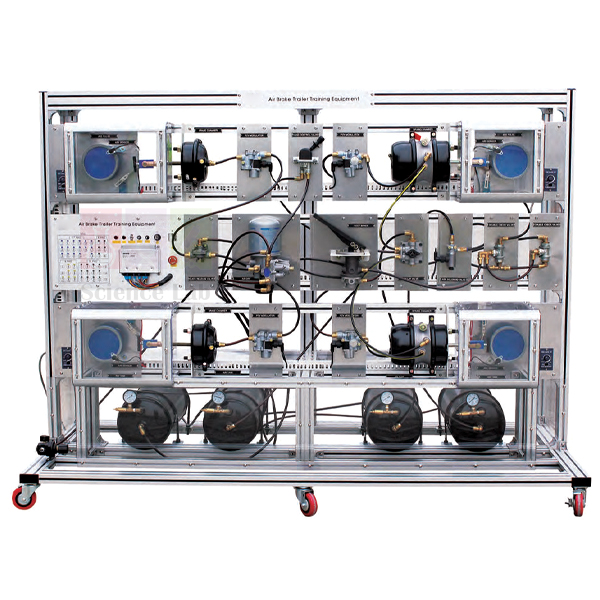
Trailer Air Brake Training Equipment
Trailer Air Brake Training Equipment (Product Code: SLE/ATE/10) is a working heavy-truck air brake and ABS trainer used to teach the operating principle, maintenance and inspection of air brake systems in automotive and heavy-vehicle workshops. Its air tank and brake circuit operate the same as on an actual vehicle, and four speed-controlled 120W motors turn the wheels so ABS behaviour can be watched under rotation. The rig is made by Jain Scientific Equipments Pvt Ltd (ScienceLab), an OEM manufacturer, at its own factory in Ambala, India.
Specifications
| Parameter | Detail |
|---|---|
| Type | Heavy-truck air brake system trainer with ABS, testable with the installed air tank and all air brake parts |
| Driving motors | Single phase 220V, speed control type, 120W — 4 nos |
| Wheel control | Wheel rotation and speed controlled by motor |
| Composition | Air tank, pressure regulator, brake pedal, air pressure gauge, single chamber (2 nos), double chamber (2 nos), ECU, parking brake valve, check valve, ABS pulse ring, PCV modulator, quick release valve, air dryer, double check valve, etc. |
| Frame | Profile stand |
| Control panel | Check terminal, power lamp, fuse holder, key switch, power switch, emergency switch |
| Safety | Rotating parts covered with acrylic covers; 4 transparent safety covers included |
| Weight | Approx. 250 kg |
| Size | Approx. 2,400 × 1,000 × 1,800 mm |
| Product code | SLE/ATE/10 |
| Manufacturer | Jain Scientific Equipments Pvt Ltd (ScienceLab) — OEM |
| Country of origin | India (made in Ambala, Haryana) |
Training contents covered on the rig:
- How to use the foot brake and hand control valve
- ABS waveform test
- Output voltage test
- Completing the brake air line test
- ABS modulator resistance test
What Is the Truck Air Brake and ABS Trainer Used For?
It is used to show trainees how compressed air stops a heavy truck. Instructors usually trace the air path first: from the air dryer and air tank, through the pressure regulator, check valves and quick release valve, to the single and double brake chambers at the wheels. Students then press the brake pedal and operate the parking brake valve while watching the air pressure gauge, so the link between pedal effort, line pressure and chamber movement becomes visible.
The check terminal on the control panel is where the electrical exercises happen: output voltage and ABS modulator resistance are measured there with a multimeter, and the ABS waveform is captured with an oscilloscope. As TVET lab equipment for heavy-vehicle programmes, the rig suits practical assessment, since a trainee can be asked to complete a disconnected brake air line and prove the circuit works. Keep the acrylic covers in place whenever the wheels turn, and use the emergency switch before anyone reaches into the wheel area.
OEM Manufacturer
Jain Scientific Equipments Private Limited, which trades as ScienceLab, is the OEM (original equipment manufacturer) of the Trailer Air Brake Training Equipment. The rig is built and assembled at the company's own licensed factory at Saha, Ambala, Haryana, India, and goes factory-direct to ITIs, polytechnics, engineering colleges, dealers and importers.
Because the manufacturer handles each order itself, questions about replacement valves, covers or a repeat unit can be raised directly with the people who build it — ask us. More about the company is on our company profile.
Related Automotive Training Equipment
Items that support the same air brake and ABS lessons:
- Trailer Type Air Brake System Training Equipment — adds a separate trailer unit for practising the trailer air line connection
- ABS Braking System Training Board Simulator — a board-level introduction to anti-lock braking before work on the full rig
- Digital Multimeter — for the output voltage and modulator resistance tests at the check terminal
- Oscilloscope Dual Trace — to display the ABS sensor waveform during the waveform test
See the complete Automotive Training Equipment range for other vehicle system trainers.
Frequently Asked Questions
Can students see the ABS working on the Trailer Air Brake Training Equipment?
Yes. On the Trailer Air Brake Training Equipment, four single-phase 220V, 120W speed-control motors turn the wheel assemblies, so the ABS pulse ring, ECU and PCV modulator can be observed and tested while the wheels rotate at a controlled speed.
Which tests are included in the training contents?
The Trailer Air Brake Training Equipment covers use of the foot brake and hand control valve, an ABS waveform test, an output voltage test, completing the brake air line test and an ABS modulator resistance test, with electrical checks made at the control panel's check terminal.
How is the air tank charged?
The Trailer Air Brake Training Equipment lists an air tank, air dryer and pressure regulator, but the air supply arrangement is not stated in our product documentation. Please contact us before ordering so we can confirm what your workshop needs to provide.
How much floor space does the trainer need?
Plan for approximately 2,400 × 1,000 × 1,800 mm and about 250 kg for the Trailer Air Brake Training Equipment, plus clear access on every side so students can reach the valves, brake chambers and control panel during practical sessions.
Who manufactures the Trailer Air Brake Training Equipment?
Jain Scientific Equipments Private Limited, trading as ScienceLab, manufactures the Trailer Air Brake Training Equipment as the OEM at its own licensed factory at Saha, Ambala, Haryana, India. Quotations, repeat orders and replacement-part enquiries go straight to the manufacturer.
Is a calibration certificate available for the air pressure gauge?
Calibration-certificate availability for the air pressure gauge on the Trailer Air Brake Training Equipment depends on the order. Please raise it through our contact page when you request a quotation, so the requirement can be discussed before the order is placed.
Can you supply several units for a heavy-vehicle workshop abroad?
Yes. The Trailer Air Brake Training Equipment is supplied to institutions in India and international markets. Share the quantity, delivery location and your local mains supply with the enquiry so the quotation reflects the 220V wheel motors and your site.
Request a Quote
For pricing and delivery details, contact us or add this trainer to your enquiry cart. Your quotation comes directly from the manufacturer.
Last updated: 24 September 2026
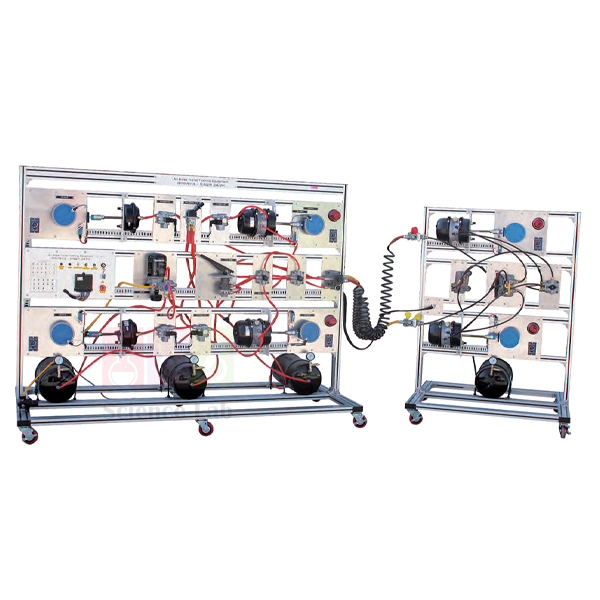
Trailer Type Air Brake System Training Equipment
Trailer Type Air Brake System Training Equipment (Product Code: SLE/ATE/11) is a heavy-truck air brake trainer used to teach the operation, inspection and maintenance of air brakes and ABS in automotive and vocational training workshops. A body-part stand and a separate trailer unit are coupled by air line, so trainees practise connecting the trailer brake circuit while four 120W motors spin the wheels. It is made by Jain Scientific Equipments Pvt Ltd (ScienceLab), an OEM vocational training lab equipment manufacturer, at its own factory in Ambala, India.
Specifications
| Parameter | Detail |
|---|---|
| Configuration | Brake system from the body part plus a separate trailer unit |
| Driving motor | Single phase 220V, speed control type, 120W — 4 nos |
| Wheel control | Wheel rotation and speed controlled with motor |
| Composition | Air tank, pressure regulator, brake pedal, air pressure gauge, single chamber (2 nos), double chamber (2 nos), ECU, parking brake valve, check valve, ABS pulse ring, PCV modulator, quick release valve, air dryer, double check valve, etc. |
| Control panel | Check terminal, power lamp, fuse holder, key switch, power switch, emergency switch |
| Size | Approx. 2,400 x 600 x 1,800 mm (main unit) + 800 x 600 x 1,600 mm (trailer) |
| Weight | Approx. 150 kg (main unit) + 60 kg (trailer) |
| Testing | Tests can be carried out with the installed air tank and all components of the air brake system |
| Product code | SLE/ATE/11 |
| Manufacturer | Jain Scientific Equipments Pvt Ltd (ScienceLab) — OEM |
| Country of origin | India (made in Ambala, Haryana) |
Training contents:
- ABS waveform test
- ABS modulator resistance test
- How to use the foot brake and hand control valve
- Completing the brake air line test
- Connecting the air line from the trailer brake system
- Output voltage test
What Is the Trailer Air Brake Trainer Used For?
The feature that sets this trainer apart is the coupling exercise. With the trailer unit parked beside the main stand, students connect the trailer air line and then confirm that a brake application at the pedal or hand control valve reaches the trailer chambers as well as the main unit. Instructors can disconnect the line again to show what happens when the trailer circuit loses supply, which makes the purpose of the check valves and double check valve easy to explain.
Electrical work follows on the same rig: ABS modulator resistance and output voltage are taken at the check terminal, and the ABS waveform is recorded while the motors spin the wheels. For colleges choosing lab equipment for technical institutes with limited floor space, the narrow main stand and separate trailer can be arranged to suit the workshop layout. Switch off at the key switch or emergency switch before touching any rotating wheel or air fitting.
OEM Manufacturer
ScienceLab is the brand name of Jain Scientific Equipments Private Limited, the OEM (original equipment manufacturer) that builds and assembles this trailer-type air brake trainer at its own licensed factory at Saha, Ambala, Haryana, India. The company is incorporated with the Ministry of Corporate Affairs under CIN U29309HR2020PTC087597, and its production site at 449, HSIIDC Industrial Area, Saha, Ambala holds Factory Licence AMB-ONLINE-CHD-J-414. Trainers are supplied factory-direct to ITIs, polytechnics, engineering colleges, dealers and importers, and repeat orders or spare-part requests go straight back to the manufacturer, so just ask us. More details are in our company profile.
Related Automotive Training Equipment
Useful additions for a truck-and-trailer brake training bay:
- Trailer Air Brake Training Equipment — a single-stand air brake and ABS rig for when a separate trailer is not needed.
- Working Model Of Hydraulic Braking System — a four-wheel hydraulic brake rig for contrasting car brakes with truck air brakes.
- Large Yard Tractor Engine Fault Diagnosis System — engine-side training for the tractor units that haul trailers.
- Standard Digital Multimeter — for resistance and voltage readings at the check terminal.
- Oscilloscope Dual Trace — to view the ABS waveform during testing.
Explore more vehicle system trainers in our Automotive Training Equipment category.
Frequently Asked Questions
How does the Trailer Type Air Brake System Training Equipment differ from the single-stand trailer air brake trainer?
The Trailer Type Air Brake System Training Equipment separates the trailer brake circuit into its own unit, so trainees can practise connecting the air line from the trailer brake system, an exercise the single-stand Trailer Air Brake Training Equipment does not list.
What are the dimensions and weights of the Trailer Type Air Brake System Training Equipment?
The main unit of the Trailer Type Air Brake System Training Equipment is approx. 2,400 x 600 x 1,800 mm and 150 kg; the trailer is approx. 800 x 600 x 1,600 mm and 60 kg, so plan floor space for both.
How many wheel motors does the Trailer Type Air Brake System Training Equipment use?
The Trailer Type Air Brake System Training Equipment uses four speed-control motors of 120W, each for a single phase 220V supply, to turn the wheels. If your workshop has a different mains supply, tell us when you enquire.
Which brake components are fitted to the Trailer Type Air Brake System Training Equipment?
The Trailer Type Air Brake System Training Equipment includes an air tank, pressure regulator, brake pedal, air pressure gauge, two single and two double chambers, ECU, parking brake valve, check valve, ABS pulse ring, PCV modulator, quick release valve, air dryer and double check valve.
What practical exercises does the Trailer Type Air Brake System Training Equipment support?
Listed training contents for the Trailer Type Air Brake System Training Equipment are the ABS waveform test, ABS modulator resistance test, use of the foot brake and hand control valve, the brake air line test, trailer air line connection and the output voltage test.
Who manufactures the Trailer Type Air Brake System Training Equipment?
The Trailer Type Air Brake System Training Equipment is manufactured by Jain Scientific Equipments Pvt Ltd (ScienceLab), the OEM, at its own licensed factory at Saha, Ambala, Haryana, India. Quotations and spare-part requests are handled directly by the manufacturer.
Can a calibration certificate be supplied for the air pressure gauge?
Please raise any calibration or inspection document needed for the Trailer Type Air Brake System Training Equipment at the enquiry stage through our contact page; we will confirm what can be supplied with your order.
What should a tender enquiry for this trainer include?
Include the quantity of Trailer Type Air Brake System Training Equipment, the delivery address in India or abroad, your mains supply and any installation or training expectations, so the manufacturer can prepare a complete quotation.
Request a Quote
For a price, send us your requirement or place the trainer in your enquiry cart. Quotations come directly from ScienceLab as the manufacturer, for institutions across India and international markets.
Last updated: 24 September 2026
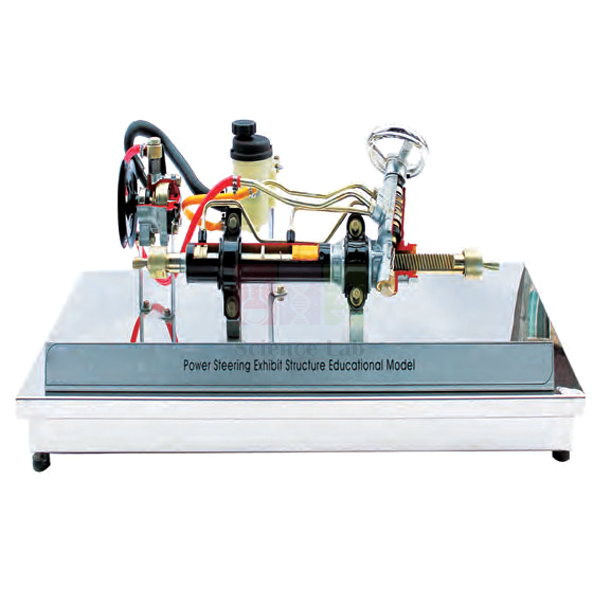
Power Steering Gear
Power Steering Gear (Product Code: SLE/ATE/12) is a sectioned structure education unit used to show how a vehicle's power steering gear, steering oil pump and oil tank work together, in automobile engineering classes and mechanic training. Students can move the gear by hand, check oil flow from the power pump and pick out each part by its colour-painted incised section. It is made by Jain Scientific Equipments Pvt Ltd (ScienceLab), the OEM manufacturer, at its own factory in Ambala, India, as engineering educational equipment for colleges and ITIs.
Specifications
| Parameter | Detail |
|---|---|
| Type | Structure education unit of a power steering gear (sectioned) |
| Composition | Power steering gear, steering oil pump, oil tank |
| Operation | Movement observed by manual operation; oil flow can be checked by power pump |
| Finish | Painted and coated with vehicle-only materials; incised sections painted in different colours |
| Weight | Approx. 45 kg |
| Size | Approx. 600 × 400 × 400 mm |
| Product code | SLE/ATE/12 |
| Manufacturer | Jain Scientific Equipments Pvt Ltd (ScienceLab) — OEM |
| Country of origin | India (made in Ambala, Haryana) |
What Is the Power Steering Gear Cutaway Used For?
In a steering and suspension lesson, the instructor turns the gear by hand while students watch the internal parts move through the sectioned housing, then relates what they see to the oil pump and tank. The pump supplies pressurised oil, the gear uses it to reduce the effort the driver needs, and the oil returns to the tank. Tracing that loop on a real, colour-coded assembly helps trainees explain each part and the power delivery principle in their own words before they meet a steering fault on a vehicle.
Because the unit is compact, it can move between classroom and workshop on a trolley, or sit on a bench beside a live vehicle so students can compare the cutaway with a complete steering box. In engineering colleges and ITIs it fits the chassis section of lab equipment for technical institutes, next to transmission and differential cutaways.
OEM Manufacturer
The Power Steering Gear trainer is an original ScienceLab product. Jain Scientific Equipments Private Limited, which trades as ScienceLab, is its OEM (original equipment manufacturer) and makes it at the company's own licensed factory at Saha, Ambala, Haryana, India.
Colleges, training centres, dealers and importers order it straight from the factory, without a trader in between, and can ask the manufacturer directly about replacement parts or matching units for a second lab. Find out more on our company profile.
Related Automotive Training Equipment
Other chassis and driveline units that fit the same course:
- Cut Model Of Rack And Pinion Steering — the other common steering layout, for side-by-side comparison
- Differential Gear — another sectioned driveline component for the chassis module
- Clutch Structure Trainer Hydraulic Manual — continues the study of hydraulically operated vehicle controls
- CRDI Diesel Engine Power Train System F/R Type — shows a steering system in place within a complete vehicle power train
Browse the full Automotive Training Equipment collection.
Frequently Asked Questions
Is the Power Steering Gear a working steering system or a cutaway?
The Power Steering Gear is a sectioned teaching unit rather than a part for fitting to a vehicle. The gear can be moved by hand to show its action, and oil flow can be checked by the power pump, so students see the hydraulic assistance principle on real components.
What parts come with the Power Steering Gear trainer?
The Power Steering Gear trainer consists of the power steering gear itself, the steering oil pump and the oil tank. Its incised sections are painted in different colours, and the unit is finished with vehicle-only paint and coating materials.
Will the Power Steering Gear fit on a standard workbench?
Yes, on a sturdy one. The Power Steering Gear measures approximately 600 × 400 × 400 mm and weighs about 45 kg, so it suits a strong bench or trolley; use two people to lift it between rooms.
How is the pump driven for the oil flow check?
The drive arrangement for the steering oil pump on the Power Steering Gear is not detailed in our product documentation. If your lesson plan depends on it, contact us before ordering and we will confirm how oil flow is demonstrated on the unit quoted.
How should the colour-coded sections be cared for?
Wipe the Power Steering Gear with a dry or lightly damp cloth and avoid harsh solvents, which can dull the colour coding that makes each incised section easy to identify. Keep it covered when not in use so workshop dust does not settle on the cut faces.
Who manufactures the Power Steering Gear?
The Power Steering Gear is manufactured by Jain Scientific Equipments Private Limited, which trades as ScienceLab, as the OEM at its own licensed factory at Saha, Ambala, Haryana, India. Colleges and dealers deal directly with the manufacturer for quotations and repeat orders.
Can we order several units for an automotive lab?
Yes. The Power Steering Gear can be quoted in single or multiple units for colleges, ITIs and training centres in India and international markets. State the quantity and delivery location in your enquiry so the quotation is complete.
Request a Quote
Request a factory-direct quotation through our contact page, or add the Power Steering Gear to your enquiry cart along with other items for your lab.
Last updated: 24 September 2026
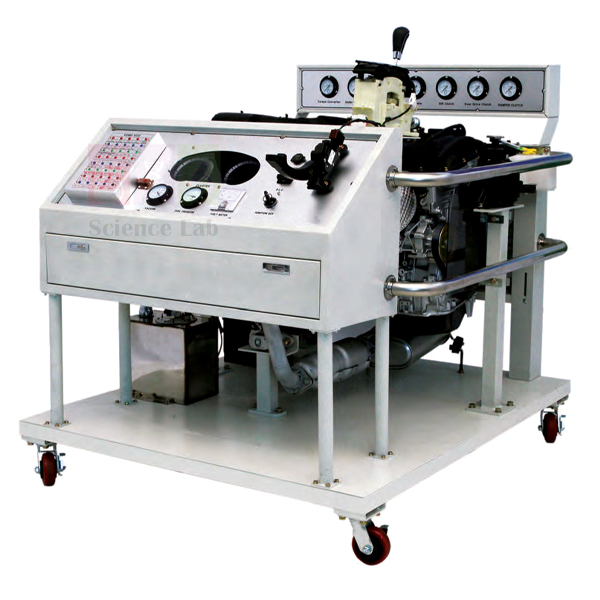
Automotive Engine Fault Diagnosis Simulator Auto Fault
Automotive Engine Fault Diagnosis Simulator Auto Fault (Product Code: SLE/ATE/13) is a mobile engine simulator used to practise diagnosing faults on an electrically controlled gasoline engine and automatic transmission in automotive training workshops. It carries complete fuel, cooling, intake, exhaust and vehicle electrical systems plus pressure and voltage gauges, so polytechnics and TVET centres can teach maintenance on a running stand. Jain Scientific Equipments Pvt Ltd (ScienceLab) builds the simulator's training stand, control box and panels as the OEM manufacturer at its own factory in Ambala, India; the gasoline engine and automatic transmission assemblies are sourced production units, not made in Ambala.
Specifications
| Parameter | Detail |
|---|---|
| Engine | Electrical control gasoline engine assembly, Auto Fault |
| Transmission | Automatic transmission assembly |
| Electrical and electronic devices | ECM, TCM, AFS, CKP, CMP, O2 sensor, WTS, control relay, etc. |
| Fuel and charging | Injector, fuel filter, fuel tank (removable), fuel pump, fuel equipment, DC 12V/60A vehicle battery, generator |
| Ignition | Ignition coil, spark plug, high voltage cables, ignition switch (key switch) |
| Cooling | Radiator, overflow tank, relay, electric fan; radiator-only stand |
| Exhaust | Catalytic converter, emission parts, silencer |
| Controls | Control box, accelerator lever |
| Gauges | Automatic transmission oil pressure gauges (1.5 MPa and 2.5 MPa); vacuum pressure gauge (0.1 MPa); fuel pressure gauge (1 MPa); battery voltage gauge (30 V) |
| Frame and protection | Stainless molding type safety guard; laser processing protection panel; anti-vibration dampers; urethane wheels |
| Storage | Drawer type storage space, 1 no |
| Weight | Approx. 400 kg |
| Size | Approx. 1,500 × 1,400 × 1,300 mm |
| Engine / assembly | Sourced production unit (as listed) |
| Product code | SLE/ATE/13 |
| Manufacturer | Jain Scientific Equipments Pvt Ltd (ScienceLab) — OEM |
| Country of origin | India (trainer built in Ambala, Haryana) |
Training contents:
- Connector checking terminal for inspection of sensors and actuators
- Inspection of every part of the intake and exhaust system
- Various practices by self-diagnosis
- Measurement and inspection of the automatic transmission
- Electric-controlled gasoline engine tune-up practice
- Hydraulic measurement and inspection in accordance with A/T range
- Exhaust measurement; measurement and inspection of cylinder compression pressure
- Radiator cap pressure measurement and radiator leakage inspection
- Measurement and adjustment of timing chain and fan belt tension
- Fuel pump operation test; oil pressure measurement and inspection
- Voltage and current measurement and adjustment in charging and starting circuits
- Inspection of automotive electrical parts, fuel system, ECU, sensors and actuators
- Inspection of cooling system belts and pumps
What Is the Gasoline Engine Fault Diagnosis Simulator Used For?
A typical session starts with a symptom. The instructor sets up a fault, and students work through a structured diagnosis: reading self-diagnosis results, probing sensors and actuators at the connector checking terminal, then confirming with the fitted gauges. Because the engine and automatic transmission share one stand, trainees see how an engine-side problem such as low fuel pressure or poor vacuum shows up alongside transmission behaviour, and the A/T oil pressure gauges let them check hydraulic pressure in each range.
Mechanical work is covered too: compression tests, timing chain and fan belt tension, radiator cap pressure and leak checks. For institutions assembling TVET lab equipment on a single budget line, this one unit spans engine, electrical, cooling and transmission modules. Run the engine only in a well-ventilated workshop or with exhaust extraction, and keep hands clear of the fan and belts while it is running.
OEM Manufacturer
This simulator's training stand, control box and protection panels come from their original maker: Jain Scientific Equipments Private Limited, trading as ScienceLab, is the OEM (original equipment manufacturer) and builds them at the company's own licensed factory at Saha, Ambala, Haryana, India. The electrically controlled gasoline engine and the automatic transmission assembly at the heart of the stand are sourced production units, not made in Ambala.
Polytechnics, engineering colleges, dealers and importers buy the complete simulator factory-direct. Follow-up needs such as spare gauges, replacement parts or a second unit for another workshop can be raised with ScienceLab directly, so ask us. Our company profile has more background.
Related Automotive Training Equipment
Equipment that pairs well with this fault simulator:
- Engine management system (MPI) — focused study of fuel injection control and sensor inputs
- FF Auto Transmission 6 Steps — shows the automatic transmission internals behind the pressure readings
- Digital Multimeter — for voltage and current checks in charging and starting circuits
- Oscilloscope Dual Trace — for viewing sensor and actuator signals at the checking terminal
- Diesel Engine Fault Diagnosis Training Equipment Auto Fault — the diesel counterpart for compression-ignition training
View the whole Automotive Training Equipment category.
Frequently Asked Questions
Does the engine run on the Automotive Engine Fault Diagnosis Simulator Auto Fault?
Yes. The Automotive Engine Fault Diagnosis Simulator Auto Fault is an engine simulator with its own fuel, ignition, cooling, intake, exhaust and electrical systems, and its training contents include exhaust measurement, engine tune-up and fuel pump operation tests.
What does Auto Fault mean on this simulator?
On the Automotive Engine Fault Diagnosis Simulator Auto Fault, Auto Fault refers to the fault diagnosis function: faults that can occur on an actual vehicle system can be checked and diagnosed on the stand. For the list of fault conditions available, contact us before ordering.
Which gauges are fitted?
The Automotive Engine Fault Diagnosis Simulator Auto Fault carries automatic transmission oil pressure gauges (1.5 MPa and 2.5 MPa), a vacuum pressure gauge (0.1 MPa), a fuel pressure gauge (1 MPa) and a battery voltage gauge (30 V) for live readings during exercises.
Is a diagnostic scan tool included?
No diagnostic scan tool is listed in the composition of the Automotive Engine Fault Diagnosis Simulator Auto Fault. Tell us which diagnostic equipment your lab already uses for the self-diagnosis exercises, and we will advise on it when preparing the quotation.
Can the simulator be moved around the workshop?
Yes. The Automotive Engine Fault Diagnosis Simulator Auto Fault rides on urethane wheels with anti-vibration dampers. At approximately 400 kg and 1,500 × 1,400 × 1,300 mm, move it on level floors with enough people to control it safely.
Who manufactures the Automotive Engine Fault Diagnosis Simulator Auto Fault?
Jain Scientific Equipments Private Limited, trading as ScienceLab, manufactures the training stand, control box and panels of the Automotive Engine Fault Diagnosis Simulator Auto Fault as the OEM at its own licensed factory at Saha, Ambala, Haryana, India. Its gasoline engine and automatic transmission assemblies are sourced production units, not made in Ambala.
Are calibration certificates available for the gauges?
Calibration-certificate availability for the gauges on the Automotive Engine Fault Diagnosis Simulator Auto Fault depends on the order. Please mention the requirement through our contact page when you request a quotation, so it can be discussed before purchase.
Request a Quote
Please contact us with your quantity and delivery location, or use the enquiry cart to request a quotation direct from the manufacturer.
Last updated: 24 September 2026
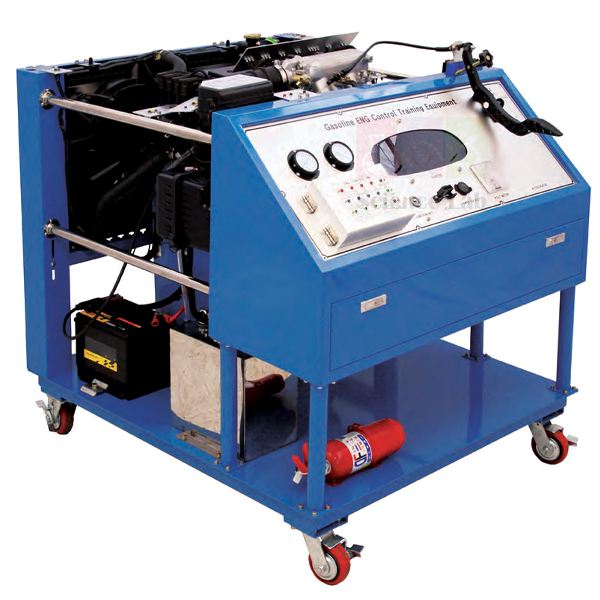
Diesel Engine Fault Diagnosis Training Equipment Auto Fault
Diesel Engine Fault Diagnosis Training Equipment Auto Fault (Product Code: SLE/ATE/14) is a running diesel engine simulator used to teach fault finding and maintenance of diesel vehicle systems in ITIs, polytechnics and engineering colleges. A check terminal box lets students test electronic circuits and sensors with a diagnostic device, and a fault insertion feature with a 3-stage PCB board lets instructors set realistic problems. Jain Scientific Equipments Pvt Ltd (ScienceLab) makes the training stand, control panel and fault-insertion system as an OEM manufacturer at its own factory in Ambala, India, while the diesel engine assembly is a sourced production unit, not made in Ambala.
Specifications
| Parameter | Detail |
|---|---|
| Engine | Diesel engine assembly |
| Fuel and electrical | Fuel filter, fuel tank, fuel pump, fuel devices, DC 12V car battery, generator |
| Cooling | Radiator, electric fan, overflow tank, relay, antifreeze; radiator-only stand |
| Exhaust | Catalyst converter, silencer |
| Controls | Start switch (key switch), control box for waveform measurement, fuel tank, accelerator lever |
| Diagnosis features | Check terminal box for testing electronic circuits and sensors with a diagnostic device; fault insertion; control panel open and close feature; 3-stage PCB board mounted |
| Frame and protection | Stainless molding type safety guard; laser processing protection panel; anti-vibration dampers; urethane wheels |
| Storage | Drawer type storage space, 1 no |
| Weight | Approx. 430 kg |
| Size | Approx. 1,500 × 1,400 × 1,300 mm |
| Engine / assembly | Sourced production unit (as listed) |
| Product code | SLE/ATE/14 |
| Manufacturer | Jain Scientific Equipments Pvt Ltd (ScienceLab) — OEM |
| Country of origin | India (trainer built in Ambala, Haryana) |
Training contents:
- Measurement and adjustment of timing chain and fan belt tension
- Measurement and adjustment of voltage and current in charging and starting circuits
- Various practices by self-diagnosis
- Exhaust measurement; measurement and inspection of cylinder compression pressure
- Radiator cap pressure measurement and radiator leakage inspection
- Connector checking terminal for inspection of sensors and actuators
- Inspection of cooling system belts and pumps
- Inspection of every part of the intake and exhaust system
- Fuel pump operation test; oil pressure measurement and inspection
- Inspection of automotive electrical parts, fuel system, ECU, sensors and actuators
- Inspection of the remaining parts
What Is the Diesel Engine Fault Trainer Used For?
Diesel diagnosis depends on fuel delivery, compression and sensor signals, and this trainer lets each of those be tested on a real engine. A common exercise has students start the engine, notice a symptom and narrow it down: waveform readings at the control box, sensor and actuator checks at the check terminal box, fuel pump and oil pressure tests, and finally a compression test to rule out mechanical causes. The fault insertion feature and 3-stage PCB board give instructors a repeatable way to set assessment tasks for whole batches of trainees.
Routine service skills fit the same stand: belt tension, radiator cap pressure and cooling leak checks, and charging and starting circuit measurements. Running it beside a fuel injection pump trainer helps vocational students connect what happens in the pump with what they measure on the engine, which makes it practical engineering lab equipment in India for diesel mechanic courses. Operate it only with exhaust extraction or good ventilation, keep the stainless guard in place, and let the engine cool before opening the radiator.
OEM Manufacturer
ScienceLab is the trading name of Jain Scientific Equipments Private Limited, the OEM (original equipment manufacturer) of this diesel fault trainer's stand, control panel and fault-insertion system. These are built and assembled at the company's own licensed factory at Saha, Ambala, Haryana, India. The diesel engine assembly they are built around is a sourced production unit, not made in Ambala.
Training institutes, dealers and importers buy the complete trainer directly from ScienceLab rather than through a trader, and anything needed later — a replacement part, a repeat unit or advice on setting up a second workshop — can be requested from us; just ask. See our company profile for background.
Related Automotive Training Equipment
Items used alongside this diesel fault trainer:
- Diesel Fuel Injection System VE pump — explains the distributor-type pump that meters diesel to the injectors
- Diesel Fuel Injection System Inline Pump — the inline pump design for comparison
- Oscilloscope Dual Trace — for reading waveforms from the control box
- Advanced Digital Multimeter — for sensor, charging and starting circuit measurements
- Automotive Engine Fault Diagnosis Simulator Auto Fault — the gasoline engine and automatic transmission version
More engine and vehicle trainers are listed under Automotive Training Equipment.
Frequently Asked Questions
How are faults created on the Diesel Engine Fault Diagnosis Training Equipment Auto Fault?
The Diesel Engine Fault Diagnosis Training Equipment Auto Fault has a fault insertion feature, a control panel that opens and closes, and a mounted 3-stage PCB board. For the number and types of faults available, please contact us before ordering.
Which diesel engine model is fitted?
The Diesel Engine Fault Diagnosis Training Equipment Auto Fault is listed with a diesel engine assembly, without a named engine model. If your syllabus calls for a particular engine type or displacement, ask us to confirm what the quoted unit carries.
Do we need our own oscilloscope for waveform work?
Probably yes. The Diesel Engine Fault Diagnosis Training Equipment Auto Fault includes a control box for waveform measurement, but no oscilloscope is listed in its composition, so plan to use your lab's instrument or order one separately.
Is a battery included?
Yes. A DC 12V car battery and a generator are part of the Diesel Engine Fault Diagnosis Training Equipment Auto Fault, along with the fuel filter, fuel tank, fuel pump and the start (key) switch.
How big and heavy is the trainer?
The Diesel Engine Fault Diagnosis Training Equipment Auto Fault measures approximately 1,500 × 1,400 × 1,300 mm and weighs about 430 kg. It stands on urethane wheels with anti-vibration dampers, so it can be repositioned on a level workshop floor.
Who manufactures the Diesel Engine Fault Diagnosis Training Equipment Auto Fault?
Jain Scientific Equipments Private Limited, trading as ScienceLab, is the OEM that manufactures the stand, control panel and fault-insertion system of the Diesel Engine Fault Diagnosis Training Equipment Auto Fault at its own licensed factory at Saha, Ambala, Haryana, India. The diesel engine assembly itself is a sourced production unit, not made in Ambala.
What should an institutional quotation request include?
For the Diesel Engine Fault Diagnosis Training Equipment Auto Fault, send the quantity, the delivery location in India or abroad, and any installation or documentation requirements your institution has. The quotation then comes directly from the manufacturer.
Request a Quote
Send your requirement through our contact page or add this trainer to the enquiry cart, and the manufacturer will reply with a quotation.
Last updated: 24 September 2026
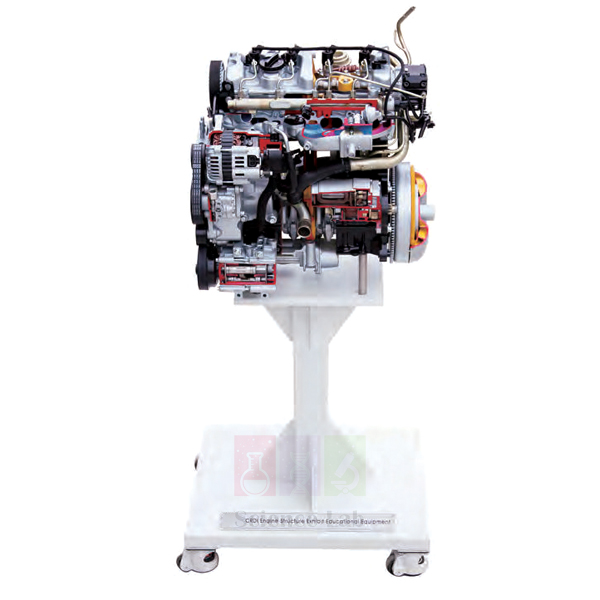
CRDI Diesel Engine SANTAFE D Engine, Stand
CRDI Diesel Engine SANTAFE D Engine, Stand (Product Code: SLE/ATE/15) is a sectioned 2,000cc CRDI BOSCH D engine on a braked, wheeled stand, used to teach the structure and operating principle of common rail diesel engines in automotive classrooms and workshops. A 220V motor under an engine speed controller turns the precisely cut engine, so learners can watch pistons, valves and crank move. It is supplied by Jain Scientific Equipments Pvt Ltd (ScienceLab), Ambala, India, to engineering colleges and training centres.
Specifications
| Parameter | Detail |
|---|---|
| Engine | 2,000cc CRDI BOSCH D engine, same as the real-vehicle unit, precisely cut to show internal movement |
| Engine ancillaries | Starting motor, generator, air conditioner compressor, intake manifold, torque converter |
| Systems shown | Fuel system, cooling system, lubrication system |
| Drive | 220V motor with engine speed controller |
| Electrical safety | Safety breaker, emergency switch, safety fuse |
| Stand | Steel frame with heat treatment painting; 4 wheels with brakes |
| Finish | Each incised section painted in a different colour |
| Weight | Approx. 250 kg |
| Size | Approx. 650 × 500 × 1,500 mm |
| Product code | SLE/ATE/15 |
| Supplied by | Jain Scientific Equipments Pvt Ltd (ScienceLab), Ambala, India |
Training contents:
- How to attach and detach the generator and starting motor
- Replacement of the timing belt and other belts
- How to replace the oil filter
What Is the CRDI D Engine Cutaway Stand Used For?
Common rail diesel theory is easier to grasp when the moving parts are visible. With the motor turning the engine slowly, an instructor can point out valve timing, piston position and crank rotation through the cut sections, then raise the speed on the controller to show the cycle as a whole. Because each incised section carries its own colour, students quickly tell the fuel, cooling and lubrication systems apart.
The stand also supports practical service tasks: removing and refitting the generator and starting motor, changing the timing belt and other belts, and replacing the oil filter. Its narrow footprint and braked wheels let a department roll it from the lecture room to the workshop, so it works as both a demonstration piece and hands-on engineering lab equipment in India for diesel technology courses. Isolate power at the safety breaker before any work around belts or pulleys.
Supplier
ScienceLab is the trading name of Jain Scientific Equipments Private Limited, Ambala, Haryana, India, which sources and supplies this CRDI engine stand to automobile departments, polytechnics and training institutes in India and international markets. The stand is built around a BOSCH common rail D engine, and the company handles the quotation, supply and delivery for the buyer.
For vendor registration, the supplying company is Jain Scientific Equipments Private Limited (GSTIN 06AAECJ8618A1ZT, LEI 3358004HRD1JIVXKYX49). More about us is on the company profile.
Related Automotive Training Equipment
Trainers that extend a CRDI diesel lesson:
- CRDI (Common Rail Direct Injector) System — a close-up of the CRDI fuel pump and a sectioned injector nozzle
- CRDI Diesel Engine Stand, Motor Type — a larger-displacement CRDI engine stand for comparison
- Diesel Engine Fault Diagnosis Training Equipment Auto Fault — moves students on from structure study to diagnosing a running diesel
- Section Model Of Four-Stroke Diesel Engine — a simpler model for introducing the four-stroke diesel cycle first
Find more engine trainers in Automotive Training Equipment.
Frequently Asked Questions
What engine is fitted to the CRDI Diesel Engine SANTAFE D Engine, Stand?
The CRDI Diesel Engine SANTAFE D Engine, Stand carries a 2,000cc CRDI BOSCH D engine, precisely cut to show internal movement, with its starting motor, generator, air conditioner compressor, intake manifold and torque converter attached.
How does the sectioned engine move during a demonstration?
A 220V motor drives the CRDI Diesel Engine SANTAFE D Engine, Stand, and the engine speed controller sets how fast the pistons, valves and crank turn, so an instructor can run it slowly for explanation or faster to show the full cycle.
Which service tasks can students practise?
On the CRDI Diesel Engine SANTAFE D Engine, Stand, students can practise attaching and detaching the generator and starting motor, replacing the timing belt and other belts, and replacing the oil filter, building routine service skills on a real engine.
What safety features are fitted?
The CRDI Diesel Engine SANTAFE D Engine, Stand has a safety breaker, emergency switch and safety fuse on the electrical side, and brakes on all 4 wheels to hold the steel frame in place during demonstrations.
How much space does the engine stand need?
The CRDI Diesel Engine SANTAFE D Engine, Stand measures approximately 650 × 500 × 1,500 mm and weighs about 250 kg. Its braked wheels let a department roll it between the lecture room and the workshop.
Who supplies the CRDI Diesel Engine SANTAFE D Engine, Stand?
Jain Scientific Equipments Private Limited, trading as ScienceLab in Ambala, Haryana, India, supplies the CRDI Diesel Engine SANTAFE D Engine, Stand to colleges, training institutes and dealers. Its GSTIN and LEI are given in the Supplier section for vendor registration.
Can the engine stand be shipped outside India?
Yes. The CRDI Diesel Engine SANTAFE D Engine, Stand is supplied to buyers in India and international markets. Send the quantity and destination with your enquiry through our contact page so the quotation can cover packing and freight.
Request a Quote
For a formal quotation, get in touch or add the engine stand to your enquiry cart.
Last updated: 24 September 2026
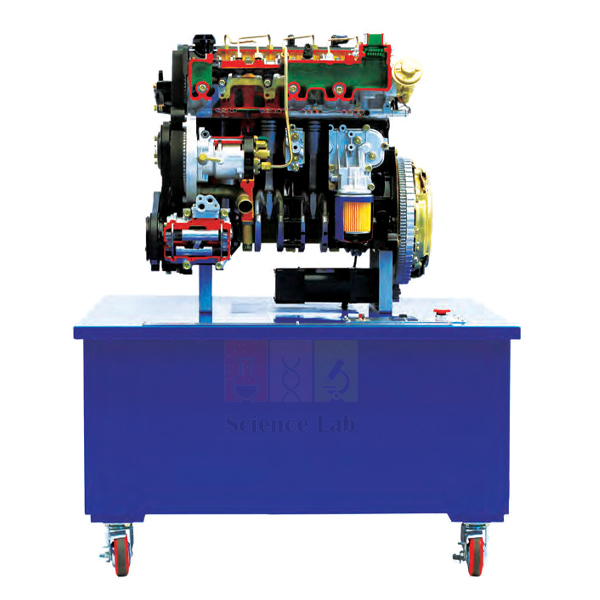
CRDI Diesel Engine Stand, Motor Type
CRDI Diesel Engine Stand, Motor Type (Product Code: SLE/ATE/16) is a motor-operated cutaway of a 2,900cc CRDI Delphi diesel engine, used to explain the structure and operating principle of common rail diesel engines in automobile technology courses. A 220V motor runs the sectioned engine automatically, the way it turns in an actual vehicle, while an LED lamp lights at ignition. It is supplied by Jain Scientific Equipments Pvt Ltd (ScienceLab), Ambala, India, to colleges and vocational training centres.
Specifications
| Parameter | Detail |
|---|---|
| Engine | 2,900cc CRDI Delphi engine, sectioned by precise cutting |
| Engine equipment | Starting motor, generator, air conditioner compressor, intake manifold |
| Systems | Fuel system, cooling system, lubrication system |
| Operation | Automatic operation type, driven by 220V motor with engine speed controller |
| Indicator | LED lamp turns on at ignition |
| Protection | Safety breaker, emergency switch, safety fuse |
| Stand | Steel frame with heat treatment painting; 4 wheels with brakes |
| Finish | Each engine part painted specifically; incised sections in different colours |
| Weight | Approx. 150 kg |
| Size | Approx. 700 × 650 × 1,500 mm |
| Product code | SLE/ATE/16 |
| Supplied by | Jain Scientific Equipments Pvt Ltd (ScienceLab), Ambala, India |
Training contents:
- Attaching and detaching the generator and starting motor
- Replacing the timing belt and the other engine belts
- Replacing the oil filter
What Is the 2,900cc CRDI Engine Stand Used For?
This stand suits the first weeks of a common rail diesel module, when students need to connect the engine's layout with its operating principle. The LED lamp confirms when the ignition is on, and with the motor running the class can watch the valve train and crank in motion while the instructor explains how a high-pressure common rail feeds each cylinder. Because the engine sits on a relatively light frame, it can be wheeled to the front of a lecture room for demonstration and back to the workshop for practical work.
In practical sessions, small groups take turns removing and refitting the generator and starting motor, changing belts and replacing the oil filter — routine jobs that build confidence before trainees work on customer vehicles. For TVET lab equipment buyers, pairing this stand with a CRDI pump-and-injector unit gives students both the whole-engine view and a close look at the injection hardware. Switch off at the safety breaker before reaching into the belt area.
Supplier
The CRDI Diesel Engine Stand, Motor Type is supplied by Jain Scientific Equipments Private Limited, which trades as ScienceLab from Ambala, Haryana, India. Because the stand is built around a Delphi CRDI engine, the company sources it and delivers it to automobile colleges, ITIs, training centres, dealers and importers in India and international markets.
Buyers deal with one supplier for the quotation, delivery and any follow-up questions about the stand. Visit the company profile to learn more about ScienceLab.
Related Automotive Training Equipment
Useful companions for a CRDI engine lesson:
- CRDI Diesel Engine SANTAFE D Engine, Stand — a second sectioned CRDI engine for comparing designs
- CRDI (Common Rail Direct Injector) System — the fuel pump and injector nozzle shown up close
- CRDI Diesel Engine Power Train System F/R Type — places a diesel engine in a complete vehicle power train
- Diesel Fuel Injection System VE pump — an earlier pump-based injection system to contrast with common rail
See all items in Automotive Training Equipment.
Frequently Asked Questions
What does Motor Type mean for the CRDI Diesel Engine Stand, Motor Type?
On the CRDI Diesel Engine Stand, Motor Type, the sectioned engine is operated automatically by a 220V motor, so it turns as it would in a vehicle. The engine speed controller sets the speed, and an LED lamp shows when the ignition is on.
Which engine is used?
The CRDI Diesel Engine Stand, Motor Type uses a 2,900cc CRDI Delphi diesel engine, fitted with its starting motor, generator, air conditioner compressor and intake manifold, and precisely cut so the pistons, valves and crank can be seen working.
How is it different from the SANTAFE D engine stand?
The CRDI Diesel Engine Stand, Motor Type and the SANTAFE D engine stand carry different CRDI engines and injection hardware. If you are choosing between them, tell us which injection system your syllabus covers and we will advise on the better fit.
How heavy is it, and can it be moved?
The CRDI Diesel Engine Stand, Motor Type weighs approximately 150 kg and measures about 700 × 650 × 1,500 mm. Its steel frame runs on four braked wheels, so it can be wheeled to the front of a lecture room and back to the workshop.
Who supplies the CRDI Diesel Engine Stand, Motor Type?
The CRDI Diesel Engine Stand, Motor Type is supplied by Jain Scientific Equipments Private Limited, which trades as ScienceLab from Ambala, Haryana, India. The company sources the stand and delivers it to colleges, training institutes and dealers in India and international markets.
Are student worksheets or a manual supplied?
Documentation supplied with the CRDI Diesel Engine Stand, Motor Type is not detailed in our current listing. Please ask about manuals or worksheets through our contact page when you request a quotation, so we can confirm what accompanies the unit.
Request a Quote
To receive a quotation for this engine stand, contact our team or add it to your enquiry cart.
Last updated: 24 September 2026
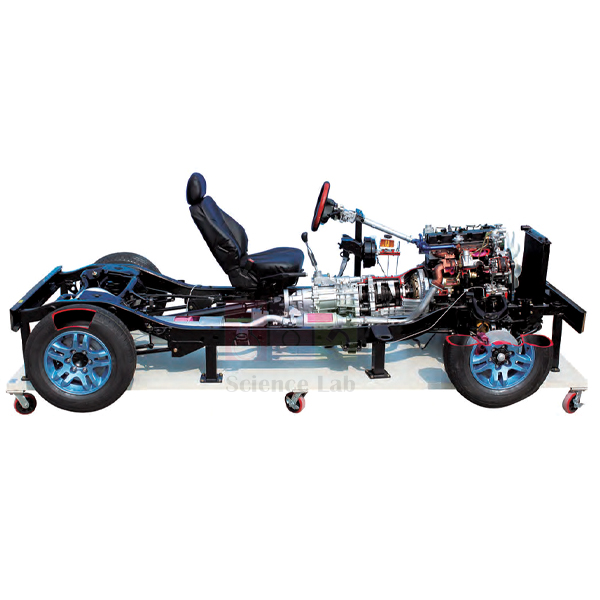
CRDI Diesel Engine Power Train System F/R Type
CRDI Diesel Engine Power Train System F/R Type (Product Code: SLE/ATE/17) is a sectioned diesel vehicle chassis used to teach how a diesel engine, F/R type manual transmission, driveshaft and front axle deliver power to the road, in automotive colleges and training workshops. Steering, brakes, shock absorbers and lighting sit on the same frame, and an AC 220V motor moves the power train as in an actual car. The training stand is made by Jain Scientific Equipments Pvt Ltd (ScienceLab), the OEM manufacturer, at its own factory in Ambala, India; the diesel engine and manual transmission assemblies it carries are sourced production units, not made in Ambala.
Specifications
| Parameter | Detail |
|---|---|
| Type | Operating F/R type manual transmission CRDI and power train system structure of a diesel engine vehicle |
| Power train | Diesel engine assembly, manual transmission assembly, change lever, driveshaft, front axle |
| Chassis systems | Brake system, steering system, shock absorber |
| Other equipment | 1 set of lighting, fuel tank, battery, intake/exhaust system |
| Drive for demonstration | AC 220V motor operation |
| Finish | Precisely cut to show internal structure; incised sections painted in different colours |
| Weight | Approx. 450 kg |
| Size | Approx. 3,000 × 2,000 × 1,300 mm |
| Engine / assembly | Sourced production unit (as listed) |
| Product code | SLE/ATE/17 |
| Manufacturer | Jain Scientific Equipments Pvt Ltd (ScienceLab) — OEM |
| Country of origin | India (trainer built in Ambala, Haryana) |
Training contents:
- Adjustment and replacement of brake lining and pad
- Replacing the shock absorber and spring
- Replacing the tyre
- Attaching, detaching and inspecting the fuel pump
- Replacing the oil filter
- Replacement of various belts and belt tension control
What Is the Manual-Transmission Diesel Power Train Trainer Used For?
Where individual cutaways teach one component at a time, this chassis shows how they work together. An instructor can start the motor, follow the drive from the engine through the manual transmission and driveshaft, and then turn to the steering, brakes and shock absorbers on the same frame. Students see why gearbox, driveshaft and axle must be understood as one power train before they diagnose driveline noise or vibration on a real vehicle.
The chassis also works as a service bay for everyday jobs: brake lining and pad adjustment, shock absorber and spring replacement, tyre changes, fuel pump removal and inspection, oil filter changes and belt tensioning. Assigning one task per group lets several trainees work around the frame at once, which suits vocational training lab equipment for automobile courses. Plan a clear floor area around the unit, and switch off the 220V drive before anyone works on wheels, brakes or belts.
OEM Manufacturer
Jain Scientific Equipments Private Limited, trading as ScienceLab, is the OEM (original equipment manufacturer) of the training stand of the CRDI Diesel Engine Power Train System F/R Type, built at the company's own licensed factory at Saha, Ambala, Haryana, India. The diesel engine and manual transmission assemblies mounted on it are sourced production units, not made in Ambala. The complete unit is supplied factory-direct rather than through a trading intermediary.
Engineering colleges, ITIs, dealers and importers can come straight to ScienceLab for quotations, repeat orders and questions about replacement parts — simply ask us. Our company profile describes the business in more detail.
Related Automotive Training Equipment
Units that deepen individual parts of the power train lesson:
- CRDI Diesel Engine Power Train System Automatic Transmission — the same concept built around an automatic transmission
- Clutch Structure Trainer Mechanical Manual — explains the clutch that links engine and manual gearbox
- Vehicle Transmission 5 Speed Manual Gearbox — a standalone manual gearbox for detailed gear-train study
- Differential Gear — the final-drive component at the end of the driveline
- Power Steering Gear — a close study of the steering system fitted to the chassis
Browse other trainers in Automotive Training Equipment.
Frequently Asked Questions
Is the CRDI Diesel Engine Power Train System F/R Type manual or automatic?
The CRDI Diesel Engine Power Train System F/R Type is the manual version, with a manual transmission assembly and change lever. An automatic transmission version, the CRDI Diesel Engine Power Train System Automatic Transmission, is listed separately for side-by-side comparison.
What makes the power train move during a demonstration?
An AC 220V motor operates the CRDI Diesel Engine Power Train System F/R Type, so the engine, transmission, driveshaft and axle show the same movement as an actual car while the instructor explains the power flow.
How much floor space is required?
The CRDI Diesel Engine Power Train System F/R Type measures approximately 3,000 × 2,000 × 1,300 mm and weighs about 450 kg, so allow working space on every side for group practicals and check access routes before delivery.
Are lights and a battery included?
Yes. The CRDI Diesel Engine Power Train System F/R Type includes 1 set of lighting and a battery, together with the fuel tank, intake/exhaust system, brake system, steering system and shock absorber.
Is the engine model or displacement specified?
The CRDI Diesel Engine Power Train System F/R Type is listed with a diesel engine assembly but no named model or displacement. Contact us if your specification sheet or tender needs this detail, and we will confirm it for the unit quoted.
Who manufactures the CRDI Diesel Engine Power Train System F/R Type?
The CRDI Diesel Engine Power Train System F/R Type is a ScienceLab trainer: Jain Scientific Equipments Private Limited (ScienceLab) builds its training stand as the OEM at its own licensed factory at Saha, Ambala, Haryana, India, while the diesel engine and manual transmission assemblies are sourced production units, not made in Ambala.
What should a college send for a quotation?
For the CRDI Diesel Engine Power Train System F/R Type, send the quantity, the delivery location in India or overseas, and your site power supply. Because the chassis is large, also mention access limits such as door widths or upper-floor installation.
Request a Quote
For a factory-direct quotation, contact us or add this power train system to your enquiry cart.
Last updated: 24 September 2026
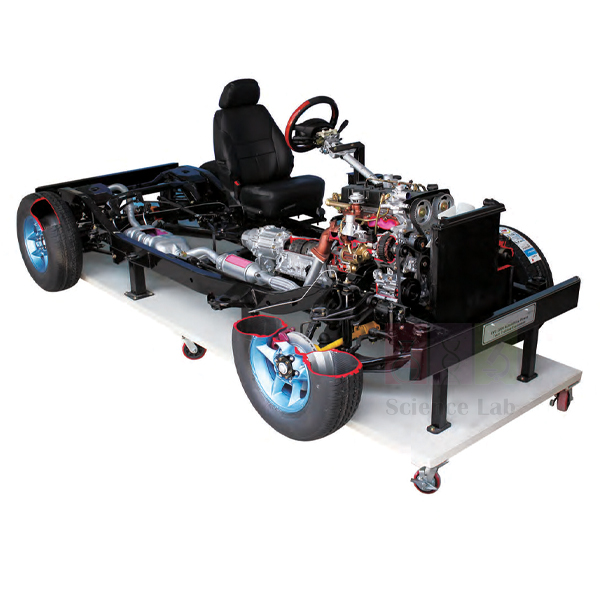
CRDI Diesel Engine Power Train System Automatic Transmission
CRDI Diesel Engine Power Train System Automatic Transmission (Product Code: SLE/ATE/18) is a full-size sectioned diesel chassis used to teach the F/R type automatic transmission and power train of a diesel engine vehicle in automotive colleges and training centres. It pairs a 2,900cc class diesel F/R engine assembly with an automatic transmission, driveshaft, front axle, steering and brakes, moved by an AC 220V motor through a controller. Its training stand is built by Jain Scientific Equipments Pvt Ltd (ScienceLab), an OEM manufacturer, at its own factory in Ambala, India; the diesel engine and automatic transmission assemblies are sourced production units, not made in Ambala.
Specifications
| Parameter | Detail |
|---|---|
| Type | F/R type automatic transmission and power train system structure of a diesel engine vehicle |
| Engine | 2,900cc class diesel F/R engine assembly |
| Transmission and driveline | Automatic transmission assembly, change lever, driveshaft, front axle |
| Chassis systems | Brake system, steering system |
| Other equipment | 1 set of lighting, fuel tank, battery, intake/exhaust system |
| Drive and control | AC 220V motor operation, controller, safety breaker |
| Finish | Precise cutting to show internal structure; incised sections painted in different colours |
| Weight | Approx. 450 kg |
| Size | Approx. 3,000 × 2,000 × 1,300 mm |
| Engine / assembly | Sourced production unit (as listed) |
| Product code | SLE/ATE/18 |
| Manufacturer | Jain Scientific Equipments Pvt Ltd (ScienceLab) — OEM |
| Country of origin | India (trainer built in Ambala, Haryana) |
Training contents:
- Tyre replacement
- Brake lining and pad adjustment and replacement
- Shock absorber and spring replacement
- Fuel pump attachment, detachment and inspection
- Oil filter replacement
- Replacement of various belts and belt tension control
What Is the Automatic-Transmission Diesel Power Train Trainer Used For?
Automatic transmissions are now common on passenger and light commercial vehicles, and technicians need to see how one fits into the wider driveline. On this chassis, students trace the drive from the diesel engine into the automatic transmission, out through the driveshaft and on to the axle, while the instructor explains how an automatic unit changes ratios without a driver-operated clutch. With the motor running, the change lever and the moving driveline make the link between lever position and power flow easy to discuss.
For practical assessment, the frame doubles as a service bay for tyre changes, brake pad and lining work, spring and shock absorber replacement, fuel pump inspection, oil filter replacement and belt tensioning. Colleges setting up engineering lab equipment in India can pair it with the manual version so students compare both drivelines side by side. Use the safety breaker to isolate the drive before any hands-on task.
OEM Manufacturer
ScienceLab is the brand of Jain Scientific Equipments Private Limited, the OEM (original equipment manufacturer) of this power train system's training stand. The 2,900cc class diesel engine and automatic transmission assemblies mounted on the stand are sourced production units, not made in Ambala. The company is incorporated under CIN U29309HR2020PTC087597, and the training stand is built at its own licensed factory at 449, HSIIDC Industrial Area, Saha, Ambala, Haryana, India, which operates under Factory Licence AMB-ONLINE-CHD-J-414.
Colleges, dealers and importers receive quotations for the complete unit straight from ScienceLab, and repeat orders or replacement-part requests go back to the same team — ask us. More background is on our company profile.
Related Automotive Training Equipment
Trainers that complement an automatic-transmission power train course:
- CRDI Diesel Engine Power Train System F/R Type — the manual-transmission version for side-by-side comparison
- Cut Model Of Automatic Transmission System — opens up an automatic gearbox for close study of its internals
- FF Auto Transmission Stand Type — a standalone automatic transmission with torque converter
- FF Auto Transmission 6 Steps — a multi-step automatic unit to explore gear steps
The full Automotive Training Equipment range lists other vehicle system trainers.
Frequently Asked Questions
How does the CRDI Diesel Engine Power Train System Automatic Transmission differ from the F/R Type model?
The CRDI Diesel Engine Power Train System Automatic Transmission is built around an automatic transmission assembly with a controller, while the F/R Type model uses a manual transmission. Teaching both lets students compare the two drivelines on full-size, sectioned chassis.
What engine does it carry?
The CRDI Diesel Engine Power Train System Automatic Transmission carries a 2,900cc class diesel F/R engine assembly, linked to the automatic transmission, driveshaft and front axle, with the fuel tank, battery and intake/exhaust system on the same frame.
Can students see inside the automatic transmission?
The CRDI Diesel Engine Power Train System Automatic Transmission is precisely cut to show internal structure, with incised sections painted in different colours. If your course needs a particular sectioned view of the transmission, ask us to confirm it before ordering.
What power supply is needed?
Movement on the CRDI Diesel Engine Power Train System Automatic Transmission comes from AC 220V motor operation through a controller, protected by a safety breaker. Confirm your site supply in the enquiry so the quotation matches your workshop.
How large is the unit?
The CRDI Diesel Engine Power Train System Automatic Transmission measures approximately 3,000 × 2,000 × 1,300 mm and weighs about 450 kg, so check doorways, floor space and access routes before delivery.
Who manufactures the CRDI Diesel Engine Power Train System Automatic Transmission?
The training stand of the CRDI Diesel Engine Power Train System Automatic Transmission is manufactured by Jain Scientific Equipments Private Limited (ScienceLab), its OEM, at its own licensed factory at Saha, Ambala, Haryana, India; the 2,900cc class diesel engine and automatic transmission assemblies are sourced production units, not made in Ambala.
Is it available for export?
Yes. The CRDI Diesel Engine Power Train System Automatic Transmission is supplied to institutions, dealers and importers in India and international markets. Share the destination and quantity through our contact page so the quotation covers packing and freight for a unit of this size.
Request a Quote
Request a quotation direct from the manufacturer through our contact form, or add the unit to your enquiry cart.
Last updated: 24 September 2026
 System901.jpg)
CRDI (Common Rail Direct Injector) System
CRDI (Common Rail Direct Injector) System (Product Code: SLE/ATE/19) is a compact educational unit used to explain the parts and operating principle of a common rail diesel fuel pump and injector nozzle in automobile and diesel mechanic courses. It pairs a CRDI engine fuel pump with an incised injector nozzle and a complete one, and at about 5 kg it can be passed round a table group. The training stand that holds these parts is made by Jain Scientific Equipments Pvt Ltd (ScienceLab), an OEM manufacturer, at its own factory in Ambala, India, whereas the CRDI fuel pump and injector nozzles themselves are sourced production units, not made in Ambala.
Specifications
| Parameter | Detail |
|---|---|
| Type | Educational unit for the CRDI fuel pump and injector nozzle |
| Composition | CRDI engine fuel pump, incised injector nozzle, injector nozzle |
| Finish | Each incised section painted in a different colour |
| Weight | Approx. 5 kg |
| Size | Approx. 400 × 300 × 300 mm |
| Engine / assembly | Sourced production unit (as listed) |
| Product code | SLE/ATE/19 |
| Manufacturer | Jain Scientific Equipments Pvt Ltd (ScienceLab) — OEM |
| Country of origin | India (trainer built in Ambala, Haryana) |
What Is the CRDI Pump and Injector Trainer Used For?
This unit is designed for the lesson where students first meet common rail technology. The instructor uses the fuel pump to explain how diesel is raised to high pressure and delivered to the rail, then moves to the injector. The complete nozzle shows what a technician sees on the engine, while the sectioned nozzle reveals the internal passages and needle that control spray into the cylinder, helping trainees link symptoms such as poor atomisation or leakage with what happens inside.
Its small size means one set can sit on each bench in a fuel-systems lab, making it practical lab equipment for technical institutes that run several practical groups in parallel. Handle the sectioned nozzle carefully, keep it free of dust and oil, and store the parts together so the set stays complete for the next class.
OEM Manufacturer
Jain Scientific Equipments Private Limited, which trades as ScienceLab, is the OEM (original equipment manufacturer) of the training stand of the CRDI (Common Rail Direct Injector) System, made at the company's own licensed factory at Saha, Ambala, Haryana, India. The CRDI engine fuel pump and injector nozzles mounted on it are sourced production units, not made in Ambala.
Institutions ordering bench sets, and the dealers and importers who serve them, get quotations for the complete unit direct from ScienceLab; replacement nozzles or additional sets can be requested the same way — ask us. Read our company profile for more.
Related Automotive Training Equipment
Trainers that put the pump and injector into context:
- CRDI Diesel Engine SANTAFE D Engine, Stand — a sectioned CRDI engine showing where the fuel system sits
- CRDI Diesel Engine Stand, Motor Type — a motor-driven CRDI engine for whole-engine demonstrations
- Diesel Fuel Injection System VE pump — an older distributor pump design to contrast with common rail
- Diesel Fuel Injection System Inline Pump — the inline pump approach for the same comparison
- Diesel Engine Fault Diagnosis Training Equipment Auto Fault — for diagnosing fuel delivery faults on a running engine
See the rest of our Automotive Training Equipment.
Frequently Asked Questions
What comes with the CRDI (Common Rail Direct Injector) System?
The CRDI (Common Rail Direct Injector) System includes a CRDI engine fuel pump, an incised (sectioned) injector nozzle and a complete injector nozzle, with each incised section painted a different colour for teaching clarity.
Why are two injector nozzles included?
The CRDI (Common Rail Direct Injector) System includes one nozzle cut open to show its internal parts and one complete nozzle, so students can relate the hidden passages and needle to what a technician sees when the injector is fitted to an engine.
Is it a working, pressurised rig?
No powered operation is listed for the CRDI (Common Rail Direct Injector) System; it is an educational unit for explaining parts and operating principles. If you need a running fuel system demonstration, contact us and we will suggest a suitable engine trainer.
Is the unit portable enough for classroom use?
Yes. The CRDI (Common Rail Direct Injector) System weighs approximately 5 kg and measures about 400 × 300 × 300 mm, so it can be carried between rooms and used on an ordinary classroom table or lab bench.
Who manufactures the CRDI (Common Rail Direct Injector) System?
The training stand of the CRDI (Common Rail Direct Injector) System is manufactured by Jain Scientific Equipments Private Limited, trading as ScienceLab, as the OEM at its own licensed factory at Saha, Ambala, Haryana, India. The CRDI fuel pump and injector nozzles are sourced production units, not made in Ambala.
Can we order one unit per bench?
Yes. The CRDI (Common Rail Direct Injector) System can be quoted in multiple units so that each bench in a fuel-systems lab has its own set. Share the quantity and delivery location in India or abroad when you enquire.
Request a Quote
Please contact us for a quotation from the manufacturer, or add the CRDI System to your enquiry cart with any related trainers.
Last updated: 24 September 2026
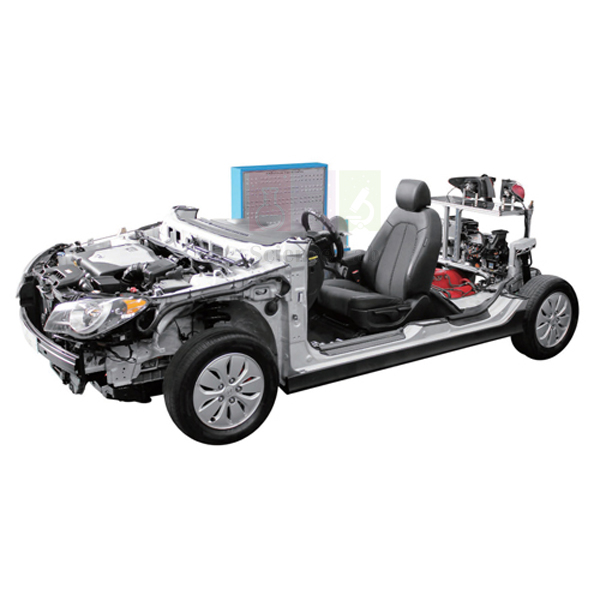
LPI Engine Fault Diagnosis Training Equipment Auto Fault
LPI Engine Fault Diagnosis Training Equipment Auto Fault (Product Code: SLE/ATE/20) is a hybrid powertrain trainer used to teach fault diagnosis on a 1,600cc LPI engine, hybrid motor and automatic transmission in advanced automotive training centres and engineering colleges. A hybrid control unit (HCU) links the ECU, TCM, BMS ECU, MCU and LDC by CAN communication, and a front control panel carries the check terminal and toggle switches. Jain Scientific Equipments Pvt Ltd (ScienceLab) manufactures the training stand and front control panel as the OEM at its own factory in Ambala, India; the LPI engine, hybrid motor and transmission assemblies are sourced production units, not made in Ambala.
Specifications
| Parameter | Detail |
|---|---|
| Powertrain | 1,600cc LPI engine and hybrid motor; engine and A/T automatic transmission |
| Engine style | I4 1.6 (1,591cc) |
| Control network | HCU (hybrid control unit) connected to ECU, TCM, BMS ECU, MCU and LDC by CAN communication |
| Sensors attached | Slant angle sensor, brake boost pressure sensor |
| Hybrid functions shown | Hybrid engine start; power support at idle or slow movement; driving force support when accelerating; energy recovery (battery charge) when decelerating, with brake switch |
| Front control panel | Display panel, ECU circuit, education check terminal, toggle switches; panel displays engine start and engine status |
| Diagnosis | With diagnosis equipment: sensor check, short circuit, failure diagnosis and output power |
| Weight | Approx. 1,300 kg |
| Size | Approx. 4,600 × 1,800 × 1,500 mm |
| Engine / assembly | Sourced production unit (as listed) |
| Product code | SLE/ATE/20 |
| Manufacturer | Jain Scientific Equipments Pvt Ltd (ScienceLab) — OEM |
| Country of origin | India (trainer built in Ambala, Haryana) |
Optional accessories, quoted on request:
- Laptop — CPU Intel Core i7; memory 8GB; USB 3.0; HDMI output; 256GB SSD
- Oscilloscope — 4 channels; bandwidth 20MHz (10MHz on ±50mV range); vertical resolution 12 bits; enhanced vertical resolution 16 bits; pulse width, runt pulse, dropout and windowed functions as listed; maximum post-trigger delay 50 s; maximum pre-trigger delay 10x the per-division time base setting
- Monitor — LED light source; 61 cm (24 inch) screen; resolution 1980 × 1080 as listed; HDMI and D-SUB inputs
What Is the LPI Hybrid Engine Fault Trainer Used For?
Hybrid systems are easiest to teach when students can watch several control units cooperate in real time. On this trainer, the instructor walks the class through each operating mode — hybrid start, idle or creep support, acceleration assist and energy recovery on braking — while the display panel shows engine start and status. Because the HCU, engine ECU, TCM, battery management ECU, motor control unit and LDC share a CAN network, students learn how a fault in one unit can appear as a symptom in another, which is central to modern hybrid diagnosis.
Diagnostic exercises use the education check terminal and toggle switches on the front panel: trainees check sensors, look for short circuits and confirm output power with diagnosis equipment, and the optional oscilloscope captures signals from the CAN-linked units. The unit is a substantial installation for engineering colleges looking for advanced lab equipment for technical institutes, so plan a dedicated bay with suitable floor strength and delivery access.
What to Specify When Ordering
- Whether the optional laptop, oscilloscope and monitor should be included in the quotation
- The number of trainers required for your workshop
- Delivery access and floor space for a unit of approximately 4,600 × 1,800 × 1,500 mm weighing about 1,300 kg
- Your site conditions, so fuel, ventilation and electrical needs can be confirmed with us before installation
OEM Manufacturer
Jain Scientific Equipments Private Limited, which trades as ScienceLab, is the OEM (original equipment manufacturer) of the training stand and front control panel, with its check terminal and toggle switches, of the LPI Engine Fault Diagnosis Training Equipment Auto Fault. These are built at the company's own licensed factory at Saha, Ambala, Haryana, India, and the complete trainer is supplied factory-direct to engineering colleges, training centres, dealers and importers. The 1,600cc LPI engine, hybrid motor and automatic transmission assemblies at its core are sourced production units, not made in Ambala.
The optional laptop, oscilloscope and monitor are standard computer and test equipment that can be quoted alongside it. For repeat orders or replacement parts, ask ScienceLab directly. Our company profile gives more background.
Related Automotive Training Equipment
Trainers that build the knowledge this hybrid unit relies on:
- Electric Vehicle Energy Management Training Equipment — continues the study of battery energy flow in electrified vehicles
- Engine management system (MPI) — engine control fundamentals before moving to hybrid control
- Automotive Engine Fault Diagnosis Simulator Auto Fault — conventional engine and A/T diagnosis for comparison
- Advanced Digital Multimeter — for sensor and short-circuit checks at the education check terminal
Explore the full Automotive Training Equipment range.
Frequently Asked Questions
Is the LPI Engine Fault Diagnosis Training Equipment Auto Fault an LPI or a hybrid trainer?
It is both. The LPI Engine Fault Diagnosis Training Equipment Auto Fault combines a 1,600cc LPI engine (I4 1.6, 1,591cc) with a hybrid motor and automatic transmission, managed by a hybrid control unit that simulates hybrid starting and energy recovery.
Which control units communicate on the CAN network?
On the LPI Engine Fault Diagnosis Training Equipment Auto Fault, the HCU sits at the centre and connects the ECU, TCM, BMS ECU, MCU and LDC through CAN communication, so students can study how a fault in one unit affects the others.
Are the laptop, oscilloscope and monitor included?
No. For the LPI Engine Fault Diagnosis Training Equipment Auto Fault, the laptop, oscilloscope and monitor are listed as options, with their specifications shown on this page. Tell us which options you want and they will be quoted alongside the trainer.
What fuel supply and site preparation does it need?
Fuel, ventilation and electrical requirements for the LPI Engine Fault Diagnosis Training Equipment Auto Fault are not detailed in our product documentation. Please contact us before installation planning so the site needs can be confirmed for your building.
How big is the installation?
The LPI Engine Fault Diagnosis Training Equipment Auto Fault measures approximately 4,600 × 1,800 × 1,500 mm and weighs about 1,300 kg, so it needs a ground-floor bay with suitable floor strength and a clear delivery route.
Who manufactures the LPI Engine Fault Diagnosis Training Equipment Auto Fault?
Jain Scientific Equipments Pvt Ltd (ScienceLab) manufactures the training stand and control panel of the LPI Engine Fault Diagnosis Training Equipment Auto Fault as the OEM at its own licensed factory at Saha, Ambala, India. The LPI engine, hybrid motor and transmission are sourced production units, not made in Ambala; the optional laptop, oscilloscope and monitor are standard equipment.
Is a calibration certificate available for the optional oscilloscope?
Calibration-certificate availability for the optional oscilloscope offered with the LPI Engine Fault Diagnosis Training Equipment Auto Fault depends on the order. Raise it through our contact page at the enquiry stage so it can be discussed before purchase.
Request a Quote
For a factory-direct quotation, installation planning and delivery, contact us or add this trainer to your enquiry cart.
Last updated: 24 September 2026
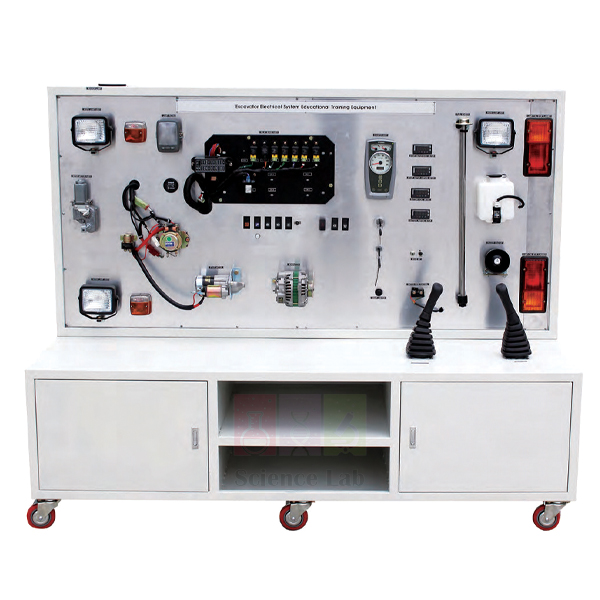
Excavator Electric Circuit Training Simulator
Excavator Electric Circuit Training Simulator (Product Code: SLE/ATE/21) is an open-layout electrical trainer used to teach troubleshooting and inspection of a hydraulic excavator's electric circuit in heavy-machinery and construction-equipment courses. It uses the electronic systems of a Hyundai heavy machinery excavator 555-7K, with parts that are hidden on a real machine laid open so trainees can see their location and operating state. It is supplied by Jain Scientific Equipments Pvt Ltd (ScienceLab), Ambala, India.
Specifications
| Parameter | Detail |
|---|---|
| Basis | Electronic systems of a Hyundai heavy machinery excavator 555-7K |
| Composition | Battery, operating lever, light system, horn, hydraulic lever, instrument panel, starter motor, battery connector, relay, digital meters, etc. |
| Layout | Components normally hidden on an actual machine are opened out to show operating state and location |
| Purpose | Understanding excavator electrical components; troubleshooting and inspection theory and training |
| Size | Approx. 2,000 × 600 × 1,700 mm |
| Training content | Measuring the input/output data in each component |
| Product code | SLE/ATE/21 |
| Supplied by | Jain Scientific Equipments Pvt Ltd (ScienceLab), Ambala, India |
What Is the Excavator Electrical Trainer Used For?
Excavator operators and service technicians meet electrical faults that are hard to trace on a working machine, where wiring runs behind panels and under the cab. On this simulator, trainees work the operating lever, hydraulic lever, horn and lights and watch the instrument panel respond, then measure the input and output at each component to learn what a healthy circuit looks like. With those normal values recorded, instructors can walk them through a logical fault-finding sequence: battery and connector first, then relays, starter motor and switches.
The open layout also helps with component identification for learners who will later work on real machines at construction and mining sites. In a TVET heavy-equipment workshop, pairing it with an operator simulator lets students learn both how the machine is driven and how its electrical system supports those controls. Disconnect the battery connector before changing any wiring on the panel.
Supplier
Jain Scientific Equipments Private Limited, trading as ScienceLab from Ambala, Haryana, India, supplies this excavator circuit simulator to ITIs, polytechnics, heavy-equipment training centres, dealers and importers in India and international markets. Because the trainer is based on the electronic systems of a Hyundai excavator, the company sources it and handles the quotation and delivery for the buyer.
Read more about ScienceLab on the company profile.
Related Automotive Training Equipment
Equipment for a complete heavy-machinery training area:
- Excavator VR Simulator — operator training on the same type of machine
- Wheel Loaders Electric Circuit Training Simulator — the matching electrical trainer for wheel loaders
- Electric Forklift Electric Circuit Training Simulator — extends circuit training to battery-electric material handling
- Digital Multimeter — a handheld meter for students' own input/output measurements
Browse all Automotive Training Equipment.
Frequently Asked Questions
Which excavator is the Excavator Electric Circuit Training Simulator based on?
The Excavator Electric Circuit Training Simulator uses the electronic systems of a Hyundai heavy machinery excavator 555-7K, laid out on an open frame of approximately 2,000 × 600 × 1,700 mm for classroom and workshop training.
Does it include working hydraulics?
No hydraulic pumps or cylinders are listed for the Excavator Electric Circuit Training Simulator. The hydraulic lever is included as part of the electrical control circuit, so students study the electrical side of the machine's hydraulic controls.
What do students measure?
On the Excavator Electric Circuit Training Simulator, students measure the input and output data at each component. Digital meters are part of the composition, and a handheld multimeter is useful so each learner can take independent readings.
What does the simulator weigh?
The weight of the Excavator Electric Circuit Training Simulator is not stated in our current documentation; its size is approximately 2,000 × 600 × 1,700 mm. Contact us for the shipping weight before planning delivery.
Is the battery supplied?
Yes. A battery and battery connector are listed in the composition of the Excavator Electric Circuit Training Simulator, along with the starter motor, relays, instrument panel, light system, horn and operating levers.
Who supplies the Excavator Electric Circuit Training Simulator?
The Excavator Electric Circuit Training Simulator is supplied by Jain Scientific Equipments Private Limited, which trades as ScienceLab from Ambala, Haryana, India, to training institutions, dealers and importers in India and international markets.
Request a Quote
To request a quotation, contact us or add the simulator to your enquiry cart.
Last updated: 24 September 2026
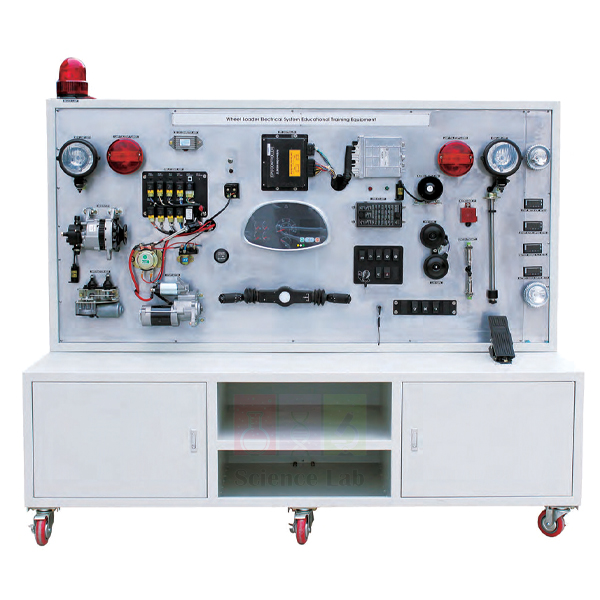
Wheel Loaders Electric Circuit Training Simulator
Wheel Loaders Electric Circuit Training Simulator (Product Code: SLE/ATE/22) is an open-frame electrical trainer used to teach troubleshooting and inspection of a heavy-machinery wheel loader's electric circuit in vocational and engineering workshops. It runs on a DC 24 V battery with an ECU, relays, starter motor, levers and built-in digital meters, so trainees can measure input and output data at each component. It comes from Jain Scientific Equipments Pvt Ltd (ScienceLab), the OEM manufacturer, and is made at its own factory in Ambala, India.
Specifications
| Parameter | Detail |
|---|---|
| Basis | Electric circuit equipment using a heavy machinery wheel loader |
| Power | DC 24 V battery |
| Composition | ECU, battery, operating lever, light system, horn, hydraulic lever, starter motor, battery connector, relay, digital meters |
| Meters | 2 A meter, 2 V meter (as listed), plus digital meters |
| Layout | Parts not visible on an actual machine are opened out to show operating state and location |
| Weight | Approx. 350 kg |
| Size | Approx. 2,000 × 600 × 1,700 mm |
| Training content | Measuring the input/output data in each component |
| Product code | SLE/ATE/22 |
| Manufacturer | Jain Scientific Equipments Pvt Ltd (ScienceLab) — OEM |
| Country of origin | India (made in Ambala, Haryana) |
What Is the Wheel Loader Electrical Trainer Used For?
Wheel loaders run on 24 V electrical systems with an ECU managing many functions, and trainees need to be comfortable with both before they work on machines in quarries, ports or construction sites. On this simulator, students operate the levers, lights and horn and crank the starter motor, reading the built-in meters to build a picture of normal circuit behaviour. Instructors then use that baseline to teach inspection routines and troubleshooting theory: checking the battery and connector, testing relays, and confirming the signals reaching and leaving the ECU.
Because the components are opened out where they can be seen, learners spend less time searching for parts and more time reasoning through a fault. The unit fits naturally into engineering educational equipment for heavy-machinery maintenance courses. Remove the battery connector before altering any wiring, and treat the 24 V battery with the same care as on a real machine.
OEM Manufacturer
ScienceLab is the trading name of Jain Scientific Equipments Private Limited, the OEM (original equipment manufacturer) of the Wheel Loaders Electric Circuit Training Simulator. The trainer is assembled at the company's own licensed factory at Saha, Ambala, Haryana, India, and delivered factory-direct to institutions, dealers and importers.
Buying from the manufacturer means quotations, repeat orders and questions about replacement relays, meters or other parts go to the team that builds the unit — ask us. The company profile explains more about the company.
Related Automotive Training Equipment
Other items for a heavy-machinery electrical lab:
- Excavator Electric Circuit Training Simulator — the same open-circuit approach applied to an excavator
- Electric Forklift Electric Circuit Training Simulator — circuit training for battery-electric forklifts
- Standard Digital Multimeter — for students to take their own readings at each component
- Heavy Duty Vehicles Differential Gear Model — covers the heavy-vehicle driveline side of loader maintenance
More trainers are available in Automotive Training Equipment.
Frequently Asked Questions
What system voltage does the Wheel Loaders Electric Circuit Training Simulator use?
The Wheel Loaders Electric Circuit Training Simulator runs from a DC 24 V battery, which is part of the composition, matching the heavy-machinery electric circuit it reproduces for measurement and fault-finding practice.
Is an ECU included?
Yes. The ECU is listed in the Wheel Loaders Electric Circuit Training Simulator together with the relays, starter motor, operating and hydraulic levers, light system, horn, battery connector and digital meters.
Which meters are fitted?
The Wheel Loaders Electric Circuit Training Simulator has digital meters, listed in the specification as 2 A meter and 2 V meter. For exact meter ranges or counts on the unit you are quoted, please contact us before ordering.
Which wheel loader model is the circuit taken from?
The Wheel Loaders Electric Circuit Training Simulator is described as electric circuit equipment from a heavy machinery wheel loader, without a named model. Ask us if your syllabus or tender requires a specific machine, and we will confirm what can be quoted.
How heavy is it and how much space does it need?
The Wheel Loaders Electric Circuit Training Simulator weighs approximately 350 kg and measures about 2,000 × 600 × 1,700 mm, so it can stand against a workshop wall with students working from the front.
Who manufactures the Wheel Loaders Electric Circuit Training Simulator?
Jain Scientific Equipments Private Limited, trading as ScienceLab, manufactures the Wheel Loaders Electric Circuit Training Simulator as the OEM at its own licensed factory at Saha, Ambala, Haryana, India, and supplies it directly to institutions, dealers and importers.
Request a Quote
Please send an enquiry or add the simulator to your enquiry cart for a quotation straight from the manufacturer.
Last updated: 24 September 2026
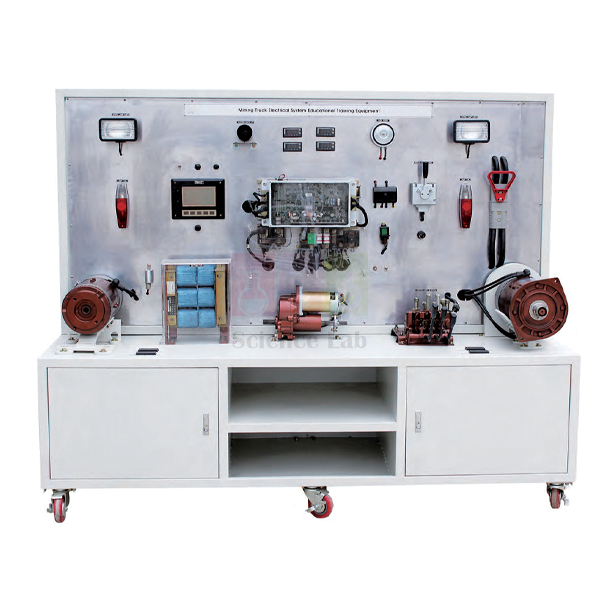
Electric Forklift Electric Circuit Training Simulator
Electric Forklift Electric Circuit Training Simulator (Product Code: SLE/ATE/23) is a training panel built from the electrical circuit device of a left-seat type electric forklift, used to teach inspection and troubleshooting of battery-electric material-handling vehicles. Its battery, levers, relays, instrument panel and motors are opened out, and the voltage and current of the driven rotor and hydraulic rotor can be measured during operation. The simulator is made by Jain Scientific Equipments Pvt Ltd (ScienceLab), the OEM manufacturer, at its own factory in Ambala, India.
Specifications
| Parameter | Detail |
|---|---|
| Basis | Electrical circuit device of a left-seat type electric forklift |
| Composition | Battery, operating lever, light system, horn, hydraulic lever, instrument panel, starter motor, battery connector, relay, digital meters, etc. |
| Live measurements | Voltage and current of the driven rotor and hydraulic rotor during operation |
| Layout | Components hidden on an actual forklift are opened out to show operating state and location |
| Weight | Approx. 350 kg |
| Size | Approx. 2,000 × 600 × 1,700 mm |
| Training content | Measuring the input/output data in each component |
| Product code | SLE/ATE/23 |
| Manufacturer | Jain Scientific Equipments Pvt Ltd (ScienceLab) — OEM |
| Country of origin | India (made in Ambala, Haryana) |
What Is the Electric Forklift Circuit Trainer Used For?
Battery-electric forklifts are common in warehouses and manufacturing plants, and their faults are usually electrical: a weak battery, a failed relay or a motor drawing abnormal current. This simulator lets trainees run the drive and hydraulic functions from the operating and hydraulic levers and watch the voltage and current of each rotor change with demand. Comparing the two rotors side by side shows why lifting and travelling place different loads on the battery.
A typical practical asks learners to record normal input/output values at every component and then use them as the reference when tracing a fault. As an entry point to electric-vehicle concepts, it gives vocational colleges a practical industrial example before students progress to road-vehicle EV systems, making it useful vocational training lab equipment for material-handling courses. Always isolate the battery connector before touching terminals or wiring.
OEM Manufacturer
The Electric Forklift Electric Circuit Training Simulator is built by its OEM (original equipment manufacturer), Jain Scientific Equipments Private Limited, which trades as ScienceLab. Assembly takes place at the company's own licensed factory at Saha, Ambala, Haryana, India.
Vocational colleges, industrial training centres, dealers and importers buy it factory-direct, and they can go back to the manufacturer for a matching unit or replacement parts later — ask us. Read more about the company on our company profile.
Related Automotive Training Equipment
Related trainers for electrical and electrified-vehicle courses:
- Electric Vehicle Energy Management Training Equipment — the next step into battery energy management on electric vehicles
- Excavator Electric Circuit Training Simulator — circuit training on a construction machine
- Wheel Loaders Electric Circuit Training Simulator — a wheel loader system with ECU for comparison
- Advanced Digital Multimeter — for independent voltage and current checks by each student
See more in our Automotive Training Equipment category.
Frequently Asked Questions
What can be measured on the Electric Forklift Electric Circuit Training Simulator?
The Electric Forklift Electric Circuit Training Simulator lets students measure voltage and current on the driven rotor and the hydraulic rotor during operation, as well as input and output data at each component of the circuit.
What is the battery voltage and capacity?
A battery is included in the Electric Forklift Electric Circuit Training Simulator, but its voltage and capacity are not stated in our product documentation. Contact us for the rating of the unit quoted before you plan charging arrangements.
Does it include a mast or forks?
No mast or forks are listed for the Electric Forklift Electric Circuit Training Simulator. It covers the forklift's electrical circuit, including the hydraulic lever and measurement of the hydraulic rotor, rather than the lifting mechanism itself.
How much space should we plan for?
Allow approximately 2,000 × 600 × 1,700 mm and about 350 kg for the Electric Forklift Electric Circuit Training Simulator, with room in front for students to operate the levers and take meter readings.
Who manufactures the Electric Forklift Electric Circuit Training Simulator?
The Electric Forklift Electric Circuit Training Simulator is manufactured by Jain Scientific Equipments Private Limited, trading as ScienceLab, as the OEM at its own licensed factory at Saha, Ambala, Haryana, India. Quotations and repeat orders come straight from the manufacturer.
Can it support an introductory electric-vehicle course?
Yes. The Electric Forklift Electric Circuit Training Simulator gives a practical industrial example of a battery-electric vehicle circuit, and it pairs well with our separate Electric Vehicle Energy Management Training Equipment for road-vehicle energy management.
Request a Quote
For a quotation from the manufacturer, contact us or add this simulator to your enquiry cart.
Last updated: 24 September 2026
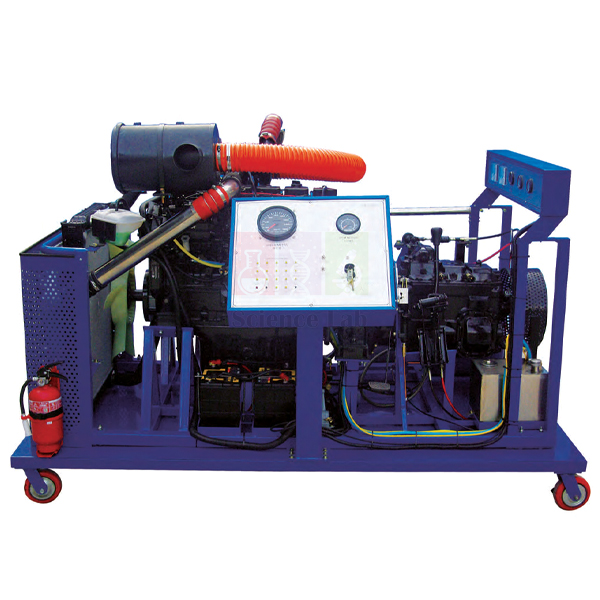
Large Yard Tractor Engine Fault Diagnosis System
Large Yard Tractor Engine Fault Diagnosis System (Product Code: SLE/ATE/24) is a heavy-duty engine simulator built on a Cummins diesel engine assembly of 400HP or more, used to teach fault diagnosis and maintenance of large diesel engines in heavy-vehicle training centres. Check terminals on the electrical circuit and sensors, a 20-port diagnosis terminal and an Auto Fault function support structured fault finding. The system is supplied by Jain Scientific Equipments Pvt Ltd (ScienceLab), Ambala, India.
Specifications
| Parameter | Detail |
|---|---|
| Engine | Cummins diesel engine assembly, 400HP or more |
| Fuel and electrical | Fuel filter, fuel tank (removable), fuel pump, fuel, battery, generator |
| Cooling | Radiator, electric fan cooling system, overflow tanks, antifreeze; stand for the radiator |
| Exhaust | Exhaust components such as an exhaust silencer |
| Controls | Ignition switch (key switch), control box, accelerator lever |
| Control panel | Meter, oil pressure gauge, power switch, power lamp, 20-port diagnosis terminal, voltmeter, ampere meter |
| Fault function | Auto Fault |
| Frame and protection | Stainless steel molded-type guards; laser processing protection panel; anti-vibration dampers; urethane wheels |
| Weight | Approx. 650 kg |
| Size | Approx. 2,400 × 1,500 × 1,500 mm |
| Product code | SLE/ATE/24 |
| Supplied by | Jain Scientific Equipments Pvt Ltd (ScienceLab), Ambala, India |
Training contents:
- Exhaust measurement; cylinder compression pressure measurement and inspection
- Connector-checking socket for inspection of sensors and actuators
- Fuel pump operation test; oil pressure measurement and inspection
- Measurement and adjustment of belt tension
- Inspection of automotive electrical parts, fuel system, ECU, sensors and actuators
- Radiator cap pressure measurement, radiator leak test and inspection
- Inspection of every part of the suction and exhaust system
- Inspection of the cooling system, belts and all kinds of pumps
- Inspection of the remaining parts
- Voltage and current measurement and inspection of circuits such as the charging circuit and maneuver circuit
What Is the Yard Tractor Engine Fault Simulator Used For?
Port terminals, logistics yards and heavy-vehicle service centres rely on technicians who can diagnose large diesel engines quickly, and practising on a full-size engine is the most direct way to build that skill. On this system, trainees start the engine from the key switch, monitor oil pressure, voltage and current on the control panel, and use the 20-port diagnosis terminal and connector-checking socket to test sensors, actuators and the ECU. Mechanical checks — compression, belt tension, radiator cap pressure and leak testing — complete a service routine that mirrors real workshop practice.
Because the engine is much larger than those on passenger-car trainers, it gives students a realistic feel for heavy-duty cooling, fuel and charging systems. Use it as the capstone unit of a TVET heavy-vehicle curriculum, after learners have covered smaller diesel engines. Run it only with good ventilation or exhaust extraction, keep the stainless guards fitted, and let the cooling system cool before opening the radiator cap.
Supplier
Jain Scientific Equipments Private Limited, which trades as ScienceLab from Ambala, Haryana, India, supplies the Large Yard Tractor Engine Fault Diagnosis System to heavy-vehicle training centres, colleges, dealers and importers. As the system is built around a Cummins engine, the company sources it and manages the quotation and delivery for buyers in India and international markets.
To learn more about ScienceLab, visit our company profile.
Related Automotive Training Equipment
Useful trainers for a heavy-vehicle workshop:
- Diesel Engine Fault Diagnosis Training Equipment Auto Fault — a smaller diesel fault trainer to prepare students first
- Trailer Air Brake Training Equipment — air brake and ABS training for the trucks and trailers these tractors move
- Heavy Duty Vehicles Differential Gear Model — the heavy-duty driveline downstream of the engine
- Digital Multimeter — for charging and maneuver circuit voltage and current checks
View all Automotive Training Equipment.
Frequently Asked Questions
What engine is installed in the Large Yard Tractor Engine Fault Diagnosis System?
The Large Yard Tractor Engine Fault Diagnosis System is built on a Cummins diesel engine assembly of 400HP or more, with its fuel, cooling, suction and exhaust systems, battery and generator mounted on the same stand.
What instruments are on the control panel?
The control panel of the Large Yard Tractor Engine Fault Diagnosis System carries a meter, oil pressure gauge, voltmeter, ampere meter, power switch, power lamp and a 20-port diagnosis terminal for sensor and circuit testing.
What faults can be set with the Auto Fault function?
Auto Fault is listed as a feature of the Large Yard Tractor Engine Fault Diagnosis System, but the list of fault conditions is not given in our current documentation. Contact us for the fault list before ordering if your assessment plan depends on it.
How large and heavy is the system?
The Large Yard Tractor Engine Fault Diagnosis System measures approximately 2,400 × 1,500 × 1,500 mm and weighs about 650 kg. Urethane wheels with anti-vibration dampers let it be moved across a level workshop floor.
What site services should we prepare?
Because the engine of the Large Yard Tractor Engine Fault Diagnosis System runs, plan for good ventilation or exhaust extraction. Fuel and electrical requirements are not detailed in our documentation, so ask us to confirm them before installation.
Who supplies the Large Yard Tractor Engine Fault Diagnosis System?
Jain Scientific Equipments Private Limited, trading as ScienceLab from Ambala, Haryana, India, supplies the Large Yard Tractor Engine Fault Diagnosis System to heavy-vehicle training centres, colleges, dealers and importers in India and international markets.
Is a calibration certificate available for the gauges and meters?
Calibration-certificate availability for the gauges and meters on the Large Yard Tractor Engine Fault Diagnosis System depends on the order. Please mention the requirement through our contact page when you request a quotation.
Request a Quote
For a quotation and delivery details, contact us or add this system to your enquiry cart.
Last updated: 24 September 2026
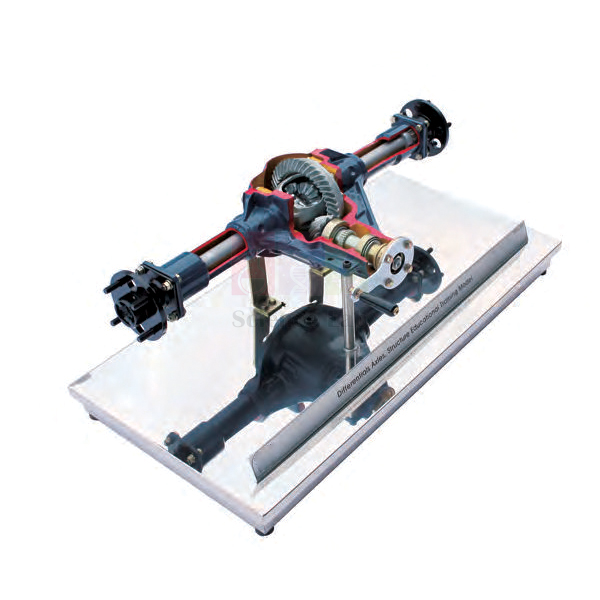
Differential Gear
Differential Gear (Product Code: SLE/ATE/25) is a manually operated cut-section trainer used to teach how a vehicle differential divides driving power between the wheels in automobile engineering classrooms and workshops. Built around a real axle differential, it lets ITI, polytechnic and engineering students turn the gears by hand and follow each colour-painted part. Jain Scientific Equipments Pvt Ltd (ScienceLab), an OEM manufacturer of engineering lab equipment in India, builds it at its own factory in Ambala, India.
Specifications
| Parameter | Detail |
|---|---|
| Composition | Differential gear (real axle) |
| Operation | Manual type — gear movement observed by hand operation |
| Construction | Structure education unit with incised (cut-away) sections |
| Colour coding | Incised sections painted in different colours for teaching clarity |
| Weight | Approx. 40 kg |
| Size | Approx. 800 × 500 × 300 mm |
| Product code | SLE/ATE/25 |
| Manufacturer | Jain Scientific Equipments Pvt Ltd (ScienceLab) — OEM |
| Country of origin | India (made in Ambala, Haryana) |
What Is the Differential Gear Trainer Used For?
In a driveline lesson the instructor first rotates the input with both wheel ends free, so the class sees the two sides turn together, and then holds one side still to show how the differential lets the opposite side speed up. This is the same action that allows a vehicle to take a corner without the inner and outer wheels fighting each other. Because each cut section carries its own colour, learners can trace the power path through the differential to each axle shaft and explain the job of every part before they dismantle a real vehicle.
At roughly 40 kg the unit sits comfortably on a sturdy workbench or trolley, which suits lab equipments for technical institutes where one trainer is shared between several classes; plan on two people for lifting. Keep the exposed gear teeth free of dust, and turn the assembly slowly during demonstrations so students can follow each gear in turn.
OEM Manufacturer
Jain Scientific Equipments Private Limited, which trades as ScienceLab, is the OEM (original equipment manufacturer) of this Differential Gear trainer. The cut-section unit is made and assembled at the company’s own licensed factory at Saha, Ambala, Haryana, India, rather than sourced from a trader, so colleges and dealers deal directly with the maker. For vendor registration, the company’s GSTIN is 06AAECJ8618A1ZT and its Legal Entity Identifier (LEI) is 3358004HRD1JIVXKYX49. Read more in our company profile.
Related Automotive Training Equipment
Trainers that work well alongside this unit when teaching how power reaches the wheels:
- Heavy Duty Vehicles Differential Gear Model — the same principle at heavy-machinery scale, with planetary gearing visible at the wheel
- Tractor Differential Gear Model — a motor-driven tractor axle and reduction gear model for comparing agricultural drivelines
- FF Auto Transmission Stand Type — covers the transmission stage that sits ahead of the final drive
- Automotive Power Train Training Equipment DOHC Gasoline — shows where engine torque originates before it reaches the axle
See the complete Automotive Training Equipment range for more driveline, engine and diagnostic trainers.
Frequently Asked Questions
Is the Differential Gear trainer motor-driven?
No. The Differential Gear (SLE/ATE/25) is a manual type unit that students turn by hand, so they can watch each gear at their own pace. For a powered demonstration, the Tractor Differential Gear Model uses a geared motor with speed control.
Is the Differential Gear made from a real differential?
Yes. The Differential Gear trainer is built from a real axle differential gear, with incised sections cut open and painted in different colours so that the internal parts of the differential can be seen and named during a lesson.
How large and heavy is the Differential Gear trainer?
The Differential Gear trainer measures approx. 800 × 500 × 300 mm and weighs approx. 40 kg. A stand or trolley is not listed in its specification, so place it on a sturdy bench, lift it with two people, and contact us if you need a stand.
Which topics can the Differential Gear trainer teach?
The Differential Gear trainer teaches identification of each part of an axle differential, its operating functions and the principle of power delivery to the wheels, including why the left and right wheels must turn at different speeds when a vehicle corners.
Who manufactures the Differential Gear trainer?
Jain Scientific Equipments Pvt Ltd (ScienceLab) is the OEM manufacturer of the Differential Gear (SLE/ATE/25). It is made at the company’s own licensed factory at Saha, Ambala, Haryana, India, and quotations, repeat orders and replacement-part enquiries are handled by the manufacturer directly.
What should a quotation request for the Differential Gear include?
A quotation request for the Differential Gear should give the product code SLE/ATE/25, the number of units, the delivery location and any tender or documentation requirements, so that ScienceLab can return a complete, factory-direct quotation in one step.
Can the Differential Gear trainer be supplied outside India?
Yes. ScienceLab supplies the Differential Gear trainer to training institutes, dealers and importers in India and international markets; packing and shipping arrangements are agreed when the quotation is prepared.
Request a Quote
To request pricing and availability for the Differential Gear (SLE/ATE/25), contact our team with your quantity and delivery location, or add it to the enquiry cart together with any other automotive trainers you need. Quotations come direct from the manufacturer.
Last updated: 24 September 2026
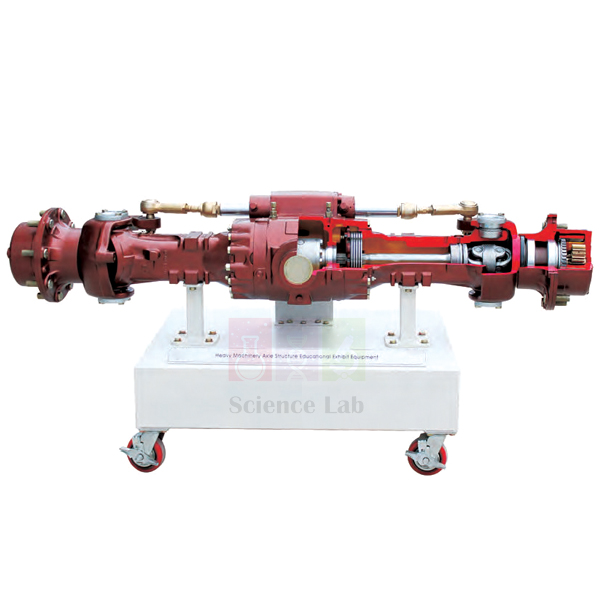
Heavy Duty Vehicles Differential Gear Model
Heavy Duty Vehicles Differential Gear Model (Product Code: SLE/ATE/26) is an opened-up heavy machinery differential used to train mechanics in the inspection and troubleshooting of heavy vehicle axles in workshops and vocational institutes. Its distinguishing feature is that the planetary gear can be seen directly on the wheel, alongside colour-coded components on a wheeled steel stand. The model is made by Jain Scientific Equipments Pvt Ltd (ScienceLab), an OEM and vocational training lab equipment manufacturer in India, at its own factory in Ambala.
Specifications
| Parameter | Detail |
|---|---|
| Composition | Large heavy machinery differential gear |
| Visibility | Parts not visible on an actual unit are opened up; planetary gear can be seen directly on the wheel |
| Colour coding | Each component coloured differently for educational effect |
| Stand | Steel frame with 5-inch lockable wheels |
| Weight | Approx. 150 kg |
| Size | Approx. 2,000 × 800 × 500 mm |
| Training focus | Component identification, operating state, inspection and troubleshooting |
| Product code | SLE/ATE/26 |
| Manufacturer | Jain Scientific Equipments Pvt Ltd (ScienceLab) — OEM |
| Country of origin | India (made in Ambala, Haryana) |
What Is the Heavy Duty Differential Gear Model Used For?
Heavy machines usually add a final reduction stage at the wheel hub, and this model makes that arrangement visible: trainees can follow drive from the differential out along the axle to the planetary set on the wheel and see why torque is multiplied close to the tyre rather than through the half-shafts. Instructors use it to walk a group through an inspection routine — where each component sits, what its normal operating state looks like and which part is likely to cause symptoms such as noise, uneven drive or overheating at one wheel end.
Because the steel frame runs on lockable wheels, the model can be rolled between workshop bays and locked in place before a session; allow clear floor space around its 2-metre length so a class can walk around both sides. As engineering lab equipment in India’s heavy-equipment training centres, it also works well for assessment, with trainees asked to point out and name components against the colour coding.
OEM Manufacturer
ScienceLab is the trading name of Jain Scientific Equipments Private Limited, the OEM (original equipment manufacturer) of this heavy-duty differential model. The model is built on its wheeled steel frame and finished at the company’s own licensed factory at Saha, Ambala, Haryana, India, and is supplied factory-direct to ITIs, polytechnics, engineering colleges, dealers and importers. For spares or matching repeat units later, ask us — the enquiry goes straight to the manufacturer. Company background is on our company profile.
Related Automotive Training Equipment
Other trainers used in heavy vehicle and machinery drivetrain courses:
- Differential Gear — a compact, hand-operated cut-section differential for introducing the basic principle first
- Tractor Differential Gear Model — a motor-driven tractor shaft and reduction gear model for farm machinery courses
- Trailer Air Brake Training Equipment — extends heavy vehicle training to air braking
- CRDI Diesel Engine Power Train System F/R Type — a diesel power train trainer covering the drive that feeds the axle
Browse the full Automotive Training Equipment category for engine, transmission and circuit simulators.
Frequently Asked Questions
How does the Heavy Duty Vehicles Differential Gear Model show the planetary gear?
The Heavy Duty Vehicles Differential Gear Model opens up parts that cannot be seen on an actual machine, so trainees can view the planetary gear directly on the wheel together with the differential and axle components, each painted in its own colour.
Can the heavy duty differential model be moved around a workshop?
Yes. The Heavy Duty Vehicles Differential Gear Model sits on a steel frame with 5-inch lockable wheels. Because it weighs approx. 150 kg, roll it only on a level floor and lock the wheels before a class gathers around it.
How much floor space does the Heavy Duty Vehicles Differential Gear Model need?
The Heavy Duty Vehicles Differential Gear Model measures approx. 2,000 × 800 × 500 mm. Allow extra clear space on both long sides so that a group of trainees can walk around it and point out components during inspection exercises.
Does the Heavy Duty Vehicles Differential Gear Model need electricity?
No motor or electrical supply is listed for the Heavy Duty Vehicles Differential Gear Model; it is an opened-up unit for inspection study. For a powered driveline demonstration, see the motor-driven Tractor Differential Gear Model or contact us.
Who manufactures the Heavy Duty Vehicles Differential Gear Model?
Jain Scientific Equipments Pvt Ltd (ScienceLab) manufactures the Heavy Duty Vehicles Differential Gear Model as the OEM, at its own licensed factory at Saha, Ambala, Haryana, India. Institutions and dealers receive quotations directly from the manufacturer rather than through a trader.
Which courses use the Heavy Duty Vehicles Differential Gear Model?
The Heavy Duty Vehicles Differential Gear Model suits heavy equipment mechanic and operator programmes, ITIs, polytechnics and engineering colleges that teach the inspection and troubleshooting of heavy vehicle and earth-moving machinery axles.
Can several units be ordered, including for export?
Yes. ScienceLab quotes multi-unit orders of the Heavy Duty Vehicles Differential Gear Model (SLE/ATE/26) for buyers in India and international markets; share the quantity and delivery location so that packing and freight can be included.
Request a Quote
For a quotation on the Heavy Duty Vehicles Differential Gear Model (SLE/ATE/26), send your requirement through our contact page or add the model to the enquiry cart with the rest of your workshop list. You will receive the quotation directly from the manufacturer.
Last updated: 24 September 2026
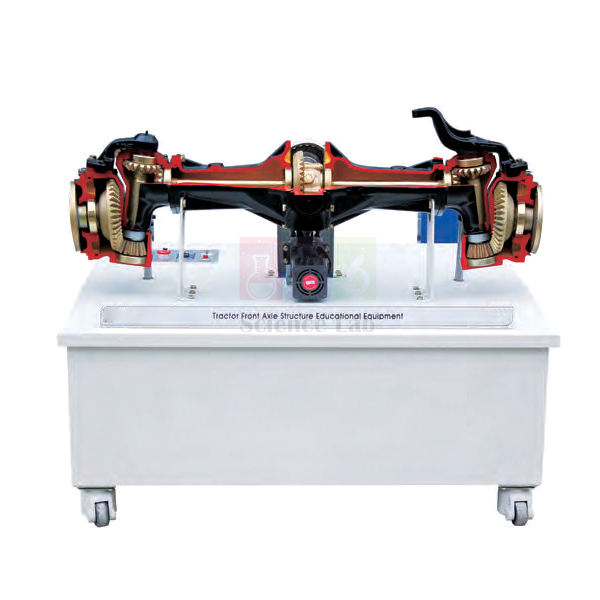
Tractor Differential Gear Model
Tractor Differential Gear Model (Product Code: SLE/ATE/27) is a motor-driven educational model of tractor shafts used to teach how the differential, axle, reduction gears and wheels of a tractor work together in agricultural engineering and farm machinery training. A single phase 220V, 180W geared motor with speed control lets trainees watch the driveline turn slowly, with hidden parts opened up and colour-coded. The OEM manufacturer, Jain Scientific Equipments Pvt Ltd (ScienceLab), builds it at its own factory in Ambala, India, as technical educational equipment for training institutes.
Specifications
| Parameter | Detail |
|---|---|
| Motor | Single phase 220V, 180W, reduction gear mounted |
| Composition | Tractor shafts, power switch, power lamp, emergency switch, fuse holder and speed control |
| Systems shown | Differentials, axle, reduction gears and wheel operation |
| Construction | Parts not seen on an actual tractor are opened for viewing; each component coloured differently |
| Stand | Steel frame with 5-inch lockable wheels |
| Weight | Approx. 150 kg |
| Size | Approx. 1,500 × 800 × 800 mm |
| Product code | SLE/ATE/27 |
| Manufacturer | Jain Scientific Equipments Pvt Ltd (ScienceLab) — OEM |
| Country of origin | India (made in Ambala, Haryana) |
What Is the Tractor Differential Gear Model Used For?
Tractors need very high torque at low wheel speed, so their rear axles combine a differential with additional reduction gearing. With this model switched on and the speed control turned low, trainees can observe that chain in motion: drive enters the differential, is split between the two sides, and is reduced again before it reaches the wheels. Instructors typically pause at each stage to compare shaft speeds, then link what the class sees to common field faults and to the inspection points a mechanic checks during servicing.
The power lamp shows when the unit is live and the emergency switch sits within reach of the demonstrator, which matters when a group stands close to rotating gears — keep hands, sleeves and pointers clear while it runs. For engineering educational equipments in India that must move between a classroom and a workshop, the lockable wheels on the steel frame make repositioning straightforward; lock them before starting the motor.
OEM Manufacturer
Jain Scientific Equipments Private Limited (trading as ScienceLab) is the original equipment manufacturer of the Tractor Differential Gear Model. The motorised unit, with its switches, fuse holder and speed control, is assembled and wired at the company’s own licensed factory at Saha, Ambala, Haryana, India, not bought in from a reseller. Because you are dealing with the maker, questions about replacement parts or additional units can be raised with us directly. Visit our company profile to learn more.
Related Automotive Training Equipment
Useful companions for a farm machinery or tractor mechanic lab:
- Large Yard Tractor Engine Fault Diagnosis System — covers the engine side of tractor-type machines
- Clutch Structure Trainer Mechanical Manual — explains the clutch that connects the engine to the driveline
- Differential Gear — a hand-operated real-axle differential for close-up study of the gear set
- Heavy Duty Vehicles Differential Gear Model — compares tractor gearing with heavy machinery planetary wheel drive
The whole Automotive Training Equipment range is listed in one category.
Frequently Asked Questions
What power supply does the Tractor Differential Gear Model need?
The Tractor Differential Gear Model runs on a single phase 220V supply. Its drive is a 180W motor with a mounted reduction gear, and a fuse holder is part of the circuit, so check that your workshop socket matches before installation.
Can the running speed of the tractor model be changed?
Yes. The Tractor Differential Gear Model includes a speed control, so instructors can run the tractor shafts slowly enough for trainees to follow each gear, and pause between stages of the explanation.
What safety features does the Tractor Differential Gear Model have?
The Tractor Differential Gear Model has a power switch, a power lamp that shows when it is live, an emergency switch and a fuse holder. Because the gears rotate in the open, keep hands, sleeves and pointers clear while it runs.
How big and heavy is the Tractor Differential Gear Model?
The Tractor Differential Gear Model measures approx. 1,500 × 800 × 800 mm and weighs approx. 150 kg. It stands on a steel frame with 5-inch lockable wheels, so it can be moved between rooms and locked in place before the motor starts.
Who manufactures the Tractor Differential Gear Model?
Jain Scientific Equipments Pvt Ltd (ScienceLab) is the OEM manufacturer of the Tractor Differential Gear Model (SLE/ATE/27), producing it at its own licensed factory at Saha, Ambala, Haryana, India, and supplying it factory-direct to institutions, dealers and importers.
Are spare fuses or a user manual supplied with the tractor model?
Spare fuses and a user manual are not listed in the Tractor Differential Gear Model’s specification. Please confirm what is packed with the unit through our contact page before ordering, so that it can be stated on your quotation.
What details does a Tractor Differential Gear Model quotation need?
For a Tractor Differential Gear Model quotation, give the code SLE/ATE/27, the quantity, the delivery address and your mains supply voltage. ScienceLab supplies institutions in India and international markets directly from its factory.
Request a Quote
Ask for a quotation on the Tractor Differential Gear Model via our contact form, or place it in the enquiry cart and submit your list in one go. Pricing comes straight from the manufacturer.
Last updated: 24 September 2026
835.jpg)
Engine management system (MPI)
Engine management system (MPI) (Product Code: SLE/ATE/28) is a mobile training stand used to teach the operation, measurement and fault diagnosis of a gasoline multipoint injection engine management system in automotive technician labs. Trainees can simulate 15 system errors by pulling plugs, read and clear codes through a 16-pin diagnostic socket, and watch fuel flow and spark plugs at work. The stand and its fault-simulation system are built by Jain Scientific Equipments Pvt Ltd (ScienceLab), an OEM and technical educational equipment manufacturer, at its own factory in Ambala, India; the MPI engine management system installed on it is a sourced production unit, not made in Ambala.
Specifications
| Parameter | Detail |
|---|---|
| Purpose | Practical and laboratory training/testing of a gasoline MPI engine management system |
| System | Gasoline injector engine management system with multipoint petrol injection, installed in the upper part of the stand |
| Stand | Mobile, on four wheels; closed structure with internal wiring not visible |
| Size | 1860 × 1450 × 700 mm |
| Power | Network power supply (220/12V) and a 12V battery |
| Fuel system monitoring | Amount of injected fuel, fuel supply system and fuel pump pressure; fuel pump and distribution system built so the fuel flow distribution can be seen |
| Engine speed | Adjustable crankshaft rotation speed |
| Air intake | Adjustable air flow in the intake manifold for demonstrating the air mass flow and air temperature sensors |
| Mixture control | Air/fuel mixture can be altered with an O2 sensor signal simulator |
| Ignition | Ignition system and spark plugs mounted for visual monitoring; high voltage circuit measurements possible; flame intensity measured by adjusting the ignition gap |
| Operation check | Injector and spark operation checked in the plug sequence 1, 3, 4, 2, with inspection of each sensor |
| Electrical measurement | Built-in voltmeter; principal electrical circuit diagram of the MPI system with built-in measurement connectors; electrical parameters of any component measurable; waveforms checked against RPM |
| Fault simulation | 15 system errors simulated by disconnecting plugs from connectors |
| Diagnostics | Control unit diagnostics via 16-pin diagnostic socket; reading and deletion of detected errors; system parameter control; control unit coding/configuration |
| Included with the stand | Exam/practical work simulation terminal (able to simulate not less than 10 different system errors), automobile oscilloscope, diagnostics equipment |
| Engine / assembly | Sourced production unit (as listed) |
| Product code | SLE/ATE/28 |
| Manufacturer | Jain Scientific Equipments Pvt Ltd (ScienceLab) — OEM |
| Country of origin | India (trainer built in Ambala, Haryana) |
What Is the MPI Engine Management Training Stand Used For?
A typical lab session starts with the system running normally: students vary crankshaft speed and intake air flow, watch the fuel distribution and spark plugs, and capture injector and ignition waveforms on the automobile oscilloscope to see how they change with RPM. The instructor then uses the O2 sensor signal simulator to push the mixture rich or lean, so learners see how the engine management system responds to sensor input and why oxygen sensor faults affect fuelling.
Fault-finding practice follows. Plugs are pulled to create any of the 15 built-in errors, and trainees work only from the circuit diagram, measurement connectors and diagnostics equipment — since the internal wiring is hidden, they must diagnose by measurement rather than by tracing wires, as on a real vehicle. Codes are read and cleared through the 16-pin socket, and the exam terminal supports assessed practical tests, making the stand useful lab equipment for technical institutes preparing technicians for petrol injection service work.
OEM Manufacturer
ScienceLab is the trading name of Jain Scientific Equipments Private Limited, the OEM (original equipment manufacturer) of this MPI training stand. The mobile stand, with its circuit diagram, built-in measurement connectors and fault-simulation system, is built at the company's own licensed factory at Saha, Ambala, Haryana, India; the gasoline MPI engine management system installed in the upper part of the stand is a sourced production unit, not made in Ambala. The complete stand is supplied factory-direct to colleges, ITIs, dealers and importers, and details of the included oscilloscope and diagnostics equipment can be requested from us with the quotation. More about the company is on our company profile.
Related Automotive Training Equipment
Trainers and instruments that complement an engine management lab:
- Automotive Engine Fault Diagnosis Simulator Auto Fault — additional engine fault-finding practice for larger groups
- LPI Engine Fault Diagnosis Training Equipment Auto Fault — compares petrol MPI with an LPI fuel system
- CRDI (Common Rail Direct Injector) System — the diesel common-rail counterpart for comparing injection strategies
- Automotive Power Train Training Equipment DOHC Gasoline — a complete gasoline power train for mechanical context
- Digital Multimeter — extra hand-held meters so several students can measure at the connectors
More engine and diagnostic trainers are listed under Automotive Training Equipment.
Frequently Asked Questions
How many faults can the Engine management system (MPI) stand simulate?
The Engine management system (MPI) stand simulates 15 system errors when plugs are disconnected from its connectors. Its exam and practical work simulation terminal is specified to simulate not less than 10 different system errors for assessed tests.
What diagnostic tools come with the Engine management system (MPI)?
The Engine management system (MPI) training stand includes an exam/practical work simulation terminal, an automobile oscilloscope and diagnostics equipment. Their makes and models are not stated in the listing, so contact us if your tender specification names particular instruments.
Can students read and clear fault codes on the MPI stand?
Yes. The Engine management system (MPI) supports control unit diagnostics through a 16-pin diagnostic socket, including reading and deleting detected errors, system parameter control and control unit coding or configuration.
What power does the Engine management system (MPI) stand use?
The Engine management system (MPI) stand is equipped with a network power supply (220/12V) and a 12V battery, so it needs a standard mains socket close to where the mobile stand will be used during practicals.
Why is the wiring of the MPI stand hidden?
The Engine management system (MPI) stand has a closed structure so that trainees must diagnose faults by measuring at the connectors on the circuit diagram, as they would on a vehicle, instead of simply following visible wires.
Who manufactures the Engine management system (MPI) training stand?
Jain Scientific Equipments Pvt Ltd (ScienceLab) is the OEM manufacturer of the Engine management system (MPI) training stand and its fault-simulation system, built at the company's own licensed factory at Saha, Ambala, Haryana, India. The gasoline MPI engine management system mounted on the stand is a sourced production unit, not made in Ambala.
How much floor space does the MPI stand need?
The Engine management system (MPI) training stand measures 1860 × 1450 × 700 mm and moves on four wheels, so it can be rolled into position where a group of trainees can gather around the engine, ignition system and circuit diagram.
Request a Quote
Send your requirement for the Engine management system (MPI), SLE/ATE/28, through our contact page, or add it to the enquiry cart. Quotations for institutions in India and international markets come direct from the manufacturer.
Last updated: 24 September 2026
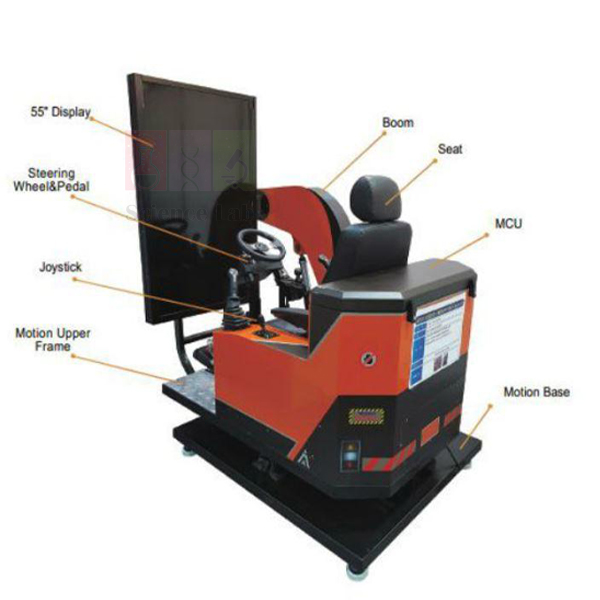
Excavator VR Simulator
Excavator VR Simulator (Product Code: SLE/ATE/29) is an orbital-type excavator operator simulator used to train drivers in driving and digging before they work on a real machine, in heavy equipment operator schools and vocational institutes. It combines 360-degree infinite rotation, 1-axis pitch motion and joystick levers of the kind used on real excavators with 55-inch Full HD displays. It is supplied by Jain Scientific Equipments Pvt Ltd (ScienceLab), Ambala, India, among its lab equipments for technical institutes.
Specifications
| Parameter | Detail |
|---|---|
| Simulator type | Orbital-type, endless-track excavator simulator |
| Rotation | 360 degree infinite rotation function |
| Motion | 1-axis motion (pitch), for functional test training |
| Running lever | Orbital type, 2-axis |
| Operator controls | Excavator joystick levers as used in real equipment |
| Display | 55-inch Full HD; horizontal type and vertical type both listed |
| Training content | Driving test and excavation test training in an actual test-site environment |
| Training video | For the functional exam (driving, digging) |
| Versions | Two simulators for excavator training are listed — confirm the configuration when enquiring |
| Product code | SLE/ATE/29 |
| Supplied by | Jain Scientific Equipments Pvt Ltd (ScienceLab), Ambala, India |
What Is the Excavator VR Simulator Used For?
New operators often struggle most with coordinating boom, arm, bucket and swing at the same time. On this simulator they learn that coordination on the same style of joystick levers they will later use, with the 360-degree orbital rotation reproducing continuous slewing of the upper structure and the pitch motion giving a sense of the machine tilting as it digs or travels. Mistakes cost nothing in fuel, wear or damage, so instructors can repeat an exercise until the movement becomes natural.
Courses usually progress from track driving to trenching and loading tasks, then to rehearsal of the functional exam using the driving and digging training video and the simulated test-site scenes. Short, focused sessions work best for beginners. For a vocational institute building a heavy-machinery wing, the simulator sits well alongside technical training equipment for operators and maintenance staff.
What to Specify When Ordering
- Which of the two listed excavator simulator versions suits your course (describe your training plan if unsure).
- Display type: 55-inch Full HD horizontal type or vertical type.
- Number of simulators needed for your trainee batch sizes.
- Whether the functional-exam training video (driving, digging) should be part of the quotation.
Supplier
ScienceLab is the trading name of Jain Scientific Equipments Private Limited, Ambala, Haryana, India, which supplies the Excavator VR Simulator to operator-training schools, construction skills centres and vocational institutes. For vendor registration in tenders, the supplying company’s GSTIN is 06AAECJ8618A1ZT and its Legal Entity Identifier (LEI) is 3358004HRD1JIVXKYX49. More about the company is on our company profile.
Related Automotive Training Equipment
Other heavy-machinery trainers that pair with operator simulation:
- Excavator Electric Circuit Training Simulator — teaches the electrical systems of the same machine type to maintenance trainees
- Wheel Loaders Electric Circuit Training Simulator — extends the programme to another common earth-moving machine
- Electric Forklift Electric Circuit Training Simulator — for material-handling equipment courses
- Heavy Duty Vehicles Differential Gear Model — shows heavy machinery driveline and planetary wheel gearing
All engine, driveline and machinery trainers are grouped under Automotive Training Equipment.
Frequently Asked Questions
Does the Excavator VR Simulator use a VR headset?
A headset is not listed for the Excavator VR Simulator; its specification describes 55-inch Full HD displays in horizontal and vertical types. Please contact us to confirm the viewing system before you order, so the quotation matches your training plan.
What motion does the Excavator VR Simulator provide?
The Excavator VR Simulator applies 1-axis motion (pitch) for functional test training, combined with an orbital design capable of 360-degree infinite rotation, so trainees experience tilting and continuous slewing as on an endless-track excavator.
Are the Excavator VR Simulator controls like a real excavator?
Yes. The Excavator VR Simulator uses excavator joystick levers of the type fitted to real equipment, together with a 2-axis orbital running lever, so the hand movements trainees practise carry over to a working machine.
What training content does the Excavator VR Simulator include?
The Excavator VR Simulator provides driving test and excavation test training in a simulated actual test-site environment, plus a training video for the functional exam covering driving and digging, which helps candidates rehearse the exam sequence.
Which Excavator VR Simulator version should we choose?
Two excavator simulators are listed for the Excavator VR Simulator, and its display is listed in 55-inch horizontal and vertical types. Tell us your course structure and trainee numbers, and we will suggest a configuration for the quotation.
Who supplies the Excavator VR Simulator?
Jain Scientific Equipments Pvt Ltd (ScienceLab), Ambala, India, supplies the Excavator VR Simulator (SLE/ATE/29) to training institutes in India and international markets. Quotations, delivery terms and configuration questions are handled directly by our team through the contact page.
What power supply and room size does the Excavator VR Simulator need?
Electrical and footprint requirements are not given in the current Excavator VR Simulator listing. Ask for them when you request a quotation, and our team will confirm them for the configuration you choose.
Request a Quote
To receive a quotation for the Excavator VR Simulator (SLE/ATE/29), write to us through the contact page or add it to your enquiry cart, mentioning the display type you prefer.
Last updated: 24 September 2026
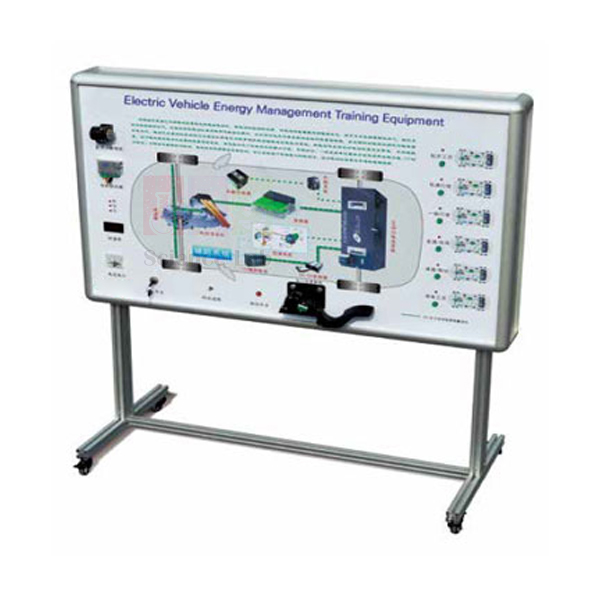
Electric Vehicle Energy Management Training Equipment
Electric Vehicle Energy Management Training Equipment (Product Code: SLE/ATE/30) is a panel trainer used to show how energy flows through an electric vehicle drive system in automobile engineering and EV technology classrooms. It simulates six conditions — start, low speed, general driving, full speed, slowing down and stop — with LED energy-flow paths and an analog motor, and runs from 220V AC with no battery to charge. Jain Scientific Equipments Pvt Ltd (ScienceLab), an OEM engineering lab equipment manufacturer, makes it at its own factory in Ambala, India.
Specifications
| Parameter | Detail |
|---|---|
| System | Electric vehicle energy management system |
| Simulated conditions | Six: start, low speed, general driving, full speed, slow down and stop |
| Panel controls and indicators | Ignition switch, operating condition switch, throttle pedal, gear switch, brake switch, digital tachometer, current indicator, etc. |
| Energy-flow display | Light-emitting diode system showing the dynamic direction of energy flow |
| Motor demonstration | Analog motor used to demonstrate the working status of the motor |
| Power supply | 220V AC input; internal transformer-rectifier circuit provides 12V DC; no battery required |
| Protection | Anti-short-circuit function on the 12V DC supply |
| Operating temperature | -40 °C to +50 °C |
| Size | 1,600 × 700 × 1,700 mm |
| Training content | Components of an electric vehicle energy management system and how they work |
| Product code | SLE/ATE/30 |
| Manufacturer | Jain Scientific Equipments Pvt Ltd (ScienceLab) — OEM |
| Country of origin | India (made in Ambala, Haryana) |
What Is the EV Energy Management Trainer Used For?
The instructor switches on the ignition, selects each condition in turn with the operating condition switch and uses the throttle pedal, gear switch and brake switch much as a driver would. As the trainer moves from start through low speed, general driving and full speed to slowing down and stop, the LED paths show which way energy is flowing while the analog motor, digital tachometer and current indicator show how hard the motor is working. Students quickly see that energy flow differs in each phase of a journey, which is the core idea of EV energy management.
A useful exercise is to have learners record tachometer and current readings for all six conditions in a table and then explain the differences. Because the panel runs from mains through an internal 12V DC supply with short-circuit protection and needs no battery, there is no charging downtime between classes — a practical advantage for engineering educational equipments in India that are shared across several batches in a day.
OEM Manufacturer
Jain Scientific Equipments Private Limited, trading as ScienceLab, is the OEM (original equipment manufacturer) of this EV energy management trainer. The panel, its switches and indicators, the LED energy-flow display and the internal 12V DC supply are assembled at the company’s own licensed factory at Saha, Ambala, Haryana, India. Colleges, skill centres, dealers and importers buy it factory-direct, and later questions about replacement parts go straight to the maker. See our company profile for more.
Related Automotive Training Equipment
Items that support an EV and electrical systems module:
- Electric Forklift Electric Circuit Training Simulator — applies electric drive concepts to a battery-powered industrial vehicle
- Demonstration, Electric Motor — revisits basic motor principles before students tackle vehicle systems
- Digital Multimeter — for general voltage and current measurement practice alongside the trainer
- Automotive Engine Fault Diagnosis Simulator Auto Fault — lets students contrast conventional engine management with the EV system
Explore more trainers in the Automotive Training Equipment category.
Frequently Asked Questions
Does the EV energy management trainer need a battery?
No. The Electric Vehicle Energy Management Training Equipment runs from a 220V AC supply, which an internal transformer-rectifier circuit converts to 12V DC, so there is no battery to charge or replace between classes.
Which driving conditions can the Electric Vehicle Energy Management Training Equipment simulate?
The Electric Vehicle Energy Management Training Equipment simulates six conditions: start, low speed, general driving, full speed, slow down and stop. Each shows its own energy flow direction on the LED display and its own motor running state.
Is the low-voltage supply of the EV trainer protected?
Yes. The 12V DC supply inside the Electric Vehicle Energy Management Training Equipment has an anti-short-circuit function, which protects the circuit when students operate the switches and pedal during practical sessions.
Does the EV trainer contain a full-size traction motor?
A full-size traction motor is not listed for the Electric Vehicle Energy Management Training Equipment; the panel demonstrates the working status of the motor with an analog motor. Contact us for details of the motor fitted before ordering.
How much space does the EV energy management trainer need?
The Electric Vehicle Energy Management Training Equipment measures 1,600 × 700 × 1,700 mm, so plan floor space for a free-standing panel that a group can gather around. Its listed operating temperature range is -40 °C to +50 °C.
Who manufactures the Electric Vehicle Energy Management Training Equipment?
Jain Scientific Equipments Pvt Ltd (ScienceLab) is the OEM manufacturer of the Electric Vehicle Energy Management Training Equipment (SLE/ATE/30). It is made at the company’s own licensed factory at Saha, Ambala, Haryana, India, and quoted directly by the manufacturer.
Can several EV trainers be ordered for a new lab?
Yes. ScienceLab quotes the Electric Vehicle Energy Management Training Equipment as single units or in multiples for new EV labs in India and international markets; include the quantity and delivery location in your enquiry.
Request a Quote
For pricing on the Electric Vehicle Energy Management Training Equipment (SLE/ATE/30), use our contact page or add it to the enquiry cart with your other EV lab items. Your quotation comes direct from the manufacturer.
Last updated: 24 September 2026