- Physics Lab Equipment
- Chemistry Lab Equipment
- Biology Lab Equipment
- Anatomical Lab Equipment
- Learning
- Educational Lab Equipment
- Magnets
- Agriculture
- Astronomy
- Earth Science
- Geography Lab Equipment
- Safety Lab Coat
- Laboratory
- Meteorological
- Electricity & Magnetism
- Heat
- School Lab Equipment
- Lab Glassware
- Science Lab Equipment
- Tvet Lab Equipment
- Robotics Kits Supplier and Manufacturer for Schools India
- Math Lab Equipment Manufacturers and Exporters in Ambala
- STEM Kits Manufacturers and Supplier India
- Engineering Lab Equipment
- Hospital Lab Equipment
- Water, Sanitation & Hygiene Supplies
- Cold Chain, Solar & Communication Equipment
- Nutrition
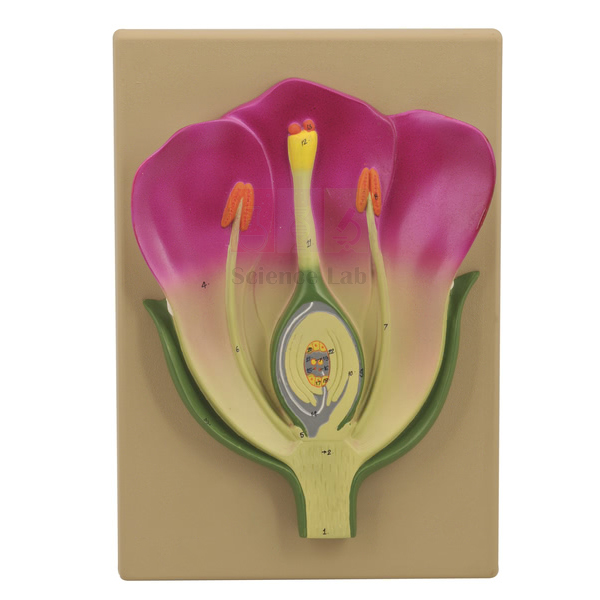
Typical Flower V.S. Model
Typical Flower V.S. Model (Product Code: SLE/EBT/18) is a vertical-section model of a flower used to show how every floral part is arranged, from receptacle to stigma, in school and college botany lessons. Mounted on a base and weighing 650 g, it stands securely for demonstrations yet is light enough to pass along a bench. It is made by Jain Scientific Equipments Pvt Ltd (ScienceLab), an OEM manufacturer, at its own factory in Ambala, India, as part of its botany lab equipment range.
Specifications
| Parameter | Detail |
|---|---|
| Type | Vertical section (V.S.) model of a flower |
| Mounting | Mounted on base |
| Weight | 650 g |
| Dimensions | 330 x 250 x 50 (as listed; unit not stated) |
| Product code | SLE/EBT/18 |
| Manufacturer | Jain Scientific Equipments Pvt Ltd (ScienceLab) — OEM |
| Country of origin | India (made in Ambala, Haryana) |
What Is the Flower V.S. Model Used For?
A vertical section is the view most textbooks and examinations use for flower structure, because it shows at a glance how the sepals, petals, stamens and carpel are attached to the receptacle and where the ovary sits in relation to the other parts. With the model on the bench, a teacher can trace the route a pollen grain takes from the stigma down the style to an ovule, and students can copy a labelled V.S. drawing from a three-dimensional example rather than from another diagram.
It is especially useful just before students cut their own vertical sections of fresh flowers with a scalpel, since they know what they are aiming to see. As one of the everyday biology teaching aids on a demonstration table or display shelf, it stays upright on its base, and its modest weight makes it easy for groups to share. Dust it regularly with a soft brush and avoid placing it where it may be knocked off a high shelf.
OEM Manufacturer
ScienceLab, the trading name of Jain Scientific Equipments Private Limited, is the OEM (original equipment manufacturer) of this sectional flower model and produces it at its own licensed factory in Saha, Ambala, Haryana. The company sells its biology, chemistry and physics models straight from the factory to schools, colleges, dealers and importers, and repeat orders are arranged with the maker rather than a trading intermediary. The company profile has more.
Related Botany Equipment
Complementary items for teaching flower structure:
- Typical Flower Model — a large model with removable parts to accompany the sectional view.
- Dicotyledonous Flower Pattern — for relating the general plan to dicot flowers.
- Monocotyledonous Flower Pattern — for comparing with monocot flower arrangement.
- Hand Lens — for examining students' own flower sections after the demonstration.
See the Botany category for further flower and plant anatomy models.
Frequently Asked Questions
What does V.S. stand for?
V.S. stands for vertical section: the Typical Flower V.S. Model shows a flower as if cut lengthwise down its centre, revealing how sepals, petals, stamens and carpel are attached and where the ovary sits.
How much does the Typical Flower V.S. Model weigh?
The Typical Flower V.S. Model weighs 650 g, so it is easy to carry between classrooms and to pass along a bench, while its base keeps it stable during a demonstration.
What are the dimensions?
The listed dimensions of the Typical Flower V.S. Model are 330 x 250 x 50. The unit is not stated in our listing, so ask through our contact page to confirm the measurements and the packed carton size.
Does it have removable parts?
Removable parts are not listed for the Typical Flower V.S. Model, which shows a fixed sectional view. If you need a flower that can be taken apart, the Typical Flower Model with removable parts is listed alongside it.
Who manufactures the Typical Flower V.S. Model?
The Typical Flower V.S. Model is manufactured by Jain Scientific Equipments Pvt Ltd (ScienceLab), the OEM, at its own licensed factory in Saha, Ambala, Haryana, India, and is supplied factory-direct to schools, colleges, dealers and importers.
How should the model be cleaned?
Clean the Typical Flower V.S. Model with a soft brush or dry cloth, avoid solvents, and never immerse it in water. Keep it on a low, stable shelf where it cannot be knocked off.
What details should an institutional order include?
An order for the Typical Flower V.S. Model should give code SLE/EBT/18, quantity, billing entity and delivery address; ScienceLab then quotes directly as the manufacturer for buyers in India and international markets.
Request a Quote
Ask for a manufacturer's quotation on the Typical Flower V.S. Model through the contact page, or place it in the enquiry cart with any other botany models you plan to buy.
Last updated: 24 September 2026