- Physics Lab Equipment
- Chemistry Lab Equipment
- Biology Lab Equipment
- Anatomical Lab Equipment
- Learning
- Educational Lab Equipment
- Magnets
- Agriculture
- Astronomy
- Earth Science
- Geography Lab Equipment
- Safety Lab Coat
- Laboratory
- Meteorological
- Electricity & Magnetism
- Heat
- School Lab Equipment
- Lab Glassware
- Science Lab Equipment
- Tvet Lab Equipment
- Robotics Kits Supplier and Manufacturer for Schools India
- Math Lab Equipment Manufacturers and Exporters in Ambala
- STEM Kits Manufacturers and Supplier India
- Engineering Lab Equipment
- Hospital Lab Equipment
- Water, Sanitation & Hygiene Supplies
- Cold Chain, Solar & Communication Equipment
- Nutrition
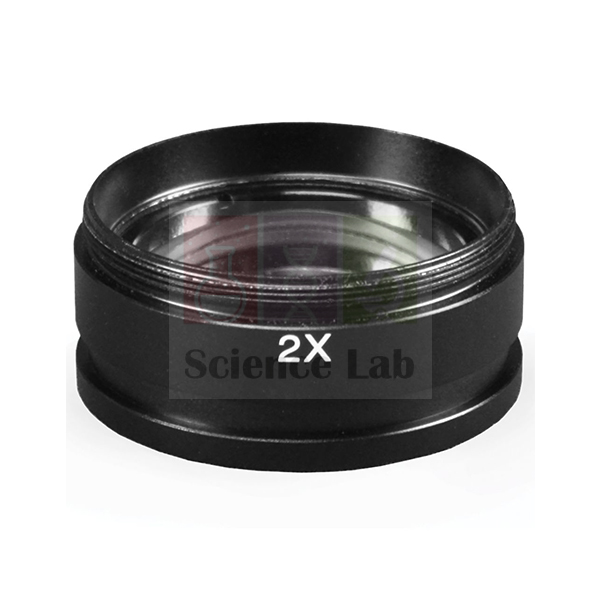
Walter Auxiliary Lens
Walter Auxiliary Lens (Product Code: SLE/M/85) is a 2x add-on lens used to increase the magnification of a stereo zoom microscope for extreme close-up views of specimens in biology, materials and inspection labs. With the lens in place, the listed magnification range moves from 7.5x–45x to 14x–90x, at a working distance of 30 mm. It is supplied by Jain Scientific Equipments Pvt Ltd (ScienceLab), Ambala, India, for college and research microscope users.
Specifications
| Parameter | Detail |
|---|---|
| Lens type | Auxiliary lens |
| Magnification factor | 2x |
| Magnification range | 7.5x–45x to 14x–90x |
| Field of view | 14.2 to 2.2 mm |
| Working distance | 30 mm |
| Brand in product name | Walter |
| Product code | SLE/M/85 |
| Supplied by | Jain Scientific Equipments Pvt Ltd (ScienceLab), Ambala, India |
What Is the Walter Auxiliary Lens Used For?
An auxiliary lens is the quickest way to push a stereo microscope beyond its built-in zoom. Doubling the magnification brings out features that are only hinted at in the standard range: the segments of an insect antenna, hairs and glands on a leaf surface, individual fibres in a textile sample, grains in a mineral or the finish of a small soldered joint.
Higher power comes with trade-offs worth planning for. The field of view narrows (listed from 14.2 mm down to 2.2 mm), so centre the feature before zooming in, and the 30 mm working distance leaves less room for forceps or probes, so do any handling at lower power first. More magnification also spreads the light over a larger image, which is why many users pair the lens with a gooseneck illuminator. Keep the glass clean with a microfiber cloth or lens tissue — at 90x every smudge shows. It is a sensible upgrade for biology lab instruments in college and research settings.
What to Specify When Ordering
- The make and model of the stereo microscope the lens will be fitted to, so we can confirm compatibility.
- Number of lenses required.
- Whether you also need lighting or cleaning accessories on the same quotation.
Supplier
Jain Scientific Equipments Private Limited, known by its trading name ScienceLab and based in Ambala, Haryana, supplies the Walter Auxiliary Lens. It is a Walter-branded accessory that we source for our customers rather than an item we produce. Laboratories and dealers can order it with stereo microscopes and illuminators from our range. See our company profile for background.
Related Microscope Products
Items used with an auxiliary lens for high-magnification stereo work:
- Walter LED Gooseneck Illuminator — brighter, angled light for higher magnification.
- Stereomicroscopes — compact stereo microscopes for specimen viewing.
- Microfiber Lens Cloth — for wiping dust and smudges from lens surfaces.
- Lens Tissue — disposable tissue for careful optical cleaning.
Find more accessories in the Microscope category.
Frequently Asked Questions
What magnification does the Walter Auxiliary Lens add?
The Walter Auxiliary Lens is a 2x lens. With it fitted, the listed magnification range changes from 7.5x–45x to 14x–90x, giving extreme close-up views of small structures that are hard to resolve at the microscope’s normal settings.
What field of view does the Walter Auxiliary Lens give?
The field of view with the Walter Auxiliary Lens is listed as 14.2 to 2.2 mm across the zoom range. The field shrinks as magnification rises, so centre the feature of interest before zooming in.
What is the working distance with the auxiliary lens fitted?
The Walter Auxiliary Lens gives a working distance of 30 mm between the lens and the specimen. That is enough for viewing, but it leaves limited room for dissecting tools, so plan manipulations at lower magnification.
Will the Walter Auxiliary Lens fit my microscope?
Fit depends on your stereo microscope’s make and mounting. Before ordering the Walter Auxiliary Lens, send us the model of the microscope it will be used on through the contact page so that we can confirm compatibility.
Is ScienceLab the maker of the Walter Auxiliary Lens?
No. The Walter Auxiliary Lens carries the Walter brand name. Jain Scientific Equipments Pvt Ltd (ScienceLab), Ambala, India, supplies it to schools, colleges, research labs and dealers along with related microscope accessories.
How should the Walter Auxiliary Lens be cleaned and stored?
Clean the Walter Auxiliary Lens with a soft microfiber cloth or lens tissue after removing loose dust, so grit does not scratch the glass. When it is not fitted, store it covered in a dry, dust-free place away from chemical fumes.
Request a Quote
Send the Walter Auxiliary Lens code SLE/M/85, your microscope model and quantity through our contact page, or use the enquiry cart to combine it with other microscope accessories.
Last updated: 24 September 2026