- Physics Lab Equipment
- Chemistry Lab Equipment
- Biology Lab Equipment
- Anatomical Lab Equipment
- Learning
- Educational Lab Equipment
- Magnets
- Agriculture
- Astronomy
- Earth Science
- Geography Lab Equipment
- Safety Lab Coat
- Laboratory
- Meteorological
- Electricity & Magnetism
- Heat
- School Lab Equipment
- Lab Glassware
- Science Lab Equipment
- Tvet Lab Equipment
- Robotics Kits Supplier and Manufacturer for Schools India
- Math Lab Equipment Manufacturers and Exporters in Ambala
- STEM Kits Manufacturers and Supplier India
- Engineering Lab Equipment
- Hospital Lab Equipment
- Water, Sanitation & Hygiene Supplies
- Cold Chain, Solar & Communication Equipment
- Nutrition
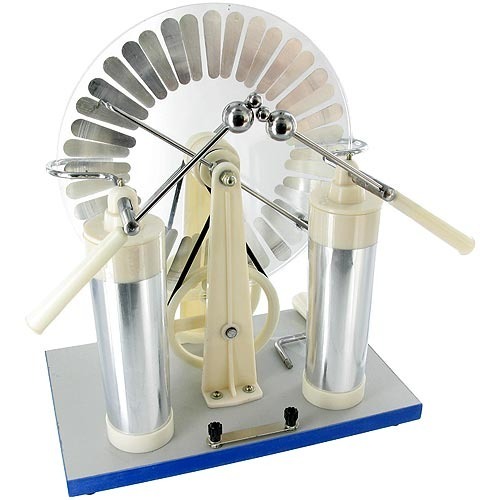
Wimshurst Electrostatic Machine (for lyceum)
Wimshurst Electrostatic Machine (for lyceum) (Product Code: SCL2301/031) is a high-voltage influence machine of the Wimshurst type for upper-secondary physics. Two plastic discs, 20 cm in diameter and carrying tinfoil sheets, rotate in opposite directions; brushes collect the separated charge and store it in two condensers (Leyden jars), whose electrodes connect to a pair of metal discharger rods with an insulated handle. Adjusting the gap between the rods produces bright sparks that make static electricity dramatic and memorable. It is made by Jain Scientific Equipments Pvt Ltd (ScienceLab), Ambala, as a centrepiece physics demonstration kit for electrostatics in India’s senior classes.
Specifications
| Parameter | Detail |
|---|---|
| Type | High-voltage electrostatic generator |
| Discs | Two plastic discs with deposited tinfoil sheets, rotating in opposite directions |
| Disc diameter | 20 cm |
| Charge collection | Two sets of brushes collect the charge and store it in two condensers |
| Condensers | Two Leyden (Leiden) jars |
| Discharger | Condenser electrodes connected to two metal rods with an insulated handle; the distance between the rods can be varied |
| Main parts | Two discs, two Leyden jars, collector combs (listed as crests), brushes, dischargers and support |
Typical Use
As the discs turn, charge builds up in the two Leyden jars until it jumps the gap between the discharger rods as a visible, audible spark. Teachers vary the rod separation to show that a larger gap needs more charge — and more turns of the discs — before a spark appears, which opens a discussion on potential difference and the breakdown of air. The machine also powers other electrostatics demonstrations: connected to an electrostatic plume it makes field lines stand out, it charges an electroscope from a distance, and it can illustrate lightning and point discharge in a simple, controlled way.
Electrostatic machines work best in dry conditions, so wipe the discs and jars with a clean dry cloth and keep the machine in a dry room before use. Always discharge the jars by bringing the discharger rods together, using the insulated handle, before touching any part of the machine, and keep students at a sensible distance during spark demonstrations; anyone with an implanted medical device should stay well clear.
Manufacturer
The machine is built by Jain Scientific Equipments Private Limited, the Ambala, Haryana firm that sells laboratory and demonstration apparatus as ScienceLab to institutions and dealers. Find out more about the company on its profile page.
Related Lab Equipment
These electrostatics items are commonly used with the machine or taught in the same unit:
- Electrostatic Sultan — its paper strips show the field when connected to the machine.
- Electroscope with Accessories — detects the charge the machine produces.
- Demonstrative Plan Condenser/ Capacitor — extends the lesson on how condensers store charge.
- Wimshurst Machine — an alternative machine from our electricity range.
- Electrostatic Investigation — further electrostatics apparatus for student work.
Explore the complete Lab Equipment category for related apparatus.
Frequently Asked Questions
What size are the discs?
Each of the two plastic discs is 20 cm in diameter and carries tinfoil sheets; the discs turn in opposite directions.
Is “Wimshurst” the same as a Wimshurst machine?
Yes. The product name uses the spelling “Wimshurst”, but the construction described — counter-rotating discs, collectors, brushes and Leyden jars — is that of the Wimshurst influence machine.
What does “for lyceum” mean?
Lyceum refers to upper-secondary level; the machine is intended for demonstrations in senior school and introductory college classes.
What spark length can it produce?
The product listing does not state a spark length or output voltage. It depends on conditions such as humidity; ask us through the contact page if you need further technical detail.
How do I make the machine safe after a demonstration?
Bring the discharger rods together with the insulated handle so the Leyden jars discharge fully, then wait a moment before touching the discs, jars or brushes.
Why does it not spark on a humid day?
Moisture on the discs and jars lets charge leak away. Dry and warm the machine gently, wipe all insulating parts clean and run it in the driest room available.
Can you supply it to colleges and export buyers?
Yes. We quote for schools, colleges and distributors across India and in international markets; include your quantity and destination.
Request a Quote
For a quotation on the Wimshurst Electrostatic Machine, write to our team or add it to the enquiry cart along with the electrostatics apparatus you plan to use with it.
Last updated: 24 September 2026