- Physics Lab Equipment
- Chemistry Lab Equipment
- Biology Lab Equipment
- Anatomical Lab Equipment
- Learning
- Educational Lab Equipment
- Magnets
- Agriculture
- Astronomy
- Earth Science
- Geography Lab Equipment
- Safety Lab Coat
- Laboratory
- Meteorological
- Electricity & Magnetism
- Heat
- School Lab Equipment
- Lab Glassware
- Science Lab Equipment
- Tvet Lab Equipment
- Robotics Kits Supplier and Manufacturer for Schools India
- Math Lab Equipment Manufacturers and Exporters in Ambala
- STEM Kits Manufacturers and Supplier India
- Engineering Lab Equipment
- Hospital Lab Equipment
- Water, Sanitation & Hygiene Supplies
- Cold Chain, Solar & Communication Equipment
- Nutrition
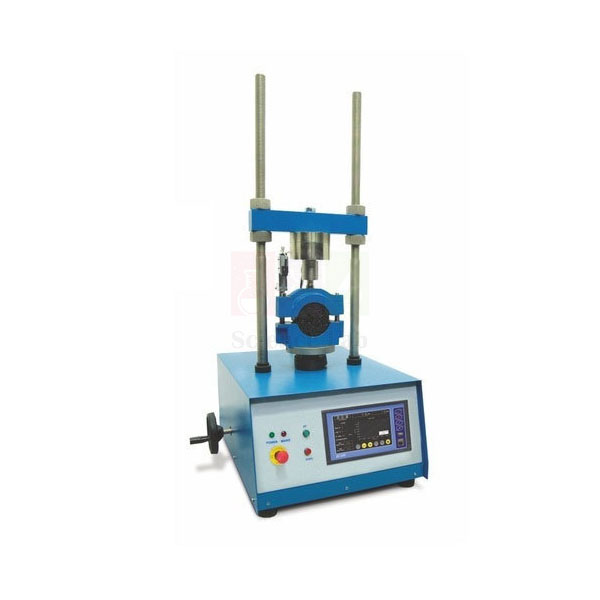
Automatic Marshall Stability Test Machine
Automatic Marshall Stability Test Machine (Product Code: SLE/CE/81) is a 50 kN bench-mounted compression frame used to determine the maximum load (stability) and flow values of bituminous mixtures in highway and civil engineering laboratories. Its data acquisition and control unit sets the platen speed from 6 to 60 mm/min, plots the test graph in real time and calculates stability and flow automatically. It is supplied by Jain Scientific Equipments Pvt Ltd (ScienceLab), Ambala, India, a laboratory equipment supplier in India.
Specifications
| Parameter | Detail |
|---|---|
| Capacity | 50 kN |
| Test | Maximum load (stability) and flow of bituminous mixtures |
| Frame | Compact two-column bench-mounting compression frame with adjustable upper cross beam; motor and worm gear housed in the base |
| Lower platen speed | Adjustable from 6 mm/min to 60 mm/min via the data acquisition and control unit |
| Platen controls | Up and down buttons on the front panel for rapid adjustment; limit switches restrict up and down travel for safety |
| Manual operation | Lateral hand wheel for calibration purposes |
| Control modes | Displacement control and limited load control |
| Results | Automatic calculation of flow and stability values; real-time display of the test graph |
| Processor | CPU card with 32-bit ARM RISC architecture |
| Memory | Permanent storage of up to 10000 test results |
| Analogue channels | 4, of which 2 are active for the Marshall test |
| Sensor inputs | Programmable digital gain for load cells, pressure transducers, strain-gauge based sensors, potentiometric sensors, and voltage and current transmitters |
| Resolution | 1/256000 points per channel |
| Sample rate | 10 data per second for each channel |
| Product code | SLE/CE/81 |
| Supplied by | Jain Scientific Equipments Pvt Ltd (ScienceLab), Ambala, India |
What Is the Marshall Stability Test Machine Used For?
The Marshall test is a standard step in designing bituminous paving mixes. Compacted cylindrical specimens made at different binder contents are conditioned and then loaded to failure at a constant rate of deformation. The peak load is recorded as stability and the deformation at that peak as flow; plotted together with density and void results, they help engineers choose the binder content for a road mix.
On this machine the operator sets the loading rate your test method specifies within the 6–60 mm/min range, starts the test and watches the load curve build on screen, while the unit stores each result for later reporting. The hand wheel allows slow manual movement when the load system is being calibrated. Keep the platens clean of bitumen, check the limit switches before each session and run the frame on a firm, level bench.
What to Specify When Ordering
- The test method and specimen size you work to, so that accessories can be confirmed in the quotation
- The loading rate or rates you need within 6–60 mm/min
- The sensors you intend to connect, such as load cells or displacement transducers
- The electrical supply available at your laboratory
Supplier
Jain Scientific Equipments Private Limited, trading as ScienceLab from Ambala, Haryana, sources and supplies the Automatic Marshall Stability Test Machine to highway engineering departments, polytechnics, road-testing laboratories, dealers and importers. It can be quoted together with the bitumen and mix-testing apparatus a Marshall laboratory needs.
Quotations cover buyers in India and international markets. Learn more about the company on the ScienceLab profile page.
Related Civil Engineering Lab Equipment
These items support the other tests in a bituminous mix design laboratory:
- Mixer Theoretical Density Meter — theoretical density of the mix for void calculations
- Centrifuge Extractor – Motorised — checks the binder content of a mix
- Centrifuge Extractor Hand Operated — a manual option for binder extraction
- Standard penetrometer — penetration grading of the bitumen
- Ring And Ball Apparatus (Electrical) — softening point of the binder
The Civil Engineering Lab Equipment category lists further bitumen, aggregate, soil and concrete apparatus.
Frequently Asked Questions
What does the Automatic Marshall Stability Test Machine measure?
The Automatic Marshall Stability Test Machine (SLE/CE/81) determines the maximum load, or stability, and the flow value of bituminous mixture specimens. Its control unit calculates both values automatically and shows the test graph in real time while the specimen is loaded.
What capacity and speed range does the Marshall machine offer?
The Automatic Marshall Stability Test Machine has a 50 kN capacity, and the speed of its lower platen can be adjusted from 6 mm/min to 60 mm/min through the data acquisition and control unit. Tests can run under displacement control or limited load control.
How many test results can the Marshall machine store?
The Automatic Marshall Stability Test Machine permanently stores up to 10000 test results. Its CPU card uses a 32-bit ARM RISC architecture, with four analogue channels (two active for the Marshall test), 1/256000-point resolution and 10 data per second per channel.
How is the Automatic Marshall Stability Test Machine calibrated?
For calibration, the Automatic Marshall Stability Test Machine can be driven by hand through a lateral hand wheel. Whether a calibration certificate can be provided for the load and displacement sensors should be discussed with us when you request a quotation.
What safety features does the Marshall machine have?
On the Automatic Marshall Stability Test Machine, limit switches restrict the up and down travel of the lower platen, and rapid platen positioning uses up and down buttons on the front panel. The motor and worm gear are enclosed in the base of the bench frame.
Are Marshall moulds and a breaking head included?
The listing for the Automatic Marshall Stability Test Machine describes the loading frame and the control unit only; it does not state which specimen moulds or breaking heads are included. Tell us your test method and specimen size and the quotation will confirm the accessories.
Who supplies the Automatic Marshall Stability Test Machine?
The Automatic Marshall Stability Test Machine is supplied by Jain Scientific Equipments Pvt Ltd (ScienceLab), Ambala, Haryana, India, to laboratories, dealers and importers in India and international markets. Enquiries can be sent through the contact page.
Request a Quote
Share your test method, specimen size and quantity through the contact page, or add the Automatic Marshall Stability Test Machine to the enquiry cart, and we will send a quotation.
Last updated: 24 September 2026