- Physics Lab Equipment
- Chemistry Lab Equipment
- Biology Lab Equipment
- Anatomical Lab Equipment
- Learning
- Educational Lab Equipment
- Magnets
- Agriculture
- Astronomy
- Earth Science
- Geography Lab Equipment
- Safety Lab Coat
- Laboratory
- Meteorological
- Electricity & Magnetism
- Heat
- School Lab Equipment
- Lab Glassware
- Science Lab Equipment
- Tvet Lab Equipment
- Robotics Kits Supplier and Manufacturer for Schools India
- Math Lab Equipment Manufacturers and Exporters in Ambala
- STEM Kits Manufacturers and Supplier India
- Engineering Lab Equipment
- Hospital Lab Equipment
- Water, Sanitation & Hygiene Supplies
- Cold Chain, Solar & Communication Equipment
- Nutrition
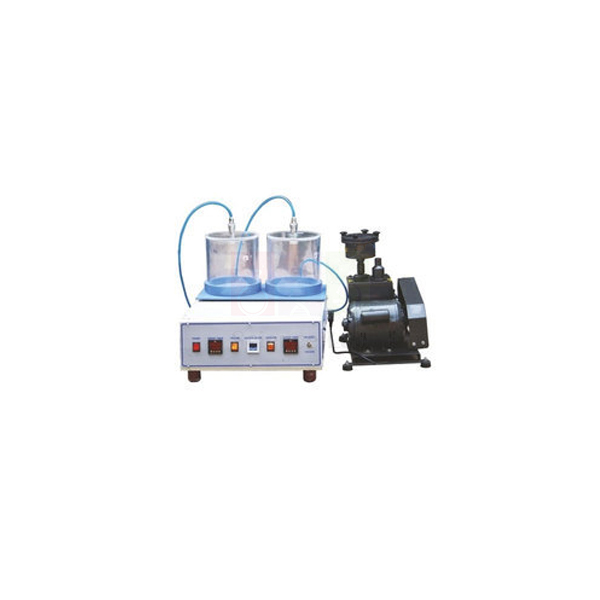
Mixer Theoretical Density Meter
Mixer Theoretical Density Meter (Product Code: SLE/CE/86) is a vacuum apparatus used to determine the theoretical density of asphalt mix in highway and civil engineering laboratories. It tests 2 samples at a time in acrylic vacuum containers over a 0–100 kPa (0–750 mm Hg) vacuum range, while a vibratory table with manual and automatic modes helps release entrapped air. It is supplied by Jain Scientific Equipments Pvt Ltd (ScienceLab), Ambala, a laboratory instruments supplier in India.
Specifications
| Parameter | Detail |
|---|---|
| Test | Theoretical density of asphalt mix by the vacuum method |
| Applications | Asphalt mix design; road condition investigation; calculation of porosity and compactness in road construction quality management |
| Vacuum containers | 2, made of acrylic pipe |
| Samples per test | 2 |
| Vacuum gauge | Fitted on the main body; Wika make, Germany (as listed) |
| Vacuum range | 0–100 kPa (0–750 mm Hg) |
| Vibratory table | Under the containers; manual and automatic modes to release entrapped air from the samples |
| Vibration loading | 10 kg |
| Controls | Complete control panel |
| Power supply | 230 V AC, single phase, 50 Hz |
| Product code | SLE/CE/86 |
| Supplied by | Jain Scientific Equipments Pvt Ltd (ScienceLab), Ambala, India |
What Is the Theoretical Density Meter Used For?
Theoretical density is the density an asphalt mix would have with no air voids at all. Comparing it with the bulk density of compacted specimens or cores gives the air void content, or porosity, and shows how well a pavement layer has been compacted. It is therefore needed both when a mix is designed and when finished road layers are checked.
Loose mix is placed in the acrylic containers, the vessels are sealed and vacuum is applied while the vibratory table agitates them, so that air trapped between the coated particles escapes; the transparent containers let the operator watch it happen. Check that the gauge reads zero before each run, keep the load on the table within 10 kg, and clean the acrylic vessels with a soft cloth rather than abrasives. Testing two samples together speeds up duplicate determinations.
What to Specify When Ordering
- Whether a vacuum pump or other vacuum source should be quoted with the apparatus
- The test method you follow, so that container and accessory details can be confirmed
- Confirmation that your supply is 230 V AC, single phase, 50 Hz
- Number of units needed (each tests 2 samples at a time)
Supplier
Jain Scientific Equipments Private Limited, which trades as ScienceLab, sources and supplies this theoretical density apparatus from Ambala, Haryana. Highway laboratories can have it quoted together with extraction, Marshall and coring equipment from the same civil engineering range.
Road-testing laboratories, engineering colleges, dealers and importers in India and international markets receive quotations and dispatch from Ambala. The company profile has more on ScienceLab.
Related Civil Engineering Lab Equipment
These items work with theoretical density testing in asphalt mix design and quality control:
- Automatic Marshall Stability Test Machine — stability and flow of compacted mix specimens
- Centrifuge Extractor – Motorised — binder content of the same mix
- Centrifuge Extractor Hand Operated — manual binder extraction for site labs
- Core Drilling Machine (Petrol) — cores whose density is compared with the theoretical value
- Vacuum Pump, Electric — a vacuum source; ask us about compatibility
See the Civil Engineering Lab Equipment category for further bitumen, aggregate and concrete apparatus.
Frequently Asked Questions
What does the Mixer Theoretical Density Meter measure?
The Mixer Theoretical Density Meter (SLE/CE/86) determines the theoretical density of asphalt mix by the vacuum method. The result is used in asphalt mix design, road condition investigation and the calculation of porosity and compactness in road construction quality management.
How many samples can the theoretical density meter test at once?
The Mixer Theoretical Density Meter tests 2 samples at a time in two vacuum containers made of acrylic pipe. The containers sit on a vibratory table with a complete control panel, and the vibration loading is 10 kg.
What vacuum range does the Mixer Theoretical Density Meter use?
The Mixer Theoretical Density Meter works over a vacuum range of 0–100 kPa (0–750 mm Hg). Vacuum is read on a Wika-make gauge from Germany, as listed, which is fitted on the main body of the apparatus.
Is a vacuum pump included with the Mixer Theoretical Density Meter?
The listing for the Mixer Theoretical Density Meter describes the main body, gauge, containers, vibratory table and control panel, but does not mention a vacuum pump. Ask us whether a pump is included or should be quoted separately for your set-up.
Why does the theoretical density meter have a vibratory table?
The vibratory table of the Mixer Theoretical Density Meter shakes the vessels under vacuum to release air trapped in the asphalt sample. It runs in manual or automatic mode, and thorough air removal is essential for a reliable theoretical density.
What power supply does the Mixer Theoretical Density Meter need?
The Mixer Theoretical Density Meter is suitable for 230 V AC, single phase, 50 Hz. If your laboratory has a different supply, mention it when you enquire so that we can advise before an order is placed.
Who supplies the Mixer Theoretical Density Meter?
The Mixer Theoretical Density Meter is supplied by Jain Scientific Equipments Pvt Ltd (ScienceLab), Ambala, Haryana, India, to laboratories, dealers and importers in India and international markets. Enquiries can be sent through the contact page.
Request a Quote
For a quotation on the Mixer Theoretical Density Meter, with or without a vacuum source, write to us through the contact page or add it to the enquiry cart.
Last updated: 24 September 2026