- Physics Lab Equipment
- Chemistry Lab Equipment
- Biology Lab Equipment
- Anatomical Lab Equipment
- Learning
- Educational Lab Equipment
- Magnets
- Agriculture
- Astronomy
- Earth Science
- Geography Lab Equipment
- Safety Lab Coat
- Laboratory
- Meteorological
- Electricity & Magnetism
- Heat
- School Lab Equipment
- Lab Glassware
- Science Lab Equipment
- Tvet Lab Equipment
- Robotics Kits Supplier and Manufacturer for Schools India
- Math Lab Equipment Manufacturers and Exporters in Ambala
- STEM Kits Manufacturers and Supplier India
- Engineering Lab Equipment
- Hospital Lab Equipment
- Water, Sanitation & Hygiene Supplies
- Cold Chain, Solar & Communication Equipment
- Nutrition
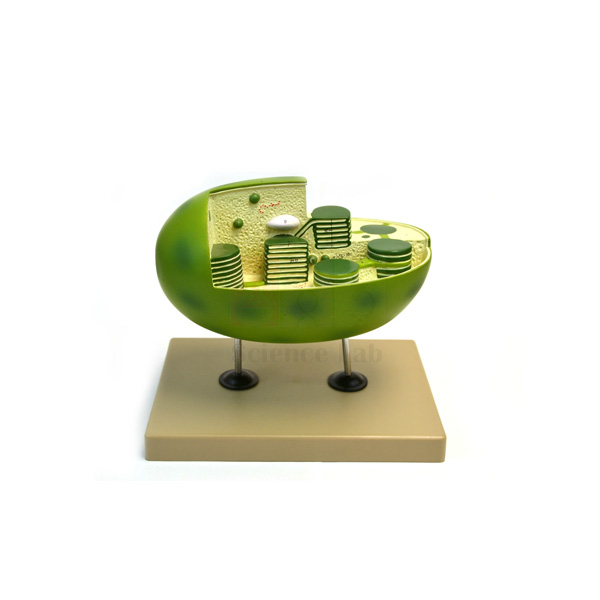
Chloroplast Model
Chloroplast Model (Product Code: SLE/ECB/02) is an enlarged teaching model of the plant cell's fundamental organelle, used to show how a chloroplast is built for photosynthesis in senior-school and college biology classes. Handcrafted in translucent fibre-reinforced resin at approximately 50,000X, it has a cutaway face exposing the thylakoid space and cross-cut grana, and comes with four reproducible keycards. It is made by Jain Scientific Equipments Pvt Ltd (ScienceLab), an OEM biology lab equipment manufacturer in India, at its own factory in Ambala.
Specifications
| Parameter | Detail |
|---|---|
| Type | Enlarged chloroplast (plant cell organelle) model |
| Magnification | Approx. 50,000X |
| Material | Translucent fibre-reinforced resin, handcrafted |
| Structures shown | Circular chromosomes, outer and inner organelle membranes, inter-membrane space, starch granules, lipid inclusions and ribosomes |
| Cutaway face | Exposes the thylakoid space and membranes of cross-cut grana |
| Grana | Protruding grana demonstrate their reticulated structure |
| Key cards | Four reproducible keycards: colour and black-and-white, labelled and unlabelled |
| Size (approx.) | 24 x 23 x 18 cm (9.5 x 9 x 7 in) |
| Weight | 2.4 kg |
| Product code | SLE/ECB/02 |
| Manufacturer | Jain Scientific Equipments Pvt Ltd (ScienceLab) — OEM |
| Country of origin | India (made in Ambala, Haryana) |
What Is the Chloroplast Model Used For?
Teachers use the model to connect structure with function in photosynthesis: the stacked thylakoid membranes of the grana, seen on the cutaway face, are where the light-dependent reactions take place, while the surrounding fluid region is where carbon is fixed into sugars and later stored as the starch granules visible on the model. The circular chromosomes and ribosomes also give a concrete starting point for discussing why chloroplasts are thought to have evolved from free-living bacteria.
A practical way to run the lesson is to project or photocopy the labelled colour keycard during teaching, then hand out the unlabelled black-and-white card as a quick identification test. As a piece of plant biology lab equipment, the model pairs naturally with a photosynthesis practical, so that students measure oxygen output or starch formation and then see on the model where each process happens.
OEM Manufacturer
Jain Scientific Equipments Private Limited, trading as ScienceLab, is the OEM (original equipment manufacturer) of the Chloroplast Model and makes it at its own licensed factory at Saha, Ambala, Haryana, India. Biology departments, dealers and importers buy it factory-direct, and the manufacturer itself answers questions about the model and handles repeat orders for additional classrooms. Institutions setting up a new vendor can use the company's GSTIN 06AAECJ8618A1ZT and Legal Entity Identifier 3358004HRD1JIVXKYX49. More about the company is on our company profile.
Related Cell Biology Equipment
Models and practical resources that complement a chloroplast lesson:
- Mitochondrion Model — the respiration organelle, for comparing the two energy-converting organelles
- Plant Cell Model — shows where chloroplasts sit within the whole plant cell
- Photosynthesis Apparatus — for the practical side of the same topic
- Microslide Photosynthesis — prepared microscope slide material on the same topic
See more organelle and cell models in our Cell Biology Equipment range.
Frequently Asked Questions
How much is the Chloroplast Model enlarged?
The Chloroplast Model is made at approximately 50,000X magnification, which turns a microscopic organelle into a desk-sized model whose membranes, grana and inclusions can be pointed out to a whole class.
What is on the four keycards supplied with the Chloroplast Model?
The Chloroplast Model comes with four reproducible keycards: colour and black-and-white versions, each labelled and unlabelled. Teachers typically use the labelled cards for teaching and the unlabelled ones as a quick identification test.
Can students see inside the grana on the Chloroplast Model?
Yes. A cutaway face on the Chloroplast Model exposes the thylakoid space and the membranes of cross-cut grana, while protruding grana show their reticulated structure from the outside, so both views can be compared.
Which structures does the Chloroplast Model show?
The Chloroplast Model shows circular chromosomes, outer and inner organelle membranes, the inter-membrane space, starch granules, lipid inclusions and ribosomes, together with the thylakoid membranes and grana revealed by its cutaway face.
How big and heavy is the Chloroplast Model?
The Chloroplast Model measures approximately 24 x 23 x 18 cm (9.5 x 9 x 7 in) and weighs 2.4 kg, a convenient size for a teacher's desk, a demonstration bench or a group table.
How should the resin Chloroplast Model be cared for?
Dust the Chloroplast Model with a soft, dry cloth and avoid solvents or abrasive cleaners that could cloud the translucent resin. Store it covered on a stable shelf, away from long exposure to direct sunlight.
Who manufactures the Chloroplast Model?
The Chloroplast Model is manufactured by Jain Scientific Equipments Pvt Ltd (ScienceLab), the OEM, at its own factory in Saha, Ambala, Haryana, India. Schools, colleges and distributors in India and international markets receive quotations directly from the manufacturer.
Request a Quote
Quotations for the Chloroplast Model come directly from the manufacturer: contact us or add the model to your enquiry cart.
Last updated: 24 September 2026