- Physics Lab Equipment
- Chemistry Lab Equipment
- Biology Lab Equipment
- Anatomical Lab Equipment
- Learning
- Educational Lab Equipment
- Magnets
- Agriculture
- Astronomy
- Earth Science
- Geography Lab Equipment
- Safety Lab Coat
- Laboratory
- Meteorological
- Electricity & Magnetism
- Heat
- School Lab Equipment
- Lab Glassware
- Science Lab Equipment
- Tvet Lab Equipment
- Robotics Kits Supplier and Manufacturer for Schools India
- Math Lab Equipment Manufacturers and Exporters in Ambala
- STEM Kits Manufacturers and Supplier India
- Engineering Lab Equipment
- Hospital Lab Equipment
- Water, Sanitation & Hygiene Supplies
- Cold Chain, Solar & Communication Equipment
- Nutrition
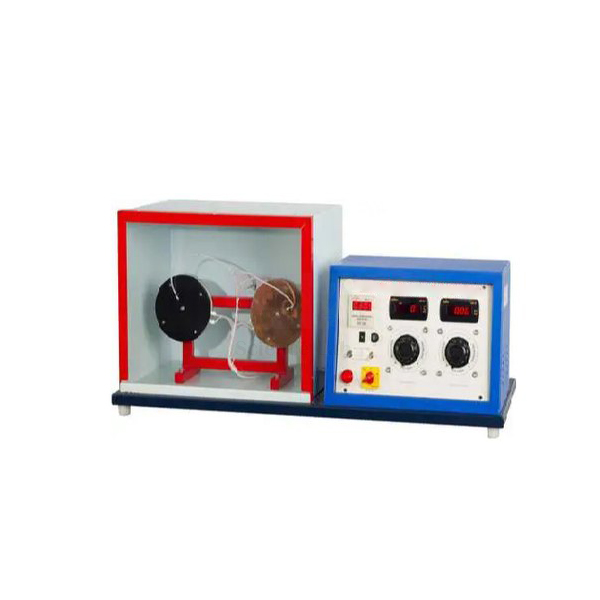
Computerized Emissivity Measurement Apparatus
Computerized Emissivity Measurement Apparatus (Product Code: SLE/MCE/71) is a thermal radiation experiment unit used to compare how strongly different metal surfaces emit heat in heat transfer and thermal engineering laboratories. Colleges looking for a radiation experiment kit at degree level choose it for its 20 mm aluminium, steel and copper samples with different finishes, heated by a 150 W halogen lamp focused through a parabolic reflector. It is made by Jain Scientific Equipments Pvt Ltd (ScienceLab), an OEM manufacturer, at its own factory in Ambala, India.
Specifications
| Parameter | Detail |
|---|---|
| Heat source | Continuously adjustable halogen lamp with parabolic reflector; electrical power 150 W |
| Maximum temperature | Approx. 560 °C |
| Sample position | On a thermocouple at the focal point of the reflector |
| Radiation detector | Thermopile mounted on a moveable carriage for measurements at different distances |
| Aluminium samples, Ø 20 mm | 1 × matt anodised on both sides; 1 × nickel-plated; 1 × heavily oxidised |
| Steel samples, Ø 20 mm | 1 × heavily oxidised; 1 × painted on both sides; 1 × matt anodised with one painted side |
| Copper samples | Ø 20 mm |
| Measuring range – temperature | 0–780 °C |
| Measuring range – radiation intensity | 0–1250 W/m² |
| Dimensions | 700 × 450 × 400 mm |
| Weight | Approx. 20 kg |
| Power supply options | 230 V, 50 Hz, 1 phase; 230 V, 60 Hz, 1 phase; or 120 V, 60 Hz, 1 phase |
| Product code | SLE/MCE/71 |
| Manufacturer | Jain Scientific Equipments Pvt Ltd (ScienceLab) — OEM |
| Country of origin | India (made in Ambala, Haryana) |
What Is the Emissivity Measurement Apparatus Used For?
Heat radiation is one of the three basic forms of heat transfer; unlike conduction and convection it travels as electromagnetic waves and can even cross a vacuum. In this apparatus a metallic sample sits on a thermocouple at the focal point of the reflector, is heated by the concentrated halogen beam, and the radiation it gives off is picked up by a thermopile. Comparing readings for anodised, nickel-plated, oxidised and painted samples at the same temperature shows students clearly how surface finish controls emissivity.
Moving the thermopile carriage to different distances lets the class examine how measured radiation intensity changes with distance from the sample. For consistent results, let each sample reach a steady temperature before reading, keep the thermopile face clean, and change hot samples only with tongs after the lamp has been switched off.
What to Specify When Ordering
- Power supply version: 230 V 50 Hz, 230 V 60 Hz or 120 V 60 Hz, single phase
- Whether extra aluminium, steel or copper samples are wanted for parallel student groups
- Number of units for the heat transfer laboratory
OEM Manufacturer
Jain Scientific Equipments Private Limited, which trades under the ScienceLab name, is the OEM of this emissivity apparatus. It manufactures the unit at its own licensed factory at Saha, Ambala, in Haryana, and sells it directly to universities, polytechnic institutes, laboratory dealers and importers.
Because you deal with the manufacturer, questions about replacement samples, halogen lamps or extra units go straight to the people who build it — simply ask us. Background on the company is available on the ScienceLab profile page.
Related Thermodynamics & Heat Transfer Lab Equipment
To cover all three modes of heat transfer, laboratories often add these units:
- Emissivity Natural Convection And Radiation — looks at radiation together with natural convection losses
- Free and Force Convection Apparatus — the convection counterpart, with four selectable heating elements
- Computerized Thermal Conductivity of Powder — the conduction counterpart, using concentric spheres
- Temperature Measurement and Calibration Apparatus — for checking thermocouples before radiation tests
Visit the Thermodynamics & Heat Transfer Lab Equipment category for the full list of heat transfer trainers.
Frequently Asked Questions
What samples come with the Computerized Emissivity Measurement Apparatus?
The Computerized Emissivity Measurement Apparatus lists 20 mm diameter samples: aluminium (matt anodised on both sides, nickel-plated, heavily oxidised), steel (heavily oxidised, painted on both sides, matt anodised with one painted side) and copper samples.
How is the sample heated in the Computerized Emissivity Measurement Apparatus?
In the Computerized Emissivity Measurement Apparatus, a continuously adjustable 150 W halogen lamp and a parabolic reflector concentrate light onto the sample at the focal point, with a listed maximum temperature of about 560 °C.
How is radiation measured on the Computerized Emissivity Measurement Apparatus?
The Computerized Emissivity Measurement Apparatus uses a thermopile on a moveable carriage to measure the radiation emitted by the sample over 0–1250 W/m², while a thermocouple under the sample reads its temperature over 0–780 °C.
Can the Computerized Emissivity Measurement Apparatus show the effect of distance?
Yes. Because the thermopile of the Computerized Emissivity Measurement Apparatus is mounted on a moveable carriage, radiation can be measured at different distances from the sample to study how intensity changes with distance.
Who manufactures the Computerized Emissivity Measurement Apparatus?
The Computerized Emissivity Measurement Apparatus is manufactured by Jain Scientific Equipments Pvt Ltd (ScienceLab), which is the OEM, at its own factory in Saha, Ambala, Haryana, India, and is quoted directly to buyers.
Is a calibration certificate available for the thermopile?
For the Computerized Emissivity Measurement Apparatus, whether a calibration certificate can be provided for the thermopile or thermocouple should be discussed with us before you order; please state your requirement on the contact page.
What details are needed to quote the Computerized Emissivity Measurement Apparatus?
A quotation for the Computerized Emissivity Measurement Apparatus needs the number of units, the power supply version, the delivery address or port, and any extra samples you want. Send them through the contact page or the enquiry cart.
Request a Quote
Request your quotation for the Computerized Emissivity Measurement Apparatus on the contact page, or add it to the enquiry cart if you are listing several items. Quotes are issued directly by the manufacturer in Ambala.
Last updated: 24 September 2026