- Physics Lab Equipment
- Chemistry Lab Equipment
- Biology Lab Equipment
- Anatomical Lab Equipment
- Learning
- Educational Lab Equipment
- Magnets
- Agriculture
- Astronomy
- Earth Science
- Geography Lab Equipment
- Safety Lab Coat
- Laboratory
- Meteorological
- Electricity & Magnetism
- Heat
- School Lab Equipment
- Lab Glassware
- Science Lab Equipment
- Tvet Lab Equipment
- Robotics Kits Supplier and Manufacturer for Schools India
- Math Lab Equipment Manufacturers and Exporters in Ambala
- STEM Kits Manufacturers and Supplier India
- Engineering Lab Equipment
- Hospital Lab Equipment
- Water, Sanitation & Hygiene Supplies
- Cold Chain, Solar & Communication Equipment
- Nutrition
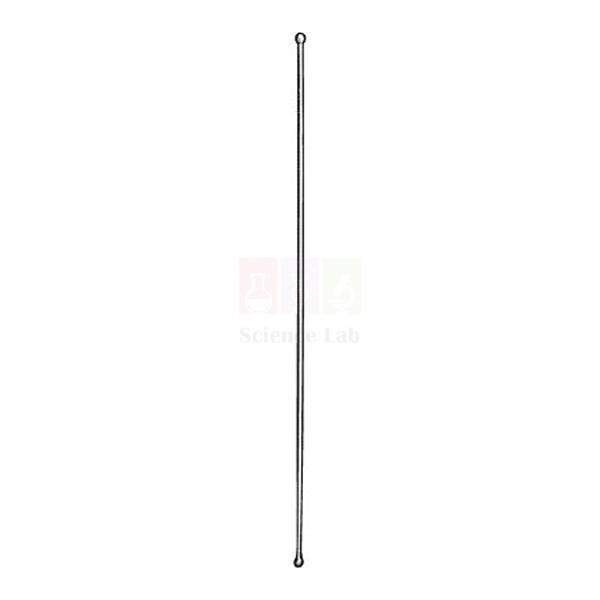
Double Ended Probe
Double Ended Probe (Product Code: SLE/SI/14) is a slender surgical probe and dilator used to explore a surgical wound or to follow the path of a fistula in operating theatres and minor-procedure rooms. Surgeons choose it for its fine 2 mm diameter and bulbous tip at both ends, on an instrument approximately 145 mm long. It is supplied by Jain Scientific Equipments Pvt Ltd (ScienceLab), Ambala, India, to hospitals and alongside lab equipment for technical institutes and medical colleges.
Specifications
| Parameter | Detail |
|---|---|
| Material | Austenitic steel (non-quenched, non-magnetic) |
| Composition | 16 to 18% chromium; 10 to 14% nickel; 2 to 3% molybdenum |
| Type | Probe / dilator |
| Diameter | 2 mm |
| Ends | Bulbous shape at both ends |
| Length | Approximately 145 mm |
| Intended use | Exploring a surgical wound or following the path of a fistula |
| Product code | SLE/SI/14 |
| Supplied by | Jain Scientific Equipments Pvt Ltd (ScienceLab), Ambala, India |
What Is a Double Ended Probe Used For?
A surgical probe lets the operator feel the depth and direction of a wound track or sinus without cutting. The rounded, bulbous ends are designed to follow an existing channel rather than create a new one, which is why the probe is used to trace a fistula from its outer opening before it is laid open or treated. With a bulb at each end, either end can be used.
Advance the probe gently along the natural path and never force it, as the instrument is meant to explore, not to pierce. After use, check that the shaft is straight and the bulbs are smooth. For school biology practicals, departments building a dissection kit for schools in India normally choose a simpler chrome dissecting probe instead of this surgical instrument.
Supplier
The Double Ended Probe is supplied by Jain Scientific Equipments Private Limited, which operates under the ScienceLab name from Ambala, Haryana, to hospitals, surgical training units, distributors and importers.
Visit our company profile for more details.
Related Surgical Instruments
Instruments commonly laid out with a probe for wound exploration:
- Tissue Forceps Standard Straight — lifts the wound edge while the probe is advanced
- Farabeuf Retractor Double Ended Pair — holds a superficial wound open for inspection
- Scalpel Handle No. 3 — carries the blade used once the track has been mapped
- Surgical Instruments, Basic Surgery /SET — a grouped set for basic surgical procedures
- Probe, Chrome — a dissection probe for biology teaching labs
The full range is in our Surgical Instruments category.
Frequently Asked Questions
What is a Double Ended Probe used for in surgery?
The Double Ended Probe is used to explore a surgical wound or to follow the path of a fistula. It works as a probe and dilator, letting the surgeon judge the depth and direction of a track without cutting tissue.
What are the dimensions of the Double Ended Probe?
The Double Ended Probe has a diameter of 2 mm and a length of approximately 145 mm. The fine gauge suits narrow tracks, and the length gives enough reach while keeping the instrument easy to control.
Why does the Double Ended Probe have bulbous ends?
The Double Ended Probe has a bulbous shape at both ends so it slides along an existing channel instead of piercing tissue. Having a bulb at each end means either end of the probe can be used.
What material is the Double Ended Probe made from?
The Double Ended Probe is made from non-quenched, non-magnetic austenitic steel with 16 to 18% chromium, 10 to 14% nickel and 2 to 3% molybdenum.
Is the Double Ended Probe the same as a biology dissecting probe?
No, the Double Ended Probe is a surgical instrument with a fine 2 mm shaft and bulbous ends. School biology dissection usually uses a simpler dissecting probe, such as our Probe, Chrome, listed in the dissection range.
Who supplies the Double Ended Probe and how can I get a quote?
Jain Scientific Equipments Pvt Ltd (ScienceLab), Ambala, Haryana, India, supplies the Double Ended Probe in India and international markets. Send the quantity and delivery location through our contact page for a quotation.
Request a Quote
To obtain pricing for the Double Ended Probe, use the contact page or add it to the enquiry cart with the forceps, retractors and scalpel handles you need.
Last updated: 24 September 2026