- Physics Lab Equipment
- Chemistry Lab Equipment
- Biology Lab Equipment
- Anatomical Lab Equipment
- Learning
- Educational Lab Equipment
- Magnets
- Agriculture
- Astronomy
- Earth Science
- Geography Lab Equipment
- Safety Lab Coat
- Laboratory
- Meteorological
- Electricity & Magnetism
- Heat
- School Lab Equipment
- Lab Glassware
- Science Lab Equipment
- Tvet Lab Equipment
- Robotics Kits Supplier and Manufacturer for Schools India
- Math Lab Equipment Manufacturers and Exporters in Ambala
- STEM Kits Manufacturers and Supplier India
- Engineering Lab Equipment
- Hospital Lab Equipment
- Water, Sanitation & Hygiene Supplies
- Cold Chain, Solar & Communication Equipment
- Nutrition
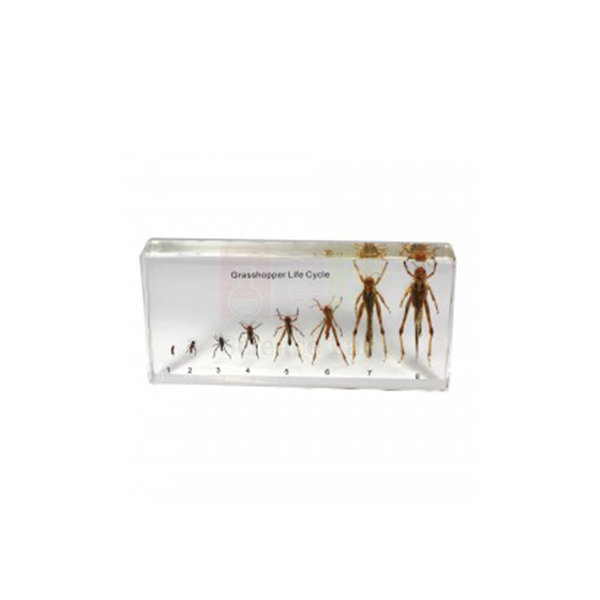
Grasshopper Lifecycle
Grasshopper Lifecycle (Product Code: SLE/EZ/29) is a teaching kit with preserved grasshopper specimens in a clear resin block, used to show incomplete metamorphosis in school and college biology lessons. One 6 1/2 x 3 x 1 in specimen block holds different stages of the grasshopper Oxya chinensis, and the kit's overall size is listed as 8 1/4 x 4 3/4 x 1 1/2 in. It is supplied by Jain Scientific Equipments Pvt Ltd (ScienceLab), Ambala, India, as a durable lab specimen.
Specifications
| Parameter | Detail |
|---|---|
| Topic | Life cycle of the grasshopper (incomplete metamorphosis) |
| Species | Oxya chinensis |
| Specimens | Different stages of the grasshopper, preserved |
| Encasement | Clear resin |
| Blocks included | One specimen block, 6 1/2 x 3 x 1 in |
| Overall size (as listed) | 8 1/4 x 4 3/4 x 1 1/2 in |
| Product code | SLE/EZ/29 |
| Supplied by | Jain Scientific Equipments Pvt Ltd (ScienceLab), Ambala, India |
What Is the Grasshopper Lifecycle Used For?
Grasshoppers develop by incomplete metamorphosis: a nymph hatches from the egg looking like a small, wingless version of the adult, then grows through a series of moults, with wing buds getting larger each time, until it becomes a winged adult. There is no pupal stage. A resin block of real specimens lets students line these stages up and see the gradual change for themselves, which is much clearer than a textbook drawing.
Oxya chinensis is a grasshopper of rice fields, so the block also suits lessons on crop pests in agricultural zoology. Teachers often place it beside a honeybee or silkworm lifecycle block and ask students to list the differences between complete and incomplete metamorphosis. The resin protects the specimens during handling; wipe it with a soft cloth and store it away from strong sunlight.
Supplier
Jain Scientific Equipments Private Limited, which trades as ScienceLab, supplies the grasshopper lifecycle kit from Ambala, Haryana, India. Schools, colleges, agricultural institutes and educational distributors can order it with other insect specimens and collecting equipment, for delivery across India and to international markets. More about the company is on the company profile page.
Related Zoology Equipment
Items for comparing life cycles and studying live grasshoppers:
- Honeybee Lifecycle Plastomount — a complete-metamorphosis life cycle for direct comparison.
- Silkworm Lifecycle Plastomount — another complete-metamorphosis insect with a pupal stage.
- Insect Net, Economy — for catching live grasshoppers and nymphs in the school grounds.
- Insect Mount Set — a wider set of insects and other arthropods for classification work.
See the Zoology category for more.
Frequently Asked Questions
What type of metamorphosis does the Grasshopper Lifecycle kit show?
The Grasshopper Lifecycle kit shows incomplete metamorphosis, in which young nymphs resemble small adults and grow through moults without a pupal stage. It contrasts well with insects such as bees and silkworms that pass through a pupa.
Which grasshopper species is used in the Grasshopper Lifecycle kit?
The Grasshopper Lifecycle kit uses specimens of Oxya chinensis, a grasshopper associated with rice fields. The different stages are preserved and encased in clear resin in a single specimen block.
How many specimen blocks are in the Grasshopper Lifecycle kit?
The Grasshopper Lifecycle kit includes one specimen block measuring 6 1/2 x 3 x 1 in. The overall size is listed as 8 1/4 x 4 3/4 x 1 1/2 in, so allow for that when planning storage.
Which stages are included in the Grasshopper Lifecycle block?
The listing says the Grasshopper Lifecycle block contains the different stages of the grasshopper but does not list them individually. Ask through our contact page if you need the exact stages confirmed before ordering.
How should the Grasshopper Lifecycle block be cared for?
Wipe the Grasshopper Lifecycle resin block with a soft, dry or slightly damp cloth, avoid solvents, and store it away from strong sunlight and heat. Handle it over a table so it is not dropped on a hard floor.
Who supplies the Grasshopper Lifecycle kit?
The Grasshopper Lifecycle kit is supplied by Jain Scientific Equipments Pvt Ltd (ScienceLab), Ambala, Haryana, India. Schools, colleges and dealers in India and international markets can order it on its own or with other insect specimens.
Request a Quote
For a Grasshopper Lifecycle quotation, send the quantity and delivery location through our contact page, or place it in the enquiry cart with other lifecycle specimens.
Last updated: 24 September 2026