- Physics Lab Equipment
- Chemistry Lab Equipment
- Biology Lab Equipment
- Anatomical Lab Equipment
- Learning
- Educational Lab Equipment
- Magnets
- Agriculture
- Astronomy
- Earth Science
- Geography Lab Equipment
- Safety Lab Coat
- Laboratory
- Meteorological
- Electricity & Magnetism
- Heat
- School Lab Equipment
- Lab Glassware
- Science Lab Equipment
- Tvet Lab Equipment
- Robotics Kits Supplier and Manufacturer for Schools India
- Math Lab Equipment Manufacturers and Exporters in Ambala
- STEM Kits Manufacturers and Supplier India
- Engineering Lab Equipment
- Hospital Lab Equipment
- Water, Sanitation & Hygiene Supplies
- Cold Chain, Solar & Communication Equipment
- Nutrition
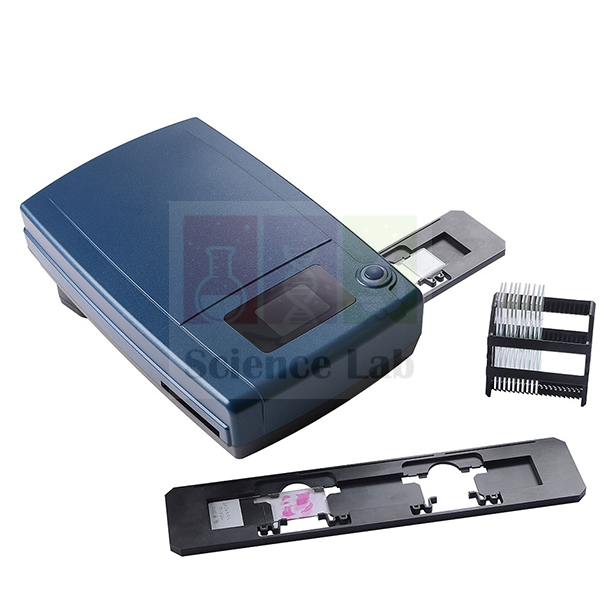
Histology Slide Scanner
Histology Slide Scanner (Product Code: SLE/PS/76) is a slide scanner used to digitise histology samples mounted on 75 x 25 mm slides with cover slips, for biology teaching and research laboratories. It scans an area of 24.3 x 36.5 mm at 10,000 dpi, 48-bit and 5 µm resolution, with a dynamic range of 3.8 OD. It is supplied by Jain Scientific Equipments Pvt Ltd (ScienceLab), Ambala, India, alongside its other biology lab equipment.
Specifications
| Parameter | Detail |
|---|---|
| Scanner model (as listed) | PrimeHisto XE |
| Slide format | 75 x 25 mm slides with cover slips |
| Scanning area | 24.3 mm (H) x 36.5 mm (W) |
| Resolution | 10,000 dpi; 5 µm |
| Bit depth | 48-bit |
| Dynamic range | 3.8 OD |
| Scan time | Digitises a sample within seconds (as described) |
| Intended users | Basic high school biology courses up to advanced college histology research |
| Product code | SLE/PS/76 |
| Supplied by | Jain Scientific Equipments Pvt Ltd (ScienceLab), Ambala, India |
What Is a Histology Slide Scanner Used For?
Instead of every student queuing at a microscope, a teacher can scan a prepared histology slide once and show or share the digital image with the whole class. Students can then zoom into tissue features on screen, annotate images for assignments, and return to the same section later for revision.
At college and research level, digitised slides make it simpler to archive a slide collection, compare sections side by side and include images in reports and presentations. For clean results, wipe the slide and cover slip before scanning and position the region of interest inside the 24.3 x 36.5 mm scanning area.
What to Specify When Ordering
- Your slide format, which should be 75 x 25 mm with cover slips.
- The computer and operating system you will use, so we can confirm connection and software details.
- Any prepared histology slide sets you want to digitise, quoted in the same order.
Supplier
Jain Scientific Equipments Private Limited, trading as ScienceLab from Ambala, Haryana, supplies this histology slide scanner to schools, colleges, universities and research laboratories, as well as dealers and importers in India and international markets. As it is an electronic instrument from another maker, ask us about the documentation, software and support that come with the unit you are quoted. The ScienceLab profile has company details.
Related Prepared Slides
Slides and imaging equipment for a digital histology workflow:
- Human Histology Slide Set of 25 — a varied tissue collection ready to digitise.
- Microslide Basic Human Histology — further histology material for class image banks.
- Glass Cover Slips — slides need cover slips before scanning.
- Research Trinocular Microscope — for live examination alongside scanned images.
- Microscope Digital Camera, 5MP — an alternative way to capture images through a microscope.
See more slide sets and accessories in the Prepared Slides category.
Frequently Asked Questions
What slides can the Histology Slide Scanner digitise?
The Histology Slide Scanner digitises samples mounted on 75 x 25 mm slides with cover slips. Slides should be clean and properly covered before scanning so that the image of the tissue is sharp and free of dust marks.
What resolution does the Histology Slide Scanner offer?
The Histology Slide Scanner offers 10,000 dpi resolution, equal to 5 µm, with 48-bit depth and a dynamic range of 3.8 OD. These figures are given for the PrimeHisto XE model named in the product listing.
How large is the scanning area of the Histology Slide Scanner?
The scanning area of the Histology Slide Scanner is 24.3 mm high by 36.5 mm wide. Position the region of interest within this area, because tissue outside it on the slide will not be captured in a single scan.
Who is the Histology Slide Scanner suitable for?
The Histology Slide Scanner is described as suitable from basic high school biology courses up to advanced college histology research. Schools use it to share slide images with a whole class, while colleges use it to archive and study sections digitally.
Which software and computer does the Histology Slide Scanner need?
Software, computer requirements and the connection interface of the Histology Slide Scanner are not listed in the product details. Please tell us your computer set-up through the contact page, and we will confirm what is supplied with the scanner in our quotation.
Who supplies the Histology Slide Scanner?
The Histology Slide Scanner (SLE/PS/76) is supplied by Jain Scientific Equipments Pvt Ltd (ScienceLab), Ambala, India. It can be sent to institutions, dealers and importers in India and international markets, together with prepared histology slides if required.
Request a Quote
To request a quotation for the Histology Slide Scanner, add it to the enquiry cart or write to us through the contact page. Include your computer set-up and any slide sets you want quoted with it.
Last updated: 24 September 2026