- Physics Lab Equipment
- Chemistry Lab Equipment
- Biology Lab Equipment
- Anatomical Lab Equipment
- Learning
- Educational Lab Equipment
- Magnets
- Agriculture
- Astronomy
- Earth Science
- Geography Lab Equipment
- Safety Lab Coat
- Laboratory
- Meteorological
- Electricity & Magnetism
- Heat
- School Lab Equipment
- Lab Glassware
- Science Lab Equipment
- Tvet Lab Equipment
- Robotics Kits Supplier and Manufacturer for Schools India
- Math Lab Equipment Manufacturers and Exporters in Ambala
- STEM Kits Manufacturers and Supplier India
- Engineering Lab Equipment
- Hospital Lab Equipment
- Water, Sanitation & Hygiene Supplies
- Cold Chain, Solar & Communication Equipment
- Nutrition
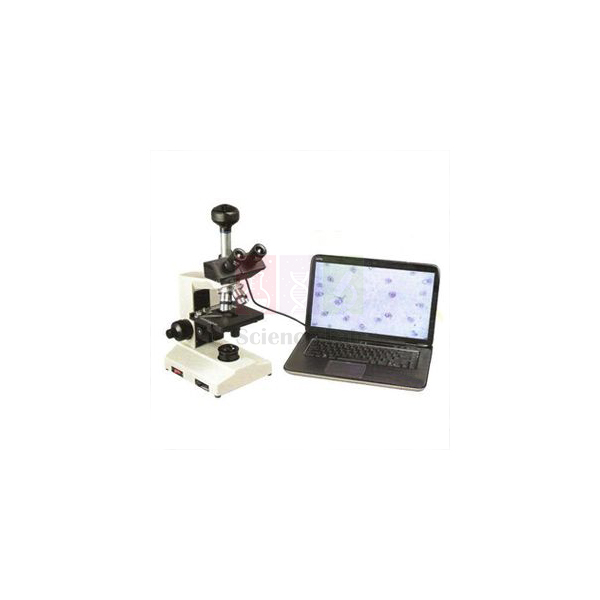
Research Trinocular Microscope
Research Trinocular Microscope (Product Code: SLE/M/27) is a compound microscope with a third photo tube, used to examine and document slides for dissertations, research records and projected teaching. It combines a 45° trinocular head with 54–74 mm interpupillary adjustment, DIN objectives from 4x to 100x oil immersion, and a pre-focusing lock on a die-cast, coaxially focused stand. It is supplied by Jain Scientific Equipments Pvt Ltd (ScienceLab), Ambala, India, among its laboratory instruments for research users.
Specifications
| Parameter | Detail |
|---|---|
| Observation head | Trinocular, inclined at 45°, rotatable through 360° |
| Interpupillary distance | Adjustment ring, 54–74 mm |
| Dioptric adjustment | Ring on the left with adjustable dioptric scale |
| Eyepieces | High eye point, wide field 10x (F.N. 20) or 15x, paired |
| Objectives | DIN 4x, 10x, 40/45x (S.L.), 100x oil immersion (S.L.) |
| Nosepiece | Quadruple, revolving on ball bearing |
| Main body | All parts die-cast for long life and good mechanical strength |
| Focusing | Coaxial control with ball-bearing guide way and large knobs; pre-focusing (auto-focusing) lock and tension adjustment ring |
| Condenser | Abbe, N.A. 1.25, aspherical lens, adjustable iris diaphragm |
| Illumination | Built-in 6 V–20 W halogen system and plano-concave mirror attachment; suitable for 220 V, 50 Hz AC |
| Mechanical stage | Large double-plate X-Y type, co-axial and low-positioned, with fine vernier graduation |
| Camera | Not included in the listed specification |
| Product code | SLE/M/27 |
| Supplied by | Jain Scientific Equipments Pvt Ltd (ScienceLab), Ambala, India |
What Is the Research Trinocular Microscope Used For?
The third tube is what sets this model apart: with a microscope camera fitted, researchers capture images for theses, lab notebooks and reports, or show the live field on a seminar-room screen while still viewing through the binocular eyepieces. Postgraduate departments in botany, zoology, microbiology and pathology use it where observations must be recorded, not just seen.
For consistent image series, set the pre-focusing lock at the working magnification so every new slide returns to the same focal plane, and note vernier positions so a field can be re-imaged later. The built-in halogen light keeps exposure steady between sessions; closing the iris diaphragm slightly adds contrast on pale specimens. Because the camera and its adapter are not in the listed specification, plan them into the order from the start.
What to Specify When Ordering
- Camera and adapter for the trinocular tube, or the camera you already own, so fit can be checked.
- Paired eyepieces: wide field 10x (F.N. 20) or 15x.
- Mains supply at site; the listed lighting suits 220 V, 50 Hz AC.
- Required stage dimensions, to be confirmed in the quotation.
Supplier
ScienceLab is the trading name used by Jain Scientific Equipments Private Limited, Ambala, Haryana, which supplies the Research Trinocular Microscope to universities, research institutes, colleges, dealers and importers. Because imaging set-ups vary, buyers can discuss the camera side of the system with the same team that quotes the microscope. Company background is on the ScienceLab profile.
Related Laboratory Equipment
Imaging options and accessories for a trinocular research microscope:
- 5mp Microscope Camera — a C-mount Wi-Fi camera that streams to phones, tablets or computers; confirm fit with the photo tube.
- Microscope Digital Camera, 5MP — a USB eyepiece camera for capture on a computer.
- Research Binocular Microscope — the binocular version for users who do not need imaging.
- Immersion Oil, 25ml — for the 100x oil-immersion objective.
- Slide Tray Cabinet, Polypropylene — keeps imaged slides organised for re-examination.
Explore more on the Microscope category page.
Frequently Asked Questions
Is a camera included with the Research Trinocular Microscope?
No camera is included in the listed specification of the Research Trinocular Microscope. Its third tube is intended for a microscope camera, so tell us which camera you plan to use, or ask for a camera from our range, and fit can be discussed before ordering.
What adjustments does the head of the Research Trinocular Microscope offer?
The Research Trinocular Microscope has a trinocular head inclined at 45° and rotatable through 360°, an interpupillary adjustment ring covering 54–74 mm, and a dioptric adjustment ring on the left with an adjustable dioptric scale.
How does the focus lock on the Research Trinocular Microscope help with imaging?
The pre-focusing lock on the Research Trinocular Microscope stores a working focus position, so each new slide comes back to the same focal plane. That saves time during image series, and the tension ring keeps the setting from drifting.
Which objectives does the Research Trinocular Microscope use?
The Research Trinocular Microscope uses DIN objectives of 4x, 10x, 40/45x (S.L.) and 100x oil immersion (S.L.) on a ball-bearing quadruple nosepiece, with paired high-eye-point WF 10x (F.N. 20) or 15x eyepieces and an Abbe N.A. 1.25 condenser.
How is the Research Trinocular Microscope illuminated?
The Research Trinocular Microscope has a built-in illumination system with a 6 V–20 W halogen bulb, suitable for a 220 V, 50 Hz AC supply, together with a plano-concave mirror attachment as an alternative light source.
What stage does the Research Trinocular Microscope have?
The Research Trinocular Microscope has a large double-plate X-Y mechanical stage, co-axial and low-positioned, with fine vernier graduation. Please confirm the stage dimensions with us through the contact page if they matter for your specimens.
Who supplies the Research Trinocular Microscope?
The Research Trinocular Microscope is supplied by Jain Scientific Equipments Private Limited, trading as ScienceLab, Ambala, Haryana, India, to universities, research institutes, colleges, dealers and importers in India and international markets.
Request a Quote
To price the Research Trinocular Microscope (SLE/M/27) with or without a camera, contact us through the contact page or add it to the enquiry cart.
Last updated: 24 September 2026