- Physics Lab Equipment
- Chemistry Lab Equipment
- Biology Lab Equipment
- Anatomical Lab Equipment
- Learning
- Educational Lab Equipment
- Magnets
- Agriculture
- Astronomy
- Earth Science
- Geography Lab Equipment
- Safety Lab Coat
- Laboratory
- Meteorological
- Electricity & Magnetism
- Heat
- School Lab Equipment
- Lab Glassware
- Science Lab Equipment
- Tvet Lab Equipment
- Robotics Kits Supplier and Manufacturer for Schools India
- Math Lab Equipment Manufacturers and Exporters in Ambala
- STEM Kits Manufacturers and Supplier India
- Engineering Lab Equipment
- Hospital Lab Equipment
- Water, Sanitation & Hygiene Supplies
- Cold Chain, Solar & Communication Equipment
- Nutrition
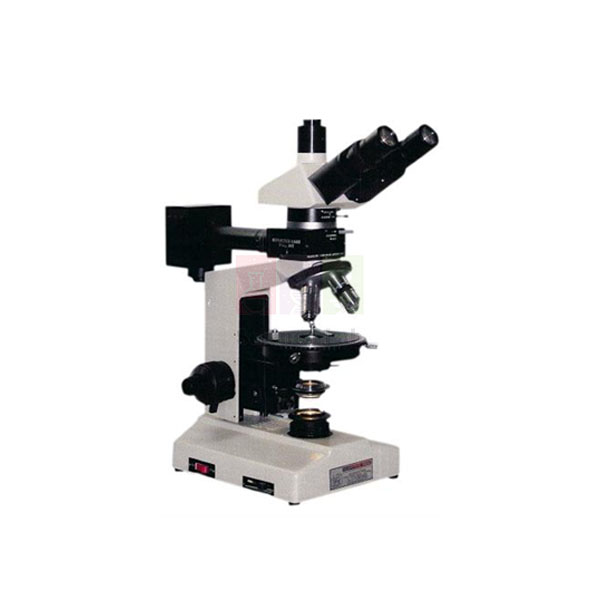
Ore Polarising Microscope
Ore Polarising Microscope (Product Code: SLE/M/42) is a trinocular polarising microscope used to identify ore minerals and study rock specimens in reflected and transmitted polarised light in geology and mining laboratories. It is fitted with two focusable 10X wide-field eyepieces carrying a double cross line, plan POL objectives from 4X to 40X and a colour CCD camera on the trinocular tube. It is supplied by Jain Scientific Equipments Pvt Ltd (ScienceLab), Ambala, India, a laboratory equipment supplier in India.
Specifications
| Parameter | Detail |
|---|---|
| Frame | Transmission and reflection mode polarisation microscopy, built-in filter holders |
| Objectives (plan achromatic, polarising) | 4X POL N.A. 0.13, W.D. 17.0 mm; 10X POL N.A. 0.3, W.D. 10.0 mm; 20X POL N.A. 0.5, W.D. 2.1 mm; 40X POL N.A. 0.75, W.D. 1.1 mm |
| Eyepieces | Wide-field 10X, 2 numbers, with double cross line, focusable |
| Tube | Fixed trinocular tube |
| Light source | High-power LED light with power supply; built-in transmitted light filters |
| Nosepiece | Minimum 4-position, centrable and detachable |
| Focus | Stroke minimum 22 mm; fine stroke minimum 100 µm |
| Condenser | Strain-free polarising condenser, swing-out type |
| Stage | Circular, rotatable and centerable mechanical stage, graduated through 360° |
| Reflected illumination | Polariser slider for the reflected illumination tube |
| Rotating scale | 360° rotatable, scale interval 5° |
| Compensator | Wedge shaped, measurement range 0–4λ |
| Camera | Colour CCD camera, minimum 5 megapixel, on the trinocular tube with a suitable mounting adapter |
| Camera sensor | 2/3 inch CCD; resolution 1920 x 1080 pixels; pixel size 3.45 x 3.45 µm |
| Product code | SLE/M/42 |
| Supplied by | Jain Scientific Equipments Pvt Ltd (ScienceLab), Ambala, India |
What Is the Ore Polarising Microscope Used For?
Ore minerals such as sulphides and oxides are opaque, so a geologist identifies them from how they reflect light: their colour, relative brightness, and whether they change as the stage turns under crossed polars. This instrument provides that reflected polarised view through the polariser slider on the reflected illumination tube, and also a transmitted polarised path for the transparent gangue minerals in a thin section.
The double cross line in each focusable eyepiece is the working reference: centre a grain on the cross, rotate the graduated stage and note where it goes dark to measure extinction positions. The 0–4λ wedge compensator assists with interference-colour work in transmitted light, and the CCD camera records the field for mineral reports or class discussion.
What to Specify When Ordering
- Whether the colour CCD camera is needed or the microscope alone
- Objective set required from the 4X, 10X, 20X and 40X POL objectives
- Mains voltage for the LED power supply
- Quantity, and any tender specification to be met
Supplier
The Ore Polarising Microscope is supplied from Ambala, Haryana, by Jain Scientific Equipments Private Limited under its ScienceLab name. Geology departments, mining institutes, dealers and importers in India and international markets can send their specification and receive a quotation for the configuration they need. The company profile has further details.
Related Laboratory Equipment
Instruments and preparation equipment for ore and mineral microscopy:
- Advance Research Polarising Microscope with Incident Light — infinity-corrected alternative with imaging software
- Research Trinocular Ore Microscope — with a vernier-read round stage and compensator set
- Mineral Test Kit — hand-specimen tests to complement microscope identification
- Single Disc Polishing Machine — for preparing polished sections
Browse the Microscope category for other polarising and research models.
Frequently Asked Questions
What specimens can the Ore Polarising Microscope examine?
The Ore Polarising Microscope works in both transmission and reflection modes. Reflected polarised light is used for opaque ore minerals in polished sections, while transmitted polarised light is used for transparent minerals in thin sections of the same rock.
What eyepieces are supplied with the Ore Polarising Microscope?
The Ore Polarising Microscope comes with two wide-field 10X eyepieces, each with a double cross line and focusing. Focusing the eyepiece makes the cross line sharp for each user, so grains can be centred and angles judged accurately.
What camera is specified for the Ore Polarising Microscope?
The Ore Polarising Microscope is specified with a colour CCD camera of minimum 5 megapixels on the trinocular tube, using a suitable mounting adapter. Its sensor is 2/3 inch, with 1920 x 1080 pixel resolution and 3.45 x 3.45 µm pixels.
Which objectives does the Ore Polarising Microscope use?
The Ore Polarising Microscope uses plan achromatic polarising objectives: 4X POL (N.A. 0.13, W.D. 17.0 mm), 10X POL (N.A. 0.3, W.D. 10.0 mm), 20X POL (N.A. 0.5, W.D. 2.1 mm) and 40X POL (N.A. 0.75, W.D. 1.1 mm).
What focusing and nosepiece features does it have?
The Ore Polarising Microscope has a focus stroke of at least 22 mm with a fine stroke of at least 100 µm, and a centrable, detachable nosepiece of at least four positions, so each objective can be centred to the rotating stage axis.
Who supplies the Ore Polarising Microscope?
The Ore Polarising Microscope is supplied by Jain Scientific Equipments Pvt Ltd, trading as ScienceLab, Ambala, Haryana, India. It is offered to geology departments, mining institutes, dealers and importers in India and international markets.
Request a Quote
For a quotation on the Ore Polarising Microscope, share your camera requirement, objectives and quantity through our contact page, or place it in the enquiry cart.
Last updated: 24 September 2026