- Physics Lab Equipment
- Chemistry Lab Equipment
- Biology Lab Equipment
- Anatomical Lab Equipment
- Learning
- Educational Lab Equipment
- Magnets
- Agriculture
- Astronomy
- Earth Science
- Geography Lab Equipment
- Safety Lab Coat
- Laboratory
- Meteorological
- Electricity & Magnetism
- Heat
- School Lab Equipment
- Lab Glassware
- Science Lab Equipment
- Tvet Lab Equipment
- Robotics Kits Supplier and Manufacturer for Schools India
- Math Lab Equipment Manufacturers and Exporters in Ambala
- STEM Kits Manufacturers and Supplier India
- Engineering Lab Equipment
- Hospital Lab Equipment
- Water, Sanitation & Hygiene Supplies
- Cold Chain, Solar & Communication Equipment
- Nutrition
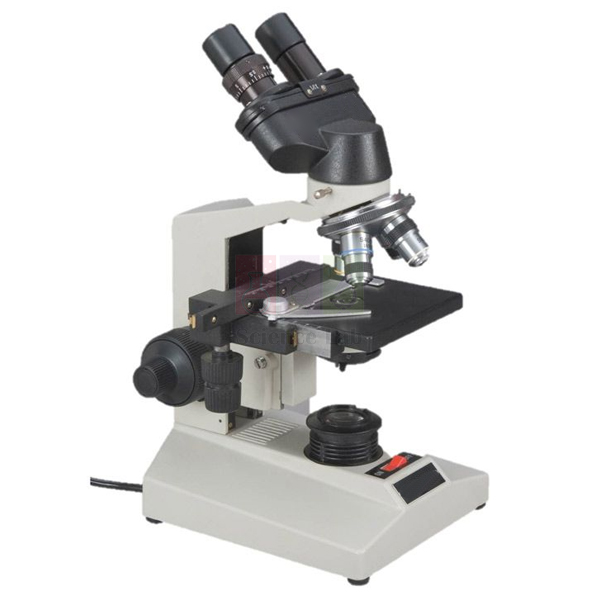
Pathological Binocular Microscope with Co-Axial Focusing Control
Pathological Binocular Microscope with Co-Axial Focusing Control (Product Code: SLE/M/25) is a two-eyepiece compound microscope used for extended examination of stained sections and smears in pathology, histology and microbiology teaching laboratories. Its 45° binocular head rotates through 360° and adjusts from 54 to 74 mm between the eyes, with dioptric correction, so each user can view comfortably through long sessions. It is supplied by Jain Scientific Equipments Pvt Ltd (ScienceLab), Ambala, India.
Specifications
| Parameter | Detail |
|---|---|
| Observation head | Binocular, inclined at 45°, rotatable through 360° |
| Interpupillary distance | Adjustment ring, 54–74 mm, with dioptric adjustment |
| Focusing control | Co-axial, as named |
| Eyepieces | Wide field 10x or 15x, paired |
| Objectives | 4x, 10x, 40/45x (S.L.), 100x oil immersion (S.L.) |
| Nosepiece | Quadruple, revolving on ball bearing |
| Main body | All parts pressure die-cast for long life and good mechanical strength |
| Condenser | Abbe, N.A. 1.25, with spherical lens and adjustable iris diaphragm |
| Illumination | Built-in base system with 6 V–20 W halogen bulb and plano-concave mirror attachment; suitable for 220 V, 50 Hz AC |
| Mechanical stage | Co-axial, low-positioned X-Y stage, 120 x 125 mm, fine vernier graduation |
| Product code | SLE/M/25 |
| Supplied by | Jain Scientific Equipments Pvt Ltd (ScienceLab), Ambala, India |
What Is the Pathological Binocular Microscope Used For?
Viewing with both eyes reduces fatigue when a student or demonstrator spends a whole practical scanning blood films, tissue sections or stained bacterial smears. That makes this binocular model a common choice for the demonstrator's bench and for senior batches in laboratory technology, pathology and microbiology courses. Paired 10x or 15x wide-field eyepieces work with 4x to 100x oil-immersion objectives, and the built-in halogen light keeps illumination consistent from bench to bench.
Each new user should first slide the interpupillary ring until the two fields merge into one circle, focus with the fixed eyepiece, then correct the other eye with the dioptric adjustment. Co-axial focusing places coarse and fine control on the same axis, so the hand stays in one position while the low-set stage knobs move the slide. Note the vernier readings of useful fields for later revision.
What to Specify When Ordering
- Paired eyepieces: wide field 10x or 15x.
- Mains supply at site; the listed lighting suits 220 V, 50 Hz AC.
- Number of units, and whether spare 6 V–20 W halogen bulbs are wanted.
- Immersion oil, cover glasses and slide storage for the course.
Supplier
This pathological binocular microscope is supplied by Jain Scientific Equipments Private Limited, which trades as ScienceLab from Ambala, Haryana, to colleges, training institutes, laboratory dealers and importers in India and international markets. For vendor registration, the supplying company is Jain Scientific Equipments Private Limited (CIN U29309HR2020PTC087597, GSTIN 06AAECJ8618A1ZT). Further details are on the ScienceLab company profile.
Related Laboratory Equipment
Items used alongside a binocular pathology microscope:
- Pathological Monocular Microscope — the single-eyepiece version for student benches.
- Immersion Oil, 25ml — for the 100x oil-immersion objective.
- Glass Cover Slips, No. 1 — thin covers for smears and sections.
- Unit System Slide Cabinet — tray storage for a large reference slide collection.
- Micrometric Slide — a stage graticule for calibrating measurements with a micrometer eyepiece.
See all models on the Microscope category page.
Frequently Asked Questions
How is the head of the Pathological Binocular Microscope with Co-Axial Focusing Control adjusted?
The Pathological Binocular Microscope with Co-Axial Focusing Control has a 45° binocular head that rotates through 360°, an interpupillary adjustment ring covering 54–74 mm, and dioptric adjustment, so each user can set it to their own eyes.
What does co-axial focusing control mean on this pathological binocular microscope?
On the Pathological Binocular Microscope with Co-Axial Focusing Control, the coarse and fine focus controls share one axis. The user can move from rough to precise focus without shifting the hand, which helps during long slide-scanning sessions.
Which objectives and eyepieces are fitted to the Pathological Binocular Microscope with Co-Axial Focusing Control?
The Pathological Binocular Microscope with Co-Axial Focusing Control carries 4x, 10x, 40/45x (S.L.) and 100x oil-immersion (S.L.) objectives on a ball-bearing quadruple nosepiece, with paired wide-field eyepieces of 10x or 15x.
How is the Pathological Binocular Microscope with Co-Axial Focusing Control illuminated?
The Pathological Binocular Microscope with Co-Axial Focusing Control has built-in base illumination with a 6 V–20 W halogen bulb for a 220 V, 50 Hz AC supply, plus a plano-concave mirror attachment, feeding an Abbe N.A. 1.25 condenser with iris diaphragm.
What stage does the Pathological Binocular Microscope with Co-Axial Focusing Control have?
The Pathological Binocular Microscope with Co-Axial Focusing Control has a co-axial, low-positioned mechanical X-Y stage of 120 x 125 mm with fine vernier graduation, for smooth scanning and for recording slide positions.
Who supplies the Pathological Binocular Microscope with Co-Axial Focusing Control?
The Pathological Binocular Microscope with Co-Axial Focusing Control is supplied by Jain Scientific Equipments Private Limited, trading as ScienceLab, Ambala, Haryana, India, to colleges, institutes, dealers and importers in India and international markets.
What should a quotation request for the Pathological Binocular Microscope with Co-Axial Focusing Control include?
Include product code SLE/M/25, the quantity, the eyepiece choice, your mains supply, any bulbs or consumables, and the delivery city or country. Vendor-registration documents for tenders can be requested in the same message.
Request a Quote
To request a quotation for the Pathological Binocular Microscope with Co-Axial Focusing Control (SLE/M/25), use the contact page or add it to the enquiry cart.
Last updated: 24 September 2026