- Physics Lab Equipment
- Chemistry Lab Equipment
- Biology Lab Equipment
- Anatomical Lab Equipment
- Learning
- Educational Lab Equipment
- Magnets
- Agriculture
- Astronomy
- Earth Science
- Geography Lab Equipment
- Safety Lab Coat
- Laboratory
- Meteorological
- Electricity & Magnetism
- Heat
- School Lab Equipment
- Lab Glassware
- Science Lab Equipment
- Tvet Lab Equipment
- Robotics Kits Supplier and Manufacturer for Schools India
- Math Lab Equipment Manufacturers and Exporters in Ambala
- STEM Kits Manufacturers and Supplier India
- Engineering Lab Equipment
- Hospital Lab Equipment
- Water, Sanitation & Hygiene Supplies
- Cold Chain, Solar & Communication Equipment
- Nutrition
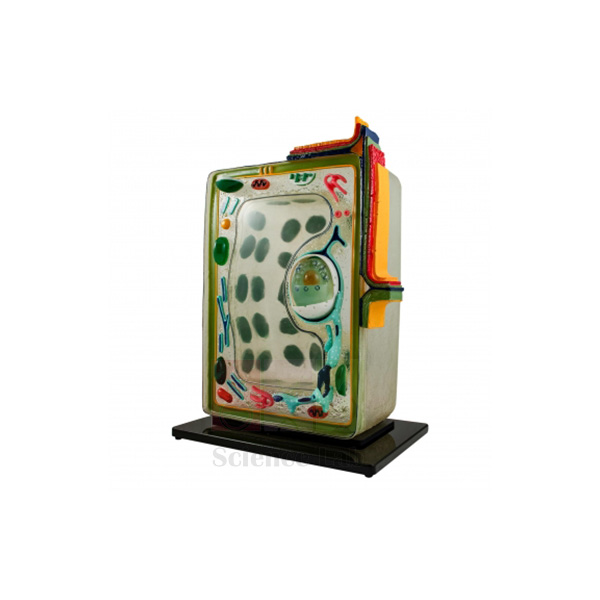
Plant Cell
Plant Cell (Product Code: SLE/ECB/10) is a large, translucent demonstration model used to teach the 25 organelles and cell inclusions of a plant cell in school, college and teacher-training biology. Its fibreglass-reinforced plastic body gives the appearance of living matter, and the cell wall is divided into distinct layers from the middle lamella to a warted tertiary wall. It is made by Jain Scientific Equipments Pvt Ltd (ScienceLab), an OEM manufacturer, at its own factory in Ambala, India, as a centrepiece of botany lab equipment in India.
Specifications
| Parameter | Detail |
|---|---|
| Organelles and inclusions shown | 25 |
| Body material | Translucent, fibreglass-reinforced plastic that gives the appearance of living matter |
| Detail parts | Moulded plastic, so colours do not chip, crack, peel or fade |
| Key structures | Endoplasmic reticulum, cross-sectioned chloroplast with distinct grana and grana discs, large central vacuole, mitochondria and ribosomes, along with the other known organelles and inclusions |
| Cell wall layers | Middle lamella, primary wall, three secondary walls, warted tertiary wall and plasma membrane |
| Size (approx.) | 16 in high x 11-1/2 in wide x 8 in deep (41 x 29 x 20 cm) |
| Weight (approx.) | 4 kg |
| Product code | SLE/ECB/10 |
| Manufacturer | Jain Scientific Equipments Pvt Ltd (ScienceLab) — OEM |
| Country of origin | India (made in Ambala, Haryana) |
What Is the Translucent Plant Cell Model Used For?
Teachers usually work from the outside in: first the middle lamella that joins neighbouring cells, then the primary wall, the three secondary walls and the warted tertiary wall, and finally the plasma membrane. From there the lesson moves to the cross-sectioned chloroplast, where the grana and grana discs are easy to point out, and on to the large central vacuole, mitochondria and endoplasmic reticulum. Because the body is translucent, internal organelles stay visible from several angles when small groups gather round for labelling or oral questioning.
The model is most effective when paired with microscope practicals on onion epidermis or leaf peels, so students connect the enlarged structures with what they actually see under the lens. It also serves as a revision aid before practical examinations. At around 4 kg it should rest on a stable bench or shelf rather than be passed hand to hand across a room.
OEM Manufacturer
The Plant Cell model comes from Jain Scientific Equipments Private Limited, the company behind the ScienceLab name, which is its OEM (original equipment manufacturer) and makes it at its own licensed factory in Saha, Ambala, Haryana, India. Because there is no trading layer between maker and buyer, schools, colleges, dealers and importers get their quotation, repeat supply and after-sales questions handled by the manufacturer — ask us about anything you need. Background on the company is on our company profile.
Related Cell Biology Equipments
These items support the same lessons on plant cell structure and comparison with other cell types:
- Chloroplast Model — a dedicated, enlarged view of the organelle shown here in cross-section.
- Mitochondrion Model — lets students study the respiration organelle in more depth after the whole-cell overview.
- Animal Cell Plaque — for side-by-side comparison of plant and animal cell features such as the wall and vacuole.
- Plant Cell Plaque — a plaque-format plant cell reference for a second bench or display.
- Visualising Cells Poster — a laminated wall poster comparing bacterial, animal and plant cells.
See the full range of Cell Biology Equipments for more models, plaques and classroom investigations.
Frequently Asked Questions
What does the Plant Cell model show?
The Plant Cell model shows 25 organelles and cell inclusions, including the endoplasmic reticulum, a cross-sectioned chloroplast with grana and grana discs, the large central vacuole, mitochondria and ribosomes, and a cell wall divided into middle lamella, primary, secondary and tertiary layers and plasma membrane.
How large and heavy is the Plant Cell model?
The Plant Cell model measures approximately 41 x 29 x 20 cm (16 x 11-1/2 x 8 in) and weighs about 4 kg. That makes it a teacher's demonstration piece for the front bench rather than an item for every student group.
Will the colours of the Plant Cell model wear off with classroom use?
The detail parts of the Plant Cell model are moulded plastic, so the colours do not chip, crack, peel or fade. Normal care still applies: lift the model with both hands and keep it away from direct heat.
How should the Plant Cell model be cleaned?
Wipe the Plant Cell model with a soft cloth, slightly dampened with mild soapy water if needed. Avoid solvents and abrasive cleaners, which can dull the translucent fibreglass-reinforced surface, and dry it before returning it to the shelf.
Is a labelling key supplied with the Plant Cell model?
Our product information for the Plant Cell model does not mention a key or guide. Please ask through our contact page to confirm what documentation is sent with the model before you order.
Who manufactures the Plant Cell model?
The Plant Cell model (SLE/ECB/10) is manufactured by Jain Scientific Equipments Pvt Ltd (ScienceLab), its OEM, at the company's own licensed factory at Saha, Ambala, Haryana, India, and is supplied factory-direct to institutions and distributors.
What should an institutional quotation request for the Plant Cell model include?
A quotation request for the Plant Cell model should mention product code SLE/ECB/10, the quantity, the delivery location and any tender or purchase-order format you must follow. Orders from India and international markets, including bulk orders, are welcome.
Request a Quote
To order the Plant Cell model or ask about quantities, contact our team or add it to your enquiry cart with other items from your lab list. You will receive a quotation directly from the manufacturer.
Last updated: 24 September 2026