- Physics Lab Equipment
- Chemistry Lab Equipment
- Biology Lab Equipment
- Anatomical Lab Equipment
- Learning
- Educational Lab Equipment
- Magnets
- Agriculture
- Astronomy
- Earth Science
- Geography Lab Equipment
- Safety Lab Coat
- Laboratory
- Meteorological
- Electricity & Magnetism
- Heat
- School Lab Equipment
- Lab Glassware
- Science Lab Equipment
- Tvet Lab Equipment
- Robotics Kits Supplier and Manufacturer for Schools India
- Math Lab Equipment Manufacturers and Exporters in Ambala
- STEM Kits Manufacturers and Supplier India
- Engineering Lab Equipment
- Hospital Lab Equipment
- Water, Sanitation & Hygiene Supplies
- Cold Chain, Solar & Communication Equipment
- Nutrition
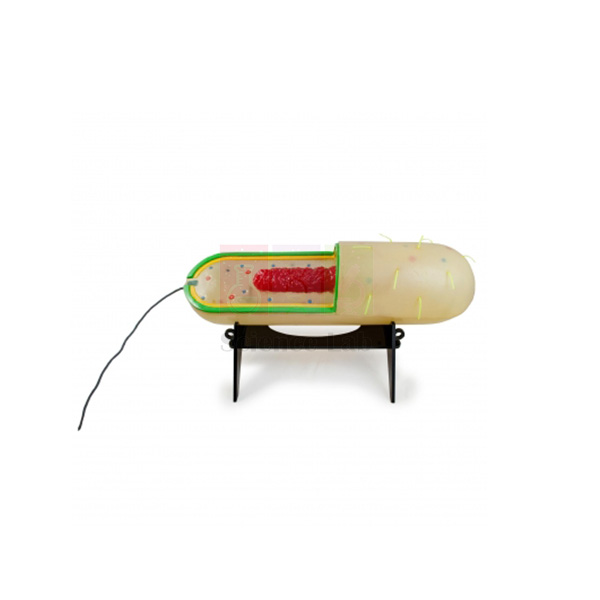
Prokaryotic Cell Model
Prokaryotic Cell Model (Product Code: SLE/ECB/11) is an enlarged bacterial-type cell model used to teach prokaryotic cell structure in school biology, college and microbiology courses. Shown at 280,000X and partly cut away, it displays pili and flagella outside and chromosomal DNA, plasmids and ribosomes inside, and the cell lifts off its stand, with key cards supplied. It is made by Jain Scientific Equipments Pvt Ltd (ScienceLab), an OEM manufacturer, at its own factory in Ambala, India, for colleges assembling microbiology lab equipment in India.
Specifications
| Parameter | Detail |
|---|---|
| Magnification | Enlarged 280,000X |
| Presentation | External cellular structures shown; partially cut away to reveal internal structures |
| Structures illustrated | Pili, flagella, chromosomal DNA, an inclusion body, plasmids, ribosomes, the cell envelope and the plasma membrane |
| Mounting | Removable from its stand |
| Supplied with | Key cards |
| Size (approx.) | 22 in long x 6-1/2 in (56 x 17 x 17 cm) |
| Weight (approx.) | 2.6 kg |
| Product code | SLE/ECB/11 |
| Manufacturer | Jain Scientific Equipments Pvt Ltd (ScienceLab) — OEM |
| Country of origin | India (made in Ambala, Haryana) |
What Is the Prokaryotic Cell Model Used For?
The model is most useful in the lesson that contrasts prokaryotes with eukaryotes. With the cutaway facing the class, the teacher can show that the chromosomal DNA lies free in the cytoplasm rather than inside a nucleus, point out the small plasmids and the ribosomes, and then turn the model to discuss the cell envelope, the pili used for attachment and the flagella used for movement. Lifting the cell off its stand makes it easy to pass to a group, and the key cards let students check their own identification of each part.
In microbiology courses it gives context before students look at stained bacterial smears, where individual structures are far too small to see. Foundation courses in nursing, pharmacy and life sciences use it to build a clear picture of bacterial anatomy that supports later topics such as antibiotic action and gene transfer through plasmids.
OEM Manufacturer
Jain Scientific Equipments Private Limited operates under the ScienceLab name and is the OEM (original equipment manufacturer) of the Prokaryotic Cell Model, which it makes at its own licensed factory at Saha, Ambala, Haryana, India. Departments, distributors and importers source the model factory-direct, so the same manufacturer handles their quotation, follow-up orders and requests for replacement key cards or a stand — ask us. Read more on the ScienceLab company profile.
Related Cell Biology Equipments
Pair the model with these items to build a complete lesson on cell types:
- Plant Cell — a detailed eukaryotic model for direct comparison with the prokaryotic layout.
- Visualising Cells Poster — a wall reference showing how bacterial, animal and plant cells differ.
- Bacteria slide Set of 12 — prepared slides of real bacteria, including cocci, bacilli and spirilla.
- Amoeba Model — a single-celled eukaryote that contrasts well with a prokaryote.
- Mitochondrion Model — supports discussion of how mitochondria resemble bacteria.
More models and investigations are listed under Cell Biology Equipments.
Frequently Asked Questions
Which structures can students identify on the Prokaryotic Cell Model?
On the Prokaryotic Cell Model students can identify pili, flagella, chromosomal DNA, an inclusion body, plasmids, ribosomes, the cell envelope and the plasma membrane. The partial cutaway shows the internal parts, while the outer surface displays the external structures.
What scale and size is the Prokaryotic Cell Model?
The Prokaryotic Cell Model represents the cell enlarged 280,000X. Its overall size is about 56 x 17 x 17 cm (22 in long) and it weighs roughly 2.6 kg, so it suits a demonstration bench or a group table.
Can the Prokaryotic Cell Model be taken off its stand?
Yes. The Prokaryotic Cell Model is removable from its stand, which makes close inspection and group work easier. Return it to the stand for storage so the flagella and pili are not bent or knocked.
What are the key cards with the Prokaryotic Cell Model for?
The key cards supplied with the Prokaryotic Cell Model identify the illustrated structures, so students can use the model for self-checking and revision without a separate textbook diagram, and teachers can run quick labelling quizzes.
How do I keep the Prokaryotic Cell Model in good condition?
Dust the Prokaryotic Cell Model with a soft brush or dry cloth and store it away from direct sunlight and heat. Do not use solvents or abrasive cleaners, and lift it by the stand or body rather than by the flagella.
Who manufactures the Prokaryotic Cell Model?
The Prokaryotic Cell Model is manufactured by Jain Scientific Equipments Pvt Ltd (ScienceLab), acting as the OEM, at its own licensed factory at Saha, Ambala, Haryana, India. Buyers in India and international markets deal directly with the manufacturer.
Can several Prokaryotic Cell Models be supplied for a department or distributor?
Yes. Send product code SLE/ECB/11 with the quantity of Prokaryotic Cell Models and the destination, and we will quote for delivery within India or to international markets. Other cell models can be added to the same quotation.
Request a Quote
For pricing and availability, send us an enquiry or place the Prokaryotic Cell Model in your enquiry cart with the rest of your requirements; the manufacturer replies with the quotation directly.
Last updated: 24 September 2026