- Physics Lab Equipment
- Chemistry Lab Equipment
- Biology Lab Equipment
- Anatomical Lab Equipment
- Learning
- Educational Lab Equipment
- Magnets
- Agriculture
- Astronomy
- Earth Science
- Geography Lab Equipment
- Safety Lab Coat
- Laboratory
- Meteorological
- Electricity & Magnetism
- Heat
- School Lab Equipment
- Lab Glassware
- Science Lab Equipment
- Tvet Lab Equipment
- Robotics Kits Supplier and Manufacturer for Schools India
- Math Lab Equipment Manufacturers and Exporters in Ambala
- STEM Kits Manufacturers and Supplier India
- Engineering Lab Equipment
- Hospital Lab Equipment
- Water, Sanitation & Hygiene Supplies
- Cold Chain, Solar & Communication Equipment
- Nutrition
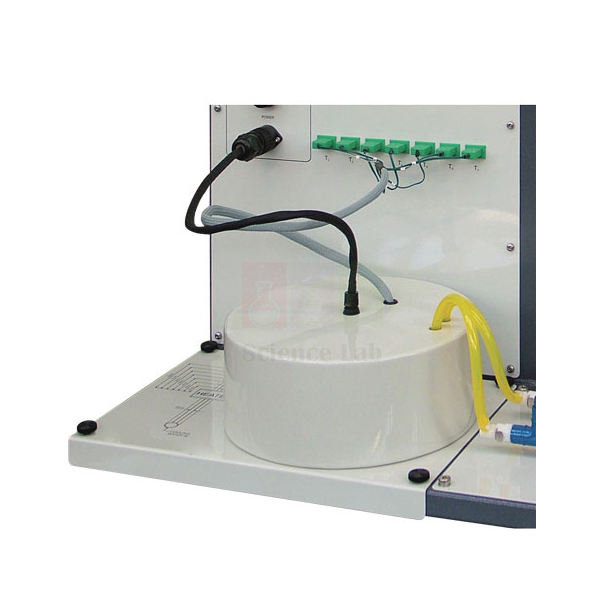
Radial Heat Conduction Experiment
Radial Heat Conduction Experiment (Product Code: SLE/EA/25) is a teaching module used to study steady-state heat conduction outwards through a solid disc in engineering heat transfer laboratories. Mechanical engineering students use it to map the radial temperature profile, read by seven thermocouples set at equally spaced radii on a solid brass disc heated at its centre. It is made by Jain Scientific Equipments Pvt Ltd (ScienceLab), an OEM manufacturer of engineering lab equipment in India, at its own factory in Ambala.
Specifications
| Parameter | Detail |
|---|---|
| Test piece | Solid brass disc |
| Heat source | Electric heater at the centre of the disc |
| Heat sink | Circular cross-section cooling tube around the circumference of the disc |
| Temperature sensors | Seven thermocouples at equally spaced radii on the disc |
| Insulation | Around the disc, reducing heat loss by convection and radiation |
| Mounting | Base plate with a clear schematic of the experiment layout |
| Electrical connections | Heater and thermocouples plug into sockets on the Heat Transfer Experiments Base Unit |
| Cooling water | Cold water feed and drain for the heat sink, provided through the base unit |
| Product code | SLE/EA/25 |
| Manufacturer | Jain Scientific Equipments Pvt Ltd (ScienceLab) — OEM |
| Country of origin | India (made in Ambala, Haryana) |
What Is the Radial Heat Conduction Experiment Used For?
Students turn on the cooling water flow through the rim tube, then adjust the heater power and wait until the disc reaches equilibrium. At steady state, the seven thermocouple readings give temperature against radius from the hot centre to the cooled edge. Because the heat spreads through an ever-larger circumference as the radius grows, the temperature does not fall in a straight line, and students compare their curve with the logarithmic profile that Fourier's law predicts for radial conduction.
Typical practicals include estimating the thermal conductivity of the brass from the heater power and the measured temperature gradient, then repeating the test at a second heater setting to check consistency. The insulation around the disc limits convection and radiation losses, so results should match simple radial conduction theory — a good check on careful technique. The module suits lab equipment for technical institutes, polytechnics and university heat transfer courses.
What to Specify When Ordering
- Whether you already have the Heat Transfer Experiments Base Unit, since the module's heater and thermocouples connect to its sockets.
- The number of radial conduction modules needed for your student groups.
- Whether a cold water feed and drain are available at the bench for the heat sink.
- Any other optional experiments you plan to run on the same base unit.
OEM Manufacturer
Jain Scientific Equipments Private Limited, which trades as ScienceLab, is the OEM (original equipment manufacturer) of the Radial Heat Conduction Experiment and makes it at its own licensed factory at Saha, Ambala, Haryana, India. Buying from the maker rather than a trader means the quotation, technical questions and any later request for replacement thermocouples or spare parts go to the people who manufacture the module — just ask us. Colleges, institutions, dealers and importers are supplied factory-direct. Learn more on the ScienceLab company profile.
Related Thermodynamics & Heat Transfer Lab Equipment
These items are often ordered with the radial conduction module to build a complete heat transfer practical bench.
- Heat Transfer — the base unit that supplies cold water, heater power and multi-line temperature displays to optional heat transfer experiments.
- Extended Surface Heat Transfer — another experiment that plugs into the Heat Transfer Experiments Base Unit, studying heat flow along a thin bar.
- Unsteady State Heat Transfer — moves students from steady conduction to transient temperature changes in immersed test shapes.
- Computerized Thermal Conductivity of Powder — extends conductivity measurement from solid metal to powdered materials.
See the full Thermodynamics & Heat Transfer Lab Equipment range for heat exchangers, convection and radiation apparatus.
Frequently Asked Questions
What is included with the Radial Heat Conduction Experiment?
The Radial Heat Conduction Experiment includes a solid brass disc with a central electric heater, a circular cross-section cooling tube around its rim as the heat sink, seven thermocouples at equally spaced radii, insulation around the disc and a base plate showing the experiment layout.
Can the Radial Heat Conduction Experiment be used on its own?
No. The Radial Heat Conduction Experiment connects its heater and thermocouples to sockets on the Heat Transfer Experiments Base Unit, which also provides the cold water feed and drain for the heat sink. Tell us whether you already own a base unit when you request a quotation.
Why is the disc of the Radial Heat Conduction Experiment insulated?
The insulation around the brass disc of the Radial Heat Conduction Experiment reduces heat loss by convection and radiation, so heat travels mainly by radial conduction from the central heater to the cooled rim and student results should match simple radial conduction theory.
How many temperature points does the Radial Heat Conduction Experiment measure?
The Radial Heat Conduction Experiment measures temperature at seven points, using seven thermocouples placed at equally spaced radii on the brass disc. Together they give students a temperature-versus-radius profile from the heated centre to the water-cooled edge once the disc reaches equilibrium.
Who manufactures the Radial Heat Conduction Experiment?
The Radial Heat Conduction Experiment is manufactured by Jain Scientific Equipments Pvt Ltd (ScienceLab), the OEM, at its own licensed factory at Saha, Ambala, Haryana, India. It is supplied factory-direct to colleges, institutions, dealers and importers in India and international markets.
Is a calibration certificate available for the Radial Heat Conduction Experiment?
Calibration-certificate availability for the Radial Heat Conduction Experiment and its thermocouples should be discussed with us before ordering. Please raise it through our contact page so the documentation that can accompany your order is confirmed in the quotation.
What information is needed for a Radial Heat Conduction Experiment quotation?
For a Radial Heat Conduction Experiment quotation, send the product code SLE/EA/25, the quantity, whether the Heat Transfer Experiments Base Unit is also required, and your delivery destination. We quote institutions and dealers across India and international markets.
Request a Quote
To buy the Radial Heat Conduction Experiment, send your requirement through the contact page or add it to the enquiry cart. Your quotation comes direct from the manufacturer, without a trader in between.
Last updated: 24 September 2026