- Physics Lab Equipment
- Chemistry Lab Equipment
- Biology Lab Equipment
- Anatomical Lab Equipment
- Learning
- Educational Lab Equipment
- Magnets
- Agriculture
- Astronomy
- Earth Science
- Geography Lab Equipment
- Safety Lab Coat
- Laboratory
- Meteorological
- Electricity & Magnetism
- Heat
- School Lab Equipment
- Lab Glassware
- Science Lab Equipment
- Tvet Lab Equipment
- Robotics Kits Supplier and Manufacturer for Schools India
- Math Lab Equipment Manufacturers and Exporters in Ambala
- STEM Kits Manufacturers and Supplier India
- Engineering Lab Equipment
- Hospital Lab Equipment
- Water, Sanitation & Hygiene Supplies
- Cold Chain, Solar & Communication Equipment
- Nutrition
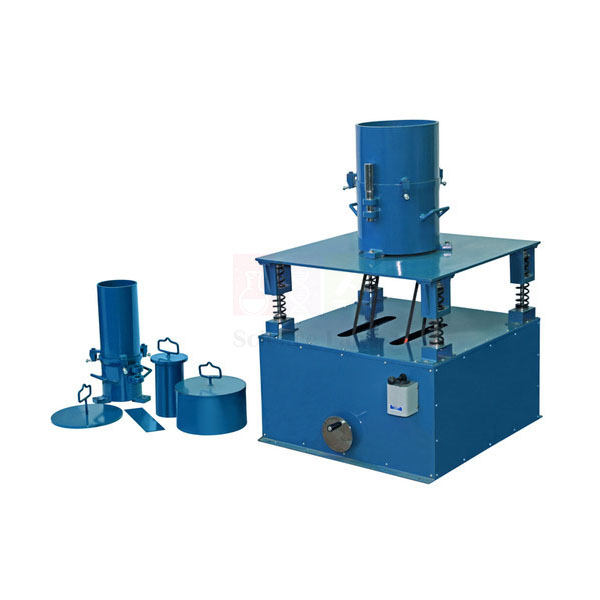
Relative density test apparatus
Relative density test apparatus (Product Code: SLE/CE/62) is a vibratory table and mould assembly used to compact free-draining sands and gravels to their densest state so their relative density can be calculated in soil mechanics laboratories. Geotechnical labs and civil engineering colleges use it with 3000 ml and 15000 ml unit weight moulds on a cushioned steel deck of about 75 cm x 75 cm. It is made by Jain Scientific Equipments Pvt Ltd (ScienceLab), an OEM and TVET lab equipment manufacturer in India, at its own factory in Ambala.
Specifications
| Parameter | Detail |
|---|---|
| Vibratory table deck | Cushioned steel vibrating deck, about 75 cm x 75 cm |
| Power supply | 415 V, three phase |
| Vibration frequency | Approximately 3600 vibrations per minute under an 11.5 kg load |
| Amplitude | Variable in three ranges: 0.05 to 0.25 mm, 0.25 to 0.45 mm and 0.45 to 0.65 mm |
| Unit weight moulds | Cylindrical metal moulds, 3000 ml and 15000 ml capacity |
| Mould accessories | Guide sleeve with clamp assembly, surcharge base plate, handle for the surcharge base plate, surcharge weight |
| Dial gauge | 0.01 mm x 50 mm travel, with 25 mm extension piece |
| Product code | SLE/CE/62 |
| Manufacturer | Jain Scientific Equipments Pvt Ltd (ScienceLab) — OEM |
| Country of origin | India (made in Ambala, Haryana) |
What Is the Relative Density Test Apparatus Used For?
Clean sands and gravels do not give a clear peak in a normal compaction test, so their state of packing is described by relative density instead. With this apparatus, dry soil is placed in the mould, the guide sleeve is clamped on, and the surcharge base plate and weight are seated on top. The table then vibrates the filled mould, and the dial gauge with its extension piece records how far the surcharge plate has settled, giving the compacted volume.
Comparing the field density of a sand fill with its maximum and minimum densities tells engineers how loose or dense the deposit is, which matters for foundations, backfill behind walls and embankments. For colleges buying from an engineering lab equipment manufacturer, it turns a textbook index into a practical exercise. Bolt the table to a firm floor so vibration goes into the specimen, not the bench.
What to Specify When Ordering
- Mould capacity: 3000 ml, 15000 ml or both, based on the particle size of your soils
- Confirmation that a 415 V three-phase supply is available where the table will stand
- Extra surcharge weights, guide sleeves or dial gauges you would like quoted
- Number of complete sets required
OEM Manufacturer
Jain Scientific Equipments Private Limited, which trades as ScienceLab, is the OEM for this relative density test apparatus. The company produces it at its own licensed factory at Saha, Ambala, Haryana, India, and sells it factory-direct, so there is no trading middleman between the maker and your laboratory.
Engineering colleges, research labs, dealers and importers receive quotations straight from the manufacturer, and follow-up orders for moulds or surcharge parts are handled by the same team — just ask us. Background on the company is on our company profile.
Related Civil Engineering Lab Equipment
Relative density results are most useful when combined with grading, moisture and field density data. These items complete the workflow:
- Core cutters — in-place density of the soil for comparison with the laboratory limits
- Test Sieves — grading to confirm the soil is a free-draining sand or gravel
- Moisture Tins — moisture content checks on field and laboratory samples
- Constant Head permeability apparatus — permeability of the same granular soils
- Direct Shear test Apparatus — shear strength of sand prepared at a known density
Browse all Civil Engineering Lab Equipment for soil, concrete and highway laboratories.
Frequently Asked Questions
What is included with the relative density test apparatus?
The relative density test apparatus includes a vibratory table, cylindrical unit weight moulds of 3000 ml and 15000 ml, a guide sleeve with clamp assembly, surcharge base plate with handle, surcharge weight, and a 0.01 mm x 50 mm dial gauge with a 25 mm extension piece.
What power supply does the relative density test apparatus need?
The relative density test apparatus runs on a 415 V three-phase supply. Check that your laboratory has a suitable three-phase outlet near a solid floor before installation, and contact us if you need guidance on connection details.
What vibration settings does the relative density test apparatus offer?
The relative density test apparatus vibrates at approximately 3600 vibrations per minute under an 11.5 kg load, with amplitude adjustable in three ranges from 0.05 to 0.25 mm, 0.25 to 0.45 mm and 0.45 to 0.65 mm.
Which soils is the relative density test apparatus meant for?
The relative density test apparatus is meant for cohesionless, free-draining soils such as clean sands and gravels, where density is better described by relative density than by a compaction curve. Clays and silts are normally tested with other methods.
Who manufactures the relative density test apparatus?
The relative density test apparatus is manufactured by Jain Scientific Equipments Pvt Ltd (ScienceLab) as the OEM at its own factory at Saha, Ambala, Haryana, India. Buyers deal with the manufacturer directly for quotations and later parts.
What should a quotation request for the relative density test apparatus include?
A quotation request for the relative density test apparatus should state the mould capacities needed, the number of sets, confirmation of a 415 V three-phase supply and the delivery address, whether in India or international markets.
Request a Quote
To price the relative density test apparatus, write to us through the contact page or place it in the enquiry cart. Your quotation comes direct from the manufacturer.
Last updated: 24 September 2026