- Physics Lab Equipment
- Chemistry Lab Equipment
- Biology Lab Equipment
- Anatomical Lab Equipment
- Learning
- Educational Lab Equipment
- Magnets
- Agriculture
- Astronomy
- Earth Science
- Geography Lab Equipment
- Safety Lab Coat
- Laboratory
- Meteorological
- Electricity & Magnetism
- Heat
- School Lab Equipment
- Lab Glassware
- Science Lab Equipment
- Tvet Lab Equipment
- Robotics Kits Supplier and Manufacturer for Schools India
- Math Lab Equipment Manufacturers and Exporters in Ambala
- STEM Kits Manufacturers and Supplier India
- Engineering Lab Equipment
- Hospital Lab Equipment
- Water, Sanitation & Hygiene Supplies
- Cold Chain, Solar & Communication Equipment
- Nutrition
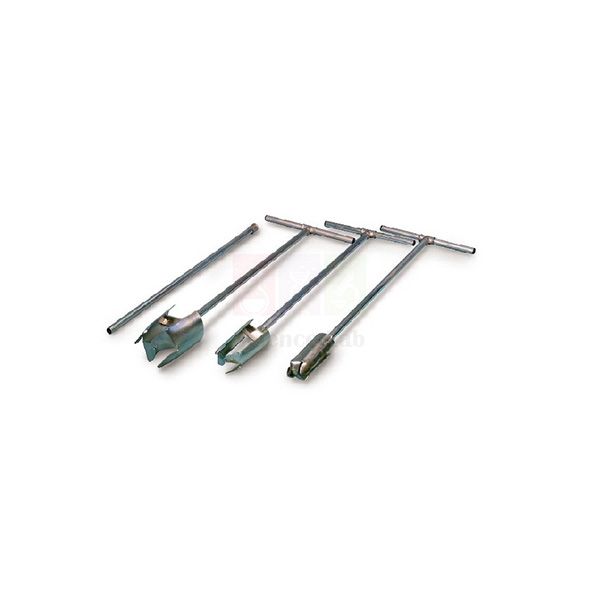
Soil Augers
Soil Augers (Product Code: SLE/CE/69) are hand-turned boring tools used to drill shallow holes and bring up disturbed soil samples for site investigation, soil surveys and environmental sampling. Field engineers and teaching labs choose between clay, standard, mud (Dutch) and sand patterns in 76 mm or 102 mm diameter, joined to a T-handle by quick-connect extensions. They are made by Jain Scientific Equipments Pvt Ltd (ScienceLab), an OEM manufacturer and laboratory equipment exporter from India, at its own factory in Ambala.
Specifications
| Parameter | Detail |
|---|---|
| Construction | Lightweight but sturdy augers, T-handle and extensions, easy to transport |
| Connections | Precision quick-connect fittings of high-strength steel on augers and extensions |
| Bits | Heat-treated super alloy bits that can be rebuilt when worn |
| Clay auger | Open bit for cohesive soils; 3 in (76 mm) or 4 in (102 mm) diameter |
| Standard soil auger | Open bit for most soil types; 76 mm or 102 mm diameter |
| Mud (Dutch) auger | Open design for muck-like, boggy and root-bound soils; 76 mm diameter only |
| Sand auger | Closed bit that retains cuttings in looser granular soils; 76 mm or 102 mm diameter |
| One-piece soil sampler | Steel construction with T-handle for tougher soils; 11 in (279 mm) or 14 in (360 mm) long |
| Handles and extensions | T-design handles; extensions from 2 to 5 ft (610 to 1,524 mm) long |
| Other versions | Threaded-connector systems and stainless steel systems for environmental sampling |
| Product code | SLE/CE/69 |
| Manufacturer | Jain Scientific Equipments Pvt Ltd (ScienceLab) — OEM |
| Country of origin | India (made in Ambala, Haryana) |
What Is the Soil Auger Used For?
The auger head is twisted into the ground with the T-handle, lifted out every few turns, and the soil caught in the bit is laid out in order of depth to build a simple log of the layers. Extensions are clicked on as the hole deepens. Open bits release sticky clay and moist soil easily, the closed sand bit stops dry granular soil from falling back down the hole, and the Dutch pattern cuts through wet, root-bound ground.
Typical jobs include preliminary checks before plate load or CBR tests, locating the water table, and collecting samples for moisture and Atterberg limit tests back in the lab. Stainless steel versions suit environmental sampling where contamination matters. Rugged, portable and easy to teach with, they are a practical part of engineering lab equipment in India for field-survey classes.
What to Specify When Ordering
- Auger type: clay, standard, mud (Dutch), sand, or one-piece soil sampler
- Diameter: 76 mm or 102 mm (the mud auger is 76 mm only)
- Handle and number of extensions, from 610 to 1,524 mm long, for your target depth
- Quick-connect steel, threaded-connector or stainless steel versions for environmental work
OEM Manufacturer
Jain Scientific Equipments Private Limited, trading as ScienceLab, is the original equipment manufacturer of these soil augers and makes them at its own licensed factory at Saha, Ambala, Haryana, India. Survey teams, universities, agricultural institutes, dealers and importers buy directly from the factory instead of through resellers.
Because the bits are designed to be rebuilt when worn, ask the manufacturer about replacement or reconditioned bits for your set rather than replacing the whole auger. Company details are on our company profile.
Related Civil Engineering Lab Equipment
Augering is usually the first step of a soil investigation. These items handle the samples it produces:
- Core cutters — undisturbed cores for in-place density once the target level is reached
- Moisture Tins — sealed containers for moisture content samples
- Sample Splitter — reducing bulky field samples to test size
- Scoops — transferring loose soil into containers and trays
- Garden Auger Soil — a simpler auger for school garden and biology field work
Explore the whole Civil Engineering Lab Equipment range.
Frequently Asked Questions
Which types of Soil Augers are available?
Soil Augers are available as clay augers and standard augers with open bits, mud (Dutch) augers for boggy or root-bound ground, and sand augers with closed bits. One-piece soil samplers with a T-handle are also offered for tougher soils.
What diameters do the Soil Augers come in?
Soil Augers in the clay, standard and sand patterns come in 76 mm (3 in) and 102 mm (4 in) diameters. The mud (Dutch) auger is made in 76 mm diameter only, so choose the size that suits your sample volume.
How can I increase the depth reached with Soil Augers?
Soil Augers reach greater depth when extensions are added between the auger and the T-handle. Extensions range from 610 to 1,524 mm (2 to 5 ft) in length; the achievable depth also depends on the soil, so tell us your target depth.
What connection system do the Soil Augers use?
Soil Augers and their extensions use precision quick-connect fittings made of high-strength steel, designed to join more quickly than conventional threaded joints. Threaded-connector and stainless steel systems are also available for environmental sampling.
Who manufactures the Soil Augers?
The Soil Augers are manufactured by Jain Scientific Equipments Pvt Ltd (ScienceLab) as the OEM at its own factory at Saha, Ambala, Haryana, India. Quotations, bit enquiries and repeat orders are handled by the manufacturer directly.
What should a quotation request for Soil Augers include?
A quotation request for Soil Augers should list each auger type and diameter, the number and length of extensions, the connection style, the quantity and the delivery location in India or international markets.
Request a Quote
Send your Soil Augers selection through the contact page or add it to the enquiry cart. Quotes are prepared by the manufacturer itself.
Last updated: 24 September 2026