- Physics Lab Equipment
- Chemistry Lab Equipment
- Biology Lab Equipment
- Anatomical Lab Equipment
- Learning
- Educational Lab Equipment
- Magnets
- Agriculture
- Astronomy
- Earth Science
- Geography Lab Equipment
- Safety Lab Coat
- Laboratory
- Meteorological
- Electricity & Magnetism
- Heat
- School Lab Equipment
- Lab Glassware
- Science Lab Equipment
- Tvet Lab Equipment
- Robotics Kits Supplier and Manufacturer for Schools India
- Math Lab Equipment Manufacturers and Exporters in Ambala
- STEM Kits Manufacturers and Supplier India
- Engineering Lab Equipment
- Hospital Lab Equipment
- Water, Sanitation & Hygiene Supplies
- Cold Chain, Solar & Communication Equipment
- Nutrition
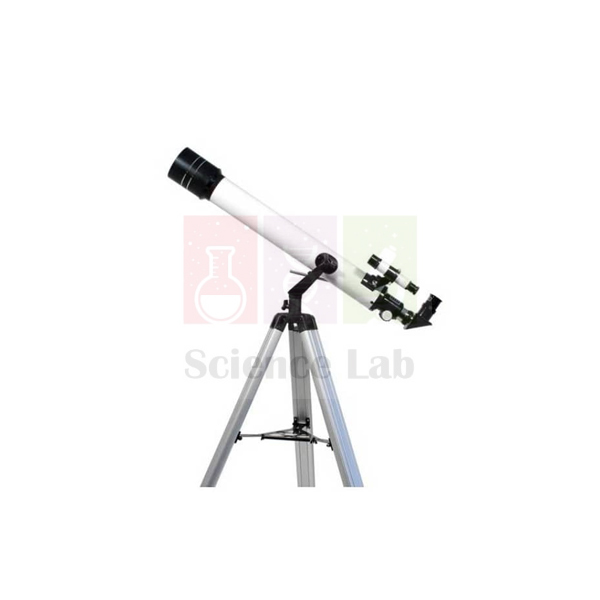
Telescope Refractor
Telescope Refractor (Product Code: SLE/M/47) is a 70 mm refracting telescope used to observe the Moon, bright planets and distant land objects in school astronomy clubs, geography lessons and outdoor science activities. It has a 400 mm focal length, two eyepieces giving 20x and 40x, an altazimuth mount and a full-size aluminium tripod that packs into the included backpack. This portable addition to optics lab equipment in India is supplied by Jain Scientific Equipments Pvt Ltd (ScienceLab), Ambala, India.
Specifications
| Parameter | Detail |
|---|---|
| Optical design | Refractor with coated glass optical elements |
| Aperture | 70 mm (2.76 in) |
| Focal length | 400 mm (16 in) |
| Eyepieces (2) | 20 mm (20x) and 10 mm (40x) |
| Diagonal | Erect-image diagonal, so views are correctly oriented |
| Mount | Smooth-functioning altazimuth mount for easy pointing |
| Tripod | Preassembled aluminium, full-size photographic tripod |
| Set-up | Quick, no tools needed |
| Carrying | Custom backpack included; telescope and tripod fit inside |
| Weight | 3.3 lb (approx. 1.5 kg) |
| Product code | SLE/M/47 |
| Supplied by | Jain Scientific Equipments Pvt Ltd (ScienceLab), Ambala, India |
What Is the Refractor Telescope Used For?
A small refractor gives students their first real look at the night sky: craters along the Moon’s terminator, the changing phases of the Moon and the brighter planets. Because the erect-image diagonal shows land views the right way up, the same telescope works in daylight for bird watching, reading distant signs or studying a landscape during a geography field visit.
Begin with the 20 mm eyepiece (20x) to find a target, centre it with the altazimuth mount, then change to the 10 mm eyepiece (40x) for closer detail. Let the telescope sit outdoors for a few minutes before observing, and never aim it at the Sun. Packed in its backpack, it travels easily to observation nights and complements school physics lab equipment in India used for lens and optics practicals.
Supplier
ScienceLab, the trading name of Jain Scientific Equipments Private Limited, supplies the Telescope Refractor from Ambala, Haryana. Schools, colleges, astronomy clubs, dealers and importers in India and international markets can order it with globes, compasses and other optics items on a single quotation. Learn more about the company on the ScienceLab profile.
Related Laboratory Equipment
Items that support astronomy and outdoor observation lessons:
- Astronomical Telescope — another telescope option to compare
- Celestial Star Globe — helps students locate constellations before observing
- Binoculars — wide-field viewing for nature study and sky scanning
- Magnetic Compass Small Size — for finding directions when setting up outdoors
- Microfiber Lens Cloth — for wiping eyepiece surfaces
Other optical instruments are listed in the Microscope category.
Frequently Asked Questions
What magnifications does the Telescope Refractor give?
The Telescope Refractor gives 20x with its 20 mm eyepiece and 40x with its 10 mm eyepiece; both eyepieces are part of the listing. Start at 20x to find a target, then switch to 40x for a closer view.
What aperture and focal length does the Telescope Refractor have?
The Telescope Refractor has a 70 mm (2.76 in) aperture and a 400 mm (16 in) focal length. Its coated glass optical elements are there to give clear, crisp images of the Moon, bright planets and distant land objects.
Can the Telescope Refractor be used for daytime land viewing?
Yes. The Telescope Refractor uses an erect-image diagonal, so views are correctly oriented rather than upside down. That makes it suitable for watching birds, landscapes and distant buildings in daylight as well as for night-sky observation.
How portable is the Telescope Refractor?
The Telescope Refractor weighs 3.3 lb (about 1.5 kg), and the telescope and its preassembled aluminium tripod both fit inside the included custom backpack. Set-up is quick and needs no tools, which suits field trips and evening observation sessions.
Can the Telescope Refractor be pointed at the Sun?
No. Never point the Telescope Refractor at the Sun or look at the Sun through it, because this can seriously injure the eyes. Solar viewing needs a purpose-made solar filter, so ask us on the contact page before planning it.
Who supplies the Telescope Refractor?
The Telescope Refractor is supplied by Jain Scientific Equipments Pvt Ltd (ScienceLab), Ambala, Haryana, India. The company quotes schools, colleges, astronomy clubs, dealers and importers in India and international markets for single units or class sets.
What should a Telescope Refractor quotation request include?
A Telescope Refractor quotation request should state the number of telescopes, the delivery location and any related items such as globes or compasses. Sharing how many student groups will observe at once helps us suggest a sensible quantity.
Request a Quote
Use the contact page to ask about the Telescope Refractor, or add it to the enquiry cart with the rest of your astronomy and optics list.
Last updated: 24 September 2026