- Physics Lab Equipment
- Chemistry Lab Equipment
- Biology Lab Equipment
- Anatomical Lab Equipment
- Learning
- Educational Lab Equipment
- Magnets
- Agriculture
- Astronomy
- Earth Science
- Geography Lab Equipment
- Safety Lab Coat
- Laboratory
- Meteorological
- Electricity & Magnetism
- Heat
- School Lab Equipment
- Lab Glassware
- Science Lab Equipment
- Tvet Lab Equipment
- Robotics Kits Supplier and Manufacturer for Schools India
- Math Lab Equipment Manufacturers and Exporters in Ambala
- STEM Kits Manufacturers and Supplier India
- Engineering Lab Equipment
- Hospital Lab Equipment
- Water, Sanitation & Hygiene Supplies
- Cold Chain, Solar & Communication Equipment
- Nutrition
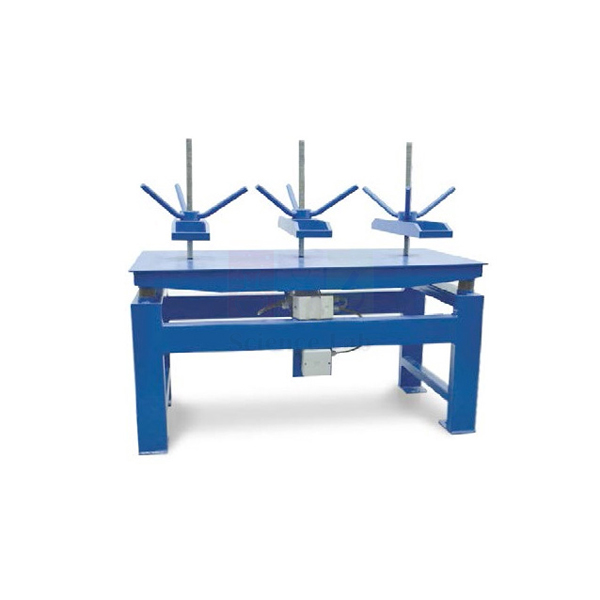
Vibrating Table
Vibrating Table (Product Code: SLE/CE/13) is a motor-driven vibration table used to compact fresh concrete in test moulds in civil engineering laboratories and site labs. Its 500 x 500 mm top carries up to 140 kg, and a speed regulation handle sets the frequency anywhere from 2600 to 3600 vibrations per minute. The table is made by Jain Scientific Equipments Pvt Ltd (ScienceLab), an OEM scientific lab equipment manufacturer in Ambala, at its own factory in India.
Specifications
| Parameter | Detail |
|---|---|
| Table top | 500 x 500 mm, with stops along the edges so moulds cannot walk off during vibration |
| Load capacity | 140 kg |
| Vibration frequency | Adjustable from a maximum of 3600 down to 2600 vibrations per minute |
| Drive | Motor with variable pitch pulley, housed in a cabinet |
| Vibration mechanism | Off-balance masses rotating on the shaft of a vibrator clamped to the underside of the table top |
| Controls | Switch for starting the motor; speed regulation handle for increasing or decreasing frequency |
| Mould holding | Cross arm adjustable on a vertical rod at the centre of the table |
| Power supply | 230 V AC, single phase, 50 cycles |
| Product code | SLE/CE/13 |
| Manufacturer | Jain Scientific Equipments Pvt Ltd (ScienceLab) — OEM |
| Country of origin | India (made in Ambala, Haryana) |
What Is the Vibrating Table Used For?
Trapped air weakens concrete specimens and makes test results scatter, so moulds are vibrated rather than only hand-rodded. Filled cube, cylinder or beam moulds are set on the table, held down by the cross arm on the central rod, and the motor is started; vibration continues until the concrete surface settles and air bubbles stop rising.
Stiffer mixes need more energy, which is why the frequency can be turned up towards 3600 vibrations per minute, while more fluid mixes are compacted at the lower end to avoid segregation. Keep the total load within 140 kg, check that the cross arm is tight before switching on, and scrape off spilt concrete before it hardens on the table top.
OEM Manufacturer
This vibrating table is built by Jain Scientific Equipments Private Limited, trading as ScienceLab, as the OEM (original equipment manufacturer). Frame, table top, drive cabinet and vibrator assembly are made and put together at the company's own licensed factory at Saha, Ambala, Haryana, India, and each table is supplied factory-direct to colleges, construction and precast laboratories, dealers and importers.
Because you buy from the maker, spares such as the pulley or vibrator parts and repeat orders are handled by the same team — ask us. Find out more on the ScienceLab company profile.
Related Civil Engineering Lab Equipment
Moulds and compaction tools used with the table:
- Concrete Cube Mould — cube specimens compacted on the table.
- Cylindrical Mould — cylinder specimens for strength tests.
- Beam Mould — beam specimens for flexural tests.
- Poker Vibrator — internal compaction when many specimens are cast.
Browse all Civil Engineering Lab Equipment.
Frequently Asked Questions
What load can the Vibrating Table carry?
The Vibrating Table is designed to carry a load of 140 kg on its 500 x 500 mm top. Spread moulds evenly across the table and keep the combined weight of moulds and concrete within this limit.
What vibration frequency does the Vibrating Table give?
The Vibrating Table runs between a maximum of 3600 and a minimum of 2600 vibrations per minute. A speed regulation handle acting on the variable pitch pulley increases or decreases the frequency to suit the mix.
How are moulds held in place during vibration?
On the Vibrating Table, stops along the edges of the table top prevent moulds from walking off, and a cross arm adjustable on a vertical rod at the centre of the table holds the moulds down while the table runs.
How does the Vibrating Table produce vibration?
The Vibrating Table uses off-balance masses rotating on the shaft of a vibrator clamped to the underside of the top. The shaft is driven by a motor with a variable pitch pulley housed in a cabinet, started by a switch.
What power supply does the Vibrating Table need?
The Vibrating Table operates on 230 V AC, single phase, 50 cycles. If your site or laboratory uses a different supply, mention it on the contact page so we can confirm what can be offered.
Who manufactures the Vibrating Table?
The Vibrating Table is manufactured by Jain Scientific Equipments Pvt Ltd (ScienceLab), the OEM, at its own licensed factory at Saha, Ambala, Haryana, India, and supplied factory-direct to institutions, laboratories, dealers and importers.
Request a Quote
Ask for a factory-direct quotation on the Vibrating Table through the contact page, or add it to the enquiry cart along with your moulds. Bulk and export enquiries are welcome.
Last updated: 24 September 2026