- Physics Lab Equipment
- Chemistry Lab Equipment
- Biology Lab Equipment
- Anatomical Lab Equipment
- Learning
- Educational Lab Equipment
- Magnets
- Agriculture
- Astronomy
- Earth Science
- Geography Lab Equipment
- Safety Lab Coat
- Laboratory
- Meteorological
- Electricity & Magnetism
- Heat
- School Lab Equipment
- Lab Glassware
- Science Lab Equipment
- Tvet Lab Equipment
- Robotics Kits Supplier and Manufacturer for Schools India
- Math Lab Equipment Manufacturers and Exporters in Ambala
- STEM Kits Manufacturers and Supplier India
- Engineering Lab Equipment
- Hospital Lab Equipment
- Water, Sanitation & Hygiene Supplies
- Cold Chain, Solar & Communication Equipment
- Nutrition
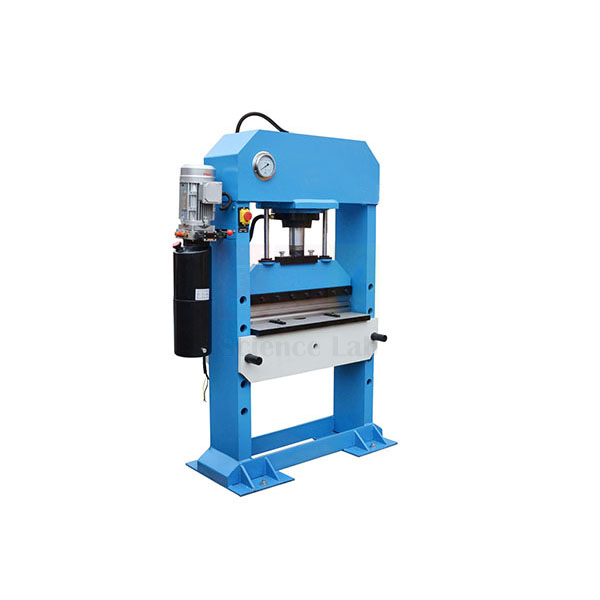
Hydraulic Press Machine
Hydraulic Press Machine (Product Code: SLE/MCE/09) is a motor-driven hydraulic press used to apply large, controllable force for pressing, straightening, bending, forming and assembly work, such as fitting bearings and bushes, in maintenance shops, fabrication workshops and engineering training institutes. It is listed from 5 to 200 tonnes at 25 MPa working pressure, with honed steel cylinders and chevron seals. It is supplied by Jain Scientific Equipments Pvt Ltd (ScienceLab), Ambala, India.
Specifications
| Parameter | Detail |
|---|---|
| Capacity | 5–200 tonnes |
| Working pressure | 25 MPa |
| Table travel | 200–270 mm |
| Bed size | 235 x 235 mm to 750 x 800 mm |
| Motor | 2–10 HP |
| Cylinders | Made from quality steel; bores honed to a mirror finish for long piston-seal life; surface ground and hardened for seal life and corrosion resistance |
| Sealing | Chevron seals and bronze strip for leak-proof performance |
| Product code | SLE/MCE/09 |
| Supplied by | Jain Scientific Equipments Pvt Ltd (ScienceLab), Ambala, India |
What Is the Hydraulic Press Used For?
A hydraulic press multiplies force with oil: the motor-driven pump pushes oil into the cylinder, and the working pressure acting on the piston area produces the rated tonnage at the ram. Because the ram can be stopped, held or reversed at any point, the press suits jobs that need control rather than speed — pressing bearings and bushes on or off shafts, straightening bent components, bending and forming, and general assembly work.
For engineering students it is also a clear demonstration of force equals pressure times area. Honed cylinder bores and chevron seals with bronze strip are there to keep the system leak-free, so keep the oil clean and check for seepage during routine care. Always centre the load on the bed, use suitable fixtures and never work above the rated capacity.
What to Specify When Ordering
- Required capacity, from 5 to 200 tonnes.
- Bed size needed for your largest job (235 x 235 mm up to 750 x 800 mm).
- Table travel required, within 200–270 mm.
- Your electrical supply for the 2–10 HP motor, which is not stated in the listing.
- Quantity and delivery location.
Supplier
ScienceLab is the trading name of Jain Scientific Equipments Private Limited, which supplies the Hydraulic Press Machine to engineering colleges, polytechnics, ITIs, automotive and maintenance workshops, dealers and importers in India and international markets. Presses can be quoted together with other workshop machines and laboratory apparatus.
Visit the ScienceLab company profile for more about the company.
Related Workshop Machine Tools
Workshops that press, form and assemble parts often use these machines too:
- Power Press Machine — faster mechanical pressing for repetitive punching and blanking.
- Arc Welding Machine — joins pressed and formed parts into fabrications.
- Pillar Drilling Machine — drills holes for pins, bolts and bushes before pressing.
- Radial Drill Machine — drilling on heavy parts too large for a pillar drill.
See all Workshop Machine Tools.
Frequently Asked Questions
What capacities is the Hydraulic Press Machine available in?
The Hydraulic Press Machine is listed in capacities from 5 to 200 tonnes, working at a pressure of 25 MPa, with motors from 2 to 10 HP depending on the capacity chosen.
What bed size and table travel does the Hydraulic Press Machine have?
The Hydraulic Press Machine has bed sizes from 235 x 235 mm on the smallest model to 750 x 800 mm on the largest, with table travel of 200–270 mm across the range.
How are the cylinders of the Hydraulic Press Machine built?
The Hydraulic Press Machine uses cylinders made from quality steel, with bores honed to a mirror finish, surfaces ground and hardened, and chevron seals with bronze strip for leak-proof performance and long seal life.
How is a Hydraulic Press Machine different from a power press?
A Hydraulic Press Machine lets the operator control force and ram position throughout the stroke, stopping or holding as needed, which suits straightening, assembly and forming; a mechanical power press is faster for repetitive punching and blanking.
What power supply does the Hydraulic Press Machine need?
The Hydraulic Press Machine uses a 2–10 HP motor depending on capacity, but the supply voltage and phase are not stated in the listing. Tell us your workshop supply and we will confirm the requirement before you order.
Who supplies the Hydraulic Press Machine?
The Hydraulic Press Machine is supplied by Jain Scientific Equipments Pvt Ltd (ScienceLab), Ambala, India, to colleges, training institutes, workshops, dealers and importers in India and international markets.
Request a Quote
Send your Hydraulic Press Machine requirement through the contact page or add it to the enquiry cart, including tonnage, bed size and quantity.
Last updated: 24 September 2026