- Physics Lab Equipment
- Chemistry Lab Equipment
- Biology Lab Equipment
- Anatomical Lab Equipment
- Learning
- Educational Lab Equipment
- Magnets
- Agriculture
- Astronomy
- Earth Science
- Geography Lab Equipment
- Safety Lab Coat
- Laboratory
- Meteorological
- Electricity & Magnetism
- Heat
- School Lab Equipment
- Lab Glassware
- Science Lab Equipment
- Tvet Lab Equipment
- Robotics Kits Supplier and Manufacturer for Schools India
- Math Lab Equipment Manufacturers and Exporters in Ambala
- STEM Kits Manufacturers and Supplier India
- Engineering Lab Equipment
- Hospital Lab Equipment
- Water, Sanitation & Hygiene Supplies
- Cold Chain, Solar & Communication Equipment
- Nutrition
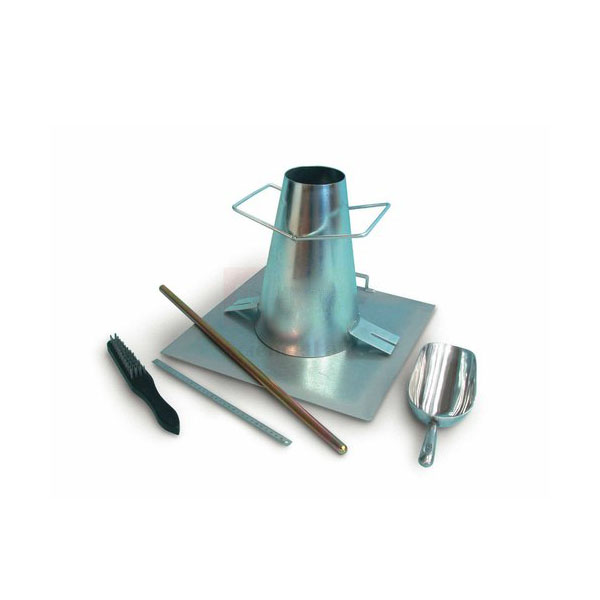
Slump Test Apparatus
Slump Test Apparatus (Product Code: SLE/CE/07) is a slump cone set used to measure the workability of fresh concrete on construction sites and in civil engineering laboratories. The cone measures 200 mm across the base, 100 mm across the top and 300 mm in height; it clamps to a base plate with a lifting handle and comes with a 16 mm x 600 mm steel rod graduated in millimetres. The set is supplied by Jain Scientific Equipments Pvt Ltd (ScienceLab), Ambala, India, a laboratory equipment supplier in India for colleges and site labs.
Specifications
| Parameter | Detail |
|---|---|
| Slump cone (internal) | 200 mm base diameter, 100 mm top diameter, 300 mm height |
| Cone fixing | Foot pieces fix to clamps on the base plate |
| Base plate | With lifting handle for easy transport |
| Graduated rod | One steel rod, 16 mm diameter x 600 mm long, rounded at both ends, graduated in mm |
| Product code | SLE/CE/07 |
| Supplied by | Jain Scientific Equipments Pvt Ltd (ScienceLab), Ambala, India |
What Is the Slump Cone Used For?
The slump test is the quickest check that a concrete batch has the consistency the mix design intended. The cone is clamped to the dampened base plate, filled in layers, and each layer is rodded with the rounded end of the steel rod before the top is struck off. The cone is then lifted straight up, and the drop of the concrete below the cone height is measured with the millimetre graduations on the rod.
The shape of the slumped concrete also tells you something: an even drop shows a cohesive mix, while a sheared or collapsed heap points to a lean or over-wet batch. Carry the set by the base-plate handle, and wash cone, plate and rod before the concrete hardens on them. For very stiff mixes, a Vee Bee or compaction factor test gives more useful readings.
Supplier
Jain Scientific Equipments Private Limited, known by its trading name ScienceLab, supplies this slump test set from Ambala, Haryana, to schools of engineering, ready-mix and site laboratories, contractors and dealers across India and international markets. The company sources the set to your order and remains your contact for quotations, spare rods or cones and repeat orders — just ask. For vendor registration, the supplying company's details are GSTIN 06AAECJ8618A1ZT and LEI 3358004HRD1JIVXKYX49. More on the ScienceLab company profile.
Related Civil Engineering Lab Equipment
Other items used for fresh-concrete workability testing:
- Scoops — for filling the cone with fresh concrete.
- Vee Bee Consistometer — measures workability of stiffer mixes.
- Compaction Factor Test Apparatus — another workability method for low-slump concrete.
- K-Slump Tester — in-situ readings that can be correlated with the slump test.
Find more in Civil Engineering Lab Equipment.
Frequently Asked Questions
What are the dimensions of the slump cone?
The cone in the Slump Test Apparatus has internal dimensions of 200 mm diameter at the base, 100 mm diameter at the top and 300 mm height. Its foot pieces fix to clamps on the base plate so the cone stays put while it is filled.
What is included in the Slump Test Apparatus?
The Slump Test Apparatus includes the slump cone, a base plate with clamps and a lifting handle, and one steel rod of 16 mm diameter and 600 mm length, rounded at both ends and graduated in millimetres. Other tools such as scoops are ordered separately.
How is the slump value read?
With the Slump Test Apparatus, the slump is read after lifting the cone: the rod's millimetre graduations measure how far the concrete has dropped below the original 300 mm cone height, giving a direct reading without a separate ruler.
Who supplies the Slump Test Apparatus?
Jain Scientific Equipments Pvt Ltd (ScienceLab), Ambala, Haryana, India supplies the Slump Test Apparatus to colleges, site and ready-mix laboratories, contractors and dealers in India and international markets, and handles quotations and dispatch directly.
Can spare rods or cones be ordered separately?
Spare parts for the Slump Test Apparatus, such as an extra graduated rod or cone, can be requested through the contact page. Tell us what you need and the quantity so availability can be confirmed.
Is the Slump Test Apparatus available in bulk for institutions?
Yes, the Slump Test Apparatus can be quoted in quantity for engineering colleges, polytechnics, contractors and dealers, including export orders. Send the number of sets and the delivery city or port with your enquiry.
Request a Quote
For a quotation on the Slump Test Apparatus, contact us through the contact page or add it to the enquiry cart along with any other workability testing items.
Last updated: 24 September 2026