- Physics Lab Equipment
- Chemistry Lab Equipment
- Biology Lab Equipment
- Anatomical Lab Equipment
- Learning
- Educational Lab Equipment
- Magnets
- Agriculture
- Astronomy
- Earth Science
- Geography Lab Equipment
- Safety Lab Coat
- Laboratory
- Meteorological
- Electricity & Magnetism
- Heat
- School Lab Equipment
- Lab Glassware
- Science Lab Equipment
- Tvet Lab Equipment
- Robotics Kits Supplier and Manufacturer for Schools India
- Math Lab Equipment Manufacturers and Exporters in Ambala
- STEM Kits Manufacturers and Supplier India
- Engineering Lab Equipment
- Hospital Lab Equipment
- Water, Sanitation & Hygiene Supplies
- Cold Chain, Solar & Communication Equipment
- Nutrition
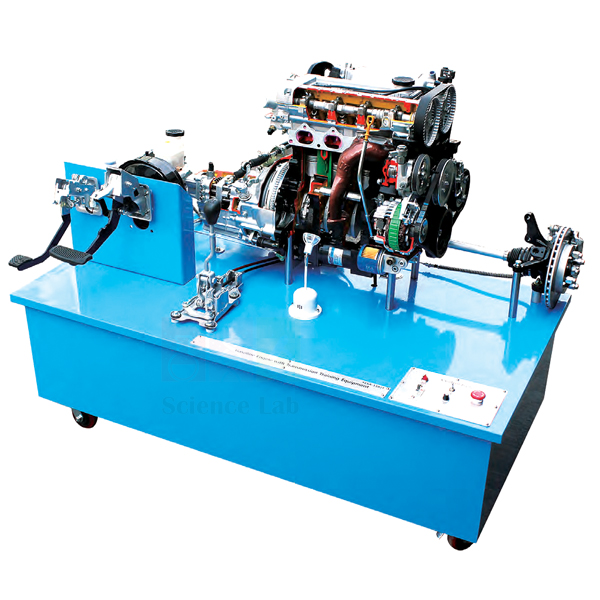
Automotive Power Train Training Equipment DOHC Gasoline
Automotive Power Train Training Equipment DOHC Gasoline (Product Code: SLE/ATE/01) is a sectioned, motor-driven power train trainer used to teach how a DOHC four-cylinder gasoline engine, FF manual transmission, clutch and brakes work together — engineering lab equipment in India for automobile, polytechnic and ITI courses. An educational model of the 1,800~2,000cc class, it lets students change gears as on a real vehicle while watching the cut internals. Its training stand and controls are made by Jain Scientific Equipments Pvt Ltd (ScienceLab), an OEM manufacturer, at its own factory in Ambala, India; the DOHC engine and transmission assemblies themselves are sourced production units, not made in Ambala.
Specifications
| Parameter | Detail |
|---|---|
| Engine | DOHC engine assembly, 4 cylinders (educational model for 1,800~2,000cc gasoline engine) |
| Transmission | FF-type manual, 5 forward and 1 reverse |
| Other assemblies | Clutch, brake system, drive shaft to the wheels |
| Drive motor | AC 220 V / 180 W |
| Controls and protection | Engine speed controller, emergency switch, safety fuse, light |
| Frame | Steel frame with heat-treatment painting |
| Wheels | 4 wheels with brakes |
| Sectioning | Precisely cut; each incised section painted a different colour, with brake structure and engine parts painted specifically |
| Weight | Approx. 250 kg |
| Size | Approx. 1,600 × 1,000 × 1,200 mm |
| Engine / assembly | Sourced production unit (as listed) |
| Product code | SLE/ATE/01 |
| Manufacturer | Jain Scientific Equipments Pvt Ltd (ScienceLab) — OEM |
| Country of origin | India (trainer built in Ambala, Haryana) |
Training contents covered on the unit:
- Replacing brake oil and removing air from the brake system
- Removing and refitting the cylinder head
- Replacing the timing belt and other belts, with belt tension adjustment
- Replacing brake disc and pads
- Removing and refitting the generator and starter motor
What Is the DOHC Power Train Trainer Used For?
Instructors use the trainer to explain the structure and operating principle of an FF manual transmission alongside the gasoline engine that drives it. Gear changes are made just as on a real vehicle, while the cut sections reveal the moving internals and the drive shaft shows the resulting wheel movement. On a DOHC engine, two overhead camshafts per cylinder head operate the intake and exhaust valves separately, so the exposed valve train and timing belt make a natural starting point for lessons on valve timing before students move on to the belt replacement exercise.
Workshop sessions usually rotate small groups through the five service tasks, which suits vocational training labs where each learner must practise hands-on procedures. Keep the emergency switch within reach of the instructor whenever the drive motor is running.
OEM Manufacturer
ScienceLab — the trading name of Jain Scientific Equipments Private Limited — is the OEM (original equipment manufacturer) of this DOHC power train trainer's training stand and control system, which are built at the company's own licensed factory at Saha, Ambala, Haryana, India. The DOHC engine and manual transmission assemblies mounted on the stand are sourced production units, not made in Ambala. The finished trainer is supplied factory-direct to engineering colleges, polytechnics, ITIs, dealers and importers, and every quotation comes straight from ScienceLab — ask us about spare parts or repeat orders. See the company profile.
Related Automotive Training Equipment
Trainers that extend the same power train syllabus:
- Automotive Power Train Training Equipment SOHC Gasoline — the single-camshaft counterpart for comparing valve-train layouts
- Clutch Structure Trainer Hydraulic Manual — a close-up study of the flywheel, pressure board and hydraulic clutch actuation
- Differential Gear — shows how driving torque is shared between the wheels after the gearbox
- Engine management system (MPI) — a stand for studying gasoline multipoint injection
- Automotive Engine Fault Diagnosis Simulator Auto Fault — a running gasoline engine stand for fault-finding once structure is understood
The complete line-up is in the Automotive Training Equipment category.
Frequently Asked Questions
Which engine does the Automotive Power Train Training Equipment DOHC Gasoline represent?
The Automotive Power Train Training Equipment DOHC Gasoline uses a DOHC four-cylinder engine assembly and is built as an educational model for the 1,800~2,000cc gasoline engine class, coupled to an FF-type manual transmission with 5 forward gears and 1 reverse.
How is movement produced on the DOHC gasoline power train trainer?
Movement on the DOHC gasoline power train trainer (SLE/ATE/01) comes from an AC 220 V / 180 W motor controlled by an engine speed controller, so internal engine movement and wheel rotation can be shown without running the engine on fuel.
What practical tasks can students carry out on the DOHC power train trainer?
Students using the Automotive Power Train Training Equipment DOHC Gasoline can practise brake oil replacement and air removal, cylinder head removal and refitting, timing belt and other belt replacement with tension adjustment, brake disc and pad replacement, and generator and starter motor removal and refitting.
How much floor space does the DOHC power train trainer need?
The DOHC gasoline power train trainer measures approximately 1,600 × 1,000 × 1,200 mm and weighs about 250 kg, so plan extra working room around it for student groups and a 220 V AC supply for its drive motor.
What safety provisions are fitted to the DOHC gasoline power train trainer?
The DOHC gasoline power train trainer is fitted with an emergency switch, a safety fuse and a light, mounted on a steel frame with heat-treatment painting that stands on four wheels with brakes. Keep the emergency switch within the instructor’s reach whenever the motor runs.
Who manufactures the Automotive Power Train Training Equipment DOHC Gasoline?
The training stand and control system of the Automotive Power Train Training Equipment DOHC Gasoline are manufactured by Jain Scientific Equipments Private Limited (ScienceLab) as the OEM, at its own licensed factory at Saha, Ambala, Haryana, India. The DOHC engine and transmission assemblies themselves are sourced production units, not made in Ambala.
What should an institutional quotation request for the DOHC power train trainer contain?
A quotation request for the DOHC gasoline power train trainer should state product code SLE/ATE/01, the quantity, the delivery address with site access details for a heavy unit, and any tender or vendor documents your institution needs. Documentation and warranty terms are confirmed in the quotation.
Request a Quote
For a quotation on the DOHC gasoline power train trainer, contact us through the contact page or add it to the enquiry cart. Quotes come direct from the manufacturer, for institutions across India and international markets.
Last updated: 24 September 2026