- Physics Lab Equipment
- Chemistry Lab Equipment
- Biology Lab Equipment
- Anatomical Lab Equipment
- Learning
- Educational Lab Equipment
- Magnets
- Agriculture
- Astronomy
- Earth Science
- Geography Lab Equipment
- Safety Lab Coat
- Laboratory
- Meteorological
- Electricity & Magnetism
- Heat
- School Lab Equipment
- Lab Glassware
- Science Lab Equipment
- Tvet Lab Equipment
- Robotics Kits Supplier and Manufacturer for Schools India
- Math Lab Equipment Manufacturers and Exporters in Ambala
- STEM Kits Manufacturers and Supplier India
- Engineering Lab Equipment
- Hospital Lab Equipment
- Water, Sanitation & Hygiene Supplies
- Cold Chain, Solar & Communication Equipment
- Nutrition
Last updated: 22 October 2026
Quick Answer
Jain Scientific Equipments Pvt Ltd (ScienceLab), Ambala, Haryana, lists 29 dissection items of school biology lab equipment in India for biology and zoology practicals in schools, colleges and universities, arranged in 5 groups from cased dissecting sets and scalpels to forceps, needles and probes, dissecting boards, trays and pans, and pins and hooks. 28 of the items are manufactured by ScienceLab at its factory at Saha, Ambala, and one is supplied by ScienceLab. Each item has its own product page, linked from the product listing under this description. The company supplies buyers in India and in 110 countries.
Quick links: Request a quotation · Jump to specifications by group · Open your enquiry cart
Explore the Dissection Equipment Range
| Range | Items | What it covers |
|---|---|---|
| Dissecting sets and kits | 5 | Cased instrument sets from the six-instrument Elementary set and the ten-instrument Student set to a 14-instrument set in a canvas case, an 18-instrument economy kit and a large 20-instrument set in a velvet-lined leatherette case. |
| Scalpels and handles | 3 | A stainless steel scalpel with a 1.5 inch blade, a stainless steel scalpel with a 130mm handle and a No.3 BP scalpel handle that holds surgical blades. |
| Forceps, needles and probes | 11 | Stainless steel precision-ground, fine-point and bent forceps, glass-filled nylon forceps, steel and plastic-handled dissecting needles, a pack of five stainless steel needles, a chrome probe, a probe with hook, plain seekers and a dissecting awl. |
| Boards, dishes, trays and pans | 8 | Soft wood dissecting boards, a flanged stainless steel dissecting dish, an aluminium tray with wax, a black-wax dissection pan, an aluminium pan with pad and clear cover, and two replacement pads. |
| Pins and hooks | 2 | Nickel-plated steel T-head dissecting pins in a box of about 100, and a set of three stainless steel hooks attached by a loop that keep tissue drawn back during dissection. |
| Total | 29 | All items listed in the Dissection Equipment range |
Dissection Equipment Specifications
Key specifications below are taken from each product's own page; open a product for its full specifications and product code.
Dissecting sets and kits (5)
| Product | Key specification |
|---|---|
| Dissecting Instruments Set | Number of instruments: 14; Instrument material: Stainless steel; Case: Canvas |
| Dissecting Kit (Economy) | Number of instruments: 18; Scissors: 1 sharp; 1 sharp-blunt, 125 mm; Packing: Plastic box |
| Dissecting Set, Elementary | Number of instruments: 6; Instrument material: Stainless steel; Case: PVC case |
| Dissecting Set, Large | Number of instruments: 20; Scissors: Sharp-blunt, 125 mm; sharp, 100 mm; Instrument material: Stainless steel |
| Dissecting Set, Student | Number of instruments: 10; Scissors: Sharp-blunt, 125 mm; sharp, 100 mm; Scalpel handle: No. 3, with 2 blades |
Scalpels and handles (3)
| Product | Key specification |
|---|---|
| Scalpel | Blade: 1.5"; Overall length: 6" (approx); Material: Stainless steel |
| Scalpel Handle no.3 | Type: BP scalpel handle, No.3; Length: 125mm; Function: Holds surgical blades |
| Scalpel, Stainless Steel | Handle length: 130mm; Blade length: 45mm; Material: Stainless steel |
Forceps, needles and probes (11)
| Product | Key specification |
|---|---|
| Dissecting Needle | Sizes listed: 125 mm long; 130 mm long (with handle); Material: Steel; Build: Sturdy |
| Dissecting Needle Plastic Handle | Needle length: 40mm; Handle length: 100mm; Needle material: Stainless steel |
| Forceps (Tweezers) | Size: 125 mm; Material: Stainless steel; Tip: Fine point |
| Forceps (Tweezers) Bent | Size: 125 mm long; Tip: Fine point, curved; Material: Stainless steel |
| Needle, Stainless Steel | Total length: 95mm; Pack size: 5 needles; Material: Stainless steel |
| Probe & Hook | Length: 6 inches; Material: Chrome plated steel; Hook: On one end of the probe |
| Probe, Chrome | Length: 140 mm; Material: Steel; Suitable for: Teasing, separating and tracing structures in dissection and slide work |
| Seekers | Needle: 35mm, blunt end; Total length: 70mm including handle; Pattern: Plain |
A further 3 items in this group appear in the full product listing below this description.
Boards, dishes, trays and pans (8)
| Product | Key specification |
|---|---|
| Dissecting Board | Material: Soft wood; Edges: Raised; Pinning: Pins can be pressed in easily by hand only |
| Dissecting Dishes | Material: Stainless steel; Shape: Rectangular; Edges: Flanged |
| Dissecting Tray with Wax | Size: 300 x 200 x 45mm; Tray material: Aluminium; Supplied with: Wax |
| Dissection Pan | Listed size: 26.5 × 19.5 × 2 cm (approx); Dissecting surface: Black wax; Size options: Small, medium and large |
| Dissection Pan, Pad & Cover | Pan and pad dimensions: 29 x 19cm (11.5 x 7.5 in); Cover: Clear plastic; accommodates specimens up to 9cm (3.5 in) high |
| Dissection Replacement Pad | Dimensions: 25 x 16cm; Thickness: 10mm; For use with: Dissection pan and pad set |
| Dissection Replacement Pad, White | Dimensions: 25 x 14cm; Thickness: 10mm; For use with: Dissection pan and pad set |
| Wooden Dissecting Board | Dimensions: 550 x 380mm; Material: Softwood; Designed for: Easy use with dissecting pins and scalpel blades |
Pins and hooks (2)
| Product | Key specification |
|---|---|
| Dissecting Hook & Chain Set | Hooks: 3; Hook material: Stainless steel; Construction: Hooks attached at one end by a loop |
| Dissecting T-Pins | Length: 2"; Pack: Box of about 100 pins; Head: T head for a firm grip |
Related Equipment in Other ScienceLab Ranges
Dissection practicals often also need these items, which are listed in other ScienceLab ranges:
Who Buys This Range
Schools issue elementary and student dissecting sets, forceps, needles and dissecting boards for biology practicals. Colleges and universities use the larger instrument sets, scalpels and BP scalpel handles, wax trays and the pan, pad and cover set in zoology and biology laboratories. Laboratory stores replace scalpels, forceps, needles, pads and pins as they wear or go missing. Laboratory dealers and distributors order class sets of instruments and tender quantities.
Other ScienceLab Equipment Ranges
| Range | What it covers |
|---|---|
| Animal Model | Zoology models, including frog, fish and rat dissection models and heart and brain sets |
| Zoology | Nets, seines, animal skeletons, insect mounts and pond kits |
| Microscope | Monocular, binocular, trinocular, stereo and digital microscopes |
| Prepared Slides | Histology, botany, cell division and microorganism slide sets |
| Biology Lab Equipment | Biology apparatus for respiration, soil ecology and phototropism |
| Biology Lab | Biology lab equipment for school and college labs, including microscopes, glassware, reagents and charts |
| Gloves & Face Masks | Latex, nitrile and vinyl examination gloves, chemical gloves and surgical masks |
Frequently Asked Questions
What does the Dissection Equipment range include?
29 items in 5 groups: cased dissecting sets and kits with 6 to 20 instruments, scalpels and a No.3 handle, forceps, needles, probes, seekers and an awl, dissecting boards, dishes, trays and pans with replacement pads, and pins and hooks.
Which items does ScienceLab manufacture?
28 of the 29 items are manufactured by ScienceLab, including all the dissecting sets and kits, scalpels and handles, forceps, needles, probes, seekers, dissecting boards, trays and pans, the replacement pads and the hook and chain set.
Which item is supplied rather than manufactured?
Only 1 item is supplied by ScienceLab: the Dissecting T-Pins, 2 inch nickel-plated steel pins with a T head for a firm grip.
How do the dissecting sets differ?
The Dissecting Set, Elementary holds 6 stainless steel instruments in a PVC case and the Dissecting Set, Student 10. The Dissecting Instruments Set has 14 in a canvas case, the Dissecting Kit (Economy) 18 in a plastic box and the Dissecting Set, Large 20 in a velvet-lined leatherette case.
Which dissecting surfaces are available?
Soft wood dissecting boards, the larger one 550 x 380mm, a flanged stainless steel dish, an aluminium tray with wax measuring 300 x 200 x 45mm, a black-wax dissection pan in small, medium and large sizes, and an aluminium pan with a synthetic pad and a clear cover for specimens up to 9cm high.
Which sets suit students and which suit teachers?
The Elementary and Student sets come in PVC cases for issuing to individual students. The Dissecting Instruments Set is listed for student and teacher dissection practicals, and the Dissecting Set, Large holds 20 instruments in a leatherette case.
Do you accept bulk, tender and export orders?
Yes. Bulk quantities of sets and loose instruments for whole classes, tender enquiries and export orders are accepted; product specifications are provided on request.
What should I include in a quotation request?
Product names or codes (for example SLE/EDE/07 for the Dissecting Set, Student), quantities, any size option such as small, medium or large for the Dissection Pan, the delivery location and any tender specification.
Request a Quote
Send product names or codes and quantities through the contact page, or add items to your enquiry cart and submit it.
ScienceLab (Jain Scientific Equipments Pvt Ltd)
1226/1-5, Bengali Mohalla, Science Market, Ambala Cantt, Haryana 133001, India
Phone: +91-7082934803
Email: sales@scilabexport.com
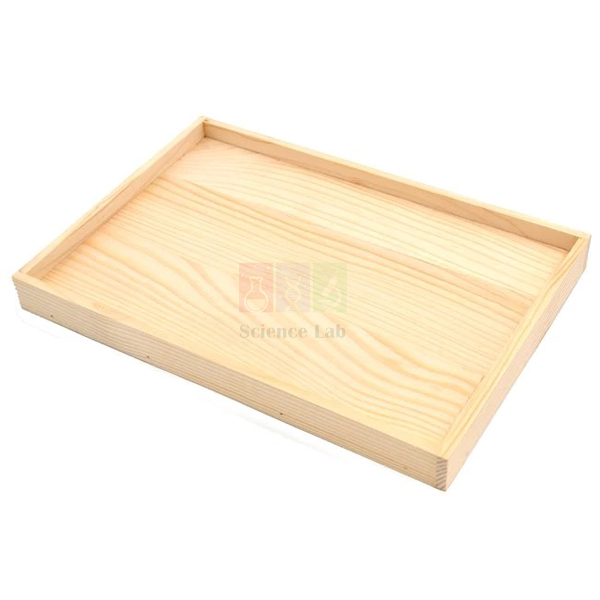
Dissecting Board
Dissecting Board (Product Code: SLE/EDE/01) is a soft wood board with raised edges on which specimens are pinned out for dissection. The soft wood lets dissecting pins be pressed in easily by hand alone, with no hammer or tool, so students can fix and re-fix a specimen quickly as the dissection progresses. It is manufactured by Jain Scientific Equipments Pvt Ltd (ScienceLab), Ambala, as biology lab equipment in India for school and college biology and zoology practicals, and pairs naturally with any dissection kit a school already uses.
Key Details
| Parameter | Detail |
|---|---|
| Type | Dissecting board for pinning specimens |
| Material | Soft wood |
| Edges | Raised |
| Pinning | Pins can be pressed in easily by hand only |
| Suitable for | Biology and zoology dissection practicals in schools and colleges |
Typical Use
The board provides a firm, pin-friendly working surface for dissecting preserved specimens and for pinning out plant material or insects for study. Students lay the specimen on the board, fix it at the corners with pins pushed in by hand, and then open and pin back the tissue layer by layer so that each structure stays exposed while it is drawn or identified. The raised edges help keep fluids and small pieces of tissue on the board rather than on the bench.
For a class practical, set out one board per pair of students with a dissection set, a supply of pins and a dissecting needle. After use, remove all pins, wipe the board down, and let it dry fully before storage so the wood stays in good condition. Boards like this are a basic item on most lists of zoology lab equipment in India.
Manufacturer
This board is made by Jain Scientific Equipments Private Limited, which operates as ScienceLab from Ambala in Haryana and produces dissection equipment alongside a broad range of school and college laboratory products. Learn more on our company profile.
Related Dissection Equipment
Items used on the same bench during a dissection practical:
- Dissecting T-Pins — pins for fixing specimens to the board
- Dissecting Set, Student — the cutting and handling instruments for each student pair
- Dissecting Needle — for separating tissues and pointing out structures
- Forceps (Tweezers) — for lifting and holding tissue while pinning
- Dissecting Tray with Wax — an alternative wax-filled surface for wetter specimens
See the full Dissection Equipment category for more tools.
Frequently Asked Questions
What is the board made of?
Soft wood, chosen so that dissecting pins can be pushed in by hand.
Do I need a hammer to fix pins?
No. Pins can be pressed in easily with the hand only.
What are the board’s dimensions?
Size is not given in our current product description. Please contact us for the measurements before ordering.
Are pins or instruments included?
The description covers the board itself. Pins and instruments are listed separately, such as Dissecting T-Pins and Dissecting Set, Student above.
Why does it have raised edges?
The raised edges help contain fluids and small pieces of tissue during dissection, keeping the bench cleaner.
How should the board be cleaned?
Take out all pins, wipe the surface with a damp cloth, and allow it to dry completely; avoid soaking the wood.
Can you supply boards for a whole laboratory?
Yes. Schools and colleges regularly order class quantities; tell us the number of boards and your delivery location.
Request a Quote
To order dissecting boards for your lab, send your requirement through the contact page or add the board and matching instruments to your enquiry cart.
Last updated: 24 September 2026
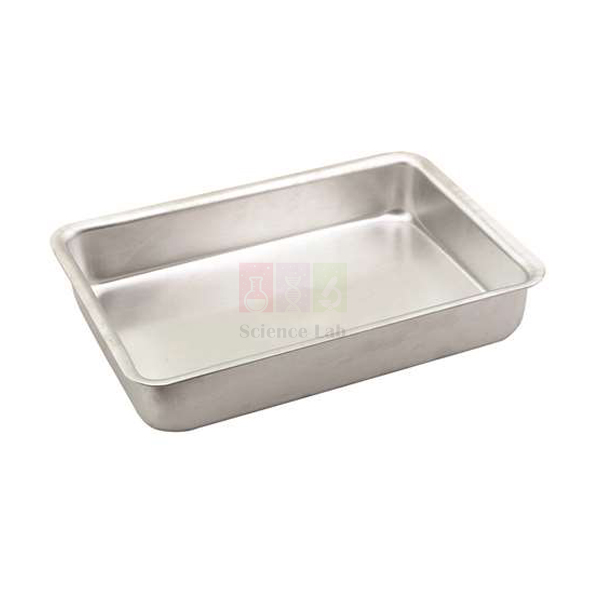
Dissecting Dishes
Dissecting Dishes (Product Code: SLE/EDE/02) are rectangular stainless steel dishes with flanged edges, used on the practical bench to hold specimens, removed organs and small instruments while a dissection is in progress. Biology teachers, lab assistants and students in schools, colleges and training institutes rely on them to keep wet material contained and the workspace organised. They are made by Jain Scientific Equipments Pvt Ltd (ScienceLab), Ambala, as part of its zoology lab equipment range for India and international markets.
Specifications
| Parameter | Detail |
|---|---|
| Product type | Dissecting dish |
| Material | Stainless steel |
| Shape | Rectangular |
| Edges | Flanged |
| Suitable for | Holding specimens, removed organs and instruments during dissection practicals |
Typical Use
In a typical practical, the specimen is opened on a dissection pan or board while a dissecting dish sits alongside to receive organs as they are removed, so each part can be examined, labelled or sketched on its own. The dish is also handy for rinsing small preserved specimens in water before work begins, and for parking forceps and needles between steps so they do not roll off the bench.
The flanged rim gives fingers a secure grip when a dish holding liquid has to be carried, and it helps limit drips on the way to the sink. Because the body is stainless steel, the dish can be scrubbed with warm soapy water after each session and dried fully before storage. Schools fitting out a new practical room often order these dishes with the rest of their school biology lab equipment in India so that every workstation receives a matching set.
Manufacturer
ScienceLab is the trading name of Jain Scientific Equipments Private Limited, a company based in Ambala, Haryana, that makes practical-room apparatus for science teaching. It is a registered MSME enterprise with manufacturing as its major activity (Udyam UDYAM-HR-01-0003714), and its overseas consignments move under Importer-Exporter Code AAECJ8618A issued by the DGFT. Background on the business is available on the company profile page.
Related Dissection Equipment
These items are commonly ordered alongside dissecting dishes to complete a dissection workstation:
- Dissection Pan — black wax pan on which the specimen itself is pinned and opened.
- Dissecting T-Pins — keep the specimen fixed in the wax while organs are moved to the dish.
- Forceps — stainless steel forceps for lifting organs into the dish without tearing them.
- Dissecting Set, Student — a cased instrument set covering cutting, holding and probing.
Browse the full Dissection Equipment category for boards, trays, needles and complete dissecting sets.
Frequently Asked Questions
What size are the Dissecting Dishes?
The listing describes a rectangular stainless steel dish with flanged edges but does not state dimensions. Please ask for the current size through our contact page before ordering, so the dishes suit your trays and bench space.
Do the dishes have a wax layer for pinning specimens?
No wax lining is described; these are plain stainless steel dishes. When a specimen has to be pinned out, use a wax-filled dissection pan or tray and keep the dish beside it for organs and rinsing.
How should the dishes be cleaned after a practical?
Empty any fluid, wash with warm water and a mild detergent, rinse and dry completely before stacking. If your lab follows a particular disinfection or sterilisation routine, check its suitability with us first.
How many dishes does a class normally need?
Most labs plan one dish per student pair or group workstation, plus a few spares. The right number depends on how your practicals are organised, and we can quote for any quantity.
Is a warranty offered?
Warranty and after-sales terms are confirmed in each quotation. Ask our team through the contact page if you need these terms in writing for your purchase file.
What should an institutional enquiry include?
Mention product code SLE/EDE/02, the quantity, the delivery address and any tender or purchase-order format your institution uses, so the quotation can be prepared in one step.
Can you supply bulk or export orders?
Yes. ScienceLab supplies schools, colleges and distributors across India and international markets; packing and dispatch are arranged to suit each order.
Request a Quote
To receive a quotation for Dissecting Dishes, send your quantity and delivery location through the contact page, or add the item to the enquiry cart along with any other dissection equipment you need.
Last updated: 24 September 2026
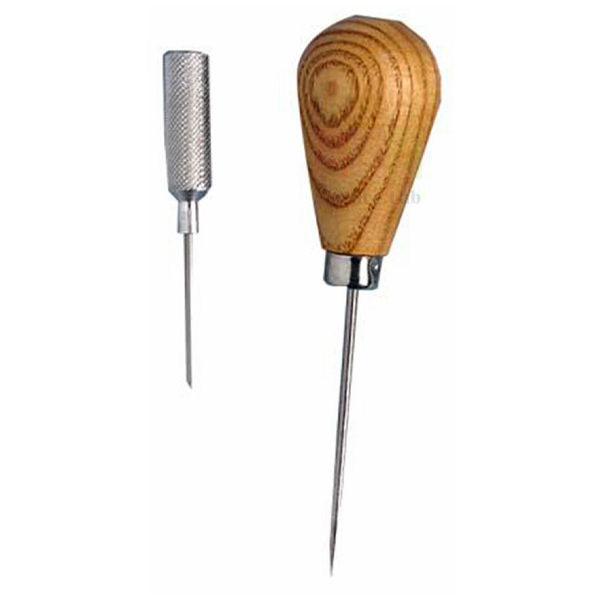
Dissecting Awl
Dissecting Awl (Product Code: SLE/EDE/03) is a pointed hand tool with a 50 mm stainless steel spike fixed in a wooden handle. It is used to pierce tough skin or cuticle before a cut is started, make small starter holes and mark points of interest on a specimen, which makes it a practical item among biology lab equipment in India for school and college practicals. The awl is produced by Jain Scientific Equipments Pvt Ltd (ScienceLab), Ambala.
Specifications
| Parameter | Detail |
|---|---|
| Product type | Dissecting awl |
| Spike material | Stainless steel |
| Spike length | 50 mm |
| Handle | Wooden |
| Suitable for | Piercing, marking and probing during dissection work |
Typical Use
Students reach for the awl when a scalpel alone would slip: puncturing the hard outer layer of an insect or crustacean, opening a small entry point in the body wall before scissors take over, or pricking holes in a card or soft board so specimens and labels can be pinned neatly. Teachers also use the point to indicate a structure during a demonstration without disturbing the surrounding tissue.
The wooden handle fills the palm and lets the user push with steady, controlled pressure. After use, wipe the spike clean, wash it briefly, and dry both the steel and the wood straight away rather than leaving the tool to soak. Many teachers add an awl to each dissection kit for school practicals in India because it covers tasks that finer needles are not built for.
Manufacturer
This awl comes from Jain Scientific Equipments Private Limited, which trades under the ScienceLab name from Ambala in Haryana and makes hand instruments, apparatus and teaching equipment for science laboratories. The company profile gives an overview of the business and its product range.
Related Dissection Equipment
Pair the awl with these tools for piercing, probing and pinning work:
- Dissecting Needle — a slimmer steel needle for teasing tissue once the awl has opened a way in.
- Probe, Chrome — a teasing probe for tracing vessels and nerves without cutting.
- Dissecting Board — a base on which the specimen is laid out while the awl is in use.
- Dissecting T-Pins — pins that fix skin flaps back after the awl and scissors have opened the specimen.
Other hand tools, trays and sets are listed in the Dissection Equipment category.
Frequently Asked Questions
How is an awl different from a dissecting needle?
An awl is made for piercing and making holes, so its spike is set in a handle suited to pushing force. A dissecting needle is slimmer and better for teasing tissue apart; many labs keep both.
What is the spike made of and how long is it?
The spike is stainless steel and 50 mm long, mounted in a wooden handle.
How do I look after the wooden handle?
Wipe it clean and dry it immediately after washing. Avoid long soaking in water or disinfectant, which can swell or crack wood over time.
Is the awl safe for younger students?
It has a sharp point, so use it under supervision, carry it point-down and return it to a case or tray after each task. Teachers of junior classes often hand it out only for specific steps.
Can I order the awl in class quantities?
Yes. State the number of pieces you need through the contact page and we will quote accordingly, together with any other dissection items on your list.
Do you ship outside India?
ScienceLab serves buyers in India and international markets. Share the destination and quantity so packing and freight can be included in the quotation.
Request a Quote
For pricing and availability of the Dissecting Awl, write to us via the contact page or place it in the enquiry cart and submit your list in one go.
Last updated: 24 September 2026
296.jpg)
Dissecting Kit (Economy)
Dissecting Kit (Economy) (Product Code: SLE/EDE/04) is an entry-level set of 18 instruments packed in a plastic box. It brings together scissors, forceps, scalpels, needles, a razor and a few glass accessories, so one student can carry out a basic dissection and prepare a temporary mount from a single box. As a budget-friendly dissection kit for school labs in India, it is assembled by Jain Scientific Equipments Pvt Ltd (ScienceLab), Ambala.
Specifications
| Parameter | Detail |
|---|---|
| Product type | Dissecting kit, economy version |
| Number of instruments | 18 |
| Packing | Plastic box |
| Scissors | 1 sharp; 1 sharp-blunt, 125 mm |
| Needles | 1 straight needle with plastic handle; 2 straight needles (steel); 1 arrow-head needle |
Full contents of the box:
- 1 Scissor, sharp
- 1 Scissor, sharp-blunt, 125 mm
- 1 Section lifter
- 1 Magnifier
- 1 Plain slide
- 1 Cover glass
- 1 Forceps, blunt
- 1 Forceps, sharp
- 2 Scalpels
- 1 Straight needle with plastic handle
- 1 Chain hook (small)
- 1 Razor
- 1 Watch glass
- 1 Blow pipe
- 2 Straight needles (steel)
- 1 Needle, arrow head
Typical Use
In a zoology practical, the scissors and scalpels open the specimen, the blunt and sharp forceps hold and lift tissue, the small chain hook keeps flaps drawn aside, and the needles tease out structures for the student to identify under the magnifier. The blow pipe can be used to gently inflate tubular organs so their path is easier to follow.
The same box also supports plant anatomy work: the razor cuts thin hand sections of stems or roots, the watch glass holds water or stain while sections are sorted, and the section lifter transfers a chosen section onto the plain slide under the cover glass. That mix of cutting tools and glassware makes it a versatile dissection set for biology classes in India, from middle school up to junior college. Wash and dry each piece after use and check that all 18 are back in the box before it is stored.
Manufacturer
Jain Scientific Equipments Private Limited is the company behind the ScienceLab brand. From its base in Ambala, Haryana, it assembles instrument kits and makes laboratory apparatus for schools, colleges and distributors. Read more on the company profile page.
Related Dissection Equipment
Buyers equipping students with this kit usually add the following:
- Dissection Pan — a wax-surfaced pan to pin the specimen on while the kit instruments are used.
- Dissecting T-Pins — the kit has no pins, so these fix the specimen in place.
- Cover Glass Slide — spare cover glasses for repeated temporary mounts.
- Dissecting Set, Large — a fuller set in a lined case for senior or teacher use.
Compare all kits, sets and single instruments in the Dissection Equipment category.
Frequently Asked Questions
What does the Economy kit contain?
Eighteen pieces in a plastic box: two scissors, a section lifter, a magnifier, a plain slide, a cover glass, blunt and sharp forceps, two scalpels, a straight needle with plastic handle, a small chain hook, a razor, a watch glass, a blow pipe, two steel straight needles and an arrow-head needle.
Are all the instruments stainless steel?
The listing names steel for the two straight needles and a plastic handle for one needle, but does not state the material of every piece. If your tender specifies materials, please confirm them with us through the contact page.
Can the glass items be replaced?
Yes. The slide, cover glass and watch glass are the pieces most likely to break over a term, and replacements can be quoted separately along with your kit order.
How is the Economy kit different from the cased dissecting sets?
It adds glass accessories, a blow pipe and a chain hook in a simple plastic box, which suits individual student issue. The cased sets focus on instruments and come in PVC or leatherette cases.
How should the kit be cleaned after a practical?
Rinse off tissue, wash in warm soapy water, dry every piece thoroughly and return it to the box. Handle the razor and scalpels by their backs while cleaning.
Is a warranty included?
Warranty and replacement terms are stated in the quotation. Ask us if you need them documented for your purchase committee.
Can you supply a full class or a distributor order?
Yes. We quote for class sets, school-wide orders and bulk quantities for buyers in India and international markets.
Request a Quote
Tell us how many Dissecting Kit (Economy) boxes you need and where they should be delivered through the contact page, or add the kit to the enquiry cart with any spares.
Last updated: 24 September 2026
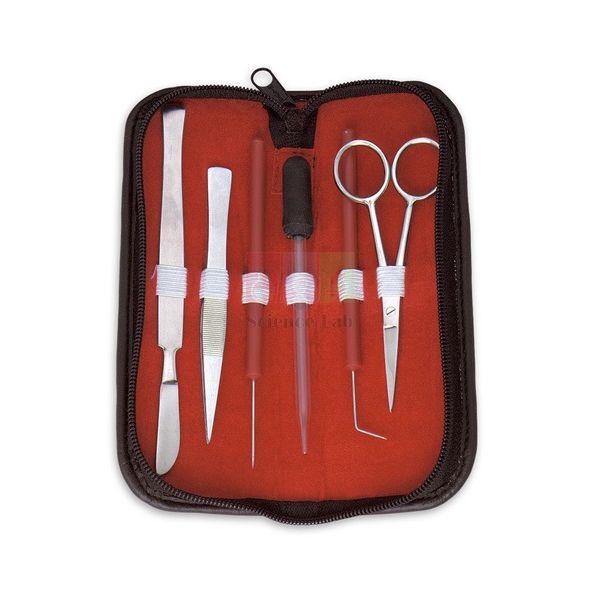
Dissecting Set, Elementary
Dissecting Set, Elementary (Product Code: SLE/EDE/05) is a set of 6 stainless steel dissecting instruments in a PVC case, used for first dissections and plant-section practicals in middle and secondary school biology. It gives each beginner the essential tools to cut, hold and tease a simple specimen, making it a practical dissection kit for school labs in India. It is made by Jain Scientific Equipments Pvt Ltd (ScienceLab), an OEM biology lab equipment manufacturer in India, at its own factory in Ambala.
Specifications
| Parameter | Detail |
|---|---|
| Product type | Elementary dissecting instruments set |
| Number of instruments | 6 |
| Instrument material | Stainless steel |
| Case | PVC case |
| Contents | 1 scissors; 1 forceps, sharp; 1 forceps, blunt; 1 straight needle with plastic handle; 1 scalpel; 1 razor |
| Product code | SLE/EDE/05 |
| Manufacturer | Jain Scientific Equipments Pvt Ltd (ScienceLab) — OEM |
| Country of origin | India (made in Ambala, Haryana) |
What Is the Elementary Dissecting Set Used For?
With only six pieces, the set keeps a young learner focused on technique. The scalpel and scissors make the opening cuts, the blunt forceps grip tissue without puncturing it, the sharp forceps pick up small parts, and the straight needle separates structures once the specimen is open. The razor is handy for slicing thin sections of leaves, stems or flowers in plant study lessons.
Teachers often issue one case per student or pair and count the instruments back in at the end of the period, which is quick with so few items. As a worm dissection kit for school practicals, it pairs well with a wax pan and pins. Rinse, dry and return each instrument to its place in the case after every session.
OEM Manufacturer
ScienceLab is the trading name of Jain Scientific Equipments Private Limited, the OEM (original equipment manufacturer) of this elementary dissecting set, which is made at the company's own licensed factory at Saha, Ambala, Haryana, India. Schools, education departments, dealers and importers buy it factory-direct rather than from a trader. Replacement instruments or repeat class sets can be requested from the manufacturer itself; just ask us. See the company profile for more about who we are.
Related Dissection Equipment
These items complement an elementary set in the same practical:
- Dissection Pan — a black-wax pan for pinning an earthworm or other specimen flat.
- Dissecting T-Pins — nickel-plated T-head pins that hold the body wall open after the first cut.
- Magnifier — a lighted, clamp-on magnifier for hands-free viewing, since this set has no lens.
- Dissecting Set, Student — the next step up, with 10 instruments including a seeker and magnifier.
More sets and individual instruments are listed under Dissection Equipment.
Frequently Asked Questions
Which instruments are in the Dissecting Set, Elementary?
The Dissecting Set, Elementary contains six instruments: scissors, sharp forceps, blunt forceps, a straight needle with a plastic handle, a scalpel and a razor, all packed together in a PVC case for easy issue and collection.
Are the instruments in the Dissecting Set, Elementary stainless steel?
Yes. The instruments in the Dissecting Set, Elementary are made of stainless steel, and the straight needle is fitted with a plastic handle, so the set stands up to repeated school use and cleaning.
Does the Dissecting Set, Elementary include a magnifier or slides?
No. The Dissecting Set, Elementary contains only the six instruments listed. A magnifier, pins or a dissection pan can be quoted separately, or you can choose the Dissecting Set, Student, which includes a magnifier.
Does the scalpel take replacement blades?
The scalpel type in the Dissecting Set, Elementary is not specified in our product details. If replaceable blades matter for your laboratory, ask us through the contact page before ordering and we will confirm.
Who manufactures the Dissecting Set, Elementary?
Jain Scientific Equipments Pvt Ltd (ScienceLab) is the OEM manufacturer of the Dissecting Set, Elementary, making it at its own licensed factory at Saha, Ambala, Haryana, India, and supplying schools and dealers directly.
What should a school send for a quotation?
For the Dissecting Set, Elementary, send product code SLE/EDE/05, the number of sets, the delivery address and any pans, pins or consumables you want on the same order. We supply buyers in India and international markets.
Request a Quote
Send the quantity of Dissecting Set, Elementary you need via the contact page, or add it to the enquiry cart, and the manufacturer will reply with a quotation.
Last updated: 24 September 2026
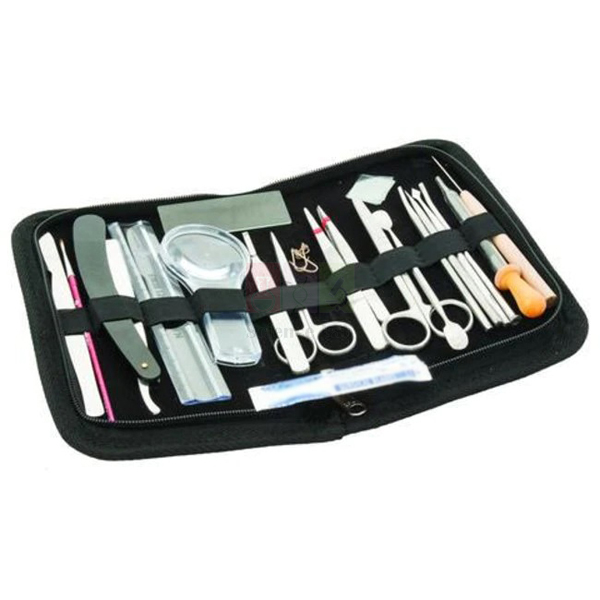
Dissecting Set, Large
Dissecting Set, Large (Product Code: SLE/EDE/06) is a comprehensive set of 20 dissecting instruments, all made of stainless steel and fitted in a velvet lined leatherette case. With two sizes of scissors, a no. 3 scalpel handle with blades, a seeker, needles and mounting accessories, it is aimed at senior secondary students, undergraduates and teachers who need a complete dissection set for biology work in India. The set is made by Jain Scientific Equipments Pvt Ltd (ScienceLab), Ambala.
Specifications
| Parameter | Detail |
|---|---|
| Product type | Dissecting instruments set, large |
| Number of instruments | 20 |
| Instrument material | Stainless steel |
| Case | Velvet lined leatherette case |
| Scissors | Sharp-blunt, 125 mm; sharp, 100 mm |
| Scalpels | 1 scalpel; 1 scalpel handle (no. 3) with 2 blades |
Contents as listed:
- 1 Scissors, sharp-blunt, 125 mm
- 1 Scissors, sharp, 100 mm
- 1 Forceps, blunt
- 1 Forceps, sharp
- 1 Scalpel
- 1 Scalpel handle (no. 3) with 2 blades
- 1 Needle, pointed (steel)
- 1 Slide
- 1 Cover slip
- 1 Watch glass
- 1 Needle with plastic handle
- 1 Blow pipe
- 1 Razor
- 1 Magnifier
- 1 Dropper
- 1 Needle, arrow head
- 1 Seeker
- 1 Section lifter
- 3 Drawing pins
Typical Use
The larger range of tools lets a student move through a longer dissection without borrowing from a neighbour. The 125 mm sharp-blunt scissors open the body wall safely, the finer 100 mm scissors handle delicate cuts, and the bladed no. 3 handle gives a controlled incision where a fixed scalpel would be too coarse. The seeker and arrow-head needle trace nerves and vessels, while the drawing pins fix labels or a drawing sheet beside the specimen.
For microscopy follow-up, the razor cuts a thin section, the section lifter moves it into the watch glass, the dropper adds water or stain, and the slide and cover slip complete a temporary mount for examination. That combination also makes the set useful botany lab equipment for stem and root section work. Dry every instrument fully before laying it back in the velvet lining, since trapped moisture is the main cause of spotting during storage.
Manufacturer
Jain Scientific Equipments Private Limited, trading as ScienceLab, builds instrument sets like this one at Ambala in Haryana for schools, universities and resellers. Its company profile explains the business, its product groups and how it works with institutional buyers.
Related Dissection Equipment
Owners of the large set often order these alongside it:
- Scalpel Handle no.3 — a spare handle of the same number as the one in the case.
- Cover Glass Slide — extra cover slips for repeated temporary mounts.
- Dissecting Hook & Chain Set — holds specimen walls apart while both hands use the instruments.
- Dissection Pan — wax-surfaced pan on which the specimen is pinned.
- Dissecting Kit (Economy) — a lower-cost boxed kit for junior classes.
See every set and single instrument in the Dissection Equipment category.
Frequently Asked Questions
Who is the large set intended for?
It suits senior school students, undergraduate zoology and botany students, and teachers who want one case holding cutting, probing and slide-preparation tools.
Are replacement blades available for the no. 3 handle?
The set ships with 2 blades on the handle. For spare blades, tell us your requirement through the contact page and we will confirm what can be supplied with your order.
What is the case made of?
A leatherette case with a velvet lining, which keeps each instrument in place and protects the cutting edges during storage and transport.
How should the set be cleaned?
Wash instruments in warm soapy water, rinse, and dry each one completely before returning it to the lining. Keep glass items separate while washing to avoid chipping.
Can the contents be customised for a tender?
If your tender lists a different instrument schedule, send it with your enquiry and we will advise what can be matched before quoting.
What warranty applies?
Warranty terms are given in the quotation for each order; ask if you need them in a specific format.
Do you supply universities and export buyers?
Yes. We quote for department, university and distributor quantities in India and international markets.
Request a Quote
Request pricing for the Dissecting Set, Large through our contact page, or add it to the enquiry cart together with spare handles, cover slips and pans.
Last updated: 24 September 2026
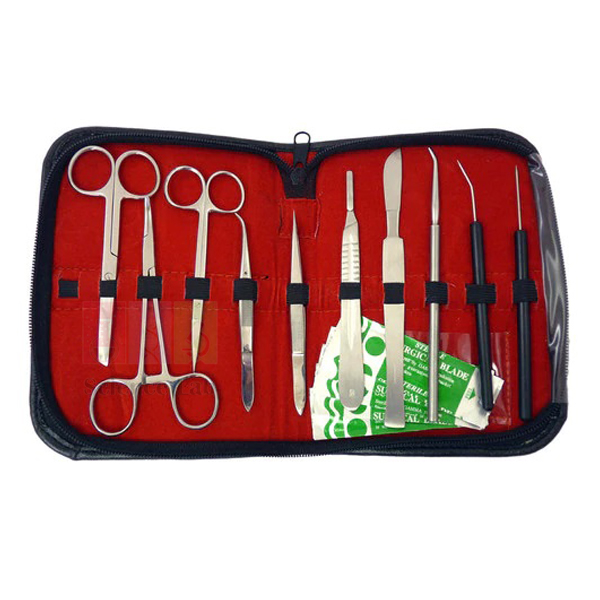
Dissecting Set, Student
Dissecting Set, Student (Product Code: SLE/EDE/07) is a mid-range set of 10 stainless steel dissecting instruments supplied in a PVC case as school biology lab equipment in India. Between its two pairs of scissors, a no. 3 scalpel handle with blades, a seeker and a magnifier, it covers most of the cutting, holding and observation steps in school and first-year college practicals. Made by Jain Scientific Equipments Pvt Ltd (ScienceLab), Ambala, it is a practical choice among science kits for students in India who want their own instruments.
Specifications
| Parameter | Detail |
|---|---|
| Product type | Dissecting instruments set, student |
| Number of instruments | 10 |
| Instrument material | Stainless steel |
| Case | PVC case |
| Scissors | Sharp-blunt, 125 mm; sharp, 100 mm |
| Scalpel handle | No. 3, with 2 blades |
Contents as listed:
- 1 Needle
- 1 Scissor, sharp-blunt, 125 mm
- 1 Scissors, sharp, 100 mm
- 1 Scalpel handle (no. 3) with 2 blades
- 2 Scalpels
- 1 Forceps, blunt
- 1 Forceps, sharp
- 1 Seeker
- 1 Razor
- 1 Magnifier
Typical Use
A typical session starts with the sharp-blunt scissors, whose rounded blade slides under the body wall without piercing the organs below. The smaller sharp scissors and the bladed handle then take care of finer cuts, the forceps hold tissue steady, and the seeker follows nerves and blood vessels so students can name them in their record book. The magnifier helps with small features such as setae, mouthparts or floral parts.
Because every student can keep a personal case through the year, teachers spend less time distributing shared tools and more time on technique. Many schools list this set among their core biology teaching aids and pair it with a wax tray per bench. Clean the blades carefully, dry all pieces and close the case only once the instruments are fully dry.
Manufacturer
The Student set is produced by Jain Scientific Equipments Private Limited, the Ambala, Haryana company that sells under the ScienceLab brand. Its range spans dissection instruments, models, glassware and apparatus for teaching laboratories; the company profile has the full background.
Related Dissection Equipment
Useful additions and alternatives for this set:
- Dissecting Tray with Wax — a pinning surface for the specimen at each bench.
- Dissecting T-Pins — the set contains no pins, so these hold the specimen open.
- Scalpel Handle no.3 — a spare handle matching the one in the case.
- Dissecting Set, Large — adds slide-preparation items and a lined case for advanced students.
- Dissecting Set, Elementry — a simpler set for younger classes.
The Dissection Equipment category lists every set and single instrument in the range.
Frequently Asked Questions
How does the Student set compare with the Elementary and Large sets?
It adds a second pair of scissors, a bladed handle, a seeker and a magnifier to the basic tools, but leaves out the slide, watch glass and dropper found in the large set.
What is the seeker used for?
A seeker is a probing instrument for following and lifting nerves, ducts and vessels without cutting them, so structures can be traced and identified.
What blades come with the handle?
The no. 3 handle is supplied with 2 blades. For spares, ask us through the contact page and we will confirm what we can include with your order.
Can each student keep a set for the whole year?
Yes, that is how many schools use it. The PVC case keeps the instruments together, and a name label on the case makes collection easy.
Is a warranty provided?
Warranty details are set out in each quotation; request them in writing if your purchase process needs it.
What information speeds up a quotation?
Product code SLE/EDE/07, the number of sets, delivery address and any accompanying items such as trays or pins.
Do you take bulk and export orders?
Yes. School, college and distributor orders are supplied across India and to international markets.
Request a Quote
Ask for a price on the Dissecting Set, Student through our contact page, or save it in the enquiry cart while you build your full order.
Last updated: 24 September 2026
896.jpg)
Forceps (Tweezers)
Forceps (Tweezers) (Product Code: SLE/EDE/08) are 125 mm stainless steel forceps with a fine point, designed for picking up and holding small, delicate material that fingers cannot manage cleanly. Students use them to peel epidermis, lower cover slips, lift thin sections and move seeds or small insects, which makes them a standard item in any temporary slides biology kit. They are made by Jain Scientific Equipments Pvt Ltd (ScienceLab), Ambala, for schools, colleges and research laboratories.
Specifications
| Parameter | Detail |
|---|---|
| Product type | Forceps (tweezers) |
| Material | Stainless steel |
| Size | 125 mm |
| Tip | Fine point |
| Suitable for | Slide preparation, handling small specimens and fine dissection work |
Typical Use
The classic first practical for these tweezers is the onion peel mount: the fine point grips the thin inner layer of a scale leaf, peels it away in one strip and lays it flat in a drop of water on the slide. The same tips then hold a cover slip at an angle and lower it slowly to keep air bubbles out. In dissection, they lift membranes and small organs, and in ecology or plant biology lab equipment sets they pick up seeds, leaf fragments and minibeasts for closer study.
Hold the forceps like a pen and apply gentle pressure; fine points are for gripping, not for prying or levering, which can spring the tips out of line. Wipe them clean after each use, dry them, and store them so the points are not knocking against other steel instruments in a drawer.
Manufacturer
ScienceLab is the brand of Jain Scientific Equipments Private Limited (CIN U29309HR2020PTC087597), an incorporated private limited company headquartered in Ambala, Haryana. The company manufactures at its licensed factory at 449, HSIIDC Industrial Area, Saha, Ambala (Factory Licence AMB-ONLINE-CHD-J-414). Learn more on the company profile page.
Related Dissection Equipment
Other gripping tools and slide items that work alongside these forceps:
- Forceps (Tweezers) Bent — a curved fine-point version for reaching around tissue.
- Forceps — shorter stainless steel forceps with precision ground points.
- Forceps, Nylon — a non-metal option where steel should not touch the sample.
- Microscope Slide Cover Forceps — specialised forceps for handling slides and cover glasses.
- Cover Glass Slide — cover glasses for the temporary mounts these tweezers help prepare.
For more instruments, visit the Dissection Equipment category.
Frequently Asked Questions
What length and material are these tweezers?
They are 125 mm long and made of stainless steel, with a fine point at the tip.
Should I choose these or the bent version?
Choose these for general picking, peeling and slide work. The bent version has a curved tip that is easier to use when the item sits under or behind other tissue.
Are they suitable for handling cover slips?
Yes. The fine point holds the edge of a cover slip securely so it can be lowered onto a mount at an angle.
How can the fine points be protected?
Avoid dropping them or using them to pry. Store them in a case, rack or separate compartment so the tips do not bend.
Can they be disinfected between classes?
Stainless steel can be wiped or washed and dried between uses. If your lab follows a specific sterilisation routine, check its suitability with us through the contact page.
Can you quote for class and bulk quantities?
Yes. Send the quantity and delivery address, and we will quote for schools, colleges and distributors in India and international markets.
Request a Quote
For a quotation on Forceps (Tweezers), reach us through the contact page or add them to the enquiry cart with the rest of your slide-preparation items.
Last updated: 24 September 2026
 Bent734.jpg)
Forceps (Tweezers) Bent
Forceps (Tweezers) Bent (Product Code: SLE/EDE/09) have a curved, fine-point tip on a 125 mm stainless steel body. The bend lets the user keep the hand and wrist out of the line of sight, so the tip stays visible while it reaches under a flap of tissue, into a body cavity or around a mounted specimen. These tweezers are made by Jain Scientific Equipments Pvt Ltd (ScienceLab), Ambala, for teaching and practical laboratories.
Specifications
| Parameter | Detail |
|---|---|
| Product type | Forceps (tweezers), bent |
| Tip | Fine point, curved |
| Size | 125 mm long |
| Material | Stainless steel |
| Suitable for | Angled gripping during dissection, slide work and specimen handling |
Typical Use
Curved tweezers come into their own once a specimen is open and pinned: the tip can slip beneath an organ to lift it clear, draw a thread of tissue out from under a membrane, or retrieve a small part from the corner of a dish without scraping the bottom. On the microscope bench, the angled tip makes it easier to pick up a section floating in a watch glass and place it on a slide.
They are equally handy away from dissection, for example when sorting specimens into vials as part of an insect collection kit for school projects. Rinse the tips after contact with preservative, dry them, and store them so the curve is not pressed against other tools. Schools buying from a biology lab equipment supplier in India commonly stock bent and straight tweezers side by side so students can choose the right grip for each task.
Manufacturer
These forceps are made by Jain Scientific Equipments Private Limited, whose products carry the ScienceLab name. The company operates from Ambala, Haryana, and supplies teaching laboratories with instruments and apparatus; details are on the company profile page.
Related Dissection Equipment
Tools that are used with curved tweezers in the same practical:
- Forceps (Tweezers) — the fine-point companion for general picking and peeling.
- Probe & Hook — separates and lifts structures before the tweezers take hold.
- Dissecting Hook & Chain Set — keeps the specimen open so both hands are free.
- Forceps, Plastic — a non-metal alternative for younger students and general handling.
Explore the complete Dissection Equipment range for more instruments.
Frequently Asked Questions
Why choose a curved tip instead of a straight one?
A curved tip reaches under and around structures and keeps the working point in view, which helps in cavities and crowded dissections. Straight tips are simpler for general picking and slide work.
What are the length and material?
The bent forceps are 125 mm long and made of stainless steel, with a fine, curved point.
Can left-handed students use them?
Yes. Tweezers work in either hand; the user simply turns them so the curve points in the most convenient direction.
Can they be used with preserved specimens?
Yes. Rinse them in water after contact with preservative and dry them fully before storage to keep the steel in good condition.
Are warranty terms available?
Yes, the terms for each order are confirmed in our quotation. Ask through the contact page if you need them before placing a purchase order.
How do I order for a whole lab or for resale?
Send code SLE/EDE/09, the quantity and your delivery address; we supply institutions and distributors in India and international markets.
Request a Quote
Get a quotation for Forceps (Tweezers) Bent by writing to us through the contact page, or add them to the enquiry cart with any other dissection tools you need.
Last updated: 24 September 2026
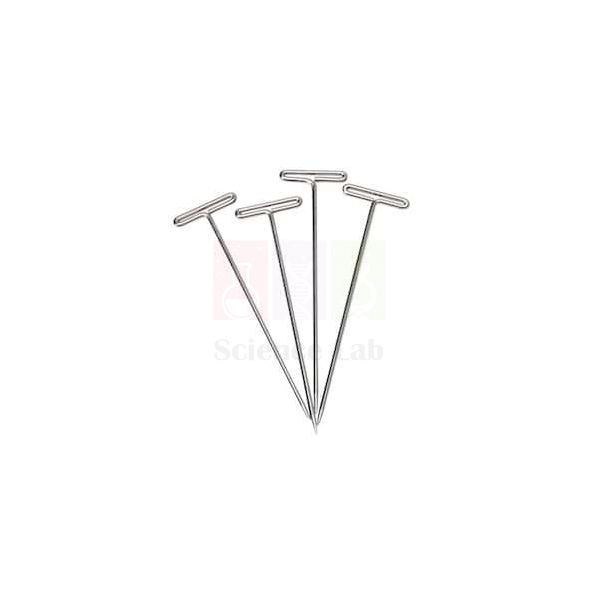
Dissecting T-Pins
Dissecting T-Pins (Product Code: SLE/EDE/10) are 2" long pins made of nickel-plated steel, each with a T head that allows a firm grip when pushing the pin in or pulling it out. A box contains about 100 pins, enough to pin out specimens for a full class on a dissection tray in school labs across India. They are supplied by Jain Scientific Equipments Pvt Ltd (ScienceLab), Ambala, as part of its dissection equipment range.
Specifications
| Parameter | Detail |
|---|---|
| Product type | Dissecting pins, T-head |
| Head | T head for a firm grip |
| Length | 2" |
| Material | Nickel-plated steel |
| Pack | Box of about 100 pins |
Typical Use
T-pins anchor a specimen to a wax pan, wax tray or soft dissecting pad so it does not slide while being cut. Pins are usually pushed in at a slant, leaning away from the specimen, so their heads stay clear of the working area; after the first incision, further pins hold the skin or body wall folded back so internal organs are exposed. The cross-bar head spreads the pressure of the thumb, which makes pinning into firm wax easier for students.
At the end of the practical, pull the pins straight out by the head, wash and dry them, and return them to the box. Counting pins out and back in is a simple habit that keeps loose sharps off the floor and benches. Teachers stocking consumables for zoology lab equipment in India often keep a spare box on hand, since pins go missing over a term.
Supplier
ScienceLab, the trading name of Jain Scientific Equipments Private Limited in Ambala, Haryana, supplies these pins together with the pans, trays and instruments they are used with, so a school can source a complete dissection bench from one place. More about the company is on the company profile page.
Related Dissection Equipment
Surfaces and tools used together with T-pins:
- Dissection Pan — black wax pan that takes and holds the pins.
- Dissecting Tray with Wax — an alternative wax-filled tray for pinning.
- Dissection Replacement Pad — a fresh pinning pad when an old one is worn.
- Dissecting Hook & Chain Set — holds walls open where pins alone are not enough.
See pans, boards and instruments in the Dissection Equipment category.
Frequently Asked Questions
How many pins are in a box?
Each box contains about 100 pins. The count is approximate, so please allow for small variation when planning class quantities.
What are the pins made of and how long are they?
They are nickel-plated steel and 2" long, with a T-shaped head.
Which surfaces do they work with?
They are intended for wax pans, wax trays and soft dissecting pads or boards. Very hard surfaces are not suitable for pinning.
Can the pins be reused?
Yes. Wash and dry them after each practical and return them to the box; discard any pin that has bent or lost its point.
Why a T head rather than a round head?
The cross-bar gives the thumb and fingers more to grip, so pins are easier to press into wax and to pull out again without slipping.
Can I order several boxes or ship overseas?
Yes. Tell us the number of boxes and destination through the contact page; we supply buyers in India and international markets.
Request a Quote
To price Dissecting T-Pins, send the number of boxes you need via the contact page, or add them to the enquiry cart along with pans or trays.
Last updated: 24 September 2026
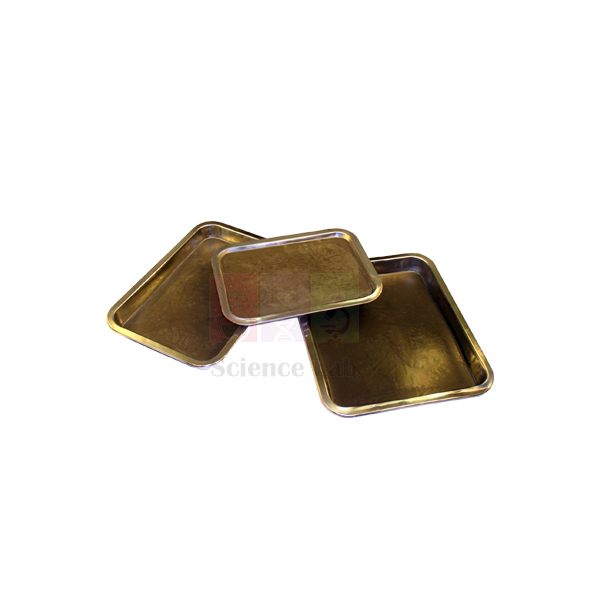
Dissection Pan
Dissection Pan (Product Code: SLE/EDE/11) is a shallow pan with a black wax surface into which specimens are pinned for dissection. The listed size is 26.5 × 19.5 × 2 cm (approx), and the pan is available in three sizes — small, medium and large — so it can be matched to anything from an earthworm to a larger preserved specimen. It is a basic item of school biology lab equipment in India and is made by Jain Scientific Equipments Pvt Ltd (ScienceLab), Ambala.
Specifications
| Parameter | Detail |
|---|---|
| Product type | Dissection pan |
| Dissecting surface | Black wax |
| Listed size | 26.5 × 19.5 × 2 cm (approx) |
| Size options | Small, medium and large |
| Suitable for | Pinning and dissecting preserved specimens in teaching laboratories |
Typical Use
The specimen is laid on the wax, pinned at the corners, and opened with scissors or a scalpel; pins pushed into the wax then hold back the body wall so organs can be traced and drawn. The dark background makes pale tissues, nerves and vessels stand out, and the raised edge of the pan keeps water or preservative from running onto the bench. Adding a little water over the specimen during the practical helps float delicate organs apart for easier viewing.
When choosing a dissection tray for school use, consider the specimen size first: a small pan is easy for younger students to handle, while the large size gives room for bigger specimens or group demonstrations. After use, remove pins, rinse the wax surface with cool or lukewarm water and wipe it dry; very hot water can soften wax, so avoid it.
Manufacturer
Jain Scientific Equipments Private Limited produces this pan under its ScienceLab brand at Ambala, Haryana, where it also makes the instruments and accessories that go with it. Visit the company profile to find out more about the company.
Related Dissection Equipment
Items used with a dissection pan in the same practical:
- Dissecting T-Pins — nickel-plated pins that fix the specimen into the wax.
- Dissection Pan, Pad & Cover — an alternative pan supplied with a pad and cover.
- Dissection Replacement Pad — a replacement pinning pad for worn surfaces.
- Dissecting Dishes — stainless steel dishes for organs removed from the pan.
- Dissecting Set, Student — the instruments needed to work on the pinned specimen.
Find more trays, boards and pads in the Dissection Equipment category.
Frequently Asked Questions
Which size do the listed dimensions refer to?
The listing gives 26.5 × 19.5 × 2 cm (approx) and states that small, medium and large sizes are available. Please confirm the dimensions of the size you want through the contact page when requesting a quote.
Why is the wax black?
A dark surface gives strong contrast with pale tissue, so organs, nerves and vessels are easier to see and draw.
What is the pan itself made of?
The listing specifies the black wax surface but not the material of the pan body. Ask us if your specification requires a particular material.
What happens when the wax becomes worn?
Wax gradually fills with pin holes over many practicals. Replacement pads are listed in the range; tell us your pan size and we will advise on a suitable replacement.
How should the pan be cleaned?
Remove every pin, rinse with cool or lukewarm water and a mild detergent, then wipe dry. Avoid very hot water and solvents that could soften or damage the wax.
Can you supply pans for several labs or for export?
Yes. State the sizes and quantities needed and your delivery location; we serve institutions and distributors in India and international markets.
Request a Quote
For a Dissection Pan quotation, share the size and quantity through the contact page or add the pan to the enquiry cart with pins and instruments.
Last updated: 24 September 2026
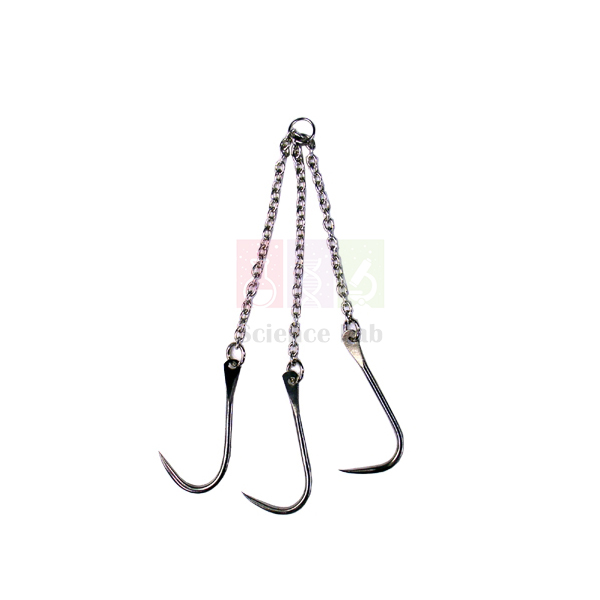
Dissecting Hook & Chain Set
Dissecting Hook & Chain Set (Product Code: SLE/EDE/12) holds specimens in place during dissection using 3 stainless steel hooks that are attached at one end by a loop. Once the body wall is opened, the hooks keep tissue drawn back so the student has both hands free for instruments, and the set is offered in a choice of large or small. It is made by Jain Scientific Equipments Pvt Ltd (ScienceLab), Ambala, a manufacturer and biology lab instruments supplier to schools, colleges and distributors.
Specifications
| Parameter | Detail |
|---|---|
| Product type | Dissecting hook and chain set |
| Hooks | 3 |
| Hook material | Stainless steel |
| Construction | Hooks attached at one end by a loop |
| Sizes | Large or small |
Typical Use
After the first incision, each hook is caught into the edge of the skin or body wall and the common loop is anchored, for example over a pin set into the wax of the pan. The three hooks spread the opening evenly on several sides, exposing organs without the crowd of pins that would otherwise be needed. Teachers find the set especially helpful in demonstrations, where the cavity must stay open while the class gathers round.
Pick the small size for small specimens and fine work, and the large size when more tissue has to be held back. Because the hooks are stainless steel, they can be washed and dried with the rest of the instruments at the end of the lesson. It makes a useful extra in any dissection kit for school biology rooms where students work in pairs.
Manufacturer
The set comes from Jain Scientific Equipments Private Limited, the Ambala, Haryana company behind the ScienceLab brand. The company is registered as an MSME with manufacturing as its main activity (Udyam UDYAM-HR-01-0003714) and holds Importer-Exporter Code AAECJ8618A from the Directorate General of Foreign Trade for its export business. The company profile has further details.
Related Dissection Equipment
These items work together with the hook and chain set:
- Dissection Pan — black wax base into which the specimen and anchor pin are set.
- Dissecting T-Pins — secure the specimen and the loop of the hook set.
- Probe & Hook — a hand-held hook and probe for lifting individual structures.
- Dissecting Board — an alternative base for mounting the specimen.
Browse all tools in the Dissection Equipment category.
Frequently Asked Questions
How many hooks are in the set?
Three stainless steel hooks, attached together at one end by a loop.
Should I order the large or small size?
Choose small for small specimens and delicate work, and large where more tissue must be held back. Exact dimensions are not listed, so please ask through the contact page if you need them.
How is the set anchored during dissection?
The loop is usually secured over a pin in a wax pan or board, while each hook holds back a section of the body wall.
Does it replace dissecting pins?
Not entirely. Pins still fix the specimen to the pan; the hook set retracts tissue so fewer pins are needed around the opening.
How should the hooks be cleaned?
Wash them in warm soapy water, rinse and dry thoroughly, then store the set so the hooks do not tangle with other instruments.
What should I include in a quotation request?
Give code SLE/EDE/12, the size (large or small), quantity and delivery address. We supply buyers across India and international markets.
Request a Quote
Request a price for the Dissecting Hook & Chain Set through our contact page, or add your chosen size to the enquiry cart.
Last updated: 24 September 2026
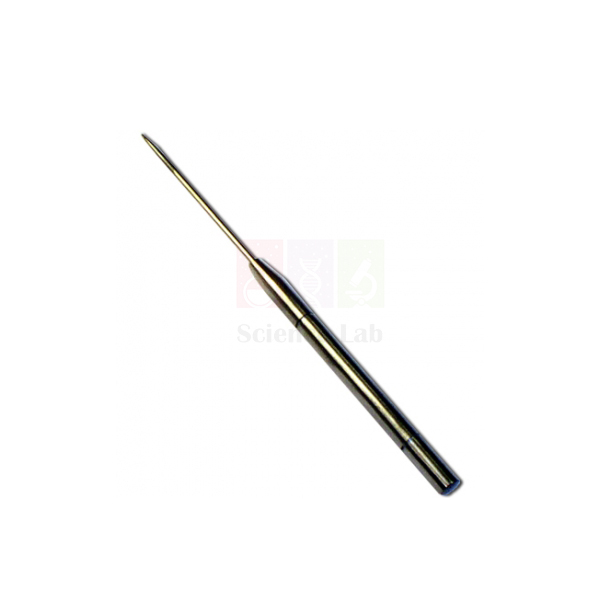
Dissecting Needle
Dissecting Needle (Product Code: SLE/EDE/13) is a sturdy steel needle used to tease apart tissue, separate fibres and lift fine structures during dissection and slide preparation. The listing gives two lengths: 125 mm long, and 130 mm long with handle. Equally at home as zoology or botany lab equipment in India, it is made by Jain Scientific Equipments Pvt Ltd (ScienceLab), Ambala, for school, college and university practicals.
Specifications
| Parameter | Detail |
|---|---|
| Product type | Dissecting needle |
| Material | Steel |
| Build | Sturdy |
| Sizes listed | 125 mm long; 130 mm long (with handle) |
| Suitable for | Teasing tissue, separating fibres and lifting small structures |
Typical Use
In zoology practicals the needle separates muscle bundles, frees nerves from connective tissue and lifts small ducts so they can be identified. On the microscope bench, two needles used together pull a sample apart in a drop of water or stain, which is how students spread plant tissue, separate anthers or tease out fibres before placing a cover slip.
Work with light, short strokes and let the point do the separating rather than forcing it through tissue. Because the needle is steel, dry it immediately after washing and store it dry; a light wipe before putting it away keeps the point clean for the next class. Labs that buy school biology lab equipment in India usually allow two needles per student for teasing work.
Manufacturer
The needle is manufactured by Jain Scientific Equipments Private Limited, which does business as ScienceLab from Ambala in Haryana and supplies teaching institutions with instruments, apparatus and models. The company profile introduces the company in more detail.
Related Dissection Equipment
Other needles and probes that complement this item:
- Dissecting Needle Plastic Handle — a version with a plastic grip for longer sessions.
- Teasing Needle (Probe) — a teasing needle listed in the zoology range.
- Probe, Chrome — a steel teasing probe for tracing structures.
- Needle, Stainless Steel — a stainless steel needle option.
- Dissecting Awl — for piercing tougher material before the needle is used.
The Dissection Equipment category lists all needles, probes and sets.
Frequently Asked Questions
Which lengths are available?
The listing states 125 mm long, and 130 mm long with handle. Mention the length you need in your enquiry so the correct version is quoted.
What is the needle made of?
It is made of steel and described as sturdy, so it resists bending during normal teasing work.
How should it be stored to avoid rust?
Dry it straight after washing and keep it in a dry case or drawer, away from damp cloths and specimen fluids.
How is a needle different from a seeker or probe?
A needle has a point for teasing and separating fine tissue. Blunter seekers and probes are preferred for tracing structures without piercing them, and many students keep both.
Is there a warranty on needles?
Terms are given in our quotation for each order. Contact us through the contact page if you need them documented.
Can you supply class packs or export quantities?
Yes. Send code SLE/EDE/13, the length, quantity and destination; we quote for buyers in India and international markets.
Request a Quote
For Dissecting Needle pricing, use the contact page or add the needle to the enquiry cart together with probes or sets.
Last updated: 24 September 2026
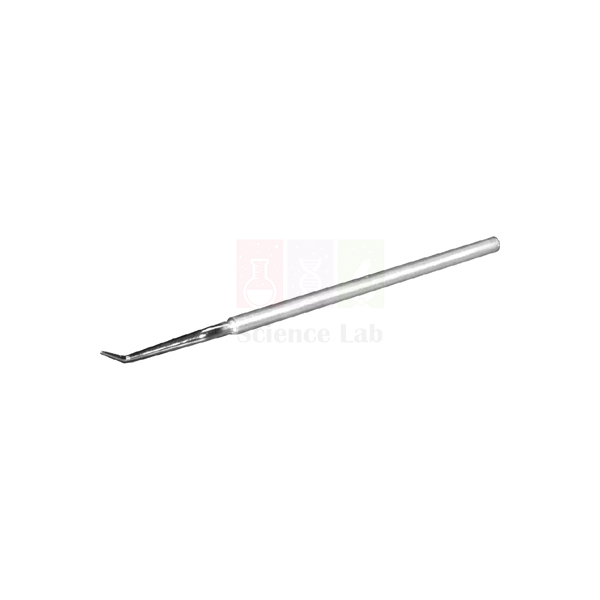
Probe, Chrome
Probe, Chrome (Product Code: SLE/EDE/14) is a teasing needle — also known as a small probe or dissecting needle — made of steel and 140 mm long. It is used to explore an opened specimen, separate layers of tissue and point out structures without cutting them, and it makes a dependable addition to a dissection set for biology students. The probe is made by a biology lab equipment manufacturer in India, Jain Scientific Equipments Pvt Ltd (ScienceLab), Ambala.
Specifications
| Parameter | Detail |
|---|---|
| Product type | Teasing needle (small probe / dissecting needle) |
| Material | Steel |
| Length | 140 mm |
| Suitable for | Teasing, separating and tracing structures in dissection and slide work |
Typical Use
Once a specimen has been pinned open, the probe is slid beneath a blood vessel, nerve or gut loop to lift it gently away from the surrounding tissue, so students can follow where it goes and label it in their diagrams. Its reach is handy when working deeper inside a body cavity, and the same tool can tease apart a small piece of tissue in a drop of water before a temporary mount is made.
Teachers often use a probe as a pointer during a live demonstration, indicating structures in the pan without disturbing them. Clean it after each class, dry it immediately and keep it apart from blades so the tip is not dulled. As a routine item from a science apparatus manufacturer in India, it is usually ordered in class quantities with forceps and scissors.
Manufacturer
ScienceLab probes are made by Jain Scientific Equipments Private Limited in Ambala, Haryana. Operating under the ScienceLab brand, the company supplies educational and laboratory equipment to institutions, dealers and project buyers; its company profile gives the full picture.
Related Dissection Equipment
Tools that are commonly used alongside this probe:
- Probe & Hook — adds a hook end for lifting and holding structures.
- Teasing Needle (Probe) — another teasing probe from the zoology range.
- Dissecting Needle — a sturdy steel needle for finer teasing.
- Forceps (Tweezers) Bent — curved tweezers to grip what the probe has lifted.
See all probes and instruments in the Dissection Equipment category.
Frequently Asked Questions
Is this a probe or a needle?
It is described as a teasing needle, which is also called a small probe or dissecting needle; the terms are used interchangeably in many labs.
How long is it and what is it made of?
It is 140 mm long and made of steel.
What does “Chrome” in the name refer to?
Chrome is part of the product name. The listing gives the material as steel; if you need details of the surface finish, please ask through the contact page.
Can it be used for slide preparation as well as dissection?
Yes. It can tease tissue apart in a drop of water or stain before the cover slip is placed, as well as tracing structures in an opened specimen.
How should it be cleaned and stored?
Wash, rinse and dry it straight away, then store it in a dry case or tray separate from sharp blades.
Do you supply bulk and export orders?
Yes. Share code SLE/EDE/14, the quantity and destination, and we will quote for delivery in India or international markets.
Request a Quote
To get a price for the Probe, Chrome, send your requirement through the contact page or add it to the enquiry cart.
Last updated: 24 September 2026
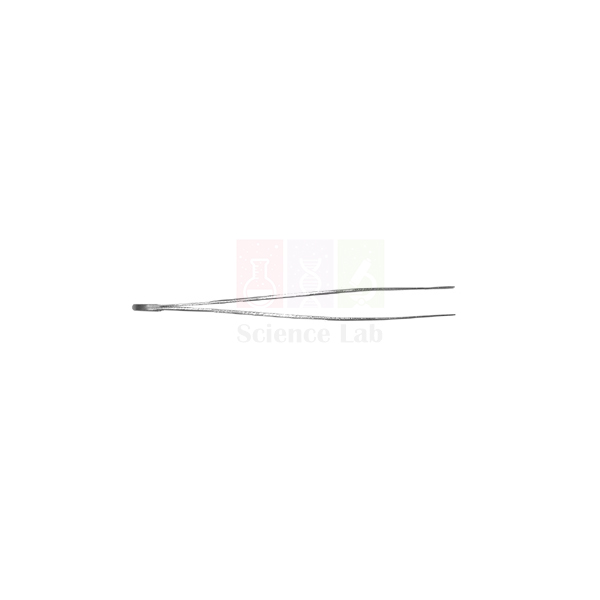
Forceps
Forceps (Product Code: SLE/EDE/15) are compact stainless steel forceps, 114 mm long, with precision ground points that meet cleanly to grip fine tissue, membranes and small specimens without slipping. Their short length gives close control for detailed work at the bench or under a magnifier, making them a handy piece of educational laboratory equipment in India for biology students, lab technicians and teachers. They are made by Jain Scientific Equipments Pvt Ltd (ScienceLab), Ambala.
Specifications
| Parameter | Detail |
|---|---|
| Product type | Forceps |
| Material | Stainless steel |
| Points | Precision ground |
| Length | 114 mm |
| Suitable for | Fine gripping in dissection, specimen handling and slide preparation |
Typical Use
During a dissection these forceps hold a fold of tissue taut while scissors or a scalpel make the cut, then lift away thin membranes to reveal the organs underneath. Because the points are ground to meet accurately, they can pick up very small items — a stained section, a seed, a single insect leg — and place them exactly where needed on a slide or in a dish.
The compact size suits work under a dissecting microscope, where long instruments are awkward to steer in the small field of view. Grip them near the tips for the finest control, keep pressure light, and never use the points as a lever. Wash and dry them after use and store them where the tips are protected, so they are ready for the next practical in a school or college lab.
Manufacturer
Jain Scientific Equipments Private Limited makes these forceps and markets them as ScienceLab from its home in Ambala, Haryana. The company equips teaching and practical laboratories with instruments and apparatus; read its company profile for more background.
Related Dissection Equipment
Instruments that are used with these forceps in the same work:
- Forceps (Tweezers) — longer fine-point tweezers for general picking and peeling.
- Forceps (Tweezers) Bent — a curved tip for reaching around structures.
- Scalpel — the cutting partner while the forceps hold tissue taut.
- Forceps, Nylon — a non-metal alternative for handling sensitive samples.
- Dissecting Microscope — magnification for the fine work these forceps are suited to.
More instruments are in the Dissection Equipment category.
Frequently Asked Questions
How long are these forceps?
They are 114 mm long, made of stainless steel.
What does “precision ground points” mean in practice?
The tips are finished so they close accurately against each other, which lets them hold small or thin items securely without crushing or dropping them.
When should I choose these instead of longer tweezers?
Pick these compact forceps for close, controlled work at the bench or under magnification; a longer pair gives more reach into deep containers or cavities.
How do I keep the points aligned?
Avoid dropping the forceps or using them to pry, and store them with the tips protected. Misaligned tips lose their grip on fine material.
What warranty applies?
Warranty terms are included in each quotation. Ask us through the contact page for details before you order.
Can you quote for institutions and distributors?
Yes. Send code SLE/EDE/15 with the quantity and delivery location; we supply buyers in India and international markets.
Request a Quote
Ask for Forceps pricing via the contact page, or add them to the enquiry cart along with the rest of your instrument list.
Last updated: 24 September 2026
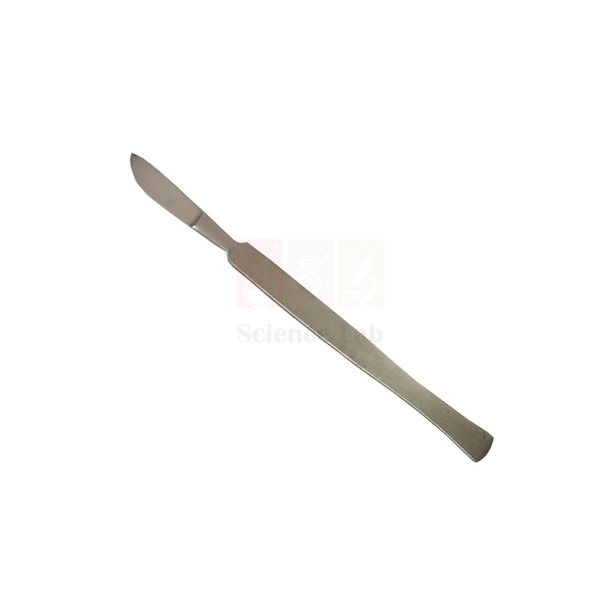
Scalpel
Scalpel (Product Code: SLE/EDE/16) is a stainless steel cutting instrument with a 1.5" blade and an overall length of about 6". It makes the clean, controlled incisions that open a specimen, cut through membranes and trim plant material, and it is used by students, teachers and technicians in school and college practicals. The scalpel is made by Jain Scientific Equipments Pvt Ltd (ScienceLab), Ambala, a scientific laboratory equipment manufacturer serving India and international markets.
Specifications
| Parameter | Detail |
|---|---|
| Product type | Scalpel |
| Material | Stainless steel |
| Blade | 1.5" |
| Overall length | 6" (approx) |
| Suitable for | Incisions and trimming in dissection and plant anatomy practicals |
Typical Use
The scalpel is held like a pencil for fine cuts, with the index finger resting on the back of the handle to steady the blade. In an animal dissection it makes the first shallow incision through the skin, frees organs from connective tissue and cuts neatly where scissors would tear. In plant work it slices stems, fruits and seeds in half so internal structures can be drawn and compared.
To keep the edge sharp, cut only on a wax pan, board or pad rather than on glass or metal. Pass the scalpel handle first, cut away from the body and put it down with the blade facing away from the user; after the practical, clean it carefully by holding the back of the blade and dry it before storage. It is one of the core items teachers list when ordering zoology lab equipment for a new batch of students.
Manufacturer
ScienceLab scalpels are made by Jain Scientific Equipments Private Limited in Ambala, Haryana, the company that owns the ScienceLab trading name. For institutional and tender buyers who need vendor registration details, it is a GST-registered business in Haryana (GSTIN 06AAECJ8618A1ZT) and holds the global Legal Entity Identifier 3358004HRD1JIVXKYX49. Visit the company profile for more.
Related Dissection Equipment
Items commonly used with a scalpel in dissection work:
- Scalpel Handle no.3 — a handle for detachable blades, if you prefer that style.
- Forceps — hold tissue taut while the scalpel cuts.
- Dissection Pan — black wax surface that protects the edge during cutting.
- Dissecting Board — a firm base for trimming plant material.
- Dissecting Set, Large — a cased set that includes scalpels with other instruments.
All cutting tools and sets are listed under Dissection Equipment.
Frequently Asked Questions
What are the blade and overall lengths?
The blade is 1.5" and the scalpel is about 6" long overall, made of stainless steel.
Does it take replaceable blades?
The listing does not state a blade-fitting system. If you want detachable blades, ask us through the contact page or consider a numbered scalpel handle with blades.
How can students use it safely?
Teach them to pass it handle first, cut away from the body and fingers, and never leave it hidden under paper towels or specimens. Collect and count scalpels at the end of each practical.
How do I keep the edge sharp?
Cut only on wax, a board or a pad, never on glass or metal trays, and store the scalpel so the blade does not rub against other instruments.
Which registration details can you provide for vendor onboarding?
Our GSTIN and LEI are given above; send any further vendor-form requirements with your enquiry and we will respond with the quotation.
Do you supply large or overseas orders?
Yes. Share code SLE/EDE/16, the quantity and destination; we serve schools, colleges and distributors in India and international markets.
Request a Quote
For a Scalpel quotation, write to us via the contact page or add the item to the enquiry cart with forceps, pans and other instruments.
Last updated: 24 September 2026
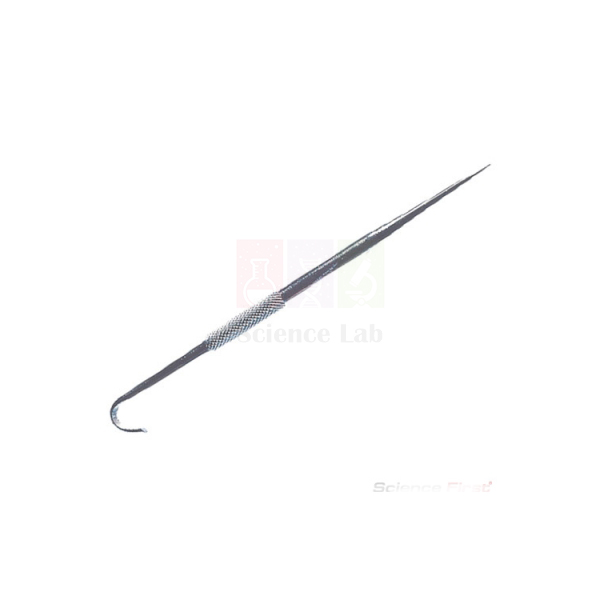
Probe & Hook
The Probe & Hook (Product Code: SLE/EDE/17) is a chrome plated steel dissecting probe with a hook on one end, 6 inches in length. Students use it to lift, separate and hold back soft tissue during practical dissections without cutting it, which is why a probe of this kind is a routine item in school biology lab equipment in India. It is manufactured by Jain Scientific Equipments Pvt Ltd (ScienceLab), Ambala, for schools, colleges and teacher-training laboratories.
Specifications
| Parameter | Detail |
|---|---|
| Type | Dissecting probe with hook |
| Material | Chrome plated steel |
| Hook | On one end of the probe |
| Length | 6 inches |
Typical Use
During a dissection the shaft is run along the natural divisions between organs to free connective tissue, to follow the course of a blood vessel or nerve, or to point out a structure to the class without damaging it. The hooked end catches a membrane or a flap of skin and draws it aside, so the region underneath stays in view while it is pinned, sketched or labelled. Because it is not a cutting tool, it is a safer first instrument for younger students than a scalpel.
As part of zoology lab equipment in India the probe and hook is usually issued alongside forceps and dissecting pins, and it is just as handy for opening up flowers or other plant material in botany practicals. After each session rinse off tissue and preservative, wash in mild detergent and dry the probe completely before storage; avoiding long soaks in water or harsh disinfectants helps protect the chrome plating.
Manufacturer
This probe is produced by Jain Scientific Equipments Private Limited, the company behind the ScienceLab brand, which makes dissection instruments and other teaching apparatus in Ambala, Haryana, India, for schools and colleges in India and international markets. Read more about the business in our company profile.
Related Dissection Equipment
Items commonly used alongside the probe and hook at the same dissection bench:
- Probe, Chrome — a chrome probe without a hook, for general tracing work
- Dissecting Hook & Chain Set — for keeping tissue retracted during longer dissections
- Forceps (Tweezers) — to grip tissue while the probe separates it
- Dissecting T-Pins — to fix the specimen and hold structures drawn aside by the hook
- Dissection Pan — a working surface to hold the specimen
See the complete Dissection Equipment range for instruments, sets, pans and boards.
Frequently Asked Questions
What is the Probe & Hook made of, and how long is it?
It is made of chrome plated steel and measures 6 inches in length, with a hook on one end.
Can it be used to cut tissue?
No. It is meant for lifting, separating and holding tissue aside; make incisions with a scalpel first, then use the probe to open up the structures.
How is the hook used in practice?
Slip the hook under a membrane or organ and draw it gently to one side so the structures beneath are exposed; pin the retracted tissue if it needs to stay in place.
How should it be cleaned and stored?
Wash off tissue and preservative, rinse, and dry thoroughly before storage. Avoid abrasive scrubbing and long soaks, which can wear or dull the plating.
Is it part of a dissecting set?
This listing is for the probe and hook as an individual instrument. Complete kits are listed in our dissection range, or contact us to check which instruments a particular set contains.
Is there a warranty?
Warranty terms are confirmed with each quotation; please contact us for details.
Can you supply class quantities or export orders?
Yes. We supply schools, colleges and distributors across India and international markets; share the product code SLE/EDE/17, the quantity and the delivery location when you enquire.
Request a Quote
To order the Probe & Hook for your laboratory, send your requirement through our contact page or add it to the enquiry cart together with any other dissection equipment you need, and we will reply with a quotation.
Last updated: 24 September 2026
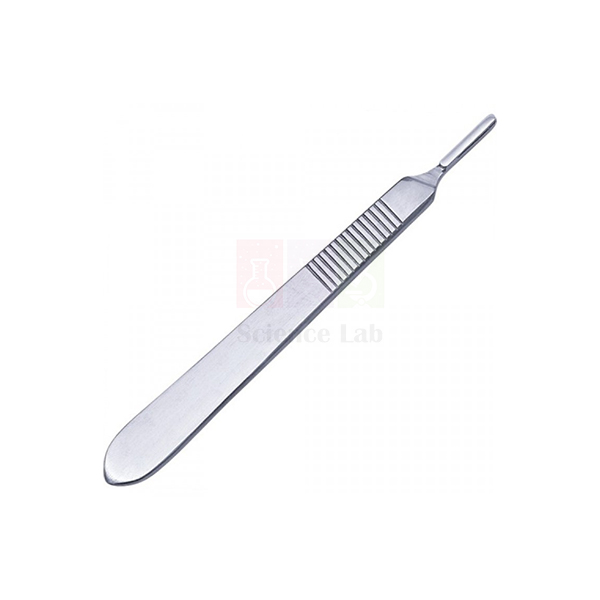
Scalpel Handle no.3
The Scalpel Handle no.3 (Product Code: SLE/EDE/18) is a stainless steel BP handle — the reusable holder into which detachable surgical blades are fitted. At 125mm long it gives a steady grip for controlled incisions in school, college and teacher-training dissections, and because only the blade is changed when it dulls, one handle can serve a laboratory for many practical sessions. It is made by Jain Scientific Equipments Pvt Ltd (ScienceLab) in Ambala and offered by the company as a biology lab equipment supplier in India.
Specifications
| Parameter | Detail |
|---|---|
| Type | BP scalpel handle, No.3 |
| Function | Holds surgical blades |
| Length | 125mm |
| Material | Stainless steel |
| Blades | Not listed as part of this item — confirm when enquiring |
Typical Use
A detachable-blade handle is the standard choice when a lab wants a sharp, consistent cutting edge for every class without regrinding fixed blades. The blade is slid onto the fitting at the tip of the handle and removed the same way; both steps should be done with forceps or a blade remover rather than fingers, with the cutting edge pointed away from the body. Hold the handle like a pencil for fine cuts through skin and body wall, and let the blade do the work rather than pressing hard.
When building a dissection set for biology in India, many teachers keep a few spare handles so that blades can be fitted before the lesson and removed safely afterwards. Used blades belong in a sharps container, never in general waste. Wash the handle in warm soapy water, rinse and dry it completely, and store it with no blade attached.
Manufacturer
Jain Scientific Equipments Private Limited manufactures this handle under its ScienceLab trade name at Ambala, Haryana, a long-standing centre for scientific instrument making in India. Our company profile describes the business and the laboratory ranges it produces.
Related Dissection Equipment
Useful companions for a detachable-blade scalpel handle:
- Scalpel, Stainless Steel — a complete stainless steel scalpel for students who need a ready-to-use instrument
- Scalpel — another scalpel option in the same dissection range
- Forceps — for fitting and removing blades safely and for holding tissue while cutting
- Dissecting Board — a firm surface to cut on
- Gloves W/o Powder Nitrile Disposable — hand protection while handling blades and specimens
Browse all instruments, sets and trays in our Dissection Equipment category.
Frequently Asked Questions
Are surgical blades included with the handle?
Blades are not listed as part of this item. If you need blades with the handles, mention it in your enquiry through our contact page and we will advise what can be supplied.
What size and material is the handle?
It is 125mm long and made of stainless steel.
Which blades fit a No.3 handle?
The handle is a No.3 BP pattern designed to hold surgical blades. Please check the blade numbers you already stock with us before ordering, so we can confirm compatibility.
How do I change a blade safely?
Grip the blade with forceps, not fingers, keep the edge facing away from you, and slide it on or off the fitting in a single controlled movement. Dispose of old blades in a sharps container.
How should the handle be cleaned?
Remove the blade first, then wash the handle in warm soapy water, rinse and dry it completely. If your lab follows a particular sterilisation routine, ask us for guidance before using it.
What information do you need for an institutional quotation?
Send the product code SLE/EDE/18, the number of handles, whether blades are required and the delivery address; we will quote for delivery within India or to international markets.
Request a Quote
Ready to equip your dissection bench? Use the contact form or place the Scalpel Handle no.3 in your enquiry cart, and our team will send a quotation with availability.
Last updated: 24 September 2026
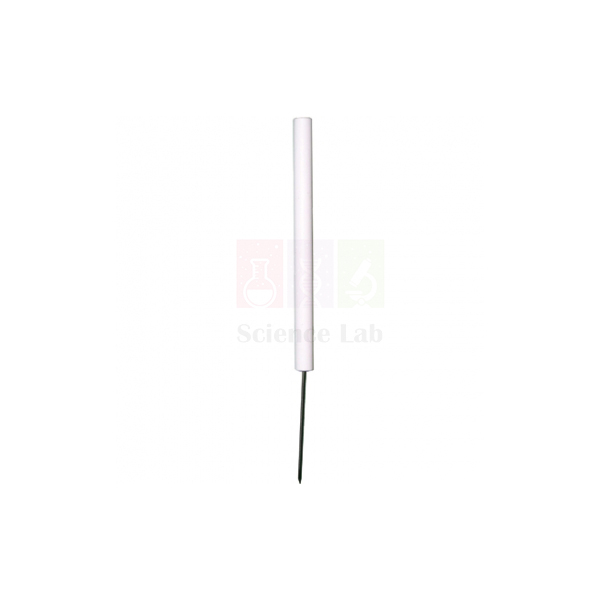
Dissecting Needle Plastic Handle
The Dissecting Needle Plastic Handle (Product Code: SLE/EDE/19) combines a 40mm stainless steel needle with a 100mm plastic handle. It is the fine-point tool students reach for when material has to be teased apart, spread out on a slide or lifted with precision, and it is a basic piece of biology lab equipment in India for both zoology and botany practicals. The instrument is manufactured by Jain Scientific Equipments Pvt Ltd (ScienceLab), Ambala.
Specifications
| Parameter | Detail |
|---|---|
| Needle material | Stainless steel |
| Needle length | 40mm |
| Handle | Plastic |
| Handle length | 100mm |
Typical Use
Much of this needle's work happens at the microscope stage rather than on the dissecting tray. Students use it to tease plant or animal tissue into thin strands in a drop of water or stain, to spread cells evenly before a cover slip goes on, and to lower the cover slip at an angle so that air bubbles are pushed out. On the tray it lifts fine membranes and separates muscle fibres or nerve threads that forceps would crush.
Because it turns up in almost every mounting exercise, the needle is a natural part of a temporary slides biology kit for school and college labs. The plastic handle keeps the tool light in the hand; for the same reason it should not be held in or near a burner flame. Wipe the needle clean after each use, dry it, and store it with the point protected so it stays straight and sharp.
Manufacturer
ScienceLab is the brand name of Jain Scientific Equipments Private Limited, a laboratory equipment maker headquartered in Ambala, Haryana, which supplies teaching institutions across India and in international markets. For background on the company, visit our company profile.
Related Dissection Equipment
Items that pair well with this needle for slide preparation and fine dissection:
- Needle, Stainless Steel — straight stainless steel dissecting needles sold in packs, for group work
- Dissecting Needle — an alternative needle style from the same range
- Petri Dish Glass With Lid — to hold tissue in liquid while it is teased apart
- Hand Lens — for checking fine separations before mounting
- Dissecting Microscope — for teasing very small structures under magnification
More needles, probes and instrument sets are listed under Dissection Equipment.
Frequently Asked Questions
How long are the needle and handle?
The stainless steel needle is 40mm long and the plastic handle is 100mm long.
Can the needle be sterilised in a flame?
Flaming is not recommended, because heat can damage the plastic handle. Clean the needle with water or a suitable laboratory disinfectant and dry it instead.
How is it used when mounting a slide?
Place the edge of the cover slip on the slide beside the specimen, support it with the needle, and lower it slowly so the liquid spreads without trapping air bubbles.
Is the needle replaceable if it bends?
Replacement needle details are not given in the product listing; please contact us and we will advise on spares or a replacement instrument.
How many needles come in one order unit?
The listing describes a single needle with plastic handle. Tell us how many you need for a class and we will quote the quantity accordingly.
Do you deliver to colleges outside India?
Yes, ScienceLab ships dissection instruments within India and to international markets. Include the product code SLE/EDE/19 and your destination in the enquiry.
Request a Quote
For prices and delivery on the Dissecting Needle Plastic Handle, write to us via the contact page or collect items in the enquiry cart and submit them together for one consolidated quotation.
Last updated: 24 September 2026
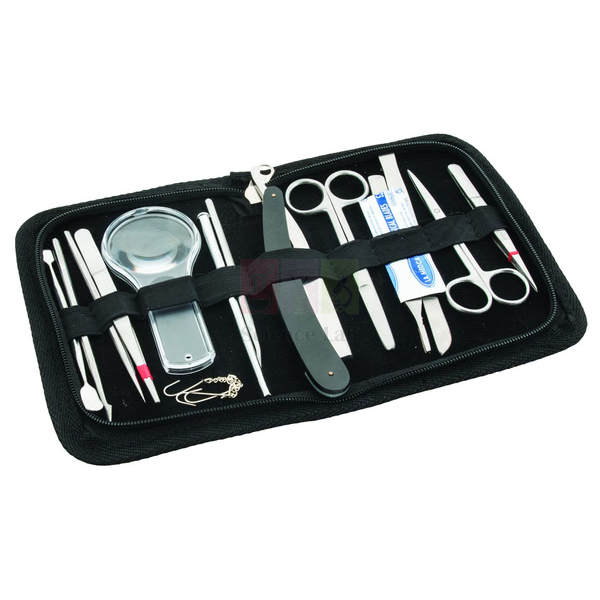
Dissecting Instruments Set
The Dissecting Instruments Set (Product Code: SLE/EDE/20) brings together 14 stainless steel dissecting instruments in a canvas case, so a student or teacher has a complete, organised toolkit for practical work instead of loose items gathered from a drawer. It suits institutions looking for a dissection kit for school use in India as well as college zoology and botany departments, and it is manufactured as biology lab equipment in India by Jain Scientific Equipments Pvt Ltd (ScienceLab), Ambala.
Specifications
| Parameter | Detail |
|---|---|
| Number of instruments | 14 |
| Instrument material | Stainless steel |
| Case | Canvas |
| Suitable for | Student and teacher dissection practicals |
Typical Use
A cased set works best when it is issued as a unit: one set per student or per pair, signed out at the start of the practical and checked back in at the end. Counting the instruments back into the case against the stated total of 14 makes a missing tool easy to spot, and students learn to lay out, use and return instruments in an orderly way — a habit that matters when sharp tools are involved. The same set moves easily between the dissection bench and field or herbarium work.
For a biology lab setup in a school in India, departments often keep a class quantity of identical sets so that every group works with the same tools and the teacher can demonstrate each step once. After use, wash and dry every instrument fully before it goes back into the canvas case, because moisture trapped in fabric can mark steel over time; store the closed case in a dry cupboard.
Manufacturer
The set comes from Jain Scientific Equipments Private Limited, a company based in Ambala, Haryana, that trades as ScienceLab and makes dissection, biology and general laboratory equipment for education. You can read about our background and facilities on the company profile page.
Related Dissection Equipment
Other sets for comparison, plus the working surface and pins a dissection needs:
- Dissecting Set, Student — an alternative set aimed at individual student use
- Dissecting Set, Large — a larger set option for comparison
- Dissecting Kit (Economy) — a budget kit for large classes
- Dissection Pan, Pad & Cover — an aluminium pan with pin-holding pad to work on
- Dissecting T-Pins — for fixing specimens to the pad or board
Compare every kit and single instrument in the Dissection Equipment category.
Frequently Asked Questions
How many instruments are in the set?
There are 14 stainless steel dissecting instruments, supplied together in a canvas case.
Which instruments does it include?
The piece-by-piece list is not published on this page. Please contact us for the current contents list before you order, especially if you need it for a tender specification.
Can individual instruments be replaced if one is lost?
Tell us which item is missing and we will advise whether a matching single instrument can be supplied.
How should the set be stored?
Clean and dry each instrument before returning it to the canvas case, then keep the case closed in a dry cupboard away from chemical fumes.
Is this set suitable for a whole class?
Yes, it is commonly ordered in class quantities so that each student or pair has an identical set. Let us know the number of students and we will quote accordingly.
What warranty applies?
Warranty coverage is stated in our quotation for each order; ask through the contact page if you need it in advance.
Can the sets be exported?
Yes. We supply schools, universities and distributors in India and international markets — quote code SLE/EDE/20 and the destination country in your enquiry.
Request a Quote
To receive a quotation for the Dissecting Instruments Set, message us on the contact page or add the set to your enquiry cart along with pans, pins and other dissection items.
Last updated: 24 September 2026
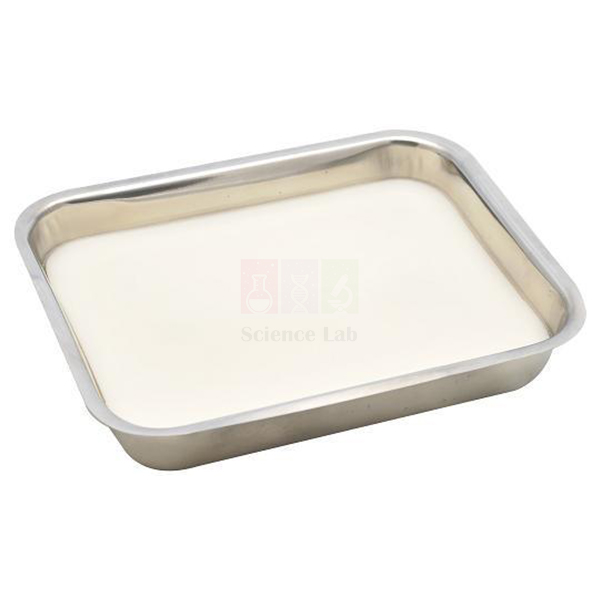
Dissecting Tray with Wax
The Dissecting Tray with Wax (Product Code: SLE/EDE/21) is an aluminium tray measuring 300 x 200 x 45mm, supplied with wax. The wax gives students a soft base into which dissecting pins can be pushed to hold a specimen open, while the raised sides contain fluids and loose tissue. It is a practical dissection tray for school labs in India and for college practical classes, manufactured by Jain Scientific Equipments Pvt Ltd (ScienceLab), Ambala.
Specifications
| Parameter | Detail |
|---|---|
| Tray material | Aluminium |
| Size | 300 x 200 x 45mm |
| Supplied with | Wax |
| Purpose | Pinning and dissecting specimens |
Typical Use
The specimen is laid on the wax, opened with a scalpel and pinned back with T-pins angled outward so the pins stay clear of the working area. Because the tray has walls 45mm high, the prepared specimen can be covered with water: many soft internal structures float apart under water and become far easier to see and trace than on a dry surface. The tray is equally useful for pinning out flowers or plant sections for drawing.
As a piece of school biology lab equipment in India, a wax tray is long-lived if it is looked after. Remove every pin at the end of the class, rinse the tray and wax surface, and let it dry before stacking. Over many sessions the wax becomes pitted from repeated pinning; teachers commonly renew the surface by carefully warming and levelling the wax so that it grips pins firmly again.
Manufacturer
This tray is made by Jain Scientific Equipments Private Limited, which operates as ScienceLab from Ambala, Haryana, and manufactures teaching laboratory equipment for education buyers in India and abroad. Institutions completing vendor registration can quote the company’s GSTIN 06AAECJ8618A1ZT and Legal Entity Identifier 3358004HRD1JIVXKYX49. Further details are on our company profile.
Related Dissection Equipment
Tools and alternatives used with a wax dissecting tray:
- Dissecting T-Pins — for fixing the specimen into the wax
- Scalpel, Stainless Steel — for the opening incisions
- Forceps (Tweezers) — to hold and lift tissue while cutting
- Dissection Pan, Pad & Cover — a wax-free alternative using a synthetic pad and clear cover
- Dissecting Dishes — for smaller specimens and separated parts
Trays, boards and instruments are all listed in the Dissection Equipment category.
Frequently Asked Questions
What are the tray dimensions?
The aluminium tray measures 300 x 200 x 45mm.
Is the wax included?
Yes, the tray is supplied with wax. The depth of the wax layer is not stated in the listing; ask us if you need that detail.
Why dissect under water in this tray?
The 45mm-deep tray can hold enough water to cover a pinned specimen, which lets delicate organs and tubes float apart so they can be traced without tearing.
How do I restore a wax surface full of pin holes?
Gently warm the wax until the surface softens and levels, then let it set before use. Keep heat low and supervised, and never leave the tray unattended on a heat source.
Should I choose wax or a synthetic pad?
Wax is simple and familiar; a synthetic pad such as our Dissection Pan, Pad & Cover avoids remelting altogether. Many labs keep both types in use.
What should a school include in its quotation request?
Mention code SLE/EDE/21, the number of trays, and your delivery address in India or abroad; add pins or instruments to the same request for a combined quote.
Request a Quote
Send your requirement for the Dissecting Tray with Wax through the contact page, or add it to the enquiry cart and submit the full list of dissection items you need.
Last updated: 24 September 2026
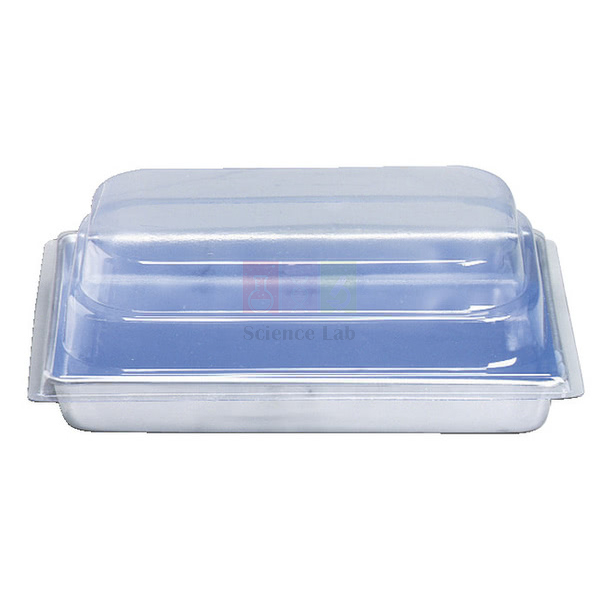
Dissection Pan, Pad & Cover
The Dissection Pan, Pad & Cover (Product Code: SLE/EDE/22) is a complete dissection system: an aluminium pan and a flexible synthetic pad measuring 29 x 19cm (11.5 x 7.5 in), plus a clear plastic cover. The pad replaces dissection wax, so there is no old wax to remelt, and the cover lets a specimen be kept between lessons. It is designed for biology lab equipment in India where the same specimen is studied over several periods, and it is manufactured by Jain Scientific Equipments Pvt Ltd (ScienceLab), Ambala.
Specifications
| Parameter | Detail |
|---|---|
| Pan and pad dimensions | 29 x 19cm (11.5 x 7.5 in) |
| Pan material | Aluminium, to prevent rusting |
| Pad | Flexible synthetic material; holds pins securely; smooth, long-lasting surface |
| Cover | Clear plastic; accommodates specimens up to 9cm (3.5 in) high |
| Cover function | Prevents excessive moisture loss; allows pans to be stacked for storage |
| Wax required | No — the pad replaces dissection wax and eliminates remelting |
Typical Use
This set is at its best in multi-lesson work. A specimen is pinned out on the pad, partly dissected, and then covered: the clear lid limits drying so tissue stays workable for the next session, and the covered pans stack neatly on a shelf instead of taking up bench space. Because the lid is transparent, students can still observe and sketch the specimen without lifting it, and the 9cm clearance leaves room for pins standing upright.
For teachers assembling biology teaching aids in India, the pad-and-pan design removes the most tedious part of wax trays — melting, pouring and levelling. After use, pull all pins, wash pad, pan and cover in mild detergent, rinse, and air-dry before reassembly. When the pad eventually wears from repeated pinning, it can be swapped for a replacement pad rather than replacing the whole set.
Manufacturer
Jain Scientific Equipments Private Limited, known to customers by its trade name ScienceLab, produces this dissection system in Ambala, Haryana, and supplies laboratories in India and international markets. See the company profile for more about who we are.
Related Dissection Equipment
Spares and tools that go with this pan system:
- Dissection Replacement Pad — a replacement synthetic pad for the dissection pan and pad set
- Dissection Replacement Pad, White — a white replacement pad for the same set
- Dissecting T-Pins — to hold specimens on the pad
- Dissecting Instruments Set — 14 stainless steel instruments in a canvas case
- Dissecting Tray with Wax — the traditional wax-based alternative
Find more trays, pans and instruments in Dissection Equipment.
Frequently Asked Questions
What size are the pan and pad?
Both measure 29 x 19cm (11.5 x 7.5 in).
How tall a specimen fits under the cover?
The clear plastic cover accommodates specimens up to 9cm (3.5 in) high.
Do I still need dissection wax?
No. The flexible synthetic pad replaces wax and holds pins securely, so there is no remelting of old wax.
Why is the pan made of aluminium?
Aluminium is used to prevent rusting, which matters for a pan that is washed after every practical.
Can the pad be replaced when it wears out?
Yes, replacement pads for the dissection pan and pad set are listed separately. Please confirm the size you need with us, as the replacement pads are listed with their own dimensions.
Is there a warranty on the set?
Warranty details are provided with our quotation; contact us if you need them before ordering.
Do you supply this set for whole labs or export?
Yes, we quote class and department quantities for customers in India and international markets. Include code SLE/EDE/22, the number of sets and whether spare pads are wanted.
Request a Quote
Ask for a price on the Dissection Pan, Pad & Cover via our contact page, or add the set and any spare pads to the enquiry cart for a single combined quotation.
Last updated: 24 September 2026
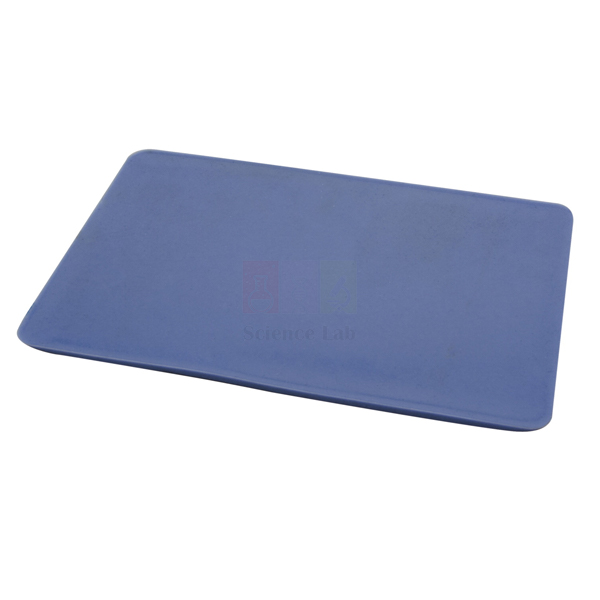
Dissection Replacement Pad
The Dissection Replacement Pad (Product Code: SLE/EDE/23) is a spare pad for the dissection pan and pad set, measuring 25 x 16cm and 10mm thick. Made of flexible synthetic material, it holds pins securely and offers a smooth, long-lasting working surface, so a worn pad can be renewed without buying a whole new pan. Labs that keep a school biology lab setup in India running term after term use it to refresh heavily pinned pads. It is made by the biology lab equipment manufacturer in India, Jain Scientific Equipments Pvt Ltd (ScienceLab), Ambala.
Specifications
| Parameter | Detail |
|---|---|
| Type | Replacement dissection pad |
| For use with | Dissection pan and pad set |
| Material | Flexible synthetic material |
| Dimensions | 25 x 16cm |
| Thickness | 10mm |
| Surface | Smooth and long-lasting; holds pins securely |
| Wax | Not needed — replaces dissection wax and eliminates remelting |
Typical Use
Every pin pushed into a pad leaves a small channel, and after many classes the most-used central area no longer grips as firmly as the edges. That is the moment to lift out the old pad and drop in a new one. The 10mm thickness gives dissecting pins enough depth to seat firmly when they are angled outward, which keeps skin flaps and membranes open while students draw and label what they see.
Because no wax is involved, there is no heating, pouring or waiting for a surface to set before the next practical. Many departments keep a few spare pads in the store so a pan is never out of action when lab specimens are being prepared for a biological practical. Clean the pad with mild detergent and water after each use, remove every pin, and store it flat and dry so it keeps its shape.
Manufacturer
ScienceLab replacement parts are produced by Jain Scientific Equipments Private Limited, an Ambala, Haryana manufacturer of laboratory teaching equipment serving customers in India and international markets. The company profile gives an overview of the organisation.
Related Dissection Equipment
The pan set this pad belongs to, and the items used with it:
- Dissection Pan, Pad & Cover — the aluminium pan system with synthetic pad and clear cover
- Dissection Replacement Pad, White — a white replacement pad, listed at 25 x 14cm
- Dissecting T-Pins — pins to fix specimens into the pad
- Dissection Pan — a separate dissection pan in the same range
All pans, pads and dissection tools are in the Dissection Equipment category.
Frequently Asked Questions
What are the dimensions of this pad?
It measures 25 x 16cm and is 10mm thick.
Will it fit the pan I already have?
It is listed as a replacement for the dissection pan and pad set. Before ordering, compare the 25 x 16cm pad size with the inside of your pan, or send us your pan details and we will confirm the fit.
How is it different from the white replacement pad?
The white pad is listed at 25 x 14cm, while this pad is 25 x 16cm; both are 10mm thick and made of flexible synthetic material.
Does it hold pins as well as wax?
The pad is made to hold pins securely and gives a smooth, long-lasting surface, without the remelting that wax needs.
How long will a pad last?
Life depends on how often and how heavily it is pinned, so no fixed figure is given. Rotating pinning positions and removing pins promptly after class both help.
Can spare pads be ordered in bulk?
Yes. Give us code SLE/EDE/23, the quantity and your delivery location in India or overseas, and we will send a quotation.
Request a Quote
Stock up on Dissection Replacement Pads by writing to us from the contact page or adding them to the enquiry cart together with pans or pins.
Last updated: 24 September 2026
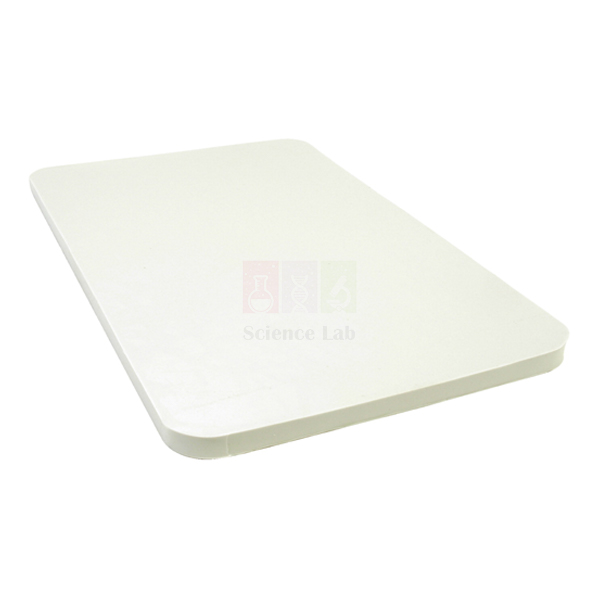
Dissection Replacement Pad, White
The Dissection Replacement Pad, White (Product Code: SLE/EDE/24) is a white, 10mm thick pad of flexible synthetic material, measuring 25 x 14cm, made as a replacement for the dissection pan and pad set. A light-coloured working surface makes dark tissue, fine vessels and small parts stand out clearly, which helps students see and record detail. Like the standard pad, it replaces dissection wax and removes the need to remelt old wax. It is manufactured by Jain Scientific Equipments Pvt Ltd (ScienceLab), Ambala, as one of its biology teaching aids for India and export customers.
Specifications
| Parameter | Detail |
|---|---|
| Type | Replacement dissection pad |
| For use with | Dissection pan and pad set |
| Colour | White |
| Material | Flexible synthetic material |
| Dimensions | 25 x 14cm |
| Thickness | 10mm |
| Wax | Not required — replaces dissection wax |
Typical Use
The white surface is chosen when contrast matters: tracing thin blood vessels, locating small glands, or photographing a finished dissection for a practical record or display. It also shows clearly when the pad needs cleaning, which encourages good hygiene habits among students. The 10mm depth accepts dissecting pins pushed in at an angle, so specimens stay spread open while observations are made.
A school laboratory equipment supplier in India will usually recommend keeping one or two spare pads per pan set, so that a pad can be changed during a busy practical week. Wash the pad with mild detergent and cold water after each class, since hot water tends to set stains on pale surfaces, then dry it flat. Swap it out once pinning no longer feels firm.
Manufacturer
This white pad is made by Jain Scientific Equipments Private Limited, the Ambala, Haryana company that sells its laboratory products under the ScienceLab name. To learn about our operations, please see the company profile.
Related Dissection Equipment
The pan set this pad is meant for, plus useful companions:
- Dissection Pan, Pad & Cover — the aluminium pan, pad and clear cover system
- Dissection Replacement Pad — the standard replacement pad, listed at 25 x 16cm
- Dissecting T-Pins — for fixing specimens into the pad
- Magnifying Glass — for examining fine structures against the white background
Explore the full Dissection Equipment range for pans, trays and instruments.
Frequently Asked Questions
What size is the white replacement pad?
It is 25 x 14cm and 10mm thick.
Why choose a white pad?
A white surface gives strong contrast against most tissue, which makes small structures easier to see, draw and photograph.
Is it the same as the standard Dissection Replacement Pad?
Both are 10mm thick flexible synthetic pads for the dissection pan and pad set, but the white pad is listed at 25 x 14cm and the standard pad at 25 x 16cm. Ask us which suits your pan.
Will stains show on the white surface?
Pale surfaces show marks more readily. Rinse promptly with cold water and mild detergent after each practical to keep the pad looking clean.
Do I need wax with this pad?
No. The pad replaces dissection wax and eliminates remelting.
How do I order white pads for several pan sets?
Send code SLE/EDE/24 with the number of pads and your delivery address, within India or abroad, and we will return a quotation.
Request a Quote
Request pricing for the Dissection Replacement Pad, White through our contact page, or place it in the enquiry cart with any other dissection supplies.
Last updated: 24 September 2026
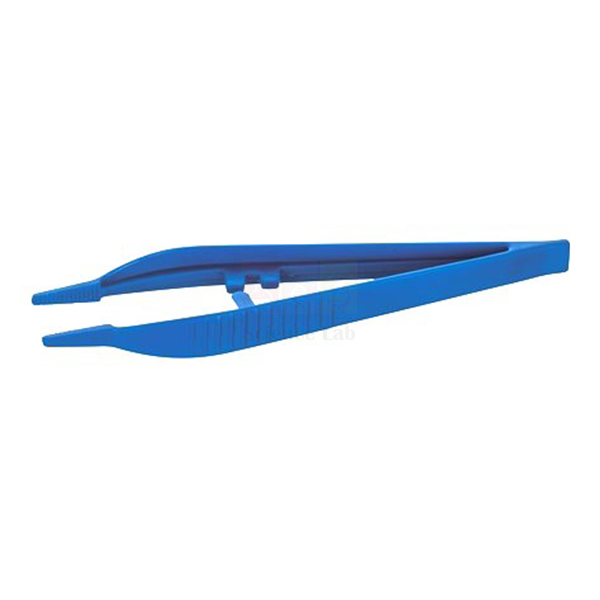
Forceps, Nylon
The Forceps, Nylon (Product Code: SLE/EDE/25) are straight forceps made of glass-filled nylon, with a blunt tip. Being non-metallic and blunt, they let students pick up and move delicate material — soft specimens, seeds, small invertebrates, filter paper or cover slips — with less risk of piercing or scratching it. They are a sensible, student-friendly choice within biology lab equipment for school labs in India, manufactured by Jain Scientific Equipments Pvt Ltd (ScienceLab), Ambala.
Specifications
| Parameter | Detail |
|---|---|
| Type | Forceps |
| Material | Nylon, glass filled |
| Shape | Straight |
| Tip | Blunt |
Typical Use
Nylon forceps come into their own wherever metal tips would do harm. In the biology lab they are used to lift leaves, petals and seeds for observation, to transfer preserved specimens between dishes, and to place or remove cover slips without chipping the glass. Glass filling makes the nylon stiffer than an unfilled plastic, so the arms spring back and grip evenly, while the blunt tip keeps younger students from puncturing soft tissue.
They also work well in field and classroom collections — for example as part of an insect collection kit for school, where small, fragile specimens must be handled gently. Rinse the forceps in water after use, wipe dry, and keep them away from open flames and hot plates, since heat can soften or distort nylon.
Manufacturer
Jain Scientific Equipments Private Limited, which trades as ScienceLab, manufactures laboratory teaching equipment in Ambala, Haryana. The company is incorporated under CIN U29309HR2020PTC087597, and production takes place at its licensed factory at 449, HSIIDC Industrial Area, Saha, Ambala (Factory Licence AMB-ONLINE-CHD-J-414). More about the business is on our company profile.
Related Dissection Equipment
Other handling tools and the containers they are typically used with:
- Forceps (Tweezers) — metal forceps for firmer gripping during dissection
- Forceps (Tweezers) Bent — a bent-tip version for reaching into specimens
- Petri Dish Glass With Lid — for holding specimens being moved or examined
- Specimen Container, PP — for storing collected material
- Hand Lens — to examine small specimens held in the forceps
For metal forceps, scalpels and full sets, browse Dissection Equipment.
Frequently Asked Questions
What are these forceps made of?
Glass-filled nylon, with straight arms and a blunt tip.
Why choose nylon forceps over stainless steel?
Nylon is non-metallic and, with a blunt tip, handles fragile items such as cover slips, seeds and soft specimens with less risk of scratching or piercing. Steel forceps remain the better choice for firm gripping during dissection.
How long are the forceps?
The length is not stated in the product listing. Please contact us and we will confirm the dimensions.
Can they be flamed or autoclaved?
Do not flame them, as nylon softens with heat. If your lab needs to sterilise plastic tools by another method, ask us before ordering so we can advise on suitability.
Are they resistant to laboratory chemicals?
Chemical compatibility is not specified in the listing. Tell us which solutions you plan to use and we will check before you order.
Do you supply them in bulk?
Yes, nylon forceps can be quoted in class quantities for schools, colleges and distributors in India and international markets; reference code SLE/EDE/25.
Request a Quote
For a quotation on Forceps, Nylon, reach us through the contact page or add them to the enquiry cart along with the rest of your lab list.
Last updated: 24 September 2026
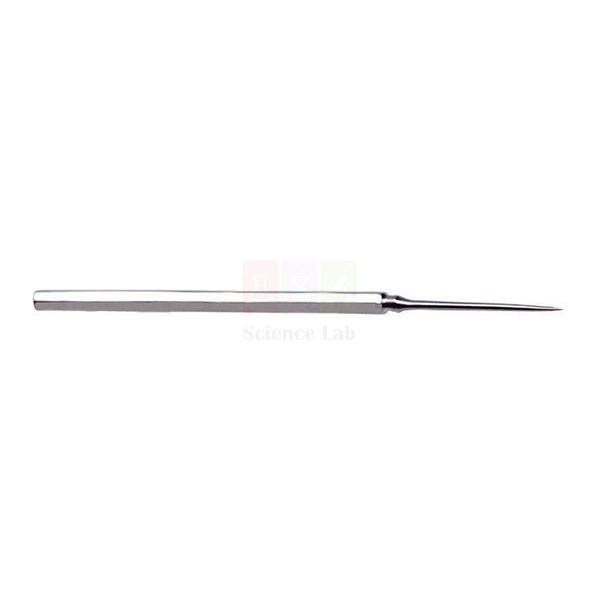
Needle, Stainless Steel
The Needle, Stainless Steel (Product Code: SLE/EDE/26) is a straight dissecting needle in stainless steel with a total length of 95mm, sold as a pack of 5. Packing five together makes it easy to equip a practical group, or to keep spares on hand when a point bends or goes missing. The needles are a staple item of school biology lab equipment in India when a dissection kit is being stocked, and they are manufactured by Jain Scientific Equipments Pvt Ltd (ScienceLab), Ambala.
Specifications
| Parameter | Detail |
|---|---|
| Type | Dissecting needle, straight |
| Material | Stainless steel |
| Total length | 95mm |
| Pack size | 5 needles |
Typical Use
Straight needles are the everyday tool for separating tissue layers, picking out small structures, and holding material steady while forceps or a scalpel do the main work. In plant practicals they help pull apart root tips or tease out anthers; in animal work they lift fine membranes and separate muscle bundles. Stainless steel resists corrosion from the water, stains and preservatives that needles are constantly exposed to.
A good approach for a class is to give each pair of students one needle from the pack and keep the rest in reserve, so practicals are not held up by a lost or damaged point. As a biology lab equipment supplier in India, ScienceLab recommends rinsing needles after every session, drying them fully and storing them points-down in a holder or with a protective cap, which protects both the tips and the people reaching for them.
Manufacturer
These needles are made by Jain Scientific Equipments Private Limited, whose products carry the ScienceLab brand. The firm works from Ambala, Haryana, and supplies schools, colleges and distributors in India and in international markets. Visit the company profile to learn more.
Related Dissection Equipment
Other fine-work instruments often ordered with these needles:
- Dissecting Needle Plastic Handle — a needle with a 100mm plastic handle for a fuller grip
- Seekers — blunt-ended stainless steel tools for tracing without piercing
- Dissecting Needle — another needle option from the same range
- Dissecting Set, Student — a student set when a full instrument kit is needed
- Petri Dish — to hold material in liquid while it is teased apart
Our complete Dissection Equipment listing covers needles, probes, forceps and sets.
Frequently Asked Questions
How many needles are in a pack?
Each pack contains 5 straight stainless steel dissecting needles.
What is the length of each needle?
The total length is 95mm.
Are these needles straight or bent?
They are straight dissecting needles.
How do I keep the points in good condition?
Avoid pressing the tip against the tray base, dry the needles after cleaning, and store them so the points are not touching other metal instruments.
Can I order single needles instead of packs?
The item is listed as a pack of 5. If you have a different quantity in mind, let us know and we will advise.
What warranty is offered?
Terms are given with each quotation; please ask through our contact page if you need them first.
Can you ship packs to institutions abroad?
Yes. We serve customers in India and international markets; include code SLE/EDE/26, the number of packs and your destination.
Request a Quote
Order packs of the Needle, Stainless Steel by sending a message from our contact page or adding them to the enquiry cart with your other dissection tools.
Last updated: 24 September 2026
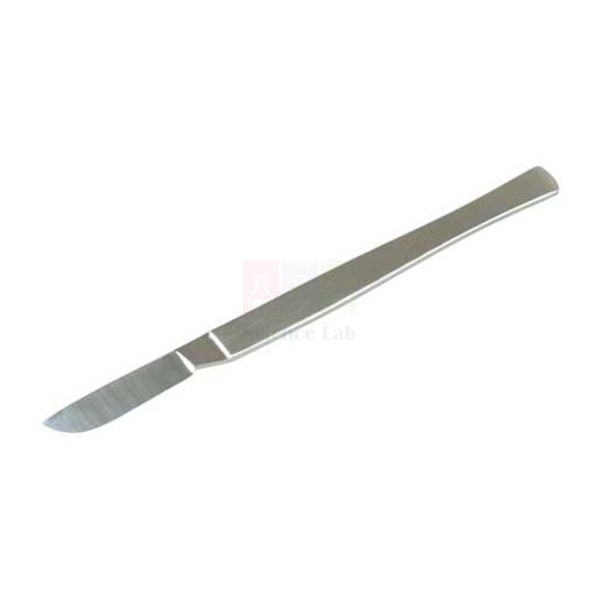
Scalpel, Stainless Steel
The Scalpel, Stainless Steel (Product Code: SLE/EDE/27) is a steel scalpel with a 130mm handle and a 45mm blade, made entirely in stainless steel. It is the cutting instrument of the dissection bench, used to make the first incision and to open body walls, stems or fruits cleanly so that other tools can follow. Suited to college practicals and senior school classes, it belongs in any dissection set for biology in India and is manufactured by Jain Scientific Equipments Pvt Ltd (ScienceLab), Ambala.
Specifications
| Parameter | Detail |
|---|---|
| Type | Scalpel |
| Material | Stainless steel |
| Handle length | 130mm |
| Blade length | 45mm |
Typical Use
With a 130mm handle the scalpel sits comfortably in the hand for longer cuts, and the 45mm blade gives enough edge to open a specimen in one controlled stroke. Students are taught to lift the skin or body wall with forceps and cut shallowly just beneath it, so that the organs underneath are not damaged. In botany, the same scalpel is used for longitudinal and transverse sections of flowers, fruits and stems.
Among zoology lab equipment in India, a scalpel calls for clear safety rules: carry it point-down, never pass it hand to hand, and always cut away from the body onto a firm board or tray. After use, clean the blade carefully by wiping from the back edge towards the tip, dry it immediately, and store the scalpel in a case or rack where the edge cannot be knocked against other instruments.
Manufacturer
ScienceLab scalpels come from Jain Scientific Equipments Private Limited in Ambala, Haryana — a company that manufactures dissection instruments along with a wide range of school and college laboratory apparatus. Company background is available on our profile page.
Related Dissection Equipment
Items used together with a scalpel in a typical practical:
- Scalpel Handle no.3 — a 125mm BP handle for labs that prefer replaceable surgical blades
- Forceps — to lift tissue ahead of the blade
- Wooden Dissecting Board — a softwood surface to cut and pin on
- Dissecting Tray with Wax — an aluminium tray with wax for pinned dissections
- Gloves W/o Powder Nitrile Disposable — hand protection during cutting
View more scalpels, sets and accessories in Dissection Equipment.
Frequently Asked Questions
What are the handle and blade lengths?
The handle is 130mm long and the blade is 45mm long.
What material is the scalpel made from?
Stainless steel.
Is the blade fixed or replaceable?
The listing gives the handle and blade lengths but does not specify the blade fitting. If you specifically need replaceable blades, see the Scalpel Handle no.3, or contact us to confirm this scalpel’s design.
How should the edge be looked after?
Cut only onto wood, wax or a pad — never glass or metal — clean and dry the blade straight after use, and store it so the edge does not touch other tools.
Is this scalpel suitable for younger students?
It is a sharp cutting instrument, so it is best used under close teacher supervision; many schools let younger classes use probes and blunt tools while the teacher makes the incisions.
How do we request an institutional quotation?
Share code SLE/EDE/27, the number of scalpels and the delivery address, whether in India or overseas, and our team will prepare a quote.
Request a Quote
Get a price for the Scalpel, Stainless Steel by contacting us through the contact page, or build your order list in the enquiry cart and send it in one go.
Last updated: 24 September 2026
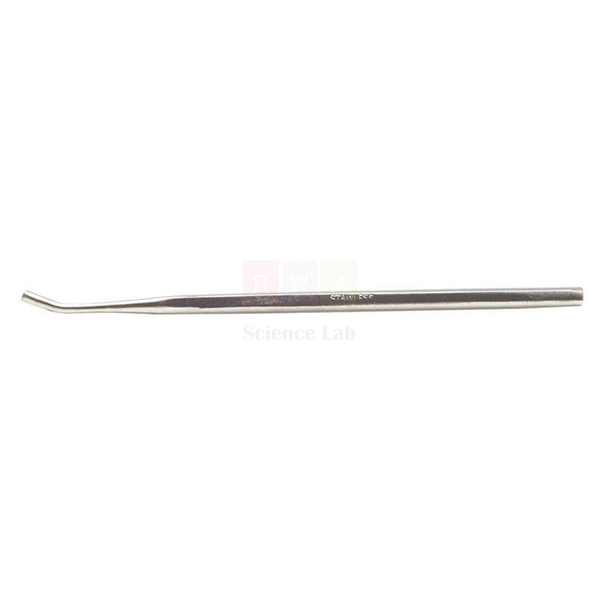
Seekers
Seekers (Product Code: SLE/EDE/28) are compact, plain-pattern stainless steel dissecting tools with a 35mm blunt-ended needle and a total length of 70mm including the handle. Where a sharp needle would pierce, a seeker slides along vessels, nerves and ducts to follow their path and separate them from surrounding tissue. They are a small but important part of zoology lab equipment in India and are manufactured by Jain Scientific Equipments Pvt Ltd (ScienceLab), Ambala.
Specifications
| Parameter | Detail |
|---|---|
| Pattern | Plain |
| Material | Stainless steel |
| Needle | 35mm, blunt end |
| Total length | 70mm including handle |
Typical Use
The blunt end is the whole point of a seeker. Once a specimen has been opened, students run the seeker gently under a blood vessel or nerve and lift it slightly, which shows where it branches and what it connects to without cutting or tearing it. The short 70mm overall length gives close control for small specimens and fine work, including work under a hand lens or dissecting microscope.
Teachers often introduce the seeker before the scalpel, because it lets students explore anatomy safely and builds careful technique. Within a school biology lab equipment set, seekers are typically issued alongside forceps and pins. Clean them after each use, dry them straight away, and store them with other fine instruments rather than loose in a drawer where the short needle can be bent.
Manufacturer
Seekers in the ScienceLab range are made by Jain Scientific Equipments Private Limited at Ambala, Haryana, India. The company builds apparatus for biology, chemistry and physics teaching and supplies institutions in India and international markets. Our company profile has the full story.
Related Dissection Equipment
Tools that work alongside seekers when tracing anatomy:
- Probe & Hook — a 6-inch chrome plated probe with a hook for holding tissue aside
- Probe, Chrome — a longer probe for larger specimens
- Needle, Stainless Steel — sharp straight needles for when piercing or teasing is needed
- Forceps (Tweezers) — to hold structures while the seeker separates them
- Dissecting Microscope — for fine tracing work on small specimens
Browse needles, probes and other fine instruments in Dissection Equipment.
Frequently Asked Questions
What is the difference between a seeker and a dissecting needle?
A seeker has a blunt end for tracing and lifting structures without piercing them, whereas a dissecting needle has a sharp point for teasing and picking.
How long is the seeker?
The needle is 35mm and the total length, including the handle, is 70mm.
What material is used?
Stainless steel, in a plain pattern.
Are seekers sold singly or in packs?
The pack quantity is not stated in the listing; contact us with the number you need and we will confirm how they are supplied.
How should seekers be stored?
Dry them after cleaning and keep them in a case or tray with other fine instruments so the short needle is not bent.
Can I get a combined quote with other dissection tools?
Yes. List code SLE/EDE/28 with any other items and quantities, plus your delivery location in India or abroad, and we will send one quotation.
Request a Quote
To buy Seekers for your lab, get in touch through the contact page or add them to the enquiry cart; we will reply with pricing and availability.
Last updated: 24 September 2026
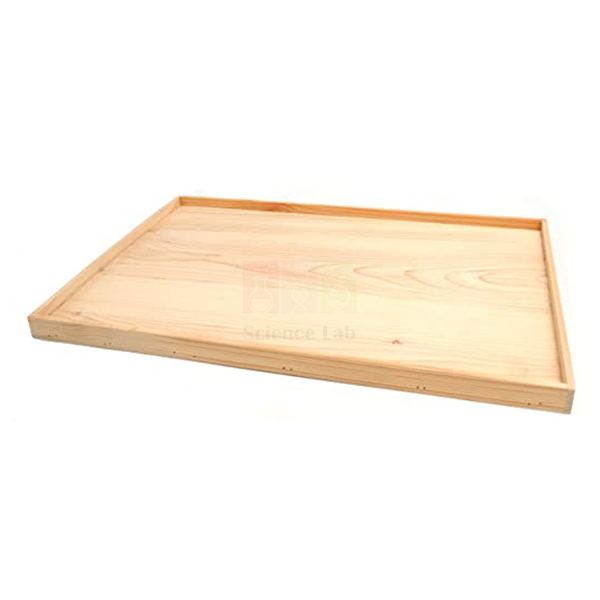
Wooden Dissecting Board
The Wooden Dissecting Board (Product Code: SLE/EDE/29) is a large 550 x 380mm board made of softwood, chosen so that dissecting pins press in easily and scalpel blades are not blunted on a hard surface. Its generous working area suits teacher demonstrations, larger preserved specimens and plant material spread out for study, and it fits naturally into a biology lab setup for schools in India as well as college practical labs. It is made by a biology lab equipment manufacturer in India, Jain Scientific Equipments Pvt Ltd (ScienceLab), Ambala.
Specifications
| Parameter | Detail |
|---|---|
| Material | Softwood |
| Dimensions | 550 x 380mm |
| Designed for | Easy use with dissecting pins and scalpel blades |
Typical Use
At 550 x 380mm the board gives enough room for a specimen, pinned-back tissue and a row of instruments laid out beside it, which is why many teachers use it for front-of-class demonstrations where students gather round. Softwood takes pins with hand pressure alone and holds them firmly, and it is forgiving to scalpel edges that would dull quickly on glass, ceramic or metal.
It is equally useful as botany lab equipment in India — for cutting sections of stems, roots and fruits, or pinning out whole plants and flowers for drawing. Because wood is porous, place a plastic sheet or tray over it for very wet or preserved specimens, wipe it down with a damp cloth after use rather than soaking it, and let it dry flat and away from direct heat to prevent warping.
Manufacturer
ScienceLab is the trading name of Jain Scientific Equipments Private Limited, a registered MSME manufacturer (Udyam UDYAM-HR-01-0003714) based in Ambala, Haryana; export shipments are handled under Importer-Exporter Code AAECJ8618A (DGFT). The company supplies laboratory equipment to institutions in India and international markets — see our company profile.
Related Dissection Equipment
Pins, instruments and alternative surfaces for the same practical:
- Dissecting T-Pins — T-headed pins for fixing specimens to the board
- Scalpel, Stainless Steel — a stainless steel scalpel for cutting on the board
- Dissecting Instruments Set — 14 stainless steel instruments in a canvas case
- Dissecting Board — a softwood board with raised edges
- Dissection Pan, Pad & Cover — a covered aluminium pan for wet specimens kept between lessons
See every board, tray and tool in our Dissection Equipment category.
Frequently Asked Questions
What size is the board?
It measures 550 x 380mm.
Why is it made of softwood?
Softwood lets dissecting pins go in easily and is kind to scalpel blades, so edges stay sharp for longer.
How thick is the board?
Thickness is not given in the product listing. Please contact us if you need it for a specification.
Can it be used with wet or preserved specimens?
Yes, but wood absorbs liquid, so we suggest laying a plastic sheet or tray on the board for very wet work and wiping it clean afterwards.
How do I clean and store it?
Remove all pins, wipe with a damp cloth and mild detergent, and dry the board flat at room temperature; avoid soaking or placing it near heaters.
What details are needed for an institutional or export order?
Provide code SLE/EDE/29, the quantity and the delivery destination; we can also share the company registration details your purchase department requires.
Request a Quote
For a quotation on the Wooden Dissecting Board, write to us via the contact page or add it to the enquiry cart with pins and instruments for a complete set-up.
Last updated: 24 September 2026