- Physics Lab Equipment
- Chemistry Lab Equipment
- Biology Lab Equipment
- Anatomical Lab Equipment
- Learning
- Educational Lab Equipment
- Magnets
- Agriculture
- Astronomy
- Earth Science
- Geography Lab Equipment
- Safety Lab Coat
- Laboratory
- Meteorological
- Electricity & Magnetism
- Heat
- School Lab Equipment
- Lab Glassware
- Science Lab Equipment
- Tvet Lab Equipment
- Robotics Kits Supplier and Manufacturer for Schools India
- Math Lab Equipment Manufacturers and Exporters in Ambala
- STEM Kits Manufacturers and Supplier India
- Engineering Lab Equipment
- Hospital Lab Equipment
- Water, Sanitation & Hygiene Supplies
- Cold Chain, Solar & Communication Equipment
- Nutrition
Last updated: 22 October 2026
Quick Answer
Jain Scientific Equipments Pvt Ltd (ScienceLab), Ambala, Haryana, a laboratory glassware supplier in India, lists 9 items in this funnel range for filtration, liquid transfer and the separation of immiscible liquids in school, college and research laboratories, arranged in 3 groups from glass, plastic and powder funnels to Buchner and separatory funnels. All 9 items are manufactured by ScienceLab at its factory at Saha, Ambala. Each item has its own product page, linked from the product listing under this description. The company supplies buyers in India and in 110 countries.
Quick links: Request a quotation · Jump to specifications by group · Open your enquiry cart
Explore the Glassware Funnels Range
| Range | Items | What it covers |
|---|---|---|
| Filter, powder and transfer funnels | 5 | Short-stem borosilicate glass funnels in 75, 90 and 120 mm diameters, plastic funnels in 35, 65 and 100 mm, a polypropylene powder funnel with a parallel stem, a white HDPE funnel with handles for filling carboys and drums, and a double funnel stand on a polished wood base. |
| Buchner funnels for vacuum filtration | 2 | Buchner funnels with a 90 mm filter plate in one-piece porcelain (about 200 ml) and two-part polypropylene (about 300 ml), both acid and alkali resistant and autoclavable. |
| Separatory funnels | 2 | A 250 ml borosilicate separatory funnel with ground-glass stopcock and 24/29 stopper, and a conical Squibb-style funnel with PTFE stopcock in 250, 500 and 1000 ml capacities. |
| Total | 9 | All items listed in the Glassware Funnels range |
Glassware Funnels Specifications
Key specifications below are taken from each product's own page; open a product for its full specifications and product code.
Filter, powder and transfer funnels (5)
| Product | Key specification |
|---|---|
| Funnel Stand, Double | Rods: Approx. 460 mm x 16 mm dia.; Base: Polished wood base with clamping screws; Type: Double |
| Funnel, HDPE | Material: HDPE (high-density polyethylene); Colour: White; Resistance: Chemical resistant |
| Glass Funnel | Diameters: 75 mm, 90 mm, 120 mm; Material: Borosilicate glass; Shape: Conical |
| Plastic Funnel | Diameters: 35 mm, 65 mm, 100 mm; Stem (as described): 30 mm stem with a 3 mm diameter opening; Material: Plastic |
| Powder Funnel | Diameter: 80 mm; Stem opening: 12.5 mm; Stem length: 30 mm |
Buchner funnels for vacuum filtration (2)
| Product | Key specification |
|---|---|
| Buchner Funnel, 90 mm, Polypropylene | Diameter: 90 mm; Capacity: About 300 ml; Stem: Tapers from about 13 mm OD at the end to 18 mm OD at the cone |
| Buchner Funnel, 90 mm, Porcelain | Diameter: 90 mm; Capacity: About 200 ml; Stem: Tapers from about 22 mm OD at the end to 30 mm OD at the cone |
Separatory funnels (2)
| Product | Key specification |
|---|---|
| Separatory Funnel | Capacity: 250 ml; Overall length: 340 mm; Outside diameter: 55 mm |
| Separatory Funnel, Squibb style | Stopper: Polyethylene, size 19/26; Capacities: 250 ml, 500 ml, 1000 ml; Style: Squibb, conical shape |
Related Equipment in Other ScienceLab Ranges
Filtration and extraction set-ups also need flasks, filter paper, a vacuum source and stand fittings, which are listed in other ScienceLab ranges:
Who Buys This Range
Schools order glass and plastic funnels for filtering mixtures through filter paper and for pouring liquids into narrow-necked vessels. Colleges, universities and research laboratories add Buchner funnels for vacuum filtration and separatory funnels for solvent extraction in inorganic and organic chemistry. Laboratory technicians and chemical stores use the powder funnel for dry reagents and the HDPE funnel for filling carboys, drums and barrels. Dealers, distributors and tender buyers order funnels in quantity together with flasks, beakers and other laboratory glassware.
Other ScienceLab Equipment Ranges
| Range | What it covers |
|---|---|
| Glassware Flasks | Conical, round-bottom, distillation, filter, iodine and culture flasks |
| Glassware Beaker | Glass and Pyrex beakers, beaker sets and beaker tongs |
| Glassware Burettes | Class-A and Class-B burettes with glass-key or PTFE stopcocks |
| Glassware Bottles | Reagent, dropping, BOD and gas washing bottles |
| Scientific Lab Plasticware | Lab plasticware such as beakers, wash bottles, carboys and racks |
| Stand bases, Rods and Rings | Steel stand bases, H-frames, support rods, tripods and retort rings |
| Retort Clamp | Standard, 3-prong and 4-prong retort clamps, including cork- and rubber-jaw types |
| Chemistry Lab | School chemistry lab items, from apparatus and glassware to reagents and safety items |
Frequently Asked Questions
What does the Glassware Funnels range include?
9 items in 3 groups: borosilicate glass, plastic, powder and HDPE funnels with a double funnel stand, porcelain and polypropylene Buchner funnels for vacuum filtration, and two separatory funnels for separating liquids that do not mix.
Are these funnels manufactured by ScienceLab?
Yes. All 9 items in this range are manufactured by ScienceLab in Ambala, from the Glass Funnel and Powder Funnel to both Buchner funnels, both separatory funnels and the double funnel stand.
Which funnel sizes are available?
The Glass Funnel comes in 75 mm, 90 mm and 120 mm diameters and the Plastic Funnel in 35 mm, 65 mm and 100 mm. Both Buchner funnels have a 90 mm filter plate, the powder funnel is 80 mm across, and the Squibb-style separatory funnel is listed in 250 ml, 500 ml and 1000 ml capacities.
Should I choose a porcelain or a polypropylene Buchner funnel?
The porcelain Buchner funnel is a one-piece design holding about 200 ml. The polypropylene Buchner funnel is lighter, holds about 300 ml and has a two-part body whose upper section snaps on to form a vacuum-tight seal without grease. Both are acid and alkali resistant and autoclavable, and both are used with a filter flask and a vacuum source.
How do the two separatory funnels differ?
The Separatory Funnel (SLE/GF/06) is a 250 ml borosilicate funnel with a ground-glass stopcock and a 24/29 ground-glass stopper. The Squibb-style funnel has a conical body, a PTFE stopcock that never needs greasing and a polyethylene 19/26 stopper.
Which funnels suit school practicals and which suit college labs?
Plastic funnels are far less likely to break than glass, so primary and middle-school classes use them, while glass funnels serve routine filtration with filter paper. Buchner and separatory funnels are used for vacuum filtration and solvent extraction in senior-secondary, college and research chemistry.
Do you accept bulk, tender and export orders?
Yes. Bulk quantities, tender enquiries and export orders are accepted, from one filtration bench to a full set of practical tables, and product specifications are provided on request so they can be checked against your tender documents.
What should I include in a quotation request?
Product names or codes (for example SLE/GF/03 for the porcelain Buchner funnel), the diameter or capacity you need, quantities, the delivery location and any tender specification.
Request a Quote
Send product names or codes and quantities through the contact page, or add items to your enquiry cart and submit it.
ScienceLab (Jain Scientific Equipments Pvt Ltd)
1226/1-5, Bengali Mohalla, Science Market, Ambala Cantt, Haryana 133001, India
Phone: +91-7082934803
Email: sales@scilabexport.com
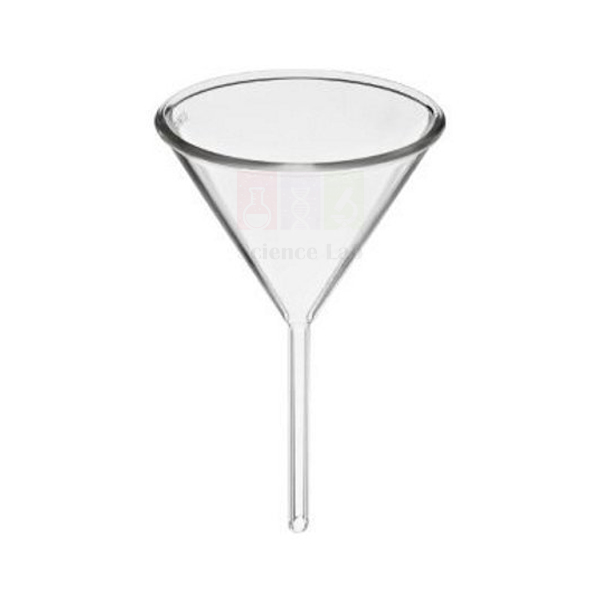
Glass Funnel
Glass Funnel (Product Code: SLE/GF/01) is a conical, short-stemmed funnel in borosilicate glass for filtering mixtures through filter paper and for transferring liquids into narrow-necked vessels without spills. Offered in 75 mm, 90 mm and 120 mm diameters, it is a basic item of borosilicate laboratory glassware used in chemistry experiments at every level from secondary school to university. It is manufactured by Jain Scientific Equipments Pvt Ltd (ScienceLab), Ambala.
Specifications
| Parameter | Detail |
|---|---|
| Material | Borosilicate glass |
| Shape | Conical |
| Stem | Short stem |
| Diameters | 75 mm, 90 mm, 120 mm |
| Resistance | Heat resistant and chemical resistant |
| Used in | Laboratory work and chemistry experiments |
Typical Use
For gravity filtration, a circle of filter paper is folded into a cone, seated in the funnel and wetted so it clings to the glass; the mixture is then poured down a glass rod onto the paper, with the stem resting against the inside wall of the receiving beaker or flask so the filtrate runs down smoothly. Separating sand from salt solution, collecting a precipitate and clarifying a solution before crystallisation are routine examples in school chemistry lab equipment sessions.
The short stem is less likely to clog with solids and is preferred for hot filtration, where a long stem can cool the liquid enough for crystals to form inside it. Choose the 75 mm funnel for small test-tube and beaker work, 90 mm for general practicals and 120 mm for larger volumes. Because it is borosilicate, the funnel can take hot solutions and most laboratory solvents.
Manufacturer
Glass funnels in this range are made by Jain Scientific Equipments Private Limited, a company in Ambala, Haryana that trades as ScienceLab and supplies laboratory glassware and apparatus to education and industry. Find out more on our company profile.
Related Glassware Funnels and Accessories
Items needed to set up a complete filtration at the bench:
- Filter Paper — folded into the funnel to retain solids
- Funnel Stand, Double — holds two funnels above the receivers
- Stirring Rod, Glass — guides the liquid onto the paper without splashing
- Glass Beaker — collects the filtrate beneath the funnel
- Plastic Funnel — an unbreakable option for junior classes and cold liquids
See the full range in Glassware Funnels.
Frequently Asked Questions
Which diameters are available?
75 mm, 90 mm and 120 mm.
What size of filter paper should I use?
Choose a paper that, once folded, sits just below the rim of the funnel so liquid cannot run over the edge of the paper. Contact us if you would like us to suggest paper for your funnel size.
What is the benefit of the short stem?
It clogs less easily with solids and reduces cooling of hot solutions, so crystals are less likely to block the stem during hot filtration.
Should I choose glass or plastic?
Glass is the choice for hot liquids and organic solvents. A plastic funnel is lighter and does not break, which suits younger students and cold aqueous work.
How do I clean it?
Rinse immediately after use, wash with laboratory detergent and a soft brush, and give a final rinse with distilled water before drying upside down.
Can you supply funnels in bulk for schools or for export?
Yes. Send the diameters, quantities and delivery location in India or abroad, and we will prepare a quotation.
Request a Quote
For pricing, contact us or add the Glass Funnel in the sizes you need to your enquiry cart.
Last updated: 24 September 2026
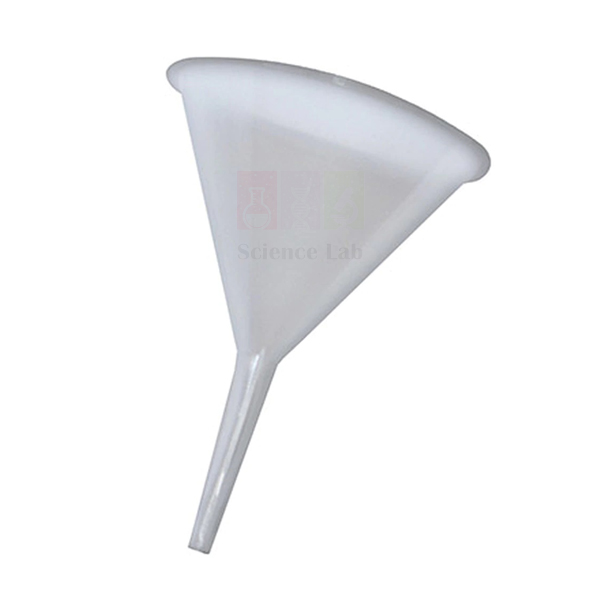
Plastic Funnel
Plastic Funnel (Product Code: SLE/GF/02) is a lightweight, chemical-resistant conical funnel for pouring and filtering at the bench, offered in 35 mm, 65 mm and 100 mm diameters. Being plastic, it is far less likely to break than glass, so primary and middle-school science teachers, lab assistants and technicians use it for everyday liquid transfers and simple filtration activities. It is part of the lab plasticware manufactured by Jain Scientific Equipments Pvt Ltd (ScienceLab), Ambala.
Specifications
| Parameter | Detail |
|---|---|
| Material | Plastic |
| Shape | Conical |
| Diameters | 35 mm, 65 mm, 100 mm |
| Resistance | Chemical resistant |
| Capacity (as described) | Two ounces |
| Stem (as described) | 30 mm stem with a 3 mm diameter opening |
| Recommended filter paper | 11 cm; when folded it fits inside the funnel without overhang |
Typical Use
Younger students use the funnel to pour water or solutions into bottles, test tubes and measuring cylinders in school practicals, and to filter muddy water or separate sand from salt solution with a folded filter paper. Technicians keep one beside each reagent stock for topping up dropping and wash bottles, where a narrow stem and a steady pour prevent spills on the bench.
Pick the 35 mm funnel for filling small bottles and tubes, 65 mm for general bench transfers and 100 mm when larger volumes are poured. Because heat resistance is not listed for this plastic funnel, use a borosilicate glass funnel for hot liquids. Rinse it after each use so residues do not carry over between reagents.
Manufacturer
Made by Jain Scientific Equipments Private Limited, which operates as ScienceLab from Ambala in Haryana and serves schools, colleges and laboratories in India and international markets. Read our company profile for more about the business.
Related Laboratory Equipment
Items commonly ordered with plastic funnels for school labs:
- Filter Paper — for simple filtration activities
- Funnel, HDPE — another plastic funnel option in our funnel range
- Powder Funnel — for transferring solids into narrow-necked containers
- Measuring Cylinder, Polypropylene — a plastic cylinder that is often filled through a funnel
- Wash Bottle LDPE with Narrow Mouth — refilled easily through a small funnel
More options are listed under Glassware Funnels.
Frequently Asked Questions
Which diameters can I order?
35 mm, 65 mm and 100 mm.
Do the two-ounce capacity and 30 mm stem apply to every size?
Our description gives these figures for the funnel without linking them to a particular diameter. If stem length or capacity matters for your use, contact us and we will confirm the details of the size you need.
What filter paper fits?
An 11 cm filter paper is recommended; folded, it sits inside the funnel without overhang.
Can I pour hot liquids through it?
Heat resistance is not listed for this funnel, so we advise using a Glass Funnel for hot solutions.
Which plastic is it made from?
The listing describes it as a chemical-resistant plastic without naming the polymer. If your work requires a specific material, ask us before ordering.
Can you supply class quantities?
Yes. Tell us the sizes, quantities and delivery location, and we will quote for school or distributor supply.
Request a Quote
Please contact us for prices, or add the Plastic Funnel to your enquiry cart with the diameters you require.
Last updated: 24 September 2026
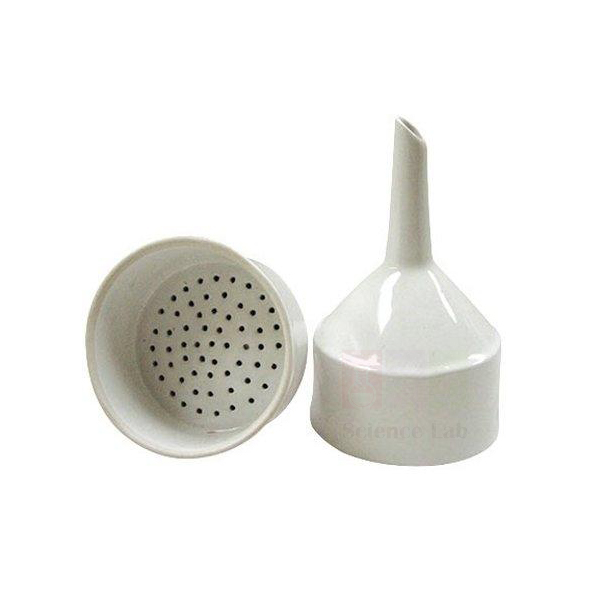
Buchner Funnel, 90 mm, Porcelain
Buchner Funnel, 90 mm, Porcelain (Product Code: SLE/GF/03) is a one-piece porcelain funnel for vacuum filtration, with a flat perforated filter platform 90 mm in diameter and a capacity of about 200 ml. Paired with a filter flask and a vacuum source, it pulls liquid rapidly through a flat filter paper, leaving crystals or precipitate as a dry cake — much faster than gravity filtration. A core item of chemistry lab equipment for college, university and pharmacy practicals, it is manufactured by Jain Scientific Equipments Pvt Ltd (ScienceLab), Ambala.
Specifications
| Parameter | Detail |
|---|---|
| Material | Porcelain — durable, acid and alkali resistant, easy to clean, autoclavable |
| Construction | One-piece design |
| Diameter | 90 mm |
| Capacity | About 200 ml |
| Stem | Tapers from about 22 mm OD at the end to 30 mm OD at the cone |
| Filter platform | Dozens of small holes, each about 1/8 inch |
| Filter paper | Order with 11 cm filter paper, cut down to fit |
| Application | Vacuum filtration |
Typical Use
The funnel is pushed into a rubber bung seated in the neck of a filter flask, and the flask’s side arm is connected to a vacuum pump or water aspirator with thick-walled tubing. A filter paper is laid flat on the perforated platform so that it covers every hole without curling up the sides, wetted with a little solvent to seal it, and the vacuum is switched on before the mixture is poured in. This is the standard way to collect product after a crystallisation, wash it with cold solvent and draw air through the cake to dry it.
Because 11 cm filter paper is larger than the 90 mm platform, trim each circle to size before use. When the filtration is finished, release the vacuum at the flask before switching off the pump to avoid suck-back. Porcelain resists acids and alkalis and can be autoclaved, so the funnel can be cleaned thoroughly and reused over many sessions.
Manufacturer
This funnel is manufactured by Jain Scientific Equipments Private Limited, better known by its trade name ScienceLab, from its base in Ambala, Haryana. The company makes laboratory apparatus for educational institutions and laboratories in India and international markets — see our company profile.
Related Laboratory Equipment
Everything needed to build a vacuum filtration set-up around this funnel:
- Conical Filter Flask — the side-arm flask the funnel sits in
- Buchner Bungs (Black) — seals the funnel stem into the flask neck
- Vacuum Pump, Hand — a simple manual vacuum source for student benches
- Vacuum Tubing — connects the flask side arm to the pump
- Filter Paper — trimmed to lie flat on the perforated plate
Compare other funnels in our Glassware Funnels category.
Frequently Asked Questions
What filter paper should I order?
Order 11 cm filter paper and cut it down so it lies flat on the 90 mm platform, covering all the holes without folding up the sides.
How much does the funnel hold?
About 200 ml.
Which bung fits the stem?
The stem tapers from about 22 mm OD at the end to 30 mm OD at the cone, so choose a bung whose bore grips the stem within that range and whose outside suits your filter flask neck. Contact us if you want us to match a bung to your flask.
Can it be sterilised?
Yes, porcelain is autoclavable, which makes the funnel suitable for work that requires sterilised apparatus.
Porcelain or polypropylene — which should I choose?
The porcelain funnel is a rigid one-piece unit that resists acids and alkalis. The polypropylene version is a lighter two-part design; choose based on weight, handling and the bungs you already have.
What warranty applies?
Warranty terms are confirmed with the quotation; ask us for the current terms when you enquire.
Can you quote for a full class set-up?
Yes. Tell us how many filtration stations you need and whether pumps, flasks and bungs should be included, and we will quote them together.
Request a Quote
For pricing, contact us or add this funnel and its accessories to your enquiry cart.
Last updated: 24 September 2026
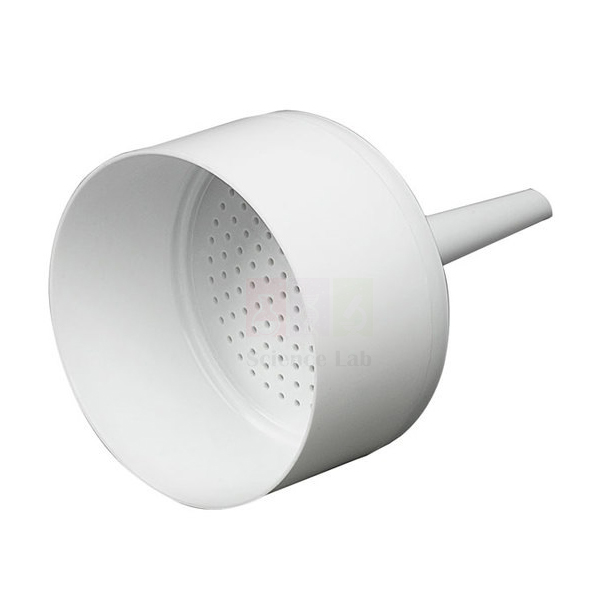
Buchner Funnel, 90 mm, Polypropylene
Buchner Funnel, 90 mm, Polypropylene (Product Code: SLE/GF/04) is a lightweight two-part funnel for vacuum filtration: the upper section snaps onto the lower one to form a vacuum-tight seal without grease, and its 90 mm filter plate carries hundreds of small perforations for efficient filtration. It holds about 300 ml and has a slimmer stem than typical porcelain Buchner funnels. Chemistry, pharmacy and life-science teaching labs choose it as practical lab equipment for college and research benches; it is manufactured by Jain Scientific Equipments Pvt Ltd (ScienceLab), Ambala.
Specifications
| Parameter | Detail |
|---|---|
| Material | Polypropylene — lightweight, acid and alkali resistant, easy to clean, autoclavable |
| Construction | Two-part; top snaps to the lower part, forming a vacuum-tight seal that does not need grease |
| Diameter | 90 mm |
| Capacity | About 300 ml |
| Filter plate | Hundreds of small perforations |
| Stem | Tapers from about 13 mm OD at the end to 18 mm OD at the cone |
| Application | Vacuum filtration |
Typical Use
Set the funnel in a filter flask with a bung that grips its narrow stem, connect the flask to a vacuum source, lay a trimmed filter paper flat across the perforated plate and wet it, then pour the mixture in with the vacuum running. Students use this arrangement to recover crystals after recrystallisation, collect precipitates in gravimetric exercises and dry a washed solid quickly, as the suction pulls air through the filter cake.
Because the funnel is light and will not shatter like ceramic if knocked over, it is well suited to busy pharmacy lab equipment sets and large practical classes. After use, unsnap the two sections so the plate and bowl can be rinsed separately, and autoclave the parts when sterile apparatus is required. Its smaller stem fits flasks and bungs that would be too narrow for a porcelain funnel.
Manufacturer
The funnel is produced by Jain Scientific Equipments Private Limited (CIN U29309HR2020PTC087597), trading as ScienceLab, which manufactures at its licensed factory at 449, HSIIDC Industrial Area, Saha, Ambala, Haryana (Factory Licence AMB-ONLINE-CHD-J-414). More about the company is on our company profile.
Related Laboratory Equipment
Pumps, flasks and fittings for a complete vacuum filtration station:
- Conical Filter Flask — receives the filtrate and connects to the vacuum line
- Vacuum Pump, Electric — steady suction for repeated filtrations
- Vacuum Pump with Pressure Gauge — lets you watch the vacuum level during filtration
- Buchner Bungs (Black) — for sealing the funnel into the flask neck (check the bore suits the slim stem)
- Buchner Funnel, 90 mm, Porcelain — the rigid one-piece ceramic alternative
Browse all funnel types in Glassware Funnels.
Frequently Asked Questions
How do the two parts fit together?
The top portion snaps onto the lower one, creating a vacuum-tight seal with no grease required. The parts can be separated again for cleaning.
What is the capacity?
About 300 ml, with a 90 mm diameter filter plate.
Will it fit my existing filter flask?
The stem tapers from about 13 mm OD at the end to 18 mm OD at the cone, which is much smaller than typical porcelain Buchner funnels. Use a bung or adapter with a bore to suit, and contact us if you need help matching one.
Can it be autoclaved?
Yes, polypropylene is autoclavable, and it also resists acids and alkalis.
What filter paper should I use?
Use a circle that lies flat on the 90 mm plate and covers all the perforations; trim larger papers to size. We can suggest a suitable paper on request.
Do you supply export and distributor orders?
Yes, ScienceLab supplies institutions and distributors in India and international markets. Send the quantity and destination for a quotation.
Request a Quote
For a price, contact us or add this funnel, a filter flask and a pump to your enquiry cart.
Last updated: 24 September 2026
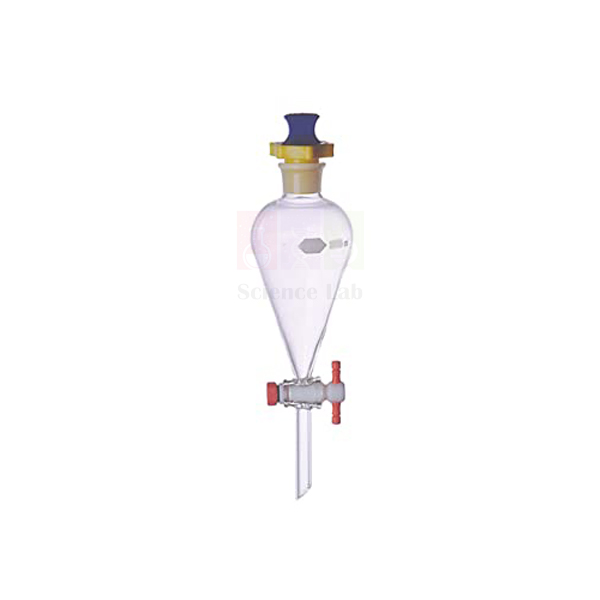
Separatory Funnel, Squibb style
Separatory Funnel, Squibb style (Product Code: SLE/GF/05) is a conical borosilicate glass separating funnel used to separate two immiscible liquids of different densities: the heavier liquid settles to the bottom and is drawn off through the PTFE stopcock, which never needs greasing. It is closed at the top with a 19/26 polyethylene stopper and is offered in 250 ml, 500 ml and 1000 ml capacities. Chemistry teachers, pharmacy and research labs use it for solvent extraction and for slowly adding reagents; it is manufactured by Jain Scientific Equipments Pvt Ltd (ScienceLab), Ambala.
Specifications
| Parameter | Detail |
|---|---|
| Style | Squibb, conical shape |
| Material | Borosilicate glass, made to withstand typical laboratory temperature variations |
| Stopcock | PTFE, never needs greasing |
| Stopper | Polyethylene, size 19/26 |
| Capacities | 250 ml, 500 ml, 1000 ml |
| Resistance | Heat resistant and chemical resistant |
| Uses | Separating immiscible liquids; slowly adding a reagent in a distillation or reaction |
Typical Use
For a liquid–liquid extraction the funnel is held in a ring or clamp on a retort stand with the stopcock closed, the two liquids are poured in, and the stopper is inserted. The funnel is then inverted, vented through the open stopcock pointing away from people, shaken gently and vented again, before being returned to the stand to let the layers separate. With the stopper removed, the lower layer is run off into a beaker or flask and the upper layer poured out through the top. Separating an organic product from an aqueous wash and extracting iodine or caffeine into a solvent are familiar practical examples.
The same separating funnel can serve as an addition funnel, feeding a reagent drop by drop into a reaction or distillation flask by adjusting the PTFE stopcock. Pick the 250 ml funnel for student extractions, 500 ml for general use and 1000 ml for larger washes. Always leave headspace above the liquids, vent frequently when volatile solvents are involved, and rinse the funnel and stopcock after use.
Manufacturer
Manufactured by Jain Scientific Equipments Private Limited, an Ambala, Haryana company whose laboratory glassware is sold under the ScienceLab brand to schools, colleges and laboratories in India and international markets. Our company profile tells you more about who we are.
Related Laboratory Equipment
Supports and receivers used with a separatory funnel during extraction:
- Retort Stand — the upright support for the funnel while the layers settle
- Funnel Holder — holds the funnel securely on the stand
- Glass Beaker — collects the lower layer as it is drained
- Conical Flask — a stoppable receiver for the separated layers
- Separatory Funnel — another separatory funnel design in our range
Explore other styles under Glassware Funnels.
Frequently Asked Questions
What does Squibb style mean?
It describes a conical-bodied separatory funnel. The tapering shape narrows the boundary between the two layers as it drains, which makes it easier to close the stopcock right at the interface.
Does the stopcock need grease?
No. The PTFE stopcock never needs greasing, so there is no grease to contaminate your extract.
What stopper is supplied?
A polyethylene stopper, size 19/26.
Which capacities are available?
250 ml, 500 ml and 1000 ml.
Can it be used to add reagents to a reaction?
Yes. It can slowly add a reagent in a distillation or to a reaction process, with the flow set by the stopcock.
Why must the funnel be vented while shaking?
Shaking volatile solvents builds up vapour pressure inside the stoppered funnel; venting through the stopcock releases it safely and keeps the stopper from being forced out.
How do I request an institutional quotation?
Send the capacities, quantities, delivery location and any tender reference through our contact page, and we will reply with pricing and dispatch details.
Request a Quote
To order, contact us or place the Squibb separatory funnel in your enquiry cart with the capacities you need.
Last updated: 24 September 2026
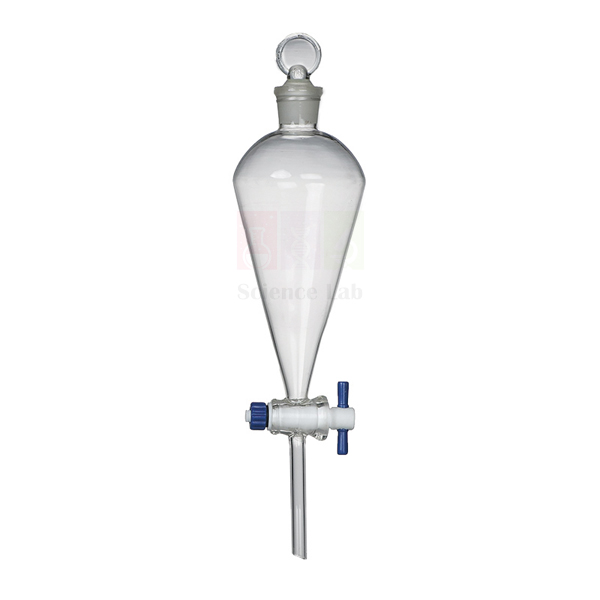
Separatory Funnel
Separatory Funnel (Product Code: SLE/GF/06) is a 250 ml funnel with a ground-glass stopcock, used to separate two liquids that do not mix and to carry out solvent extractions in inorganic and organic chemistry. School chemistry teachers, college practical labs and research benches rely on it whenever one liquid layer has to be drawn off cleanly from another. It is made by Jain Scientific Equipments Pvt Ltd (ScienceLab), Ambala, as part of a borosilicate glassware range made in India for institutional buyers at home and abroad.
Specifications
| Parameter | Detail |
|---|---|
| Material | High-quality borosilicate glass |
| Capacity | 250 ml |
| Overall length | 340 mm |
| Outside diameter | 55 mm |
| Stopcock | Ground-glass stopcock |
| Stopper | 24/29 ground-glass stopper |
| Connection finish | 24/29 standard taper joints, designed for use with other ground-glass joint glassware |
| Thermal behaviour | Withstands the heating and cooling variations common in chemistry processes |
Typical Use
For a liquid–liquid extraction, close the stopcock, pour in the mixture and the extracting solvent, and seat the 24/29 stopper. Invert the funnel, shake gently and vent through the opened stopcock (pointed away from people) to release built-up vapour, then stand it upright in a ring or holder until two sharp layers form. Run the lower layer out through the stopcock into a flask, and pour the upper layer out through the neck so the two do not remix. Common practicals include separating an oil from water, moving iodine from an aqueous solution into a non-polar solvent, and washing crude organic products during synthesis experiments.
Because its connections follow the 24/29 standard taper, the funnel can also be joined to other ground-glass joint glassware of the same size, for example to add a liquid slowly into a reaction flask. Keep the stopper matched to this funnel, never leave a stoppered funnel close to a heat source, and store it with the stopper removed so the joint does not seize. Used this way it is a dependable item of chemistry lab glassware in India’s school and college laboratories.
Manufacturer
Jain Scientific Equipments Private Limited is the company behind the ScienceLab name. From its base in Ambala, Haryana, it produces laboratory glassware and teaching apparatus for schools, colleges and laboratories in India and international markets. Read more about the business on the company profile page.
Related Laboratory Equipment
Items that usually sit beside this funnel in an extraction set-up:
- Separatory Funnel, Squibb style — a different body style of separatory funnel from the same range.
- Separating Funnel 500ml — a larger option when extraction volumes outgrow 250 ml.
- Retort Stand — holds the funnel at working height while the layers settle.
- Funnel Holder — keeps the funnel steady over the receiving vessel.
- Conical Flask — collects the lower layer as it drains through the stopcock.
See every funnel type in the Glassware Funnels category.
Frequently Asked Questions
What size is this separatory funnel?
It holds 250 ml, with an overall length of 340 mm and an outside diameter of 55 mm. For other capacities, see the related items above or ask us.
Will it fit my ground-glass joint flasks and adapters?
It has 24/29 standard taper connections, so it mates with other ground-glass joint glassware of the same 24/29 size. Check the joint marking on your existing glassware before ordering.
Is the stopcock glass or PTFE?
This model has a ground-glass stopcock and a 24/29 ground-glass stopper. If you need a different stopcock type, please contact us before placing an order.
How do I stop the stopper or stopcock from sticking?
Rinse the funnel soon after use, dry the joints and store the stopper out of the neck. Apply a light film of stopcock grease only where your lab procedure allows it, as grease can contaminate some extractions.
Can I get test or calibration paperwork with the funnel?
Documentation needs vary by buyer, so please discuss them with us through the contact page and we will confirm what can be provided for your order.
Do you handle bulk orders for colleges or overseas distributors?
Yes. We supply institutions and trade buyers in India and international markets; share the quantity, product code SLE/GF/06 and delivery location so we can prepare a quotation.
Request a Quote
To price this funnel for your lab, send your requirement through our contact page or add it to the enquiry cart with the rest of your glassware list.
Last updated: 24 September 2026
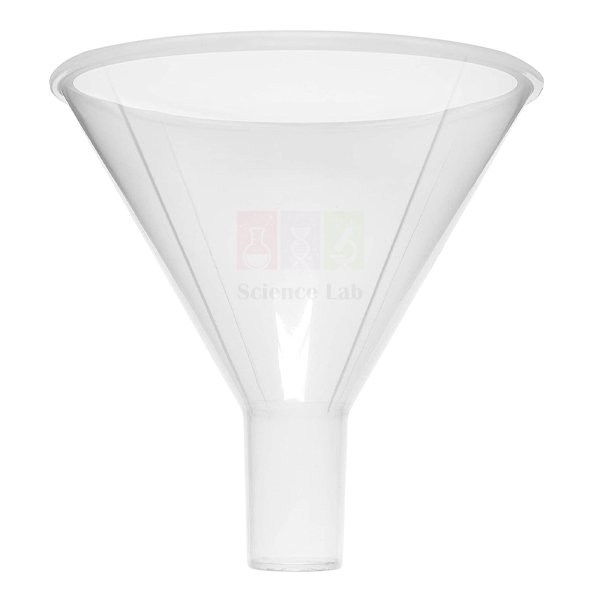
Powder Funnel
Powder Funnel (Product Code: SLE/GF/07) is a polypropylene funnel built for pouring powdered reagents and granular solids into bottles and flasks. Its parallel stem keeps powder moving instead of letting it pack and bridge in the neck, which makes weighing out and transferring dry chemicals quicker and cleaner. Lab technicians, chemistry teachers and stores staff buying from a school laboratory equipment supplier in India use it for everyday handling of solids, and it belongs to the chemistry lab equipment for schools produced by Jain Scientific Equipments Pvt Ltd (ScienceLab), Ambala.
Specifications
| Parameter | Detail |
|---|---|
| Material | Plastic (polypropylene) |
| Diameter | 80 mm |
| Stem opening | 12.5 mm |
| Stem length | 30 mm |
| Stem design | Parallel stem that minimises bridging of powder |
| Sterilisation | Steam autoclavable |
| Filter paper | Use with 11 cm filter paper |
Typical Use
Set the funnel in the mouth of the receiving container, tip the weighed solid in steadily and tap the side lightly so the last grains run through. The short, wide 12.5 mm stem suits salts, sugar, sand, soil samples and crystals that would choke a narrow liquid funnel. In school practicals it is handy for charging conical flasks before a reaction, refilling reagent bottles from bulk packs and preparing solutions where the solid goes in first and the solvent follows. Fitted with 11 cm filter paper, it can also serve for a quick gravity filtration.
Because it is steam autoclavable, the same funnel can move between a chemistry bench and a microbiology prep area when media powders have to be dispensed. Keep one funnel for each reagent family where cross-contamination matters, wipe out residues with a dry brush before rinsing, and let it dry fully before the next powder transfer. Schools buying from a laboratory equipment supplier in India often order it together with filter paper and wide-neck flasks.
Manufacturer
This powder funnel is produced under the ScienceLab brand by Jain Scientific Equipments Private Limited, a company headquartered in Ambala, Haryana, that equips teaching and testing laboratories in India and international markets. The company profile explains the range and how the business works.
Related Laboratory Equipment
Pair the powder funnel with these items for weighing, transferring and filtering solids:
- Filter Paper — for the occasions when the funnel is used to filter a suspension.
- Flask, Conical, Wide Neck — a receiving flask with a wide opening that suits powder transfers.
- Bottle Reagent, W.M. Glass — wide-mouth storage for the powdered reagents you dispense.
- Glass Funnel — the better choice for pouring liquids and hot solutions.
Compare other designs in the Glassware Funnels category.
Frequently Asked Questions
Why use a powder funnel instead of an ordinary funnel?
Its parallel stem, with a 12.5 mm opening, minimises bridging so powders keep flowing. A standard liquid funnel with a narrow tapering stem tends to clog with dry solids.
What are the dimensions?
The funnel is 80 mm in diameter, with a 12.5 mm stem opening and a 30 mm stem length.
Can it be sterilised?
Yes, it is steam autoclavable, so it can be sterilised along with other autoclavable plasticware in a routine cycle.
Which filter paper size fits it?
Use it with 11 cm filter paper when you need it for filtration.
Is it suitable for hot liquids or strong solvents?
It is designed for powdered reagents. For hot liquids or aggressive solvents, choose a glass funnel, or ask us about your specific chemical before use.
What details do you need for a school or tender quotation?
Send the product code SLE/GF/07, quantity, delivery address and any paperwork your purchase department requires; we then return a formal quotation.
Request a Quote
Ready to order? Use the contact page for a written quotation, or place the Powder Funnel in the enquiry cart alongside your other plasticware.
Last updated: 24 September 2026
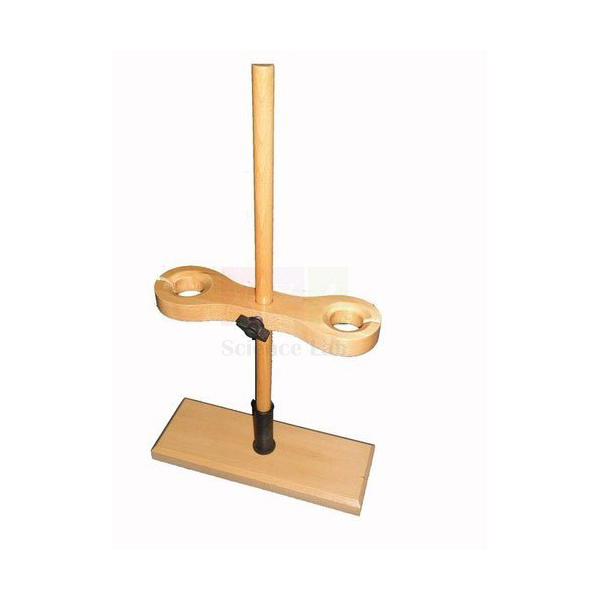
Funnel Stand, Double
Funnel Stand, Double (Product Code: SLE/GF/18) is a bench stand of the double type, used to hold funnels over receiving vessels so that two filtrations or transfers can run side by side. It pairs a polished wood base fitted with clamping screws with rods of approx. 460 mm length and 16 mm diameter. Chemistry teachers running group practicals, and technicians who need a stable filtration station, will find it a practical part of any school laboratory setup in India. It is made by Jain Scientific Equipments Pvt Ltd (ScienceLab), Ambala.
Specifications
| Parameter | Detail |
|---|---|
| Type | Double |
| Base | Polished wood base with clamping screws |
| Rods | Approx. 460 mm x 16 mm dia. |
| Purpose | Supporting funnels during filtration and liquid transfer |
Typical Use
Place the stand on a level bench, set a beaker or flask beneath each position, and seat the funnels so their stems rest just inside the receivers and touch the inner wall. With two positions available, a pair of students can filter their own samples at the same time, or one student can compare two filter papers, two precipitates or a sample against a blank without juggling clamps. Typical class work includes separating sand or chalk from water, collecting precipitates in qualitative analysis and filtering solutions before crystallisation.
Tighten the clamping screws before loading so the set-up stays firm while liquid is poured. The wooden base should be wiped dry after spills rather than soaked, and acids or solvents should not be left standing on it. When planning chemistry lab equipment for a school in India, a double stand saves bench space compared with two separate retort stands.
Manufacturer
ScienceLab is the trading name of Jain Scientific Equipments Private Limited, a private limited company (CIN U29309HR2020PTC087597) based in Ambala, Haryana. Its apparatus is produced at the company’s licensed factory at 449, HSIIDC Industrial Area, Saha, Ambala (Factory Licence AMB-ONLINE-CHD-J-414), for customers in India and international markets. Company background is on the profile page.
Related Laboratory Equipment
To build a complete filtration station around this stand, consider:
- Glass Funnel — the standard funnel to seat in each position for filtration.
- Plastic Funnel — a lighter, less breakable option for junior classes.
- Filter Paper — folded into the funnels to separate solids from liquids.
- Glass Beaker — collects the filtrate under each funnel.
- Burette Stand and Funnel Stand — an alternative when one stand must serve both titration and filtration.
More funnels and accessories are listed under Glassware Funnels.
Frequently Asked Questions
How many funnels does the stand hold?
It is the double type, designed for two funnels working side by side. For single or multi-position versions, please ask our team.
What are the rod dimensions?
The rods are approx. 460 mm long and 16 mm in diameter, mounted on a polished wood base.
Are funnels included?
The listing covers the stand. Funnels, filter paper and beakers are separate items; see the related products above.
Will my existing funnels fit?
Fit depends on your funnel’s size and stem. Send us the funnel diameter you use and we will confirm suitability before you order.
How should the wooden base be cared for?
Wipe up spills promptly with a damp cloth and dry the surface. Avoid leaving acids, alkalis or solvents on the polished wood.
Can you quote for a whole laboratory or for export?
Yes. Share the quantity of SLE/GF/18 required, the rest of your equipment list and the delivery destination, in India or abroad, and we will prepare one consolidated quotation.
Request a Quote
For pricing and availability, write to us via the contact page or add this stand to the enquiry cart and submit your list in one go.
Last updated: 24 September 2026
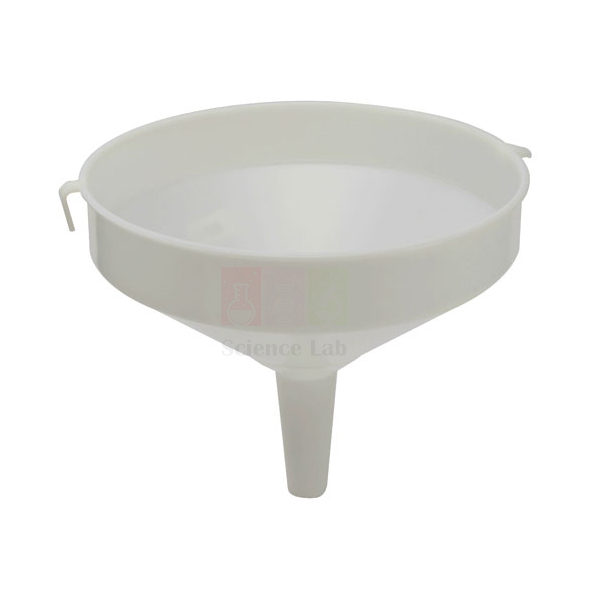
Funnel, HDPE
Funnel, HDPE (Product Code: SLE/GF/19) is a white, chemical-resistant high-density polyethylene funnel with handles, designed for multipurpose liquid transfer and especially for filling carboys, drums and barrels. Where a small bench funnel would overflow or tip, this funnel gives chemical stores, water-testing rooms and teaching labs a steadier way to decant bulk liquids. It is part of the chemistry lab equipment in India produced by Jain Scientific Equipments Pvt Ltd (ScienceLab), Ambala.
Key Details
| Parameter | Detail |
|---|---|
| Material | HDPE (high-density polyethylene) |
| Colour | White |
| Resistance | Chemical resistant |
| Handling | Handles for ease of use |
| Suitable for | Multipurpose use; convenient filling of carboys, drums and barrels |
Typical Use
The funnel comes into its own at the point where bulk stock is split or topped up: filling a distilled-water carboy, refilling a waste-solvent drum, transferring dilute acid into a storage container, or charging a barrel of cleaning solution. Hold it by the handles, rest the outlet firmly in the container neck and pour slowly so air can escape and the liquid does not surge back. Keeping one funnel for water and a separate, labelled one for each chemical stream avoids cross-contamination between stores.
HDPE resists many common laboratory chemicals, but compatibility always depends on the substance, concentration and temperature, so check your chemical against a resistance chart before first use. Rinse the funnel after each transfer, let it drain upside down and store it away from direct sunlight. Institutions ordering from a school laboratory equipment supplier in India usually add it to their stores list alongside carboys and aspirator bottles.
Manufacturer
ScienceLab products such as this funnel come from Jain Scientific Equipments Private Limited, a laboratory equipment company operating out of Ambala in Haryana, India. It serves schools, colleges, testing labs and distributors in India and international markets. Visit the ScienceLab company profile to learn more.
Related Laboratory Equipment
Useful companions for bulk liquid handling and storage:
- Carboy With Stop Cock — a bulk container this funnel is made to fill, with a tap for dispensing.
- Aspirator with stopcock — another tap-fitted store for distilled water or reagents.
- Measuring Cylinder, Polypropylene — measures volumes before or after bulk transfer.
- Powder Funnel — for moving dry chemicals rather than liquids.
Browse all funnel types in the Glassware Funnels category.
Frequently Asked Questions
What sizes is the HDPE funnel available in?
Sizes are not listed on this page. Tell us the neck size of your carboys or drums through our contact page and we will advise on the options available.
Is it resistant to acids and solvents?
It is made from chemical-resistant HDPE. Resistance varies with each chemical, strength and temperature, so confirm compatibility for aggressive solvents or hot liquids before use.
What are the handles for?
They let you hold and steady the funnel while pouring into carboys, drums and barrels, making bulk filling safer and more convenient.
Can I use it for drinking-water or food work?
This funnel is offered for laboratory and chemical-store use. If you need it for food or potable water, discuss your requirement with us first.
How do I clean it between different liquids?
Rinse thoroughly with water, then with a suitable cleaning solution if residue remains, and drain dry. For incompatible chemicals, keep dedicated, labelled funnels.
Can you supply quantities for multiple campuses or overseas buyers?
Yes. Quote product code SLE/GF/19 with the required quantity and delivery location, anywhere in India or abroad, and we will respond with pricing and dispatch details.
Request a Quote
Ask for a price through our contact page, or add the HDPE funnel to your enquiry cart with your carboys and storage items.
Last updated: 24 September 2026