- Physics Lab Equipment
- Chemistry Lab Equipment
- Biology Lab Equipment
- Anatomical Lab Equipment
- Learning
- Educational Lab Equipment
- Magnets
- Agriculture
- Astronomy
- Earth Science
- Geography Lab Equipment
- Safety Lab Coat
- Laboratory
- Meteorological
- Electricity & Magnetism
- Heat
- School Lab Equipment
- Lab Glassware
- Science Lab Equipment
- Tvet Lab Equipment
- Robotics Kits Supplier and Manufacturer for Schools India
- Math Lab Equipment Manufacturers and Exporters in Ambala
- STEM Kits Manufacturers and Supplier India
- Engineering Lab Equipment
- Hospital Lab Equipment
- Water, Sanitation & Hygiene Supplies
- Cold Chain, Solar & Communication Equipment
- Nutrition
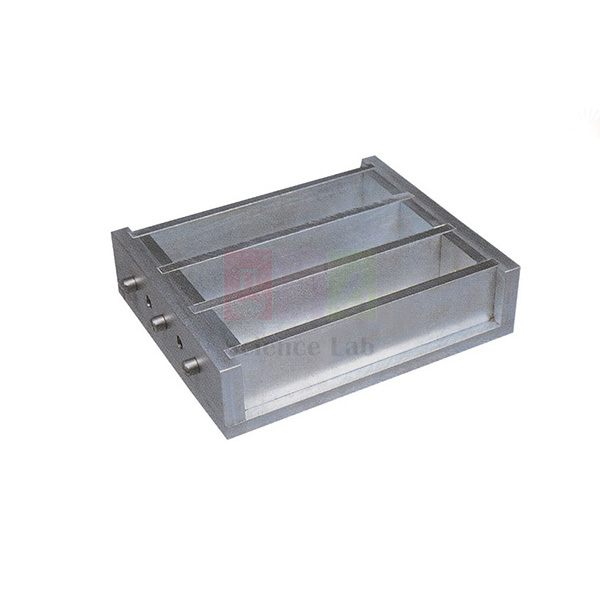
Prism Mould Three Gang
Prism Mould Three Gang (Product Code: SLE/CE/29) is a three-compartment mould used to cast mortar prism specimens for strength testing of cement and mortar in civil engineering laboratories. It casts three 40.1 × 40 × 160 mm prisms at once, comes complete with base, and every part carries an identification number so it goes back together correctly. Jain Scientific Equipments Pvt Ltd (ScienceLab) makes it as the OEM at its own factory in Ambala, India.
Specifications
| Parameter | Detail |
|---|---|
| Compartments | Three (three-gang) |
| Size | 40.1 × 40 × 160 mm |
| Base | Supplied complete with base |
| Assembly | All parts marked with an identification number for correct assembly |
| Product code | SLE/CE/29 |
| Manufacturer | Jain Scientific Equipments Pvt Ltd (ScienceLab) — OEM |
| Country of origin | India (made in Ambala, Haryana) |
What Is the Three Gang Prism Mould Used For?
Mortar prisms are the standard specimen for many cement strength tests: each prism is broken in flexure, and the two halves are then crushed in compression, so one three-gang mould yields a full set of results from a single mix. The mortar is placed in layers and compacted, often on a jolting apparatus, then struck off level and cured before demoulding.
Clean and lightly oil the inner faces before each casting, and reassemble the parts by their identification numbers so the compartments stay square and the prisms come out to size. Tighten the mould evenly on its base to stop mortar leaking at the joints. A well-kept mould is a long-term asset, which is why labs buy from an engineering lab equipment manufacturer that can supply matching repeat units.
OEM Manufacturer
Jain Scientific Equipments Private Limited, trading as ScienceLab, is the OEM of the Prism Mould Three Gang and produces it at its licensed factory at Saha, Ambala, Haryana, India. The moulds are supplied factory-direct to cement and concrete laboratories, engineering colleges, dealers and importers, so extra moulds for a larger testing programme can be ordered from the same source. For replacement parts, ask us. Learn more on the ScienceLab company profile.
Related Civil Engineering Lab Equipment
Casting, compacting, curing and testing mortar prisms uses several other items from the same range.
- Jolting Apparatus — compacts mortar in the prism mould.
- Laboratory digital planetary mixer — mixes the mortar before casting.
- Cement curing bench-type cabinet — cures the prisms before demoulding.
- Flexure Testing Machine Manual — for flexural strength testing.
- Straight Edge — strikes off surplus mortar level with the mould.
See the whole Civil Engineering Lab Equipment range for cement, mortar and concrete testing.
Frequently Asked Questions
What is the Prism Mould Three Gang used for?
The Prism Mould Three Gang is used to cast three mortar prisms at a time for cement and mortar strength testing. The prisms are typically broken in flexure and their halves tested in compression, giving a complete result set from one mix.
What size prisms does the Prism Mould Three Gang cast?
The Prism Mould Three Gang is listed with a size of 40.1 × 40 × 160 mm for each prism. If your test method needs a particular tolerance, mention it in the enquiry so it can be confirmed.
Is a base included with the Prism Mould Three Gang?
Yes. The Prism Mould Three Gang is supplied complete with its base, so the three compartments can be assembled, filled and compacted without buying a separate base plate.
How is the Prism Mould Three Gang assembled correctly?
Every part of the Prism Mould Three Gang is marked with an identification number. Matching the numbered parts during reassembly keeps each compartment square and the prisms true to size after every cleaning.
Who manufactures the Prism Mould Three Gang?
The Prism Mould Three Gang is manufactured by Jain Scientific Equipments Pvt Ltd (ScienceLab) as the OEM at its own licensed factory at Saha, Ambala, Haryana, India, and supplied factory-direct to laboratories, dealers and importers.
How should the Prism Mould Three Gang be maintained?
Clean the Prism Mould Three Gang soon after demoulding, remove hardened mortar from the joints, and apply a thin coat of release oil before storage. This protects the faces and keeps the numbered parts fitting together properly.
Request a Quote
To order the Prism Mould Three Gang (SLE/CE/29), send the number of moulds and delivery details through the contact page or the enquiry cart. Every quotation is prepared by the manufacturer itself, Jain Scientific Equipments Pvt Ltd (ScienceLab), Ambala.
Last updated: 24 September 2026