- Physics Lab Equipment
- Chemistry Lab Equipment
- Biology Lab Equipment
- Anatomical Lab Equipment
- Learning
- Educational Lab Equipment
- Magnets
- Agriculture
- Astronomy
- Earth Science
- Geography Lab Equipment
- Safety Lab Coat
- Laboratory
- Meteorological
- Electricity & Magnetism
- Heat
- School Lab Equipment
- Lab Glassware
- Science Lab Equipment
- Tvet Lab Equipment
- Robotics Kits Supplier and Manufacturer for Schools India
- Math Lab Equipment Manufacturers and Exporters in Ambala
- STEM Kits Manufacturers and Supplier India
- Engineering Lab Equipment
- Hospital Lab Equipment
- Water, Sanitation & Hygiene Supplies
- Cold Chain, Solar & Communication Equipment
- Nutrition
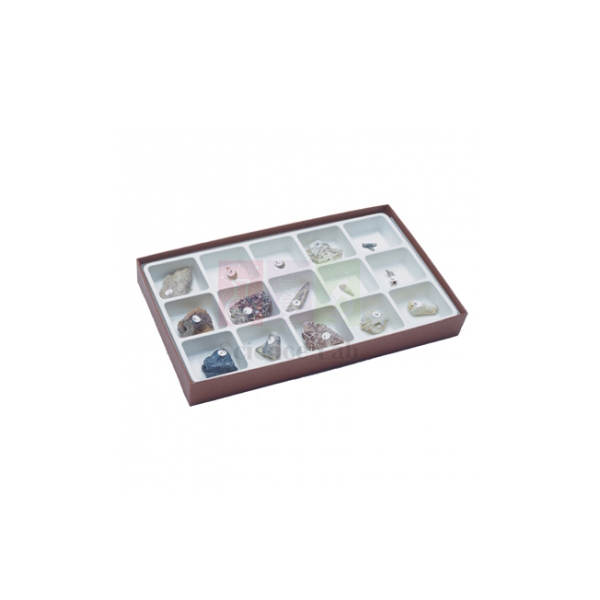
Fossil Collection
The Fossil Collection (Product Code: SLE/ES/06) is a selection of 15 fossils chosen to illustrate the major life forms that have existed throughout geologic history. A descriptive key sheet and a geologic time chart come with the specimens, so students can first learn what each fossil is and then place it in the correct era. It suits introductory geology, geography and biology classes where learners meet fossils for the first time, and it is supplied by Jain Scientific Equipments Pvt Ltd (ScienceLab), Ambala, a school laboratory equipment supplier in India.
Specifications
| Parameter | Detail |
|---|---|
| Number of fossils | 15 |
| Coverage | Major life forms present throughout geologic history |
| Identification aid | Descriptive key sheet |
| Dating aid | Geologic time chart for matching each fossil to its era |
| Level | Introduction to basic fossils |
Typical Use
A common approach is a two-stage practical. In the first stage, students observe each fossil closely, note its shape, symmetry and texture, and use the descriptive key sheet to name it. In the second, they move to the geologic time chart and decide in which era that organism lived, building a simple timeline across the bench. Asking students to explain why some groups appear only in older rocks while others continue to the present opens a discussion of extinction and change over time.
The collection is a natural fit among biology teaching aids in India for evolution and classification lessons, as well as in geography units on sedimentary rocks. Handle specimens over a tray or soft mat, keep them dry, and clean them only with a soft brush; avoid water on fragile pieces and never use acids or detergents.
Supplier
Jain Scientific Equipments Private Limited, known to customers as ScienceLab, sources and supplies specimen collections like this one from its base in Ambala, Haryana, as part of a wider catalogue of educational laboratory equipment. Read more on the company profile.
Related Earth Science Equipment
Items that support fossil and geologic time lessons:
- Advanced Fossil Collection — a larger set of animal and plant fossils for senior classes
- Investigating Geological Time And Fossils Chart — a framed wall chart of the time scale with fossils mounted, for class display
- Fossil Hunt Kit — a dig activity that lets students find fossils before identifying them
- Hand Lens — brings out fine surface detail on each specimen
- Storage Boxes – Rock – Mineral Specimens — keeps specimens separated between lessons
For more fossils, rocks and minerals, visit the Earth Science category.
Frequently Asked Questions
How many fossils are in the collection?
Fifteen, selected to represent major life forms across geologic history.
What printed material comes with it?
A descriptive key sheet for identification and a geologic time chart for matching each fossil to its era.
Can I see the list of specimens before ordering?
The individual species list is not in our current product notes. Contact us and we will confirm the contents with your quotation.
Is this collection suitable for beginners?
Yes. It is designed to introduce students to basic fossils. Senior classes that need broader coverage may prefer the Advanced Fossil Collection.
How should the fossils be stored?
Keep them dry and separated so they do not rub against each other; a compartment box works well.
What warranty applies?
These are natural specimens rather than instruments. Any replacement terms for damage in transit are confirmed with your quotation.
Can you supply several collections or ship overseas?
Yes. We handle multi-set orders for schools and distributors in India and international markets.
Request a Quote
For pricing on the Fossil Collection (SLE/ES/06), contact us with the quantity required, or add it to the enquiry cart.
Last updated: 24 September 2026
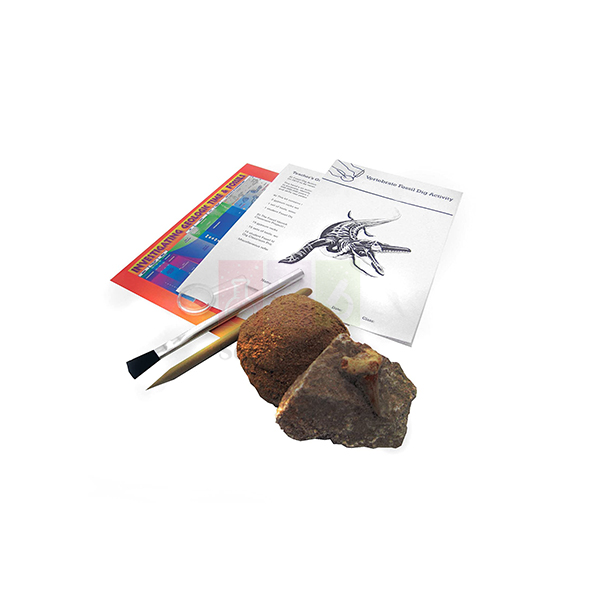
Vertebrate Fossil Dig
The Vertebrate Fossil Dig (Product Code: SLE/ES/07) gives students in grades 6-12 the experience of a realistic excavation. Genuine vertebrate fossils are encased in a sediment similar to that of their natural location, and learners uncover them with a digging tool and brush, just as a field team would, before examining the results under a magnifying glass. A guide accompanies the kit to structure the activity. It is one of the high school science kits supplied by Jain Scientific Equipments Pvt Ltd (ScienceLab), Ambala, to schools and colleges.
Specifications
| Parameter | Detail |
|---|---|
| Specimens | Genuine vertebrate fossils |
| Dig matrix | Sediment similar to the fossils' natural location |
| Tools included | Brush, magnifying glass and digging tool |
| Teaching material | Guide |
| Grade level | Grades 6-12 |
Typical Use
Unlike picking fossils out of loose gravel, this dig asks for patience: students remove the sediment a little at a time with the digging tool, sweep the loosened grains away with the brush, and stop to examine what is emerging under the magnifying glass before going deeper. Encourage them to photograph or sketch the fossil at each stage and to note its orientation in the block, which introduces the idea that position in the rock is itself evidence. Senior students can go further and discuss what kind of animal the bone or tooth came from and how it became buried.
Because the work is slow and careful, the kit suits a series of short sessions or a club project, and it can form the basis of a science fair project kit display showing each stage of the excavation. Work over a tray to collect debris, keep the brush strokes light near exposed fossil surfaces, and consider safety glasses while chipping at the sediment.
Supplier
ScienceLab is the trading name of Jain Scientific Equipments Private Limited, headquartered in Ambala, Haryana, which supplies specimen kits such as this dig alongside its laboratory equipment range. Buyers completing vendor registration can quote the company's CIN U29309HR2020PTC087597 and GSTIN 06AAECJ8618A1ZT. See the company profile for more.
Related Earth Science Equipment
Resources that build on a vertebrate excavation:
- Fossil Hunt Kit — a quicker gravel-based dig that works as a warm-up activity
- Geology History Kit — students build stratified layers to see how sediments bury remains
- Fossil Collection — identified fossils and a time chart for comparing and dating finds
- Hand Lens — additional magnifiers for group work
- Forceps — for lifting small loose fragments away from the fossil
Explore further in the Earth Science category.
Frequently Asked Questions
Which age group is this kit for?
It is intended for students in grades 6-12.
Are the fossils real?
Yes. The kit contains genuine vertebrate fossils.
What tools come with it?
A brush, a magnifying glass and a digging tool, together with a guide.
What is the fossil encased in?
A sediment similar to that found in the fossils' natural location. For details of the sediment's composition, please contact us.
Which animals do the fossils come from?
Species details are not in our current product notes; ask us and we will confirm them before you order.
How many students can share one kit?
The kit includes one set of tools, so it works best with an individual or a small team. Order additional kits for larger classes.
Do you supply schools outside India?
Yes. We serve institutions and distributors in India and international markets; lead times and warranty terms are stated on each quotation.
Request a Quote
To order the Vertebrate Fossil Dig, send an enquiry quoting SLE/ES/07 and the number of kits, or use the enquiry cart to combine it with other items.
Last updated: 24 September 2026
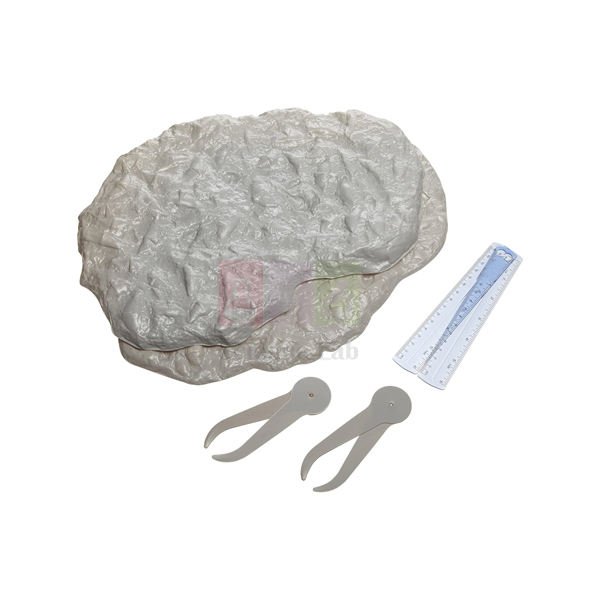
Variation And Evolution Fossil Kit
The Variation And Evolution Fossil Kit (Product Code: SLE/ES/08) introduces students to intraspecific and interspecific variation using real measurement data. Fifty fossil brachiopods are imbedded in reproduction plastic rocks, and learners use calipers and rulers to record their internal and external dimensions, then compare the numbers within and between species. With reproduction rock formations and a Teacher's Guide included, it works as a biology experiment kit for students studying evolution, and is supplied by Jain Scientific Equipments Pvt Ltd (ScienceLab), Ambala.
Specifications
| Parameter | Detail |
|---|---|
| Fossil specimens | 50 fossil brachiopods |
| Mounting | Imbedded in reproduction plastic rocks |
| Also included | Reproduction rock formations |
| Measuring tools | Calipers and rulers |
| Measurements taken | Internal and external dimensions |
| Concepts covered | Intraspecific and interspecific variation |
| Teaching material | Teacher's Guide |
Typical Use
Students divide the brachiopods between groups, measure agreed dimensions such as shell length and width with the calipers, and enter the results in a shared class table. Plotting the values as a histogram shows that even individuals of one species are not identical (intraspecific variation), while comparing the spread of two species shows how distinct forms differ (interspecific variation). The discussion then turns naturally to natural selection: which variations might have mattered to a brachiopod living on the sea floor, and how would they be preserved in the fossil record?
The kit sits comfortably among school biology lab equipment in India for evolution and statistics-in-science units, and it also reinforces good measuring technique. Remind students to zero the calipers before each reading, measure every specimen twice, and handle the plastic rocks without twisting so the fossils stay firmly seated.
Supplier
This kit is supplied by Jain Scientific Equipments Private Limited, the Ambala, Haryana company that trades as ScienceLab and serves biology, geography and earth science departments with teaching resources. The company profile gives an overview of the business.
Related Laboratory Equipment
Useful for expanding or extending the measurement activity:
- Caliper Vernier (Metal) — extra calipers so more groups can measure at once
- Ruler, White Vinyl — additional rulers for quick length checks
- Hand Lens — for comparing growth lines and shell ornament
- Fossil Collection — places brachiopods among other major life forms
- Investigating Geological Time And Fossils Chart — shows where these organisms fit on the time scale
More fossil kits and collections are in the Earth Science category.
Frequently Asked Questions
How many specimens does the kit contain?
Fifty fossil brachiopods, imbedded in reproduction plastic rocks.
Are the rocks real?
No. The rocks and rock formations are reproductions; the brachiopods set into them are fossils.
What is the difference between intraspecific and interspecific variation?
Intraspecific variation is the difference between individuals of the same species; interspecific variation is the difference between separate species. The kit lets students measure both.
How many calipers and rulers are included?
Calipers and rulers are included, but quantities are not in our current product notes. Contact us to confirm before planning group sizes.
Is there a teacher resource?
Yes, a Teacher's Guide is supplied with the kit.
What does a school need to send for a quotation?
The product code SLE/ES/08, number of kits, delivery address and any tender reference.
Is export supply available?
Yes. We supply schools, colleges and distributors in India and international markets.
Request a Quote
For the Variation And Evolution Fossil Kit, contact our sales team or add the kit to your enquiry cart and submit your full list in one go.
Last updated: 24 September 2026
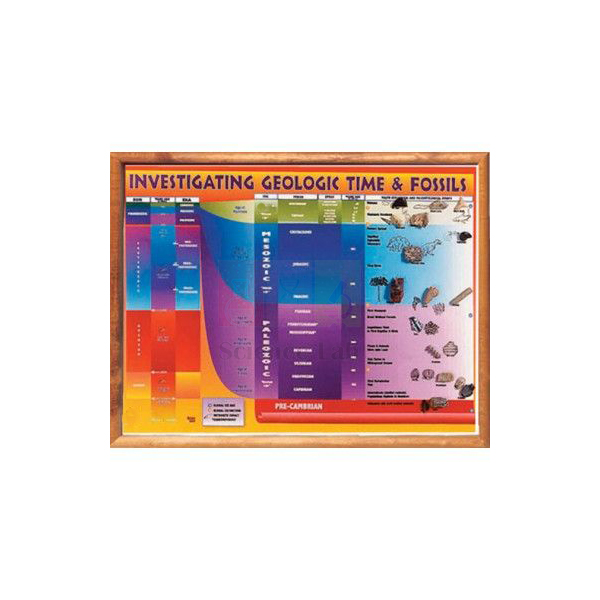
Investigating Geological Time And Fossils Chart
The Investigating Geological Time And Fossils Chart (Product Code: SLE/ES/09) is a revised, multi-colour wall chart that sets out the entire geologic time scale using current geologic dating information. Representative fossils from the corresponding geologic periods are mounted directly on the chart, so students see real specimens beside the period in which those organisms lived. Measuring 18 in x 24 in and supplied with a wood frame, it gives a geography, geology or biology room a permanent reference display. It is supplied by Jain Scientific Equipments Pvt Ltd (ScienceLab), Ambala, one of the school science lab equipment suppliers in India.
Specifications
| Parameter | Detail |
|---|---|
| Type | Multi-colour geologic time scale chart with mounted fossils |
| Coverage | Entire geologic time scale, with current dating information |
| Specimens | Representative fossils mounted beside their geologic periods |
| Size | 18 in x 24 in |
| Frame | Wood frame |
| Edition | Completely revised |
| Also listed | Geological Time & Fossils Chart Transparency |
Typical Use
Deep time is hard to picture, and a chart that pairs each period with an actual fossil makes the sequence concrete. Teachers use it as the anchor for a lesson on the eras and periods, pointing out how the mounted specimens change from simple marine forms to more complex life as the scale moves forward. Students can then be given unlabelled fossils or pictures and asked to place them on the chart, justifying each choice from the features they see.
Hung at eye level, the chart becomes a reference that students return to throughout a unit on rocks, fossils and evolution, and it works alongside a biology chart set in school labs across India. Keep it out of direct sunlight to protect the colours, dust the frame with a dry cloth, and avoid touching the mounted fossils.
Supplier
Jain Scientific Equipments Private Limited, which operates under the ScienceLab name in Ambala, Haryana, supplies mounted specimen charts such as this to schools and colleges together with its own laboratory equipment. Visit the company profile to learn more.
Related Earth Science Equipment
Hands-on material to use with the chart:
- Fossil Collection — loose fossils that students can match to eras on the chart
- Advanced Fossil Collection — a broader specimen set for senior classes
- Geology History Kit — students build rock layers to see why older fossils lie deeper
- Variation And Evolution Fossil Kit — a measuring practical on variation within fossil species
- Investigating The Chemical Composition Of Minerals — a companion framed display of mounted minerals
Find more charts, fossils and models in the Earth Science category.
Frequently Asked Questions
What size is the chart?
It measures 18 in x 24 in and comes with a wood frame.
Are fossils actually attached to the chart?
Yes. Representative fossils for the corresponding geologic periods are mounted on it.
Is the transparency version included?
A Geological Time & Fossils Chart Transparency is listed with this product. Please contact us to confirm whether it is supplied with the framed chart or ordered separately.
How up to date is the time scale?
The chart is a completely revised edition showing current geologic dating information. Ask us for the edition details if your syllabus follows a specific version of the time scale.
Can it be wall-mounted?
It is supplied framed for display. Fixing hardware is not listed, so use hooks suited to your wall and the framed weight.
What should a purchase enquiry include?
Product code SLE/ES/09, the quantity, the delivery address and any institutional purchase format.
Do you supply outside India?
Yes, we deliver to customers in India and international markets. Warranty and dispatch terms are given with each quotation.
Request a Quote
To price this chart, send us an enquiry or add it to the enquiry cart along with any fossil collections you plan to order.
Last updated: 24 September 2026
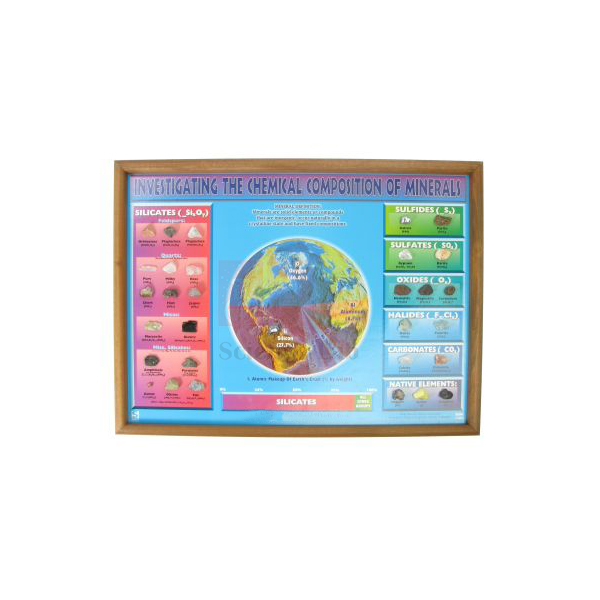
Investigating The Chemical Composition Of Minerals
Investigating The Chemical Composition Of Minerals (Product Code: SLE/ES/10) is a mounted-specimen project that explains how the predominant elements of the Earth's crust combine into the "recipes" for minerals. Real minerals from seven chemical families (silicate, sulfate, sulfide, oxide, halide, carbonate and native element) are mounted on an 18 in x 24 in chart, wood framed on a sturdy backing, and the product listing also includes 10 additional rocks and charts. It links chemistry and earth science teaching and is supplied by Jain Scientific Equipments Pvt Ltd (ScienceLab), Ambala, a laboratory equipment supplier in India.
Specifications
| Parameter | Detail |
|---|---|
| Type | Mineral chemistry chart with mounted specimens |
| Mineral families mounted | Silicate, Sulfate, Sulfide, Oxide, Halide, Carbonate and Native element |
| Chart size | 18 in x 24 in |
| Construction | Wood framed on sturdy backing |
| Additional items listed | 10 additional rocks & charts |
| Teaching focus | Relationship between crustal elements and mineral composition |
Typical Use
The display lets a teacher move from the list of elements that dominate the crust to the minerals built from them. Students look at each mounted family, note which element or group (for example sulfate, carbonate or oxide) defines it, and compare the appearance of minerals that share an anion. Native elements provide a useful contrast because they occur uncombined. A worksheet asking students to write the family, likely elements present and one visible property for each mineral turns the chart into an active exercise.
It pairs well with a periodic table chart in Indian school labs, helping chemistry students see that the symbols and formulas they learn describe real materials underfoot. Hang the frame away from damp walls and direct sunlight, and discourage handling of the mounted specimens; dust gently with a soft brush when needed.
Supplier
ScienceLab, the brand of Jain Scientific Equipments Private Limited in Ambala, Haryana, supplies this mineral display to schools and colleges as part of its earth science and chemistry teaching range. Company background is on our company profile.
Related Earth Science Equipment
Resources that extend a lesson on mineral composition:
- Periodic Table of Chemical Elements chart — for locating the elements that make up each mineral family
- Mineral ID Starter Set — loose minerals and tools for hands-on physical testing
- Minerals Test Kit — streak plate, magnet and hardness scale for identification practicals
- Ores Of Common Metals — shows how oxide and sulfide minerals become sources of metals
- Investigating Geological Time And Fossils Chart — a companion framed specimen chart for the same wall
Browse more collections in the Earth Science category.
Frequently Asked Questions
Which mineral families are represented?
Silicate, sulfate, sulfide, oxide, halide, carbonate and native element minerals are mounted on the chart.
How large is the display?
The chart is 18 in x 24 in, wood framed on sturdy backing.
What are the 10 additional rocks and charts?
They are listed as part of this product. The exact items are not detailed in our current notes, so please contact us for the full contents list.
Can I get a list of the individual minerals?
Yes, on request. We will confirm the specimen names with your quotation.
Is it better suited to chemistry or geography classes?
Both. It explains how crustal elements build minerals, so it supports chemistry lessons on compounds as well as earth science units on rocks and minerals.
What information does a school need to provide for a quotation?
Product code SLE/ES/10, quantity, delivery location and any tender paperwork your institution uses.
Is international shipping possible?
Yes. We supply India and international markets; warranty and delivery terms are confirmed per order.
Request a Quote
For this mineral composition display, contact us with your requirement or add it to the enquiry cart together with related mineral kits.
Last updated: 24 September 2026
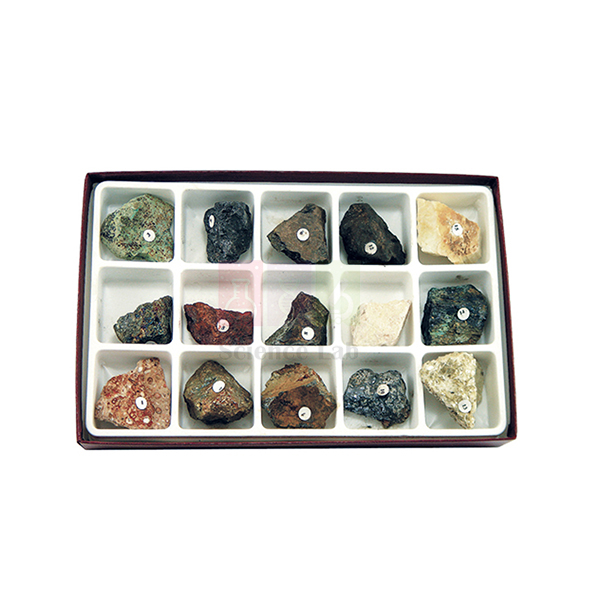
Ores Of Common Metals
Ores Of Common Metals (Product Code: SLE/ES/11) is a collection of 15 specimens of the more important metal ores. An ore is a rock or mineral mass that contains enough of an element or compound to make it economically feasible to mine, and this set lets students see and handle the actual materials from which everyday metals are obtained. It serves geography rooms as well as school chemistry lab equipment in India for lessons on metals and their extraction, and is supplied by Jain Scientific Equipments Pvt Ltd (ScienceLab), Ambala.
Specifications
| Parameter | Detail |
|---|---|
| Type | Ore specimen collection |
| Number of specimens | 15 |
| Coverage | The more important ores of common metals |
| Key concept | An ore holds enough of an element or compound to be economically feasible to mine |
| Suitable for | Earth science, geography and chemistry teaching |
Typical Use
The collection gives weight to a topic that is often taught only from diagrams. Students examine each specimen for colour, lustre, density in the hand and streak, and discuss why one rock is worth mining while another containing the same metal is not; the answer depends on concentration, ease of extraction and demand, which brings economics and environment into the science lesson. Teachers can then ask learners to link each ore to the metal it yields and to a product they use every day.
The set is a useful companion to a science lab kit for class 10 chapters on metals and non-metals, and it supports senior lessons on extraction and refining. As a general precaution with metal ores, wash hands after handling, keep specimens away from food, and store them in a labelled compartment box so each one stays identified.
Supplier
This collection is supplied by Jain Scientific Equipments Private Limited, which trades as ScienceLab from Ambala, Haryana. Its vendor registration details are GSTIN 06AAECJ8618A1ZT and Importer-Exporter Code AAECJ8618A (DGFT), under which export orders are shipped. Read more on the company profile.
Related Earth Science Equipment
Tools and collections that support an ores lesson:
- Black Streak Plates — for streak tests, a quick way to tell many metallic ores apart
- Minerals Test Kit — magnet, streak plate and hardness scale for identifying specimens
- Investigating The Chemical Composition Of Minerals — shows the oxide, sulfide and other families that many ores belong to
- Mineral ID Starter Set — extends identification practice to a wider range of minerals
- Storage Boxes – Rock – Mineral Specimens — cell boxes to keep ore specimens separate and labelled
See all rock, mineral and fossil sets in the Earth Science category.
Frequently Asked Questions
How many ore specimens are included?
Fifteen specimens of the more important ores.
Which metals do the ores represent?
The individual ore names are not in our current product notes. Contact us and we will send the specimen list with your quotation.
What makes a mineral an ore?
A rock or mineral mass is called an ore when it contains enough of an element or compound to make mining it economically feasible.
Can students test the specimens?
Yes, simple non-destructive tests such as streak, lustre and magnetism are well suited to ore specimens. Avoid crushing or heating them in class.
What vendor details can you provide for institutional purchase?
We can provide our company registration details, including GSTIN and IEC numbers, along with a formal quotation quoting product code SLE/ES/11.
Do you supply in bulk or overseas?
Yes. We supply schools, colleges and distributors across India and international markets; delivery time and replacement terms are confirmed on quotation.
Request a Quote
To order Ores Of Common Metals, send us your enquiry or add the collection to the enquiry cart with any testing tools you need.
Last updated: 24 September 2026
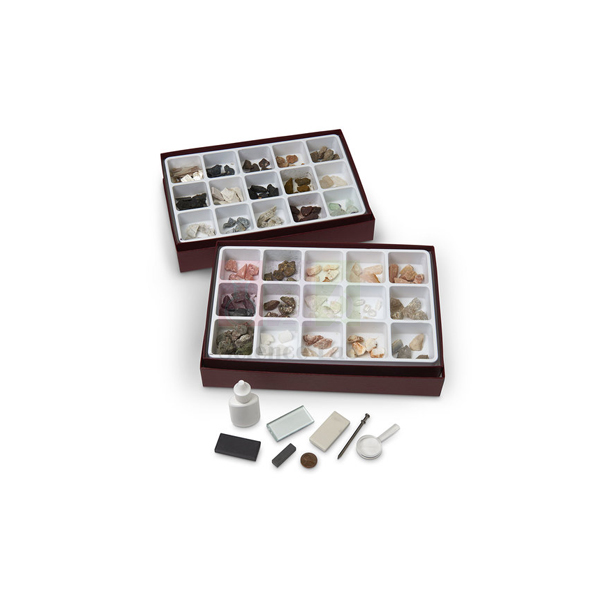
Mineral ID Starter Set
The Mineral ID Starter Set (Product Code: SLE/ES/12) contains 30 different minerals, with 5 of each sample, for identification using the taxonomic key contained in the lab manual. Students test each specimen for hardness, specific gravity, colour, streak and cleavage, and a Mineral Testing Kit is included with the tools needed for those tests. It is a complete, class-ready science kit with manual support for schools in India and abroad, supplied by Jain Scientific Equipments Pvt Ltd (ScienceLab), Ambala.
Specifications
| Parameter | Detail |
|---|---|
| Minerals | 30 different minerals, 5 of each sample |
| Identification method | Taxonomic key contained in the lab manual |
| Properties tested | Hardness, specific gravity, colour, streak and cleavage |
| Mineral Testing Kit | Streak plate, glass plate, hand lens, magnet, acid bottle, nail, penny and hardness scale |
Typical Use
Because every mineral is supplied five times over, up to five groups can work through the same specimens in parallel and then compare their conclusions. A typical practical runs through the key step by step: rub the specimen on the streak plate, try to scratch the glass plate, test against the nail and penny to bracket the hardness, check for magnetism, look at cleavage surfaces through the hand lens magnifier, and, where the key calls for it, use the acid bottle to check for fizzing. Each result narrows the choices in the taxonomic key until the mineral is named.
The set builds scientific habits as much as mineral knowledge: recording observations before drawing conclusions, repeating a test when results disagree, and using a dichotomous key. Wipe streak and glass plates clean between tests, keep the acid bottle under teacher control, and return minerals to their own compartments so the five sets stay complete.
Supplier
Jain Scientific Equipments Private Limited supplies this set under its ScienceLab trading name from Ambala, Haryana, where the company builds and sources equipment for school and college science departments. Company information is on the company profile.
Related Earth Science Equipment
Consumables and add-ons for mineral identification practicals:
- Minerals Test Kit — an extra set of testing tools in a pouch for additional groups
- Black Streak Plates — spare unglazed porcelain tiles for streak testing
- Streak Plates Glass — extra glass plates for separating hard and soft minerals
- Hydrochloric Acid Dilute — a common choice for the acid fizz test on carbonates, used under supervision
- Storage Boxes – Rock – Mineral Specimens — keeps the 30 minerals sorted between classes
More rock and mineral resources are in the Earth Science category.
Frequently Asked Questions
How many minerals are in the set?
Thirty different minerals, with five of each sample.
Which properties do students test?
Hardness, specific gravity, colour, streak and cleavage.
What does the Mineral Testing Kit contain?
A streak plate, glass plate, hand lens, magnet, acid bottle, nail, penny and hardness scale.
Is acid supplied in the acid bottle?
The kit lists an acid bottle; whether it is shipped filled depends on transport rules for your destination. Contact us to confirm, as many schools fill it locally with dilute acid.
Why does the kit include a penny and a nail?
They serve as everyday hardness references: if a mineral scratches or is scratched by them, students can narrow its hardness before checking the hardness scale.
How is specific gravity measured?
The lab manual guides the method. A balance and water container from your laboratory are normally needed; ask us if you would like suitable equipment added to your quotation.
Can you quote for multiple sets or export?
Yes. Send product code SLE/ES/12 and quantity; we supply India and international markets.
Request a Quote
To order the Mineral ID Starter Set, contact us or add it to the enquiry cart with spare streak plates or storage boxes.
Last updated: 24 September 2026
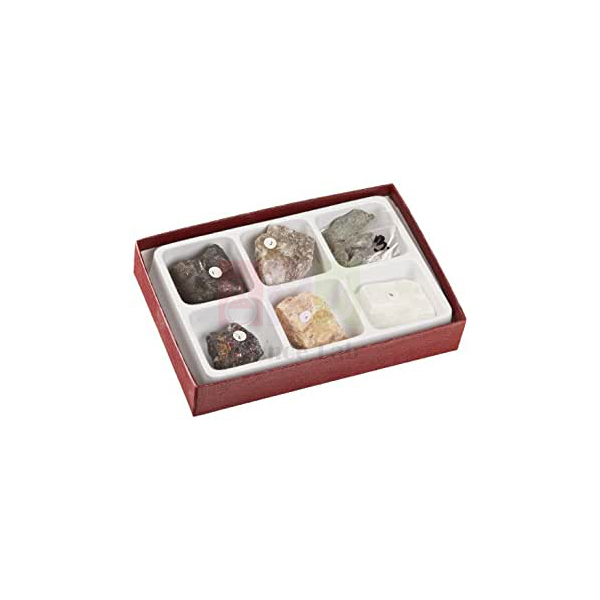
Minerals In Our Food Collection
The Minerals In Our Food Collection (Product Code: SLE/ES/13) connects geology with the kitchen table. Its six numbered specimens, each approximately 1 1/2 in x 1 1/2 in, represent some of the many minerals, from calcium to zinc, that end up in common foods and vitamins or are used in food processing and preserving. The collection helps students understand how we depend on minerals for daily nutrition, and makes a compact addition to a health education kit in schools across India. It is supplied by Jain Scientific Equipments Pvt Ltd (ScienceLab), Ambala.
Specifications
| Parameter | Detail |
|---|---|
| Number of specimens | Six, numbered |
| Specimen size | Approximately 1 1/2 in x 1 1/2 in |
| Theme | Minerals used in common foods, vitamins, food processing and preserving |
| Range | From calcium to zinc |
| Learning goal | Our use of minerals for daily nutrition |
Typical Use
Students are often surprised that the same elements found in rocks appear on food packets and vitamin labels. A good lesson starts by passing the numbered specimens around, then asking pairs to collect nutrition labels from home and find the minerals listed there. Each group matches a label entry to a specimen and researches one role that mineral plays, whether in the body or in processing and preserving food. The numbering makes it easy to run a quiz or a matching worksheet without writing on the specimens.
The collection suits earth science, biology and home science classes, and it can serve as a hands-on science kit in primary school nutrition topics as well as in higher classes. Remind students that these are rock and mineral specimens for observation only; they must never be tasted, and hands should be washed after handling.
Supplier
ScienceLab is the brand under which Jain Scientific Equipments Private Limited of Ambala, Haryana, offers specimen collections and laboratory equipment to schools. The company profile describes the business in more detail.
Related Earth Science Equipment
Other collections that show why minerals matter in everyday life:
- Ores Of Common Metals — follows minerals from the ground to the metals we use
- Investigating The Chemical Composition Of Minerals — explains the elements that minerals are built from
- Mineral ID Starter Set — moves on to identifying minerals by their properties
- Hand Lens — for a closer look at crystal shape and texture
Explore more specimen sets in the Earth Science category.
Frequently Asked Questions
How many specimens are in the collection?
Six numbered specimens.
How big is each specimen?
Approximately 1 1/2 in x 1 1/2 in. As natural materials, individual pieces vary slightly.
Which minerals are included?
The collection covers minerals from calcium to zinc that are used in foods, vitamins and food processing. The named specimen list is not in our current notes; contact us for it.
Are the specimens safe to taste or eat?
No. They are geological specimens for observation only and must not be tasted.
Which subjects can use this collection?
Earth science, biology, health education and home science, wherever nutrition and the origin of food minerals are taught.
What should a quotation request include?
Product code SLE/ES/13, number of collections, delivery address and any purchase-order format.
Can you deliver internationally?
Yes. We supply India and international markets, with warranty and dispatch details confirmed per order.
Request a Quote
For the Minerals In Our Food Collection, send us an enquiry or add it to the enquiry cart along with other earth science collections.
Last updated: 24 September 2026