- Physics Lab Equipment
- Chemistry Lab Equipment
- Biology Lab Equipment
- Anatomical Lab Equipment
- Learning
- Educational Lab Equipment
- Magnets
- Agriculture
- Astronomy
- Earth Science
- Geography Lab Equipment
- Safety Lab Coat
- Laboratory
- Meteorological
- Electricity & Magnetism
- Heat
- School Lab Equipment
- Lab Glassware
- Science Lab Equipment
- Tvet Lab Equipment
- Robotics Kits Supplier and Manufacturer for Schools India
- Math Lab Equipment Manufacturers and Exporters in Ambala
- STEM Kits Manufacturers and Supplier India
- Engineering Lab Equipment
- Hospital Lab Equipment
- Water, Sanitation & Hygiene Supplies
- Cold Chain, Solar & Communication Equipment
- Nutrition
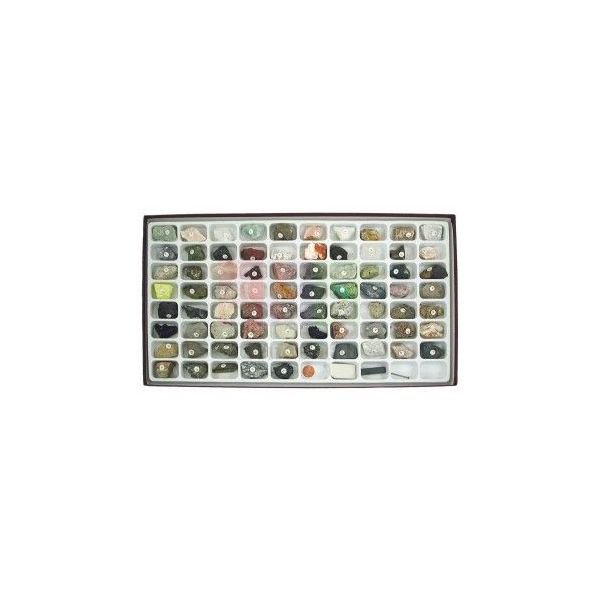
Introductory Earth Science Collection
The Introductory Earth Science Collection (Product Code: SLE/ES/14) is a basic unit of 75 rocks and minerals that demonstrates the major rock-forming minerals. Specimens measure 1-1/4 in x 3/4 in and are held in a compartmented container, with a streak plate, magnet and magnifier for testing, plus a scale of hardness and a guide to recognised physical properties. It gives a new earth science course a broad reference collection in one box, supplied by Jain Scientific Equipments Pvt Ltd (ScienceLab), Ambala, a school science kit supplier in India.
Specifications
| Parameter | Detail |
|---|---|
| Specimens | 75 rocks and minerals |
| Focus | Major rock-forming minerals |
| Specimen size | 1-1/4 in x 3/4 in |
| Edition specimens (as listed) | 3 in x 3 in |
| Reference material | Scale of hardness and recognised physical properties |
| Testing tools | Streak plate, magnet and magnifier |
| Storage | Compartmented container |
Typical Use
With 75 specimens in one container, the collection supports a whole term of rock and mineral work rather than a single lesson. Early sessions can focus on sorting: rocks versus minerals, then igneous, sedimentary and metamorphic groupings. Later, students use the magnifier to study grain size and crystal shape, the streak plate and magnet to test individual minerals, and the hardness scale and property guide to confirm identifications. Because the specimens are compact, several can be laid out on one desk for side-by-side comparison.
Schools setting up junior science lab equipment often start with a collection like this and add larger specimens later. Keep the compartments in order after every lesson, wipe the streak plate clean, and store the container away from moisture so the specimens stay clean and dry.
Supplier
Jain Scientific Equipments Private Limited, trading as ScienceLab from Ambala, Haryana, supplies this collection to schools, colleges and teacher-training institutes along with its wider range of science teaching equipment. Learn about the company on our company profile.
Related Earth Science Equipment
Items that expand an introductory rocks and minerals course:
- Expanded Rock Collection — more igneous, sedimentary and metamorphic rocks for classification work
- Mineral Study Kit — number-coded minerals for focused testing
- Black Streak Plates — spare plates so several groups can run streak tests together
- Hand Lens — additional magnifiers for class-wide observation
- Rocks Clever Catch — a throw-and-answer ball for revising rock types
See the full Earth Science category for more collections and models.
Frequently Asked Questions
How many specimens are included?
Seventy-five rocks and minerals, chosen to show the major rock-forming minerals.
What size are the specimens?
The standard specimens are 1-1/4 in x 3/4 in. Edition specimens of 3 in x 3 in are also listed; please contact us to confirm which specimen size applies to your order.
Which testing tools come with the collection?
A streak plate, a magnet and a magnifier, together with a scale of hardness and a guide to recognised physical properties.
How are the specimens stored?
In a compartmented container, so each specimen keeps its own place.
Can lost or broken specimens be replaced?
Tell us the specimen and its position in the container and we will advise on replacement availability.
What does an institutional order need?
Product code SLE/ES/14, quantity, delivery details and any tender or purchase-order reference.
Do you export?
Yes. We supply schools and distributors in India and international markets.
Request a Quote
To request a quotation for the Introductory Earth Science Collection, contact us or add it to the enquiry cart with any extra testing tools.
Last updated: 24 September 2026
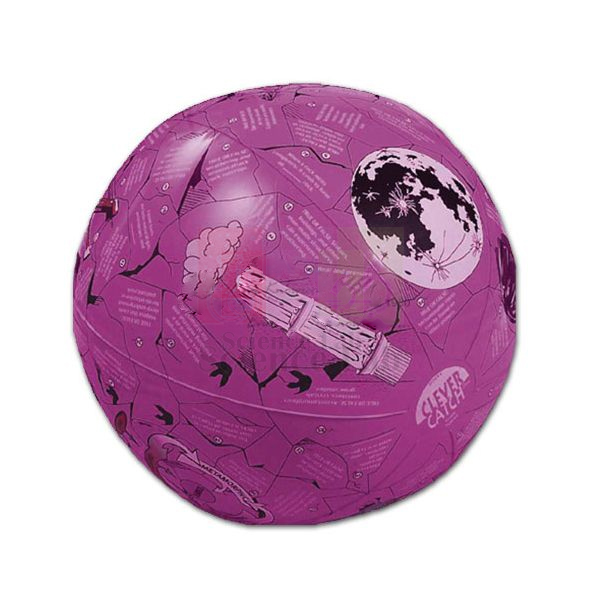
Rocks Clever Catch
Rocks Clever Catch (Product Code: SLE/ES/15) is a 24 in inflatable vinyl ball printed with 96 facts about igneous, metamorphic and sedimentary rocks. Designed for grades 6-8, it turns the review of earth materials into a game: students toss the ball around the classroom and respond to the fact under their hand, so revision becomes quick, active and noisy in the best sense. It is a game-based science kit for students, supplied by Jain Scientific Equipments Pvt Ltd (ScienceLab), Ambala.
Specifications
| Parameter | Detail |
|---|---|
| Type | Inflatable learning ball |
| Size | 24 in |
| Material | Vinyl |
| Content | 96 facts about rocks |
| Topics covered | Igneous, metamorphic and sedimentary rock types |
| Grade level | Grades 6-8 |
Typical Use
The ball works best as a five- or ten-minute starter or plenary. The teacher throws it to a student, who reads the fact under a chosen thumb, says which rock type it relates to, and throws it on. Variations keep the game fresh: teams can score points for correct classifications, students can be asked to turn a fact into a question for the next catcher, or the class can keep a running list of new vocabulary. It can also be bounced on the playground or spun at home for individual revision.
Used before a practical session with real specimens, it refreshes the key terms students need, and it fits well with a class 8 science kit when a rocks and soil unit is being revised. Inflate it until firm but not tight, keep it away from sharp edges and rough surfaces, and wipe the vinyl with a damp cloth after outdoor use.
Supplier
This learning ball is supplied by Jain Scientific Equipments Private Limited, which serves schools under the ScienceLab name from Ambala, Haryana. Purchase departments completing vendor forms can use the company's GST registration (GSTIN 06AAECJ8618A1ZT) and Legal Entity Identifier (LEI 3358004HRD1JIVXKYX49). Further background is on our company profile.
Related Earth Science Equipment
Follow the game with hands-on rock study:
- Expanded Rock Collection — real igneous, sedimentary and metamorphic specimens to match the facts
- Class Rock Pack — a flow-chart lesson for identifying rock and soil samples
- Rock Study Kit — number-coded rock specimens for hands-on tests
- Introductory Earth Science Collection — a broad rocks and minerals set with testing tools
- Astronomy Clever Catch — the same toss-and-answer format for astronomy topics
More earth science games, models and specimens are in the Earth Science category.
Frequently Asked Questions
Which age group is it for?
Grades 6-8.
How many facts are printed on the ball?
Ninety-six facts covering igneous, metamorphic and sedimentary rocks.
How big is the ball and what is it made of?
It is a 24 in inflatable ball made of vinyl.
Can it be used outdoors?
Yes. It can be bounced on the playground as well as tossed indoors; avoid rough or sharp surfaces that could puncture the vinyl.
Is a teacher's answer guide included?
An answer guide is not listed for this item. Contact us if you need supporting notes for the game.
How many balls does a class need?
One ball is enough for a whole-class game; larger classes can split into groups with one ball each.
Do you supply schools abroad?
Yes. We serve India and international markets, with delivery and warranty terms confirmed on quotation.
Request a Quote
To order Rocks Clever Catch (SLE/ES/15), send your enquiry or add it to the enquiry cart with any rock collections for the same unit.
Last updated: 24 September 2026

Earth in 3-D Student Book
The Earth in 3-D Student Book (Product Code: SLE/ES/16) is a visual introduction to geology built around aerial photographs of geologically significant locations that have been digitally transformed into 3-D views. Its sixteen aerial images illustrate dozens of landforms typically covered in earth science textbooks, such as mesas, landslides, faults, dunes and volcanoes, and a series of study questions accompanies each photograph. Two pairs of 3-D glasses are included with every book. It forms part of the educational science equipment range supplied by Jain Scientific Equipments Pvt Ltd (ScienceLab), Ambala.
Specifications
| Parameter | Detail |
|---|---|
| Format | Student book |
| Images | Sixteen aerial photographs converted to 3-D views |
| Landforms illustrated | Dozens, including mesas, landslides, faults, dunes and volcanoes |
| Activities | Study questions with each photograph |
| Included with each book | Two pairs of 3-D glasses |
Typical Use
Seen through the 3-D glasses, an aerial photograph stops being a flat pattern of colours and becomes a landscape with height, slope and depth. Students can trace the scar of a landslide, follow the offset along a fault, or pick out the steep sides and flat top of a mesa, then answer the study questions that go with each image. Because two pairs of glasses come with every book, the book suits paired work: one student reads the question aloud while the other examines the view, then they swap.
Where a 3D science model kit shows landforms in miniature, this book shows them as they actually appear from the air, and the two approaches reinforce each other well. The book is also useful for map-reading lessons, where students compare a 3-D view with the matching topographic features. Keep the glasses in a case or envelope between lessons so the lenses stay scratch-free.
Supplier
ScienceLab, the trading name of Jain Scientific Equipments Private Limited in Ambala, Haryana, supplies this book to schools and libraries together with the maps, models and specimen sets it offers for geography and earth science. Visit the company profile for more about us.
Related Earth Science Equipment
Physical models that match the landforms in the book:
- Landform Relief Maps — raised relief maps that students can touch as well as see
- Miniature Landform Models Set — small 3-D models of volcanoes, glaciers, faulting and folding
- Volcano Model — a sectional view of the structures behind the volcanoes in the photographs
- Fractures, Faults and Dislocations Model — shows fault structures in cross-section
- Economy Stream Table Kit — recreates erosion and deposition by running water
Browse the Earth Science category for more teaching resources.
Frequently Asked Questions
How many images are in the book?
Sixteen aerial images, each converted into a 3-D view.
Are 3-D glasses included?
Yes. Two pairs of 3-D glasses come with each book.
Which landforms does it cover?
Dozens of landforms typically found in earth science textbooks, including mesas, landslides, faults, dunes and volcanoes.
Does it include activities?
Yes. A series of study questions accompanies each photograph.
Is an answer key or teacher edition available?
A teacher edition is not listed with this item. Ask us about any teacher support material before ordering.
How many books does a class need?
With two pairs of glasses per book, one book per pair of students works well.
Can you supply class sets or ship abroad?
Yes. We supply schools and distributors in India and international markets; quote code SLE/ES/16 and the number of copies.
Request a Quote
To order the Earth in 3-D Student Book, contact us with the quantity required, or add it to the enquiry cart together with landform models.
Last updated: 24 September 2026
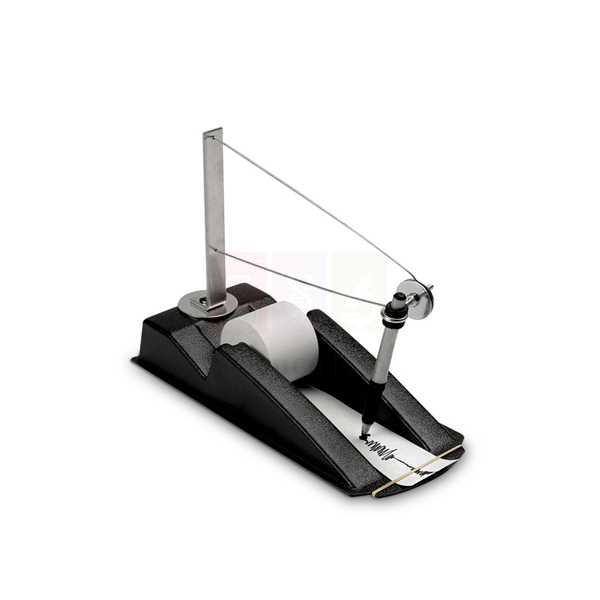
Seismograph Model For Science Lab
The Seismograph Model For Science Lab (Product Code: SLE/ES/17) is a small table-top unit that shows students how earthquakes are measured and how their intensity is worked out. Students simulate their own earthquakes and the seismograph records the intensity of each tremor, so the class can compare results and try to top the Richter scale. The model brings an abstract topic within reach for geography, earth science and physics classes, and is made by Jain Scientific Equipments Pvt Ltd (ScienceLab), a school science lab equipment manufacturer in Ambala.
Key Details
| Parameter | Detail |
|---|---|
| Type | Table-top seismograph model |
| Purpose | Shows how earthquakes are measured and their intensity calculated |
| Operation | Students simulate earthquakes; the seismograph records their intensity |
| Scale referenced | Richter scale |
| Size | Small, table-top |
| Suitable for | Classroom demonstrations and group activities |
Typical Use
A lesson usually begins with a question: how can anyone put a number on something as chaotic as an earthquake? The teacher then demonstrates a gentle simulated tremor and shows the trace the seismograph records, before letting groups create stronger and weaker "earthquakes" of their own. Comparing the recorded traces makes the connection between the size of the disturbance and the size of the recording visible, which leads naturally to how seismologists use such records to assign a magnitude. The friendly challenge of trying to top the Richter scale keeps students engaged.
Beyond geography and disaster-management lessons, the unit works as a demonstration model in the physics lab for vibrations and waves. Place it on a stable, level surface away from the edge of the bench, reset the recording between trials so each trace can be compared, and keep simulated shaking within what the model is designed for.
Manufacturer
The seismograph model is produced by Jain Scientific Equipments Private Limited, the Ambala, Haryana manufacturer behind the ScienceLab brand, which makes demonstration models and apparatus for school and college science departments. Our company profile has more about the organisation.
Related Earth Science Equipment
Models that explain where earthquakes come from and what they affect:
- Fractures, Faults and Dislocations Model — shows the fault structures along which many earthquakes occur
- Earth Globe Model — detachable layers of the Earth's interior through which seismic waves travel
- Volcano Model — links volcanic activity with ground movement
- Miniature Landform Models Set — faulting and folding models for the same tectonics unit
Find more models in the Earth Science category.
Frequently Asked Questions
What does the model demonstrate?
How earthquakes are measured and how their intensity is calculated, using earthquakes that students simulate themselves.
Can it detect real earthquakes?
It is a teaching model designed to record simulated tremors in the classroom, not a scientific monitoring instrument.
How large is the unit?
It is a small table-top unit. Exact dimensions are not in our current product notes; contact us if you need them for storage planning.
Does it need power or special recording paper?
Power and consumable requirements are not listed here. Please ask us before ordering so we can confirm what the recording mechanism uses.
Is a calibration certificate provided?
As a demonstration model it is not intended for calibrated measurement. If your institution requires any test documentation, discuss it with us at the enquiry stage.
What warranty applies?
Warranty terms are confirmed with each quotation.
Can you supply several schools or export?
Yes. We supply institutions and distributors across India and international markets; quote product code SLE/ES/17 and the quantity needed.
Request a Quote
For the Seismograph Model For Science Lab, send us an enquiry or add it to the enquiry cart with related earth science models.
Last updated: 24 September 2026

Storage Boxes – Rock – Mineral Specimens
Storage Boxes – Rock – Mineral Specimens (Product Code: SLE/ES/18) are compartmented collection boxes that keep individual rock and mineral samples separated, visible and easy to put back in place after a lesson. Earth science teachers, geography departments and college geology rooms use them to organise reference sets and student-collected field samples. Built from rugged polystyrene and leather-finished cardboard, they are made by Jain Scientific Equipments Pvt Ltd (ScienceLab), Ambala, as part of its range of educational laboratory equipment in India.
Specifications
| Parameter | Detail |
|---|---|
| Product type | Collection box for storing rock and mineral specimens |
| Construction | Rugged polystyrene and leather-finished cardboard |
| Sizes offered | Four sizes available |
| Listed box size | 40-cell box |
| Cell size (40-cell box) | 1.5 x 2 (as listed in our catalogue) |
| Suitable for | School and college rock and mineral collections in earth science and geography |
Typical Use
Teachers usually place one specimen per cell, with a small numbered label beneath each sample, so the box doubles as an identification key during practical classes. Keeping every rock or mineral in its own compartment stops softer samples such as gypsum or talc from being scratched by harder neighbours, and it turns end-of-term stock-taking into a quick visual check. The 40-cell format suits a reference set that a class works through over several lessons.
As part of a school laboratory setup in India, boxes are commonly organised on shelves by theme – igneous, sedimentary and metamorphic rocks, or ores and common minerals – so students can take out one set at a time. Keep the boxes flat and away from damp, handle the cardboard parts with dry hands, and clean the polystyrene surfaces with a dry cloth rather than water.
Manufacturer
ScienceLab is the trading name of Jain Scientific Equipments Private Limited, a company based in Ambala, Haryana, that produces teaching apparatus for earth science, physics, chemistry and biology laboratories. Specimen storage like this box is sent to schools and colleges in India and international markets; more background is on our company profile.
Related Earth Science Equipment
A storage box is most useful alongside the specimens and test tools it will hold. These items belong to the same collecting and identification workflow:
- Mineral ID Starter Set — a ready group of minerals to fill the cells.
- Expanded Rock Collection — a larger rock set for building a sorted reference box.
- Rock Study Kit — supports classroom study of the rocks being stored.
- Minerals Test Kit — streak, hardness and magnet checks before specimens are labelled and boxed.
See the complete Earth Science range for globes, landform models and fossil sets.
Frequently Asked Questions
Are rock or mineral specimens included with the box?
No specimens are listed as part of this item; it is the storage box itself. Collections such as the Mineral ID Starter Set can be ordered separately, and if you would like a pre-filled box please ask us through the contact page.
What sizes can I choose from?
Four sizes are available. The 40-cell box is the version detailed on this page; for the cell count and dimensions of the other three sizes, contact us and we will confirm them for your enquiry.
What does the 1.5 x 2 cell size mean for my specimens?
Our catalogue records each cell of the 40-cell box as 1.5 x 2. Please confirm the unit and check the fit against your largest samples with our team before ordering, so bulky specimens are not left without a compartment.
What materials is the box made from?
Rugged polystyrene and leather-finished cardboard. Store it dry and wipe it with a dry cloth; soaking or washing will damage the cardboard.
Is a warranty provided?
Warranty and after-sales terms are stated in each quotation. Ask us for the terms that apply to your order.
What should an institutional quotation request include?
Quote the product code SLE/ES/18, the size or sizes required, the quantity of boxes, the delivery address and any labelling needs. Bulk orders for multiple laboratories in India and international markets can be quoted together.
Request a Quote
To order Storage Boxes – Rock – Mineral Specimens (SLE/ES/18), send your size and quantity through our contact page, or add the item to the enquiry cart with other earth science items for one combined quotation.
Last updated: 24 September 2026
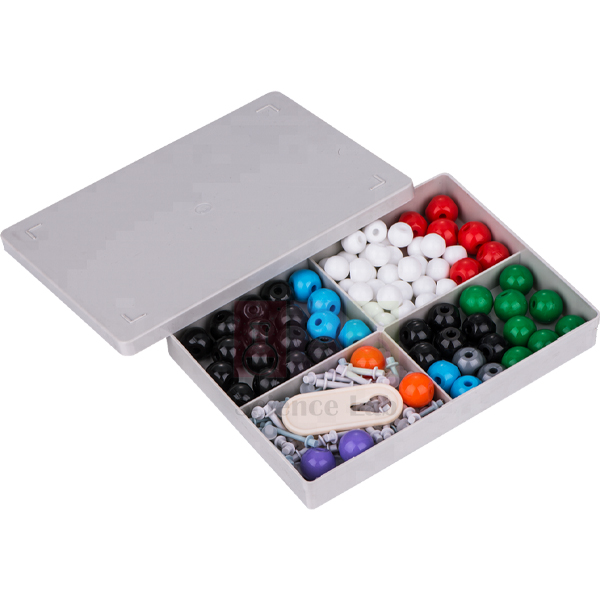
Molecular Model Set with 76 Plastic Spheres
Molecular Model Set with 76 Plastic Spheres (Product Code: SLE/Mo/05) is a ball-and-spoke model set used to build organic, inorganic and crystal structure models in school and college chemistry. It contains 76 plastic spheres, 23 mm in diameter except for 30 smaller 17 mm hydrogen models, with 102 plastic connecting rods in a durable storage case. This molecular model set for organic chemistry is made by Jain Scientific Equipments Pvt Ltd (ScienceLab), an OEM manufacturer, at its own factory in Ambala, India.
Specifications
| Parameter | Detail |
|---|---|
| Spheres | 76, plastic |
| Sphere size | 23 mm diameter; the 30 hydrogen models are 17 mm |
| Connecting rods | 102, plastic |
| Model style | Ball-and-spoke |
| Builds | Most organic molecules, crystal structure models and the usual inorganic molecular models |
| Storage | Durable storage case |
| Product code | SLE/Mo/05 |
| Manufacturer | Jain Scientific Equipments Pvt Ltd (ScienceLab) — OEM |
| Country of origin | India (made in Ambala, Haryana) |
What Is the 76-Sphere Molecular Model Set Used For?
Ball-and-spoke models keep the atoms apart on visible rods, which makes bond angles and three-dimensional shapes easy to read from any direction. With 30 hydrogen spheres and larger spheres for the other atoms, the set builds several hydrocarbons, alcohols, acids and other organic molecules at once, so a group can compare related compounds on the same bench. The smaller 17 mm hydrogens also show clearly how hydrogen atoms crowd around a carbon skeleton.
Beyond organic chemistry, the spheres and 102 rods can be arranged into repeating units to model crystal structures, and into familiar inorganic molecules such as water, ammonia and carbon dioxide. Count the spheres and rods back into the storage case at the end of each lesson; a set with a known count is quick to check for missing parts.
OEM Manufacturer
Jain Scientific Equipments Private Limited (CIN U29309HR2020PTC087597), which trades as ScienceLab, is the OEM (original equipment manufacturer) of this molecular model set. Production takes place at the company's licensed factory at 449, HSIIDC Industrial Area, Saha, Ambala (Factory Licence AMB-ONLINE-CHD-J-414). Schools, colleges, dealers and importers in India and international markets order the set factory-direct and receive quotations from the manufacturer itself; see our company profile for more.
Related Molecule Models
Other sets for molecular and crystal structure teaching:
- Atom Molecular Models Set — colour-coded atoms for organic families
- Professional Chemistry Molecular Structure Model — shows bond length, type and angle
- Molecular Model Set – Elementary Organic, 30 atom — a smaller introductory set
- Set for Demonstration of Crystal Lattices — for dedicated lattice demonstrations
- Molecular Models, Pre-Assembled, Iron, Zinc, and Copper — ready-built metal structure models
See every set in the Molecule category.
Frequently Asked Questions
How many parts are in the Molecular Model Set with 76 Plastic Spheres?
The Molecular Model Set with 76 Plastic Spheres (SLE/Mo/05) contains 76 plastic spheres and 102 plastic connecting rods, packed in a durable storage case. The spheres are 23 mm in diameter, except for the 30 hydrogen models, which are 17 mm.
Why are the hydrogen spheres smaller?
In the Molecular Model Set with 76 Plastic Spheres, the 30 hydrogen models are 17 mm while the other spheres are 23 mm. The smaller size reflects hydrogen's small atomic radius and makes hydrogens easy to pick out on a crowded organic model.
What can be built with the 76-sphere model set?
The Molecular Model Set with 76 Plastic Spheres builds models of most organic molecules, crystal structure models and the usual inorganic molecular models, so one set covers structural chemistry from introductory organic lessons to simple solid-state work.
What kind of model does this set make?
The Molecular Model Set with 76 Plastic Spheres is a ball-and-spoke set: spheres represent atoms and plastic rods represent bonds. This open style shows bond angles and molecular shape clearly, whereas space-filling models emphasise the overall size of a molecule.
Who manufactures the Molecular Model Set with 76 Plastic Spheres?
Jain Scientific Equipments Pvt Ltd (ScienceLab) manufactures the Molecular Model Set with 76 Plastic Spheres as the OEM at its licensed factory at Saha, Ambala, Haryana, India. Schools, colleges, dealers and importers in India and international markets can order it direct.
What should a quotation request for this model set include?
A quotation request for the Molecular Model Set with 76 Plastic Spheres should give product code SLE/Mo/05, the number of sets (for example one per student group), your delivery location and any other molecule models to be quoted together.
Request a Quote
Quotations for the Molecular Model Set with 76 Plastic Spheres come direct from the manufacturer: send the number of sets and delivery details through our contact page, or add it to the enquiry cart with other chemistry models.
Last updated: 24 September 2026
Minerals Test Kit
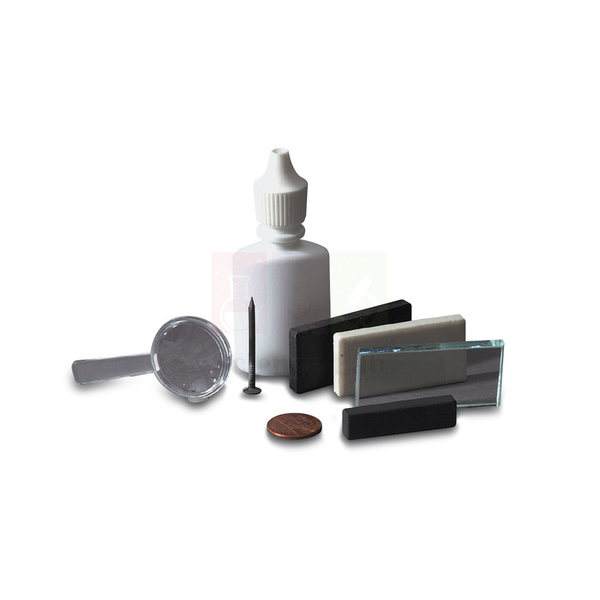
The Minerals Test Kit (Product Code: SLE/ES/19) gathers the simple tools students need to identify rocks, minerals and fossils by their physical properties – streak, hardness, magnetism and close visual detail – in one resealable zip-lock pouch. It is used by middle and secondary school classes, geography departments and introductory college geology practicals as a compact science kit for students working in pairs or small groups. The kit is made by Jain Scientific Equipments Pvt Ltd (ScienceLab), Ambala.
Specifications
| Parameter | Detail |
|---|---|
| Purpose | Tools for rock, mineral and fossil identification by students |
| Packing | Zip-lock pouch |
| Streak testing | Streak plate |
| Hardness comparison | Glass plate, nail, penny and hardness scale |
| Close observation | Hand lens |
| Liquid tests | Dropper bottle |
| Magnetism check | Magnet |
Typical Use
A standard identification sequence starts with the hand lens to note colour, lustre, grain size and crystal shape. Students then drag the specimen across the streak plate to reveal the colour of its powder, which is often more reliable than surface colour. Hardness is bracketed by trying to scratch the sample with the penny and the nail, and by testing whether the sample scratches the glass plate; the result is compared with the hardness scale in the pouch. The magnet quickly picks out iron-bearing minerals such as magnetite.
The dropper bottle is intended for liquid tests; any reagent it holds is provided by the school and should be used only under teacher supervision. As a hands-on earth science kit it works well in rotation stations, where each group records results on a worksheet before comparing identifications with a reference collection. After class, wipe the plates dry and return every tool to the pouch so nothing goes missing between lessons.
Manufacturer
This kit comes from Jain Scientific Equipments Private Limited, which trades under the ScienceLab name from Ambala in Haryana and produces educational apparatus for schools, colleges and training institutes. Its earth science items are sent to customers in India and international markets. Read the ScienceLab company profile for background on the business.
Related Earth Science Equipment
These items complete a mineral identification practical built around this kit:
- Mineral ID Starter Set — known specimens to test and identify.
- Ores Of Common Metals — ore samples that show streak and magnetism tests clearly.
- Black Streak Plates — extra plates for classes with many groups or for light-coloured streaks.
- Hand Lens — additional lenses so every student can observe at once.
- Storage Boxes – Rock – Mineral Specimens — cell boxes to keep identified samples sorted.
More collections and models are listed in our Earth Science category.
Frequently Asked Questions
What exactly is inside the pouch?
A streak plate, a glass plate, a hand lens, a dropper bottle, a magnet, a nail, a penny and a hardness scale, all packed in a zip-lock pouch.
Does the kit include rock or mineral samples?
No specimens are listed in the contents. Pair the kit with a collection such as the Mineral ID Starter Set, or use samples your students have collected.
Is a test liquid supplied in the dropper bottle?
The contents list the dropper bottle only, with no liquid. If your practical uses a reagent, it should be prepared by the teacher and used under supervision; ask us via the contact page if you need matching chemicals quoted.
How do I care for the plates and tools?
Brush powder off the streak plate after each test, keep the glass plate in the pouch to avoid chipping, and keep the magnet away from the hand lens and any electronic devices.
How many kits does a class need?
The listing does not fix a number of users per kit. Most teachers plan by the size of their working groups; tell us your class size and we will quote the quantity you choose.
Can you supply class sets or export orders?
Yes. Bulk quantities for schools and institutions in India and international markets can be quoted; include the product code SLE/ES/19, quantity and delivery location in your request.
Request a Quote
Request pricing for the Minerals Test Kit through our contact page, or place it in the enquiry cart with any specimen sets you need so we can quote them together.
Last updated: 24 September 2026
Medical DNA Model
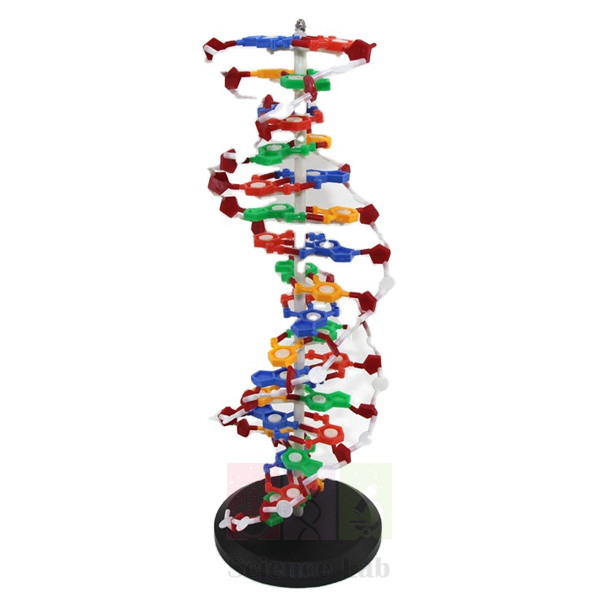
Medical DNA Model (Product Code: SLE/Mo/06) is a PVC demonstration model used to show the structure of the DNA molecule in biology and medical-education classrooms. Measuring 23 × 22 × 68.5 cm, it is intended for teachers to show students how the DNA structure is put together, which makes it a practical biology teaching aid for schools and colleges in India. It is made by Jain Scientific Equipments Pvt Ltd (ScienceLab), an OEM manufacturer, at its own factory in Ambala, India.
Specifications
| Parameter | Detail |
|---|---|
| Model type | Teacher's demonstration model of DNA structure (listed as a DNA / protein structure model) |
| Material | PVC |
| Model size | 23 × 22 × 68.5 cm |
| Packing | 4 pieces per carton |
| Carton size | 46 × 45 × 64 cm |
| Gross weight (G.W., as listed with the packing details) | 10 kg |
| Product code | SLE/Mo/06 |
| Manufacturer | Jain Scientific Equipments Pvt Ltd (ScienceLab) — OEM |
| Country of origin | India (made in Ambala, Haryana) |
What Is the Medical DNA Model Used For?
DNA is a double helix: two sugar-phosphate backbones twist around each other, and pairs of nitrogenous bases form the rungs between them. On a flat textbook diagram the twist, the base pairing and the grooves along the helix are hard to picture, so a large model on the front bench lets the teacher point to each feature while the whole class follows.
Teachers use the Medical DNA Model when introducing the molecular basis of inheritance in senior-secondary biology, and when explaining replication and mutation in nursing, paramedical and medical foundation classes. Turning the model slowly shows how the two strands wind around a common axis. For care, wipe the PVC surface with a soft, slightly damp cloth and keep it away from solvents and direct heat.
What to Specify When Ordering
- Total quantity — the model is packed 4 pieces per carton, so larger orders are planned in cartons.
- Delivery address and route — each carton measures 46 × 45 × 64 cm, which helps with freight planning.
- Any student DNA kits you want quoted alongside the demonstration model.
OEM Manufacturer
ScienceLab is the trading name of Jain Scientific Equipments Private Limited, the OEM (original equipment manufacturer) of the Medical DNA Model. The model is produced at the company's own licensed factory at Saha, Ambala, Haryana, India, rather than bought in from a trader, and is dispatched factory-direct to schools, colleges, nursing and medical institutes, dealers and importers.
Because the carton packing and carton size are known in advance, freight for institutional orders can be worked out with the manufacturer before dispatch. Read more on the ScienceLab company profile.
Related Molecule Models
Follow the teacher's demonstration with hands-on DNA models and practical work:
- Mini DNA 22 layer base pair Molecular Model — a student kit for building a short double-helix segment after the demonstration.
- Molecular Model Kit, Ten Layer DNA — a self-build kit that lets groups assemble roughly one turn of the helix.
- Molecular Model, RNA 12 Base — for comparing single-stranded RNA with the double helix shown on this model.
- DNA extraction lab kit — lets students isolate real DNA once they understand its structure.
See every DNA and molecular model in the Molecule range.
Frequently Asked Questions
What is the Medical DNA Model made of?
The Medical DNA Model is made of PVC, a rigid plastic suited to a teaching model that is handled regularly in class. Clean it with a soft, slightly damp cloth and avoid solvents, which can mark or dull a plastic surface.
How big is the Medical DNA Model?
The Medical DNA Model measures 23 × 22 × 68.5 cm, a demonstration size meant for teachers showing the DNA structure to a class. It is packed 4 pieces per carton, and each carton measures 46 × 45 × 64 cm.
Who is the Medical DNA Model meant for?
The Medical DNA Model is meant for teachers and lecturers who need to show students how the DNA structure is built, in school biology, nursing, paramedical and medical foundation classes. Students can then practise with smaller self-build DNA kits from the same Molecule range.
Who manufactures the Medical DNA Model?
The Medical DNA Model is manufactured by Jain Scientific Equipments Pvt Ltd, trading as ScienceLab, as the OEM at its own licensed factory in Saha, Ambala, Haryana, India. Orders and quotations are handled directly by the manufacturer, not through a trading intermediary.
How should I order the Medical DNA Model for several classrooms?
The Medical DNA Model is packed 4 pieces per carton, so orders for several classrooms are simplest to plan in cartons. State the total quantity and delivery address when you enquire, and the quotation will show the cartons needed.
Can ScienceLab supply the Medical DNA Model for export?
Yes, Jain Scientific Equipments Pvt Ltd (ScienceLab) ships the Medical DNA Model to buyers in India and international markets. Share the quantity, destination country and preferred shipping terms through the contact page so export packing can be included in the quotation.
Request a Quote
To order the Medical DNA Model, send your quantity and delivery details through the contact page or add the model to the enquiry cart. Quotations come direct from the manufacturer in Ambala.
Last updated: 24 September 2026