- Physics Lab Equipment
- Chemistry Lab Equipment
- Biology Lab Equipment
- Anatomical Lab Equipment
- Learning
- Educational Lab Equipment
- Magnets
- Agriculture
- Astronomy
- Earth Science
- Geography Lab Equipment
- Safety Lab Coat
- Laboratory
- Meteorological
- Electricity & Magnetism
- Heat
- School Lab Equipment
- Lab Glassware
- Science Lab Equipment
- Tvet Lab Equipment
- Robotics Kits Supplier and Manufacturer for Schools India
- Math Lab Equipment Manufacturers and Exporters in Ambala
- STEM Kits Manufacturers and Supplier India
- Engineering Lab Equipment
- Hospital Lab Equipment
- Water, Sanitation & Hygiene Supplies
- Cold Chain, Solar & Communication Equipment
- Nutrition
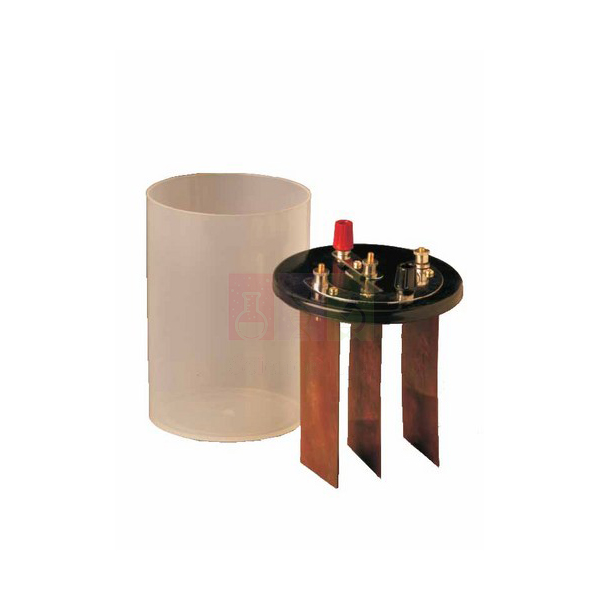
Voltameter, Copper
Voltameter, Copper (Product Code: SLE/EM/27) is an electrolysis cell in which the charge passed is measured by the mass of copper deposited. Three copper plates hang from the bakelite cover of a plastic jar: the two outer plates act together as a double anode, while the inner plate is the cathode and lifts out easily for weighing. Physics and chemistry teachers use it for practicals on Faraday’s laws of electrolysis, making it one of the simpler electrochemistry instruments a school or college lab can own. It is made by Jain Scientific Equipments Pvt Ltd (ScienceLab), Ambala, India.
Specifications
| Parameter | Detail |
|---|---|
| Electrodes | Three copper plates |
| Anode | Two outer plates acting as a double anode, connected to one binding post on top |
| Cathode | Inner copper plate fixed to a second binding post; easily removed for weighing |
| Cover | Bakelite, with the plates suspended from it |
| Vessel | Plastic jar |
Typical Use
To find the electrochemical equivalent of copper, clean and weigh the cathode, fill the jar with copper sulphate solution, and connect the anode and cathode posts to a DC supply through an ammeter, a rheostat and a key. Pass a steady current for a timed interval, then rinse, dry and reweigh the cathode: the gain in mass divided by the charge passed (current × time) gives the result. Because the cathode sits between the two anode plates, copper deposits on both of its faces, which helps give an even coating.
A regulated supply and a rheostat make it easier to hold the current constant during the run. Handle the cathode by its edges once it has been cleaned, dry it thoroughly before each weighing, and rinse all plates after use so that dried electrolyte does not build up on the cover. The same cell can also be used to show that the anode loses copper while the cathode gains it.
Manufacturer
Jain Scientific Equipments Private Limited makes the copper voltameter under its ScienceLab trading name in Ambala, Haryana, as part of an electricity range used by schools and colleges in India and international markets. For company details, visit our profile page.
Related Laboratory Equipment
What you need to run a complete electrolysis practical:
- Cupric Sulphate (Copper Sulphate) — for preparing the electrolyte
- Digital Ammeter — records the current passed through the cell
- Rheostat — keeps the current steady during the timed run
- Precision Variable Power Supply — a regulated DC source for electrolysis
- Electrodes, Copper — separate copper electrodes for other electrolysis set-ups
Visit our Electricity Equipments category for more apparatus.
Frequently Asked Questions
Which plate is the cathode?
The inner copper plate, which is fixed to its own binding post and can be removed easily for weighing. The two outer plates form the double anode.
Is the copper sulphate electrolyte included?
The listing covers the jar, cover and three plates only, so the electrolyte should be ordered or prepared separately — we can quote it with the voltameter.
What experiment is it mainly used for?
Determining the electrochemical equivalent of copper and verifying Faraday’s first law of electrolysis.
What current should be used?
A recommended current is not given in our current listing; contact us and we will advise before you plan the practical.
Why are there two anode plates?
Placing an anode on each side of the cathode lets copper deposit on both faces of the cathode.
How should the plates be looked after?
Rinse them after each use, dry them before storage, and clean the cathode before weighing so that only freshly deposited copper is measured.
Can you supply several voltameters for a practical batch?
Yes. We supply schools, colleges and distributors in India and international markets; send the quantity and delivery location for a quotation.
Request a Quote
For pricing on the Voltameter, Copper, reach us through the contact page or add it to the enquiry cart.
Last updated: 24 September 2026
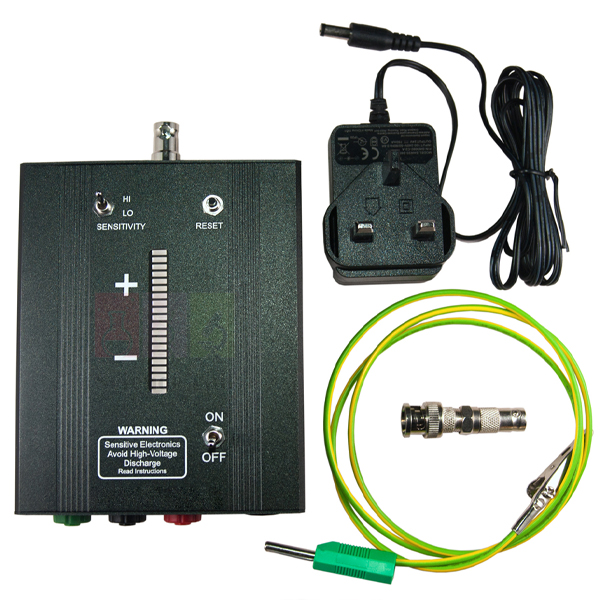
E-Field Detector
E-Field Detector (Product Code: SLE/EAM/01) is an electronic charge detector for electrostatics teaching. Its LED array shows not only whether a charge is positive or negative but also how large it is, and external voltmeter sockets allow quantitative measurements. It can pick up very small charges and their polarity, and detect charge at a distance, so physics teachers can show clearly which way electrons have moved when an object is charged. It is made by Jain Scientific Equipments Pvt Ltd (ScienceLab), Ambala, India.
Specifications
| Parameter | Detail |
|---|---|
| Indicator | LED array showing polarity and size of charge |
| Display range | Hi sensitivity 6 – 125pC; Lo sensitivity 0.6 – 12.5nC |
| Display resolution | Hi sensitivity min. resolution 6pC; Lo sensitivity min. resolution 0.6nC |
| Socket output range | 0 – 4.7V, equivalent to Hi sensitivity 0 – 470pC; Lo sensitivity 0 – 47nC |
| Input voltage | 24V DC |
| Power adapter | 24V AC-DC adapter included |
| Current draw | 50mA |
| Weight | 252g |
| Dimensions (L x W x H) | 145 x 100 x 50mm |
| Instructions | Comprehensive instructions covering traditional electrostatics experiments and newer ways to investigate charge |
Typical Use
School electrostatics has usually relied on attraction-and-repulsion experiments or a delicate gold leaf electroscope, which show that a charge is present but not its sign. With the E-Field Detector the class sees straight away whether rubbing a rod has left it positive or negative, and therefore in which direction electrons have moved. Typical activities include charging different materials by friction, charging by induction, sharing charge with a proof plane, and detecting a charged object held some distance away — turning abstract ideas into observations students can record.
For quantitative work, connect a voltmeter to the output sockets: 0 – 4.7V corresponds to 0 – 470pC on Hi sensitivity or 0 – 47nC on Lo, so results can be tabulated and graphed. Set-up is quick and simple, which helps specialist and non-specialist teachers alike, and the controls are easy enough for students to gather data themselves. Use Hi sensitivity for small charges and Lo for larger ones, and power the unit from the supplied 24V adapter. As physics lab equipment for secondary and college electrostatics, it complements rather than replaces the traditional apparatus.
Manufacturer
The E-Field Detector is manufactured by Jain Scientific Equipments Private Limited, the company behind the ScienceLab brand in Ambala, Haryana. Buyers completing vendor registration can quote GSTIN 06AAECJ8618A1ZT and LEI 3358004HRD1JIVXKYX49. Read more on our company profile.
Related Electricity and Magnetism Equipment
Apparatus for a complete electrostatics practical:
- Digital Voltmeter — reads the detector’s socket output for quantitative charge values
- Proof Plane 20mm Dia — transfers charge samples to the detector
- Electroscope, Gold Leaf — the traditional charge indicator, for side-by-side comparison
- Van de Graaff Generator — a source of larger charges for demonstrations
- Wimshurst Machine — a hand-cranked electrostatic generator
Explore our Electricity and Magnetism category for more apparatus.
Frequently Asked Questions
Can it show whether a charge is positive or negative?
Yes. The LED array indicates the polarity of the charge as well as its size.
What charge range can it display?
6 – 125pC on Hi sensitivity and 0.6 – 12.5nC on Lo sensitivity, with minimum resolutions of 6pC and 0.6nC respectively.
Is a power supply included?
Yes, a 24V AC-DC adapter is included. The detector runs on 24V DC and draws 50mA.
Can readings be recorded with a voltmeter?
Yes. The output sockets give 0 – 4.7V, equivalent to 0 – 470pC (Hi) or 0 – 47nC (Lo).
Does it replace a gold leaf electroscope?
It does things an electroscope cannot, such as showing polarity and giving a voltage output, but many teachers keep both so students can compare the traditional and electronic methods.
Is a calibration certificate available?
Please discuss calibration certificate requirements with us when you enquire — contact us.
What warranty is offered?
Warranty terms are confirmed in the quotation; ask us for details.
What information does an institutional quotation need?
Quantity, delivery location in India or abroad, and any related items such as voltmeters or electrostatic generators; our GSTIN and LEI are given above for vendor registration.
Request a Quote
For E-Field Detector pricing, contact us or add it to the enquiry cart.
Last updated: 24 September 2026
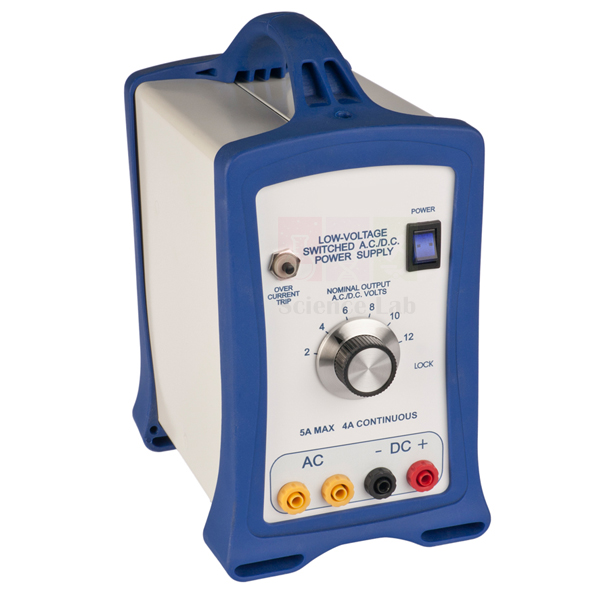
Switched Power Supply
Switched Power Supply (Product Code: SLE/EAM/02) is a rugged bench power unit giving 0 to 12V in 2V steps, as either capacitor-smoothed d.c. or a.c., with an output of up to 5A. It is a traditional switched design meant for laboratory work that needs a dependable source of emf, and it serves schools and colleges looking for a general-purpose lab power supply unit in India. It is supplied by Jain Scientific Equipments Pvt Ltd (ScienceLab), Ambala, India.
Specifications
| Parameter | Detail |
|---|---|
| Output voltage (d.c.) | 0 to 12V in 2V increments, capacitor smoothed |
| Output voltage (a.c.) | 0 to 12V in 2V increments |
| Output current | 5A max, 4A continuous |
| Input | Switched, 230/240V a.c. 50Hz |
| Current protection | Thermal circuit breaker (front-panel thermal trip), manual reset |
| Voltage limiter | Front-panel Allen key insert; the unit can be locked at any setting |
| Switch protection | Internal mechanism disconnects the output while the voltage setting is changed, protecting the switch contacts from overload |
| Case | Robust powder-coated case with integral carrying handle |
| Storage | Sized so that 4 units can be carried in a single storage tray |
Typical Use
Stepped outputs suit practicals where students need repeatable voltages rather than fine adjustment: 2V steps for plotting current against voltage in Ohm’s law work, a low d.c. setting for small motors and electromagnets, or low-voltage a.c. for transformer and induction experiments. Because the output is disconnected while the selector is being moved, changing steps under load does not overload the switch contacts — a real advantage when many hands use the same unit.
Before the class starts, the teacher can use an Allen key through the front panel to lock the unit at the setting the experiment needs. If a circuit draws too much current, the thermal circuit breaker trips; clear the fault and reset it manually from the front panel. Keep continuous loads within 4A, carry units by the integral handle, and store them four to a tray to save bench and cupboard space.
Supplier
This power supply is supplied by Jain Scientific Equipments Private Limited, which trades as ScienceLab from Ambala, Haryana, and provides laboratory equipment to schools, colleges and distributors in India and international markets alongside its own manufactured range. See our company profile for more.
Related Electricity and Magnetism Equipment
Instruments and apparatus used with a bench supply:
- Precision Variable Power Supply — a regulated, continuously variable d.c. alternative
- Precision Switched Power Supply — another switched-output option in the same category
- Digital Voltmeter — checks the output voltage in circuit
- Digital Ammeter — monitors the load current
- Primary and Secondary Coil Set — a transformer experiment that uses the a.c. output
See more in the Electricity and Magnetism category.
Frequently Asked Questions
Which outputs does it provide?
0 to 12V d.c. (capacitor smoothed) and 0 to 12V a.c., both in 2V increments.
How much current can it deliver?
5A maximum and 4A continuous.
What mains input does it need?
230/240V a.c. 50Hz.
What happens if a circuit is overloaded?
The front-panel thermal circuit breaker trips. It is reset manually once the fault is cleared.
Can I stop students from turning the voltage up?
Yes. The voltage limiter uses a front-panel Allen key insert, and the unit can be locked at any setting.
Is the d.c. output regulated?
It is described as capacitor smoothed rather than regulated. For a fully smoothed and regulated output, see the Precision Variable Power Supply.
What warranty and calibration documents are available?
Warranty terms are confirmed with the quotation, and calibration certificate requirements can be discussed with us — contact us.
Can you quote for a full lab set of supplies?
Yes. Send the quantity and delivery location in India or abroad, and we will quote for the units and any meters or leads you need.
Request a Quote
To price the Switched Power Supply, please contact us or add it to the enquiry cart.
Last updated: 24 September 2026
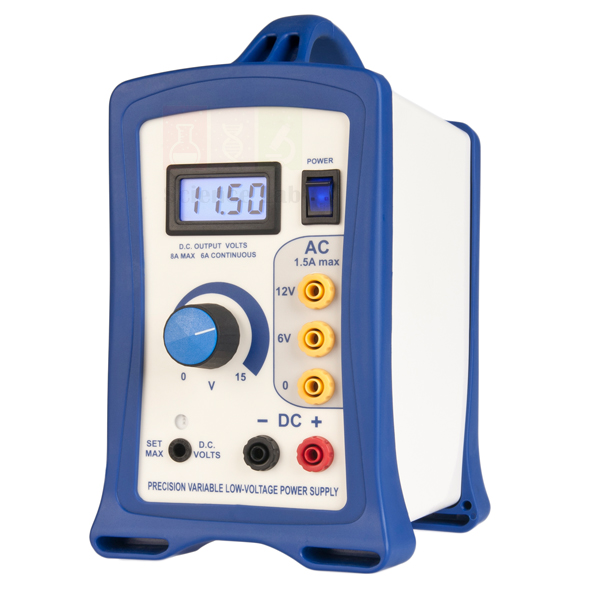
Precision Variable Power Supply
Precision Variable Power Supply (Product Code: SLE/EAM/03) is a regulated bench supply giving 0 to 15V d.c., continuously variable and fully smoothed, at up to 8A, plus separate unregulated 6V and 12V a.c. outputs for transformer work. A built-in digital panel meter, a teacher-set voltage limiter and automatic over-current protection make it a practical regulated power supply for school and college physics labs in India. It is made by Jain Scientific Equipments Pvt Ltd (ScienceLab), Ambala, India.
Specifications
| Parameter | Detail |
|---|---|
| D.C. output voltage | 0 to 15V d.c., continuously variable; fully smoothed and regulated |
| D.C. output current | 8A d.c. max, 6A continuous |
| A.C. outputs | 6V and 12V a.c., unregulated, 1.5A a.c. max; can be used in parallel with the d.c. output |
| Max ripple at full current | 300mV |
| Max voltage variation with load current | 2% |
| Display | Digital panel meter showing the d.c. output (d.c. only) |
| Voltage limiter | Front-panel Allen key adjustment |
| Current protection | Electronic automatic on d.c.; thermal automatic on a.c. Above 8A the d.c. output falls to zero and restores itself once the current is reduced — no resetting required |
| Input | 90–265V a.c. 50/60Hz |
| Case | Robust powder-coated steel with integral plastic handle; removable mains lead |
| Mains switch | Illuminated, front panel |
| Weight | 2.2kg |
| Dimensions | 125 x 175 x 230mm; four units fit in a single storage tray |
| Versions | Same facilities available with continuously variable d.c. (this model) or switched output |
Typical Use
Set the required voltage against the built-in digital meter and the supply holds it as the circuit changes, within the stated 2% variation with load current. That keeps readings steady in Ohm’s law, internal resistance, electrolysis and component-characteristic experiments, where a sagging supply would otherwise distort results. The 6V and 12V a.c. outputs can run at the same time as the d.c. output, so transformer investigations and other a.c. work do not need a second unit on the bench.
Before a practical, the teacher uses an Allen key through the front panel to set the dial to the highest voltage students should use; the main control then works normally up to that value but gives no increase beyond it. If a circuit draws more than 8A, the d.c. output drops to zero and returns by itself once the current is reduced. At 2.2kg and 125 x 175 x 230mm, the unit is easy to carry by its handle and quick to store, leaving more room on the bench.
Manufacturer
Jain Scientific Equipments Private Limited, trading as ScienceLab from Ambala, Haryana, makes this power supply as part of its electricity and magnetism range for education and training laboratories in India and international markets. Our company profile has more on the business.
Related Electricity and Magnetism Equipment
Items commonly used with a regulated bench supply:
- Precision Switched Power Supply — a switched-output alternative if you prefer fixed steps
- Digital Ammeter — measures load current during experiments
- Resistance Substitution Box — selectable resistances for Ohm’s law and load tests
- Primary and Secondary Coil Set — uses the a.c. outputs for transformer investigations
- Voltameter, Copper — an electrolysis cell that benefits from a steady d.c. supply
More apparatus is listed in our Electricity and Magnetism category.
Frequently Asked Questions
Is the d.c. output regulated?
Yes. It is fully smoothed and regulated, with a maximum voltage variation of 2% with load current and maximum ripple of 300mV at full current.
How much current is available?
8A d.c. maximum with 6A continuous, and 1.5A a.c. maximum from the 6V and 12V a.c. outputs.
What mains supply does it accept?
90–265V a.c. at 50/60Hz.
What happens on overload?
On the d.c. side, protection is electronic and automatic: above 8A the output falls to zero and recovers once the current is reduced. The a.c. side has automatic thermal protection.
Can I limit the maximum voltage students use?
Yes, with an Allen key through the front panel; the main control then works normally only up to the value you set.
Is there a switched version?
Yes. The same facilities are offered with either continuously variable d.c. or a switched output. Compare the Precision Switched Power Supply in the same category, or ask us which suits your lab.
Is a calibration certificate or warranty provided?
Calibration certificate requirements can be discussed with us, and warranty terms are confirmed with the quotation — contact us.
What should an institutional quotation request include?
Quantity, delivery location in India or abroad, whether you need variable or switched units, and any meters or leads to be quoted together.
Request a Quote
For pricing on the Precision Variable Power Supply, contact us or add it to your enquiry cart.
Last updated: 24 September 2026
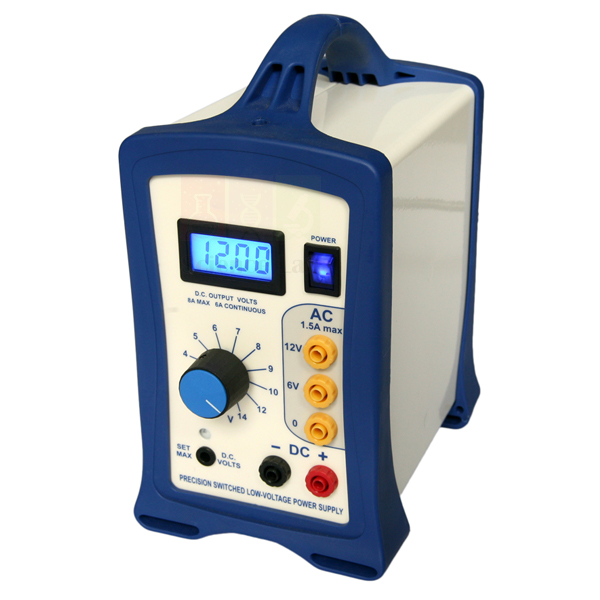
Precision Switched Power Supply
Precision Switched Power Supply (Product Code: SLE/EAM/04) is a compact bench unit that gives a fully smoothed, regulated DC output from 0 to 15 V, plus separate unregulated 6 V and 12 V AC outlets, for student practicals and teacher demonstrations. It is the switched-output member of a series that is also offered with a continuously variable control, and it suits schools and colleges that want one regulated power supply able to handle everything from low-current resistor circuits to high-current electromagnetism work. It is made by Jain Scientific Equipments Pvt Ltd (ScienceLab) in Ambala, India.
Specifications
| Parameter | Detail |
|---|---|
| DC output voltage | 0 to 15 V DC, fully smoothed and regulated |
| Output selection | Switched output on this model; the same design is also offered with continuously variable DC |
| DC output current | 8 A maximum, 6 A continuous |
| AC outputs | 6 V and 12 V AC, unregulated, 1.5 A maximum; can be used in parallel with the DC output |
| Load regulation | Maximum voltage variation with load current: 2% |
| Ripple | 300 mV maximum at full current |
| Display | Built-in digital panel meter showing the DC output in use at all times (DC only) |
| DC current protection | Electronic and automatic: above 8 A the output voltage falls to zero and returns once the current is reduced, with no resetting |
| AC current protection | Thermal, automatic |
| Voltage limiter | Adjusted with an Allen key through the front panel; the main control works normally up to the set ceiling and gives no increase beyond it |
| Mains input | 90–265 V AC, 50/60 Hz |
| Controls | Clear, simple controls with an illuminated front-panel mains switch |
| Case | Robust powder-coated steel with integral plastic handle and removable mains lead |
| Dimensions | 125 x 175 x 230 mm |
| Weight | 2.2 kg |
| Storage | Four units fit in a single storage tray |
Typical Use
Because the output is regulated, the voltage set on the panel meter is held steady whatever is connected, so students plotting current against voltage for a resistor, a filament lamp or a coil get consistent readings from one bench to the next. The high DC current rating makes the unit a natural partner for demonstrations that need several amperes, such as a current-carrying conductor in a magnetic field or the field around a straight wire, while the 6 V and 12 V AC outlets serve transformer investigations and can run at the same time as the DC terminals.
A useful habit before any class practical is to set the Allen-key limiter to the highest voltage the day's components can tolerate; students then have the full range of the main control below that ceiling but cannot push past it. If the display suddenly reads zero, the automatic over-current protection has operated – look for a short circuit or reduce the load and the output returns without any reset. At 2.2 kg, with four units to a tray, this piece of school physics lab equipment is quick to hand out and collect between lessons.
Manufacturer
The supply comes from Jain Scientific Equipments Private Limited, the company behind the ScienceLab name, which designs and manufactures teaching apparatus in Ambala, Haryana, for schools, colleges and training institutes in India and international markets. More about the company is on the ScienceLab company profile page.
Related Electricity and Magnetism Equipment
These items are often ordered with this power supply because they draw on its outputs or measure what it delivers:
- Force on a Conductor Apparatus — the rolling crossbar needs a low-voltage bench supply and currents of several amperes.
- Magnetic Field Unit Vertical Wire — field-pattern units in this series call for a DC supply able to deliver 5–8 A.
- Digital Ammeter — a separate meter for logging the current drawn by the circuit under test.
- Digital Voltmeter — measures the voltage across an individual component rather than the whole output.
- Precision Variable Power Supply — the continuously variable version, for labs that prefer a smooth control.
Browse the full Electricity and Magnetism range for more apparatus.
Frequently Asked Questions
What outputs does this power supply provide?
A regulated 0 to 15 V DC output rated at 8 A maximum (6 A continuous), plus unregulated 6 V and 12 V AC outlets rated at 1.5 A maximum. Only the DC output is shown on the digital display.
Can the AC and DC outputs be used at the same time?
Yes. The AC outlets can be used in parallel with the DC output, for example running a transformer experiment on AC while the DC terminals power another circuit.
What happens if students short-circuit the output?
On the DC side the protection is electronic: once more than 8 A is drawn the output voltage drops to zero and comes back as soon as the current is reduced, with nothing to reset. The AC side uses automatic thermal protection.
How is the switched version different from the variable version?
Both share the same regulation, protection and outputs; the difference is how the DC voltage is selected. For the exact switch positions on this model, please ask us through the contact page before ordering.
Will it run on our local mains supply?
It accepts 90–265 V AC at 50 or 60 Hz and has a removable mains lead. If your site needs a particular plug type, mention it when you enquire.
Is a calibration certificate or warranty available?
Calibration-certificate availability and warranty terms are confirmed with each quotation. Please raise them with us via the contact page.
What should an institutional or bulk enquiry include?
State the quantity, whether you also need the variable version, your delivery location and any tender format required. ScienceLab supplies schools, colleges and distributors in India and international markets.
Request a Quote
To price the Precision Switched Power Supply for your lab, send your requirement through our contact page or add it to the enquiry cart together with the meters and apparatus you plan to use with it.
Last updated: 24 September 2026
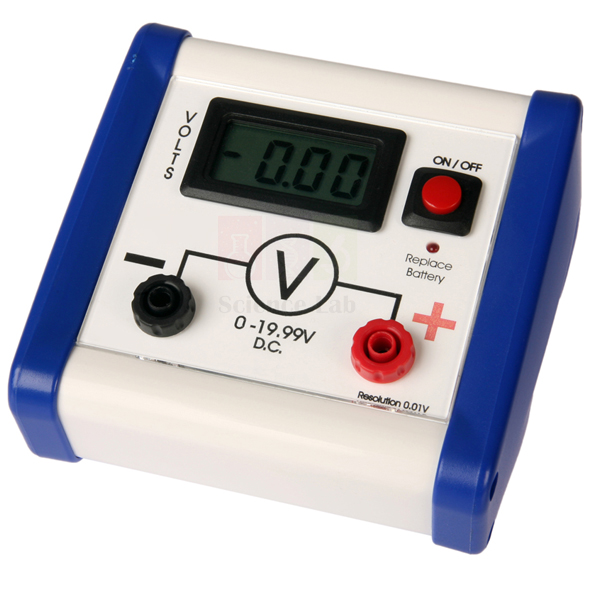
Digital Voltmeter
Digital Voltmeter (Product Code: SLE/EAM/05) is a battery-powered bench meter that reads DC potential difference from 0 to ±20 V with 0.01 V resolution, giving students a clear numerical display for circuit practicals. It sits alongside the other digital measuring instruments in a school or college electricity lab and is housed in a robust ABS and PVC case built for daily handling. The meter is made by Jain Scientific Equipments Pvt Ltd (ScienceLab), Ambala, India.
Specifications
| Parameter | Detail |
|---|---|
| Range | 0 to ±20 V DC |
| Resolution | 0.01 V |
| Accuracy | ±2% |
| Input impedance | 10 MΩ approx. |
| Power | 9 V PP3 battery |
| Battery saving | Auto-off after approximately 50 minutes |
| Battery indicator | LED prompts when the battery needs changing |
| Case | Robust ABS and PVC housing |
| Materials | PVC, ABS, acrylic |
| Dimensions | 110 x 100 x 70 mm |
| Weight | 250 g |
Typical Use
Connected in parallel across a resistor, lamp or cell, the voltmeter supplies the potential-difference half of every Ohm's law experiment, series-and-parallel circuit investigation and cell EMF measurement in the syllabus. Its high input impedance means the meter draws almost no current, so the reading reflects the circuit rather than the instrument, and the 0.01 V resolution lets students see the small drop in terminal voltage when a cell starts supplying current. Because the range covers both polarities, a reversed connection simply shows a negative value, which turns a common wiring slip into a lesson about polarity instead of a damaged meter.
For a class set, the auto-off feature matters: a meter left on at the end of a lesson switches itself off after roughly 50 minutes instead of draining its PP3 overnight, and the LED warning tells the technician which units need a fresh battery before the next practical. The compact 250 g case sits easily on a crowded bench next to a power supply and an ammeter.
Manufacturer
ScienceLab is the trading name of Jain Scientific Equipments Private Limited (CIN U29309HR2020PTC087597), an Ambala, Haryana company that manufactures teaching apparatus at its licensed factory at 449, HSIIDC Industrial Area, Saha, Ambala (Factory Licence AMB-ONLINE-CHD-J-414). Read the company profile for background on the business and its product lines.
Related Electricity and Magnetism Equipment
A voltmeter is only one part of a working circuit; these items complete the set-up:
- Digital Ammeter — the matching current meter, needed for resistance and power calculations.
- Lost Volts — internal-resistance apparatus that is used with a voltmeter, an ammeter and a 6 V DC source.
- Resistance Substitution Box — supplies a choice of known resistances to measure across.
- Precision Switched Power Supply — a regulated DC source for the circuit being tested.
See every meter and apparatus in the Electricity and Magnetism category.
Frequently Asked Questions
What can this voltmeter measure?
DC voltages from 0 to ±20 V, displayed to 0.01 V with an accuracy of ±2%. The published range is DC only, so for AC work please ask us about a suitable alternative.
How is it powered?
By a single 9 V PP3 battery. An auto-off circuit switches the meter off after about 50 minutes, and an LED indicator shows when the battery should be replaced.
Will connecting the meter change the reading in my circuit?
Hardly at all in typical school circuits. With an input impedance of about 10 MΩ, it takes very little current from the circuit it is measuring.
What happens if students connect it the wrong way round?
The meter reads both polarities across its range, so a reversed connection shows as a negative voltage rather than an off-scale reading.
Can you provide a calibration certificate?
Whether a calibration certificate can be supplied is decided order by order. Please discuss it, along with warranty terms, via our contact page.
Do you supply class sets or export orders?
Yes, class quantities are regularly quoted for schools and colleges, and ScienceLab ships to India and international markets. Include the quantity and delivery location in your enquiry.
Request a Quote
Tell us how many Digital Voltmeters you need through the contact page, or place them in the enquiry cart with matching ammeters and power supplies for one combined quotation.
Last updated: 24 September 2026
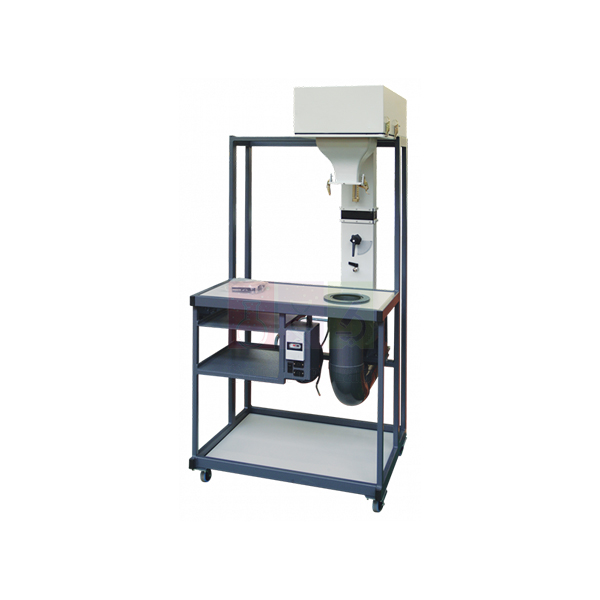
Modular Air Flow Bench
Modular Air Flow Bench (Product Code: SLE/EA/01) is a small-scale wind tunnel base unit used to supply controlled air to interchangeable experiment modules for teaching the principles of air flow in fluid mechanics and aerodynamics laboratories. Lecturers and technicians value it as the common base for eight different experiment modules, with quick-release pressure couplings that make changing from one experiment to the next simple and quick. It is made by Jain Scientific Equipments Pvt Ltd (ScienceLab), an OEM manufacturer, at its own factory in Ambala, India.
Key Details
| Parameter | Detail |
|---|---|
| Type | Small-scale wind tunnel with electric fan and adjustable air flow control |
| Experiment modules served | Base unit for eight different modules demonstrating key air-flow principles and phenomena |
| Frame | Sturdy steel framework carrying the fan |
| Air path | Fan supplies air through a flow-control valve to a specially designed plenum chamber and an aerodynamically shaped contraction |
| Module mounting | Each module fits either the plenum chamber or the contraction |
| Exhaust | Air leaves the module through the bench top and emerges at an exhaust at the rear |
| Pressure connections | Quick-release couplings |
| Smoke experiments | Flexible ducting can be fitted to the exhaust to direct waste smoke safely away |
| Storage | Shelves and storage space for modules not in use |
| Format | Compact bench, easy to move and store |
| Product code | SLE/EA/01 |
| Manufacturer | Jain Scientific Equipments Pvt Ltd (ScienceLab) — OEM |
| Country of origin | India (made in Ambala, Haryana) |
What Is the Air Flow Bench Used For?
The bench provides one steady, adjustable air source so that a department can run a whole series of air-flow practicals without buying a separate fan and ducting for each. A module is fitted to the plenum chamber or the contraction, its pressure points are connected through the quick-release couplings, and the flow-control valve sets the air supply for the test. Topics such as jet behaviour, flow through and around shaped bodies and pressure measurement can then be covered one module after another in the same session.
Because spent air leaves through the bench top to a rear exhaust, the area in front of the student stays clear. When smoke is used to make the flow visible, connect flexible ducting to the exhaust and lead it to a window or extraction point. Return modules to the built-in shelves after class so fittings stay clean and undamaged.
What to Specify When Ordering
- Which of the experiment modules you want with the bench; ask us which, if any, are included as standard.
- Whether you plan smoke visualisation, so flexible exhaust ducting and a smoke source can be discussed.
- Your mains supply for the electric fan, which is not stated in the listing.
- Number of benches for your student groups.
OEM Manufacturer
The Modular Air Flow Bench is an OEM product of Jain Scientific Equipments Private Limited, known by its trading name ScienceLab. The bench is made and assembled at the company's licensed factory in Saha, Ambala, Haryana, India, and the bench is shipped factory-direct.
Engineering colleges, polytechnics, dealers and importers can come back to the manufacturer for extra modules, replacement parts and repeat orders — ask us for what you need. Company details are on the profile page.
Related Aerodynamics Lab Equipment
These items extend air-flow teaching beyond the bench:
- Effect And Jet Flow — an air-jet experiment module from the same range; confirm fit with the bench when ordering.
- Flow Visualisation smoke tunnel — smoke generator set for making flow patterns visible.
- Subsonic Wind Tunnel — a larger tunnel for measured lift, drag and pressure tests.
- Flow Visualisation Wind Tunnel — vertical smoke tunnel for streamline demonstrations.
Browse all Aerodynamics Lab Equipment.
Frequently Asked Questions
How many experiments can the Modular Air Flow Bench run?
The Modular Air Flow Bench is the base unit for eight different experiment modules that demonstrate key principles and phenomena of air flow. Each module fits either the plenum chamber or the contraction, so one bench serves the whole set.
Are experiment modules included with the Modular Air Flow Bench?
The Modular Air Flow Bench is described as the base unit that the modules fit onto, so modules should be specified separately. Tell us which experiments you want to run and we will confirm what is included in your quotation.
How is air flow controlled on the Modular Air Flow Bench?
On the Modular Air Flow Bench, an electric fan feeds air through a flow-control valve into a plenum chamber and shaped contraction. Adjusting the valve sets the flow delivered to the module, and quick-release couplings connect the pressure measurement points.
Can smoke be used with the Modular Air Flow Bench?
Yes. When smoke is used with the Modular Air Flow Bench for flow visualisation, flexible ducting can be fitted to the rear exhaust so that waste smoke is carried safely away from the students and the working area.
Who manufactures the Modular Air Flow Bench?
The Modular Air Flow Bench is manufactured by Jain Scientific Equipments Pvt Ltd (ScienceLab) as the OEM, at its own licensed factory in Ambala, Haryana, India, and supplied factory-direct to institutions, dealers and importers in India and international markets.
What does a quotation for the Modular Air Flow Bench need?
A quotation for the Modular Air Flow Bench needs the number of benches, the modules you want, whether smoke experiments are planned, your mains supply and the delivery address. Send these through the contact page.
Request a Quote
Get a quotation direct from the manufacturer through the contact page, or add the Modular Air Flow Bench to the enquiry cart.
Last updated: 24 September 2026
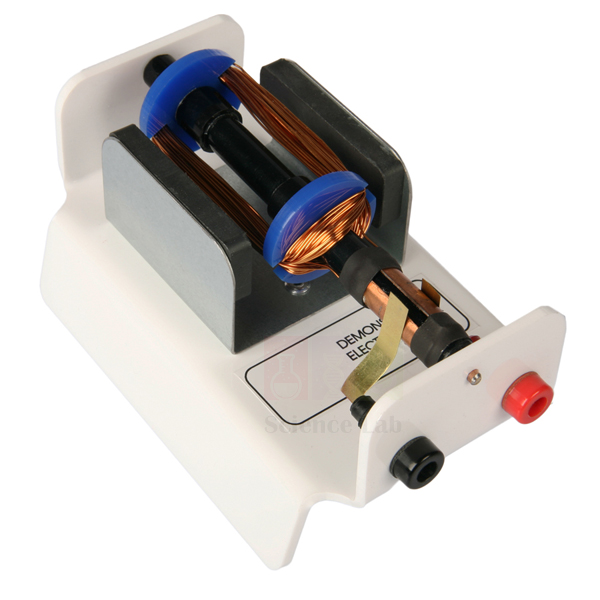
Demonstration Electric Motor
Demonstration Electric Motor (Product Code: SLE/EAM/06) is a ready-built, fully working DC motor laid out so that a whole class can see every essential part of a simple motor: a single rectangular coil, the magnets that provide the field, and the commutator and brushes that keep it turning. Physics teachers use it as a demonstration model for the physics lab when introducing the motor effect, and it runs from a low DC voltage. The unit is made by Jain Scientific Equipments Pvt Ltd (ScienceLab) of Ambala, India.
Key Details
| Parameter | Detail |
|---|---|
| Type | Ready-built, fully functional demonstration DC motor |
| Armature | Single rectangular coil rotating in a linear magnetic field |
| Field magnets | Ferrite slab magnets, reversible to change the field direction |
| Commutation | Simple commutator and brush arrangement |
| Supply required | DC, 1.5 V to 6 V |
| Current reversal | By reversing the supply leads |
| Teaching level | Shows the essential features of a simple motor as taught in the KS4 syllabus |
Typical Use
The motor is ideal for the lesson where students first link the force on a current-carrying wire to continuous rotation. With the coil turning, the teacher can reverse the leads to show that the rotation reverses, then turn the ferrite slab magnets round to show the same thing happening when the field is reversed; doing both at once returns the motor to its original direction, a neat check on Fleming's left-hand rule. Pausing the coil by hand lets the class see how the commutator swaps the current connection every half turn, which is the step many students find hardest to picture.
Start at the low end of the 1.5 V to 6 V range and raise the supply gradually so the class can see the speed respond. Like any single-coil motor, it may occasionally come to rest where the brushes sit on the commutator gap; a gentle flick of the coil sets it going again. Used alongside a simple physics demonstration kit on electromagnetism, it gives a concrete picture that diagrams alone cannot.
Manufacturer
Jain Scientific Equipments Private Limited, known to customers by its ScienceLab brand, produces physics demonstration apparatus from its base in Ambala, Haryana, and supplies teaching labs in India and international markets. The ScienceLab profile page gives more detail about the company.
Related Electricity and Magnetism Equipment
Teachers building a motor-effect lesson usually add some of these:
- Force on a Conductor Apparatus — shows the single-wire force that the motor turns into rotation.
- A.C. Generator — the reverse process, where a rotating magnet induces a current in a coil.
- Battery Holder, C — a single-cell holder that provides 1.5 V, the bottom of the motor's supply range.
- Precision Variable Power Supply — regulated, adjustable DC for exploring speed across the full range.
- Digital Ammeter — records the current the motor draws as the voltage changes.
More motor and electromagnetism apparatus is listed in the Electricity and Magnetism category.
Frequently Asked Questions
What supply does the motor need?
A DC supply between 1.5 V and 6 V. Cells or a low-voltage bench power supply both work, provided they stay within that range.
Can it be run from an AC outlet?
No. The motor is specified for DC, and its commutator design relies on a steady current direction.
Does it need assembling?
No. It is supplied ready-built and fully functional, so it can be used as soon as a DC source is connected.
How do I reverse the direction of rotation?
Either reverse the supply leads to change the current direction, or reverse the ferrite slab magnets to change the field direction.
Which classes is it suitable for?
It covers the essential simple-motor features taught in the KS4 syllabus, so it fits secondary-school lessons on the motor effect and electromagnetism.
Is there a warranty or spare-parts support?
Warranty terms and spares are confirmed when we quote. Please ask through our contact page.
Can you quote for several schools at once?
Yes. For a group or tender enquiry, list the quantity per site and the delivery addresses, and we will prepare a combined quotation for India or international delivery.
Request a Quote
Send your requirement for the Demonstration Electric Motor via the contact page, or add it to the enquiry cart with any supply or meters you need.
Last updated: 24 September 2026