- Physics Lab Equipment
- Chemistry Lab Equipment
- Biology Lab Equipment
- Anatomical Lab Equipment
- Learning
- Educational Lab Equipment
- Magnets
- Agriculture
- Astronomy
- Earth Science
- Geography Lab Equipment
- Safety Lab Coat
- Laboratory
- Meteorological
- Electricity & Magnetism
- Heat
- School Lab Equipment
- Lab Glassware
- Science Lab Equipment
- Tvet Lab Equipment
- Robotics Kits Supplier and Manufacturer for Schools India
- Math Lab Equipment Manufacturers and Exporters in Ambala
- STEM Kits Manufacturers and Supplier India
- Engineering Lab Equipment
- Hospital Lab Equipment
- Water, Sanitation & Hygiene Supplies
- Cold Chain, Solar & Communication Equipment
- Nutrition
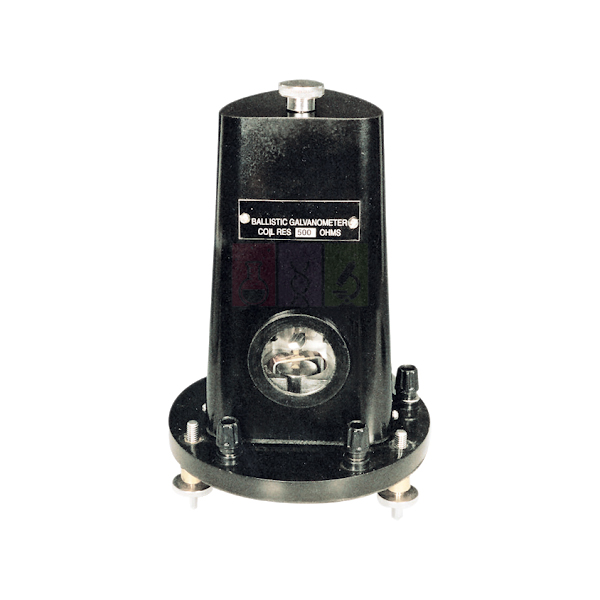
Ballistic Galvanometer
The Ballistic Galvanometer (Product Code: SLE/CH/90) is a sensitive moving-coil instrument built to measure the total electric charge carried by a short pulse of current, rather than a steady current. Its heavy, slowly swinging coil receives the whole pulse before it starts to move, so the size of its first swing, or throw, indicates the charge that has passed. Physics departments in colleges and senior schools use it for capacitor and electromagnetic induction experiments, and it belongs among the physics lab instruments in India that make these classic practicals possible. It is made by Jain Scientific Equipments Pvt Ltd (ScienceLab), Ambala.
Key Details
| Parameter | Detail |
|---|---|
| Type | Ballistic galvanometer (moving-coil instrument) |
| Purpose | Measuring the charge passed in a brief current pulse |
| Suitable for | Capacitor discharge, comparison of capacitances, flux measurement with a search coil |
| Users | College and senior-school physics laboratories |
| Range, sensitivity and dimensions | Confirmed on enquiry |
Typical Use
A typical practical charges a capacitor from a known voltage and then discharges it through the galvanometer: the throw is proportional to the stored charge, so repeating the test with a second capacitor lets students compare the two capacitances. With a search coil connected, the galvanometer records the charge induced when the coil is pulled out of a magnetic field, giving a measure of the magnetic flux. Other undergraduate experiments use it to study mutual inductance and to find very high resistances by the leakage method.
Set the galvanometer on a firm, level bench away from vibration and magnets, and let the coil come to rest before each reading. Record the first throw only, then use a short-circuit or damping key to stop the coil before the next test. Keep the coil clamped, or the terminals shorted, whenever the instrument is moved, as this protects the delicate suspension.
Manufacturer
This instrument is built by Jain Scientific Equipments Private Limited, which markets its range as ScienceLab from Ambala, Haryana, India. For company background, see the company profile.
Related Laboratory Equipment
Items commonly used in ballistic galvanometer experiments:
- Capacitor (Charging and Discharging) — the circuit whose discharge the galvanometer measures
- Search Coil — for measuring magnetic flux by induced charge
- Power Supply Variable — charges the capacitor to a set voltage
- Moving Coil Galvanometer — a standard galvanometer for steady-current work
- Galvanometer 50-0-50mV — a centre-zero meter for simpler induction demonstrations
See more in Chemistry Lab Equipment and our Physics Lab Equipment range.
Frequently Asked Questions
How is a ballistic galvanometer different from an ordinary galvanometer?
Its coil swings slowly, so it measures the total charge of a short current pulse from its first throw, while an ordinary galvanometer indicates a steady current.
What are its range and sensitivity?
These specifications are not in our current product listing. Please contact us for the datasheet before ordering.
Which accessories do I need?
Typically a capacitor, a DC source, a charge–discharge key and, for flux experiments, a search coil. Accessories are not listed as included, so confirm with us what will be supplied.
Is a calibration certificate available?
Discuss calibration certificate availability with us when you request a quotation.
What warranty applies?
Warranty terms are confirmed at quotation — ask us for current terms.
What should a college quotation request include?
Quantity, the experiments you plan to run, any accessories needed, and the delivery location in India or overseas.
Request a Quote
For price and specification details of the Ballistic Galvanometer, contact us or add it to your enquiry cart with the rest of your physics practical equipment.
Last updated: 24 September 2026
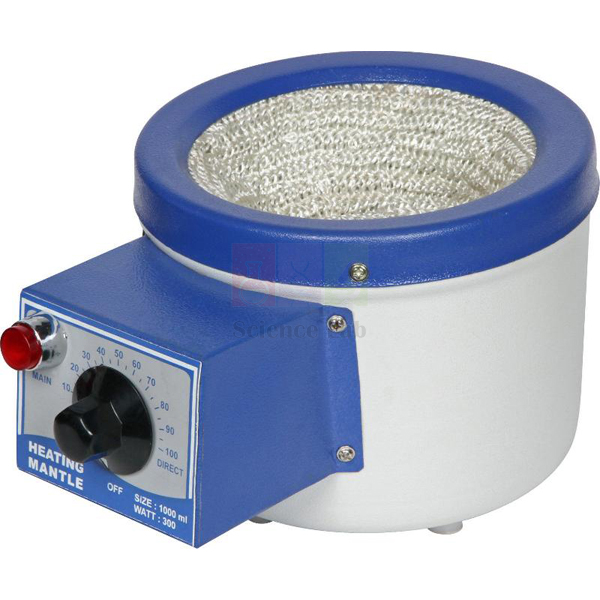
Heating Mantles
Heating Mantles (Product Code: SLE/CH/91) from this listing are 1000 ml, 220 V units that wrap a round bottom flask in an electrically heated glass-yarn net, giving even heat with no open flame. That makes them particularly useful for heating inflammable liquids, and they are widely used in laboratories working with chemicals, pharmaceuticals, dyes and glass plants, as well as in college chemistry and pharmacy lab equipment in India. Each mantle has an energy regulator and an inbuilt indicator light, and is made by Jain Scientific Equipments Pvt Ltd (ScienceLab), Ambala.
Specifications
| Parameter | Detail |
|---|---|
| Capacity | 1000 ml |
| Voltage | 220 V |
| Heating element | Electric heating net hand knitted from glass yarn, with no joint, to maintain the strength of the yarn |
| Maximum temperature | Stands high temperature up to 350°C |
| Body | Spun in one piece from non-rusting aluminium (up to 1000 ml capacity), stoving painted |
| Insulation | Lagged with special grade mineral wool |
| Control | Energy regulator |
| Other features | Original mantle wire; inbuilt indicator light; easy-to-replace mantle |
| Applications | Laboratories, chemicals, pharmaceuticals, dyes, glass plants |
Typical Use
A heating mantle is the preferred heat source for reflux, distillation and solvent recovery in a round bottom flask, because the hemispherical glass-yarn net matches the shape of the flask and spreads heat over its whole lower surface. There is no flame and no exposed hot plate, so volatile, inflammable solvents such as alcohols can be heated with far less fire risk than on a burner. Students in organic chemistry practicals and technicians in pharmaceutical and dye labs set the energy regulator low at first, then raise it until the liquid boils steadily.
Use a flask that matches the 1000 ml cavity so the net is in full contact with the glass, and never switch the mantle on empty or with a dry flask. Watch the indicator light to confirm power, clamp the flask neck separately rather than letting the mantle carry its weight, and allow the unit to cool before removing the flask. If the heating net is ever damaged, the mantle is designed to be replaced easily rather than scrapping the whole unit.
Manufacturer
These mantles are manufactured by Jain Scientific Equipments Private Limited, trading as ScienceLab, from its base in Ambala, Haryana, India, where it produces heating and general laboratory equipment. Read more on our company profile.
Related Laboratory Equipment
Glassware and alternative mantles for the same heating work:
- Round Bottom Flask — the flask shape the mantle is designed to heat
- Liebig Condenser — completes a distillation or reflux set-up on the mantle
- Heating Mantle 250ml — a smaller size for small-volume work
- Multi Position Heating Mantle — heats several flasks at once for class batches
- Heating Mantle With Stirrer (Rota Mantle) — adds stirring for mixtures that need agitation
Compare all models in the Heating Mantle category or browse Chemistry Lab Equipment.
Frequently Asked Questions
What flask size does this mantle take?
It is a 1000 ml heating mantle. For other flask sizes, see the related mantles above or ask us.
What is the maximum temperature?
The glass-yarn heating net stands high temperature up to 350°C.
Can it run on a different mains voltage?
This model is listed for 220 V. Tell us your supply voltage before ordering if it differs.
How is the temperature controlled?
Through the energy regulator, which varies the heating power; an inbuilt indicator light shows when the mantle is on.
Can the heating mantle be replaced if damaged?
Yes, it is designed as an easy-to-replace mantle. Contact us for replacement availability.
What warranty applies?
Warranty terms are confirmed with the quotation — contact us for details.
Do you supply mantles in bulk for colleges or for export?
Yes, we supply institutions and distributors across India and international markets. Share the quantity, voltage and delivery location for a quotation.
Request a Quote
To price Heating Mantles for your laboratory, contact us with the quantity and supply voltage, or add them to your enquiry cart with matching flasks and condensers.
Last updated: 24 September 2026
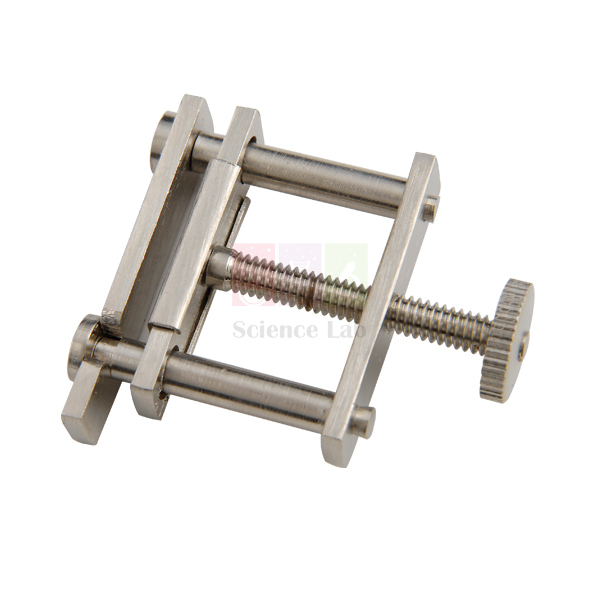
Hoffman Screw Clip
Hoffman Screw Clip (Product Code: SLE/CH/92) is a screw-adjusted clamp that squeezes flexible tubing to slow, meter or completely stop the flow of a liquid or gas. Unlike a spring pinch clip, which is either open or shut, the screw lets you set a partial restriction and leave it there, which makes it useful on gas-delivery lines, siphons and reservoir outlets in teaching laboratories. Chemistry teachers, lab technicians and students in schools and colleges rely on it whenever a set-up needs steady, hands-free flow control. It is made by Jain Scientific Equipments Pvt Ltd (ScienceLab), Ambala, as part of its school chemistry lab equipment in India.
Specifications
| Parameter | Detail |
|---|---|
| Type | Hoffman-pattern screw clip for flexible tubing |
| Construction | Screwed, with hinged side bar |
| Material | Copper, iron |
| Finish | Plated metal / plated brass |
| Tubing size | For use with tubes up to 20 mm outer diameter |
Typical Use
The hinged side bar swings aside so the clip can be placed around a length of tubing that is already connected at both ends, then closed and locked by the screw. Turning the screw presses the tube flat in small steps: a gas stream from a generator can be slowed to a countable bubble rate, the drip from a reservoir set to a chosen speed, or a line sealed completely so reagent is held back between stages of an experiment.
Before ordering, check that your tubing is no more than 20 mm across the outside. Avoid overtightening thin-walled tubing, which can split or take a permanent crease, and back the screw off when apparatus is put away so the tube recovers its round shape. Buyers sourcing from a chemistry lab instruments supplier often order these clips together with matching rubber tubing so every bench has a ready flow-control set.
Manufacturer
This clip is produced by Jain Scientific Equipments Private Limited, which trades under the brand ScienceLab from Ambala, Haryana, India, and supplies laboratory apparatus to schools, colleges and distributors. Learn more about the company in our company profile.
Related Chemistry Lab Equipment
Items usually ordered for the same tubing and flow-control set-ups:
- Rubber Tubing — flexible tubing for the clip to regulate; confirm the outer diameter is within 20 mm
- Vacuum Tubing — thick-walled tubing for suction lines that may also need a shut-off point
- Borosilicate Glass Tubing — glass delivery tubes joined to the flexible sections the clip controls
- Pinch Clip — spring clip for simple open-or-shut control where no fine adjustment is needed
- Hoffman Clips — another Hoffman-type clip in our range to compare before ordering
See the complete Chemistry Lab Equipment range for stands, clamps and other bench apparatus.
Frequently Asked Questions
What tubing size does the Hoffman Screw Clip accept?
It is made for tubes up to 20 mm outer diameter. If your tubing is close to that limit or unusually thick-walled, send us its dimensions through our contact page before ordering.
How is it different from a pinch clip?
A screw clip holds any setting between fully open and fully closed, so it can meter flow; a spring pinch clip only opens or shuts the tube.
Can I fit it without disconnecting my apparatus?
Yes. The hinged side bar opens so the clip can be placed around tubing mid-line, then closed and tightened.
What metal is it made from?
Copper and iron are listed for this clip, with a plated metal or plated brass finish. If you need a particular finish for a tender, mention it in your enquiry and we will confirm what is available.
Should it be used as the shut-off on a fuel gas line?
No. Use it to regulate flow within experimental set-ups; always close the gas tap or burner valve to shut off a fuel gas supply.
What warranty applies?
Warranty terms are not listed on this page; please ask through our contact page and we will confirm them with your quotation.
Do you supply in bulk to institutions and overseas buyers?
Yes. We supply schools, colleges and distributors across India and international markets; include the quantity, delivery location and your tubing size so we can quote accurately.
Request a Quote
Add the Hoffman Screw Clip to our enquiry cart or contact us with the quantity you need for a quotation.
Last updated: 24 September 2026
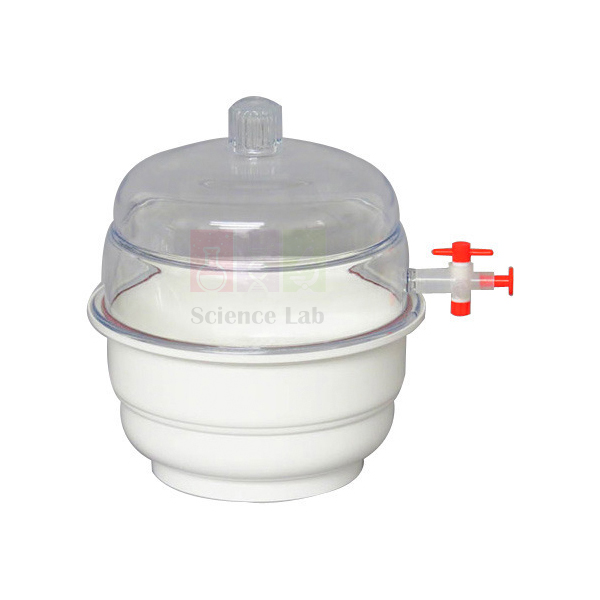
Vacuum Desiccator
Vacuum Desiccator (Product Code: SLE/CH/93) is a sealable chamber for drying samples, or keeping them dry, over a desiccant, with a stopcock that allows the air inside to be pumped out so moisture leaves faster. Its moulded polycarbonate dome is rigid and transparent, giving a clear view of the desiccant and samples without breaking the seal, while the lower part is polypropylene. Analytical, research and teaching laboratories use it to cool crucibles after ignition, store moisture-sensitive reagents and dry solids to constant weight. It is made by Jain Scientific Equipments Pvt Ltd (ScienceLab), Ambala, a laboratory equipment supplier in India.
Specifications
| Parameter | Detail |
|---|---|
| Materials | Polypropylene and polycarbonate |
| Top dome | Moulded in rigid, transparent polycarbonate; knurled knob on top for easy handling |
| Lower part | Polypropylene |
| Seal | Internal groove on the flange to hold a silicone rubber O-ring |
| Vacuum holding | Up to 740 mm of Hg for 24 hrs without any greasing |
| Stopcock | Polypropylene, fitted with a self-lubricating PTFE plug |
| Stopcock action | Three-way: vacuum creation, shutting off and vacuum releasing |
| Sterilisation | Autoclavable |
Typical Use
Charge the lower section with fresh desiccant, place the sample vessels inside, and seat the dome so the O-ring bears evenly on the flange. Connect the stopcock to a vacuum pump, turn the PTFE plug to the evacuating position and pump down, then turn it to shut off and disconnect the pump; the chamber is specified to hold up to 740 mm of Hg for 24 hrs with no grease on the flange. When you need to open it, turn the plug slowly to the release position so air bleeds back gently and does not scatter fine powders.
In gravimetric work, crucibles and weighing bottles are cooled here between heating and weighing so they do not pick up atmospheric moisture, and hygroscopic salts or dried precipitates can be stored for days. Keep the flange and O-ring free of dust, replace spent desiccant regularly, and clean the polycarbonate dome with mild detergent rather than harsh solvents. Chemistry, pharmacy and materials departments choosing lab equipment for college use in India will find it a dependable option for dry storage.
Manufacturer
Jain Scientific Equipments Private Limited trades as ScienceLab and is based in Ambala, Haryana, India, where it makes laboratory apparatus for education and research. Buyers completing vendor registration can use the company's GSTIN 06AAECJ8618A1ZT and Legal Entity Identifier (LEI) 3358004HRD1JIVXKYX49. Read our company profile for more background.
Related Laboratory Equipment
Items that complete a vacuum drying set-up:
- Vacuum Pump, Hand — manual pumping through the stopcock where no power point is nearby
- Vacuum Pump, Electric — for labs that pump the desiccator down frequently
- Vacuum Tubing — thick-walled tube to link the pump to the stopcock without collapsing
- Silica Gel Coarse — desiccant to charge the lower section
- Crucible with lid — one of the vessels most often cooled inside a desiccator before weighing
Browse our Chemistry Lab Equipment range for more drying, heating and weighing apparatus.
Frequently Asked Questions
How long does the Vacuum Desiccator hold vacuum?
It is specified to hold vacuum up to 740 mm of Hg for 24 hrs without greasing. A clean flange and an undamaged O-ring are needed to achieve this.
Do I need vacuum grease on the flange?
No. The silicone rubber O-ring seated in the flange groove seals without grease, so there is no grease residue to contaminate samples.
Is desiccant included?
A desiccant is not listed as part of the supply. Order it separately, for example our Silica Gel Coarse, or ask us to add it to your quotation.
Can it be autoclaved?
Yes, it is described as autoclavable. For the recommended cycle, please check with us through our contact page.
What internal diameter or capacity does it have?
Dimensions are not listed on this page; contact us with the size of the vessels you want to store and we will advise.
How does the three-way stopcock work?
The PTFE plug is turned to one position to evacuate the chamber, another to shut it off after pumping, and a third to release the vacuum before opening.
What should an institutional quotation request include?
State the quantity, any preferred size, whether you also need pumps or desiccant, and the delivery location. We supply institutions in India and international markets.
Request a Quote
To price the Vacuum Desiccator, add it to the enquiry cart or send your requirements through our contact page.
Last updated: 24 September 2026
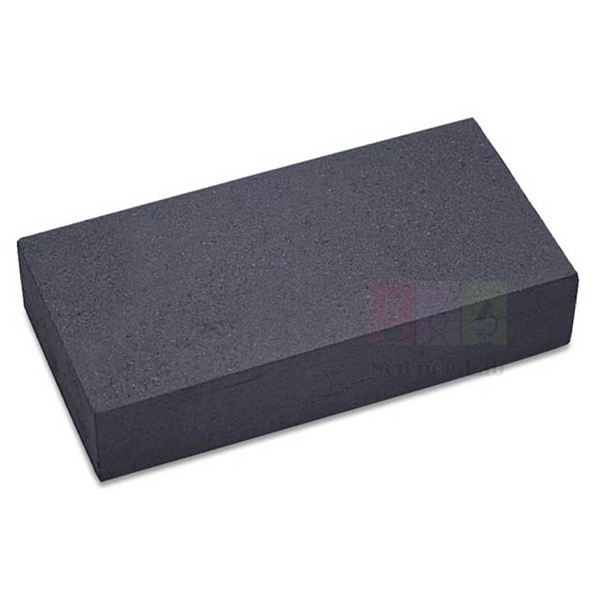
Charcoal Block
Charcoal Block (Product Code: SLE/CH/95) is a block of natural charcoal used as the working surface when soldering with a flame. While the joint is heated, the charcoal absorbs oxygen from around the work, which helps prevent firestain on silver, and the soft block can be carved with small dips in which scraps of silver melt into neat round balls. It also protects the bench beneath from the heat of the torch. Metalwork and jewellery-making students, craft workshops and chemistry teaching labs all use it. The block is supplied by Jain Scientific Equipments Pvt Ltd (ScienceLab), Ambala, as part of its range as a lab consumables supplier in India.
Key Details
| Parameter | Detail |
|---|---|
| Type | Natural charcoal block |
| Purpose | Surface to solder on |
| Key property | Absorbs oxygen during soldering to help prevent firestain |
| Workability | Soft enough to carve dips for forming small round balls of silver |
| Surface protection | Shields the work surface from the heat of a flame torch |
| Supplied as | Individual block; ask us for current dimensions and pack quantities |
Typical Use
Lay the pieces to be joined on the flat face, apply flux and solder, and play the torch flame over the work; the glowing charcoal reflects heat back into the joint and keeps oxygen away from the hot metal. To make granules or small spheres, scrape a shallow hollow into the block with a scriber, drop in a clipping of silver and heat until it draws up into a ball. Because the block is soft, it wears with every session, and some users tie iron wire binding around it to stop it breaking apart over long use.
In school chemistry, a charcoal block is also the traditional support for the charcoal cavity test in qualitative analysis, where a little of a salt is heated in a hollow using a blowpipe flame. Whichever way it is used, let the block cool fully and check that no part is still glowing before putting it away, and store it somewhere dry. Labs ordering from a chemistry consumables supplier in India often keep a few spare blocks for exactly this reason.
Supplier
This charcoal block is supplied by Jain Scientific Equipments Private Limited, the company behind the ScienceLab brand, based in Ambala, Haryana, India. Alongside the laboratory apparatus it manufactures, the company supplies consumables so institutions can source a complete bench set from one vendor. Visit our company profile to learn more.
Related Chemistry Lab Equipment
Apparatus used with a charcoal block for flame work:
- Blow Pipe Brass — directs a fine, hot flame onto a sample sitting in a charcoal cavity
- Bunsen Burner — the usual flame source for blowpipe work in school labs
- Micro Burner — a smaller flame for delicate heating on the block
- Crucible Tong — for moving hot pieces off the block safely
Explore the full Chemistry Lab Equipment range for burners and heating accessories.
Frequently Asked Questions
Why solder on charcoal instead of a ceramic board?
Charcoal absorbs oxygen around the joint, helping to prevent firestain, and it can be carved to hold small parts or form balls of silver. It also protects the surface underneath from torch heat.
How can I stop the block from cracking?
Tying iron binding wire around the block helps hold it together as it wears. Avoid dropping it and let it cool slowly after use.
Can it be used for the charcoal cavity test in chemistry?
Yes, that is a traditional use: a small sample is heated in a hollow in the block with a blowpipe flame, under teacher supervision and with good ventilation.
How long does a block last?
It is a consumable, so each heating burns away a little of the surface. Life depends on how often and how hard it is used, so there is no fixed figure.
What size is the block?
Dimensions are not listed on this page. Please ask through our contact page and we will confirm the current size.
Can you supply blocks in quantity for a workshop or school?
Yes. We supply institutions and distributors in India and international markets; tell us the number of blocks and delivery location for a quotation.
Request a Quote
Place the Charcoal Block in our enquiry cart or contact us with your quantity and we will respond with a quotation.
Last updated: 24 September 2026

Centrifuge Machine
Centrifuge Machine (Product Code: SLE/CH/96) is a microprocessor-based bench centrifuge that spins sample tubes at controlled speed so denser material, such as precipitates, cells or suspended solids, is driven to the bottom of each tube. A square mild-steel body, powder coated, carries a double-walled lightweight ABS lid, and a two-line LCD panel shows the countdown timer and a digital rpm reading while the programmable controller holds the set speed. College chemistry and biology labs, paramedical teaching labs and research groups use it for routine separations. It is made by Jain Scientific Equipments Pvt Ltd (ScienceLab), Ambala, which supplies this laboratory centrifuge in India and international markets.
Specifications
| Parameter | Detail |
|---|---|
| Control | Microprocessor based |
| Body | Square M.S. (mild steel) body, powder coated |
| Lid | Double-walled, lightweight ABS |
| Display panel | Microprocessor-based LCD, 2 lines x 16 characters |
| Timer | 0–59 minute countdown timer |
| Speed | Digital rpm meter with programmable speed controller |
| Rotor head supplied | One angle head: 8 x 15 ml or 4 x 50 ml |
Typical Use
Fill tubes to the same level, place them in opposite positions in the angle head so the load is balanced, close the lid, then set the run time on the countdown timer and the speed on the programmable controller. The digital rpm meter lets students see when the rotor has reached the set speed, and the timer ends the run automatically, so a class can repeat a separation under the same conditions every time. Wait for the rotor to stop completely before opening the lid.
The 8 x 15 ml head suits batches of smaller tubes, for example several student groups separating precipitates at once, while the 4 x 50 ml head handles larger volumes such as sample preparation before analysis. Choose the head when ordering, keep the chamber clean and dry, and wipe up any spill immediately. For departments setting up lab equipment for research in India, it offers timed, repeatable runs in a compact bench unit.
Manufacturer
The Centrifuge Machine is manufactured by Jain Scientific Equipments Private Limited, trading as ScienceLab, a company based in Ambala, Haryana, India, that produces laboratory and teaching equipment. Our company profile gives further detail.
Related Laboratory Equipment
Tubes, racks and alternative centrifuges for the same separation work:
- Oak Ridge Centrifuge Tubes — sample tubes; choose a size that fits the 15 ml or 50 ml head you order
- Test Tube Racks — hold tubes upright while filling and after spinning
- Laboratory Centrifuge — another bench model to compare for your workload
- Micro Centrifuge — for very small sample volumes in microtubes
- Hand Centrifuge — a non-electric option for basic demonstrations
More apparatus is listed under Chemistry Lab Equipment.
Frequently Asked Questions
Which rotor head comes with the Centrifuge Machine?
One angle head is supplied: either 8 x 15 ml or 4 x 50 ml. Tell us which you need; if you want both, ask about an additional head through our contact page.
What is the maximum speed?
The maximum rpm is not listed on this page. The unit has a digital rpm meter and programmable speed controller; contact us for the full datasheet.
How long can a run be set for?
The countdown timer covers 0–59 minutes.
Why must the tubes be balanced?
An uneven load makes the rotor vibrate, which can damage the machine and disturb the separation. Always place tubes of equal fill opposite each other.
What power supply does it need?
Electrical ratings are not stated here. Mention your local mains voltage in your enquiry so we can confirm a suitable configuration.
Is a calibration certificate available?
Please discuss calibration certificate availability with us when you request a quotation.
What details should an institutional quotation include?
The rotor head choice, quantity, mains voltage, delivery location and any warranty or service terms you need confirmed. We supply institutions across India and international markets.
Request a Quote
Add the Centrifuge Machine to our enquiry cart or reach us through the contact page for pricing and availability.
Last updated: 24 September 2026

DNA-RNA Model
DNA-RNA Model (Product Code: SLE/CH/97) is a build-it-yourself molecular model kit that shows how nucleic acids are assembled: sugar and phosphate units form the backbone, coloured base tubes pair across the middle, and separate pieces stand for the hydrogen bonds between base pairs. Because white uracil tubes are included alongside thymine, the same set can be used to compare DNA with RNA. Biology, biochemistry and chemistry teachers in schools and colleges use it for lessons on genetics and molecular structure, and students use it for 3D science model kit projects in India. It is made by Jain Scientific Equipments Pvt Ltd (ScienceLab), Ambala.
Specifications
| Parameter | Detail |
|---|---|
| Base tubes | 30 coloured tubes: guanine red, cytosine green, thymine blue, adenine grey, uracil white |
| Hydrogen-bond pieces | 12 white two-prong centres representing the hydrogen bond between base pairs |
| Sugar units | 28 black trigonal atom centres |
| Phosphate units | 25 red two-prong atom centres |
| Backbone links | 50 yellow tubes linking the phosphate groups to the sugar rings |
| Display | Wooden base with support rod |
Typical Use
Students first join black sugar centres and red phosphate centres with yellow tubes to build each backbone, then attach base tubes and connect complementary pairs through the white hydrogen-bond pieces: adenine with thymine and guanine with cytosine. Swapping the blue thymine tubes for white uracil tubes turns a DNA segment into an RNA-style strand, which makes the difference between the two nucleic acids easy to see. The finished model stands on the wooden base and support rod for display during the lesson.
Sort the pieces by colour before class and give each group a colour key so base identity is never confused. Count the parts back into the box afterwards, since small components are easily lost. As a hands-on biology experiment kit for students, it works well for revision, group activities and project displays.
Manufacturer
ScienceLab is the brand name of Jain Scientific Equipments Private Limited, based in Ambala, Haryana, India. The company is incorporated under CIN U29309HR2020PTC087597 and manufactures at its licensed factory at 449, HSIIDC Industrial Area, Saha, Ambala (Factory Licence AMB-ONLINE-CHD-J-414). Find out more in our company profile.
Related Laboratory Equipment
Models and activities that pair well with this kit in a genetics unit:
- Molecular Model, RNA 12 Base — a dedicated RNA model for comparison with the DNA build
- Molecular Model Kit, Ten Layer DNA — a longer double-helix build for display
- DNA Activity Model — another hands-on DNA model for group work
- DNA extraction lab kit — lets students isolate real DNA after studying its structure
- DNA Fingerprinting Electrophoresis Lab Activity — extends the topic to DNA analysis
This model is listed in our Chemistry Lab Equipment category, alongside other teaching models and apparatus.
Frequently Asked Questions
What is included in the DNA-RNA Model?
30 coloured base tubes, 12 white hydrogen-bond centres, 28 black sugar centres, 25 red phosphate centres, 50 yellow linking tubes, and a wooden base with support rod.
Can it show RNA as well as DNA?
Yes. White uracil tubes are included, so students can replace thymine and build an RNA-style strand.
How are hydrogen bonds shown?
By the 12 white two-prong centres that connect the paired bases across the two strands.
How many base pairs can be built?
The kit is described by its part counts rather than a finished length. Contact us if you need a model of a particular size and we will advise.
Does it arrive assembled?
It is supplied as a kit of parts with the base and support rod, so students build the structure themselves.
How should the parts be cleaned?
Wipe them with a damp cloth and let them dry before storing. Keep small parts away from very young children.
Can schools order class sets or tender quantities?
Yes. Send the number of kits, delivery location and any tender paperwork you need; we supply institutions in India and international markets.
Request a Quote
To request pricing, add the DNA-RNA Model to the enquiry cart or write to us via the contact page.
Last updated: 24 September 2026
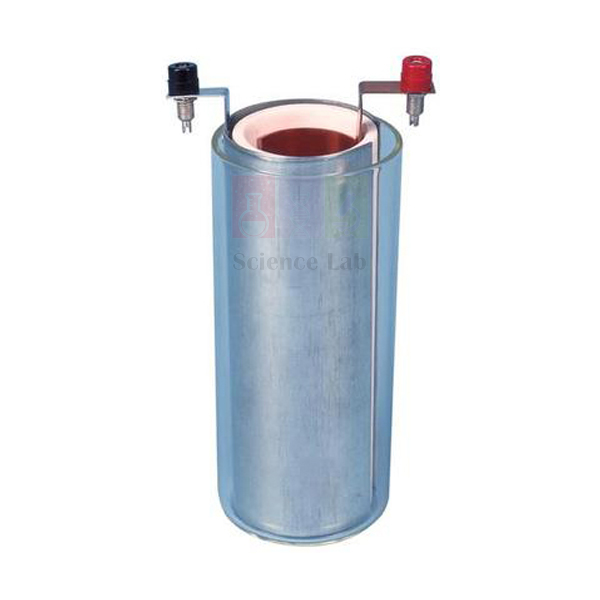
Daniell Cell
Daniell Cell (Product Code: SLE/CH/98) is a classic zinc–copper electrochemical cell for studying how a redox reaction between two metals and their salt solutions produces a voltage. It consists of a cylindrical zinc electrode and a copper electrode, a clay vessel and a battery glass; filled with electrolyte it supplies approx. 1.1 volts, and 4 mm jacks make connection to a meter straightforward. Chemistry and physics teachers in schools and colleges use it to introduce galvanic cells, electrode potentials and the origin of battery voltage. It is made by Jain Scientific Equipments Pvt Ltd (ScienceLab), Ambala, as an electrochemical cell kit for school and college labs.
Specifications
| Parameter | Detail |
|---|---|
| Purpose | Studying the properties of an electrochemical cell |
| Electrodes | Cylindrical zinc electrode and copper electrode |
| Vessels | Clay vessel and battery glass |
| Output voltage | Approx. 1.1 V when filled with cell electrolyte |
| Connections | Via 4 mm jacks |
| Dimensions | 105 mm in height, 65 mm diameter |
| Suitable filling | Copper sulphate solution (CuSO4), 10% concentration; zinc sulphate solution (ZnSO4), 10% concentration |
| Supplied | Without filling (electrolytes not included) |
Typical Use
Prepare 10% copper sulphate and 10% zinc sulphate solutions, place each electrode in the solution of its own metal with the clay vessel keeping the two liquids apart, and connect a voltmeter to the 4 mm jacks. Students should read close to 1.1 V, and can then discuss which electrode is oxidised, which way electrons flow through the external circuit, and why the clay vessel must let ions pass while stopping the solutions from mixing freely.
After the lesson, pour out both electrolytes, rinse the clay vessel and electrodes with clean water, and let everything dry so crystals do not build up in the clay. The zinc electrode is gradually consumed as the cell works, so inspect it before each class. As part of a school chemistry lab equipment set in India, the cell links electrochemistry theory to a reading students can take themselves.
Manufacturer
Jain Scientific Equipments Private Limited, known by its brand name ScienceLab, makes this cell and other teaching apparatus in Ambala, Haryana, India. You can read more about us in the company profile.
Related Chemistry Lab Equipment
What you need to fill, connect and measure the cell:
- Cupric Sulphate (Copper Sulphate) — for preparing the 10% copper sulphate electrolyte
- Zinc Sulfate 100 g — for preparing the 10% zinc sulphate electrolyte
- Digital Voltmeter — to read the approx. 1.1 V output
- Banana Plug Connectors Leads — plug leads for wiring the jacks to a meter; check plug size against the 4 mm jacks
- Student Voltaic Cell Set — for comparing other metal pairs in follow-up work
More electrochemistry and bench apparatus is available in our Chemistry Lab Equipment category.
Frequently Asked Questions
Are the electrolytes included with the Daniell Cell?
No. The cell is delivered without a filling. Copper sulphate and zinc sulphate solutions, each at 10% concentration, are the suitable fillings.
What voltage does it produce?
Approximately 1.1 volts when filled with the cell electrolyte.
How do I connect it to a meter?
Through its 4 mm jacks, using leads fitted with matching plugs.
How big is it?
It stands 105 mm high with a diameter of 65 mm, small enough for student benches.
Can it power a bulb or motor?
It is intended for studying cell properties rather than as a power source, and its current capacity is not specified. Contact us if you plan a load experiment.
How should it be stored between classes?
Empty both solutions, rinse all parts with water and let them dry fully before storing.
Do you supply sets for a whole class?
Yes. Tell us how many cells you need and whether the electrolytes should be quoted too; we supply institutions in India and international markets.
Request a Quote
Put the Daniell Cell in our enquiry cart or get in touch for a quotation covering quantity and delivery.
Last updated: 24 September 2026