- Physics Lab Equipment
- Chemistry Lab Equipment
- Biology Lab Equipment
- Anatomical Lab Equipment
- Learning
- Educational Lab Equipment
- Magnets
- Agriculture
- Astronomy
- Earth Science
- Geography Lab Equipment
- Safety Lab Coat
- Laboratory
- Meteorological
- Electricity & Magnetism
- Heat
- School Lab Equipment
- Lab Glassware
- Science Lab Equipment
- Tvet Lab Equipment
- Robotics Kits Supplier and Manufacturer for Schools India
- Math Lab Equipment Manufacturers and Exporters in Ambala
- STEM Kits Manufacturers and Supplier India
- Engineering Lab Equipment
- Hospital Lab Equipment
- Water, Sanitation & Hygiene Supplies
- Cold Chain, Solar & Communication Equipment
- Nutrition
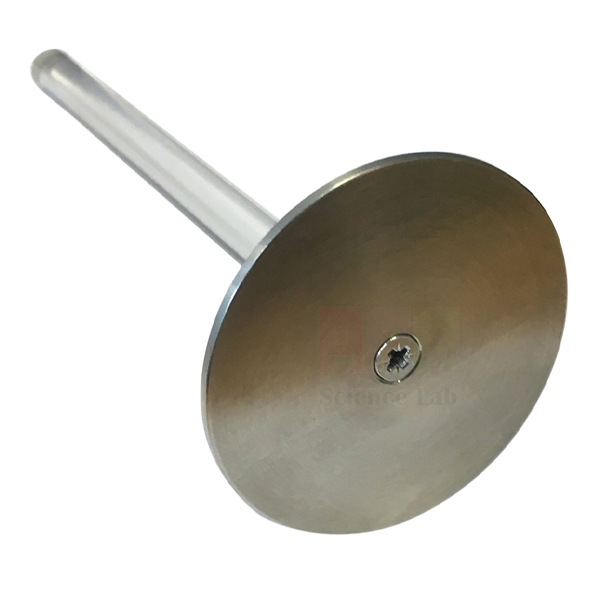
Proof Plane 20mm Dia
Proof Plane 20mm Dia (Product Code: SLE/EAM/14) is a small circular metal plate on an insulating handle, used in electrostatics to pick up a sample of charge from a conductor and carry it to a detector. As the smallest plate in a range of three sizes, it is suited to sampling charge from small areas, for example when comparing different parts of a charged Van de Graaff dome. It is one of the simple but important physics lab instruments made by Jain Scientific Equipments Pvt Ltd (ScienceLab) in Ambala, India.
Specifications
| Parameter | Detail |
|---|---|
| Plate | Circular metal plate, 20 mm diameter |
| Handle | Insulating |
| Purpose | Transferring charge and investigating charge distribution in electrostatics |
| For use with | Van de Graaff generator |
| Other sizes in the range | 40 mm and 60 mm diameter plates |
Typical Use
Holding the proof plane by its handle, the student touches the plate against a charged conductor, lifts it away and brings it to the cap of an electroscope or into a Faraday's pail; the size of the response shows how much charge the plate collected. Repeating this at a sharply curved region and at a flatter region of the same conductor reveals that charge gathers more densely where the surface curves most, which is the principle behind lightning conductors and the point discharge seen on a Van de Graaff generator.
The 20 mm plate is the choice when you want to sample a small, well-defined patch of surface; the larger plates in the range collect more charge and give a bigger deflection. Always discharge the plate by touching it to earth between samples, hold it only by the handle, and keep the handle clean and dry, since grease or damp air lets charge leak away and spoils electrostatics results.
Manufacturer
ScienceLab proof planes are made by Jain Scientific Equipments Private Limited, a manufacturer of electrostatics and general physics apparatus based in Ambala, Haryana. The company profile explains more about the firm and its range.
Related Electricity and Magnetism Equipment
A proof plane needs a charge source and a detector; these items complete the set:
- Van de Graaff Generator — the charged conductor the proof plane is designed to sample.
- Van De Graaff Accessory Kit — includes a Faraday's pail and other items for electrostatics demonstrations.
- Electroscope, Gold Leaf — shows the charge carried by the proof plane through leaf deflection on a scale.
- E-Field Detector — indicates the sign and size of charge with an LED array.
For more electrostatics apparatus, browse Electricity and Magnetism.
Frequently Asked Questions
What size is this proof plane?
The plate is 20 mm in diameter. The same design is also available with 40 mm and 60 mm plates.
Which plate size should I choose?
Choose the 20 mm plate to sample small areas and compare charge density at different points; larger plates pick up more charge and give a stronger signal on the detector. Many labs keep more than one size.
What equipment is it used with?
It is intended for use with a Van de Graaff generator, together with a detector such as an electroscope or a Faraday's pail.
Why do my results fade on humid days?
Moisture or grease on the insulating handle allows charge to leak. Keep the handle clean and dry, and work in the driest part of the room.
Is it supplied singly or in a set?
The pack quantity is not stated on this page. Please tell us how many you need through our contact page and we will confirm.
Can you supply schools in bulk or overseas?
Yes. ScienceLab quotes class and institutional quantities for India and international markets; include your delivery location in the enquiry.
Request a Quote
For pricing on the Proof Plane 20mm Dia, or a mix of plate sizes, contact us through the contact page or add it to the enquiry cart with your electrostatics apparatus.
Last updated: 24 September 2026
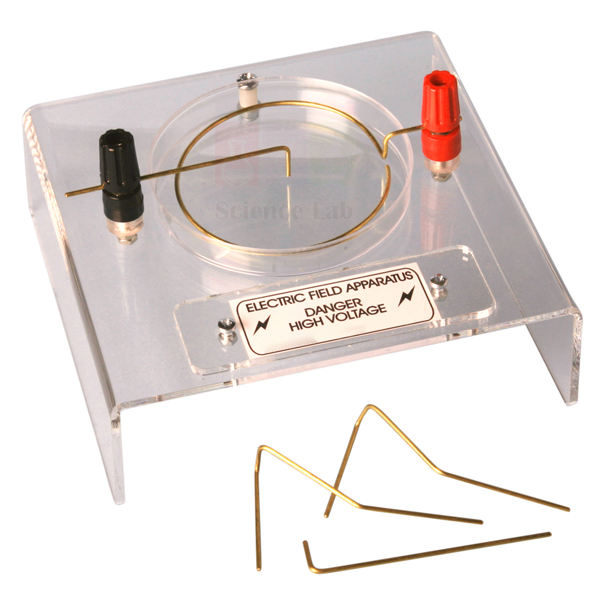
Electric Field Apparatus
Electric Field Apparatus (Product Code: SLE/EAM/15) makes invisible electric fields visible: fine particles floating on liquid paraffin in a 90 mm petri dish line up along the field between a pair of electrodes once a high voltage is applied. Built on a clear acrylic base that can go straight onto an overhead projector, it is a simple physics demonstration kit for showing the field patterns of various electrode configurations to a whole class. It is made by Jain Scientific Equipments Pvt Ltd (ScienceLab), Ambala, India.
Specifications
| Parameter | Detail |
|---|---|
| Type | Electric field pattern demonstration model |
| Dish | 90 mm petri dish, filled with liquid paraffin in use |
| Electrodes | Various electrode configurations |
| Connections | 4 mm terminals for the high-voltage supply |
| Base | Clear acrylic, allows projection with an overhead projector |
| Dimensions | 150 x 150 x 60 mm |
| Supply required | Safe, low-current limited 0–5 kV EHT supply |
| Not supplied | Semolina or fine grass seed |
Typical Use
Pour a shallow layer of liquid paraffin into the petri dish and sprinkle semolina or fine grass seed evenly over the surface. With the EHT supply switched off and turned to zero, connect it to the 4 mm terminals, then raise the voltage slowly: the grains swing round and settle into chains that trace the field lines between the electrodes. Changing the electrode arrangement lets students compare how the pattern differs from one configuration to the next, noting where the lines crowd together and where they spread out, and link each picture to the idea of field strength.
Set on an overhead projector, the acrylic base throws the pattern onto the screen so everyone sees the same result, making this a useful piece of physics lab equipment for introducing electric fields before any calculation. Only use a current-limited EHT supply, make every change to the electrodes with the supply switched off, and clean the paraffin out of the dish after the lesson.
Manufacturer
The apparatus is manufactured by Jain Scientific Equipments Private Limited in Ambala, Haryana, and sold under the company's ScienceLab brand. For purchase departments completing vendor forms, the company's GSTIN is 06AAECJ8618A1ZT and its Legal Entity Identifier is 3358004HRD1JIVXKYX49. See the company profile for more.
Related Electricity and Magnetism Equipment
To run this demonstration and build the wider electrostatics topic around it:
- EHT Power Supply — an adjustable, current-limited high-voltage source of the kind this apparatus requires.
- Magnetic Field Unit Vertical Wire — the magnetic counterpart, also on a clear acrylic base for projection.
- E-Field Detector — indicates the sign and size of charge for follow-up work.
- Proof Plane 20mm Dia — samples charge from conductors when studying charge distribution.
All our electrostatics and field apparatus is listed in Electricity and Magnetism.
Frequently Asked Questions
What power supply does it need?
A safe, low-current limited EHT supply adjustable from 0 to 5 kV, connected through the 4 mm terminals. Do not use a supply without current limiting.
What do I need to add before use?
Liquid paraffin for the dish and semolina or fine grass seed to show the pattern. The semolina or seed is not supplied; if you would like us to include paraffin, mention it through our contact page.
Can the whole class see the pattern?
Yes. The clear acrylic base allows the pattern to be projected with an overhead projector.
How big is the apparatus?
It measures 150 x 150 x 60 mm, which fits the stage of a typical overhead projector, and the dish is 90 mm across.
Which electrode shapes are provided?
The apparatus demonstrates fields between various electrode configurations. For the exact set supplied, please check with us before ordering.
Is a warranty included?
Warranty terms are confirmed in the quotation for your order.
Do you accept institutional and export orders?
Yes. Send your quantity, delivery location and any vendor documentation you need, and we will quote for India or international markets.
Request a Quote
Price the Electric Field Apparatus, with an EHT supply if required, through our contact page or by adding both to the enquiry cart.
Last updated: 24 September 2026
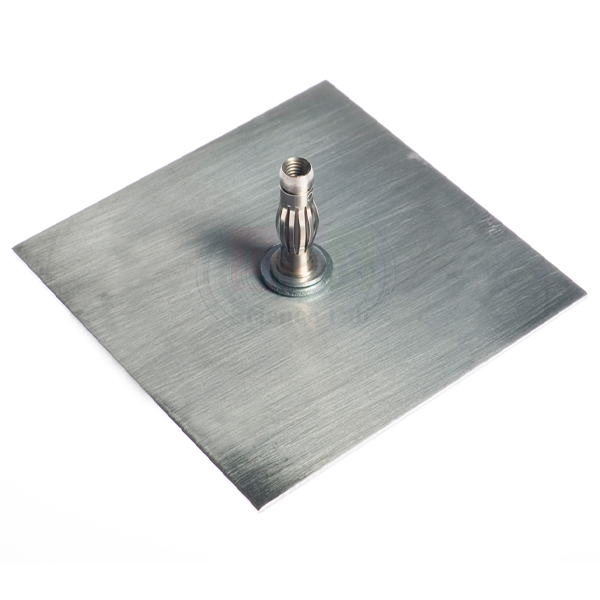
Zinc Plate
Zinc Plate (Product Code: SLE/EAM/16) is a 40 x 40 mm zinc plate mounted on a 4 mm connector so that it can replace the top plate of an electroscope. Once fitted, it turns the electroscope into a simple photoelectric effect kit: a negatively charged plate loses its charge when lit by ultraviolet of a suitable wavelength, which students see as the leaf falling. It is made by Jain Scientific Equipments Pvt Ltd (ScienceLab), Ambala, India.
Specifications
| Parameter | Detail |
|---|---|
| Plate | Zinc, 40 x 40 mm |
| Mounting | 4 mm connector |
| Fits | Replaces the top plate of an electroscope |
| Demonstrates | Discharge under UV lighting; the photo-electric effect |
| Also required | UV lamp of suitable wavelength (not part of this item) |
Typical Use
Clean the zinc surface first, since a dull oxide layer weakens the effect, then plug the plate into the electroscope in place of its usual top plate and give it a negative charge so the leaf rises. When the UV lamp is switched on and aimed at the plate, electrons are emitted from the zinc and the leaf slowly collapses. Repeating with a positive charge produces no discharge, and holding a sheet of ordinary glass between lamp and plate stops the effect as well, because the glass absorbs the short-wavelength ultraviolet that does the work.
Those three observations – negative charge lost, positive charge kept, glass blocks it – lead students to the idea of photons and threshold frequency far more convincingly than a diagram. The demonstration fits naturally into a radiation experiment sequence at senior level. UV lamps can harm eyes and skin, so never look into the lamp, keep exposure short and use suitable eye protection.
Manufacturer
This accessory is produced by Jain Scientific Equipments Private Limited, the Ambala, Haryana company behind the ScienceLab name, which makes electrostatics and modern-physics apparatus for schools and colleges. Read more on the company profile.
Related Electricity and Magnetism Equipment
The zinc plate works as part of an electroscope set-up; these items help complete it:
- Electroscope, Gold Leaf — a plate-topped electroscope with a deflection scale; ask us to confirm fit with the zinc plate.
- E-Field Detector — confirms whether the plate carries negative or positive charge.
- Proof Plane 20mm Dia — transfers charge onto the electroscope from a charged source.
- Van de Graaff Generator — a hand-cranked source of static charge for electrostatics lessons.
More electrostatics apparatus is available in Electricity and Magnetism.
Frequently Asked Questions
What size is the zinc plate?
40 x 40 mm, mounted on a 4 mm connector.
Will it fit my electroscope?
It is designed to replace the top plate of an electroscope using its 4 mm connector. Tell us which electroscope you have through our contact page and we will confirm compatibility.
Is a UV lamp included?
No. A UV lamp of suitable wavelength is required separately. Not every UV source works, since the radiation must be short enough in wavelength to release electrons from zinc, so ask us before choosing a lamp.
Why does the leaf not fall when the plate is positively charged?
Ultraviolet releases electrons from the zinc. A positively charged plate attracts them back, so no charge is lost; this contrast is a key part of the demonstration.
How should the plate be cared for?
Keep the zinc surface clean and bright, cleaning it before each session, and store the plate dry so the surface does not dull.
Can you supply it with other electrostatics apparatus?
Yes. Combined orders for schools and colleges in India and international markets are quoted together, including warranty terms.
Request a Quote
Enquire about the Zinc Plate through the contact page, or add it to the enquiry cart along with the electroscope you plan to use it with.
Last updated: 24 September 2026
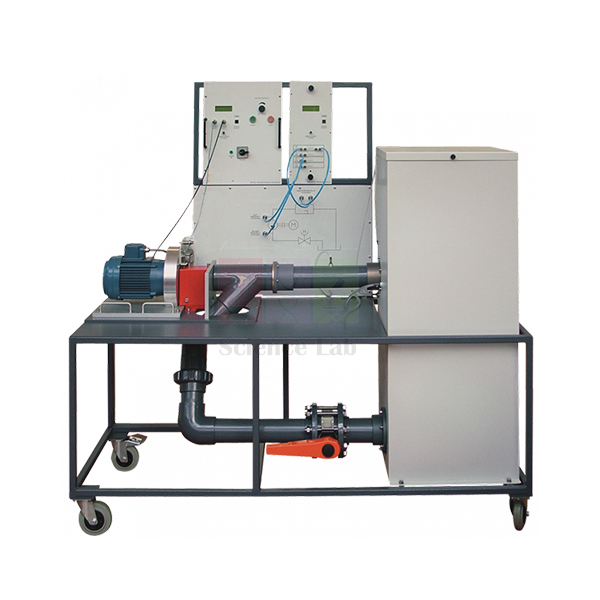
Axial Flow Pump Module
The Axial Flow Pump Module (Product Code: SLE/EFM/03) is a self-contained test rig built around an axial flow pump, mounted in a mobile frame with full instrumentation that includes a digital pressure display. It lets students study and test a common type of rotodynamic pump safely and at a realistic scale, without needing any external water supply. The module is made by Jain Scientific Equipments Pvt Ltd (ScienceLab), Ambala, and is part of the engineering educational equipment we build for colleges in India and abroad.
Specifications
| Parameter | Detail |
|---|---|
| Pump type | Axial flow (rotodynamic) |
| Mounting | Mobile frame |
| Instrumentation | Full instrumentation, including a digital pressure display |
| Speed and flow | Fully variable, for a range of tests |
| Water supply | Own water reservoir; no external water supply needed |
| Drive | Part of the Modular Fluid Power range; connects with the Universal Dynamometer as a common motive-power source |
| Connection plate | Schematic diagram showing the water flow circuit and how the parts of the module connect |
Typical Use
The core experiment is the pump characteristic: at a fixed speed, students throttle the flow in steps, record pressure rise and shaft power at each point, and plot head, power and efficiency against flow rate. Repeating the test at other speeds shows how the whole curve shifts and gives a practical introduction to the pump scaling laws. Axial flow pumps move large volumes against relatively modest heads, so comparing their curves with those of a centrifugal pump helps students understand why each design suits different duties, from drainage and irrigation to cooling-water circuits.
Because the module carries its own reservoir, it can be wheeled into any teaching space as lab equipment for college practicals without plumbing. Sharing one Universal Dynamometer across several Fluid Power modules keeps the cost of a full lab down, and the schematic on the connection plate helps students trace the circuit before they start. Check the reservoir level before each session and drain it for long storage.
Manufacturer
ScienceLab is how Jain Scientific Equipments Private Limited presents its products to schools, colleges and training centres. The company operates from Ambala, Haryana, where it manufactures teaching apparatus including this pump module; details are on our company profile.
Related Fluid Mechanics Equipment
Equipment that builds out a rotodynamic machines lab with this module:
- Universal Dynamometer — the shared drive that supplies and measures shaft power
- Two Stage (Series And parallel) — centrifugal pumps for comparing radial-flow and axial-flow behaviour
- Centrifugal Fan Module — extends rotodynamic testing from water to air
- Vane Pump — a positive displacement contrast to the axial flow design
See the complete Fluid Mechanics collection for more hydraulics apparatus.
Frequently Asked Questions
Does the Axial Flow Pump Module need a water connection?
No. It is self-contained with its own water reservoir.
What drives the pump?
The module is part of the Modular Fluid Power range and connects with the Universal Dynamometer, which acts as a common motive-power source for several modules.
Is the Universal Dynamometer included?
It is listed as a separate product. Tell us whether you already own one when you request a quotation.
What readings are displayed?
The module has full instrumentation including a digital pressure display; the dynamometer adds speed, torque and shaft power.
What are the module’s size, weight and reservoir capacity?
These details are not in our current listing. Our team can confirm them so you can plan floor space.
Is operator training or installation guidance available?
Please discuss your commissioning needs with us at the enquiry stage.
Can it be shipped internationally?
Yes. We supply institutions in India and international markets; include your destination in the enquiry.
Request a Quote
Equipping a fluid machines lab? Contact us with your module list, or add the Axial Flow Pump Module to the enquiry cart for a combined quotation.
Last updated: 24 September 2026
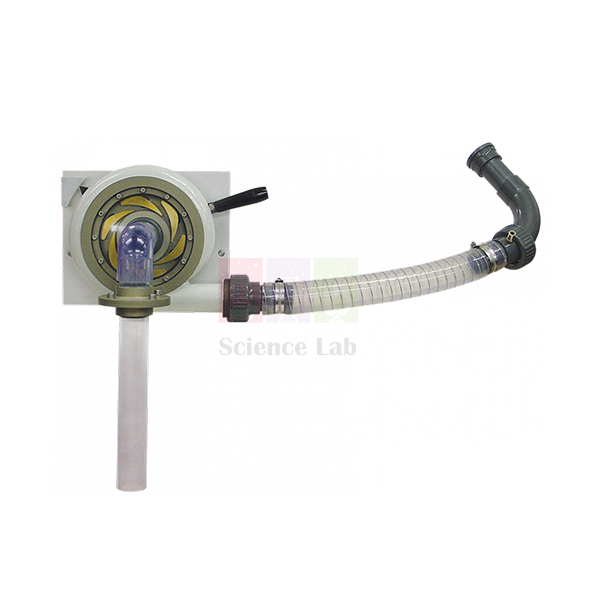
Francis Turbine
The Francis Turbine (Product Code: SLE/EFM/04) is a teaching model of the reaction turbine found in many hydroelectric plants. Adjustable guide vanes control the water entering the machine and direct it at an angle onto the blades of a radial impeller, and a clear viewing window and draft tube let students watch the turbine working as they change the vane setting. It is manufactured by Jain Scientific Equipments Pvt Ltd (ScienceLab), Ambala, a technical educational equipment manufacturer supplying engineering departments and polytechnics.
Specifications
| Parameter | Detail |
|---|---|
| Turbine type | Reaction turbine |
| Moving part | Radial impeller |
| Flow control | Adjustable guide vanes that control the water flow and direct it at an angle to the impeller blades |
| Visibility | Clear viewing window and draft tube |
| Learning focus | How the guide vane setting affects the way the turbine works |
Typical Use
The Francis design is widely used around the world because it adapts to a wide range of applications, which makes it a natural centrepiece for hydraulic machines practicals. A typical session sets the guide vanes to one opening, loads the turbine in stages and records speed, torque and flow to build output and efficiency curves; the vanes are then moved to a new position and the test repeated. Students quickly see that each vane opening has its own best operating point, and why power stations adjust guide vanes rather than simply throttling the supply.
Being a reaction machine, the runner turns under both the pressure and the velocity of the water, unlike an impulse wheel. Watching through the window and down the draft tube, the class can relate swirl and flow pattern to efficiency and discuss how the draft tube recovers energy from the leaving water. For engineering lab equipment in India’s degree and diploma programmes, testing this turbine against a Pelton wheel gives a complete picture of reaction and impulse behaviour.
Manufacturer
Our Francis Turbine is made by Jain Scientific Equipments Private Limited, which trades as ScienceLab and is headquartered in Ambala, Haryana. The firm builds hydraulics, mechanics and science apparatus for teaching laboratories; see the company profile for background.
Related Fluid Mechanics Equipment
Apparatus that complements a turbine study programme:
- Pelton Wheel (Turbine) — the impulse-turbine counterpart for comparison tests
- Universal Dynamometer — measures speed, torque and shaft power on Fluid Power machines (ask us about pairing)
- Cavitation In Venturi — explains the cavitation risk that turbine designers must manage
- Water Turbine with Dynamo Model — a simple hydro-power model for introductory classes
Browse our Fluid Mechanics category for pumps, flumes and flow apparatus.
Frequently Asked Questions
Is the Francis Turbine an impulse or a reaction turbine?
It is a reaction turbine, with a radial impeller as its moving part.
What can students change during a test?
The adjustable guide vanes. Changing their setting alters how much water enters and the angle at which it meets the impeller blades.
Can students see inside while it runs?
Yes, through the clear viewing window and draft tube.
What water supply and loading device does it need?
These requirements are not detailed in our current listing. Please contact us so we can confirm the supply and measurement set-up for your lab.
What are the turbine’s dimensions and rated output?
We can provide size and performance details with your quotation; they are not published on this page.
How is it maintained?
Drain water after use, keep the viewing window clean with a soft cloth, and check that the guide vane mechanism moves freely before each session.
Do you supply universities overseas?
Yes. We serve institutions in India and international markets; share the destination and quantity when you enquire.
Request a Quote
For pricing on the Francis Turbine, send your enquiry or add it to the enquiry cart with any companion apparatus for your hydraulics lab.
Last updated: 24 September 2026
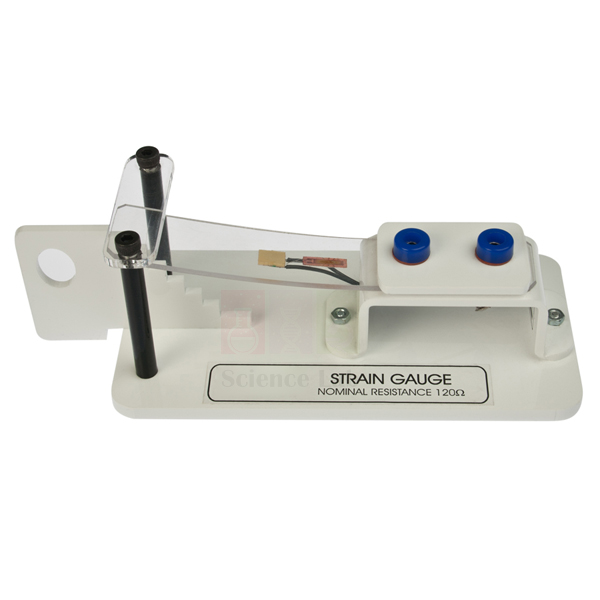
Mini Strain Gauge
Mini Strain Gauge (Product Code: SLE/EAM/17) is a 120 ohm metal foil resistive strain gauge bonded to a flexible plastic strip, designed to show students how bending a material changes the resistance of a gauge attached to it. Travel limiters protect the strip whichever way it is bent, and a step gauge lets it be flexed in repeatable 5 mm increments. A compact teaching item for physics and engineering lab equipment collections, it is made by Jain Scientific Equipments Pvt Ltd (ScienceLab), Ambala, India.
Specifications
| Parameter | Detail |
|---|---|
| Sensor type | Metal foil resistive strain gauge |
| Mounting | Bonded to a flexible plastic strip |
| Gauge resistance | 120 ohms |
| Resistance change | About 1 ohm at maximum flex |
| Bending | Either direction, with travel limiters to prevent damage |
| Step gauge | Provided, for bending the strip in 5 mm increments |
| Connections | 4 mm sockets |
| For real measurements | Use as part of a bridge network with suitable amplification |
Typical Use
A good starting point is to connect a sensitive resistance meter across the sockets and flex the strip one step at a time with the step gauge: the reading creeps up when the foil is stretched and falls when it is compressed. The change, only about one ohm across the full travel, makes the central teaching point for itself – the effect is real but tiny, which is exactly why industrial strain gauges are never read directly.
The next stage is a Wheatstone bridge experiment. With the gauge forming one arm and the bridge balanced at zero flex, each 5 mm step produces a small out-of-balance voltage that an amplifier can raise to a measurable level, mirroring how load cells, electronic scales and structural sensors work. Because the travel limiters stop the strip before it is over-bent, groups can repeat the sequence many times without harming the bonded foil.
Manufacturer
Jain Scientific Equipments Private Limited (CIN U29309HR2020PTC087597) is the incorporated company that trades as ScienceLab; its apparatus is produced at the company's licensed factory in the HSIIDC Industrial Area, Saha, Ambala, Haryana (Factory Licence AMB-ONLINE-CHD-J-414). The company profile gives an overview of its work.
Related Electricity and Magnetism Equipment
To turn the gauge's small resistance change into a measurement, buyers look at:
- Instrumentation Amplifier — a switched-gain amplifier intended for sensors such as strain gauges; ask us about connecting it to this unit.
- Wheatstone Bridge Four Gap — the bridge network in which the gauge forms one arm.
- Resistance Substitution Box — supplies a matching resistance to balance the bridge.
- Strain Gauge — a larger version with the gauge on a steel strip and its own bridge network.
- Digital Strain Display — a multi-channel instrument for direct strain readings at advanced level.
Further sensors and circuit apparatus are in Electricity and Magnetism.
Frequently Asked Questions
What is the resistance of the gauge?
120 ohms, changing by about 1 ohm at maximum flex.
Can I read strain directly with a meter?
You can see the resistance change with a sensitive meter, which demonstrates the principle. For real measurements the gauge must be used in a bridge network with suitable amplification.
Can students damage it by bending it too far?
The strip can be bent in either direction, and travel limiters stop it before damage occurs. Handle the foil area gently all the same.
What does the step gauge do?
It lets the strip be bent in 5 mm increments, so each reading corresponds to a known, repeatable deflection.
How does it connect to other apparatus?
The gauge connections are brought out to 4 mm sockets for use with standard 4 mm leads.
Is a calibration certificate available?
This is a demonstration unit; certificate availability and warranty terms can be discussed with us through the contact page.
Do you supply technical institutes and export buyers?
Yes. We quote for schools, colleges and training institutes across India and international markets; include quantity and delivery details.
Request a Quote
Request pricing for the Mini Strain Gauge through our contact page, or add it to the enquiry cart together with a bridge or amplifier.
Last updated: 24 September 2026

Piezo Transducer
Piezo Transducer (Product Code: SLE/EAM/18) is a 15 mm diameter ceramic piezoelectric element, protected by an integral press-stud, that turns a sharp mechanical tap into a voltage pulse of up to 20 V. Working the other way, it converts an electrical signal into sound, so a single small device shows energy conversion in both directions. It makes a handy addition to STEM science kit activities on energy transfer and is made by Jain Scientific Equipments Pvt Ltd (ScienceLab), Ambala, India.
Specifications
| Parameter | Detail |
|---|---|
| Element | Ceramic, 15 mm diameter |
| Protection | Integral protective press-stud |
| Output | Voltage pulses of up to 20 V when given a sharp tap |
| Output shown on | Voltmeter, data-logger or oscilloscope |
| Reverse effect | Connected to a signal generator, converts the electrical signal to sound waves |
Typical Use
For the direct effect, connect the transducer to an oscilloscope or data-logger and tap the press-stud sharply: a tall, narrow spike appears on the trace, and students can compare light and firm taps to show that more mechanical input produces a larger pulse. A voltmeter can be used too, but because each pulse lasts only a moment the display may just flicker, so an oscilloscope or logger gives the clearest record. The same principle drives the spark in a piezo gas lighter, a link students recognise at once.
For the reverse effect, connect the transducer to a signal generator from the electronics lab and it becomes a small loudspeaker, turning the electrical signal into sound waves. Varying the generator frequency lets the class hear the pitch change, which makes the unit useful in a sound wave experiment as well as in energy-conversion lessons. Always tap the protective stud rather than the edge of the ceramic, which is brittle.
Manufacturer
ScienceLab is the trading identity of Jain Scientific Equipments Private Limited, a maker of physics and electronics teaching apparatus located in Ambala, Haryana, with customers in India and international markets. Company details are on the profile page.
Related Electricity and Magnetism Equipment
These items show the transducer's output or drive its reverse effect:
- Oscilloscope Dual Trace — captures the shape and height of each voltage pulse.
- Signal Generator and Amplifier — provides the electrical signal for the sound-producing reverse effect.
- Digital Voltmeter — its 20 V range suits quick checks of pulse size.
- Gas Lighter, Piezo Electric — an everyday device that uses the same piezoelectric principle.
- Mini Strain Gauge — another sensor that converts mechanical deformation into an electrical change.
See more sensors and apparatus in Electricity and Magnetism.
Frequently Asked Questions
How much voltage does it produce?
Pulses of up to 20 V when the element is given a sharp tap.
What do I need to display the output?
A voltmeter, data-logger or oscilloscope. For brief pulses, an oscilloscope or data-logger shows the result most clearly.
Can it produce sound?
Yes. Connected to a signal generator, it converts the electrical signal into sound waves, demonstrating the reverse piezoelectric effect.
Is it robust enough for students?
The 15 mm ceramic element has an integral protective press-stud, so students tap the stud rather than the ceramic itself. Avoid dropping it on hard floors.
What leads or connectors does it use?
The connection type is not listed on this page. Please confirm it through our contact page so you can order matching leads.
Can you quote for multiple units or overseas delivery?
Yes. Send the quantity and destination, and we will quote for India or international markets, including warranty terms.
Request a Quote
To price the Piezo Transducer, use our contact page or add it to the enquiry cart with an oscilloscope or signal generator if needed.
Last updated: 24 September 2026
411.jpg)
Pelton Wheel (Turbine)
The Pelton Wheel (Turbine) (Product Code: SLE/EFM/05) is an impulse turbine with tangential flow: a jet of water from a variable spear nozzle strikes a ring of paired buckets and drives the wheel round. A clear viewing window on the side lets students see exactly how the jet and buckets interact. Built by Jain Scientific Equipments Pvt Ltd (ScienceLab), Ambala, it is designed as lab equipment for college and polytechnic hydraulics courses studying high-pressure, low-flow machines.
Specifications
| Parameter | Detail |
|---|---|
| Turbine type | Impulse turbine, tangential flow |
| Inlet | Variable spear jet |
| Buckets | Arranged in pairs to balance the wheel correctly and work efficiently |
| Viewing | Clear viewing window on the side of the turbine |
| Best suited to | Applications with high pressure and low flow |
Typical Use
The variable spear jet is the key teaching control. Moving the spear changes the jet, and with it the velocity of the water hitting the buckets, so students can explore how jet speed, wheel speed and power output relate. A standard exercise records output across a range of wheel speeds at a fixed spear setting and then repeats the run at another setting, revealing that the wheel performs best when its bucket speed is a particular fraction of the jet speed — a result students can compare with impulse-momentum theory.
Watching through the side window, the class sees the jet split by each pair of buckets and turned back on itself, which explains why the buckets are paired: the split keeps side forces balanced and allows the water to leave with little remaining energy. Pelton wheels suit mountain hydro schemes with high heads and modest flows, so for vocational training lab equipment in India this turbine connects classroom theory with real installations. Contrasting it with a Francis reaction turbine rounds off the topic.
Manufacturer
Jain Scientific Equipments Private Limited manufactures the Pelton Wheel at Ambala in Haryana and sells it under the ScienceLab trading name to engineering and science teaching institutions. Learn more on our company profile.
Related Fluid Mechanics Equipment
Apparatus that fits the same turbine and jet-flow lessons:
- Francis Turbine — a reaction turbine to contrast with the impulse principle
- Universal Dynamometer — measures speed, torque and shaft power on Fluid Power machines (confirm pairing with us)
- Pipe Flow And Nozzle Kit — explores how nozzles convert pressure into jet velocity
- Bernoulli’s Theorem — the energy principle behind jet formation
Find more hydraulics apparatus in the Fluid Mechanics range.
Frequently Asked Questions
What type of turbine is the Pelton Wheel?
An impulse turbine with tangential flow, suited to high pressure and low flow.
How is the water jet controlled?
By the variable spear jet at the inlet, which lets students change the velocity of the water striking the buckets.
Why are the buckets in pairs?
Pairing balances the wheel correctly and helps it work efficiently.
What pump or water supply is required?
Supply requirements are not stated in our current listing. Contact us and we will confirm what is needed to run it in your lab.
Are wheel diameter and bucket count specified?
Not on this page; we can share dimensional details on request.
Can a calibration certificate be supplied?
Discuss any certificate or test-record needs with our team before ordering so we can advise.
Can we order it together with other fluid mechanics apparatus?
Yes. One enquiry can cover several items, for delivery within India or to international markets.
Request a Quote
Ask for a Pelton Wheel quotation through our contact page, or save it in the enquiry cart while you finish selecting your turbine lab equipment.
Last updated: 24 September 2026