- Physics Lab Equipment
- Chemistry Lab Equipment
- Biology Lab Equipment
- Anatomical Lab Equipment
- Learning
- Educational Lab Equipment
- Magnets
- Agriculture
- Astronomy
- Earth Science
- Geography Lab Equipment
- Safety Lab Coat
- Laboratory
- Meteorological
- Electricity & Magnetism
- Heat
- School Lab Equipment
- Lab Glassware
- Science Lab Equipment
- Tvet Lab Equipment
- Robotics Kits Supplier and Manufacturer for Schools India
- Math Lab Equipment Manufacturers and Exporters in Ambala
- STEM Kits Manufacturers and Supplier India
- Engineering Lab Equipment
- Hospital Lab Equipment
- Water, Sanitation & Hygiene Supplies
- Cold Chain, Solar & Communication Equipment
- Nutrition
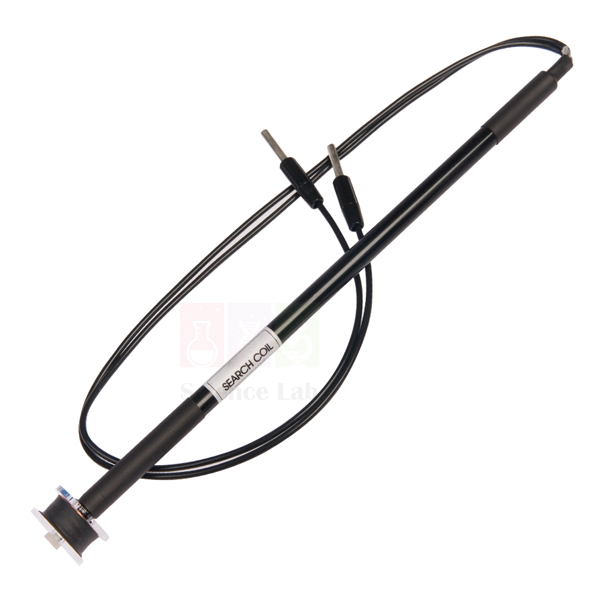
Search Coil
The Search Coil (Product Code: SLE/EAM/25) is a hand-held probe for investigating changing magnetic fields: a 3300 turn, 25mm diameter coil mounted on a plastic handle. When the field through the coil changes, an EMF is induced in its many turns, and connecting the coil to an AC millivoltmeter or oscilloscope turns that EMF into a reading students can compare from place to place. Manufactured by Jain Scientific Equipments Pvt Ltd (ScienceLab), Ambala, it is a compact addition to any electromagnetic induction kit in India for senior school and college physics.
Specifications
| Parameter | Detail |
|---|---|
| Coil | 3300 turns |
| Coil diameter | 25mm |
| Handle | Plastic |
| Connection | 4mm flying leads |
| Read with | AC millivoltmeter or oscilloscope |
| Application | Investigating changing magnetic fields |
Typical Use
A search coil only responds to a field that is changing, so it is normally used near a coil, solenoid or transformer carrying alternating current. Students hold the probe by its handle, move it around the source and watch the induced signal on the meter or oscilloscope trace. Rotating the coil until the reading peaks shows the field direction at that point, while stepping it away from the source shows how quickly the field strength falls with distance. Because the induced EMF is proportional to the rate of change of flux, doubling the supply frequency at the same current also makes a neat demonstration of Faraday’s law.
The large number of turns gives a usable signal even from modest fields, so the probe works well in ordinary physics lab equipment set-ups without special amplifiers. Keep the flying leads twisted together to reduce pick-up, and hold the coil steady while a reading is taken.
Manufacturer
Jain Scientific Equipments Private Limited manufactures this probe under its ScienceLab trading name in Ambala, Haryana, where it produces induction, magnetism and circuit apparatus for classrooms. The company profile describes the business in more detail.
Related Electricity and Magnetism Equipment
Field sources and instruments that complete a search-coil investigation:
- Oscilloscope Dual Trace — displays the induced signal and lets it be compared with the driving current
- Signal Generator and Amplifier — drives a coil with an alternating current to create the changing field
- Primary and Secondary Coil Set — provides coils whose fields can be mapped with the probe
- Faraday’s Law Apparatus — a companion unit for the wider electromagnetic induction topic
For more induction and magnetism apparatus, visit our Electricity and Magnetism category.
Frequently Asked Questions
How many turns does the Search Coil have?
3300 turns, wound as a 25mm diameter coil on a plastic handle.
Can I use it with a steady magnet?
Only while the magnet or coil is moving. A search coil detects changing fields, so a stationary magnet gives no reading; an AC-driven coil gives a continuous signal.
What meter do I need?
An AC millivoltmeter or an oscilloscope, connected through the 4mm flying leads. A standard DC voltmeter will not show the alternating signal properly.
Is a meter supplied with the coil?
No, the meter or oscilloscope is separate. Please contact us if you would like a quote for both together.
Is a calibration certificate available for field measurements?
The probe is intended for comparative classroom measurements. If you need calibration documentation, discuss availability with our team before ordering.
Can you supply class sets and export orders?
Yes. We supply schools, colleges and distributors in India and international markets, and quantities are confirmed with each quotation.
Request a Quote
To buy the Search Coil, send your requirement via the contact page or add it to the enquiry cart with any field sources or meters you need.
Last updated: 24 September 2026
275.jpg)
Two Stage (Series And parallel)
The Two Stage (Series And parallel) apparatus (Product Code: SLE/EFM/08) is a two-pump centrifugal test rig in which students run each pump alone, or both together in series or in parallel, and measure how the combined system behaves. Each pump has its own motor, speed control, torque load cell and speed sensor, and flow is found from the differential pressure across a Venturi meter. It is manufactured by Jain Scientific Equipments Pvt Ltd (ScienceLab), Ambala, and forms part of our engineering lab equipment for India’s mechanical and civil engineering departments.
Specifications
| Parameter | Detail |
|---|---|
| Pumps | Two centrifugal pumps, working alone, in series or in parallel |
| Drive | Two bearing-mounted motors, one driving each pump independently |
| Per-pump instrumentation | Electronic Motor Drive for speed control, load cell for torque, sensor for pump speed |
| Configuration | Two-way valve selects single, parallel or series operation; each pump has its own inlet valve |
| Water circuit | Integral reservoir → strainers → series of valves → Venturi meter → back to reservoir for re-use |
| Flow measurement | Differential pressure across the Venturi meter |
| Layout | Instrument and control modules fit into a frame above and behind the pumps |
Typical Use
Students usually begin with one pump, plotting head, power and efficiency against flow. They then switch the two-way valve to series and see the heads add at a given flow, before changing to parallel and seeing the flows add at a given head — the two classic results every engineer needs when designing a pumping station or booster system. Because each motor has its own speed control and torque measurement, the pumps can also be run at different speeds to show what happens when mismatched machines share a system.
Closing an inlet valve progressively lets the class see cavitation begin and hear the change in pump noise, giving a vivid lesson in suction conditions. The same rig teaches flow measurement: students convert the Venturi differential pressure into flow rate and compare the result with theory. Since water returns to the reservoir for re-use, water consumption stays low, which makes the rig well suited as lab equipment for college buildings without large drainage facilities. Clean the strainers regularly and refill the reservoir with clean water.
Manufacturer
Jain Scientific Equipments Private Limited, the Ambala, Haryana company behind the ScienceLab brand, makes this rig for teaching laboratories. Its corporate identity number is CIN U29309HR2020PTC087597, and apparatus is produced at the licensed works at 449, HSIIDC Industrial Area, Saha, Ambala, under Factory Licence AMB-ONLINE-CHD-J-414. See our company profile for further details.
Related Fluid Mechanics Equipment
Apparatus that extends the pump, cavitation and Venturi topics covered by this rig:
- Variable Speed Series And Parallel Pumps — an alternative rig for series and parallel pump studies
- Cavitation In Venturi — a closer look at the cavitation students observe here
- Bernoulli’s Theorem — the principle behind Venturi flow measurement
- Axial Flow Pump Module — compares centrifugal and axial flow pump characteristics
Explore the full Fluid Mechanics range.
Frequently Asked Questions
Can the pumps be tested individually?
Yes. Each pump can work alone, and a two-way valve switches the system to series or parallel operation.
How is flow rate measured?
From the differential pressure across the Venturi meter in the delivery line.
Can the two pumps run at different speeds?
Yes. Each is driven by its own bearing-mounted motor with an electronic Motor Drive, a torque load cell and a speed sensor.
Does it need a mains water connection?
The pumps draw from an integral reservoir and the water returns to it for re-use. Please contact us for filling and electrical requirements.
Can students observe cavitation?
Yes. The rig is designed to let students see cavitation as well as study Venturi flow measurement.
What are the footprint and pump ratings?
These are not listed on this page; our team can supply them with a quotation.
What information do you need for an institutional quote?
Quantity, delivery address, electrical supply and any tender reference. We supply across India and to international markets.
Request a Quote
To receive pricing for the Two Stage (Series And parallel) rig, contact us or place it in the enquiry cart along with other apparatus for your hydraulics laboratory.
Last updated: 24 September 2026
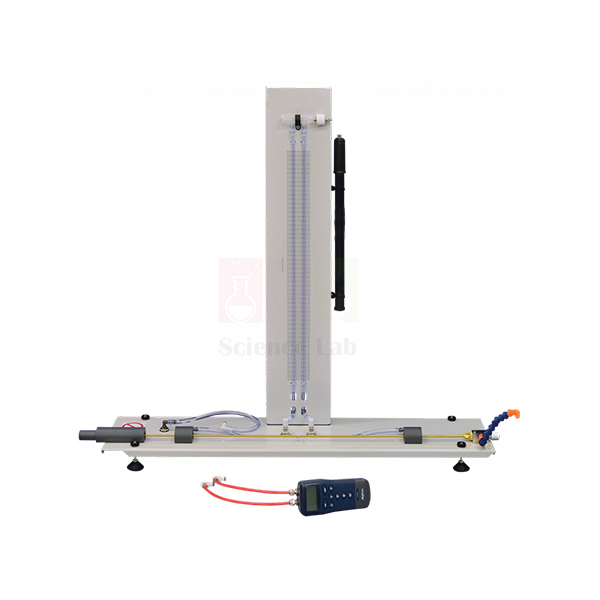
Friction Loss In Pipe
The Friction Loss In Pipe apparatus (Product Code: SLE/EFM/09) measures the pressure lost as water flows along a test pipe, across both laminar and turbulent regimes. Static pressure tappings either side of the pipe feed a water manometer for small differentials and a hand-held digital pressure meter for larger ones, while a precision needle valve sets the flow. The apparatus stands on a hydraulic bench and is made by Jain Scientific Equipments Pvt Ltd (ScienceLab), Ambala, for fluid mechanics courses at engineering colleges and polytechnics.
Specifications
| Parameter | Detail |
|---|---|
| Pressure tappings | Static tappings upstream and downstream of the test pipe |
| Low-range measurement | Water manometer for lower differential pressures in the laminar and lower turbulent regions |
| High-range measurement | Hand-held digital pressure meter for higher pressures in the turbulent region |
| Manometer mounting | Back panel with calibrated scales |
| Manometer datum | Air valve and hand-pump for adjusting the datum |
| Flow control | Precision needle valve downstream of the test pipe |
| Water supply | Stands on a hydraulic bench; Header Tank supplies the test pipe for low flow rate experiments |
Typical Use
Students set the apparatus on the hydraulic bench and fit the Header Tank, which provides a steady supply for the low-flow runs. Starting with the needle valve nearly closed, they read the head loss on the water manometer, collect a timed volume to find the flow rate, then open the valve a little and repeat. At low flows the head loss rises in direct proportion to velocity; as the flow increases past transition the relationship steepens, and the class switches to the digital pressure meter to follow the higher differentials in the turbulent region.
Plotting friction factor against Reynolds number turns the readings into a small Moody-style chart and lets students compare their laminar results with the theoretical Poiseuille line. As mechanics lab equipment for India’s civil and mechanical engineering syllabi, the apparatus supports reports on pipe design, pump sizing and energy loss. Use the hand-pump to bring the manometer levels to a convenient datum before each series, and bleed air from the tappings so readings settle quickly.
Manufacturer
Jain Scientific Equipments Private Limited produces the Friction Loss In Pipe apparatus in Ambala, Haryana, marketing it under its ScienceLab trade name to colleges and training institutions. More about the company is on our company profile.
Related Fluid Mechanics Equipment
Other pipe-flow and energy-loss apparatus often used in the same course:
- Bernoulli’s Theorem — the energy equation that head loss modifies
- Pipe Flow And Nozzle Kit — further pipe and nozzle flow experiments
- Viscosity And Particle Drag — explores the viscosity that governs laminar friction
- Water Hammer Apparatus — shows pressure surges when pipe flow is stopped suddenly
Browse the Fluid Mechanics category for flumes, pumps and pressure apparatus.
Frequently Asked Questions
Which flow regimes can be studied?
Laminar and turbulent. The water manometer covers the laminar and lower turbulent regions; the hand-held digital pressure meter covers the higher pressures of the turbulent region.
Is a hydraulic bench included?
The apparatus is designed to stand on a hydraulic bench, which is not listed as part of this item. Please contact us to discuss a suitable water supply.
What is the Header Tank for?
It supplies the test pipe during low flow rate experiments, giving a steady head for laminar-region readings.
How is flow controlled?
By a precision needle valve downstream of the test pipe, which allows fine, accurate adjustment.
What are the test pipe diameter and length?
These dimensions are not given on this page; we can confirm them with your quotation.
Can a calibration certificate be provided for the pressure meter?
Raise any certificate requirement with our team at the enquiry stage and we will advise.
Do you ship to colleges abroad?
Yes. We supply institutions in India and international markets.
Request a Quote
For a quotation on the Friction Loss In Pipe apparatus, write to us with your quantity and location, or add it to the enquiry cart.
Last updated: 24 September 2026
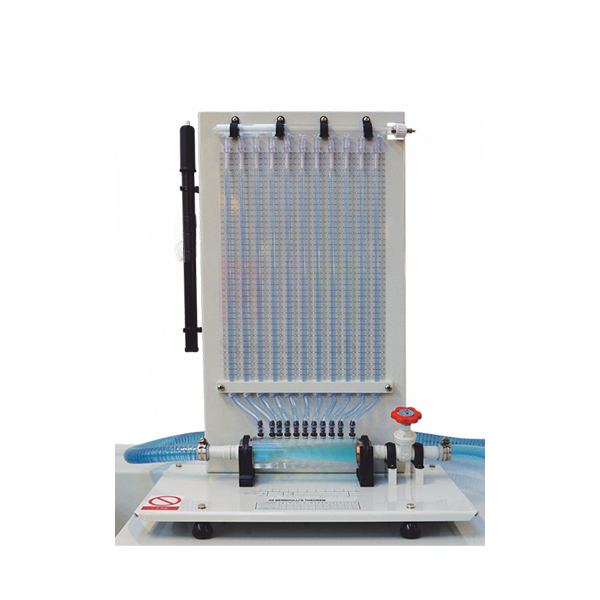
Bernoulli's Theorem
The Bernoulli’s Theorem apparatus (Product Code: SLE/EFM/10) demonstrates the exchange between pressure and velocity as water passes through a horizontal Venturi tube. Manometer tubes held vertically on a scaled panel show the pressure head at points along the tube, so students can see pressure fall in the throat and recover downstream. Built with plastic materials and corrosion-resistant finishes, it is manufactured by Jain Scientific Equipments Pvt Ltd (ScienceLab), Ambala, as lab equipment for college and polytechnic fluid mechanics practicals.
Specifications
| Parameter | Detail |
|---|---|
| Main components | Horizontal Venturi tube, downstream flow-control valve and manometer tubes |
| Manometer panel | Holds the tubes vertically, with a scale behind them for direct reading of water levels |
| Manifold | Common manifold above the tubes with an air pressure-control valve |
| Datum adjustment | Hand-pump connected to the air valve above the manometer tubes |
| Flow control | Downstream valve, so it causes no upstream turbulence |
| Base | Adjustable feet |
| Materials | Plastic materials and corrosion-resistant finishes throughout |
Typical Use
After levelling the base on its adjustable feet, students open the flow-control valve to set a steady flow and read the water level in each manometer tube against the panel scale. The heads drop towards the narrow throat of the Venturi, where velocity is highest, and rise again as the section widens. Using the measured flow and the tube cross-sections, the class calculates velocity head at each station and checks whether the total head stays constant, as Bernoulli’s equation predicts, or falls slightly because of friction.
Placing the control valve downstream keeps the approach flow undisturbed, so the readings reflect the Venturi itself rather than turbulence from a partly closed valve. If the water levels sit too high or too low on the scale, a hand-pump on the manifold air valve brings them back to a convenient datum. For engineering educational equipment in India, this apparatus also introduces the Venturi meter as a practical flow-measuring device, a topic students revisit in pump and pipe-network work. Drain the tubes after use and keep the panel scale clean.
Manufacturer
This apparatus is manufactured in Ambala, Haryana, by Jain Scientific Equipments Private Limited, whose ScienceLab brand covers fluid mechanics, physics and wider laboratory teaching equipment. Our company profile tells you more about who we are.
Related Fluid Mechanics Equipment
Apparatus that follows on naturally from the Bernoulli experiment:
- Cavitation In Venturi — what happens when throat pressure drops too far
- Friction Loss In Pipe — quantifies the head losses that Bernoulli’s ideal equation ignores
- Pipe Flow And Nozzle Kit — more pressure-velocity experiments in pipes and nozzles
- Two Stage (Series And parallel) — uses a Venturi meter for flow measurement in a pump rig
The complete Fluid Mechanics range lists further hydraulics apparatus.
Frequently Asked Questions
What does the Bernoulli’s Theorem apparatus include?
A horizontal Venturi tube, a downstream flow-control valve and manometer tubes on a panel, with a common manifold and air pressure-control valve, on a base with adjustable feet.
Why is the flow-control valve downstream?
So it does not cause any turbulence upstream of the Venturi, keeping the readings clean.
How is the manometer datum adjusted?
Students connect a hand-pump to the air valve above the manometer tubes. Whether a hand-pump is supplied with the unit can be confirmed through our contact page.
What water supply does it need?
Supply requirements are not listed on this page; our team can advise on connecting it in your lab.
Will it corrode with regular use?
It uses plastic materials and corrosion-resistant finishes throughout to protect against corrosion.
How many manometer tubes and what Venturi dimensions?
These details are not published here; please ask us and we will send them with the quotation.
Can we order several sets for a class?
Yes. Send the quantity and delivery location; we supply institutions in India and international markets.
Request a Quote
Request pricing for the Bernoulli’s Theorem apparatus via our contact form, or add it to the enquiry cart together with the other fluid mechanics equipment on your list.
Last updated: 24 September 2026
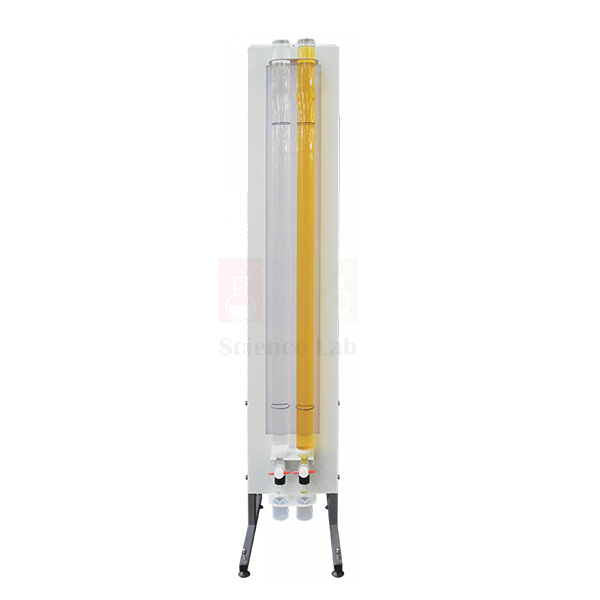
Viscosity And Particle Drag
Viscosity And Particle Drag (Product Code: SLE/EFM/11) is a simple falling-sphere viscometer that shows students how the viscosity of a liquid resists a sphere dropping through it. The self-standing unit holds two glass tubes of test fluid side by side, so two liquids can be compared in one session without repeated draining and refilling. It is used in fluid mechanics teaching laboratories of engineering colleges, polytechnics and technical institutes, and is made by Jain Scientific Equipments Pvt Ltd (ScienceLab), Ambala, as part of its engineering lab equipment in India.
Specifications
| Parameter | Detail |
|---|---|
| Type | Falling-sphere viscometer, self-standing unit |
| Test columns | Two glass tubes, each filled with a chosen test fluid for direct comparison |
| Illumination | Back plate with a low-voltage backlight so the spheres stay visible through the fluid |
| Draining | Valve system at the tube base that minimises fluid loss and helps empty the tube after tests |
| Test bodies | Spheres chosen for the correct density and size for each fluid; shapes must fit through the valve at the base |
| Suitable test fluids | Water, thin machine oil, castor oil and motor oil |
| Measurement method | Stopwatch timing of the sphere as it falls a set distance down the tube |
Typical Use
Students fill the two tubes with the liquids they want to study, pick a sphere whose density and size suit each fluid, and release it at the top of the column. Once the sphere has settled to a steady speed, they time it over the marked fall distance with a stopwatch. From the fall time they work out the terminal velocity and relate it to the drag on the sphere and the viscosity of the liquid — the classic Stokes’ law exercise. Running water in one tube and castor oil in the other makes the contrast between a thin and a thick fluid obvious to the whole group.
For consistent readings, let air bubbles clear before each drop, release the sphere along the centre of the tube, and repeat several drops per fluid to average the times. Because viscosity changes with temperature, note the room temperature with each data set. Departments looking for a viscosity measurement apparatus in India that also introduces particle drag will find the twin-tube layout saves bench time between groups.
Manufacturer
This twin-tube viscometer comes from Jain Scientific Equipments Private Limited, a company based in Ambala, Haryana, that sells its laboratory products under the ScienceLab name. Its fluid mechanics line is designed around practical teaching in engineering and applied science courses. Learn more about the business on our company profile.
Related Laboratory Equipment
Items a lab usually sets out alongside a falling-sphere viscosity practical:
- Stopwatch, Digital — times the sphere over the set fall distance
- Steel Ball — extra spheres for drop tests; check the size passes the base valve
- Glass Measuring Cylinder — handy for measuring and transferring test fluids
- Lift And Drag — takes drag studies further with force measurement on models in a flume
See the complete Fluid Mechanics range for more teaching apparatus.
Frequently Asked Questions
Can two liquids be tested in the same session?
Yes. The unit holds two glass tubes, so a different fluid can stay in each one for side-by-side comparison without draining between groups.
Which test fluids are suitable?
Water, thin machine oil, castor oil and motor oil are listed as suitable. For any other liquid, contact us before use.
Are the test spheres included, and in what sizes?
The apparatus is used with spheres selected for the right density and size for each fluid, and every shape must fit through the base valve. Please confirm the exact set of spheres supplied when you request a quotation.
Is a stopwatch supplied with the unit?
Timing is done with a stopwatch, but one is not listed as part of the unit. A digital stopwatch can be added to your order.
How is the unit emptied and cleaned after oil tests?
The valve system at the base drains the tube with minimal loss. Collect used oil in a suitable container and wipe spheres clean before storing them.
Is a calibration certificate available?
This is a teaching viscometer rather than a reference instrument; discuss any certificate needs with us through the contact page.
Can you supply several units for a college or export order?
Yes. Send the quantity, delivery location in India or abroad, and any special needs, and we will reply with pricing and lead time.
Request a Quote
For prices and availability, contact us or add this apparatus to your enquiry cart. We supply institutions across India and international markets.
Last updated: 24 September 2026
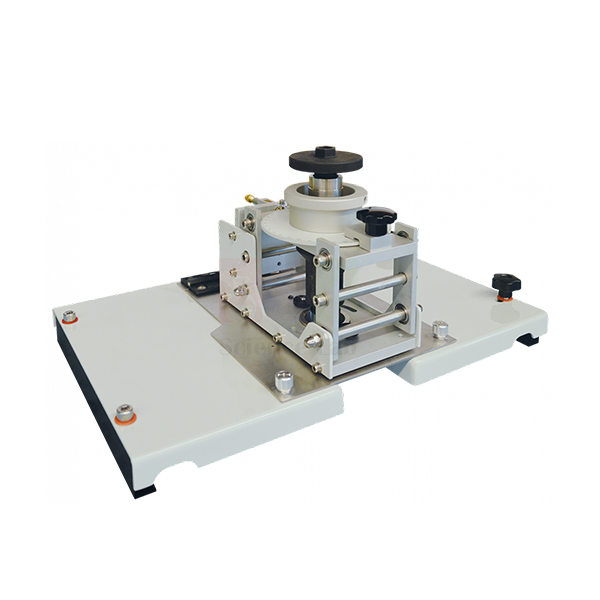
Lift And Drag
Lift And Drag (Product Code: SLE/EFM/12) is a force balance for measuring the hydrodynamic force on a model placed in the water flow of a laboratory flume. Its balance assembly is an articulated parallelogram linked to a load cell, and a separate display unit shows the measured force. The apparatus is aimed at civil and mechanical engineering departments teaching how bodies in a moving fluid experience lift and drag, and it is built by Jain Scientific Equipments Pvt Ltd (ScienceLab), Ambala, a maker of lab equipment for technical institutes.
Specifications
| Parameter | Detail |
|---|---|
| Balance type | Articulated parallelogram linked to a load cell |
| Force path | Parallelogram resists bending moments so only the force on the model reaches the load cell |
| Mounting | Balance assembly sits on a carrier that runs along the rails of the flume |
| Readout | Display unit showing the force measured by the load cell |
| Display mounting | Display unit hangs on the flume |
| Used with | A laboratory flume with rails (flume not listed as part of this item) |
Typical Use
A test model is attached to the balance and lowered into the flow, and the carrier is rolled along the flume rails to place it in the working section. As water passes the model, the parallelogram linkage keeps the model’s orientation steady and passes only the fluid force to the load cell, so turning moments do not distort the reading shown on the display unit. Students change the flow rate or the model’s shape and orientation, record the force each time, and plot how it varies — the basis for discussing drag coefficients, streamlining and lift on inclined bodies.
Zero the display with the model in still water before each series, allow the flow to stabilise after every change, and keep the carrier rails clean so the assembly runs freely. As engineering lab equipment in India, the balance suits both undergraduate practicals and simple project work on bluff and streamlined shapes.
Manufacturer
ScienceLab is the brand under which Jain Scientific Equipments Private Limited of Ambala, Haryana, designs and supplies hydraulics teaching equipment such as this balance. The company is a registered MSME manufacturer (Udyam UDYAM-HR-01-0003714), and its overseas consignments move under DGFT Importer-Exporter Code AAECJ8618A. Background on the company is on our company profile page.
Related Fluid Mechanics Equipment
Other items used in the same flume-based flow experiments:
- Meter Flume — an open-channel flume for the flow; confirm rail fit with us before ordering
- Bridge Piers — profiled piers for observing flow around bodies in the same channel
- Sluice Gate with Tappings — a further flume accessory for pressure and depth studies
- Viscosity And Particle Drag — introduces drag on falling spheres before force-balance work
Browse the full Fluid Mechanics category for flumes and accessories.
Frequently Asked Questions
Is the flume included with Lift And Drag?
No flume is listed as part of this item; the balance is built to run on a flume’s rails with the display unit hung on the flume. Tell us which flume you have so we can check the fit.
Why use a parallelogram linkage instead of a simple arm?
The parallelogram resists bending moments, so only the force acting on the model is transmitted to the load cell, giving a cleaner force reading.
Does it read lift and drag at the same time?
The balance passes the model force to one load cell shown on the display unit. For the exact measuring arrangement for lift and for drag, please contact us.
Which test models come with the balance?
Models are not specified in our current product details; ask us for the model shapes available with your order.
How should the load cell be looked after?
Avoid knocking or overloading the balance, dry the assembly after use and store it off the flume when the lab is idle.
What warranty applies?
Warranty terms are given with the quotation; contact us for current terms.
What should an institutional enquiry include?
Share the quantity, your flume details, delivery location and any tender documents required, and we will respond with a formal offer.
Request a Quote
To order Lift And Drag for your fluids lab, contact us or place it in the enquiry cart. Supply is available across India and international markets.
Last updated: 24 September 2026
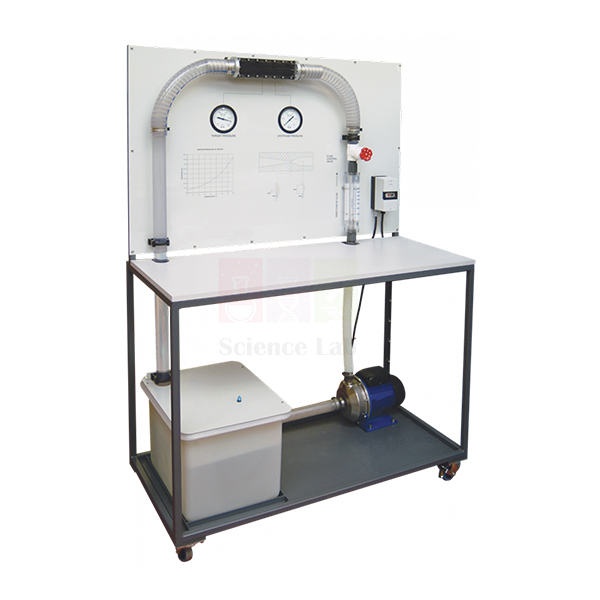
Cavitation In Venturi
Cavitation In Venturi (Product Code: SLE/EFM/13) is a self-contained, mobile teaching unit that produces clearly visible cavitation in a Venturi so students can watch vapour bubbles form and collapse while taking flow and pressure readings. It gives mechanical, chemical and civil engineering students hands-on practice with the continuity equation and Bernoulli’s equation in a setting where the theory visibly breaks down. The unit is produced by Jain Scientific Equipments Pvt Ltd (ScienceLab), Ambala, an engineering lab equipment manufacturer serving colleges and polytechnics.
Specifications
| Parameter | Detail |
|---|---|
| Construction | Robust frame holding all components; self-contained, mobile unit |
| Main components | Water tank, electric pump, flow-control valve, flow meter and Venturi |
| Pressure measurement | Pressure gauges upstream of the Venturi and at the Venturi throat |
| Temperature | Thermometer showing the temperature of the water in the tank |
| Safety features | Pump with electrical protection; water tank with splash cover to prevent spillage |
| Learning outcomes | Calculating flow and pressure, different methods of creating cavitation, and causes of error |
Typical Use
With the pump running, students open the flow-control valve step by step and read the flow meter together with the gauges upstream of the Venturi and at its throat. As velocity through the throat rises, throat pressure falls until it reaches the vapour pressure of the water and a cloud of bubbles appears. Comparing the measured pressure drop with the value predicted by the continuity and Bernoulli equations shows where simple theory holds and where losses and cavitation take over. Because vapour pressure depends on temperature, the tank thermometer reading is recorded with every set of results.
Classes can explore more than one way of bringing on cavitation and then discuss the sources of error in their calculations. Keep the splash cover in place while running, top up the tank with clean water, and let the pump stop before adjusting pipework. As lab equipment for college India departments, the unit wheels between rooms, so one set can serve several practical groups.
Manufacturer
Cavitation In Venturi is part of the hydraulics range made by Jain Scientific Equipments Private Limited, a private limited company in Ambala, Haryana, whose products carry the ScienceLab brand. For details of the company’s background and other product lines, visit our company profile.
Related Fluid Mechanics Equipment
Apparatus that fits the same run of pressure and flow practicals:
- Bernoulli’s Theorem — establishes the Venturi pressure–velocity theory before cavitation is introduced
- Calibration of a Pressure Gauge — shows students how the dial gauges they read actually work
- Pressure Measurement Bench — broader practice with pressure measuring methods
- Water Hammer Apparatus — a companion study of pressure effects in pipe flow
More hydraulics teaching units are listed in our Fluid Mechanics category.
Frequently Asked Questions
Does the unit need an external water supply or hydraulic bench?
No. It carries its own water tank, electric pump, flow-control valve and flow meter on one frame, so it works as a self-contained unit.
Where is pressure measured?
Pressure gauges read the pressure upstream of the Venturi and at the Venturi throat.
Why is there a thermometer on the tank?
Water temperature affects its vapour pressure and therefore when cavitation starts, so the thermometer lets students record it with each result.
Is it safe to run in a classroom?
The pump includes electrical protection and the tank has a splash cover to prevent spillage. Normal lab supervision still applies.
What electrical supply does the pump need?
Supply voltage is not given in our current product details; contact us with your local mains supply so we can confirm.
Can a calibration certificate be provided for the gauges?
Please discuss certificate requirements with us at the time of enquiry through our contact page.
Do you supply universities outside India?
Yes, we handle orders for institutions in India and international markets; include the destination in your enquiry.
Request a Quote
For a quotation on Cavitation In Venturi, contact us or add it to the enquiry cart with any other equipment for your lab.
Last updated: 24 September 2026
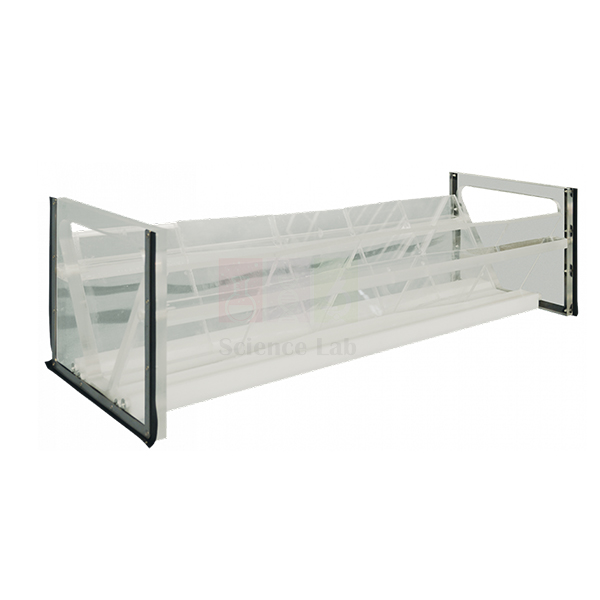
Trapezoidal Flume
Trapezoidal Flume (Product Code: SLE/EFM/14) is a clear acrylic flow-measuring flume with a 60° trapezoidal profile, intended for measuring discharge in an open channel with particular emphasis on low-flow situations. Because the body is transparent, students can watch the water surface change as it passes through the section rather than simply reading a number. It suits hydraulics and irrigation engineering teaching, and is manufactured by Jain Scientific Equipments Pvt Ltd (ScienceLab), Ambala, whose engineering educational equipment is used in colleges across India.
Specifications
| Parameter | Detail |
|---|---|
| Type | Trapezoidal flow-measuring flume |
| Material | Clear acrylic |
| Profile | 60° trapezoidal section |
| Purpose | Measurement of flows, with emphasis on low-flow situations |
| Installation | Channel mounting details confirmed on enquiry |
Typical Use
Measuring flumes work by narrowing the channel so the flow passes through critical depth; once that happens, a single upstream depth reading can be related to discharge. A trapezoidal section keeps useful sensitivity when only a little water is flowing, which is why this flume is chosen for low-flow gauging exercises such as small streams, irrigation furrows and drainage outlets. In the lab, students set a series of flow rates, read the upstream water level for each, and build a depth–discharge rating curve that they compare with the flow measured independently.
Seal the flume carefully in its channel so no water bypasses the section, level it before taking readings, and allow the flow to settle after each change. Clean acrylic with water and a soft cloth only, as solvents can craze clear plastics. Beyond routine practicals, the flume also serves as lab equipment for research in India on small-channel flow measurement.
Manufacturer
The flume is produced in Ambala, Haryana, by Jain Scientific Equipments Private Limited. ScienceLab is the company’s trading name for its educational and laboratory equipment, including open-channel hydraulics apparatus. Our company profile has more about who we are.
Related Fluid Mechanics Equipment
Open-channel items commonly used in the same hydraulics practical sequence:
- Meter Flume — a laboratory channel with recirculating supply; ask us to confirm fitting
- Culvert — clear culvert models for open and orifice flow studies
- Sluice Gate with Tappings — control-structure experiments with pressure readings
- Self Regulating Siphon — another clear acrylic model for discharge control studies
View all items in the Fluid Mechanics category.
Frequently Asked Questions
What is this flume best suited to measure?
Flow rates in open channels, with the emphasis on low-flow situations where many other measuring structures lose sensitivity.
Why is it made of clear acrylic?
Transparency lets students see the water surface profile and the change in depth through the flume while they take readings.
Does it come with a channel or water supply?
It is a flume section only; no channel or pump is listed with it. Share your channel details via our contact page so we can advise on fitting.
What overall dimensions does it have?
Dimensions beyond the 60° trapezoidal profile are not listed in our current product details; contact us for a drawing.
How do I keep the acrylic clear?
Rinse with clean water after use, wipe with a soft cloth and avoid solvents or abrasive pads.
What warranty is offered?
Warranty terms are stated in our quotation; ask us for current terms.
Request a Quote
Ready to add low-flow measurement to your hydraulics lab? Contact us or add the Trapezoidal Flume to your enquiry cart; we supply India and international markets.
Last updated: 24 September 2026