- Physics Lab Equipment
- Chemistry Lab Equipment
- Biology Lab Equipment
- Anatomical Lab Equipment
- Learning
- Educational Lab Equipment
- Magnets
- Agriculture
- Astronomy
- Earth Science
- Geography Lab Equipment
- Safety Lab Coat
- Laboratory
- Meteorological
- Electricity & Magnetism
- Heat
- School Lab Equipment
- Lab Glassware
- Science Lab Equipment
- Tvet Lab Equipment
- Robotics Kits Supplier and Manufacturer for Schools India
- Math Lab Equipment Manufacturers and Exporters in Ambala
- STEM Kits Manufacturers and Supplier India
- Engineering Lab Equipment
- Hospital Lab Equipment
- Water, Sanitation & Hygiene Supplies
- Cold Chain, Solar & Communication Equipment
- Nutrition
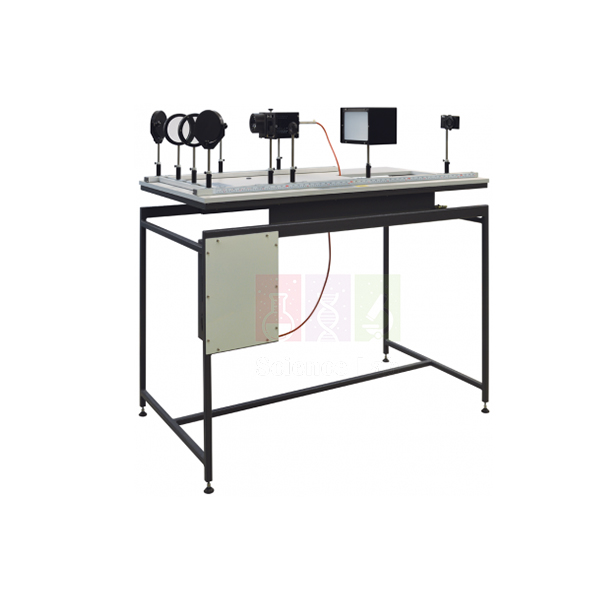
Schlieren Apparatus
Schlieren Apparatus (Product Code: SLE/EA/02) is an optical flow-visualisation system used to make density gradients in air visible, so that students can see supersonic flow patterns, shockwaves and expansions around models in aerodynamics and gas dynamics laboratories. It displays density changes as variations in illumination intensity and includes digital imaging equipment to record what students see. It is made by Jain Scientific Equipments Pvt Ltd (ScienceLab), an OEM manufacturer, at its own factory in Ambala, India.
Key Details
| Parameter | Detail |
|---|---|
| Principle | Density gradients shown as variations in intensity of illumination |
| Flow features shown | Supersonic air-flow patterns around models; shockwaves and expansions |
| Optics | Mirrors and lenses of high optical standard to reduce the possibility of image distortion |
| Image recording | Digital imaging equipment included |
| Typical pairing | Useful with an intermittent supersonic wind tunnel |
| Learning outcome | Students compare shock and expansion positions and angles with values predicted by theory |
| Product code | SLE/EA/02 |
| Manufacturer | Jain Scientific Equipments Pvt Ltd (ScienceLab) — OEM |
| Country of origin | India (made in Ambala, Haryana) |
What Is the Schlieren Apparatus Used For?
Air is invisible, but where its density changes, light passing through it is bent very slightly. A schlieren system turns that bending into brighter and darker regions on the image, so a shockwave in front of a model appears as a sharp line and an expansion fan appears as a graded band. This lets students see the structure of supersonic flow instead of only inferring it from pressure readings.
Intermittent supersonic tunnels run for short bursts, which is why the included digital imaging equipment matters: each run can be captured and studied afterwards. Students measure shock angles from the saved images and check them against oblique-shock theory for the model and Mach number used. Keep the mirrors and lenses clean and covered when not in use, and align the optics before every session.
What to Specify When Ordering
- The wind tunnel or test section the apparatus will be used with, including the size of the viewing window.
- How you intend to store and view recorded images (for example on a departmental PC); ask us about the imaging equipment supplied.
- Available bench or floor space on each side of the test section for the optics.
- Number of sets required.
OEM Manufacturer
ScienceLab is the trading name of Jain Scientific Equipments Private Limited, the OEM that produces the Schlieren Apparatus at its own licensed factory at Saha, Ambala, Haryana, India. The apparatus is made and assembled there rather than sourced from a trading house.
Universities, aerospace and mechanical engineering departments, dealers and importers receive quotations and technical support directly from the manufacturer, and can ask us about replacement optics or parts later. Visit the ScienceLab profile to learn more.
Related Aerodynamics Lab Equipment
Compressible and visual flow studies often use these units alongside the schlieren system:
- Laval Nozzle Pressure Apparatus — measures subsonic and supersonic expansion through nozzles.
- Flow Visualisation Wind Tunnel — smoke streamlines for low-speed flow around models.
- Flow Visualisation smoke tunnel — a compact smoke generator and duct set.
- Subsonic Wind Tunnel — lift, drag and pressure measurements at low speed.
See the complete Aerodynamics Lab Equipment range.
Frequently Asked Questions
What does the Schlieren Apparatus show?
The Schlieren Apparatus shows density gradients in air as variations in illumination intensity. Students can see supersonic flow patterns around models, including shockwaves and expansions, and compare their positions and angles with theoretical predictions.
Does the Schlieren Apparatus include a camera?
Yes. The Schlieren Apparatus includes digital imaging equipment to record the images. This is especially useful with an intermittent supersonic wind tunnel, where each run is short and the flow pattern needs to be captured for later study.
Which wind tunnel is the Schlieren Apparatus used with?
The Schlieren Apparatus is described as useful with an intermittent supersonic wind tunnel. Tell us which tunnel or test section you have, including window size, and we will advise on fitting the apparatus to it.
Why does optical quality matter in a Schlieren Apparatus?
In a Schlieren Apparatus, any flaw in the mirrors or lenses shows up as false light and dark patches. This apparatus uses mirrors and lenses of high optical standard to reduce the possibility of optical distortion in the images.
Who manufactures the Schlieren Apparatus?
The Schlieren Apparatus is manufactured by Jain Scientific Equipments Pvt Ltd (ScienceLab), the OEM, at its licensed factory in Ambala, Haryana, India. It is supplied factory-direct to universities, dealers and importers in India and international markets.
How can I request a quotation for the Schlieren Apparatus?
To request a quotation for the Schlieren Apparatus, send the details of your wind tunnel or test section, the number of sets and the delivery location through the contact page, and the manufacturer will reply directly.
Request a Quote
Prices for the Schlieren Apparatus are quoted direct by the manufacturer. Use the contact page or add the apparatus to the enquiry cart.
Last updated: 24 September 2026
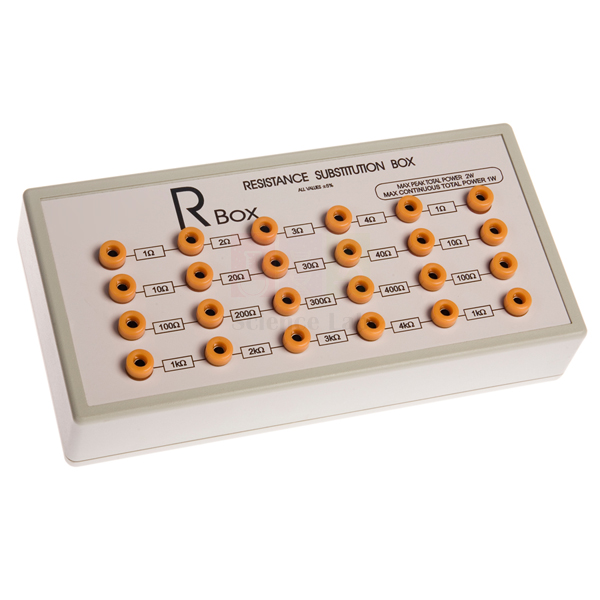
Resistance Substitution Box
Resistance Substitution Box (Product Code: SLE/EAM/07) is a robust resistance box for the physics lab that lets students build any value from 1 to 12,221 Ω by linking its internal resistors in series through 4 mm sockets. A printed connection diagram on the panel shows exactly which sockets to join, so the box works equally well as a known resistor, a variable load or a stand-in for an unknown component. It is made by Jain Scientific Equipments Pvt Ltd (ScienceLab), Ambala, India.
Specifications
| Parameter | Detail |
|---|---|
| Resistance range | 1 to 12,221 Ω |
| Selection method | Resistors selected with 4 mm sockets and arranged in series |
| Power rating | 2 W |
| Panel | Clear connection diagram on the main panel |
| Construction | Robust box design |
Typical Use
The name describes its classic job: the substitution method. Students measure the current through an unknown resistor, swap the box into its place and adjust the selected value until the meter shows the same reading; the box setting then equals the unknown resistance. The same box serves as the known arm when balancing Wheatstone bridge experiments, as a stepped load for plotting current against voltage, and as a series resistor when a lamp or LED needs its current limiting.
Because every resistance is made by joining sockets rather than turning a dial, the circuit on the panel matches the circuit diagram in the notebook, which helps students connect the idea of resistors adding in series with a real measurement. Keep an eye on the 2 W rating: at low resistance settings, a higher supply voltage can push the dissipated power up quickly, so check the expected current before switching on and start at a modest voltage.
Manufacturer
This box is built by Jain Scientific Equipments Private Limited, which trades as ScienceLab from Ambala, Haryana, and is a registered MSME manufacturer (Udyam UDYAM-HR-01-0003714); export consignments are shipped under Importer-Exporter Code AAECJ8618A issued by the DGFT. Visit the company profile to learn more about ScienceLab.
Related Electricity and Magnetism Equipment
To wire the box into a measuring circuit, buyers commonly add:
- Stackable Leads — 4 mm leads for linking the sockets and connecting the box to the circuit.
- Digital Ammeter — provides the matching current reading at the heart of the substitution method.
- Digital Voltmeter — measures the potential difference across the selected resistance.
- Wheatstone Bridge Four Gap — the box can act as the known resistance when balancing the bridge.
- Decade Resistance Box — an alternative style of resistance box for labs comparing formats.
Explore more circuit apparatus in the Electricity and Magnetism category.
Frequently Asked Questions
What resistance values can I set?
Any value from 1 to 12,221 Ω that the internal resistors can make when connected in series, chosen by linking the 4 mm sockets as shown on the panel diagram.
How much power can the box handle?
It is rated at 2 W. Work out the expected power before connecting, especially when a low resistance is selected with a higher supply voltage.
What leads does it take?
Connections are made through 4 mm sockets, so standard 4 mm plug leads are used both to link resistors and to connect the box into a circuit.
What is the tolerance of the resistors?
The tolerance is not listed on this page. If your practical needs a specific tolerance, please check with us through the contact page before ordering.
Is a calibration certificate available?
Certificate availability depends on the order, so please discuss it with us when you request a quote.
What should our purchase enquiry include?
Give the quantity, the delivery location and any tender or vendor-registration paperwork you need; we supply schools, colleges and distributors in India and international markets.
Request a Quote
Ask for pricing on the Resistance Substitution Box through our contact page, or collect it in the enquiry cart with meters and leads for one quotation.
Last updated: 24 September 2026
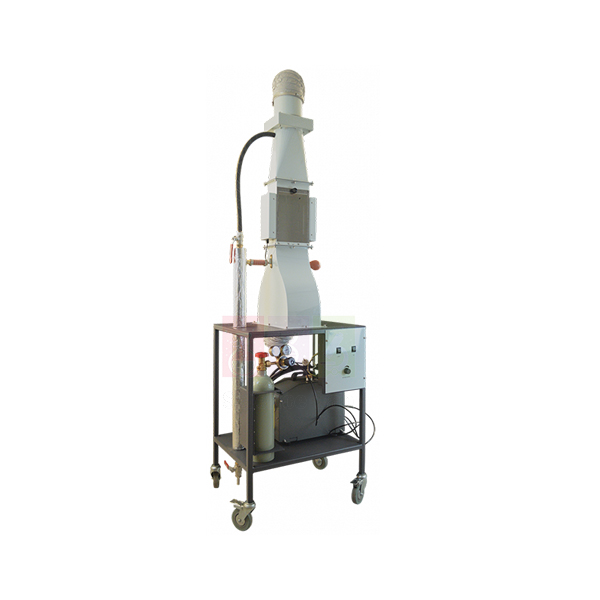
Flow Visualisation Wind Tunnel
Flow Visualisation Wind Tunnel (Product Code: SLE/EA/03) is a vertical, suction-type smoke wind tunnel used to show how air flows around differently shaped models during demonstrations and student investigations in aerodynamics and fluid mechanics laboratories. Its distinguishing feature is a smoke comb below the lit, transparent working section, fed by a generator that vaporises food-grade oil, with air flowing vertically upwards. It is made by Jain Scientific Equipments Pvt Ltd (ScienceLab), an OEM manufacturer, at its own factory in Ambala, India.
Key Details
| Parameter | Detail |
|---|---|
| Tunnel type | Vertical, suction type; air flow vertically upwards |
| Fan | Variable speed, mounted on top of the tunnel |
| Controls | Control unit on the frame for fan speed |
| Smoke source | Smoke generator vaporising food-grade oil; smoke is non-toxic |
| Smoke comb | Mounted below the working section; can be moved from side to side |
| Working section | Transparent, removable front wall; optional models attach to the back of the working section |
| Lighting | Lamps illuminate the working section from both sides |
| Flow conditioning | Filter helps provide uniform air flow |
| Frame | Metal frame fitted with castors for mobility |
| Product code | SLE/EA/03 |
| Manufacturer | Jain Scientific Equipments Pvt Ltd (ScienceLab) — OEM |
| Country of origin | India (made in Ambala, Haryana) |
What Is the Flow Visualisation Wind Tunnel Used For?
Smoke released from the comb forms thin, parallel filaments that rise through the working section and bend around whatever model is fixed there. A class can watch the streamlines stay attached to a streamlined shape, break away behind a flat plate or cylinder, and roll up into a wake. Moving the comb from side to side lets students trace the flow over the top, middle or edge of a model, and changing fan speed shows how the pattern alters as velocity rises.
The removable front wall makes swapping models quick between demonstrations, and the lamps on both sides make the smoke easy to see, even for a group standing back from the tunnel. Dim the room lights for the clearest view, keep the smoke generator topped up with the correct oil, and wheel the tunnel to a store area on its castors after use.
What to Specify When Ordering
- Which optional models you want for the working section.
- Supply of smoke oil for the generator; ask us about the correct grade and quantity.
- Your mains supply for the fan, lamps and smoke generator, which is not stated in the listing.
- Number of tunnels for lecture rooms and student labs.
OEM Manufacturer
Jain Scientific Equipments Private Limited, trading as ScienceLab, is the OEM behind the Flow Visualisation Wind Tunnel. The tunnel is manufactured at the company's own licensed factory at 449, HSIIDC Industrial Area, Saha, Ambala, Haryana, India, and dispatched directly from there to customers.
Because the maker handles every enquiry itself, schools of engineering, science centres, dealers and importers can order extra models, spares and repeat units from the same source — ask us for anything you need. Find more on the company profile.
Related Aerodynamics Lab Equipment
Pair the smoke tunnel with these units for a full sequence from seeing the flow to measuring it:
- Flow Visualisation smoke tunnel — a compact smoke generator and duct set as an alternative format.
- Subsonic Wind Tunnel — measures the lift, drag and pressures behind the patterns students see.
- Flight Demonstration Wind Tunnel — shows separation and stall on a moving model aircraft.
- Modular Air Flow Bench — base unit for bench-top air-flow experiment modules.
Browse all Aerodynamics Lab Equipment.
Frequently Asked Questions
How does the Flow Visualisation Wind Tunnel produce smoke?
The Flow Visualisation Wind Tunnel uses a smoke generator that vaporises food-grade oil. The smoke, listed as non-toxic, is fed to a comb below the working section, where it forms visible filaments that follow the upward air flow around the model.
Which way does air flow in the Flow Visualisation Wind Tunnel?
Air flows vertically upwards in the Flow Visualisation Wind Tunnel. It is a suction-type tunnel: a variable-speed fan on top draws air through a filter and the working section, which helps give a uniform flow for clear smoke lines.
Are models included with the Flow Visualisation Wind Tunnel?
Models for the Flow Visualisation Wind Tunnel are listed as optional. They attach to the back of the working section once the transparent front wall is removed. Tell us which shapes you want so they can be added to your quotation.
Can the Flow Visualisation Wind Tunnel be moved between rooms?
Yes. The Flow Visualisation Wind Tunnel stands on a metal frame fitted with castors, and the fan-speed control unit is mounted on the same frame, so the whole tunnel can be wheeled between a lecture room and a laboratory.
Who manufactures the Flow Visualisation Wind Tunnel?
The Flow Visualisation Wind Tunnel is manufactured by Jain Scientific Equipments Pvt Ltd (ScienceLab), the OEM, at its own licensed factory in Saha, Ambala, Haryana, India, and supplied factory-direct across India and international markets.
What information does a quotation for the smoke wind tunnel need?
For a quotation on the Flow Visualisation Wind Tunnel, give the number of tunnels, the optional models you need, your mains voltage and the delivery address through the contact page, and the manufacturer will reply directly.
Request a Quote
Ask the manufacturer for a price through the contact page, or add the Flow Visualisation Wind Tunnel to the enquiry cart.
Last updated: 24 September 2026

Faraday's Law Apparatus
Faraday's Law Apparatus (Product Code: SLE/EAM/08) is an electromagnetic induction apparatus used to show and measure the pulse of electricity a falling magnet induces in a coil, in school and college physics labs. A small cylindrical magnet, supplied with it, drops down an acrylic tube through a movable coil, and twin coils of 150 and 300 turns let students compare results. It is made by Jain Scientific Equipments Pvt Ltd (ScienceLab), an OEM manufacturer, at its own factory in Ambala, India, as part of its electromagnetic induction kit range.
Specifications
| Parameter | Detail |
|---|---|
| Guide tube | Acrylic tube supporting an easily moved coil |
| Coils | Twin coils of 150 turns and 300 turns |
| Magnet | Small cylindrical magnet, supplied |
| Output | A pulse of electricity each time the magnet passes through the coil |
| Display needed | Oscilloscope to monitor the pulse and measure its amplitude; PC-based oscilloscopes are particularly suited |
| Documentation | Full instructions included |
| Product code | SLE/EAM/08 |
| Manufacturer | Jain Scientific Equipments Pvt Ltd (ScienceLab) — OEM |
| Country of origin | India (made in Ambala, Haryana) |
What Is the Faraday's Law Apparatus Used For?
A first run is purely qualitative: drop the magnet and watch the oscilloscope trace rise and then swing the other way as the magnet enters and leaves the coil, a direct picture of Lenz's law. Switching between the 150-turn and 300-turn coils then shows how the size of the induced pulse depends on the number of turns, while turning the magnet over reverses the trace. A PC-based oscilloscope makes this especially easy because each single-shot event can be captured, stored and compared on screen.
For senior students the apparatus becomes a quantitative investigation of Faraday's law. Sliding the coil to a different position on the tube changes how far the magnet falls before reaching it, and therefore its speed; students work out that speed from the equations of motion and plot pulse amplitude against it. It is compact physics lab equipment in India's senior classrooms that ties induction to mechanics in one practical. Place a soft pad at the bottom of the tube so the magnet is not chipped by repeated drops.
OEM Manufacturer
Jain Scientific Equipments Private Limited, which trades as ScienceLab, is the OEM (original equipment manufacturer) of the Faraday's Law Apparatus and makes it at its own licensed factory at Saha, Ambala, Haryana, India. The apparatus is built and assembled by the company itself rather than sourced from a trader, and it goes factory-direct to schools, colleges, dealers and importers. If you later need a replacement magnet or coil, ask us: spares and repeat orders are handled by the manufacturer. Read more on the company profile.
Related Electricity and Magnetism Equipment
These products complete an induction practical built around this apparatus:
- Oscilloscope Dual Trace — displays the induced pulse so its amplitude can be measured.
- Metal Ruler — measures the drop height used to work out the magnet's speed.
- Search Coil — a hand-held coil for exploring changing magnetic fields with an oscilloscope.
- A.C. Generator — extends the topic from a single pulse to continuous induced current.
Find more induction and magnetism apparatus in the Electricity and Magnetism category.
Frequently Asked Questions
What comes with the Faraday's Law Apparatus?
The Faraday's Law Apparatus comes with the acrylic guide tube and its movable coil arrangement, twin coils of 150 and 300 turns, a small cylindrical magnet and full instructions. An oscilloscope is needed to display the pulse but is ordered as a separate item.
Does the Faraday's Law Apparatus need an oscilloscope?
Yes. The Faraday's Law Apparatus produces a brief pulse of electricity each time the magnet falls through the coil, and an oscilloscope is used to monitor that pulse and measure its amplitude. PC-based oscilloscopes are particularly suited because they capture single events.
Why does the Faraday's Law Apparatus have two coils?
The twin coils of 150 and 300 turns let students compare the induced pulse for two different numbers of turns on the Faraday's Law Apparatus, adding a second variable alongside magnet speed and showing how the induced voltage depends on the turns.
How do students change the magnet speed?
On the Faraday's Law Apparatus the coil is moved along the acrylic tube, which changes how far the magnet falls before reaching it. Senior students calculate the speed at the coil from the equations of motion and relate it to the measured pulse amplitude.
Who manufactures the Faraday's Law Apparatus?
The Faraday's Law Apparatus is manufactured by Jain Scientific Equipments Pvt Ltd (ScienceLab) as the OEM, at its own licensed factory at Saha, Ambala, Haryana, India. Quotations, repeat orders and questions about a spare magnet come straight from the manufacturer through our contact page.
What should a quotation request include?
For a Faraday's Law Apparatus quotation, send the product code SLE/EAM/08, the number of units, whether an oscilloscope should be quoted with it, and your delivery location. We supply schools and colleges across India and international markets.
Request a Quote
Quotes for the Faraday's Law Apparatus come direct from the manufacturer. Write to us through the contact page or add it to the enquiry cart together with an oscilloscope or other induction apparatus.
Last updated: 24 September 2026
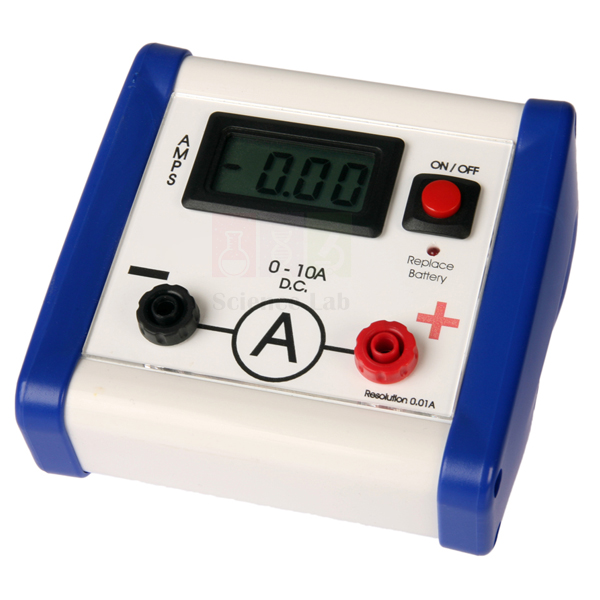
Digital Ammeter
Digital Ammeter (Product Code: SLE/EAM/09) measures direct current from 0 to ±10 A and shows it to 0.01 A, so one meter covers both small lamp circuits and the heavy currents used in electromagnetism demonstrations. Running from a 9 V PP3 battery, it needs no mains connection on the bench, which makes it a practical addition to the physics lab instruments used in school and college practicals. It is made by Jain Scientific Equipments Pvt Ltd (ScienceLab), Ambala, India.
Specifications
| Parameter | Detail |
|---|---|
| Range | 0 to ±10 A DC |
| Resolution | 0.01 A |
| Accuracy | ±2% |
| Input impedance | 0.01 Ω approx. |
| Power | 9 V PP3 battery |
Typical Use
The meter is wired in series with the component being studied, and its very low input impedance means it adds almost nothing to the resistance of the circuit, so the current it shows is the current that would flow without it. Together with a voltmeter it forms the familiar ammeter-voltmeter pair for Ohm's law, resistivity and power experiments, and the bipolar range shows a minus sign rather than a damaged movement if a student connects it the wrong way round.
The upper end of the range is where this meter earns its place. Demonstrations such as the magnetic field around a vertical wire or the force on a current-carrying conductor need several amperes, well beyond many general-purpose classroom meters, and this ammeter lets the class read the actual current rather than guess it. One rule is worth repeating before every practical: an ammeter must never be connected directly across a power supply or cell, because its low impedance would effectively short-circuit the source.
Manufacturer
Jain Scientific Equipments Private Limited, operating under the ScienceLab trade name in Ambala, Haryana, produces this ammeter as part of its range of meters and circuit apparatus for schools, colleges and technical institutes. Company background is available on the ScienceLab profile.
Related Electricity and Magnetism Equipment
The following items are used in the same circuits and demonstrations as this ammeter:
- Digital Voltmeter — the partner meter for potential difference in the same practical.
- Magnetic Field Unit Vertical Wire — runs at 5–8 A, a current this meter can monitor.
- Force on a Conductor Apparatus — takes currents of up to 8 A, within the meter's range.
- Lost Volts — internal-resistance apparatus that needs an ammeter and a voltmeter.
- Precision Switched Power Supply — a regulated, high-current DC source for these circuits.
More meters and apparatus are listed under Electricity and Magnetism.
Frequently Asked Questions
What current range does it cover?
0 to ±10 A DC, displayed in steps of 0.01 A with an accuracy of ±2%.
Is it sensitive enough for very small currents?
It reads in hundredths of an ampere, which suits lamps, motors and electromagnet circuits. For milliamp-level work such as LED characteristics, ask us to suggest a more sensitive meter.
How is it powered?
By a 9 V PP3 battery, so it can be used on any bench without a mains socket.
Can it measure AC current?
The published range is DC only. If you need AC current measurement, contact us before ordering.
How should students connect it?
Always in series with the component. Connecting it across a supply creates a near short circuit because of its very low input impedance of about 0.01 Ω.
Can you provide a calibration certificate or warranty details?
Both are confirmed per order. Please raise them through our contact page when requesting a quote.
Request a Quote
To order Digital Ammeters in class quantities for India or international delivery, contact us through the contact page or add them to the enquiry cart along with voltmeters and supplies.
Last updated: 24 September 2026
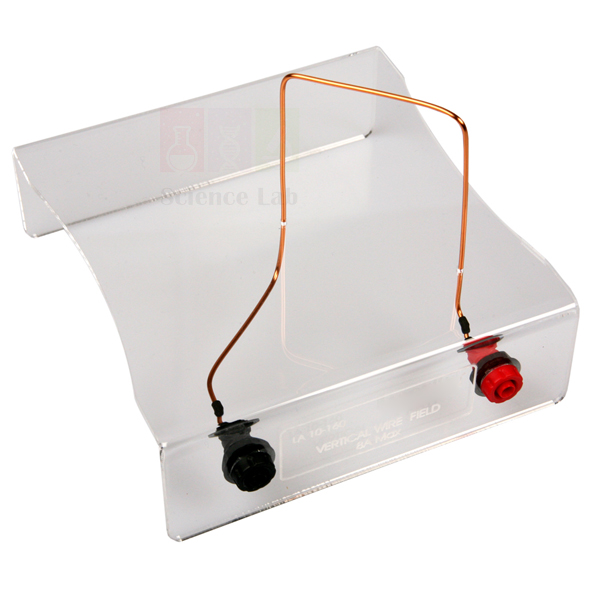
Magnetic Field Unit Vertical Wire
Magnetic Field Unit Vertical Wire (Product Code: SLE/EAM/10) is a clear acrylic base with a straight conductor passing vertically through it, used to reveal the circular magnetic field around a current-carrying wire with plotting compasses or iron filings. It belongs to a small electromagnetic kit for schools made up of three field units, and its transparent base works on the bench or on an overhead projector for whole-class viewing. The unit is made by Jain Scientific Equipments Pvt Ltd (ScienceLab), Ambala, India.
Specifications
| Parameter | Detail |
|---|---|
| Type | Vertical wire field unit |
| Base | Clear acrylic, 150 x 150 x 45 mm |
| Connections | 4 mm sockets |
| Viewing | Suitable for bench or overhead projector use |
| Field detection | Used with plotting compasses or iron filings |
| Supply requirement | DC power supply capable of providing 5–8 A |
| Series | Three types: 15 turn long solenoid, vertical wire field and twin vertical coils |
| Twin coil model (for comparison) | Single-turn coil rated 8 A max; 5-turn coil rated 5 A max |
Typical Use
With the wire connected to a high-current DC supply, students sprinkle a thin layer of iron filings on the acrylic base and tap it gently; the filings settle into concentric rings centred on the wire. Replacing the filings with a ring of plotting compasses shows the direction of the field, and reversing the supply leads makes every needle swing round, which is the ideal moment to introduce the right-hand grip rule. Placed on an overhead projector, the same pattern is thrown onto the screen so the whole room can follow it.
Because the unit needs 5 to 8 A to give a clear pattern, switch the current on only while observing and off again straight after, so the wire and supply stay cool. As a magnetism experiment it pairs naturally with the solenoid and twin-coil versions in the same series, letting students compare the field of a single straight wire with that of a coil. Brush filings onto a sheet of paper afterwards and keep them well away from the sockets.
Manufacturer
This field unit comes from Jain Scientific Equipments Private Limited, which trades as ScienceLab and manufactures physics apparatus in Ambala, Haryana. Institutional and tender buyers who need vendor registration details can quote GSTIN 06AAECJ8618A1ZT and LEI 3358004HRD1JIVXKYX49. The company profile has further information.
Related Electricity and Magnetism Equipment
A complete field-pattern demonstration usually calls for the following:
- Precision Switched Power Supply — regulated DC rated up to 8 A, matching the unit's supply requirement.
- Digital Ammeter — its 10 A range lets students record the current through the wire.
- Compass Plotting (Clear) — small plotting compasses for tracing the field direction around the wire.
- Plotting Compass, Single Glass Face — an alternative compass style for the same task.
- Stackable Leads — 4 mm leads for connecting the unit's sockets to the supply.
See the complete Electricity and Magnetism range for the other field units and accessories.
Frequently Asked Questions
Which version of the field unit is this?
This listing is the vertical wire field unit. The series also includes a 15 turn long solenoid and twin vertical coils; tell us if you need those as well.
What power supply does it need?
A DC supply able to deliver 5–8 A. Ordinary low-current classroom supplies will not produce a clear pattern.
Are plotting compasses or iron filings included?
The unit is designed to be used with them, but they are not listed as part of it. Please confirm what you need through our contact page so they can be added to your quotation.
Can the pattern be shown to the whole class?
Yes. The clear acrylic base is suitable for use on an overhead projector as well as on the bench.
What are the ratings of the twin coil model?
In the twin coil version, the single-turn coil is rated at 8 A maximum and the 5-turn coil at 5 A maximum.
Is there a warranty on the unit?
Warranty terms are stated in each quotation. Ask us for details when you enquire.
Do you handle tender and export orders?
Yes. Share your tender format, quantity and delivery location, and we will quote for India or international markets.
Request a Quote
Request pricing for the Magnetic Field Unit Vertical Wire through the contact page, or add it to the enquiry cart with a suitable power supply and compasses.
Last updated: 24 September 2026
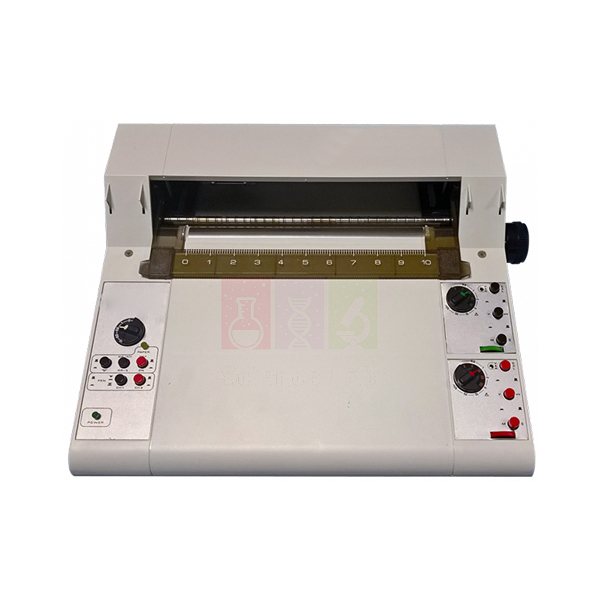
Two Channel Recorder
Two Channel Recorder (Product Code: SLE/EA/04) is a two-pen chart recorder used to draw a permanent paper trace of electrical signals during laboratory experiments, and it is listed to work with the Flight Demonstration Wind Tunnel. Engineering lab staff use it for its 200 mm chart, a 1 mV to 50 V input range, 16 chart speeds and long-life fibre-tip pens that stand up to student use. It is supplied by Jain Scientific Equipments Pvt Ltd (ScienceLab), Ambala, India.
Specifications
| Parameter | Detail |
|---|---|
| Recorder type | Two-pen chart recorder |
| Works with | Flight Demonstration Wind Tunnel |
| Chart width | 200 mm |
| Range | 1 mV – 50 V |
| Configuration | 1-channel and 2-channel versions |
| Chart speed | 16 different speeds from 0.1 to 20 mm/sec or mm/min |
| Pen lift | Separate electric pen-lift per channel |
| Pens | Long-life fibre-tip pens that withstand long-term laboratory use |
| Design | Ergonomic, for ease of use by students |
| Product code | SLE/EA/04 |
| Supplied by | Jain Scientific Equipments Pvt Ltd (ScienceLab), Ambala, India |
What Is the Two Channel Recorder Used For?
A chart recorder moves paper at a set speed while a pen follows the input voltage, so a changing quantity is drawn as a line against time. With two pens, students can plot two signals on one chart and see directly how one responds to the other, which is ideal for transient experiments such as the motion demonstrations on a wind tunnel model. The paper record can be annotated, measured with a ruler and stapled into the lab report.
Pick a fast mm/sec speed to spread out quick events and a slow mm/min speed for long runs. Set each channel's range so the trace uses most of the 200 mm width without hitting the edge. The electric pen-lift on each channel lets you raise a pen between runs to avoid stray marks, and capping the pens after the session keeps the fibre tips from drying out.
What to Specify When Ordering
- 1-channel or 2-channel version.
- The signals you will record, so they can be checked against the 1 mV – 50 V range.
- Whether it will be used with the Flight Demonstration Wind Tunnel or with other apparatus.
- Spare pens and chart paper for the term; ask us what can be quoted.
Supplier
Jain Scientific Equipments Private Limited, under its ScienceLab brand, supplies the Two Channel Recorder to aeronautical and mechanical engineering departments, polytechnics, dealers and importers in India and international markets. The recorder can be quoted together with the wind tunnel and other aerodynamics equipment in one order.
For company background, see the ScienceLab profile.
Related Aerodynamics Lab Equipment
These items are used with the recorder or as alternative ways to capture signals:
- Flight Demonstration Wind Tunnel — the apparatus this recorder is listed to work with.
- Subsonic Wind Tunnel — lift, drag and pressure experiments in a larger tunnel.
- Oscilloscope Dual Trace — for viewing fast two-channel signals on screen instead of paper.
- Advanced Digital Multimeter — checks signal levels before setting the recorder range.
See the full Aerodynamics Lab Equipment category.
Frequently Asked Questions
What is the input range of the Two Channel Recorder?
The Two Channel Recorder covers an input range of 1 mV to 50 V, which lets it trace both small sensor signals and larger voltages. Choose the range on each channel so the trace fills the 200 mm chart without running off the edge.
How many chart speeds does the Two Channel Recorder have?
The Two Channel Recorder offers 16 different chart speeds from 0.1 to 20, selectable in mm/sec or mm/min. Fast speeds spread out quick transients, while slow speeds suit long, gradual runs.
Is the Two Channel Recorder available in a single-channel version?
Yes. The Two Channel Recorder is listed in 1-channel and 2-channel versions. Each channel has its own electric pen-lift, so on the two-channel model either pen can be raised independently between runs.
Which apparatus does the Two Channel Recorder work with?
The Two Channel Recorder is listed to work with the Flight Demonstration Wind Tunnel. It can also record other voltage signals within its 1 mV to 50 V range; confirm your signal source with us through the contact page.
Who supplies the Two Channel Recorder?
The Two Channel Recorder is supplied by Jain Scientific Equipments Pvt Ltd (ScienceLab), Ambala, Haryana, India, to engineering institutions, dealers and importers in India and international markets, and can be ordered together with the wind tunnel it serves.
Is a calibration certificate available for the Two Channel Recorder?
A calibration certificate for the Two Channel Recorder is not listed as standard. If your laboratory requires one, please discuss it with us through the contact page before you place the order.
Request a Quote
Request a price for the Two Channel Recorder through the contact page or add it to the enquiry cart.
Last updated: 24 September 2026
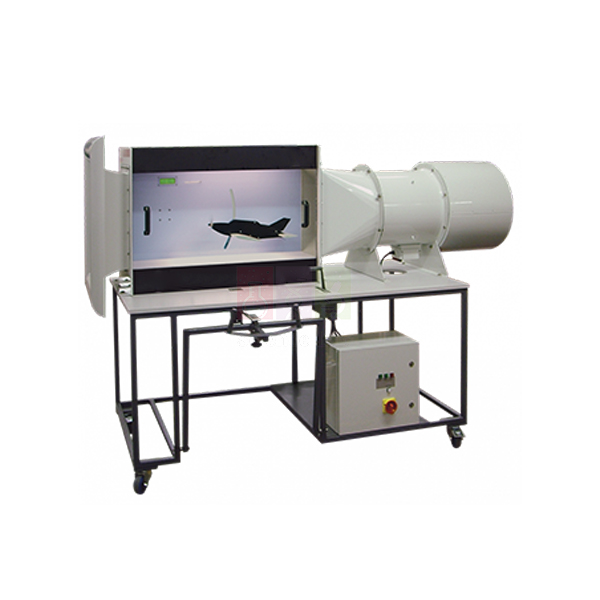
Flight Demonstration Wind Tunnel
Flight Demonstration Wind Tunnel (Product Code: SLE/EA/05) is a teaching wind tunnel with a free-moving model aircraft used to demonstrate the basic principles of flight — aerofoil lift, stall, longitudinal stability and transient motion — in aeronautical and mechanical engineering classrooms. The model can move vertically and pitch about its quarter-chord point independently, while an electronic display shows air speed, attitude, altitude, pressure and lift. It is made by Jain Scientific Equipments Pvt Ltd (ScienceLab), an OEM manufacturer, at its own factory in Ambala, India.
Key Details
| Parameter | Detail |
|---|---|
| Model motion | Aircraft moves vertically and pitches about the quarter-chord point, independently |
| Flight phases simulated | Take-off, level flight, cruise and landing |
| Demonstrations | Aerofoil lift, stall, longitudinal stability and transient motion |
| Electronic display | Air speed, attitude, altitude, pressure and lift |
| Stall indication | Tufts on the wing show flow separation and stall |
| Working section | Brightly illuminated |
| Model balance | Adjustable centre of gravity |
| Compatible recorder | Two Channel Recorder (SLE/EA/04) is listed to work with this tunnel |
| Product code | SLE/EA/05 |
| Manufacturer | Jain Scientific Equipments Pvt Ltd (ScienceLab) — OEM |
| Country of origin | India (made in Ambala, Haryana) |
What Is the Flight Demonstration Wind Tunnel Used For?
Unlike a tunnel where the model is held rigidly on a balance, here the aircraft is free to rise and pitch, so students see it behave the way a real aeroplane does. As air speed increases the model lifts off, settles into level flight and cruise, and comes back down for a landing when speed is reduced. When the wing reaches too steep an angle, the tufts on the wing flutter and reverse as the flow separates, giving a clear visual of stall that matches the drop in lift on the display.
Shifting the adjustable centre of gravity forward or aft is a direct way to teach longitudinal stability: students watch the model damp out a disturbance in one setting and oscillate or diverge in another. For transient-motion work, the Two Channel Recorder can be added to put the response on paper. The illuminated working section keeps the model visible to a whole class during lectures.
What to Specify When Ordering
- Whether you want the Two Channel Recorder quoted with the tunnel for paper records.
- Your mains supply for the fan, display and lighting (not stated in the listing).
- Room layout and viewing arrangement for lecture demonstrations.
- Number of units required.
OEM Manufacturer
The Flight Demonstration Wind Tunnel is manufactured by Jain Scientific Equipments Private Limited, which operates under the ScienceLab name, as the original equipment manufacturer. It is produced at the company's licensed factory in Saha, Ambala, Haryana, India, and supplied from the factory to aviation training institutes, engineering colleges, dealers and importers.
Dealing with the manufacturer directly means one point of contact for technical questions, replacement parts such as models or tufts, and repeat orders — just ask us. More about the company is on the profile page.
Related Aerodynamics Lab Equipment
Combine the flight demonstrator with these units in an aerodynamics lab:
- Two Channel Recorder — chart recorder listed to work with this tunnel.
- Subsonic Wind Tunnel — quantitative lift and drag measurement on fixed models.
- Flow Visualisation Wind Tunnel — smoke streamlines that show separation around shapes.
- Modular Air Flow Bench — bench-top air-flow experiments for smaller groups.
Explore the Aerodynamics Lab Equipment category.
Frequently Asked Questions
What does the Flight Demonstration Wind Tunnel demonstrate?
The Flight Demonstration Wind Tunnel demonstrates aerofoil lift, stall, longitudinal stability and transient motion. Its model aircraft simulates take-off, level flight, cruise and landing, so students connect textbook theory with visible aircraft behaviour.
How does the model move in the Flight Demonstration Wind Tunnel?
In the Flight Demonstration Wind Tunnel, the model aircraft can move vertically and pitch about its quarter-chord point, each independently. This freedom lets it respond to air speed and centre-of-gravity changes much as a real aircraft would.
What readings does the Flight Demonstration Wind Tunnel display?
The Flight Demonstration Wind Tunnel includes an electronic display of air speed, attitude, altitude, pressure and lift, so the class can link what they see the model doing with measured values at the same moment.
How is stall shown on the Flight Demonstration Wind Tunnel?
On the Flight Demonstration Wind Tunnel, tufts attached to the wing clearly show flow separation and stall. As the angle rises past the stall point, the tufts become disturbed and reverse, while the displayed lift falls.
Who manufactures the Flight Demonstration Wind Tunnel?
The Flight Demonstration Wind Tunnel is manufactured by Jain Scientific Equipments Pvt Ltd (ScienceLab), the OEM, at its own licensed factory in Ambala, Haryana, India, and supplied factory-direct to institutions in India and international markets.
Can a chart recorder be used with the Flight Demonstration Wind Tunnel?
Yes. The Two Channel Recorder (SLE/EA/04) is listed to work with the Flight Demonstration Wind Tunnel, giving a paper record for transient-motion experiments. Ask us to include it in your quotation if you need printed traces.
Request a Quote
Quotations come direct from the manufacturer. Contact us through the contact page or add the Flight Demonstration Wind Tunnel to the enquiry cart.
Last updated: 24 September 2026