- Physics Lab Equipment
- Chemistry Lab Equipment
- Biology Lab Equipment
- Anatomical Lab Equipment
- Learning
- Educational Lab Equipment
- Magnets
- Agriculture
- Astronomy
- Earth Science
- Geography Lab Equipment
- Safety Lab Coat
- Laboratory
- Meteorological
- Electricity & Magnetism
- Heat
- School Lab Equipment
- Lab Glassware
- Science Lab Equipment
- Tvet Lab Equipment
- Robotics Kits Supplier and Manufacturer for Schools India
- Math Lab Equipment Manufacturers and Exporters in Ambala
- STEM Kits Manufacturers and Supplier India
- Engineering Lab Equipment
- Hospital Lab Equipment
- Water, Sanitation & Hygiene Supplies
- Cold Chain, Solar & Communication Equipment
- Nutrition
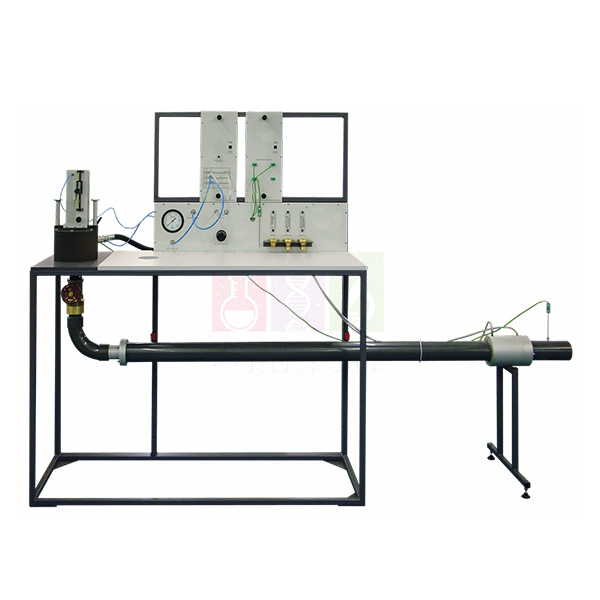
Laval Nozzle Pressure Apparatus
Laval Nozzle Pressure Apparatus (Product Code: SLE/EA/06) is a floor-standing compressed-air test rig used to study the thermodynamics and fluid mechanics of adiabatic air expansion through subsonic and supersonic nozzles in engineering laboratories. It comes with three interchangeable, polished brass nozzles — convergent, convergent-divergent (Laval) and convergent-parallel — and a stainless-steel probe on a vertical traverse that maps pressure along the nozzle axis. It is made by Jain Scientific Equipments Pvt Ltd (ScienceLab), an OEM manufacturer, at its own factory in Ambala, India.
Specifications
| Parameter | Detail |
|---|---|
| Nozzles | Three interchangeable, profiled and polished brass nozzles with mimics: convergent, convergent-divergent (Laval) and convergent-parallel |
| Air circuit | Compressed air passes a pressure regulator and isolating valve; flow settles along a horizontal pipe, passes an orifice and exits to atmosphere |
| Mass flow | Determined by students from the pressures around the orifice |
| Instrumentation | Digital temperature and pressure displays for key points around the apparatus |
| Chest pressure | Also shown on an analogue gauge |
| Inlet pressure | Pressure regulator maintains upstream pressure, with an analogue reference gauge |
| Axial probe | Stainless-steel probe on a manually adjustable vertical traverse; digital indicator shows probe position in the nozzle |
| Frame | Floor-standing; holds a pressure chest with removable lid and nozzle traverse mechanism, a worktop and an instrument frame |
| Dimensions | Length 2900 mm x depth 600 mm x height 1730 mm |
| Weight | 123 kg |
| Product code | SLE/EA/06 |
| Manufacturer | Jain Scientific Equipments Pvt Ltd (ScienceLab) — OEM |
| Country of origin | India (made in Ambala, Haryana) |
What Is the Laval Nozzle Apparatus Used For?
The rig lets students watch compressible flow theory happen. With the convergent nozzle they find that mass flow stops rising once the throat chokes; with the convergent-divergent Laval nozzle they see pressure keep falling past the throat as the flow becomes supersonic; and with the convergent-parallel nozzle they compare what happens when the passage does not widen. Traversing the probe step by step along the axis, and reading its position on the digital indicator, gives a pressure profile for each nozzle and each inlet pressure.
Temperature and pressure readings at key points, plus the orifice pressures used to calculate mass flow, give everything needed to compare results with isentropic-flow equations. Swapping nozzles is done through the removable chest lid, and the mimic on each nozzle helps students relate probe position to the nozzle shape. Set the regulator gradually, close the isolating valve before changing nozzles, and allow room for a 2900 mm long frame.
What to Specify When Ordering
- Your compressed-air supply; the required pressure and flow are not stated in the listing, so ask us before ordering.
- Floor space for the 2900 x 600 x 1730 mm, 123 kg frame.
- Your mains supply for the digital displays.
- Number of rigs and whether spare nozzles are needed.
OEM Manufacturer
ScienceLab is the trade name of Jain Scientific Equipments Private Limited, the original equipment manufacturer of the Laval Nozzle Pressure Apparatus. The rig is produced at the company's own licensed factory at 449, HSIIDC Industrial Area, Saha, Ambala, Haryana, India, and delivered straight from the factory rather than through a trading intermediary.
Mechanical and aerospace engineering departments, dealers and importers can therefore raise quotations, technical queries and requests for replacement parts or extra nozzles with the maker itself — ask us. See the company profile for more.
Related Aerodynamics Lab Equipment
Useful companions for compressible and internal-flow teaching:
- Schlieren Apparatus — makes shockwaves and expansions in supersonic flow visible.
- Orifice and Venturi meter demonstrator — introduces flow measurement with orifices in incompressible flow.
- Bernoulli’s Theorem Demonstration module — the low-speed counterpart to pressure changes in a converging-diverging duct.
- Subsonic Wind Tunnel — external-flow experiments on models at low speed.
View all Aerodynamics Lab Equipment.
Frequently Asked Questions
Which nozzles come with the Laval Nozzle Pressure Apparatus?
The Laval Nozzle Pressure Apparatus includes three interchangeable, profiled and polished brass nozzles with mimics: a convergent nozzle, a convergent-divergent (Laval) nozzle and a convergent-parallel nozzle, each fitting the traverse mechanism in the pressure chest.
How is pressure measured along the nozzle?
On the Laval Nozzle Pressure Apparatus, a stainless-steel probe on a manually adjustable vertical traverse measures pressure along the nozzle axis, and a digital indicator shows the probe position, so students can plot pressure against distance.
How is mass flow found on the Laval Nozzle Pressure Apparatus?
On the Laval Nozzle Pressure Apparatus, air leaving the nozzle settles along a horizontal pipe and passes through an orifice to atmosphere. Students use the displayed pressures around the orifice to determine the overall mass flow.
What size is the Laval Nozzle Pressure Apparatus?
The Laval Nozzle Pressure Apparatus is floor-standing and measures 2900 mm long, 600 mm deep and 1730 mm high, with a weight of 123 kg. It also needs a compressed-air connection; ask us about the supply required.
Who manufactures the Laval Nozzle Pressure Apparatus?
The Laval Nozzle Pressure Apparatus is manufactured by Jain Scientific Equipments Pvt Ltd (ScienceLab), the OEM, at its own licensed factory in Saha, Ambala, Haryana, India, and supplied factory-direct to institutions in India and international markets.
Is a calibration certificate available for the Laval Nozzle Pressure Apparatus?
A calibration certificate for the Laval Nozzle Pressure Apparatus's pressure and temperature displays is not listed as standard. If you need one, please discuss the requirement with us through the contact page before ordering.
Request a Quote
For a price direct from the manufacturer, use the contact page or add the Laval Nozzle Pressure Apparatus to the enquiry cart.
Last updated: 24 September 2026
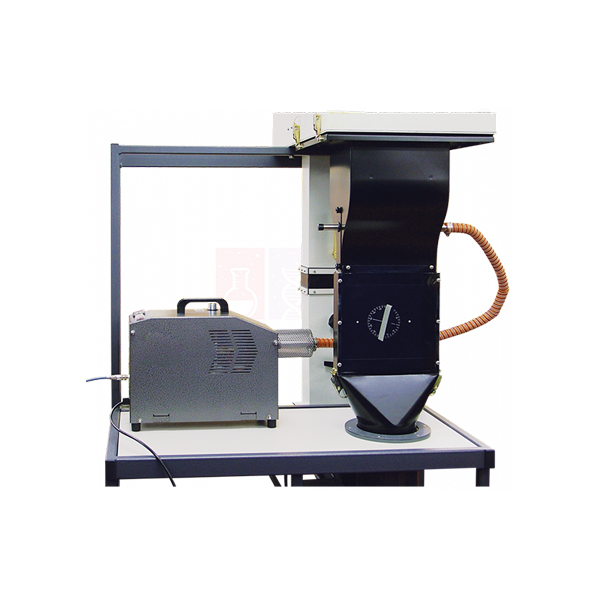
Flow Visualisation
Flow Visualisation (Product Code: SLE/EA/07) is a smoke-tunnel set used to make air-flow patterns visible for teaching aerodynamics and fluid mechanics in engineering laboratories and demonstration rooms. The listed set brings together a smoke generator, a three-piece smoke tunnel duct including the working section, a CO2 gas bottle with bracket, pipe and exhaust duct and 2.5 litres of smoke oil, at 37 kg total net weight, and it runs on either 100–120 VAC or 220–240 VAC. It is made by Jain Scientific Equipments Pvt Ltd (ScienceLab), an OEM manufacturer, at its own factory in Ambala, India.
Specifications
| Parameter | Detail |
|---|---|
| Electrical supply | 100–120 VAC, 50–60 Hz or 220–240 VAC, 50–60 Hz |
| Smoke generator | 410 x 180 x 370 mm; 14 kg |
| CO2 gas bottle and bracket | 7.5 kg |
| Smoke tunnel duct | Three pieces including working section; 10.5 kg |
| Pipe and exhaust duct | 2.5 kg |
| Smoke oil | 2.5 litre |
| Total net weight | 37 kg |
| Packed (approx.) | 0.32 m³; 42 kg |
| Storage temperature | –25 °C to +55 °C |
| Operating temperature | +5 °C to +40 °C |
| Operating relative humidity | 80% at temperatures below 31 °C, decreasing linearly to 50% at 40 °C |
| Product code | SLE/EA/07 |
| Manufacturer | Jain Scientific Equipments Pvt Ltd (ScienceLab) — OEM |
| Country of origin | India (made in Ambala, Haryana) |
What Is the Flow Visualisation Smoke Tunnel Used For?
The smoke generator produces a fine visible smoke that is carried into the tunnel duct and through the working section, where it traces the path of the air around a model or through a passage. Students can see streamlines bunch together where flow speeds up, spread where it slows, and break into eddies behind blunt shapes — ideas that are hard to grasp from equations alone. Spent smoke is led away through the pipe and exhaust duct.
Because the duct comes in three pieces and the whole set weighs 37 kg net, it can be stored compactly and assembled on a bench when needed, and the choice of 100–120 V or 220–240 V supply suits different national mains. Operate it within +5 °C to +40 °C and the stated humidity limits, keep the smoke oil level topped up, and route the exhaust towards a window or extraction point.
What to Specify When Ordering
- Electrical supply version: 100–120 VAC or 220–240 VAC.
- Whether the CO2 bottle should be shipped filled or will be filled locally; ask us, as shipping rules for gas cylinders vary.
- Extra smoke oil beyond the 2.5 litres listed.
- Number of sets and the delivery address (packed about 0.32 m³ and 42 kg per set).
OEM Manufacturer
Jain Scientific Equipments Private Limited (CIN U29309HR2020PTC087597), better known by its trading name ScienceLab, is the OEM that manufactures the Flow Visualisation set. It is made at the company's licensed factory at 449, HSIIDC Industrial Area, Saha, Ambala, Haryana, India, operating under Factory Licence AMB-ONLINE-CHD-J-414.
Colleges, science centres, dealers and importers buying factory-direct can rely on the manufacturer for quotations, replacement duct pieces or other parts and repeat orders — simply ask us. The company profile has more details.
Related Aerodynamics Lab Equipment
These units complement the smoke tunnel in a flow-visualisation and aerodynamics lab:
- Flow Visualisation Wind Tunnel — a vertical, mobile smoke tunnel with its own frame and lighting.
- Modular Air Flow Bench — base unit whose exhaust can take ducting for smoke experiments.
- Effect And Jet Flow — shows air-jet attachment and switching that smoke makes easy to see.
- Subsonic Wind Tunnel — measures forces and pressures on models.
Browse the Aerodynamics Lab Equipment category.
Frequently Asked Questions
What is included in the Flow Visualisation set?
The Flow Visualisation set is listed with a smoke generator, a smoke tunnel duct in three pieces including the working section, a CO2 gas bottle with bracket, pipe and exhaust duct, and 2.5 litres of smoke oil, for a total net weight of 37 kg.
What power supply does the Flow Visualisation set need?
The Flow Visualisation set is listed for 100–120 VAC or 220–240 VAC at 50–60 Hz. State your mains voltage when ordering so the matching version is supplied for your laboratory or country.
What operating conditions suit the Flow Visualisation smoke tunnel?
The Flow Visualisation smoke tunnel operates from +5 °C to +40 °C, with relative humidity up to 80% below 31 °C falling linearly to 50% at 40 °C. It can be stored between –25 °C and +55 °C.
How big is the Flow Visualisation smoke generator?
The Flow Visualisation smoke generator measures 410 x 180 x 370 mm and weighs 14 kg. Packed for shipment, the complete set occupies about 0.32 m³ and weighs about 42 kg.
Who manufactures the Flow Visualisation set?
The Flow Visualisation set is manufactured by Jain Scientific Equipments Pvt Ltd (ScienceLab), the OEM, at its own licensed factory in Saha, Ambala, Haryana, India, and supplied factory-direct to institutions, dealers and importers in India and international markets.
Can the Flow Visualisation set be exported with the CO2 bottle?
Export of the Flow Visualisation set is handled case by case, because gas cylinders may need special shipping arrangements. Ask us through the contact page whether the CO2 bottle is sent filled or empty for your destination.
Request a Quote
Quotations for the Flow Visualisation set come straight from the manufacturer. Write to us via the contact page or add it to the enquiry cart.
Last updated: 24 September 2026
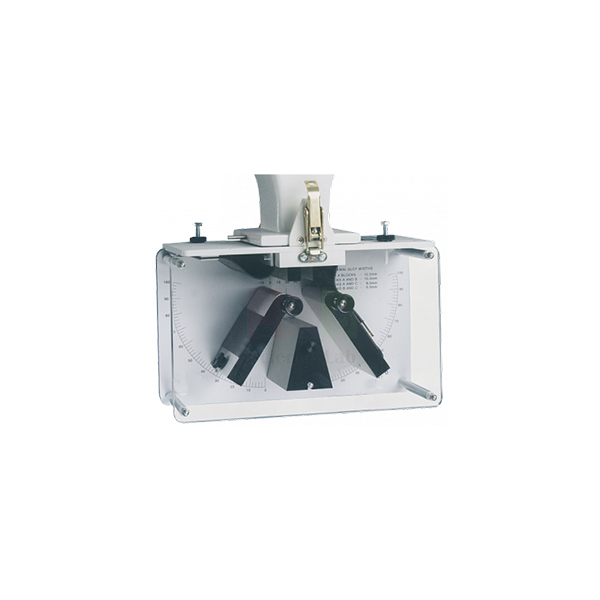
Effect And Jet Flow
Effect And Jet Flow (Product Code: SLE/EA/08) is an air-flow experiment module used to demonstrate how a jet of air attaches to a nearby wall and can be deflected or switched — the wall-attachment behaviour known as the Coanda effect — in fluid mechanics and aerodynamics teaching laboratories. An aerodynamically shaped nozzle produces the jet, the attachment wall can be rotated to bend the jet through large angles, and a second wall allows flip-flop switching like a fluidic switch. It is made by Jain Scientific Equipments Pvt Ltd (ScienceLab), an OEM manufacturer, at its own factory in Ambala, India.
Key Details
| Parameter | Detail |
|---|---|
| Format | Experiment module |
| Jet source | Aerodynamically shaped nozzle from which a jet of air emerges |
| Attachment wall | The jet flows against a wall and attaches to it; the wall can be rotated to show deflection of the jet through large angles |
| Second wall | Can be introduced on the other side of the jet; the jet may then be switched from one side to the other, as in a fluidic flip-flop switch |
| Further investigations | Effect of sealing the walls; effect of adding a central splitter |
| Product code | SLE/EA/08 |
| Manufacturer | Jain Scientific Equipments Pvt Ltd (ScienceLab) — OEM |
| Country of origin | India (made in Ambala, Haryana) |
What Is the Jet Flow Module Used For?
A free jet entrains the air around it. When a wall is close to one side, the jet cannot draw in air from that side as easily, the pressure there drops, and the jet is pulled onto the wall and follows it. Students see this first with a single wall, then rotate the wall to discover how far the jet will follow a surface before it breaks away — the principle behind many aircraft high-lift devices and industrial air knives.
Adding the second wall turns the module into a simple bistable device: the jet locks onto one wall and stays there until it is disturbed, then flips to the other. This is exactly how a fluidic flip-flop switch works, a no-moving-parts logic element. Sealing the walls and inserting the central splitter let students test how each change alters attachment and switching, so the module supports open-ended project work as well as set practicals.
What to Specify When Ordering
- The air supply or base unit the module will be used with; confirm fit with us, for example with the Modular Air Flow Bench.
- Whether you also need a smoke source to make the jet visible.
- Number of modules for your student groups.
OEM Manufacturer
The Effect And Jet Flow module is an original product of Jain Scientific Equipments Private Limited, which does business as ScienceLab. As the OEM, the company manufactures it at its own licensed factory in Saha, Ambala, Haryana, India, and sends it out factory-direct to universities, polytechnics, dealers and importers.
Quotations, compatibility questions and later requests for parts are all answered by the manufacturer, so there is no middleman between your laboratory and the maker — ask us whatever you need. The ScienceLab profile gives more background.
Related Aerodynamics Lab Equipment
Items that support jet and air-flow experiments:
- Modular Air Flow Bench — base unit that supplies controlled air to experiment modules.
- Flow Visualisation smoke tunnel — smoke equipment for making jet paths visible.
- Flow Visualisation Wind Tunnel — smoke streamlines around models in a vertical tunnel.
- Impact of a Jet Apparatus — measures the force of a water jet, a useful contrast in jet momentum.
See all Aerodynamics Lab Equipment.
Frequently Asked Questions
What does the Effect And Jet Flow module demonstrate?
The Effect And Jet Flow module demonstrates how an air jet from a shaped nozzle attaches to a nearby wall and follows it, known as the Coanda effect. Rotating the wall shows the jet being deflected through large angles.
How does the Effect And Jet Flow module show fluidic switching?
In the Effect And Jet Flow module, a second wall can be placed on the other side of the jet. The jet then attaches to one wall and can be switched to the other, just as in a fluidic flip-flop switch.
What further experiments can be done with the Effect And Jet Flow module?
Beyond wall attachment and switching, the Effect And Jet Flow module lets students investigate the effect of sealing the walls and of adding a central splitter to the device, and observe how each change alters the behaviour of the jet.
Does the Effect And Jet Flow module need a separate air supply?
The Effect And Jet Flow is described as a module, so it is used with a suitable air source such as an air flow bench. Tell us what equipment you have through the contact page and we will confirm compatibility.
Who manufactures the Effect And Jet Flow module?
The Effect And Jet Flow module is manufactured by Jain Scientific Equipments Pvt Ltd (ScienceLab), the OEM, at its own licensed factory in Ambala, Haryana, India, and supplied factory-direct across India and international markets.
Request a Quote
For a quotation direct from the manufacturer, contact us through the contact page or add the Effect And Jet Flow module to the enquiry cart.
Last updated: 24 September 2026
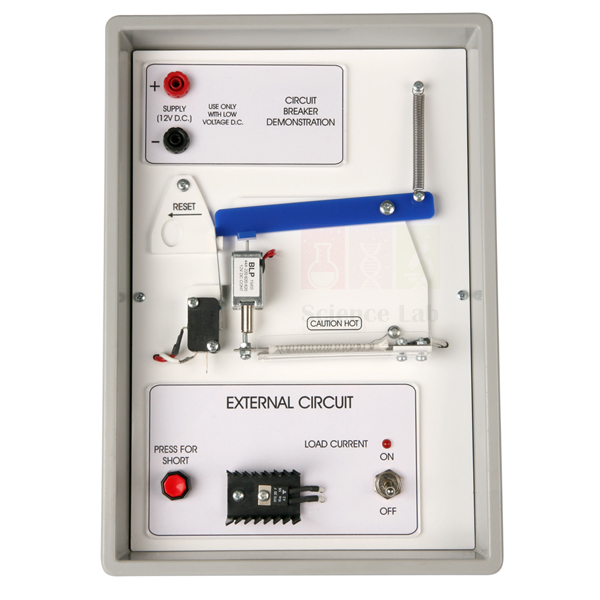
Circuit Breaker
Circuit Breaker (Product Code: SLE/EAM/11) is a demonstration unit that shows, on safe low-voltage DC, how a modern domestic circuit breaker protects a circuit in two different ways: a thermal trip that responds to a slow overload and a solenoid trip that reacts to a sudden current surge. By combining a solenoid experiment with a bi-metal strip demonstration, it links two textbook topics to a device students see in every home. It is made by Jain Scientific Equipments Pvt Ltd (ScienceLab), Ambala, India.
Key Details
| Parameter | Detail |
|---|---|
| Type | Circuit breaker demonstration apparatus |
| Slow overload protection | Thermal trip using a bi-metal strip |
| Surge overload protection | Solenoid (electromagnetic) trip |
| Supply required | 12 V DC, safe low voltage |
| Connections | 4 mm sockets |
| Housing | Robust tray with acrylic protective cover |
| Teaching focus | Applications of solenoids and bi-metal strips; key principles of the domestic circuit breaker |
Typical Use
A lesson usually starts with the slow overload. As the current is held above normal, the bi-metal strip warms, bends and eventually releases the contacts, and students can relate the delay to an overloaded extension board that gets hot before anything trips. The contrasting surge overload makes the solenoid pull in almost at once, showing why a real breaker needs a fast electromagnetic response for short circuits as well as a slower thermal one for sustained overloads.
Because everything runs from 12 V DC and sits under a clear acrylic cover, students can watch both mechanisms at close range without any exposure to mains wiring. The unit works well as a capstone electricity experiment after separate lessons on electromagnets and thermal expansion, and it opens a natural discussion about how breakers differ from fuses in household safety.
Manufacturer
Jain Scientific Equipments Private Limited, whose products carry the ScienceLab name, manufactures electrical demonstration apparatus like this unit in Ambala, Haryana, for classrooms in India and international markets. Find out more on the company profile page.
Related Electricity and Magnetism Equipment
Buyers of this demonstrator often add these items to power it or extend the safety topic:
- Precision Switched Power Supply — regulated DC whose range covers the 12 V this unit needs.
- Digital Ammeter — lets students see the current at which each trip operates.
- Earth Neutral Live Demo — covers fuses, earthing and safe appliance wiring in the same topic.
- Electromagnetic System — builds understanding of the solenoid behind the surge trip.
- Stackable Leads — 4 mm leads for connecting the unit to its supply.
Browse related apparatus in the Electricity and Magnetism category.
Frequently Asked Questions
What power supply does it need?
A 12 V DC supply, connected through the 4 mm sockets on the unit.
Does it connect to the mains?
No. It runs on safe low-voltage DC, so the demonstration involves no mains wiring.
What exactly does it demonstrate?
Two protection mechanisms: a thermal trip operated by a slow overload through a bi-metal strip, and a solenoid trip operated by a current surge, together showing the principles of a domestic circuit breaker.
Can students handle it?
The mechanisms are protected by an acrylic cover inside a robust tray, making it suitable for close viewing under teacher supervision.
How is a circuit breaker different from a fuse?
A fuse wire melts and must be replaced, whereas a breaker opens the circuit mechanically using devices such as a bi-metal strip and a solenoid. Pairing this unit with a fuse demonstration makes the comparison clear.
Are spares or a warranty available?
Spares and warranty terms are confirmed with each quotation; please ask through our contact page.
Request a Quote
For pricing on the Circuit Breaker demonstrator, send us your quantity and delivery location via the contact page, or add it to the enquiry cart with a power supply and leads.
Last updated: 24 September 2026
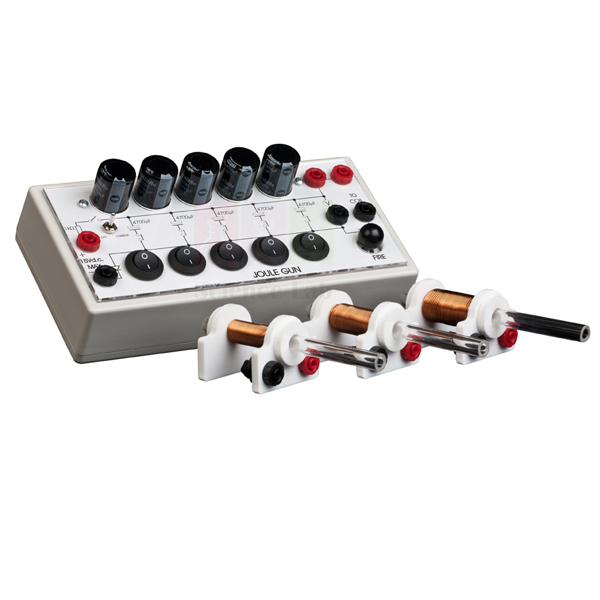
Joule Gun
Joule Gun (Product Code: SLE/EAM/12) stores electrical energy in a bank of capacitors and, at the press of a FIRE button, releases it as a pulse through a low resistance coil that launches a small steel projectile. It turns an abstract chain of ideas – capacitor charging, energy storage, electromagnetism, mechanical energy and efficiency – into one memorable physics experiment kit for senior school and college students. It is made by Jain Scientific Equipments Pvt Ltd (ScienceLab), Ambala, India.
Specifications
| Parameter | Detail |
|---|---|
| Energy store | Control box with five high value capacitors, switched into the charge circuit as required |
| Firing | FIRE button releases the stored energy as a pulse into a low resistance coil |
| Projectile | Small steel projectile |
| Investigable variables | Voltage, time, capacity, distance, kinetic energy and potential energy |
| Topics covered | Energy storage, capacitor charging, mechanical energy, efficiency, electromagnetism |
| Mass | 0.5 kg |
| Dimensions | 220 x 110 x 80 mm, excluding coil |
Typical Use
Students choose how many of the five capacitors to switch into the charge circuit, charge them, note the voltage and calculate the stored energy from E = ½CV². After firing, they measure how far the steel projectile travels and use it to estimate the kinetic energy it gained, or the potential energy it would reach if launched upwards. Comparing that mechanical energy with the electrical energy stored gives a figure for efficiency, and the discussion of where the rest went – heating in the coil and wiring, sound, friction – is often the most valuable part of the lesson.
Because voltage, charging time, capacity and distance can all be changed one at a time, the apparatus supports proper fair-test investigations rather than a single demonstration, and it pairs well with force and motion work on projectiles. Treat every firing as a launch: keep the path clear, never aim the coil at anyone, and have observers wear eye protection.
Manufacturer
Jain Scientific Equipments Private Limited develops and manufactures investigative physics apparatus such as the Joule Gun under its ScienceLab brand in Ambala, Haryana. You can read about the company on its profile page.
Related Electricity and Magnetism Equipment
For measuring the variables and building up the background theory, consider:
- Digital Stopclock — times the charging period when time is the variable under test.
- Metal Ruler — measures the distance travelled by the projectile.
- Capacitor (Charging and Discharging) — introduces capacitor charging before students move on to the gun.
- Capacitance Selector — a switched set of capacitors for exploring how capacitance affects charging.
- Electromagnetic System — shows how coil current creates the magnetic pull used to launch the projectile.
More energy and electromagnetism apparatus is in the Electricity and Magnetism category.
Frequently Asked Questions
How does the Joule Gun work?
Energy is stored in the capacitors in the control box. Pressing FIRE discharges it as a pulse through a low resistance coil, whose magnetic field launches the small steel projectile.
What can students investigate with it?
Voltage, time, capacity, distance, kinetic energy and potential energy can all be varied or measured, which makes efficiency calculations possible.
How many capacitors are there, and what are their values?
There are five high value capacitors that are switched into the charge circuit as needed. Individual values are not listed here, so please ask us via the contact page if you need them for worksheets.
What supply is needed to charge it?
The charging supply is not specified on this page. Confirm the requirement with us before ordering so the right source can be included in your quotation.
How large is the unit?
The apparatus measures 220 x 110 x 80 mm excluding the coil, and the apparatus has a mass of 0.5 kg.
Is it safe for a classroom?
It is intended for supervised use. Keep the firing path clear, never point the coil at people, and use eye protection for everyone nearby.
Can you quote for colleges or export customers?
Yes. Send the quantity and delivery country or city, and we will quote for India or international markets, including warranty terms.
Request a Quote
Get a price for the Joule Gun through our contact page, or add it to the enquiry cart together with the timing and measuring items you need.
Last updated: 24 September 2026
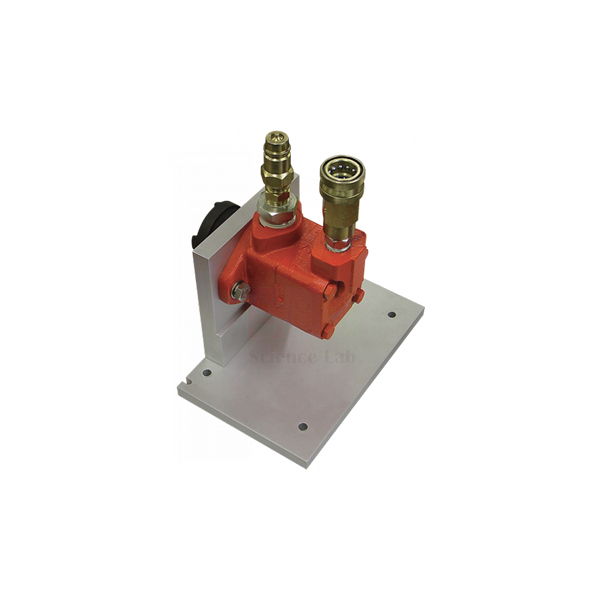
Vane Pump
The Vane Pump (Product Code: SLE/EFM/01) is a fixed displacement, balanced vane pump that delivers a set volume of oil for every full turn of its shaft. It is built for use with the Positive Displacement Pump Module, where students run it for experiments, demonstrations and project work on hydraulic machines. Produced by Jain Scientific Equipments Pvt Ltd (ScienceLab), Ambala, it belongs to our engineering lab equipment for India’s polytechnics, engineering colleges and technical training centres.
Specifications
| Parameter | Detail |
|---|---|
| Pump type | Positive displacement, fixed displacement balanced vane |
| Working fluid | Oil |
| Delivery | A given volume of fluid for each full rotation of the pump shaft |
| Flow direction | Set by pump rotation; tested in one direction, determined by the Universal Dynamometer |
| Connections | Self-sealing, to reduce oil spillage and simplify installation on the pump module |
| For use with | Positive Displacement Pump Module |
| Dimensions | 300 mm x 300 mm x 300 mm (approx) |
| Weight | 9 kg |
Typical Use
Once the pump is mounted on the Positive Displacement Pump Module and coupled to the Universal Dynamometer, students can vary shaft speed and delivery pressure and record how flow, torque and power respond. Because a positive displacement pump moves a fixed volume per revolution, the class can compare the theoretical flow with the measured flow to find volumetric efficiency, and see how internal leakage grows as pressure rises. In a balanced vane design, opposing pressure zones inside the housing help even out the side loads on the rotor, a point worth discussing when comparing it with other pump types.
Among lab equipment for technical institutes, interchangeable pumps like this one let a single test module cover several machines in one term. The self-sealing connections keep oil where it belongs during changeovers, so students can remove and fit the pump without draining the circuit. Wipe connections before fitting, keep the oil clean, and follow the direction of rotation set by the dynamometer.
Manufacturer
Jain Scientific Equipments Private Limited, known to customers by its ScienceLab brand, manufactures teaching equipment in Ambala, Haryana. It holds MSME registration under Udyam UDYAM-HR-01-0003714, and its export consignments move under DGFT Importer-Exporter Code AAECJ8618A. Our company profile has more information.
Related Fluid Mechanics Equipment
Machines and drive units that belong in the same pump-testing programme:
- Universal Dynamometer — drives the pump and reads speed, torque and shaft power
- Gear Pump — a second positive displacement design for side-by-side comparison
- Axial Flow Pump Module — contrasts displacement pumping with a rotodynamic pump
- Reciprocating Compressor — another dynamometer-driven machine for the same lab
View all apparatus in our Fluid Mechanics category.
Frequently Asked Questions
What does the Vane Pump need in order to run?
It is designed for the Positive Displacement Pump Module and is tested in the direction determined by the Universal Dynamometer. Please contact us to confirm what your existing set-up already includes.
Is the Positive Displacement Pump Module part of this item?
This listing covers the vane pump itself. Ask us about the module and drive when you request a quotation.
Which fluid does it pump?
Oil. The exact grade to use is best confirmed with our team before commissioning.
How large and heavy is it?
Approximately 300 mm x 300 mm x 300 mm, weighing 9 kg.
Can the flow direction be reversed?
Pump rotation sets the flow direction, but the pump is tested in one direction only, as determined by the Universal Dynamometer.
What warranty and documentation are provided?
Warranty terms and any test documentation are stated on the quotation; raise specific needs when you enquire.
Do you supply engineering colleges outside India?
Yes. We supply institutions in India and international markets; include the destination in your enquiry.
Request a Quote
Planning a pump-testing lab? Send us your requirements, or add the Vane Pump to the enquiry cart along with the dynamometer and other modules.
Last updated: 24 September 2026
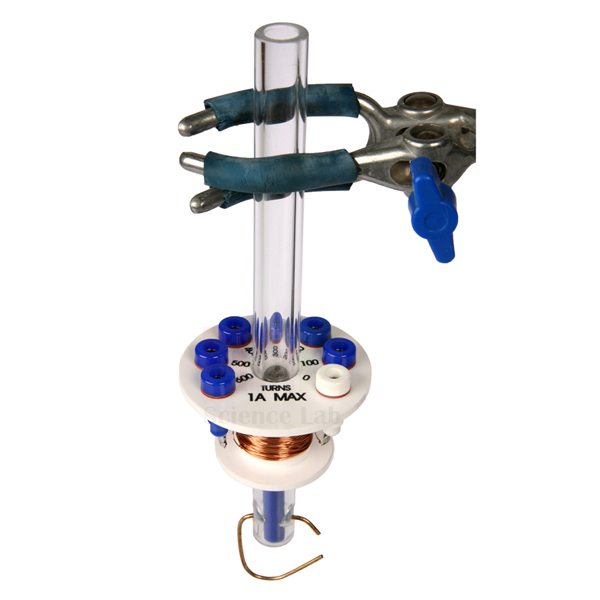
Electromagnetic System
Electromagnetic System (Product Code: SLE/EAM/13) is a self-contained unit that lets students find out how the current and the number of turns affect the strength of an electromagnet. Its coil is tapped at 100, 200, 300, 400, 500 and 600 turns, and ordinary paper clips act as the weights, so a whole investigation needs little more than a low-voltage DC supply. This practical piece of physics lab equipment is made by Jain Scientific Equipments Pvt Ltd (ScienceLab), Ambala, India.
Specifications
| Parameter | Detail |
|---|---|
| Type | Self-contained electromagnet investigation unit |
| Coil tappings | 100, 200, 300, 400, 500 and 600 turns |
| Variables studied | Current and number of turns |
| Strength measurement | Paper clips used as weights |
| Supply required | Low-voltage DC power supply |
| Suggested supply | Designed for use with ScienceLab power supplies |
Typical Use
The unit is set up for a clean two-part investigation. In the first part the current is held steady while the connection is moved from one tapping to the next, and students count how many paper clips the electromagnet will hold at each number of turns. In the second part the tapping stays fixed while the supply is adjusted, with an ammeter recording the current each time. Plotting paper clips against turns and against current gives two graphs that make the relationship obvious, and it is an equally good basis for a science fair project on electromagnet strength.
For consistent results, use clips of the same size, bring them up to the electromagnet the same way each time, and switch the current off between readings so the coil does not warm up during the run. Groups can share one supply by taking turns, since the tappings allow each reading to be set up in seconds.
Manufacturer
The Electromagnetic System is produced by Jain Scientific Equipments Private Limited, an Ambala, Haryana manufacturer that sells its teaching apparatus under the ScienceLab name and designs units like this one to work alongside its own power supplies. The ScienceLab company profile has more on the business.
Related Electricity and Magnetism Equipment
These items supply, control and measure the current in this investigation:
- Precision Variable Power Supply — a smoothly adjustable low-voltage DC source for the current-variation part.
- Digital Ammeter — records the coil current for each reading.
- Rheostat — an alternative way to vary the current from a fixed supply.
- Iron-Clad Electromagnet — a battery-powered electromagnet for comparison demonstrations.
- Circuit Breaker — shows an everyday application of a solenoid once the basics are understood.
Visit the Electricity and Magnetism category for further magnetism apparatus.
Frequently Asked Questions
Which numbers of turns can be selected?
The coil has tappings at 100, 200, 300, 400, 500 and 600 turns, giving six settings for the turns investigation.
What power supply is required?
A low-voltage DC power supply. The unit is designed to be used with ScienceLab power supplies, which can be quoted with it.
What is the maximum current the coil can take?
A current rating is not listed on this page. Please confirm it through our contact page before planning your current range.
How is the strength of the electromagnet measured?
By counting paper clips used as weights, which keeps the method simple and cheap to repeat.
Can students set it up themselves?
Yes. It is self-contained and runs on low voltage, so small groups can carry out the investigation under normal teacher supervision.
Do you supply complete class sets?
Yes. Tell us how many units and supplies you need, plus your delivery location in India or abroad, and we will send a combined quotation including warranty terms.
Request a Quote
Ask for a price on the Electromagnetic System via the contact page, or add it to the enquiry cart with a power supply and ammeter for each group.
Last updated: 24 September 2026
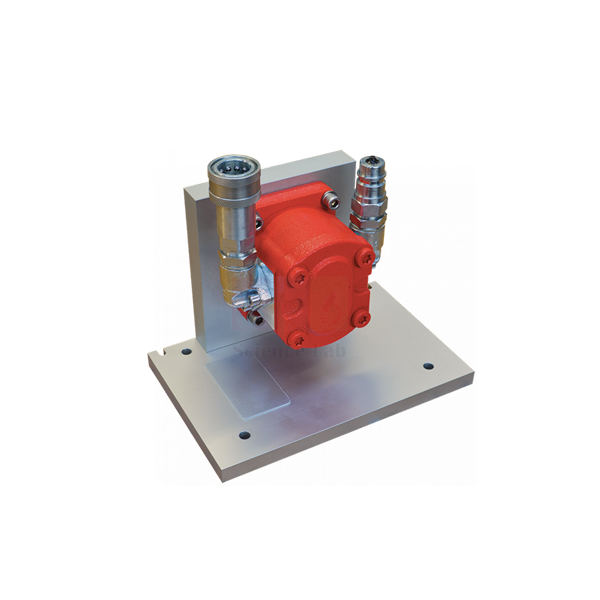
Gear Pump
The Gear Pump (Product Code: SLE/EFM/02) is a positive displacement pump in which a pair of meshing gears carries a fixed volume of oil from inlet to outlet on every full rotation of the shaft. Designed to fit the Positive Displacement Pump Module, it gives students a hands-on way to study one of the simplest and most widely used hydraulic pump designs through experiments, demonstrations and projects. It is manufactured by Jain Scientific Equipments Pvt Ltd (ScienceLab), Ambala, an engineering lab equipment manufacturer serving technical colleges and training institutes.
Specifications
| Parameter | Detail |
|---|---|
| Pump type | Positive displacement gear pump |
| Pumping element | Double gears |
| Working fluid | Oil |
| Delivery | A given volume of fluid for each full rotation of the pump shaft |
| Flow direction | Generally set by gear rotation; test in one direction only, determined by the Universal Dynamometer |
| Connections | Self-sealing, reducing oil spillage and simplifying installation on the pump module |
| For use with | Positive Displacement Pump Module |
Typical Use
Gear pumps are found in lubrication systems, machine-tool hydraulics and mobile equipment, so the experiments carry over directly to what students will see in industry. On the module, the class runs the pump at several speeds, notes how delivered flow follows speed almost in step, and then raises the outlet pressure to observe the torque demand increase and the small drop in flow caused by leakage past the gear teeth. Working out the displacement per revolution from measured data, and comparing it with the value expected from the gear geometry, is a good exercise in engineering estimation.
For TVET and diploma courses that need mechanics lab equipment in India with a clear link to maintenance work, running the gear pump alongside a vane pump on the same module lets learners compare noise, flow smoothness and efficiency between the two designs. The self-sealing connections make that swap quick and tidy. Keep the oil topped up and clean, and never run the pump dry.
Manufacturer
The Gear Pump is produced by Jain Scientific Equipments Private Limited of Ambala, Haryana — the company behind the ScienceLab name — which designs and builds apparatus for engineering, science and vocational teaching. Find out more on the company profile page.
Related Fluid Mechanics Equipment
Apparatus used with, or compared against, the Gear Pump:
- Universal Dynamometer — the drive that sets test direction and measures shaft power
- Vane Pump — an alternative positive displacement pump for the same module
- Two Stage (Series And parallel) — centrifugal pumps that show how rotodynamic machines behave differently
Our full Fluid Mechanics range covers pumps, turbines and flow-measurement apparatus.
Frequently Asked Questions
How does the Gear Pump move oil?
Its double gears trap oil between the teeth and the casing and carry it to the outlet, delivering a given volume for each full rotation of the shaft.
Can it be used on its own?
It is intended for the Positive Displacement Pump Module, driven in the direction set by the Universal Dynamometer. Contact us to check compatibility with your existing equipment.
What are its dimensions and weight?
These are not listed in our current product data; we can provide them with your quotation.
Why are the connections self-sealing?
They reduce oil spillage and make it simpler to install the pump on the module or swap it for another pump.
Which oil should be used?
Please confirm the recommended oil with our team before first use.
What should our purchase enquiry include?
Quantity, whether you already own the module and dynamometer, and the delivery address. We supply institutions in India and international markets.
Request a Quote
To price the Gear Pump for your lab, reach our team or put it in the enquiry cart and send the full list in one go.
Last updated: 24 September 2026