- Physics Lab Equipment
- Chemistry Lab Equipment
- Biology Lab Equipment
- Anatomical Lab Equipment
- Learning
- Educational Lab Equipment
- Magnets
- Agriculture
- Astronomy
- Earth Science
- Geography Lab Equipment
- Safety Lab Coat
- Laboratory
- Meteorological
- Electricity & Magnetism
- Heat
- School Lab Equipment
- Lab Glassware
- Science Lab Equipment
- Tvet Lab Equipment
- Robotics Kits Supplier and Manufacturer for Schools India
- Math Lab Equipment Manufacturers and Exporters in Ambala
- STEM Kits Manufacturers and Supplier India
- Engineering Lab Equipment
- Hospital Lab Equipment
- Water, Sanitation & Hygiene Supplies
- Cold Chain, Solar & Communication Equipment
- Nutrition
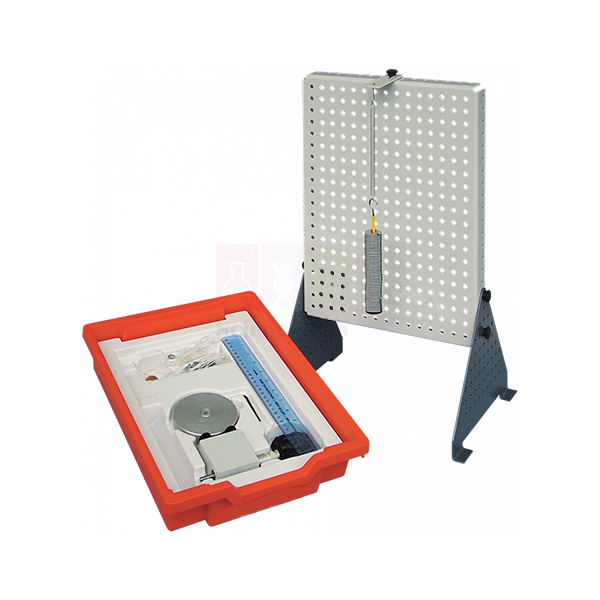
Potential And Energy Kit
Potential And Energy Kit (Product Code: SLE/ETP/25) is an engineering science kit containing a pendulum, a spring and a flywheel, used to study potential and kinetic energy and the transfer of energy from one form to another in school and college labs. Students and lecturers mount its parts on the Work Panel, and the kit introduces terms such as moment of inertia and elastic potential energy. It is produced by Jain Scientific Equipments Pvt Ltd (ScienceLab), an OEM manufacturer, at its own factory in Ambala, India.
Key Details
| Parameter | Detail |
|---|---|
| Kit parts | A pendulum, a spring and a flywheel |
| Topics | Difference between potential and kinetic energy; transfer of energy from one form to another |
| Engineering terms introduced | Moment of inertia, elastic potential energy |
| Mounting | Parts fit to the Engineering Science Work Panel |
| Range | Part of a series of kits that allows many experiments using different arrangements of their parts |
| Product code | SLE/ETP/25 |
| Manufacturer | Jain Scientific Equipments Pvt Ltd (ScienceLab) — OEM |
| Country of origin | India (made in Ambala, Haryana) |
What Is the Potential And Energy Kit Used For?
Each part isolates one kind of energy store. Raising the pendulum bob gives it gravitational potential energy that turns into kinetic energy at the bottom of the swing and back again; stretching or compressing the spring stores elastic potential energy that is released as motion; and the spinning flywheel shows that a rotating body carries kinetic energy whose size depends on its moment of inertia.
Working through the three parts in one session lets students compare how energy is stored and passed on, which is the core idea behind a flywheel experiment or a moment of inertia kit in any mechanics syllabus. Fix the Work Panel firmly to the bench before starting, keep fingers and loose sleeves clear of the flywheel while it spins, and repeat each observation so the class can discuss losses to friction.
OEM Manufacturer
Jain Scientific Equipments Private Limited, which trades as ScienceLab, builds the Potential And Energy Kit as the original equipment manufacturer at its own licensed factory in Saha, Ambala, Haryana, India. Schools and colleges therefore deal with the company that makes the kit, and dealers and importers are supplied factory-direct rather than through a trading intermediary. If a spring or another part needs replacing later, ask us and the request goes straight to the maker. The ScienceLab profile has more about the company.
Related Laboratory Equipment
Pair the kit with its mounting panel and with other engineering science kits that extend the same mechanics course.
- Engineering Science Work Panel — the perforated metal panel the kit parts are fitted to.
- Gear Trains Kit — spur, bevel and worm gears for gear ratio and efficiency work.
- Moments Kit — turning-effect experiments that complement energy topics.
- Hook's Law And Spring Rate — takes the spring idea further into load and extension measurements.
- Set Of 5 trays And Lids — matching trays for storing kit parts between classes.
More engineering teaching apparatus is listed under Materials Testing and Properties.
Frequently Asked Questions
What parts come in the Potential And Energy Kit?
The Potential And Energy Kit contains a pendulum, a spring and a flywheel. Students test each part to see the difference between potential and kinetic energy and to follow how energy transfers from one form to another.
Does the Potential And Energy Kit need the Engineering Science Work Panel?
Yes, the Potential And Energy Kit is designed so that students, teachers or lecturers fit its parts to the Work Panel. If your lab does not already have a panel, include the Engineering Science Work Panel in the same enquiry.
Which engineering terms does the Potential And Energy Kit introduce?
The Potential And Energy Kit introduces moment of inertia and elastic potential energy, alongside the basic contrast between potential and kinetic energy. These terms prepare students for later work on flywheels, springs and energy storage in machines.
Can the kit parts be rearranged for other experiments?
Yes. The Potential And Energy Kit belongs to a versatile series of kits that allows many experiments using different arrangements of their parts, so a lecturer can adapt set-ups to the engineering science topic being taught.
Who manufactures the Potential And Energy Kit?
The Potential And Energy Kit is manufactured by Jain Scientific Equipments Pvt Ltd (ScienceLab), the OEM, at its own licensed factory in Saha, Ambala, Haryana, India, and is supplied directly to institutions, dealers and importers.
How should the Potential And Energy Kit be handled safely?
Mount the Potential And Energy Kit on a firmly fixed panel, keep hands clear of the spinning flywheel, and avoid over-stretching the spring. Store the parts dry in a tray after each practical so they stay ready for the next class.
How can I get a quotation for the Potential And Energy Kit?
Send the number of Potential And Energy Kits, whether you need Work Panels too, and your delivery address in India or international markets through the contact page. The quotation is issued directly by the manufacturer.
Request a Quote
Ask for pricing on the Potential And Energy Kit through the contact page or place it in the enquiry cart. You receive the quote directly from the manufacturer in Ambala.
Last updated: 24 September 2026
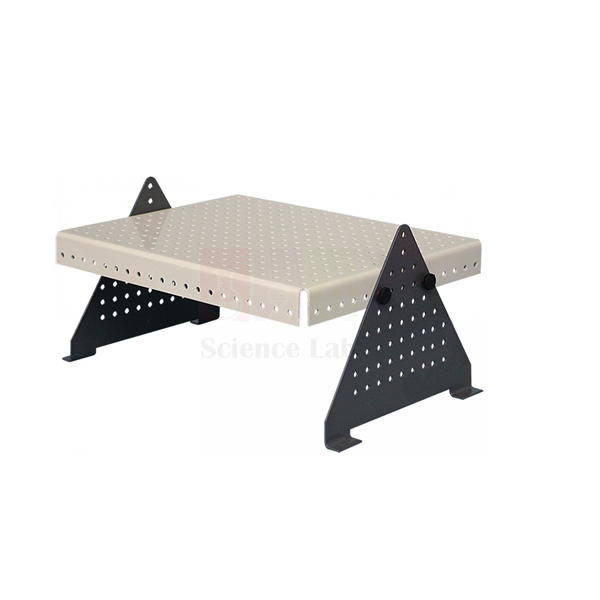
Engineering Science Work Panel
Engineering Science Work Panel (Product Code: SLE/ETP/26) is a bench-top mounting frame of thick perforated metal used to hold the parts of engineering science kits in any position an experiment needs, in school, polytechnic and college labs. It consists of a main panel and two supports, fits on any standard desk or bench top, and comes with a CD-ROM plus reproducible worksheets, guidance notes and lecturer notes with answers. The panel is made by Jain Scientific Equipments Pvt Ltd (ScienceLab), an OEM manufacturer, at its own factory in Ambala, India.
Key Details
| Parameter | Detail |
|---|---|
| Construction | Main panel and two supports |
| Material | Thick perforated metal (panel and supports) |
| Placement | Fits on any standard desk or bench top |
| Use with | Engineering Science kits; kit parts can be fixed in any position suitable for the experiment |
| Teaching resources | Reproducible worksheets, guidance notes and lecturer notes (with answers) for typical experiments with each kit |
| Media | CD-ROM supplied with the Work Panel |
| Product code | SLE/ETP/26 |
| Manufacturer | Jain Scientific Equipments Pvt Ltd (ScienceLab) — OEM |
| Country of origin | India (made in Ambala, Haryana) |
What Is the Engineering Science Work Panel Used For?
The Work Panel is the common base for the engineering science kits. Students, teachers or lecturers fix the parts of a kit through the perforations wherever the experiment requires, so the same panel can carry a gear train one week and an energy or moments set-up the next. Held on its two supports at the bench, it keeps the whole set-up in view of the group.
Because the choice of fixing points is wide, lecturers can go beyond the standard worksheets and extend experiments to a greater range of arrangements. The reproducible worksheets and lecturer notes with answers make it practical lab equipment for technical institutes, where several groups run the same practical and staff need consistent marking guidance.
What to Specify When Ordering
- Number of Work Panels — usually one per bench group that will run kits at the same time.
- Which engineering science kits will be mounted on the panels, so they can be quoted together.
- Whether you need extra storage, such as the matching sets of trays and lids.
- Delivery address and any institutional paperwork your purchase process requires.
OEM Manufacturer
The Engineering Science Work Panel is fabricated by Jain Scientific Equipments Private Limited, known by its trading name ScienceLab, as the original equipment manufacturer at its own licensed factory at Saha, Ambala, Haryana, India. Institutions, dealers and importers buy it straight from the factory instead of through a reseller, and follow-up orders for extra panels come back to the same maker. The company is a registered MSME with manufacturing as its major activity (Udyam UDYAM-HR-01-0003714), and export consignments move under its DGFT Importer-Exporter Code AAECJ8618A. See the ScienceLab company profile.
Related Laboratory Equipment
These engineering science kits and accessories are set up on, or stored alongside, the Work Panel.
- Gear Trains Kit — spur, bevel and worm gears for gear ratio and velocity ratio experiments.
- Potential And Energy Kit — pendulum, spring and flywheel whose parts fit the panel.
- Moments Kit — turning-effect experiments from the same kit series.
- Tensile Tester Kit — introductory materials-testing kit in the same code series.
- Set Of 5 trays And Lids — stackable trays for kit parts and printed worksheets.
View the complete Materials Testing and Properties category.
Frequently Asked Questions
What is included with the Engineering Science Work Panel?
The Engineering Science Work Panel comes as a main panel with two supports, plus a CD-ROM and reproducible worksheets, guidance notes and lecturer notes with answers covering typical experiments with each engineering science kit.
What is the Engineering Science Work Panel made of?
The main panel and both supports of the Engineering Science Work Panel are made from thick perforated metal. The perforations let users fix kit parts, and the panel itself, in any position that suits the experiment.
Will the Engineering Science Work Panel fit our lab benches?
The Engineering Science Work Panel is designed to fit on any standard desk or bench top, so no special furniture is needed. If your benches are unusual, describe them through the contact page and we will advise.
Can lecturers go beyond the supplied worksheets?
Yes. With the Engineering Science Work Panel, the wide choice of fixing points and the selection of kit parts let teachers or lecturers extend the experiments to an even greater range than the standard worksheets describe.
Who manufactures the Engineering Science Work Panel?
Jain Scientific Equipments Pvt Ltd (ScienceLab) manufactures the Engineering Science Work Panel as the OEM at its own licensed factory in Saha, Ambala, Haryana, India, supplying institutions, dealers and importers directly.
Is the Engineering Science Work Panel available for bulk and export orders?
Yes. ScienceLab quotes the Engineering Science Work Panel in quantity for institutions and dealers in India and international markets. Share the number of panels, the kits required and the destination through the contact page.
Request a Quote
Request a price for the Engineering Science Work Panel, with or without kits, through the contact page or the enquiry cart. The quotation is prepared directly by the manufacturer.
Last updated: 24 September 2026
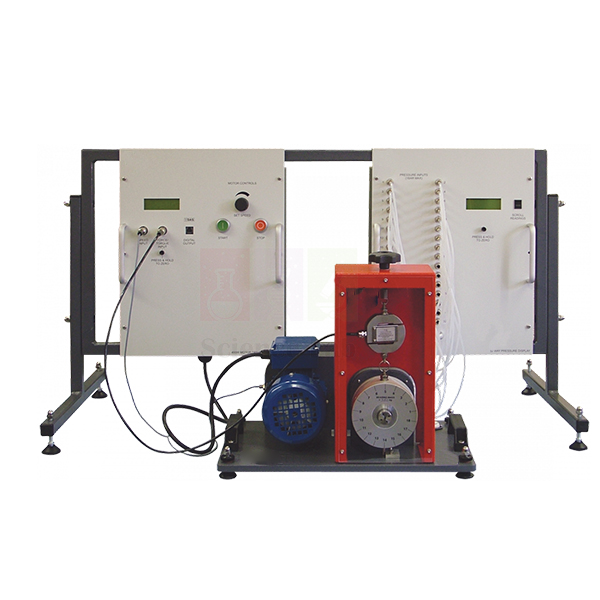
Air Bearing Apparatus
Air Bearing Apparatus (Product Code: SLE/ETM/01) is a bearing trainer used to show how a pressurised air film forms between a spinning shaft and its bush and supports load, in theory of machines and tribology laboratories. Students set shaft speed through a belt-driven motor drive module, load the bush by hand against a load cell, and read film pressure at tappings spaced evenly around the bush on a multichannel digital display. It is made by Jain Scientific Equipments Pvt Ltd (ScienceLab), an OEM engineering lab equipment manufacturer, at its own factory in Ambala, India.
Key Details
| Parameter | Detail |
|---|---|
| Drive | Variable-speed motor turning a belt drive to a precision bearing shaft |
| Shaft | High-quality surface finish; spins inside a vertically loaded bush |
| Bearing bush | Pressure tappings equally spaced around its circumference |
| Pressure display | Multichannel digital pressure display unit connected to the tappings |
| Loading | Hand-operated load control with a bearing bush load cell |
| Motor Drive Module | Varies bearing speed; displays bearing speed and the load at the load cell (speed sensor and load cell connect to it) |
| Instrument Frame | Holds the Motor Drive Module and Pressure Display Module, with extra space for an optional frame-mounted data acquisition unit |
| Product code | SLE/ETM/01 |
| Manufacturer | Jain Scientific Equipments Pvt Ltd (ScienceLab) — OEM |
| Country of origin | India (made in Ambala, Haryana) |
What Is the Air Bearing Apparatus Used For?
The apparatus lets students see the pressure distribution that allows a journal bearing to carry load without metal-to-metal contact. With the shaft running at a chosen speed, they read each tapping on the multichannel display, plot pressure against angular position around the bush, and repeat at other speeds and loads. Comparing the area under the pressure curve with the load cell reading links the measured film pressure to the load the bearing supports.
Typical exercises cover how peak pressure and its position shift as load rises, how speed affects the film’s load capacity, and where the film starts to break down at low speed. Bring the shaft up to speed before adding load, increase the hand-operated load in small steps, and let the display settle before recording. This makes it useful engineering educational equipment in India for mechanical engineering, tribology and machine design courses.
What to Specify When Ordering
- Whether the optional frame-mounted data acquisition unit is required (ask us about availability)
- Number of sets for your laboratory
- Whether related bearing apparatus, such as the Journal Bearing Demonstration, should be quoted together
OEM Manufacturer
ScienceLab is the trading name of Jain Scientific Equipments Private Limited, and the company is the OEM (original equipment manufacturer) of this air bearing apparatus. It builds and assembles the unit at its own licensed factory at Saha, Ambala, Haryana, India, rather than buying it in from a trader, and supplies it factory-direct to engineering colleges, universities, polytechnics, dealers and importers.
Because the maker handles your order directly, questions about the motor drive module, the pressure display or replacement parts go straight to the people who build them — just ask us. Read more on the ScienceLab company profile.
Related Theory of Machines Equipment
Apparatus for a complete bearings and tribology practical:
- Journal Bearing Demonstration — an oil-lubricated journal bearing for comparing liquid and gas films.
- Michell Pad Apparatus — hydrodynamic lubrication in a tilting-pad bearing.
- Hertzian Contact Apparatus — contact between two surfaces pressed together without a separating film.
- Whirling of Shaft Apparatus — the dynamic behaviour of shafts running at speed.
Browse all apparatus in the Theory of Machines category.
Frequently Asked Questions
What does the Air Bearing Apparatus measure?
The Air Bearing Apparatus measures film pressure at tappings equally spaced around the bearing bush, together with shaft speed and the load applied to the bush, so students can relate the pressure distribution to speed and load.
How is load applied to the bearing?
Load on the Air Bearing Apparatus is applied with a hand-operated load control acting on the vertically loaded bush, and a load cell measures it. The Motor Drive Module displays the measured load alongside the bearing speed.
How is shaft speed controlled?
The Air Bearing Apparatus uses a variable-speed motor and belt drive to turn its precision bearing shaft. The Motor Drive Module lets the user vary bearing speed and shows the value read from a speed sensor.
Can results be logged to a computer?
The Air Bearing Apparatus has an Instrument Frame with extra space for an optional frame-mounted data acquisition unit. Ask us about data acquisition availability when you enquire, since it is an option rather than part of the basic unit.
Who manufactures the Air Bearing Apparatus?
The Air Bearing Apparatus is manufactured by Jain Scientific Equipments Pvt Ltd (ScienceLab), the OEM, at its own licensed factory in Saha, Ambala, Haryana, India, and is supplied factory-direct to institutions in India and international markets.
Is a calibration certificate available?
Calibration-certificate availability for the Air Bearing Apparatus load cell and pressure display should be discussed with us before ordering. Share your documentation requirements through the contact page and we will confirm what can be provided.
What does a quotation request need?
For an Air Bearing Apparatus quotation, state the number of sets, whether the optional data acquisition unit is needed, and the delivery location. Send these through the contact page or add the apparatus to the enquiry cart.
Request a Quote
Quotations for the Air Bearing Apparatus come directly from the manufacturer. Send your requirements through the contact page or add the apparatus to the enquiry cart.
Last updated: 24 September 2026
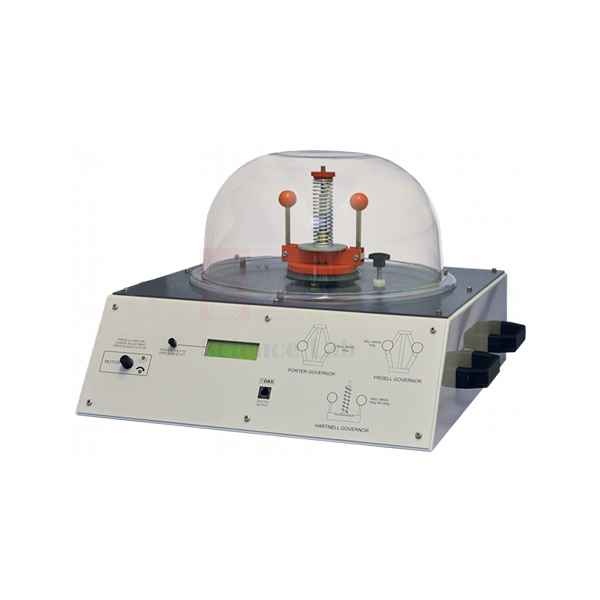
Governor
Governor (Product Code: SLE/ETM/02) is a centrifugal governor apparatus used to study how rotating masses lift a sleeve as speed increases, comparing Porter, Proell and Hartnell governors in theory of machines laboratories. A variable-speed motor in the base unit drives each of the three governors, a sensor records sleeve lift, and a clear dome with a power interlock lets students watch safely. It is built by Jain Scientific Equipments Pvt Ltd (ScienceLab), an OEM and technical educational equipment manufacturer, at its own factory in Ambala, India.
Key Details
| Parameter | Detail |
|---|---|
| Governors included | Porter, Proell and Hartnell |
| Drive | Base unit with a variable-speed motor that turns each governor |
| Operating principle | Rotating weights (masses) and levers raise a sleeve |
| Porter and Proell governors | Sleeve raised against gravity; additional weights (supplied) vary the sleeve mass |
| Hartnell governor | Sleeve raised against a compression spring; adjustable arm length and rotating mass |
| Measurement | Sensor measures the position (lift) of each governor sleeve |
| Safety | Clear dome with an interlock that shuts off power to the motor |
| Product code | SLE/ETM/02 |
| Manufacturer | Jain Scientific Equipments Pvt Ltd (ScienceLab) — OEM |
| Country of origin | India (made in Ambala, Haryana) |
What Is the Governor Apparatus Used For?
A governor regulates engine speed by moving a sleeve, and through it a fuel or steam control, as its rotating masses swing outward. With this apparatus students run each governor across a speed range, record sleeve lift from the sensor at each speed and plot the characteristic curve of lift against speed. Comparing the dead-weight Porter and Proell designs with the spring-loaded Hartnell shows how the controlling force shapes sensitivity and stability.
Further runs add the supplied weights to the Porter and Proell sleeves, or change the Hartnell arm length and rotating mass, and show how the curve shifts, which leads naturally to governor effort, power and hunting. Close the clear dome before starting, since the interlock cuts motor power while it is open, and raise speed gradually as readings are taken. It is core mechanics lab equipment in India for dynamics of machinery syllabi.
OEM Manufacturer
Jain Scientific Equipments Private Limited, known by its trading name ScienceLab, is the original equipment manufacturer (OEM) of this governor apparatus. The company manufactures it at its own licensed factory at Saha, Ambala, Haryana, India, and supplies the complete set factory-direct to universities, engineering colleges, polytechnics, ITIs, dealers and importers in India and international markets.
Buying from the manufacturer means repeat orders for extra sets, replacement sleeve weights or other spare parts are handled by the same team that produces the governors — ask us for details. The ScienceLab profile page tells you more about the company.
Related Theory of Machines Equipment
Other apparatus from the same dynamics of machinery course:
- Cam Mechanism — follower motion studies, often taught alongside governors.
- Gyroscope Experiment Manual — gyroscopic couple, another rotating-mass experiment.
- Static and Dynamic Balancing Apparatus — balancing of rotating masses on a shaft.
- Engine Speed Control Apparatus — speed regulation seen from the control engineering side.
See the full Theory of Machines range.
Frequently Asked Questions
Which governors are included with the Governor apparatus?
The Governor apparatus includes three governors — Porter, Proell and Hartnell — each driven by the variable-speed motor in the base unit, so students can compare dead-weight and spring-loaded designs on one machine.
How is sleeve lift measured?
On the Governor apparatus, a sensor measures the position, or lift, of each governor sleeve as it rises with speed, giving the readings needed to plot lift against speed for every governor.
What can students adjust on the governors?
With the Governor apparatus, students can add the supplied weights to change the sleeve mass of the Porter and Proell governors, and adjust the arm length and rotating mass of the Hartnell governor to see how each change alters its characteristic.
What safety features does the Governor apparatus have?
The Governor apparatus has a clear dome with an interlock that shuts off power to the motor. Students can watch the governors in motion safely, yet still reach them to examine or adjust them when the motor is stopped.
Who manufactures the Governor apparatus?
The Governor apparatus is manufactured by Jain Scientific Equipments Pvt Ltd (ScienceLab), which is the OEM and produces it at its own licensed factory in Saha, Ambala, Haryana, India, for supply to institutions in India and international markets.
What does a quotation request need?
For a Governor apparatus quotation, give the number of sets, the delivery location and whether spare sleeve weights or other parts should be included. Quotations come directly from the manufacturer through the contact page or the enquiry cart.
Request a Quote
Ask the manufacturer directly for a Governor apparatus quotation through the contact page, or add it to the enquiry cart together with other theory of machines apparatus.
Last updated: 24 September 2026
Journal Bearing Demonstration
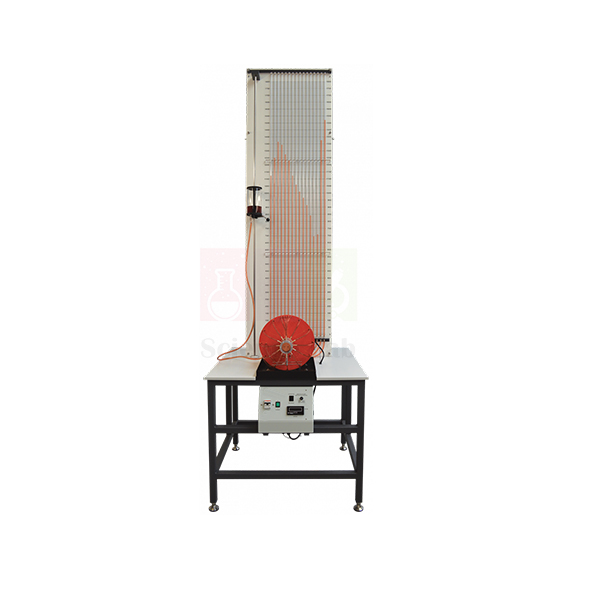
Journal Bearing Demonstration (Product Code: SLE/ETM/03) is a floor-standing lubrication apparatus used to show how an oil film builds pressure around a rotating shaft in theory of machines and tribology laboratories. A motor-driven steel shaft turns inside a clear acrylic bearing with an extra-large clearance, and 16 pressure tappings feed a rear manometer panel so the oil pressure head at every point is visible at once. It is produced by Jain Scientific Equipments Pvt Ltd (ScienceLab), an OEM manufacturer, at its own factory in Ambala, India, as part of its lab equipment for technical institutes.
Specifications
| Parameter | Detail |
|---|---|
| Construction | Floor-standing |
| Shaft | Plain steel, directly driven by an electric motor |
| Bearing | Clear acrylic shell, freely supported on the motor shaft and sealed with a rubber diaphragm |
| Clearance | Especially large, to show the oil in the bearing clearly |
| Pressure tappings | 12 equi-spaced around the circumference plus 4 along the topside and on a vertical radial plane (16 in total) |
| Manometer | Rear manometer panel connected by light, flexible plastic tubes; shows the oil pressure head at all 16 points |
| Loading | Weights attached to arms connected to the bearing |
| Speed control | Control unit adjusts motor speed in both directions; display shows motor speed |
| Oil supply | Adjustable reservoir feeding the low-pressure region at both ends of the bearing |
| Supplied with | A container of suitable oil |
| Product code | SLE/ETM/03 |
| Manufacturer | Jain Scientific Equipments Pvt Ltd (ScienceLab) — OEM |
| Country of origin | India (made in Ambala, Haryana) |
What Is the Journal Bearing Demonstration Used For?
Students load the bearing with weights on its arms, run the shaft at a set speed and read the oil pressure head on all 16 manometer tubes at once. The 12 circumferential readings give a polar plot of pressure around the journal, showing where the film pressure peaks and where it falls away, while the four extra tappings show how pressure varies along the top of the bearing and on the vertical plane.
Repeating the test at different speeds and loads, and in both directions of rotation, shows how the pressure pattern follows the running conditions, while the extra-large clearance makes the oil wedge visible through the acrylic. Set the reservoir level before starting, clear any air from the manometer tubes, and let readings stabilise after each change. The unit suits tribology and machine design classes that rely on engineering lab equipment in India.
OEM Manufacturer
This journal bearing demonstration is manufactured by ScienceLab, the trading name of Jain Scientific Equipments Private Limited, which is its OEM. Production and assembly take place at the company’s own licensed factory at Saha, Ambala, Haryana, India, and the apparatus is supplied factory-direct to technical universities, engineering colleges, TVET institutes, dealers and importers in India and international markets.
If you later need replacement manometer tubing, a spare diaphragm or additional sets, the manufacturer can quote them directly — ask us. Company details are on the ScienceLab profile.
Related Theory of Machines Equipment
Apparatus that extends a lubrication and bearings practical:
- Air Bearing Apparatus — the same pressure-distribution study with an air film.
- Michell Pad Apparatus — oil-film lubrication in a tilting-pad bearing.
- Hertzian Contact Apparatus — contact between surfaces with no lubricant film between them.
- Friction Slide Apparatus — dry sliding friction, for comparison with lubricated contact.
More apparatus is listed under Theory of Machines.
Frequently Asked Questions
How many pressure tappings does the Journal Bearing Demonstration have?
The Journal Bearing Demonstration has 16 pressure tappings: 12 equally spaced around the bearing circumference and four more along its topside and on a vertical radial plane, all connected to the rear manometer panel.
How is the bearing loaded?
Students load the Journal Bearing Demonstration by attaching weights to arms connected to the bearing, which is freely supported on the motor shaft. Changing the weights shows how load alters the oil pressure distribution.
Can the shaft run in both directions?
Yes. The control unit of the Journal Bearing Demonstration adjusts motor speed in both directions of rotation, and a display shows the motor speed, so the effect of reversing the shaft on the oil film can be observed.
Is oil included with the apparatus?
Yes, a container of suitable oil is supplied with the Journal Bearing Demonstration. An adjustable reservoir feeds this oil to the low-pressure region at both ends of the bearing during operation.
Why is the bearing clearance so large?
The Journal Bearing Demonstration uses an especially large clearance so the oil in the bearing can be seen clearly through the clear acrylic shell, making the formation of the lubricating film visible to a whole class.
Who manufactures the Journal Bearing Demonstration?
The Journal Bearing Demonstration is manufactured by Jain Scientific Equipments Pvt Ltd (ScienceLab), the OEM, at its own licensed factory in Saha, Ambala, Haryana, India, and is supplied factory-direct to institutions in India and international markets.
What should a quotation request include?
For a Journal Bearing Demonstration quotation, give the number of units, the delivery location and any spare parts you want included. Quotations are issued directly by the manufacturer through the contact page or the enquiry cart.
Request a Quote
Request a price for the Journal Bearing Demonstration straight from the manufacturer via the contact page, or add it to the enquiry cart with any other bearing apparatus you need.
Last updated: 24 September 2026
Damper Kit
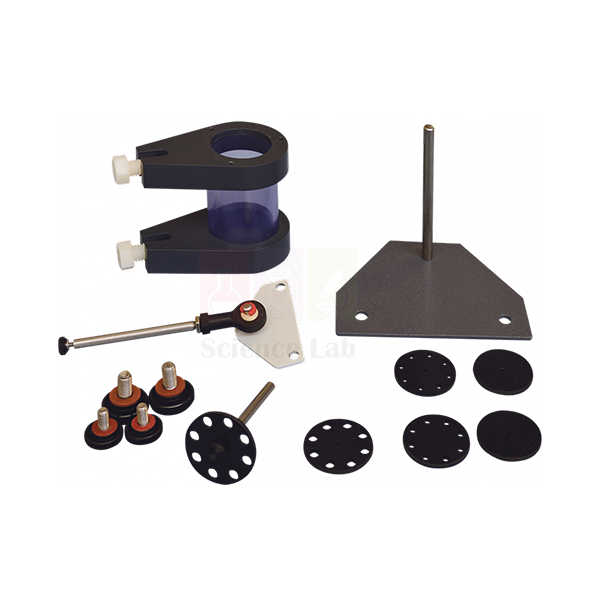
Damper Kit (Product Code: SLE/ETM/04) is a dashpot damping accessory used to add viscous damping to beam vibration experiments on the Free Vibrations Test Frame in theory of machines laboratories. A simple piston disc moving in a cylinder fits to the Test Frame beneath the beam, and the damping level is set by the non-toxic fluid students pour in, which is not supplied. It is made by Jain Scientific Equipments Pvt Ltd (ScienceLab), an OEM and TVET lab equipment manufacturer in India, at its own factory in Ambala.
Key Details
| Parameter | Detail |
|---|---|
| Type | Dashpot damper formed by a simple piston disc and cylinder |
| Mounting | Fits to the Test Frame under the beam |
| Damping fluid | Easily found non-toxic fluids (not supplied) |
| Damping level | Varied by the choice of fluid |
| Project work | Students may try their own fluids and their own piston discs |
| Product code | SLE/ETM/04 |
| Manufacturer | Jain Scientific Equipments Pvt Ltd (ScienceLab) — OEM |
| Country of origin | India (made in Ambala, Haryana) |
What Is the Damper Kit Used For?
Real machines and structures never vibrate for ever, because friction and fluid resistance remove energy in every cycle. Fitted beneath the beam, the kit’s piston disc has to push fluid aside in the cylinder each time the beam moves, turning an almost undamped oscillation into a decaying one. By comparing successive peaks, students calculate the logarithmic decrement and damping ratio and see how both change with the fluid used.
Start with the cylinder empty to record the undamped response, then repeat with fluids of increasing viscosity that are safe and easy to obtain, keeping the fill level the same each time. Because students may also make their own piston discs, the kit supports project work on how disc size or shape alters damping. It is straightforward engineering educational equipment for vibration and dynamics courses in India.
What to Specify When Ordering
- The Free Vibrations Test Frame, if your laboratory does not already have one (the kit fits to it)
- The beam experiment it will be used with, for example the Free Vibration Of Beam Spring
- Number of kits per laboratory
- Damping fluids are not supplied, so plan to source suitable non-toxic fluids locally
OEM Manufacturer
ScienceLab is the trading name of Jain Scientific Equipments Private Limited, the OEM that makes this damper kit at its own licensed factory at Saha, Ambala, Haryana, India. Colleges, polytechnics and training institutes, as well as dealers and importers, buy it factory-direct together with the test frame and the vibration experiments it serves.
Institutional and tender buyers registering the company as a vendor can use GSTIN 06AAECJ8618A1ZT and LEI 3358004HRD1JIVXKYX49. Replacement piston discs or extra kits can be quoted by the manufacturer on request — ask us, and see the company profile for more about ScienceLab.
Related Theory of Machines Equipment
Parts of the same free vibrations set-up:
- Free Vibrations Test Frame — the frame the damper kit mounts on.
- Free Vibration Of Beam Spring — the pivoted-beam experiment it damps.
- Free Vibrations Of A Cantilever — another free vibration experiment for the same frame.
- Damper Kit For Mass/Spring — the dash-pot version for mass-spring experiments.
View all apparatus in Theory of Machines.
Frequently Asked Questions
What is the Damper Kit?
The Damper Kit is a dashpot damper made from a simple piston disc and cylinder. It fits to the Free Vibrations Test Frame under the beam and adds viscous damping to free vibration experiments.
Is damping fluid included with the Damper Kit?
No. The Damper Kit works with easily found non-toxic fluids, which are not supplied, so each laboratory chooses and sources its own fluids to obtain different damping levels.
Which experiments is the Damper Kit used with?
The Damper Kit fits to the Test Frame beneath the beam, so it is used with beam-type free vibration experiments on that frame, such as the Free Vibration Of Beam Spring set-up, to compare undamped and damped motion.
Can students modify the Damper Kit for projects?
Yes. The Damper Kit is intended so students may try their own fluids and their own piston discs, which makes it suitable for project work on how fluid and disc design affect the damping produced.
Who manufactures the Damper Kit?
The Damper Kit is manufactured by Jain Scientific Equipments Pvt Ltd (ScienceLab), the OEM, at its own licensed factory in Saha, Ambala, Haryana, India, and is supplied factory-direct with or without the matching test frame.
What does a quotation request need?
For a Damper Kit quotation, state how many kits you need, whether the Free Vibrations Test Frame and beam experiments should be quoted too, and the delivery location. The manufacturer replies directly through the contact page or the enquiry cart.
Request a Quote
Quotes for the Damper Kit come straight from the manufacturer. Use the contact page or add the kit to the enquiry cart along with the rest of your free vibrations equipment.
Last updated: 24 September 2026
Free Vibration Of Beam Spring
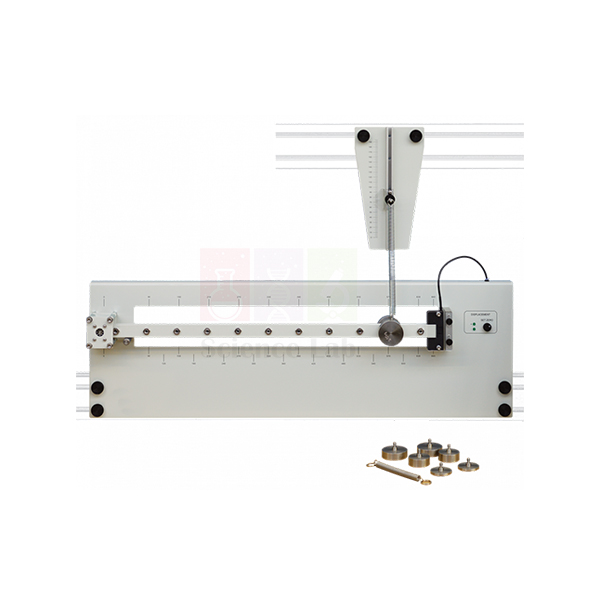
Free Vibration Of Beam Spring (Product Code: SLE/ETM/05) is a one-degree-of-freedom vibration experiment used to study how a rigid beam, pivoted at one end and hung from a coiled spring at the other, oscillates in theory of machines laboratories. It mounts on the Free Vibrations Test Frame through a back panel carrying self-aligning pivot bearings and a non-contacting displacement sensor, so oscillations are measured with negligible damping. It is manufactured by Jain Scientific Equipments Pvt Ltd (ScienceLab), an OEM vocational training lab equipment manufacturer in India, at its own factory in Ambala.
Key Details
| Parameter | Detail |
|---|---|
| System | Simple one-degree-of-freedom free vibration system |
| Beam | Rigid beam pivoted at its left-hand end; right-hand end suspended by a coiled spring |
| Pivot | High-quality self-aligning bearings allowing the beam to rotate through a small angle |
| Sensor | Non-contacting displacement sensor measuring oscillations at the right-hand end with negligible damping, while helping to guide the movement |
| Back panel | Fixes to the Test Frame; holds the pivot and the sensor |
| Topics | Moment of inertia; oscillation damping; spring constant and Hooke’s Law; simple harmonic motion and frequency of oscillation; phase difference between displacement and its derivatives |
| Real-world link | The beam-and-spring system appears in machines and vehicle suspensions |
| Product code | SLE/ETM/05 |
| Manufacturer | Jain Scientific Equipments Pvt Ltd (ScienceLab) — OEM |
| Country of origin | India (made in Ambala, Haryana) |
What Is the Beam Spring Vibration Experiment Used For?
The beam, pivot and spring form the same arrangement found in many machines and in vehicle suspensions, reduced to a single degree of freedom that students can analyse by hand. They can determine the spring constant by static loading to confirm Hooke’s Law, work out the beam’s moment of inertia about the pivot and predict its natural frequency. Displacing the free end and releasing it lets the non-contacting sensor record the oscillation, so the measured frequency can be checked against the prediction.
Because the sensor does not touch the beam, inherent damping is negligible, which makes any added damping easy to see; fitting the separate Damper Kit beneath the beam extends the study to damped motion. The recorded trace also shows the phase difference between displacement and its derivatives, velocity and acceleration, linking the experiment to simple harmonic motion theory. It is a compact piece of mechanics lab equipment in India for dynamics and vibrations courses.
What to Specify When Ordering
- The Free Vibrations Test Frame, if not already in your laboratory (the experiment fixes to it)
- The Damper Kit, if damped vibration is part of your syllabus
- Number of sets per laboratory
OEM Manufacturer
Jain Scientific Equipments Private Limited, trading as ScienceLab, is the original equipment manufacturer (OEM) of this beam-spring vibration experiment and produces it at its own licensed factory at Saha, Ambala, Haryana, India. Engineering colleges, universities and polytechnics order it factory-direct, often as one of several free vibration experiments sharing a single test frame, and dealers and importers source it from the manufacturer in the same way.
Spare springs, additional sets or matching experiments can be discussed directly with the maker — ask us. More about the company is on the ScienceLab profile page.
Related Theory of Machines Equipment
Items that complete or extend this free vibration study:
- Free Vibrations Test Frame — the bench frame this experiment fixes to.
- Damper Kit — adds dashpot damping beneath the beam.
- Free Vibrations Of A Cantilever — a companion experiment where beam stiffness replaces the spring.
- Free and Forced Vibration Apparatus — takes the study on to forced vibration and resonance.
Find more apparatus in the Theory of Machines category.
Frequently Asked Questions
What does the Free Vibration Of Beam Spring experiment demonstrate?
The Free Vibration Of Beam Spring experiment demonstrates free vibration of a one-degree-of-freedom system: a rigid beam pivoted at one end and suspended by a coiled spring at the other, an arrangement also found in machines and vehicle suspensions.
How are the oscillations measured?
A non-contacting displacement sensor on the back panel measures the oscillations at the right-hand end of the beam. Because it never touches the beam, the Free Vibration Of Beam Spring experiment runs with negligible damping from the measurement.
Which topics does the experiment cover?
The Free Vibration Of Beam Spring experiment covers moment of inertia, oscillation damping, spring constant and Hooke’s Law, simple harmonic motion and frequency of oscillation, and the phase difference between displacement and its derivatives.
Does it need the Free Vibrations Test Frame?
Yes. The Free Vibration Of Beam Spring experiment has a back panel that fixes to the Free Vibrations Test Frame, which holds it steady and level. Order the frame as well if your laboratory does not already have one.
Who manufactures the Free Vibration Of Beam Spring experiment?
The Free Vibration Of Beam Spring experiment is manufactured by Jain Scientific Equipments Pvt Ltd (ScienceLab), the OEM, at its own licensed factory in Saha, Ambala, Haryana, India, and supplied factory-direct to institutions in India and international markets.
What does a quotation request need?
For a Free Vibration Of Beam Spring quotation, give the number of sets, whether the Test Frame and Damper Kit are needed, and the delivery location. The manufacturer quotes directly through the contact page or the enquiry cart.
Request a Quote
For a manufacturer-direct price on the Free Vibration Of Beam Spring experiment, write through the contact page or add it to the enquiry cart with the test frame and any other vibration experiments.
Last updated: 24 September 2026
Free Vibrations Of A Cantilever
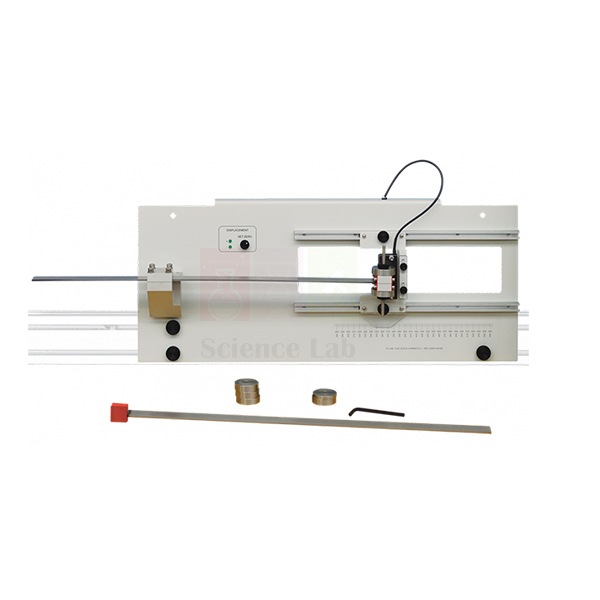
Free Vibrations Of A Cantilever (Product Code: SLE/ETM/06) is a vibration experiment used to show how a clamped beam with an end mass oscillates like a mass-spring system, its own stiffness acting as the spring, in theory of machines laboratories. Students set the oscillating length with a sturdy clamp on a back panel that fixes to the Free Vibrations Test Frame, while a non-contacting sensor on two runners follows the tip without touching it. It is made by Jain Scientific Equipments Pvt Ltd (ScienceLab), an OEM laboratory equipment manufacturer in India, at its own factory in Ambala.
Key Details
| Parameter | Detail |
|---|---|
| System | One-degree-of-freedom free vibration; a beam with a mass at the end behaves like a mass-spring system, with beam stiffness replacing spring stiffness |
| Purpose | Examines what happens when the spring element is not light |
| Back panel | Fixes to the Test Frame; holds a sturdy clamp and two runners |
| Clamp | Holds the beam and is used to adjust the oscillating length of the cantilever |
| Sensor | Non-contacting sensor on the runners, measuring oscillations at the end of the cantilever with negligible damping |
| Topics | Simple harmonic motion (SHM) and frequency of oscillation; beam stiffness; Rayleigh’s method; Dunkerley’s method; second moment of area; phase difference between displacement and its derivatives |
| Real-world link | A visual example of oscillations that occur in real structures such as aircraft wings |
| Product code | SLE/ETM/06 |
| Manufacturer | Jain Scientific Equipments Pvt Ltd (ScienceLab) — OEM |
| Country of origin | India (made in Ambala, Haryana) |
What Is the Cantilever Vibration Experiment Used For?
A cantilever with an end mass is the simplest model of a structure that vibrates under its own stiffness, from a diving board to an aircraft wing. Students clamp the beam at a chosen length, deflect the tip and release it while the non-contacting sensor records the oscillation; repeating at several lengths shows how frequency falls as the cantilever gets longer. Measured frequencies are then compared with values predicted from the beam’s stiffness and second moment of area.
Because the beam is not a light spring, its own mass affects the result, so the experiment is used to compare simple predictions with Rayleigh’s method and Dunkerley’s method, which account for distributed mass. The trace also shows the phase difference between displacement, velocity and acceleration. Tighten the clamp firmly at each new length, keep the sensor runners in line with the tip, and use small initial deflections for clean, repeatable traces.
What to Specify When Ordering
- The Free Vibrations Test Frame, if your laboratory does not already have one
- Number of cantilever sets needed for your student groups
- Any companion experiments for the same frame, such as the Free Vibration Of Beam Spring
OEM Manufacturer
ScienceLab, the trading name of Jain Scientific Equipments Private Limited, manufactures this cantilever vibration experiment as the OEM at its own licensed factory at Saha, Ambala, Haryana, India. Institutions building a vibrations laboratory can source the experiment, the test frame and companion set-ups factory-direct from one manufacturer, whether they are universities, polytechnics, dealers or importers.
Repeat orders and replacement parts are quoted by the manufacturer itself — just ask us. Read about ScienceLab on the company profile.
Related Theory of Machines Equipment
Apparatus that works alongside the cantilever experiment:
- Free Vibrations Test Frame — holds the cantilever’s back panel steady and level.
- Free Vibration Of Beam Spring — the companion experiment with a separate coiled spring.
- Vibration Of Spiral Spring Apparatus — torsional free vibration using a spiral spring.
- Whirling of Shaft Apparatus — another case where an elastic member’s stiffness sets a critical frequency.
The rest of the range is in Theory of Machines.
Frequently Asked Questions
What does the Free Vibrations Of A Cantilever experiment show?
The Free Vibrations Of A Cantilever experiment shows that a beam with a mass at its end vibrates like a mass-spring system, with the beam’s stiffness replacing the spring’s, and examines what happens when the spring element is not light.
Can the cantilever length be changed?
Yes. On the Free Vibrations Of A Cantilever experiment, a sturdy clamp on the back panel holds the beam, and students use it to adjust the oscillating length of the cantilever between tests.
How are the oscillations measured?
A non-contacting sensor held on two runners measures the oscillations at the end of the cantilever. Because it has no physical contact with the beam, the Free Vibrations Of A Cantilever experiment runs with negligible damping from the measurement.
Which theory topics does it support?
The Free Vibrations Of A Cantilever experiment supports simple harmonic motion and frequency of oscillation, beam stiffness, Rayleigh’s method, Dunkerley’s method, second moment of area, and the phase difference between displacement and its derivatives.
Who manufactures the Free Vibrations Of A Cantilever experiment?
The Free Vibrations Of A Cantilever experiment is manufactured by Jain Scientific Equipments Pvt Ltd (ScienceLab), the OEM, at its own licensed factory in Saha, Ambala, Haryana, India, and is supplied factory-direct in India and international markets.
What does a quotation request need?
For a Free Vibrations Of A Cantilever quotation, state the number of sets, whether the Free Vibrations Test Frame is required, and the delivery location. Quotes come directly from the manufacturer via the contact page or the enquiry cart.
Request a Quote
To get the manufacturer’s price for the Free Vibrations Of A Cantilever experiment, use the contact page or add it to the enquiry cart, listing any frame or companion experiments you also need.
Last updated: 24 September 2026