- Physics Lab Equipment
- Chemistry Lab Equipment
- Biology Lab Equipment
- Anatomical Lab Equipment
- Learning
- Educational Lab Equipment
- Magnets
- Agriculture
- Astronomy
- Earth Science
- Geography Lab Equipment
- Safety Lab Coat
- Laboratory
- Meteorological
- Electricity & Magnetism
- Heat
- School Lab Equipment
- Lab Glassware
- Science Lab Equipment
- Tvet Lab Equipment
- Robotics Kits Supplier and Manufacturer for Schools India
- Math Lab Equipment Manufacturers and Exporters in Ambala
- STEM Kits Manufacturers and Supplier India
- Engineering Lab Equipment
- Hospital Lab Equipment
- Water, Sanitation & Hygiene Supplies
- Cold Chain, Solar & Communication Equipment
- Nutrition
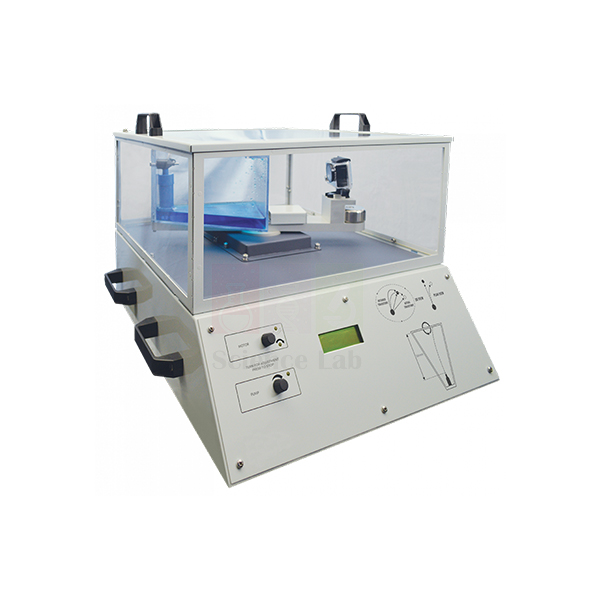
Coriolis Force
Coriolis Force (Product Code: SLE/ETM/15) is a benchtop apparatus used to show the Coriolis force by making a jet of water visibly deflect inside a rotating frame of reference, in physics and engineering laboratories. Students control the arm’s speed and direction of rotation and the pump rate from dials and a digital display on the base unit. It is made by Jain Scientific Equipments Pvt Ltd (ScienceLab), an OEM manufacturer, at its own factory in Ambala, India.
Key Details
| Parameter | Detail |
|---|---|
| Base | Benchtop base unit supporting a rotating arm |
| On the arm | Transparent water tank and counterbalance |
| Water jet | Produced by a submersible pump housed in the water tank |
| Controls | Dials and a digital display for speed and direction of rotation, and for pump rate |
| Observation | The jet of water deflects when the arm rotates |
| Principle | Coriolis force: a fictitious force that appears to act on objects moving within a rotating frame of reference |
| Product code | SLE/ETM/15 |
| Manufacturer | Jain Scientific Equipments Pvt Ltd (ScienceLab) — OEM |
| Country of origin | India (made in Ambala, Haryana) |
What Is the Coriolis Force Apparatus Used For?
The Coriolis effect explains why winds curve across the Earth, why long-range projectiles drift and why fluids behave unexpectedly in rotating machinery, yet it is hard to picture from equations alone. Here the whole reference frame spins: the water tank rides on the rotating arm, the submersible pump fires a jet across it, and anyone watching sees the jet bend away from a straight line as soon as the arm turns.
Students can reverse the direction of rotation and watch the deflection swap sides, raise the speed to see a stronger effect, or change the pump rate to alter the jet velocity. Those three variables make it a memorable physics demonstration kit for dynamics and fluid mechanics lectures. Fill the tank to a sensible level and check that the counterbalance is in place before starting rotation.
OEM Manufacturer
This Coriolis Force apparatus is produced by Jain Scientific Equipments Private Limited, whose trading name is ScienceLab, as the OEM at its own licensed factory at Saha, Ambala, Haryana, India. Universities, colleges and distributors order it factory-direct, so pump, tank or display queries and repeat orders are dealt with by the manufacturer — ask us.
Learn more on the ScienceLab profile.
Related Theory of Machines Equipment
Other rotating-system apparatus for the same syllabus:
- Corollis Component of Acceleration Apparatus — the Coriolis component of acceleration studied in a mechanism.
- Gyroscope Experiment Manual — another rotating-frame effect, gyroscopic couple.
- Governor — centrifugal effects on a rotating mechanism.
- Whirling of Shaft Apparatus — behaviour of a spinning shaft at critical speed.
View the whole Theory of Machines category.
Frequently Asked Questions
What does the Coriolis Force apparatus show?
The Coriolis Force apparatus shows a jet of water deflecting when the arm carrying the water tank rotates. The deflection is due to the Coriolis force, a fictitious force that appears to act on objects moving within a rotating frame of reference.
How is the water jet produced?
In the Coriolis Force apparatus SLE/ETM/15, the transparent water tank on the rotating arm houses a submersible pump that produces the jet of water. The pump rate can be adjusted from the base unit to change the jet.
Which settings can students change?
Dials and a digital display on the Coriolis Force base unit let students adjust the speed of rotation, the direction of rotation and the pump rate. Changing each one shows how the deflection of the jet responds.
Why is there a counterbalance on the arm?
The rotating arm of the Coriolis Force apparatus carries both the transparent water tank and a counterbalance. Balancing the arm helps it rotate smoothly about the benchtop base unit while the demonstration runs.
Who manufactures the Coriolis Force apparatus?
Jain Scientific Equipments Pvt Ltd (ScienceLab) is the OEM manufacturer of the Coriolis Force apparatus SLE/ETM/15, which is made at its own licensed factory in Saha, Ambala, Haryana, India, and sold direct by the maker.
Can the Coriolis Force apparatus be ordered in bulk or exported?
Yes, the Coriolis Force apparatus is supplied to institutions, dealers and importers across India and international markets. Share your quantity, mains supply and delivery destination on the contact page to receive a quotation.
Request a Quote
To receive a quotation for the Coriolis Force apparatus (SLE/ETM/15), write to us through the contact page or add it to the enquiry cart. The manufacturer sends the quote directly.
Last updated: 24 September 2026
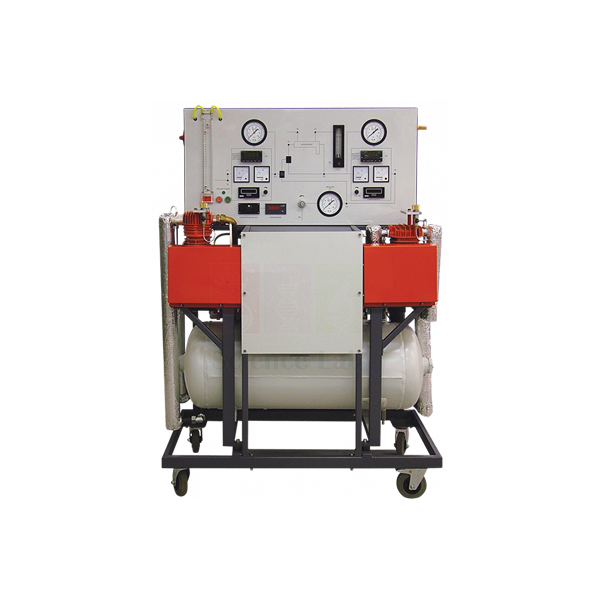
Two Stage Compressor Test Set
Two Stage Compressor Test Set (Product Code: SLE/EA/09) is a self-contained, mobile two-stage reciprocating air compressor test set used to investigate compressor operation and performance in single-stage, two-stage and intercooled two-stage modes in thermodynamics laboratories. As technical educational equipment it stands out because each of its two twin-cylinder compressors has its own electronic drive, load cell and speed sensor, so true shaft power is measured for each stage. It is made by Jain Scientific Equipments Pvt Ltd (ScienceLab), an OEM manufacturer, at its own factory in Ambala, India.
Key Details
| Parameter | Detail |
|---|---|
| Compressors | Two twin-cylinder, air-cooled reciprocating compressors, each driven by an electric motor through a low-maintenance toothed belt |
| Operating modes | Single-stage; two-stage; two-stage with inter-cooling |
| Motor control | Electronic drive units control both motors independently |
| Electrical power | Meters show the electrical power consumption of each motor |
| Torque | Close-coupled load cell on each motor |
| Speed | Sensor on each motor, shown on a digital indicator |
| Shaft power | True shaft power from the product of torque and speed |
| Intercooler | Integral, water-cooled |
| Air receiver | Included |
| Air routing | Diverter valves direct air from the first stage to the receiver, directly to the second stage, or to the second stage through the intercooler |
| Controls | All controls and instrumentation on an easy-to-operate mimic panel |
| Construction | Self-contained, mobile |
| Product code | SLE/EA/09 |
| Manufacturer | Jain Scientific Equipments Pvt Ltd (ScienceLab) — OEM |
| Country of origin | India (made in Ambala, Haryana) |
What Is the Two Stage Compressor Test Set Used For?
Students first run one compressor as a single-stage machine delivering straight to the receiver, then route air from the first stage directly into the second, and finally pass it through the water-cooled intercooler before the second stage. Comparing shaft power and electrical input across the three set-ups shows why staged compression with inter-cooling reduces the work needed, a central idea in compressor design.
Because the two compressor speeds are controlled independently, the stages can be matched under different conditions and the effect of speed matching on overall performance explored. Before each run, check that intercooler water is flowing when that mode is selected, confirm the diverter valves are set for the intended air path, and keep hands clear of the toothed belt drives while the motors run.
What to Specify When Ordering
- Number of test sets required
- Cooling-water availability for the water-cooled intercooler
- The electrical supply at your laboratory, so it can be confirmed in the quotation
OEM Manufacturer
ScienceLab, the trading name of Jain Scientific Equipments Private Limited, is the OEM of the Two Stage Compressor Test Set and manufactures it at its own licensed factory at Saha, Ambala, Haryana, India. Procurement teams registering the company as a vendor can use GSTIN 06AAECJ8618A1ZT and LEI 3358004HRD1JIVXKYX49.
Colleges, dealers and importers buy direct from the maker, and repeat orders or spares questions go to the same team — ask us. Visit the company profile for background.
Related Thermodynamics & Heat Transfer Lab Equipment
Compression and gas-law practicals continue on these units:
- Rotary Air Compressor Test Bench — a rotary vane compressor for comparison with reciprocating machines
- Air Blower Test Setup — a low-pressure radial fan at the other end of the air-machine range
- Two Stage (Series And parallel) — a fluid mechanics rig on series and parallel staging
- Expansion Of Perfect Gas — the gas-law behaviour behind compression and expansion
Explore the full Thermodynamics & Heat Transfer Lab Equipment category for more compressor and thermal trainers.
Frequently Asked Questions
Which operating modes does the Two Stage Compressor Test Set offer?
The Two Stage Compressor Test Set works as a single-stage compressor, a two-stage compressor, or a two-stage compressor with inter-cooling; diverter valves route the air to the receiver, directly to the second stage, or through the water-cooled intercooler.
How is shaft power measured on the Two Stage Compressor Test Set?
On the Two Stage Compressor Test Set, a close-coupled load cell on each motor measures torque and a sensor measures speed; the product of torque and speed gives true shaft power for each compressor.
What type of compressors does the Two Stage Compressor Test Set use?
The Two Stage Compressor Test Set uses two twin-cylinder, air-cooled reciprocating compressors, each driven by an electric motor through a low-maintenance toothed belt and controlled by its own electronic drive unit.
Can the two compressor speeds be set separately?
Yes. The Two Stage Compressor Test Set controls the two compressor speeds independently, which gives flexibility to match the stages under different conditions and to study how speed matching affects performance.
Who manufactures the Two Stage Compressor Test Set?
The Two Stage Compressor Test Set is manufactured by Jain Scientific Equipments Pvt Ltd (ScienceLab), the OEM, at its own factory in Ambala, Haryana, India; quotations and technical questions are answered directly by the manufacturer.
What information is needed to quote the Two Stage Compressor Test Set?
For a Two Stage Compressor Test Set quotation, share the quantity, the electrical supply available at your laboratory, cooling-water availability for the intercooler and the delivery location in India or abroad.
Is a calibration certificate available for the load cells and sensors?
Whether a calibration certificate can be provided for the load cells and speed sensors of the Two Stage Compressor Test Set should be discussed with us before ordering; list your needs on the contact page.
Request a Quote
Request your Two Stage Compressor Test Set quotation through the contact page, or add it to the enquiry cart with your other laboratory items. The quote comes straight from the manufacturer.
Last updated: 24 September 2026
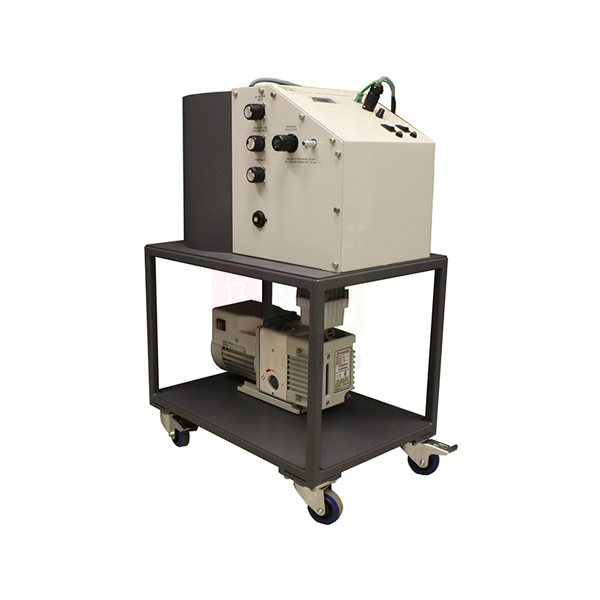
Emissivity Natural Convection And Radiation
Emissivity Natural Convection And Radiation (Product Code: SLE/EA/10) is a heat transfer apparatus used to separate radiant heat loss from natural (free) convection around a heated element in engineering college laboratories. Students run its pressure vessel from 1 bar (gauge) of compressed air down to about 5 Pa (absolute) and extrapolate towards a total vacuum, where convection disappears. This engineering lab equipment in India is made by Jain Scientific Equipments Pvt Ltd (ScienceLab), an OEM manufacturer, at its own factory in Ambala, India.
Specifications
| Parameter | Detail |
|---|---|
| Principle | Compares heat transfer by radiation and by natural (free) convection at different pressures and under vacuum |
| Test element | Small heated element hanging in the centre of a pressure vessel |
| Element surface | Matt black, with a thermocouple attached to measure its temperature |
| Vessel interior | Black, with a thermocouple fitted to the vessel wall |
| Pressure range | Charged with compressed air up to 1 bar (gauge) or evacuated down to about 5 Pa (absolute) |
| Pressure measurement | Two pressure transducers – one for pressures above atmospheric, one for pressures below atmospheric |
| Instrumentation | Instruments and a digital display for temperatures, pressures and power to the element |
| Learning outcomes | Emissivity of a surface; verification of the Stefan-Boltzmann equation; Nusselt, Grashof, Prandtl and Knudsen numbers |
| Product code | SLE/EA/10 |
| Manufacturer | Jain Scientific Equipments Pvt Ltd (ScienceLab) — OEM |
| Country of origin | India (made in Ambala, Haryana) |
What Is the Natural Convection and Radiation Apparatus Used For?
In a typical practical, students heat the element and log its surface temperature, the vessel wall temperature and the electrical power at several vessel pressures, then plot heat loss against pressure. Because convection weakens as the gas thins out, extending the curve towards zero pressure leaves the radiation component on its own. From that value the emissivity of the matt black surface is calculated and checked against the Stefan-Boltzmann equation.
The same readings let learners work with dimensionless groups such as the Nusselt, Grashof, Prandtl and Knudsen numbers, which makes the unit a strong fit among lab equipments for technical institutes teaching heat transfer. Let the element and vessel settle at each pressure before recording, because steady values give a cleaner extrapolation.
OEM Manufacturer
ScienceLab is the trading name of Jain Scientific Equipments Private Limited, the OEM (original equipment manufacturer) of this apparatus. It is produced at the company's own licensed factory at Saha, Ambala, Haryana, India, and supplied factory-direct to engineering colleges, polytechnics, universities, dealers and importers. When a department needs a replacement thermocouple or a repeat unit for a second lab, it deals with the manufacturer itself — just ask us. Company background is on the ScienceLab company profile.
Related Thermodynamics & Heat Transfer Lab Equipment
These apparatus extend a radiation and convection practical into other heat transfer modes:
- Computerized Emissivity Measurement Apparatus — a second route to surface emissivity for comparing methods.
- Free and Force Convection Apparatus — moves the study from natural convection to forced air flow.
- Extended Surface Heat Transfer — conduction along a bar that loses heat by convection and radiation.
- Conductivity Of Liquid And Gases — measures conduction through a thin gas or liquid layer.
Browse the complete range of Thermodynamics & Heat Transfer Lab Equipment.
Frequently Asked Questions
What does the Emissivity Natural Convection And Radiation apparatus measure?
The Emissivity Natural Convection And Radiation apparatus measures the temperatures, vessel pressure and electrical power needed to find how a heated matt black element loses heat by radiation and by natural convection, so students can calculate its surface emissivity.
What pressure range does the vessel cover?
The pressure vessel of the Emissivity Natural Convection And Radiation apparatus can be charged with compressed air up to 1 bar (gauge) or evacuated down to about 5 Pa (absolute), giving a wide span of test points for the extrapolation to vacuum.
Why does the apparatus have two pressure transducers?
The Emissivity Natural Convection And Radiation apparatus uses one pressure transducer for pressures above atmospheric and another for pressures below atmospheric, so both pressurised and evacuated test points are measured accurately instead of stretching a single sensor across the whole range.
How is radiation separated from convection?
Students record the heat loss from the element at several pressures and extrapolate the results down to a total vacuum, where no convection can occur. The heat transfer that remains on the Emissivity Natural Convection And Radiation apparatus is then due to radiation alone.
Who manufactures the Emissivity Natural Convection And Radiation apparatus?
Jain Scientific Equipments Pvt Ltd, trading as ScienceLab, manufactures the Emissivity Natural Convection And Radiation apparatus as the OEM at its own licensed factory at Saha, Ambala, Haryana, India, and quotes it directly to institutions, dealers and importers.
Is a calibration certificate available?
Calibration-certificate availability for the Emissivity Natural Convection And Radiation apparatus should be discussed with us before ordering. Please state the requirement through the contact page so that it can be addressed in your quotation.
What should a quotation request include?
For the Emissivity Natural Convection And Radiation apparatus (SLE/EA/10), mention the quantity, your institution, the delivery location in India or abroad and any questions about electrical supply or accessories, so the manufacturer can prepare an accurate quote.
Request a Quote
To order the Emissivity Natural Convection And Radiation apparatus, send your requirement through the contact page or add it to the enquiry cart. Quotations come direct from the manufacturer for single units and multi-lab orders across India and international markets.
Last updated: 24 September 2026
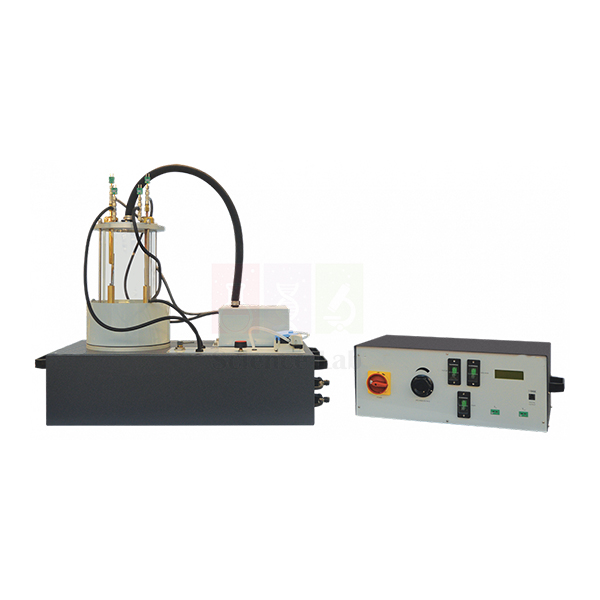
Filmwise And Dropwise Condensation And Boiling
Filmwise And Dropwise Condensation And Boiling (Product Code: SLE/EA/11) is a phase-change heat transfer apparatus used to demonstrate boiling and condensation inside a partially filled glass vessel in engineering laboratories. Students vary the current through a resistance wire heater in the water to move between boiling regimes, while two water-cooled vertical cylinders act as condensing surfaces. It is made by Jain Scientific Equipments Pvt Ltd (ScienceLab), an OEM engineering lab equipment manufacturer, at its own factory in Ambala, India.
Specifications
| Parameter | Detail |
|---|---|
| Test vessel | Partially filled glass vessel in which both heating and condensing take place |
| Heater | Heater coil (resistance wire heater element) in the water, with adjustable current |
| Heater wire temperature | Reaches significantly higher than 100 °C |
| Boiling regimes observed | Subcooled boiling (small bubbles form and rise); nucleate boiling (large bubbles form and rise); unstable and stable film boiling (a vapour blanket forms and radiation becomes important) |
| Condensing surfaces | Two water-cooled vertical cylinder specimens |
| Condensation measurement | Heat transfer found from the cooling water flow rate and its temperature change at each cylinder |
| Product code | SLE/EA/11 |
| Manufacturer | Jain Scientific Equipments Pvt Ltd (ScienceLab) — OEM |
| Country of origin | India (made in Ambala, Haryana) |
What Is the Filmwise and Dropwise Condensation Unit Used For?
For boiling experiments, students raise the heater current in steps and watch the water move from subcooled boiling, through nucleate boiling, to film boiling, where a vapour blanket surrounds the wire and radiation starts to matter. Because the vessel is glass, the whole group sees each regime form instead of inferring it from numbers alone.
For condensation work, vapour condenses on the two water-cooled vertical cylinders, and the cooling water flow rate and temperature change at each cylinder give the heat transferred. The name refers to the two condensation modes taught with it: filmwise, where condensate spreads as a continuous film, and dropwise, where it gathers as separate droplets. Raise the current gradually and let each condition settle before logging, a habit that suits any college buying engineering lab equipment in India for heat transfer courses.
OEM Manufacturer
Jain Scientific Equipments Private Limited, which trades as ScienceLab, is the OEM (original equipment manufacturer) of this condensation and boiling apparatus and makes it at its own licensed factory at Saha, Ambala, Haryana, India. Because the unit comes straight from the maker rather than through a trader, questions about a replacement glass vessel or heater element go directly to the people who build it — ask us and we will advise. More about the company is on our company profile.
Related Thermodynamics & Heat Transfer Lab Equipment
Pair this apparatus with other phase-change and temperature experiments from the same range:
- Computerized Boiling Heat Transfer Apparatus — an alternative boiling set-up with computerised readings.
- Saturated Steam The Marcet Boiler — links boiling to saturated steam pressure and temperature.
- Emissivity Natural Convection And Radiation — studies the radiation heat transfer that becomes important in film boiling.
- Temperature Measurement and Calibration Apparatus — builds the temperature measurement skills these tests rely on.
See every item in Thermodynamics & Heat Transfer Lab Equipment.
Frequently Asked Questions
Which boiling regimes can students observe?
The Filmwise And Dropwise Condensation And Boiling apparatus shows subcooled boiling with small rising bubbles, nucleate boiling with large rising bubbles, and unstable and stable film boiling, where a vapour blanket forms around the heater wire as its current is increased.
How is condensation heat transfer measured?
On the Filmwise And Dropwise Condensation And Boiling apparatus, water condenses on two water-cooled vertical cylinders; students measure the cooling water flow rate and its temperature change at each cylinder and use these values to calculate the heat transferred.
Why is the test vessel made of glass?
The partially filled glass vessel of the Filmwise And Dropwise Condensation And Boiling apparatus lets students watch the boiling process directly and note how bubbles and the vapour blanket change, which makes the different regimes much easier to recognise and discuss.
How hot does the heater wire become?
The heater wire in the Filmwise And Dropwise Condensation And Boiling apparatus reaches significantly higher than 100 °C during the boiling experiments, so students should switch off and allow the unit to cool before handling any part of the vessel.
Does the apparatus need a cooling water supply?
Yes, the two condensing cylinders of the Filmwise And Dropwise Condensation And Boiling apparatus are water-cooled, so a cooling water supply is used during condensation tests. Ask us through the contact page about connection details for your lab.
Who manufactures the Filmwise And Dropwise Condensation And Boiling apparatus?
The Filmwise And Dropwise Condensation And Boiling apparatus is manufactured by Jain Scientific Equipments Pvt Ltd (ScienceLab), the OEM, at its own licensed factory in Saha, Ambala, India, and is supplied factory-direct to colleges, dealers and importers.
What details help with a quotation?
When requesting a quote for the Filmwise And Dropwise Condensation And Boiling apparatus (SLE/EA/11), give the number of units, your institution name, the delivery destination and any questions on water or electrical connections, so the manufacturer can reply accurately.
Request a Quote
For prices and availability of the Filmwise And Dropwise Condensation And Boiling apparatus, use our contact page or place it in the enquiry cart. Your quotation comes direct from the manufacturer, for delivery in India and international markets.
Last updated: 24 September 2026
Temperature Measurement and Calibration Apparatus
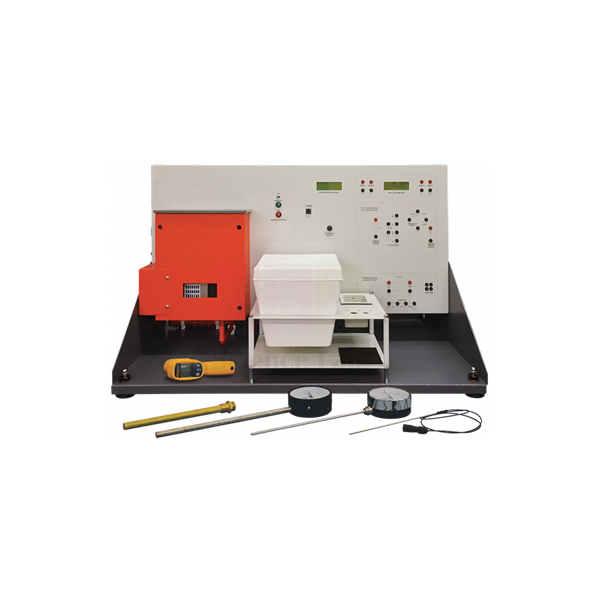
Temperature Measurement and Calibration Apparatus (Product Code: SLE/EA/12) is a benchtop teaching unit used to compare eight different temperature measurement devices and calibrate them against a precision reference sensor in engineering and physics laboratories. Students work between an insulated ice box and a guarded tank that heats water steadily up to boiling, while a display gives the reference temperature, local pressure and local boiling point. It is made by Jain Scientific Equipments Pvt Ltd (ScienceLab), an OEM maker of thermometry apparatus in India, at its own factory in Ambala.
Specifications
| Parameter | Detail |
|---|---|
| Mounting | Fits on a desk or benchtop |
| Devices included | Eight different temperature measurement devices, for studying their characteristics and calibrating them against a standard |
| Temperature reference | Built-in precision reference sensor |
| Display | Shows the reference temperature and the local pressure from a built-in pressure sensor; calculates the local boiling point of water from barometric pressure |
| Heating | Carefully rated immersion heater that warms the tank water steadily up to boiling |
| Ice point | Insulated icebox filled with crushed ice by the students |
| Water heater tank | Fully guarded, with a drain tap for connection to a suitable container or local water drain |
| Safety | Water level float switch and safety temperature cut-out switch that turn off the heater if the water level is low |
| Product code | SLE/EA/12 |
| Manufacturer | Jain Scientific Equipments Pvt Ltd (ScienceLab) — OEM |
| Country of origin | India (made in Ambala, Haryana) |
What Is the Temperature Calibration Apparatus Used For?
Students place the temperature devices beside the reference sensor, first in the crushed-ice box and then in the heater tank as the water warms, recording readings at intervals. Comparing each device with the reference shows its characteristics, such as offset and response, and teaches how a calibration against a standard is built up. The slow, steady heating leaves time to take accurate results at every step.
Because the display works out the local boiling point from barometric pressure, learners see why water rarely boils at exactly the textbook value and correct their upper fixed point accordingly. The unit suits physics departments as well as lab equipments for technical institutes where instrumentation courses cover sensor calibration. Draining the tank through its tap between groups keeps each session short.
OEM Manufacturer
ScienceLab is the brand under which Jain Scientific Equipments Private Limited (CIN U29309HR2020PTC087597) produces this calibration apparatus as the OEM (original equipment manufacturer). Manufacturing takes place at the company's own licensed factory, 449, HSIIDC Industrial Area, Saha, Ambala, Haryana, India (Factory Licence AMB-ONLINE-CHD-J-414). Buying factory-direct means laboratories, dealers and importers have quotations, repeat orders and spare-part enquiries handled by the maker itself. Read more on the ScienceLab profile page.
Related Thermodynamics & Heat Transfer Lab Equipment
Useful additions for a temperature measurement practical:
- Digital Thermometer — a handheld instrument students can add to their comparison readings.
- Immersion Thermometer — a further thermometer for side-by-side checks against the reference.
- Saturated Steam The Marcet Boiler — extends the pressure and boiling point link to saturated steam.
- Unsteady State Heat Transfer — puts transient temperature measurement into practice.
Explore the full Thermodynamics & Heat Transfer Lab Equipment range.
Frequently Asked Questions
How many temperature devices come with the apparatus?
The Temperature Measurement and Calibration Apparatus includes eight different temperature measurement devices, so students can compare their characteristics and calibrate each one against the built-in reference. Ask us for the list of device types when you request a quotation.
What acts as the temperature standard?
A built-in precision reference sensor is the standard on the Temperature Measurement and Calibration Apparatus. Its reading appears on the display together with the local pressure from the built-in pressure sensor, giving a trusted value to compare other devices against.
Why does the display calculate the local boiling point?
Water boils at different temperatures as barometric pressure changes, so the Temperature Measurement and Calibration Apparatus calculates the local boiling point from its pressure sensor. Students then use the correct upper fixed point instead of assuming a fixed textbook figure.
What safety features does the heater tank have?
The water heater tank of the Temperature Measurement and Calibration Apparatus is fully guarded and has a water level float switch and a safety temperature cut-out switch, which turn off the heater if the water level becomes too low.
How is the hot water changed between experiments?
The heater tank on the Temperature Measurement and Calibration Apparatus has a drain tap that connects to a suitable container or local water drain, so hot water can be changed safely and quickly, which reduces the time each experiment takes.
Who manufactures the Temperature Measurement and Calibration Apparatus?
Jain Scientific Equipments Pvt Ltd (ScienceLab) is the OEM of the Temperature Measurement and Calibration Apparatus and manufactures it at its own licensed factory in Saha, Ambala, Haryana, India, supplying institutions and trade buyers directly.
Is a calibration certificate supplied?
Calibration-certificate availability for the Temperature Measurement and Calibration Apparatus or its reference sensor should be discussed with us before you order. Please mention it through the contact page so the quotation can address it.
Request a Quote
Request pricing for the Temperature Measurement and Calibration Apparatus through the contact page, or add it to the enquiry cart with other laboratory items. Quotes are issued direct by the manufacturer for buyers in India and international markets.
Last updated: 24 September 2026

Jacketed Vessel and Coil
Jacketed Vessel and Coil (Product Code: SLE/EA/13) is a process-style heat exchanger used to show how a stirred vessel is heated either through its outer jacket or through an internal coil in chemical and mechanical engineering laboratories. Students run it with a continuous feed or a fixed batch, using a motorised stirrer and a dedicated batch thermocouple to see how agitation changes heat transfer. It is made by Jain Scientific Equipments Pvt Ltd (ScienceLab), an OEM and technical educational equipment manufacturer, at its own factory in Ambala, India.
Key Details
| Parameter | Detail |
|---|---|
| Type | Heat exchanger that mimics those used in the process industry |
| Heating methods | Through the outer skin (‘jacket’) of the vessel, or through a coil inside the vessel |
| Operating modes | Continuous feed to the vessel for heating, or a fixed batch |
| Agitation | Motorised stirrer to show how stirring affects heat transfer |
| Temperature measurement | Extra thermocouple to measure the batch temperature |
| Fluid connections | Self-sealing quick connectors between the Service Module and the heat exchanger, for safety and simplicity |
| Error-proofing | Hot and cold fluid streams use different connectors |
| Product code | SLE/EA/13 |
| Manufacturer | Jain Scientific Equipments Pvt Ltd (ScienceLab) — OEM |
| Country of origin | India (made in Ambala, Haryana) |
What Is the Jacketed Vessel and Coil Used For?
The unit recreates the stirred-tank heating found across the process industry, so students can compare jacket heating with coil heating in the same vessel. Switching the motorised stirrer on and off between runs shows clearly how agitation raises the rate of heat transfer to the liquid.
In batch mode, a fixed charge is heated and the extra thermocouple tracks the batch temperature over time; with continuous feed, liquid flows through while it is heated, giving a steady-state comparison. Always couple the hot and cold streams to their own connectors, which are deliberately different to prevent mix-ups. This makes it a realistic piece of engineering lab equipment in India for unit-operations teaching.
What to Specify When Ordering
- Whether you also need the Service Module that supplies the hot and cold fluid streams through the quick connectors.
- Which other heat exchangers from the same range you want for side-by-side comparison.
- The number of units required for your laboratory.
OEM Manufacturer
Jain Scientific Equipments Private Limited, known by its trading name ScienceLab, is the OEM (original equipment manufacturer) of the Jacketed Vessel and Coil and builds it at its own licensed factory at Saha, Ambala, Haryana, India. Colleges setting up a unit-operations or heat transfer lab can have this vessel quoted together with other exchangers from the same range, all from one manufacturer. Dealers and importers are supplied factory-direct too. See our company profile for more background.
Related Thermodynamics & Heat Transfer Lab Equipment
Other heat exchangers and services that fit the same practical programme:
- Heat Exchanger — the hot and cold water service unit for the heat exchanger range.
- Shell and Tube Heat Exchanger — a common industrial design for comparison with jacket heating.
- Plate Heat Exchanger — a compact alternative built from gasketed plates.
- Concentric Tube Heat Exchanger — the simplest tube-in-tube layout for baseline tests.
View all Thermodynamics & Heat Transfer Lab Equipment.
Frequently Asked Questions
Can the vessel be heated by both the jacket and the coil?
Yes. The Jacketed Vessel and Coil can transfer heat through the outer skin, or jacket, of the vessel or through a coil inside it, so students can compare the two methods on the same batch of liquid.
Does it run in batch or continuous mode?
The Jacketed Vessel and Coil works both ways: you can set a fixed batch for heating or run a continuous feed through the vessel, which lets students compare transient batch heating with steady continuous operation.
What does the motorised stirrer show?
The motorised stirrer on the Jacketed Vessel and Coil demonstrates how stirring affects heat transfer. Running the same test with and without agitation shows students why stirred vessels are standard practice in the process industry.
Does the Jacketed Vessel and Coil need a service module?
The Jacketed Vessel and Coil is designed to connect to a Service Module through self-sealing quick connectors for its hot and cold fluid streams. Ask us through the contact page which service unit to include in your quotation.
How are connection errors prevented?
All fluid connections on the Jacketed Vessel and Coil use self-sealing quick connectors, and the hot and cold streams have different connector types, so students cannot easily swap them and set-up stays safe and simple.
Who manufactures the Jacketed Vessel and Coil?
The Jacketed Vessel and Coil is manufactured by Jain Scientific Equipments Pvt Ltd (ScienceLab), the OEM, at its own licensed factory at Saha, Ambala, India, and quotations are issued directly by the manufacturer to institutions and trade buyers.
Request a Quote
Ask for a quotation for the Jacketed Vessel and Coil on our contact page or add it to the enquiry cart along with any companion exchangers. The manufacturer replies directly, for delivery within India and to international markets.
Last updated: 24 September 2026
Shell and Tube Heat Exchanger
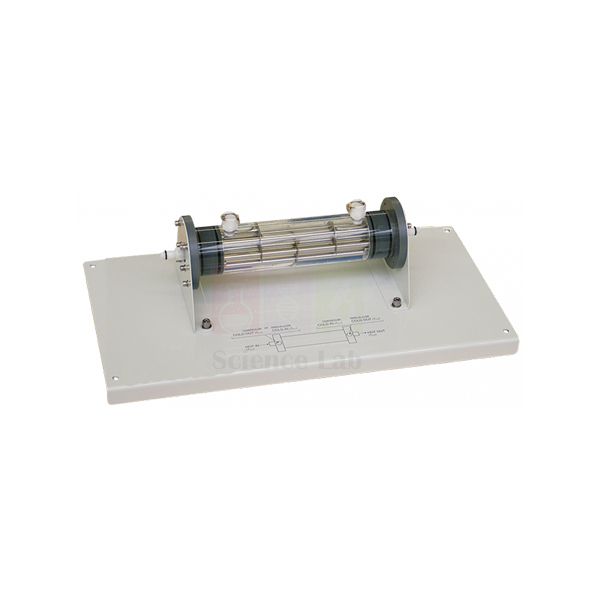
Shell and Tube Heat Exchanger (Product Code: SLE/EA/14) is a teaching heat exchanger used to demonstrate one of the most common designs in industry, with one fluid flowing through a bundle of small tubes and the other through the surrounding shell, in engineering laboratories. Baffles around the tube bundle create turbulent mixed flow on the shell side, helping students link lab results with plant practice. It is made by Jain Scientific Equipments Pvt Ltd (ScienceLab), an OEM manufacturer, at its own factory in Ambala, India.
Key Details
| Parameter | Detail |
|---|---|
| Construction | A large tube (the shell) surrounding several smaller tubes (the tube bundle) |
| Flow arrangement | One fluid passes through the shell and the other through the tube bundle, transferring heat between them |
| Baffles | Fitted around the bundle to create a turbulent mixed flow |
| Design advantage | Compact, yet able to work at higher pressures than other designs |
| Industrial relevance | One of the most common heat exchanger types used in industry |
| Product code | SLE/EA/14 |
| Manufacturer | Jain Scientific Equipments Pvt Ltd (ScienceLab) — OEM |
| Country of origin | India (made in Ambala, Haryana) |
What Is the Shell and Tube Heat Exchanger Used For?
In a typical exercise, students record the inlet and outlet temperatures and flow rates of the shell-side and tube-side streams, work out the heat transferred, and compare the result with other exchanger types. Seeing the tube bundle inside a shell also makes the textbook diagrams of industrial exchangers much easier to follow.
The baffles force the shell-side fluid across the tubes rather than simply along them, which raises turbulence and improves heat transfer. Polytechnics and TVET colleges value the unit because it is the exchanger trainees are most likely to meet on a plant, and ScienceLab builds it as a TVET lab equipment manufacturer in India.
OEM Manufacturer
Jain Scientific Equipments Private Limited, trading as ScienceLab, is the OEM (original equipment manufacturer) of this Shell and Tube Heat Exchanger and produces it at its own licensed factory in Saha, Ambala, Haryana, India. Institutions receive it factory-direct rather than through a trading intermediary, so technical questions and follow-up orders reach the team that makes it. Distributors and importers can also buy directly for projects in India and international markets. Background on the company is on the ScienceLab profile.
Related Thermodynamics & Heat Transfer Lab Equipment
Compare the shell-and-tube design with these exchangers and services:
- Concentric Tube Heat Exchanger — the simplest tube-in-tube design for baseline results.
- Plate Heat Exchanger — a compact plate design to set against the tube bundle.
- Heat Exchanger — a hot and cold water service unit built for heat exchanger experiments.
- Parallel and Counter Flow Heat Exchanger — shows how flow direction changes performance.
The complete range is listed under Thermodynamics & Heat Transfer Lab Equipment.
Frequently Asked Questions
How does the Shell and Tube Heat Exchanger work?
In the Shell and Tube Heat Exchanger, one fluid flows through a bundle of smaller tubes while the other flows through the large surrounding shell, so heat passes through the tube walls from the hotter stream to the colder one.
What do the baffles do?
The baffles around the tube bundle of the Shell and Tube Heat Exchanger create a turbulent mixed flow on the shell side. Turbulence disturbs the slow-moving layer next to the tubes, which helps heat move between the two fluids more effectively.
Why is this design so common in industry?
The Shell and Tube Heat Exchanger represents a design widely used in industry because it is compact but can work at higher pressures than other designs, which is why it appears in so many process and power plants.
What supply and measuring equipment does it need?
Water supply and measurement requirements for the Shell and Tube Heat Exchanger depend on the set-up being quoted. Ask us through the contact page and we will confirm which service unit and instruments it is used with.
Who manufactures the Shell and Tube Heat Exchanger?
The Shell and Tube Heat Exchanger is manufactured by Jain Scientific Equipments Pvt Ltd, trading as ScienceLab, which is the OEM and makes it at its own licensed factory at Saha, Ambala, India, for supply to colleges, dealers and importers.
What should a quotation request mention?
For the Shell and Tube Heat Exchanger (SLE/EA/14), mention the quantity, your institution, the delivery destination and whether you also need other exchangers or a service unit, so the manufacturer can send one complete quotation.
Request a Quote
For a price on the Shell and Tube Heat Exchanger, write to us through the contact page or add it to the enquiry cart. Quotations come straight from the manufacturer, for buyers in India and international markets.
Last updated: 24 September 2026
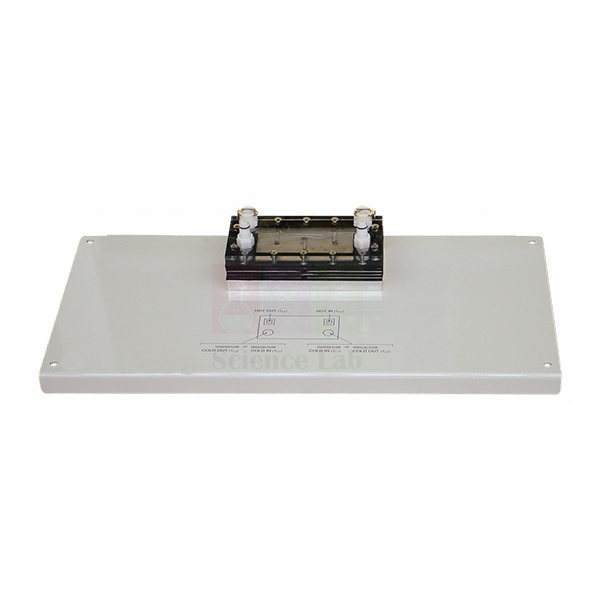
Plate Heat Exchanger
Plate Heat Exchanger (Product Code: SLE/EA/15) is a gasketed-plate heat exchanger used to teach how compact exchangers pass heat between hot and cold streams flowing on alternate sides of metal plates in engineering laboratories. Students examine how flow disturbers on the plates boost heat transfer and how capacity changes when plates and spacers are added or removed. It is made by Jain Scientific Equipments Pvt Ltd (ScienceLab), an OEM manufacturer of engineering educational equipments in India, at its own factory in Ambala.
Key Details
| Parameter | Detail |
|---|---|
| Construction | A set of metal plates separated by spacers (gaskets) |
| Plate surface | Flow disturbers on the plate sides to help improve heat transfer |
| Flow path | Holes in the plates and gaskets make the hot and cold flows run on alternate sides of the plates |
| Capacity | Altered simply by adding or removing plates and spacers |
| Footprint | Compact, suited to applications with limited space |
| Product code | SLE/EA/15 |
| Manufacturer | Jain Scientific Equipments Pvt Ltd (ScienceLab) — OEM |
| Country of origin | India (made in Ambala, Haryana) |
What Is the Plate Heat Exchanger Used For?
The plate exchanger works on the same principle as tube types — a metal wall separating hot and cold fluids — but thin plates with flow disturbers pack a large surface into a small volume. Students log the temperatures and flow rates of both streams, calculate the heat transferred and compare the figures with tube-in-tube and shell-and-tube results.
Since capacity depends on the number of plates, instructors can use it to discuss how transfer area sets performance. When the plate pack is opened for inspection or cleaning, reassemble plates and gaskets in their original order so the flows stay on alternate sides. It suits polytechnics buying vocational training lab equipment for courses covering dairy, HVAC or process plants, where plate exchangers are widely used.
OEM Manufacturer
This Plate Heat Exchanger is produced by Jain Scientific Equipments Private Limited, which trades as ScienceLab and acts as the OEM (original equipment manufacturer), at its own licensed factory in Saha, Ambala, Haryana, India. Because you are dealing with the maker, questions about replacement gaskets or extra plates go straight to the people who assemble the exchanger — ask us and we will advise. Schools of engineering, dealers and importers are all supplied factory-direct; read more on our company profile.
Related Thermodynamics & Heat Transfer Lab Equipment
Build a comparative heat exchanger practical with these items:
- Shell and Tube Heat Exchanger — the higher-pressure industrial design to contrast with plates.
- Concentric Tube Heat Exchanger — a simple tube-in-tube reference for comparison.
- Heat Exchanger — the hot and cold water service unit for the exchanger range.
- Jacketed Vessel and Coil — adds stirred-vessel heating from the process industry.
More options are in Thermodynamics & Heat Transfer Lab Equipment.
Frequently Asked Questions
How are the hot and cold fluids kept apart?
In the Plate Heat Exchanger, holes in the metal plates and gaskets route the hot and cold flows along alternate sides of each plate, so the two streams never mix while heat passes through the thin plate walls.
What are the flow disturbers for?
The flow disturbers on the sides of the Plate Heat Exchanger plates break up smooth flow over the metal surface, which helps improve heat transfer between the hot and cold streams compared with a plain, flat plate.
Can the capacity be changed?
Yes. The capacity of the Plate Heat Exchanger can be altered simply by adding or removing plates and spacers, which is one reason plate designs are easy to adapt. Ask us before changing the plate pack on a teaching unit.
Why choose a plate design over a tube design?
A Plate Heat Exchanger is compact, so it suits applications with limited space, and its capacity is easy to change. Tube designs such as shell-and-tube exchangers, by contrast, are preferred where higher working pressures are needed.
Can I get replacement gaskets?
Replacement gaskets or plates for the Plate Heat Exchanger are handled by the manufacturer itself. Send the product code SLE/EA/15 and your requirement through the contact page and we will confirm what can be supplied.
Who manufactures the Plate Heat Exchanger?
The Plate Heat Exchanger is manufactured by Jain Scientific Equipments Pvt Ltd (ScienceLab) as the OEM at its own licensed factory in Saha, Ambala, Haryana, India, and is supplied factory-direct to institutions, dealers and importers.
Request a Quote
To receive a quotation for the Plate Heat Exchanger, contact us via the contact page or add the item to the enquiry cart. Quotes are sent directly by the manufacturer to buyers in India and international markets.
Last updated: 24 September 2026