- Physics Lab Equipment
- Chemistry Lab Equipment
- Biology Lab Equipment
- Anatomical Lab Equipment
- Learning
- Educational Lab Equipment
- Magnets
- Agriculture
- Astronomy
- Earth Science
- Geography Lab Equipment
- Safety Lab Coat
- Laboratory
- Meteorological
- Electricity & Magnetism
- Heat
- School Lab Equipment
- Lab Glassware
- Science Lab Equipment
- Tvet Lab Equipment
- Robotics Kits Supplier and Manufacturer for Schools India
- Math Lab Equipment Manufacturers and Exporters in Ambala
- STEM Kits Manufacturers and Supplier India
- Engineering Lab Equipment
- Hospital Lab Equipment
- Water, Sanitation & Hygiene Supplies
- Cold Chain, Solar & Communication Equipment
- Nutrition
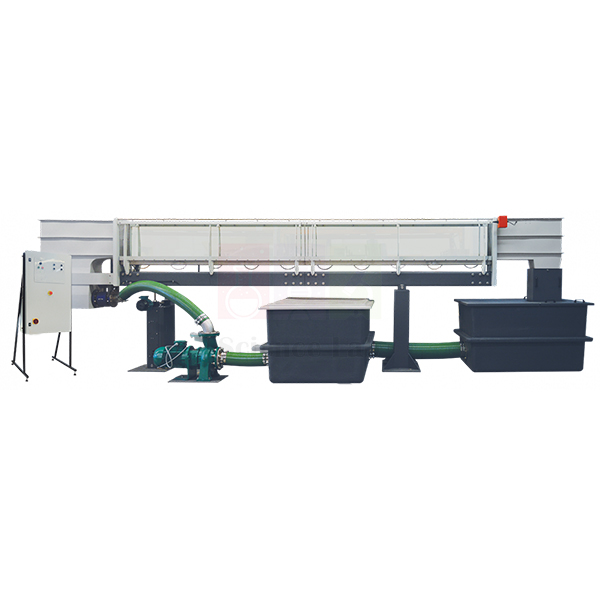
Meter Flume
Meter Flume (Product Code: SLE/EFM/23) is a 300 mm wide open-channel flume, available in lengths from 5 to 15 m, for student study and advanced research across a wide range of fluid flow topics. It has its own built-in recirculating water supply with a digital flow meter, and pressure tappings along the working section for detailed measurement. The flume forms the backbone of a university or institute hydraulics laboratory, and a large range of ancillaries is available to extend what it can teach. It is manufactured by Jain Scientific Equipments Pvt Ltd (ScienceLab), Ambala, a producer of engineering lab equipment in India.
Specifications
| Parameter | Detail |
|---|---|
| Channel width | 300 mm |
| Length | 5 to 15 m |
| Pressure tappings | At 0.25 metre intervals along the working section |
| Tapping connection | Multi-tube manometer or 32-way pressure display |
| Water supply | Built-in recirculating supply |
| Flow measurement | Digital flow meter connected to the recirculating supply |
| Ancillaries | Wide range available to extend the experiments |
| Application | Student study and advanced research into fluid flow topics |
Typical Use
A flume of this kind supports a full open-channel syllabus: uniform flow and Manning’s equation, specific energy and critical depth, hydraulic jumps, flow over weirs and under gates, and flow around structures such as culverts and bridge piers. Students set the discharge on the digital flow meter, install the structure being studied, and read water levels and the tapping pressures spaced every 0.25 metre along the working section to build surface and pressure profiles. Because the water recirculates, there is no need for a separate sump or mains supply during a session.
For research groups, the longer versions give more distance for flow to develop before it reaches a test model, and the 32-way pressure display option speeds up data collection. Keep the water clean to protect the flow meter, check that tapping lines are free of air before each run, and drain and dry the channel when it will stand unused. Choose the length that suits your room and experiments, and check ancillary fit with us when ordering.
Manufacturer
Larger laboratory installations like this flume are engineered by Jain Scientific Equipments Private Limited, which trades as ScienceLab from its base in Ambala, Haryana. Learn about the company on our company profile page.
Related Fluid Mechanics Equipment
Channel models and instruments used with a laboratory flume:
- Sluice Gate with Tappings — ten-tapping gate for pressure distribution studies
- Culvert — circular and rectangular culvert models for open and orifice flow
- Bridge Piers — profiled piers and sediment walls for velocity and scour tests
- Lift And Drag — rail-mounted force balance for models in the flow
- Trapezoidal Flume — clear flow-measuring section for low-flow work
The complete Fluid Mechanics category lists further apparatus.
Frequently Asked Questions
What lengths are available?
The flume is 300 mm wide and can be supplied from 5 to 15 m long. Tell us the space you have and we will suggest a length.
Does it need a separate pump or water supply?
No. It has a built-in recirculating water supply connected to a digital flow meter.
How are pressures along the channel measured?
Tappings at 0.25 metre intervals along the working section connect either to a multi-tube manometer or to a 32-way pressure display. Confirm which option you want in your enquiry.
Are the channel models included?
Ancillaries such as gates, culverts and piers are available separately, so the flume can be expanded over time.
What electrical supply and floor space are needed?
These depend on the chosen length and are not given in our current listing; contact us for installation details.
Can a calibration certificate be provided for the flow meter?
Please discuss certificate requirements with us when you request a quotation.
What warranty and installation support apply?
Terms are confirmed with the quotation; ask us for current details.
Do you supply flumes for overseas universities?
Yes, we quote for institutions across India and international markets; include the destination and required length.
Request a Quote
To plan a Meter Flume for your laboratory, contact us with the length you need, or add it to the enquiry cart.
Last updated: 24 September 2026
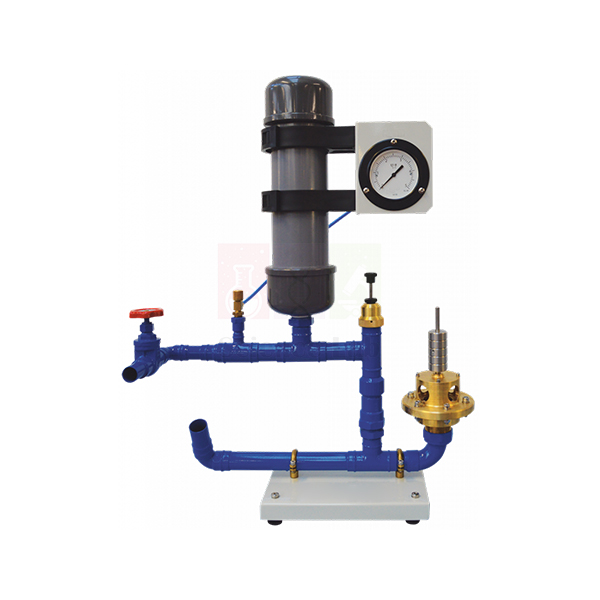
Hydraulic Ram Pump
Hydraulic Ram Pump (Product Code: SLE/EFM/24) demonstrates a pump with no motor at all: it uses the momentum of a large, slow-moving column of water to lift a smaller amount of water to a higher level. The apparatus has three main parts — a wall-mounted header tank, the pump, and the interconnecting pipework — with an inner and outer valve on the supply pipe and an air vessel to reduce hydraulic shock. It is used in mechanical, civil and agricultural engineering teaching, and is made by Jain Scientific Equipments Pvt Ltd (ScienceLab), Ambala, a laboratory instruments supplier in India.
Specifications
| Parameter | Detail |
|---|---|
| Pump type | Hydraulic ram — not a normal mechanically-operated pump |
| Main parts | Header tank, pump, and interconnecting pipework |
| Header tank | Mounts to a suitable wall |
| Valves | Supply pipe fitted with an inner and an outer valve |
| Outer valve loading | Weight platform for loading with the weights provided, which changes the pump’s cycle times |
| Shock control | Air vessel to reduce hydraulic shock |
| Weights | Provided |
Typical Use
Water runs down the supply pipe from the header tank and escapes through the outer valve until its speed is enough to snap that valve shut. The sudden stop acts like a plunger: the moving column’s energy forces some water through the inner valve into the delivery pipe, the air vessel cushions the pressure pulse, and the cycle repeats on its own. Students measure how much water is delivered and how much is spilled at the outer valve, then calculate the pump’s efficiency from the flows and heads involved.
Adding weights to the outer valve platform changes how long each cycle lasts, so the class can investigate how cycle time affects delivered flow and efficiency. Fix the header tank securely to a wall that can carry its full weight of water, keep the valves free of debris, and check the air vessel still holds air if the pump becomes noisy. The ram pump is a memorable way to show how the water hammer effect can be turned into useful work in places without electricity.
Manufacturer
Our hydraulic ram apparatus is manufactured by Jain Scientific Equipments Private Limited, better known by its ScienceLab brand, in Ambala, Haryana. Registered as an MSME manufacturing enterprise (Udyam UDYAM-HR-01-0003714), the company ships overseas orders under DGFT Importer-Exporter Code AAECJ8618A. Visit the company profile for more background.
Related Laboratory Equipment
Items that help with running and measuring a ram pump experiment:
- Water Hammer Apparatus — measures the pressure surge the ram pump relies on
- Stopwatch, Digital — times volume collection and valve cycles
- Measuring Cylinder 1000 ml — collects delivered and spilled water to find flow rates
- Vane Pump — a motor-driven pump for contrast with the ram principle
See more hydraulics apparatus in the Fluid Mechanics category.
Frequently Asked Questions
Does the ram pump need electricity?
No. It is not a normal mechanically-operated pump; it runs on the momentum of water flowing down from the header tank.
What is supplied?
The header tank, the pump with its inner and outer valves and air vessel, the interconnecting pipework, and the weights for the outer valve platform.
How is the header tank installed?
It mounts to a suitable wall, so plan a sturdy wall location near a water supply and drain.
What do the weights do?
Loading the outer valve platform with the weights provided changes the pump’s cycle times, letting students study their effect on performance.
What delivery height can it achieve?
Head and flow figures are not given in our current product details; contact us for performance data.
What warranty is offered?
Warranty terms are stated in the quotation; ask us for the current terms.
Can you supply several units for a department or an export order?
Yes. Share the quantity and delivery location, and we will send pricing and lead time.
Request a Quote
For a quotation on the Hydraulic Ram Pump, contact us or add it to your enquiry cart. We serve customers in India and international markets.
Last updated: 24 September 2026
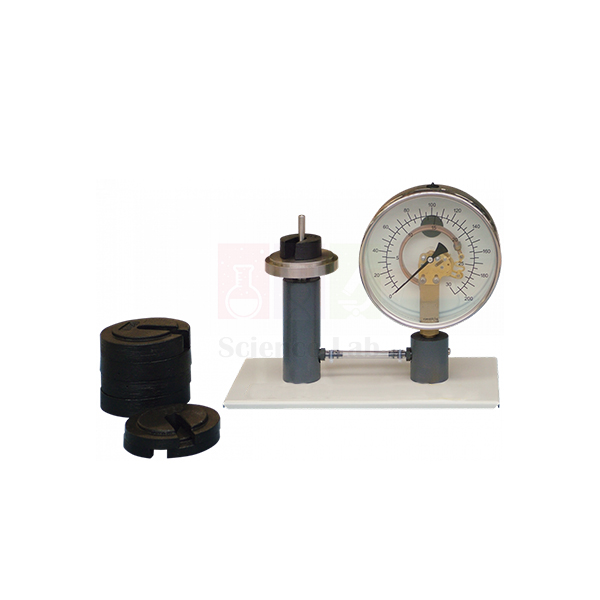
Calibration of a Pressure Gauge
Calibration of a Pressure Gauge (Product Code: SLE/EFM/25) is a teaching apparatus that shows both how a Bourdon-type pressure gauge works and how it is calibrated. A gauge with a transparent dial, so its working mechanism is on view, is connected to a dead weight tester; students load known weights, calculate the pressure they produce and compare it with the gauge reading. It introduces the principles of lab equipment calibration to mechanical, instrumentation and civil engineering students, and is manufactured by Jain Scientific Equipments Pvt Ltd (ScienceLab), Ambala.
Specifications
| Parameter | Detail |
|---|---|
| Arrangement | Pressure gauge connected to a dead weight tester |
| Gauge dial | Transparent, showing the working mechanism |
| Gauge mechanism | Thin-walled tube of oval cross-section bent into an arc; one end held rigidly and admitting pressure, the other free and linked to a dial and pointer |
| Pointer response | Moves by an amount proportional to the pressure increase as the tube tries to straighten |
| Dead weight tester | Weights on a platform apply a known force to a piston of known area |
| Pressure transfer | Flexible tube containing water carries the piston pressure to the gauge tube |
Typical Use
Students add weights to the dead weight tester platform in increments, and at each step they calculate the true pressure from the total load and the known piston area and write down the gauge reading. They then remove the weights step by step and record the readings again on the way down. Plotting gauge reading against true pressure for loading and unloading reveals the gauge’s error at each point and any hysteresis, and lets them draw up a correction chart.
Watching the oval tube through the clear dial as it tries to straighten under pressure makes the Bourdon principle easy to grasp, and many students meet this mechanics lab equipment before using dial gauges on larger rigs. Place the weights gently and centrally, rotate the piston slightly while readings are taken if the design allows, and make sure no air is trapped in the water-filled flexible tube.
Manufacturer
The apparatus is designed and built in Ambala, Haryana, by Jain Scientific Equipments Private Limited, which markets its instruments as ScienceLab. More details are on our company profile.
Related Laboratory Equipment
Pressure-measurement equipment that students use alongside this experiment:
- Bourdon Gauge — a stand-alone gauge of the same type for other pressure demonstrations
- Pressure Measurement Bench — compares different pressure-measuring methods
- Water Hammer Apparatus — applies a Bourdon gauge and a transducer in a working pipe rig
- Cavitation In Venturi — uses dial gauges to track pressure at a Venturi throat
Browse our Fluid Mechanics category for more.
Frequently Asked Questions
How is the pressure worked out during calibration?
The weights put a known force on a piston of known area, so pressure equals that force divided by the piston area.
Can students see inside the gauge?
Yes. The dial is transparent, so the oval tube, its fixed end and the pointer linkage are all visible.
What fluid is used in the system?
A flexible tube containing water transfers the pressure from the piston to the gauge tube.
What pressure range does the gauge cover?
The range and the weight set details are not listed in our current product information; contact us for these figures.
Does the apparatus come with a calibration certificate?
It is built to teach calibration rather than serve as a reference standard; talk to us about any certificate needs when you enquire.
How should it be maintained?
Keep the piston and cylinder clean, store the weights dry, and top up or bleed the water-filled tube if readings become erratic.
What should an institutional enquiry include?
Quantity, delivery location in India or abroad, and any tender format; we will reply with a formal quotation.
Request a Quote
For pricing on Calibration of a Pressure Gauge, contact us or add it to the enquiry cart. We supply India and international markets.
Last updated: 24 September 2026
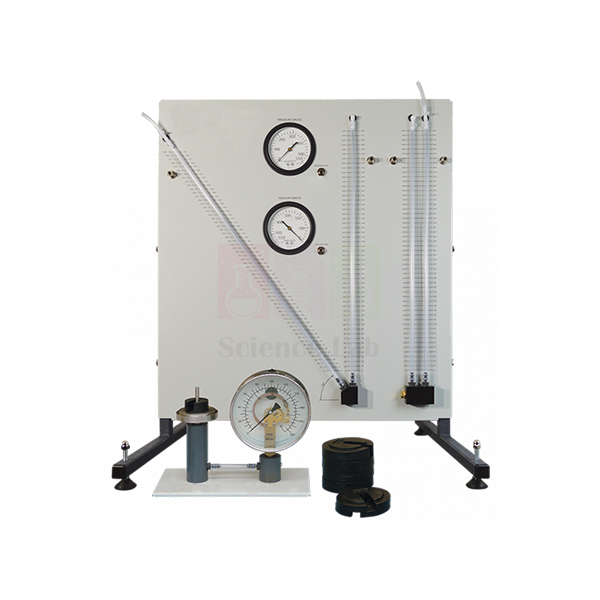
Pressure Measurement Bench
The Pressure Measurement Bench (Product Code: SLE/EFM/26) is a two-unit teaching apparatus that lets students investigate and compare vertical and inclined U-tube manometers with Bourdon-type vacuum and pressure gauges, and then see how a Bourdon gauge is calibrated. Because manometers and Bourdon gauges sit inside more complex instruments such as pneumatic comparators and flow indicators, the bench gives mechanical and instrumentation students a clear grounding in how these devices work before they meet them in larger systems. It is manufactured by Jain Scientific Equipments Pvt Ltd (ScienceLab), Ambala, as lab equipment for technical institutes, engineering colleges and polytechnics.
Key Details
| Parameter | Detail |
|---|---|
| Type | Bench apparatus for studying pressure-measuring instruments |
| Units supplied | Two: a manometers and gauges unit, and a Bourdon pressure gauge calibration unit |
| Manometers and gauges unit | Framed structure with a backboard carrying all the instruments listed below |
| Manometers | Vertical U-tube manometer; U-tube manometer with an inclined limb |
| Bourdon gauges | One gauge for measuring vacuum; one gauge for measuring positive pressure |
| Pressure source | Syringe assembly for pressurising and for reducing pressure |
| Calibration unit | Separate Bourdon gauge with dead-weight calibration apparatus, arranged so the Bourdon tube mechanism can be clearly observed |
| Learning focus | Operation, characteristics and principles of calibration of manometers and Bourdon gauges |
Typical Use
In a typical practical, students use the syringe assembly to apply a small positive pressure or a partial vacuum and read the vertical U-tube, the inclined-limb manometer and the matching Bourdon gauge side by side. Comparing the readings shows why an inclined limb spreads a small pressure change over a longer length of scale, why liquid-column instruments suit low pressures, and how a mechanical dial gauge responds to the same input. Changing the syringe setting slowly and letting the liquid columns settle before reading gives more consistent results.
The second half of the session moves to the calibration unit. Students load the dead-weight apparatus, note the Bourdon gauge reading against the known applied pressure, and build a calibration table or curve while watching the curved Bourdon tube move the pointer. The bench is well suited to fluid mechanics and instrumentation courses that need engineering lab equipment in India for both demonstration and small-group work.
Manufacturer
This bench is built by Jain Scientific Equipments Private Limited, a company based in Ambala, Haryana, that trades under the name ScienceLab and makes apparatus for engineering, science and technical teaching laboratories. Background on the company and its range is available in our company profile.
Related Fluid Mechanics Equipment
Apparatus that fits naturally into the same pressure-measurement or hydrostatics practical:
- Calibration of a Pressure Gauge — a dead-weight tester with a transparent-dial gauge for extra calibration practice
- Bourdon Gauge — a standalone gauge with a clear back for showing the tube mechanism at the front of a class
- U Tube Manometer — a borosilicate glass U-tube for separate pressure or differential-pressure demonstrations
- Manometer, Glass — a backplate-mounted glass manometer with stopcock for additional student stations
- Center of Pressure — the next hydrostatics topic: force and moment on a submerged plane surface
Explore the full Fluid Mechanics range for flow, pump and turbine apparatus.
Frequently Asked Questions
What is included with the Pressure Measurement Bench?
Two units: the manometers and gauges unit (vertical U-tube manometer, inclined-limb U-tube manometer, vacuum Bourdon gauge, pressure Bourdon gauge and syringe assembly on a framed backboard) and a separate Bourdon gauge calibration unit with dead-weight apparatus.
Why are there two different manometers?
So students can compare them directly. Tilting one limb makes the liquid travel further along the scale for the same pressure change, which makes small pressures easier to read than on a vertical U-tube.
Can the bench show vacuum as well as positive pressure?
Yes. One Bourdon gauge measures vacuum and the other positive pressure, and the syringe assembly can both raise and reduce the pressure applied to the instruments.
What pressure ranges do the gauges cover?
Gauge ranges and the manometer fill liquid are not stated in our current product description. Please contact us for the detailed datasheet before ordering.
Can a calibration certificate be supplied with the gauges?
This depends on the order; please discuss your requirement with us through the contact page at the enquiry stage.
What should we include in a request for an institutional quotation?
Tell us the number of benches, the delivery address or port, and any tender format you must follow. Warranty terms are stated in the quotation itself.
Do you supply multiple benches or ship abroad?
Yes. We supply colleges and training centres across India and international markets; quantities, packing and dispatch time are confirmed when we quote.
Request a Quote
For pricing on the Pressure Measurement Bench, send your requirement through our contact page or add the item to your enquiry cart.
Last updated: 24 September 2026
Vortex Apparatus
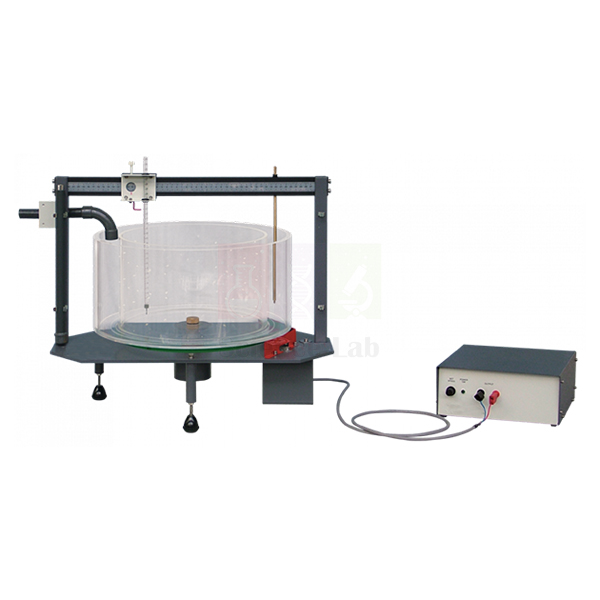
Vortex Apparatus (Product Code: SLE/EFM/27) is a rotating-vessel apparatus used to create a forced vortex in water and measure the shape of its free surface in engineering college and polytechnic fluid mechanics labs. A low-voltage, variable-speed motor spins the vessel about its vertical axis, and a traverse probe with a linear scale on each axis maps the surface point by point. It is manufactured by Jain Scientific Equipments Pvt Ltd (ScienceLab), an OEM manufacturer, at its own factory in Ambala, India.
Key Details
| Parameter | Detail |
|---|---|
| Type | Forced vortex apparatus with a rotating water vessel |
| Drive | Low-voltage, variable-speed motor rotating the vessel about its vertical axis |
| Speed control | Separate speed-control unit, sited away from the main apparatus |
| Water fill | Water added to the rotating vessel until it is about half full |
| Surface measurement | Traverse probe moving horizontally and vertically, with a linear scale on each axis |
| Total head measurement | Traverse probe can be replaced by a Pitot tube to measure the distribution of total head |
| Product code | SLE/EFM/27 |
| Manufacturer | Jain Scientific Equipments Pvt Ltd (ScienceLab) — OEM |
| Country of origin | India (made in Ambala, Haryana) |
What Is the Vortex Apparatus Used For?
Students start the vessel turning, add water until it is roughly half full and watch a forced vortex develop: the surface falls rapidly towards the centre and produces an air core. After a few minutes of steady rotation the vortex becomes constant, and only then are readings taken, stepping the traverse probe across the radius and recording surface height against radial position from the two scales. Repeating the traverse at different motor speeds shows how the profile deepens as rotation increases, and the results can be compared with the parabolic shape predicted by forced-vortex theory.
For a second set of readings the traverse probe is swapped for a Pitot tube, so the class can plot how total head varies across the vessel. Because the speed-control unit sits away from the vessel, the instructor can adjust rotation without disturbing the water, which suits group demonstrations as well as individual lab reports. It is practical engineering lab equipment in India for hydraulics and fluid mechanics syllabi at degree and diploma level.
OEM Manufacturer
ScienceLab is the trading name of Jain Scientific Equipments Private Limited, the OEM (original equipment manufacturer) of this vortex apparatus, which it builds at its own licensed factory at Saha, Ambala, Haryana, India. Engineering colleges, polytechnics, dealers and importers therefore deal with the maker itself rather than a trader: technical questions, replacement parts and repeat orders are handled at source, so just ask us. Learn more about the company on our company profile.
Related Fluid Mechanics Equipment
Other items that complement vortex experiments in the same hydraulics lab:
- Bernoulli's Theorem — builds on the total-head idea with a Venturi tube and manometer panel.
- Cavitation In Venturi — links pressure, velocity and flow in a visible demonstration.
- Pressure Measurement Bench — grounds students in manometer and gauge readings before head measurements.
- Stopwatch, Digital — times how long the vortex takes to settle before readings are taken.
The complete Fluid Mechanics category lists our pumps, flumes and flow apparatus.
Frequently Asked Questions
How is the speed of the Vortex Apparatus controlled?
The Vortex Apparatus uses a separate speed-control unit, sited away from the main apparatus, to drive its low-voltage, variable-speed motor. Keeping the controller apart lets the instructor change the rotation speed without disturbing the water surface being measured.
How do students measure the surface profile?
Students use the traverse probe of the Vortex Apparatus, which moves both horizontally and vertically. Each axis has a linear scale, so the height of the water surface can be recorded at known radial positions and plotted as a profile.
Can the Vortex Apparatus measure total head?
Yes. On the Vortex Apparatus the traverse probe can be replaced by a Pitot tube to measure the distribution of total head across the vessel. Please ask us to confirm whether a Pitot tube is included in your supply.
What are the vessel size and motor voltage?
The current Vortex Apparatus listing describes the motor only as low-voltage and variable-speed and does not state the vessel dimensions. Ask us through the contact page for the datasheet of the unit you are quoted before planning bench space.
How long before readings can be taken?
After water is added to the rotating vessel of the Vortex Apparatus, allow a few minutes of steady rotation. Once the forced vortex becomes constant and the surface stops changing shape, students can traverse the profile and record readings.
Who manufactures the Vortex Apparatus?
The Vortex Apparatus is manufactured by Jain Scientific Equipments Pvt Ltd (ScienceLab), the OEM, at its own licensed factory at Saha, Ambala, Haryana, India. Quotations, replacement-part enquiries and repeat orders are handled directly by the manufacturer.
Can you supply overseas institutions?
Yes. The Vortex Apparatus is supplied to colleges and training centres in India and international markets. Send the product code SLE/EFM/27, the quantity and the destination, and export packing and shipping are agreed at the quotation stage.
Request a Quote
To get a price for the Vortex Apparatus straight from its manufacturer, write to us via the contact form or place it in your enquiry cart with the quantity you need.
Last updated: 24 September 2026
Center of Pressure
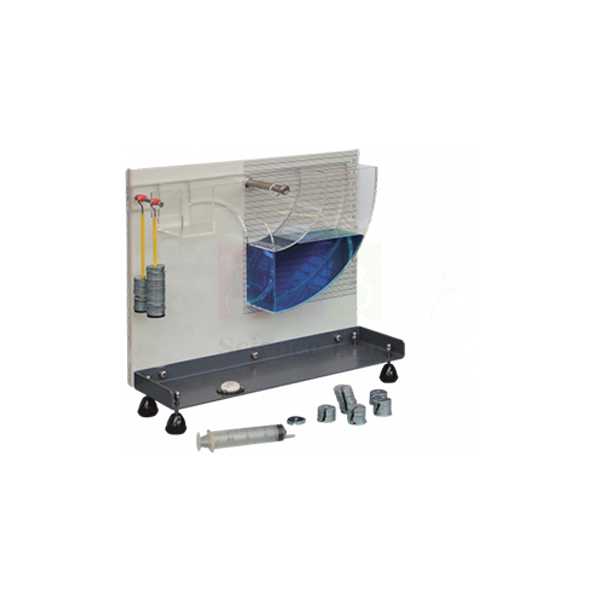
The Center of Pressure apparatus (Product Code: SLE/EFM/28) is a pivoted clear plastic assembly that students use to find the centre of pressure on a plane surface when it is totally or partially submerged in water. A clear quadrant mounted on a vertical panel holds the water, a scale shows the head, and weights hung from a lever arm balance the hydrostatic moment. Compact and self-contained, it is made by Jain Scientific Equipments Pvt Ltd (ScienceLab), Ambala, for hydrostatics practicals in engineering colleges, polytechnics and other buyers of mechanics lab equipment.
Key Details
| Parameter | Detail |
|---|---|
| Type | Pivoted centre of pressure (hydrostatic force) apparatus |
| Construction | Vertical panel holding a clear plastic quadrant, to which water is added |
| Head indication | Scale on the panel showing the head of water |
| Quadrant markings | Engraved lines to help set the plane surface vertical or at an angle |
| Quadrant geometry | Cylindrical sides with their central axis coincident with the moment measurement axis, so pressure on the curved faces exerts no moment about the pivot |
| Moment measurement | Weights suspended from a lever arm |
| Test conditions | Plane surface fully or partially submerged |
| Format | Compact, self-contained unit suited to classroom demonstrations |
Typical Use
The experiment works because of the quadrant's shape. Its curved sides are centred on the pivot, so the water pressure acting on them passes through the pivot and produces no turning effect; the only moment left is the one from pressure on the flat test face. Students add water in stages, read the head from the panel scale, and restore balance by adding weights to the lever arm. From the balancing moment they calculate the hydrostatic thrust and the depth of the centre of pressure, then compare it with the theoretical value for a partially submerged face and, once the water covers the face completely, for a fully submerged one.
Using the engraved lines, the plane can also be set at an angle to study inclined surfaces, a useful extension for civil and mechanical engineering groups. Level the panel before starting, add water gently to avoid splashing onto the balance side, and drain and dry the quadrant after the session to keep the clear plastic free of marks. The unit is a practical choice of lab equipment for college fluid mechanics courses that need a bench-top hydrostatics experiment.
Manufacturer
This apparatus comes from Jain Scientific Equipments Private Limited, an Ambala, Haryana manufacturer operating under the ScienceLab brand. For tender and vendor registration forms, the company's GSTIN is 06AAECJ8618A1ZT and its Legal Entity Identifier (LEI) is 3358004HRD1JIVXKYX49. More about the business is on our company profile.
Related Fluid Mechanics Equipment
Useful additions for a hydrostatics and pressure practical:
- Pressure Measurement Bench — manometers and Bourdon gauges for the pressure-measurement part of the same module
- Calibration of a Pressure Gauge — a dead-weight tester that relates known forces and areas to pressure
- Hangers with Slotted Weights — extra slotted weights if more balancing increments are needed (check fit with us)
- Measuring Cylinder, Polypropylene — an unbreakable cylinder for adding water to the quadrant in controlled steps
- Bernoulli's Theorem — the natural next step from fluid statics into flowing water
Browse our Fluid Mechanics equipment for further hydraulics apparatus.
Frequently Asked Questions
Why do the curved faces of the quadrant not affect the result?
Their central axis coincides with the moment measurement axis, so the fluid pressure on them produces no moment about the pivot. The measured moment comes only from pressure on the plane test surface.
Can inclined plane surfaces be tested?
Yes. Engraved lines on the quadrant help students hold the plane either vertical or at an angle.
Are the balance weights included?
The moment is measured with weights on a lever arm, but the weight set supplied is not detailed in our current description. Please contact us to confirm contents.
Does it need a water supply or hydraulic bench?
It is a self-contained unit; water is added directly to the quadrant, so a simple container or measuring cylinder is enough.
How should the clear plastic parts be cleaned?
Drain after use and wipe with a soft cloth and plain water; avoid abrasive pads or solvents, which can scratch or cloud clear plastics.
Is a calibration certificate or warranty provided?
Both are handled per order. Discuss certificate needs with us, and the warranty period will be stated in your quotation.
Can several units be ordered for a class?
Yes, multiple sets can be supplied for colleges and institutes across India and international markets; share the quantity when you enquire.
Request a Quote
Ask for a quotation on the Center of Pressure apparatus through our contact page, or collect several items in the enquiry cart and send them together.
Last updated: 24 September 2026
Variable Speed Series And Parallel Pumps
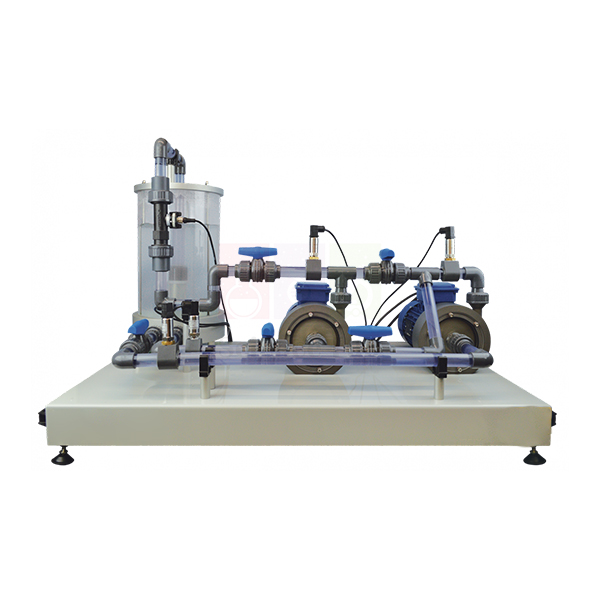
Variable Speed Series And Parallel Pumps (Product Code: SLE/EFM/29) is a bench-top test set for studying how centrifugal pumps perform on their own and when two are combined in series or in parallel. It pairs one variable speed and one fixed speed centrifugal pump, each driven independently by its own bearing-mounted motor, drawing from a clear acrylic reservoir. The set is built for fluid machinery and hydraulics laboratories in engineering and diploma institutions by Jain Scientific Equipments Pvt Ltd (ScienceLab), Ambala, a technical educational equipment manufacturer.
Key Details
| Parameter | Detail |
|---|---|
| Type | Bench-top centrifugal pump test set |
| Pumps | One variable speed centrifugal pump and one fixed speed centrifugal pump |
| Drive | Two bearing-mounted motors, each driving one pump independently |
| Operating modes | Single pump, two pumps in series, two pumps in parallel |
| Water supply | Clear acrylic reservoir; water returns to it for re-use, keeping water use to a minimum |
| Circuit | Water passes through a series of valves to a flow and temperature measurement device |
| Operating conditions | Set with adjustable inlet and delivery valves |
Typical Use
A standard sequence begins with one pump running alone. Students close the delivery valve in steps, recording flow at each setting to build the pump's characteristic, then repeat at different speeds on the variable speed pump to see how the curve shifts. Next they valve the two pumps into series, which adds head for the same flow, and then into parallel, which adds flow at a similar head. Plotting all the curves on one chart makes the difference between the two arrangements clear and shows why the choice matters when matching pumps to a real piping system.
Because one pump is variable speed and the other fixed, the set also lets students explore what happens when unequal pumps share a duty, a situation common in building services and water supply. The inlet valves can be throttled to create more demanding suction conditions. With a closed water circuit and a transparent reservoir, it is a tidy, visible choice of engineering lab equipment in India for colleges, polytechnics and TVET centres.
Manufacturer
The pump set is produced under the ScienceLab name by Jain Scientific Equipments Private Limited, whose operations are in Ambala, Haryana, India. Our company profile describes the wider range of engineering and science teaching equipment we make.
Related Fluid Mechanics Equipment
Apparatus often chosen with this set for a fluid machines course:
- Two Stage (Series And parallel) — an alternative two-pump rig that uses a Venturi meter for flow measurement
- Axial Flow Pump Module — contrasts centrifugal behaviour with a different rotodynamic pump type
- Cavitation In Venturi — shows the cavitation limits that affect pump suction design
- Friction Loss In Pipe — measures the pipe losses that make up the system curve a pump works against
See every item in our Fluid Mechanics category.
Frequently Asked Questions
Can each pump be run on its own?
Yes. Each pump has its own bearing-mounted motor, so either can run alone, or both can be combined in series or in parallel.
Why is one pump variable speed and the other fixed speed?
It lets students see how speed changes a pump's performance and how two unequal pumps behave when they share the same flow path.
What is measured on the set?
Water is delivered to a flow and temperature measurement device. Details of any pressure or head instrumentation, and of motor ratings, are not in our current description, so please contact us for the datasheet.
Does it need a mains water connection?
No continuous supply is described: the pumps draw from the clear acrylic reservoir and the water returns there for re-use.
How should the reservoir be maintained?
Use clean water, drain the reservoir if the set will stand unused for long periods, and wipe the acrylic with a soft cloth to keep it clear.
What details help with a tender or institutional quotation?
Send the quantity, installation site, electrical supply available at your lab and any tender specification sheet. Warranty terms are included in our quotation.
Is export supply possible?
Yes, the set can be supplied within India and to international markets; shipping arrangements are agreed when you order.
Request a Quote
Request pricing for the Variable Speed Series And Parallel Pumps set via our contact page, or save it to the enquiry cart alongside other fluid mechanics items.
Last updated: 24 September 2026
Manual Volumetric Fuel Gauge
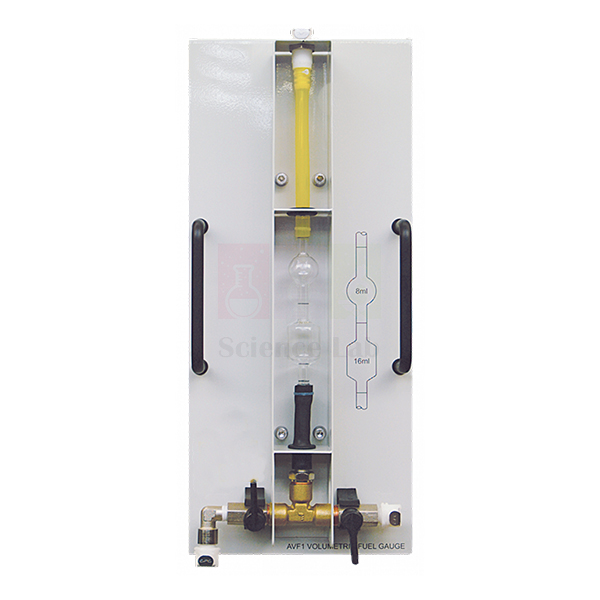
Manual Volumetric Fuel Gauge (Product Code: SLE/EE/01) is a pipette-type fuel meter used to measure how much fuel an engine consumes during bench tests in engineering and automotive laboratories. Students time the engine as it draws a set volume from a precision-calibrated two-bulb pipette, then calculate the fuel flow rate for petrol or diesel engines. It is made by Jain Scientific Equipments Pvt Ltd (ScienceLab), an OEM and engineering lab equipment manufacturer, at its own factory in Ambala, India.
Key Details
| Parameter | Detail |
|---|---|
| Measuring element | Precision-calibrated two-bulb pipette |
| Flow control | Control valves, including a valve that cuts off the tank supply so the engine draws fuel from the pipette only |
| Filling | Fuel enters the pipette from the fuel tank |
| Installation | Mounts on the instrumentation frame of the engine test set and connects between the fuel tank and the engine under test |
| Couplings | Self-sealing couplings for quick connection and disconnection with minimum loss or spillage of fuel |
| Suitable fuels | Petrol or diesel |
| Measurement method | Time taken to consume a set volume of fuel, from which the fuel flow rate is calculated |
| Product code | SLE/EE/01 |
| Manufacturer | Jain Scientific Equipments Pvt Ltd (ScienceLab) — OEM |
| Country of origin | India (made in Ambala, Haryana) |
What Is the Manual Volumetric Fuel Gauge Used For?
The gauge is the fuel-consumption instrument of an engine test bench. With the engine held at a steady speed and load, the student closes the tank valve so the engine runs from the pipette alone, then times how long it takes to use the marked volume. Dividing that volume by the elapsed time gives the volumetric fuel flow rate, the starting point for specific fuel consumption, brake thermal efficiency and energy-balance calculations.
Because every reading is taken by eye and stopwatch, the principle stays visible to learners instead of being hidden inside a sensor, which makes it a sound choice among lab equipments for technical institutes running IC engine practicals. Take several timings at each load point and average them, and reopen the tank valve between readings so the pipette refills before the next measurement.
What to Specify When Ordering
- Which engines the gauge will serve – it suits both petrol and diesel
- The engine test set it will mount on, since it fits the instrumentation frame between tank and engine
- Whether you also need matching engines such as the 4 Stroke Petrol Engine or 4 Stroke Diesel Engine
- How many test benches you are equipping
OEM Manufacturer
ScienceLab is the trading name of Jain Scientific Equipments Private Limited, the OEM (original equipment manufacturer) behind this fuel gauge. The gauge is made and assembled at the company's own licensed factory at Saha, Ambala, Haryana, and supplied factory-direct to engineering colleges, polytechnics, training institutes, dealers and importers rather than through a trader.
Because the manufacturer handles your order itself, questions about replacement pipettes, valves or couplings go straight to the people who build the unit – just ask us. More about the company is on our company profile.
Related Automotive Training Equipment
The fuel gauge works alongside the engines and measuring accessories of an engine test bench:
- 4 Stroke Petrol Engine — a test engine whose fuel use this gauge can time
- 4 Stroke Diesel Engine — compression-ignition engine for comparing diesel consumption
- Exhaust Gas Calori meter — measures the heat leaving in the exhaust to complete an engine energy balance
- Stopwatch, Digital — for timing the pipette volume if the bench has no timer of its own
- Four Stroke Four Cylinder Petrol Engine Test Bench — a complete multi-cylinder bench for fuel-consumption and power studies
Browse the full range of engine, transmission and braking trainers in Automotive Training Equipment.
Frequently Asked Questions
What does the Manual Volumetric Fuel Gauge measure?
The Manual Volumetric Fuel Gauge measures an engine's fuel consumption by timing how long the engine takes to use a set volume of fuel from its calibrated two-bulb pipette. From that time and volume, students calculate the fuel flow rate used in efficiency and specific fuel consumption work.
Can the Manual Volumetric Fuel Gauge be used with diesel engines?
Yes. The Manual Volumetric Fuel Gauge is suitable for petrol or diesel, so one gauge can serve both spark-ignition and compression-ignition engines on the same test set. Drain the pipette when changing fuels so that readings are not affected by a mixture of the two.
How is the Manual Volumetric Fuel Gauge connected to the engine?
The Manual Volumetric Fuel Gauge mounts on the instrumentation frame of the test set and connects between the fuel tank and the engine under test. Self-sealing couplings let staff connect and disconnect it quickly with minimum loss or spillage of fuel.
Is a stopwatch included with the Manual Volumetric Fuel Gauge?
A timer is not listed as part of the Manual Volumetric Fuel Gauge, so plan to use a stopwatch or the timing facility of your bench. If you would like a stopwatch quoted with the gauge, mention it in your enquiry on our contact page.
Who manufactures the Manual Volumetric Fuel Gauge?
The Manual Volumetric Fuel Gauge is manufactured by Jain Scientific Equipments Pvt Ltd (ScienceLab) as the OEM, at its own factory in Saha, Ambala, Haryana, India. Orders, spares queries and repeat supplies are handled directly by the manufacturer rather than through a trading intermediary.
Is a calibration certificate available for the Manual Volumetric Fuel Gauge?
The pipette of the Manual Volumetric Fuel Gauge is precision calibrated, but certificate availability should be discussed with us before ordering. Tell us in your enquiry if your institution needs a calibration certificate so we can confirm what accompanies the quotation.
What details should a quotation request for the Manual Volumetric Fuel Gauge include?
A quotation request for the Manual Volumetric Fuel Gauge should state the quantity, the engine or test set it will be used with, whether matching engines are also needed, and the delivery destination in India or abroad, so we can quote the complete fuel-measurement setup.
Request a Quote
To order the Manual Volumetric Fuel Gauge, send your requirement through our contact page or add it to the enquiry cart. Quotations come direct from the manufacturer, for engineering institutions in India and international markets.
Last updated: 24 September 2026