- Physics Lab Equipment
- Chemistry Lab Equipment
- Biology Lab Equipment
- Anatomical Lab Equipment
- Learning
- Educational Lab Equipment
- Magnets
- Agriculture
- Astronomy
- Earth Science
- Geography Lab Equipment
- Safety Lab Coat
- Laboratory
- Meteorological
- Electricity & Magnetism
- Heat
- School Lab Equipment
- Lab Glassware
- Science Lab Equipment
- Tvet Lab Equipment
- Robotics Kits Supplier and Manufacturer for Schools India
- Math Lab Equipment Manufacturers and Exporters in Ambala
- STEM Kits Manufacturers and Supplier India
- Engineering Lab Equipment
- Hospital Lab Equipment
- Water, Sanitation & Hygiene Supplies
- Cold Chain, Solar & Communication Equipment
- Nutrition
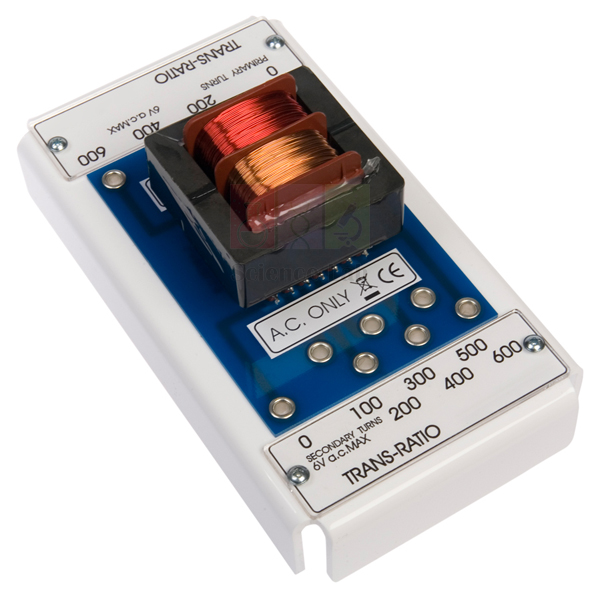
Trans-Ratio
Trans-Ratio (Product Code: SLE/EAM/30) is a fully self-contained transformer system that lets students investigate turns ratios and efficiency with the minimum of complication. The primary coil is tapped at 200, 400 and 600 turns and the secondary at every hundred turns from 100 to 600, with all tappings brought out to 4mm sockets, so dozens of ratios can be set up simply by moving leads. Manufactured by Jain Scientific Equipments Pvt Ltd (ScienceLab), Ambala, it is a ready-to-use transformer experiment kit for school and college laboratories, supplied with full instructions and experiment details.
Specifications
| Parameter | Detail |
|---|---|
| Type | Fully self-contained transformer system |
| Primary tappings | 200, 400 and 600 turns |
| Secondary tappings | 100, 200, 300, 400, 500 and 600 turns |
| Connections | All tappings brought out to 4mm sockets |
| Supply required | AC supply of up to 6V |
| Monitoring | AC voltmeters (not part of the unit) |
| Documentation | Full instructions supplied with experiment details |
| Size | 180 x 100 x 75mm |
Typical Use
Connect an AC supply of up to 6V across a chosen primary tapping and an AC voltmeter across a secondary tapping, then compare the voltage ratio with the turns ratio. Using the 200-turn primary with the 400-turn secondary gives a step-up of two; swapping to the 600-turn primary with the 100-turn secondary shows a strong step-down. Working through several combinations, students tabulate Vs/Vp against Ns/Np and see the transformer equation emerge from their own data, while differences from the ideal ratio open a discussion of flux leakage and losses.
With AC ammeters added in both circuits, the same unit supports efficiency measurements by comparing input and output power. Teachers also use it to show electromagnetic induction in its simplest form: no connection between the coils except the changing magnetic field. As a transformer experiment kit for school use it avoids the loose cores and clamps of demountable sets, which keeps practical time focused on the physics. Always use AC, never DC, and keep the input within the stated limit.
Manufacturer
Trans-Ratio is produced by Jain Scientific Equipments Private Limited, the Ambala, Haryana company behind the ScienceLab brand of teaching apparatus for physics, electricity and magnetism. Learn more on our company profile.
Related Electricity and Magnetism Equipment
Supply and measuring instruments for transformer practicals:
- Power Supply, Stepped — a low-voltage AC/DC bench supply; use its AC output within the unit’s limit
- Analogue Voltmeter AC — monitors primary and secondary voltages
- Analogue Ammeter AC — measures currents for efficiency calculations
- Digital Multimeter — a second meter so both coil voltages can be read at once
- Demountable Transformer Kit — for follow-up work on cores and coil construction
More induction apparatus is available in our Electricity and Magnetism category.
Frequently Asked Questions
Which turns ratios can be set?
Any combination of primary tappings at 200, 400 or 600 turns with secondary tappings at 100, 200, 300, 400, 500 or 600 turns, giving both step-up and step-down ratios.
What supply does it need?
An AC supply of up to 6V. A DC supply will not produce transformer action.
Are meters included?
No. AC voltmeters are required for monitoring, and AC ammeters are useful for efficiency work; these are ordered separately.
Does it come with instructions?
Yes, full instructions are supplied with experiment details, which helps teachers new to the apparatus plan a practical quickly.
How large is the unit?
It measures 180 x 100 x 75mm, compact enough for a student bench with meters and supply alongside.
Is a calibration certificate available?
The unit is a teaching transformer rather than a measuring instrument; for any documentation needs, discuss certificate availability with us before ordering.
Can you supply class sets for India and overseas?
Yes. We quote for schools, colleges and distributors in India and international markets; include quantity and destination in your enquiry.
Request a Quote
Request a quotation for Trans-Ratio through our contact page, or add it with suitable meters and a power supply to the enquiry cart.
Last updated: 24 September 2026
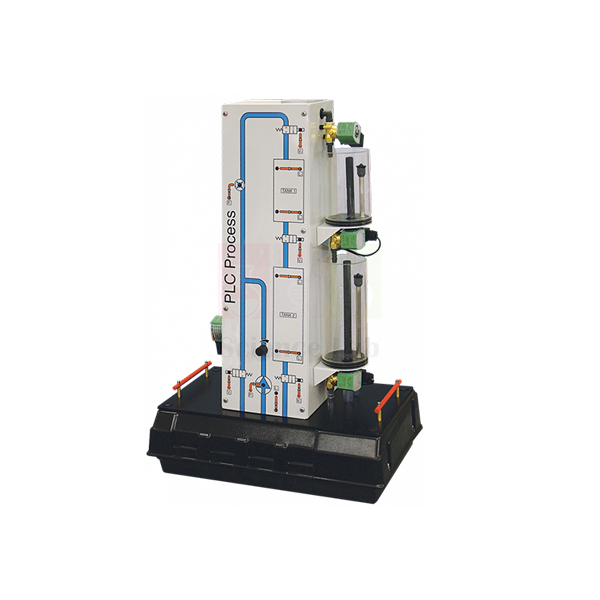
PLC Process
PLC Process (Product Code: SLE/EE/06) is a two-tank water-circulation rig used to practise programmable logic controller (PLC) sequencing and level control of a small process plant in engineering and technical-institute laboratories. Students wire its float switch, tank level sensors, pulsed flow sensor, solenoid valves and variable-speed pump into control exercises as water moves from a reservoir to an upper tank, down to a lower tank and back. It is made by Jain Scientific Equipments Pvt Ltd (ScienceLab), an OEM manufacturer, at its own factory in Ambala, India.
Key Details
| Parameter | Detail |
|---|---|
| Tanks | Two transparent tanks, mounted one above the other |
| Water path | Reservoir → upper tank → drains down to lower tank → back into the reservoir |
| Reservoir monitoring | Float switch monitoring the water level in the reservoir |
| Tank level sensing | Two level sensors in each tank, measuring maximum and minimum water levels |
| Flow sensing | In-line flow sensor with pulsed output; pulse frequency proportional to flow rate, number of pulses proportional to volume |
| Pump | Variable-speed pump transferring water from the reservoir into the upper tank; pump control is on/off, with a manual control to set the speed |
| Valves | Solenoid valves that can be individually opened or closed to control and redirect the movement of water |
| Product code | SLE/EE/06 |
| Manufacturer | Jain Scientific Equipments Pvt Ltd (ScienceLab) — OEM |
| Country of origin | India (made in Ambala, Haryana) |
What Is the PLC Process Rig Used For?
The rig gives students a real, visible plant to automate. A typical exercise starts with the float switch confirming there is water in the reservoir; the program then switches the pump on to fill the upper tank and uses that tank's maximum-level sensor to decide when to stop. Opening a solenoid valve lets the water drain to the lower tank, whose own pair of sensors tells the program when to return it to the reservoir.
Because the pump is switched on or off while its running speed is set by hand, learners can compare fill times at different speeds and use the pulse count from the flow sensor to totalise the volume moved. The rig suits ladder-logic courses, instrumentation practicals and final-year projects, and sits comfortably among other engineering lab equipment in India's polytechnics and engineering colleges.
OEM Manufacturer
Jain Scientific Equipments Private Limited, which trades as ScienceLab, is the OEM (original equipment manufacturer) of the PLC Process rig. The rig is built and assembled at the company's own licensed factory at Saha, Ambala, Haryana, India, so engineering colleges, training institutes, dealers and importers buy from the maker rather than from a trader.
For tender and vendor-registration paperwork, the company's GSTIN is 06AAECJ8618A1ZT and its LEI is 3358004HRD1JIVXKYX49. You can read more about the business on the ScienceLab company profile.
Related Control & Process Engineering Trainers
These trainers from the same range carry the level and flow work done on the PLC Process rig into continuous control of level, temperature and pressure.
- Coupled Tanks Apparatus — continuous liquid-level control of one or two tanks by varying pump speed
- Process Trainer — adds temperature, level and pressure loops around a stirred process vessel
- Pressure Process Training — pressure regulation with an industrial controller and pneumatic valve
- Thermal Control Process Apparatus — a thermal plant for comparing on/off switching with continuous control
Browse the full Control & Process Engineering Trainers category for more process-control and servo apparatus.
Frequently Asked Questions
What is included in the PLC Process rig?
The PLC Process rig comprises two transparent tanks mounted one above the other, a reservoir with a float switch, a variable-speed pump, individually switched solenoid valves, an in-line pulsed flow sensor and two level sensors on each tank. Ask us to confirm accessories for your order.
Does the PLC Process rig come with a PLC?
A programmable logic controller is not listed among the PLC Process rig's components, so treat the controller as a separate item. Tell us which PLC or I/O system you plan to use when you enquire, and we will confirm what can be supplied with the rig.
How does the flow sensor on the PLC Process rig report flow?
The PLC Process rig's in-line flow sensor gives a pulsed output: the pulse frequency is proportional to flow rate and the number of pulses is proportional to the volume passed, so a PLC counter input can totalise volume or work out flow.
Can the pump speed on the PLC Process rig be changed?
Yes, manually. On the PLC Process rig the pump itself is controlled on or off, while a manual control lets the user set its running speed, so students switch the pump from their program and adjust speed by hand to compare filling behaviour.
Who manufactures the PLC Process rig?
The PLC Process rig is manufactured by Jain Scientific Equipments Pvt Ltd (ScienceLab), the OEM, at its own licensed factory in Saha, Ambala, Haryana, India. Quotations, repeat orders and questions about spare parts for the tanks, sensors or valves are handled directly by the manufacturer.
Is the PLC Process rig available for export?
Yes. The PLC Process rig is supplied factory-direct to engineering colleges, training institutes, dealers and importers in India and international markets. For a quotation, send the quantity, delivery destination and any controller preference through our contact page.
Request a Quote
To request a quote for the PLC Process rig, send your requirement through the contact page or add it to the enquiry cart. Quotations come direct from the manufacturer, Jain Scientific Equipments Pvt Ltd (ScienceLab).
Last updated: 24 September 2026
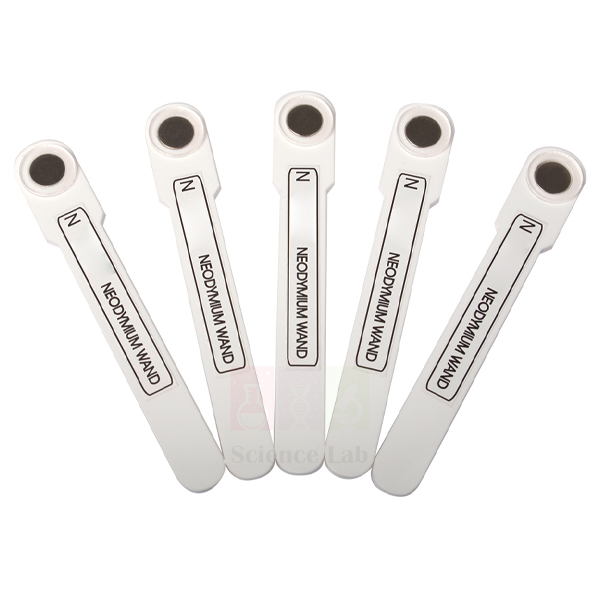
Neodymium Wand
The Neodymium Wand (Product Code: SLE/EAM/31) is a set of 5 acrylic wands, each fitted with a powerful 12mm diameter neodymium button magnet. Mounting each magnet in a wand makes these very strong magnets safe for pupil use, so children can explore attraction, magnetic materials and fields without pinched fingers or magnets snapping together. The set is made by Jain Scientific Equipments Pvt Ltd (ScienceLab), Ambala, and suits primary classrooms, junior science lab equipment collections and secondary physics groups alike.
Specifications
| Parameter | Detail |
|---|---|
| Supplied as | Set of 5 wands |
| Wand material | Acrylic |
| Magnet | Powerful neodymium button magnet, 12mm diameter, one per wand |
| Dimensions | 125 x 20 x 10mm |
| Key benefit | Makes strong magnets safe for pupil use |
Typical Use
Pupils use the wands to sort everyday objects into magnetic and non-magnetic materials, to test whether magnetism acts through paper, card, wood or water, and to count how many paper clips each wand can lift through different thicknesses of material. Because there are five wands in a set, a class can work in small groups at once. Older students can use the wands with a plotting compass to trace field lines or to find the poles of the button magnet.
The strength of neodymium makes effects obvious that weaker classroom magnets only hint at, such as attraction through a tabletop or the drag felt when the wand is moved over a copper or aluminium sheet. Remind users to keep the wands away from phones, cards and computers, and to store them apart so the magnets do not collect filings or clash together.
Manufacturer
These wands are made by Jain Scientific Equipments Private Limited, which trades as ScienceLab and manufactures magnetism and general science apparatus for schools from its base in Ambala, Haryana. Our company profile explains more about the business.
Related Electricity and Magnetism Equipment
Items that pair well with the wands in magnetism lessons:
- Compass Plotting (Clear) — traces the field lines around each button magnet
- Magnetic Field Demonstrator — makes the shape of the field visible to the whole group
- Neodymium Magnets — loose neodymium magnets for teacher-led extension work
- Magnetic Wands — an alternative wand style for younger pupils
- Splat The Rat — a neodymium-magnet demonstration of Lenz’s Law for the next step
See more magnetism apparatus in our Electricity and Magnetism section.
Frequently Asked Questions
How many wands are in a set?
Five acrylic wands, each fitted with its own 12mm diameter neodymium button magnet.
Why mount the magnets in wands?
Neodymium magnets are very strong. The wands make them safe for pupil use by giving a handle to hold and keeping fingers away from the magnet face.
What age groups can use them?
They suit supervised primary and middle-school activities as well as secondary physics; the teacher should brief pupils on keeping the magnets away from electronics.
How should the wands be cleaned and stored?
Wipe the acrylic with a soft damp cloth, remove any iron filings from the magnet with tape, and store the wands so the magnets are not touching each other.
Can I order extra sets for a whole class?
Yes. Multiple sets can be supplied for schools and distributors in India and international markets; contact us with the number of sets required.
Is there a warranty on the magnets?
Warranty terms are confirmed with each quotation. Ask our team if you need them before placing an order.
Request a Quote
Add the Neodymium Wand set to the enquiry cart or send us your quantity through the contact page to receive a quotation.
Last updated: 24 September 2026
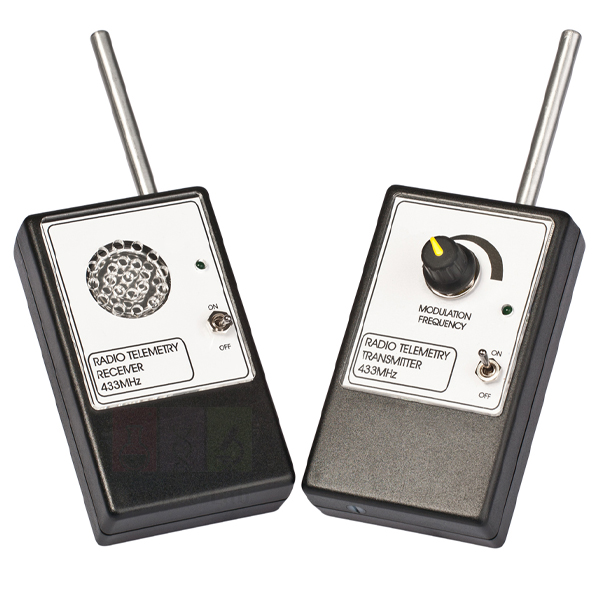
RF Telemetry
RF Telemetry (Product Code: SLE/EAM/32) is a complete teaching system for exploring how radio communication behaves. It consists of a 433MHz low power transmitter that sends out a variable audio tone and a matching receiver with a built-in loudspeaker, so students can literally hear when the link is working, weakening or blocked. Built by Jain Scientific Equipments Pvt Ltd (ScienceLab), Ambala, an electronics lab equipment manufacturer for schools and colleges, it supports lessons on directionality, shielding and range.
Specifications
| Parameter | Detail |
|---|---|
| System | Low power transmitter and matching receiver |
| Frequency | 433MHz |
| Transmitter signal | Variable audio tone |
| Receiver output | Built-in loudspeaker |
| Unit size | 90 x 60 x 20mm each, excluding aerials |
| Power | 9V PP3 battery required for each unit |
| Investigations | Directionality, shielding, range and comparison with other communication systems |
Typical Use
With a battery fitted in each unit, the transmitter is switched on and its tone set, and the receiver is carried away from it while students listen. Rotating either aerial shows how orientation affects reception; stepping further away shows how the signal fades with range; and wrapping the transmitter in metal foil, or placing it inside a metal box, shows the effect of shielding, which can then be compared with plastic, wood or a human body in the path. These simple tests make abstract ideas about electromagnetic waves tangible.
The system is particularly effective as a comparison with other communication methods covered in the syllabus, such as infrared remote controllers, visible light links and microwaves, because students can ask the same questions of each and contrast the answers. It fits both physics communication topics and introductory electronics courses. Remove the batteries when the units are stored for long periods.
Manufacturer
RF Telemetry is a ScienceLab product from Jain Scientific Equipments Private Limited, an Ambala, Haryana maker of electronics, physics and electricity apparatus for education. The company profile has more background on the firm.
Related Laboratory Equipment
Apparatus for comparing radio with other communication systems and measuring range:
- Microwave Transmitter/Receiver — lets students contrast microwave behaviour with the radio link
- Apparatus Microwave — further microwave experiments for the waves and communication topic
- Windup Meter Tapes — measures the distance between transmitter and receiver in range tests
Other communication and circuit apparatus appears in our Electricity and Magnetism category.
Frequently Asked Questions
What frequency does the system use?
The transmitter and matching receiver operate at 433MHz and are low power, intended for classroom-scale experiments.
How does the receiver indicate the signal?
Through its built-in loudspeaker, which reproduces the variable audio tone sent by the transmitter.
What batteries are needed?
Each unit requires a 9V PP3 battery. Please contact us to confirm whether batteries are included with your order.
What can students investigate with it?
The directionality, shielding and range of radio communication, especially in comparison with IR controllers, light and microwaves.
How big are the units?
Each measures 90 x 60 x 20mm excluding aerials, so both fit easily on a bench or in a pocket during range tests.
Are there any regulatory points to check for export?
Radio equipment rules vary between countries, so international buyers should share their destination when enquiring and we will discuss the requirements with them.
Do you supply schools in bulk?
Yes. We supply schools, colleges and distributors in India and international markets, with quantities confirmed on the quotation.
Request a Quote
Send your enquiry for RF Telemetry through the contact page, or add it to the enquiry cart with any other communication apparatus you need.
Last updated: 24 September 2026
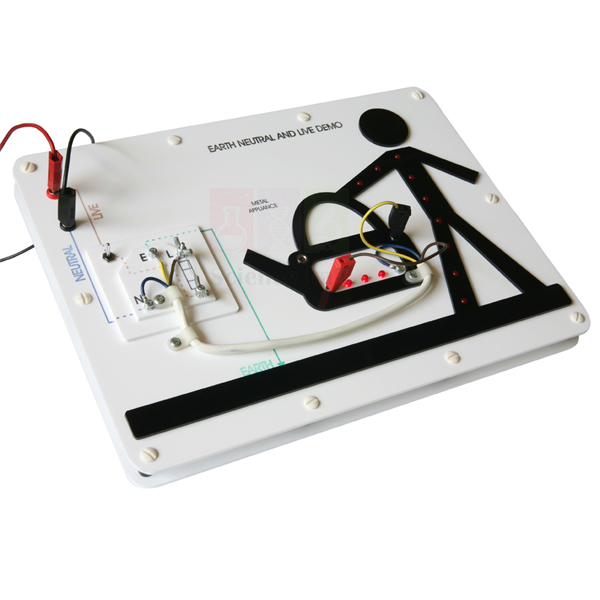
Earth Neutral Live Demo
The Earth Neutral Live Demo (Product Code: SLE/EAM/33) is a safe, low-voltage model of a domestic circuit that shows how the earth wire and fuse act together to protect both the user and the appliance. Students trace the current from the ‘power station’ through a 13A socket, plug and kettle along the live wire and back through the neutral, then watch what happens when a fault is introduced. It is manufactured by Jain Scientific Equipments Pvt Ltd (ScienceLab), Ambala, a school laboratory equipment supplier in India, for electricity-safety teaching in secondary science.
Specifications
| Parameter | Detail |
|---|---|
| Demonstrates | The danger of an unearthed appliance; the safe wiring of an appliance; the action of a fuse |
| Circuit path | ‘Power station’, 13A socket, plug and appliance (kettle), via live and neutral wires |
| Plug layout | 3 pin plug laid out in positionally correct form, showing wiring and fuse position |
| Indicators | LEDs in the kettle show the appliance working or current passing through a person to ground |
| Fuse | Easily visible; can be seen to ‘blow’ when a fault occurs |
| Supplied with | 10 metres of fuse wire and full instructions |
| Power required | 12V D.C. power supply |
| Connections | 4mm shrouded sockets |
| Labelling | Clearly labelled throughout |
Typical Use
The lesson starts with the appliance wired correctly: when the 12V D.C. supply is switched on, the LEDs in the kettle light to show it is working. The teacher then creates a fault by moving the live wire from inside the kettle to its case. With the earth wire connected, a large current flows to earth and the fuse visibly melts, cutting off the supply and protecting both the user and the appliance. With the earth wire removed, the fuse does not blow; instead, LEDs light to show current passing through the ‘person’ to ground, making the danger of an unearthed metal-cased appliance unmistakable.
Because the plug is laid out in its true positions, students can relate what they see to wiring a real plug and to why the fuse sits in the live line. Rewire a new length of fuse wire after each blown-fuse demonstration and keep the supply switched off while changing connections. It is a practical addition to physics lab equipment for schools in India covering domestic electricity, all without exposing pupils to mains voltage.
Manufacturer
This demonstrator is made by Jain Scientific Equipments Private Limited, whose ScienceLab brand covers electricity, magnetism and general physics apparatus manufactured in Ambala, Haryana. More information is on our company profile.
Related Electricity and Magnetism Equipment
Items for powering the demonstration and extending the electrical-safety topic:
- Battery Eliminator 12 Volt — a rectified low-voltage supply option for the DC input
- Power Supply, Stepped — a stepped AC/DC bench supply; use its DC output
- Circuit Breaker — shows how thermal and solenoid trips protect a modern domestic circuit
- Stackable Leads — 4mm connecting leads; check the plug style suits shrouded sockets
Explore our full Electricity and Magnetism range for more circuit demonstrations.
Frequently Asked Questions
Does the demonstration use mains electricity?
No. It requires a 12V D.C. power supply, so the fault conditions can be shown safely in class.
What is supplied with the unit?
The demonstrator comes with 10 metres of fuse wire and full instructions. The 12V D.C. supply and leads are separate.
What faults can be shown?
A live-to-case fault with the earth connected, which blows the fuse, and the same fault without an earth wire, where LEDs light to indicate current flowing through a person to ground.
How is the fuse replaced after a demonstration?
A fresh length is cut from the supplied fuse wire and fitted in place of the blown piece; the full instructions explain the procedure.
How are connections made?
Through 4mm shrouded sockets. Please contact us if you need advice on suitable leads.
What should an institutional quotation include?
Product code SLE/EAM/33, quantity, whether a 12V D.C. supply and leads are needed, and the delivery address in India or abroad.
Is warranty information available?
Yes, warranty terms are given with our quotation on request.
Request a Quote
To order the Earth Neutral Live Demo, add it to the enquiry cart or write to us through the contact page; we supply institutions in India and international markets.
Last updated: 24 September 2026
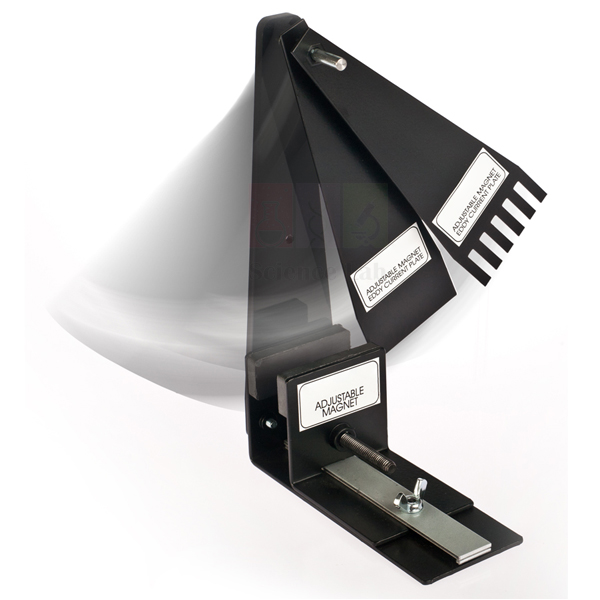
Adjustable Magnet
The Adjustable Magnet (Product Code: SLE/EAM/34) is a variable-gap field source for bench work on magnetism and induction. A steel frame carries lockable, adjustable jaws that hold magnets on either side of a gap, so students can widen or narrow that gap and observe how the field between the poles changes. It is produced by Jain Scientific Equipments Pvt Ltd (ScienceLab), Ambala, for school and college physics laboratories, and works well as the central piece of a practical magnetism experiment kit in India or overseas.
Specifications
| Parameter | Detail |
|---|---|
| Construction | Steel frame with lockable, adjustable jaws |
| Magnets accepted | 50 x 20mm ferrite slab magnets or neodymium button magnets |
| Field adjustment | Field strength changed by adjusting the distance between the jaws |
| Supplied with | 2 ferrite magnets, an eddy current pendulum demonstration and a universal accessory bracket |
| Measurement | Used with a coil to determine the flux density in the gap |
| Dimensions | 120 x 50 x 50mm |
| Mass | 0.25kg |
Typical Use
A common exercise starts with the jaws opened wide: a coil is placed in the gap, a reading of flux density is taken, and the jaws are then closed in small steps with a fresh reading at each setting. Plotting gap against flux density gives students a clear picture of how quickly a magnetic field weakens with distance. Because the jaws lock, the chosen separation holds steady while the reading is recorded, which makes the results repeatable from one group to the next.
The eddy current pendulum demonstration supplied with the unit turns the same gap into a lesson on magnetic braking: a metal pendulum swinging through the field slows noticeably as the currents induced in it oppose its motion. This makes a natural bridge into electromagnetic induction kit topics such as Lenz’s law. Swapping the ferrite slabs for neodymium button magnets (not included) lets a class compare a weaker and a stronger field in the same frame. Keep the magnets away from watches, phones and moving-coil meters, and store them so they cannot snap together and chip.
Manufacturer
This magnet assembly is made by Jain Scientific Equipments Private Limited, the Ambala, Haryana company that sells under the ScienceLab name. The business is incorporated as a private limited company under CIN U29309HR2020PTC087597, and it manufactures at its licensed factory at 449, HSIIDC Industrial Area, Saha, Ambala (Factory Licence AMB-ONLINE-CHD-J-414). More background is available on our company profile page.
Related Electricity and Magnetism Equipment
Items that pair with the Adjustable Magnet in field-strength and induction lessons:
- Search Coil — a coil for probing the field inside the gap
- Neodymium Magnets — stronger magnets to compare with the ferrite slabs (confirm size fit with us)
- Eddy Current Unit — extends the magnetic braking idea shown by the pendulum
- Faraday’s Law Apparatus — follow-on work on induced voltage
- Force on a Conductor Apparatus — shows the motor effect in a magnetic field
See the complete Electricity and Magnetism range for more field, induction and circuit apparatus.
Frequently Asked Questions
What is included with the Adjustable Magnet?
The steel frame with its lockable jaws comes with 2 ferrite magnets, an eddy current pendulum demonstration and a universal accessory bracket.
Which magnets fit in the jaws?
The jaws accept 50 x 20mm ferrite slab magnets or neodymium button magnets. Only the ferrite magnets are supplied; neodymium buttons are a separate purchase.
How do I change the field strength?
Adjust the distance between the jaws and lock them in place. A smaller gap gives a stronger field between the magnets.
Can I measure flux density with this unit alone?
No. The magnet provides the field; a coil and a suitable meter are needed to determine the flux density in the gap.
What is the field value at a given gap?
A rated flux density figure is not part of our current product data. Please contact us if you need typical values before ordering.
Is a calibration certificate available?
This is a teaching field source rather than a reference magnet. If your purchase process needs a certificate, discuss it with our team before placing the order.
Can schools order several units?
Yes. For a class set or tender, send the quantity and delivery location through the contact page; we supply institutions in India and international markets.
Request a Quote
For pricing and availability on the Adjustable Magnet, send us an enquiry or add the item to your enquiry cart with any other apparatus you need.
Last updated: 24 September 2026
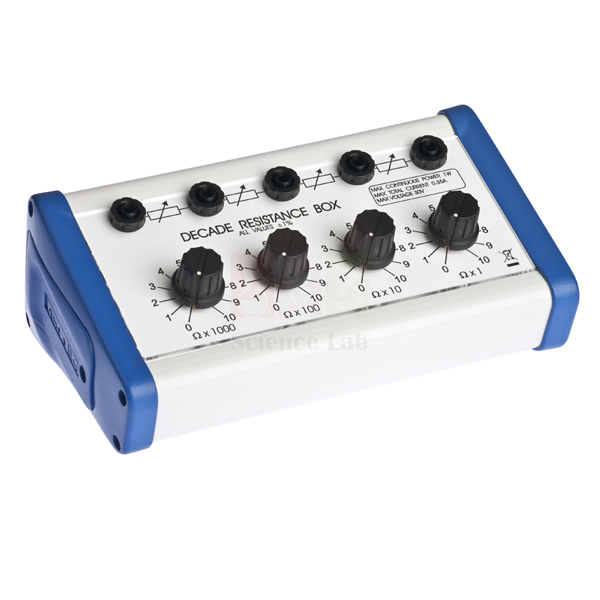
Decade Resistance Box
The Decade Resistance Box (Product Code: SLE/EAM/35) lets students dial in any whole-ohm resistance from 1Ω to 9999Ω, using four decades of 1% tolerance resistors. Physics teachers use it wherever a circuit needs a known, adjustable resistance — Ohm’s law, bridge circuits, potential dividers and meter-range work. It is manufactured by Jain Scientific Equipments Pvt Ltd (ScienceLab), Ambala, and is a practical resistance box for India lab benches in schools, colleges and technical institutes.
Specifications
| Parameter | Detail |
|---|---|
| Type | Four-decade resistance box |
| Range | 1Ω to 9999Ω |
| Step size | 1Ω |
| Resistor tolerance | 1% |
| Power rating | 1W continuous |
| Maximum current | 0.35A |
| Connections | 4mm sockets, which also allow use as a potential divider |
Typical Use
In an Ohm’s law experiment kit the box replaces a drawer full of loose resistors: students set a value, record current and voltage, change one decade and repeat, so the relationship between resistance and current emerges from a single tidy circuit. It also serves as the known arm of a Wheatstone or meter bridge, where the fine 1Ω steps let a class balance the bridge closely, and as a series resistor when extending the range of a meter. Wired through its 4mm sockets as a potential divider, it provides a chosen fraction of a supply voltage for sensor or component tests.
Before switching on, check that the current through the selected setting will stay below the 0.35A maximum and that dissipation stays within the 1W continuous rating — at low resistance settings even a modest supply voltage can exceed these limits. Setting all decades to a high value first and working downwards is a simple habit that protects the resistors.
Manufacturer
Jain Scientific Equipments Private Limited builds this decade box in Ambala, Haryana, and markets it to teaching laboratories under its ScienceLab brand. The company’s range covers physics, chemistry, biology and engineering teaching apparatus; our company profile gives an overview of the business.
Related Electricity and Magnetism Equipment
Apparatus that completes a resistance or Ohm’s law circuit with this box:
- Precision Variable Power Supply — an adjustable source for driving the circuit
- Digital Ammeter — reads the current so it can be kept under the 0.35A limit
- Digital Voltmeter — measures the voltage across the selected resistance
- Resistance Selector — a quicker option when only a few standard values are needed
- Stackable Leads — plug leads for wiring the circuit
Browse our Electricity and Magnetism category for further circuit components and meters.
Frequently Asked Questions
What range does the Decade Resistance Box cover?
From 1Ω to 9999Ω in 1Ω steps, set across four decades.
How close to the set value is the resistance?
The resistors are 1% tolerance, which is adequate for most school and college circuit work.
What current and power can it take?
Maximum current is 0.35A and the power rating is 1W continuous. Stay within both limits, especially at low settings.
How is it different from the Resistance Selector?
The selector switches between a fixed set of standard values, while this box gives every whole-ohm value across its range — better when you need fine adjustment, such as balancing a bridge.
Are connecting leads supplied?
Leads are not listed as part of this item. It uses 4mm sockets, so standard 4mm plug leads such as our Stackable Leads are suitable.
Can you provide a calibration certificate?
Please raise this with our team when you enquire so we can advise on what documentation is available for your order.
What should an institutional quotation request include?
The quantity, delivery address and any tender reference. Send them through our contact page; we supply across India and to international markets.
Request a Quote
Need a price for one box or a full lab set? Contact ScienceLab directly, or place the Decade Resistance Box in the enquiry cart and submit it with the rest of your list.
Last updated: 24 September 2026
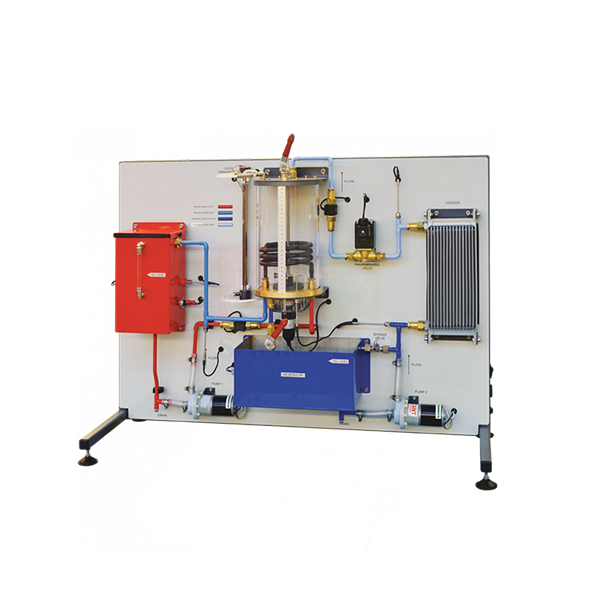
Process Trainer
Process Trainer (Product Code: SLE/EE/07) is a two-module teaching system used to build and study temperature, level and pressure control loops in engineering college and polytechnic laboratories. Its experiment module centres on a stirred process vessel linked by a heat exchanger to separate heating and cooling loops, while a control module with a mimic diagram gives students access to every connection. The trainer is produced by Jain Scientific Equipments Pvt Ltd (ScienceLab), an OEM manufacturer, at its own factory in Ambala, India.
Key Details
| Parameter | Detail |
|---|---|
| System layout | Experiment module plus a control module that links to it |
| Process vessel | Stirrer, temperature sensor, level and pressure sensors, heat exchanger and vent valve |
| Heating loop | Pump, heater tank and heater |
| Process and cooling loop | Pump, cooler, fan, valves and reservoir |
| Loop coupling | The two loops are linked by the heat exchanger in the process vessel |
| Connections | Sockets and a built-in computer interface on the experiment module |
| Control module | Clear mimic diagram with switches and controls; access to the connections of each part of the experiment module |
| Manual controls | Pump speed, cooler-fan speed, heater power and stirrer |
| Product code | SLE/EE/07 |
| Manufacturer | Jain Scientific Equipments Pvt Ltd (ScienceLab) — OEM |
| Country of origin | India (made in Ambala, Haryana) |
What Is the Process Trainer Used For?
The Process Trainer lets students see how a real process plant behaves before they automate it. Running the heating loop warms the vessel through the heat exchanger, the cooling loop removes heat through the cooler and fan, and the stirrer keeps the contents mixed so the temperature sensor reads a representative value. From the control module, learners first operate every actuator by hand and record how temperature, level and pressure respond.
With that open-loop data they can close loops through the sockets or the built-in computer interface and compare manual, on/off and PID-type strategies. The unit fits process-instrumentation, chemical-engineering and control-systems practicals, and is a practical choice of lab equipment for technical institutes that want several measured variables on one system.
OEM Manufacturer
ScienceLab is the trading name of Jain Scientific Equipments Private Limited, and the company is the original equipment manufacturer (OEM) of this Process Trainer. Both the experiment module and the control module are made at its own licensed factory in Saha, Ambala, Haryana, India. Colleges and distributors therefore deal with the maker itself when they need replacement parts or a matching unit for an extra bench — just ask us. Company background is on the ScienceLab profile page.
Related Control & Process Engineering Trainers
Other trainers in this range study single variables in more depth, which is useful when a lab wants to follow the Process Trainer with focused exercises.
- Thermal Control Process Apparatus — temperature control of a heated block using heater power, fan speed and a variable vane
- Coupled Tanks Apparatus — liquid-level and flow control with one or two tanks
- Pressure Process Training — accumulator pressure control with an industrial controller
- Controller — analogue controller blocks, including a three-term PID block, for building loops
See every item in the Control & Process Engineering Trainers category.
Frequently Asked Questions
What are the two modules of the Process Trainer?
The Process Trainer has an experiment module and a control module. The experiment module carries the process vessel, heating loop and cooling loop; the control module links to it, shows a mimic diagram and provides switches and controls for manual operation of each part.
Which variables can be measured on the Process Trainer?
The Process Trainer's process vessel includes a temperature sensor plus level and pressure sensors, so students can measure and control temperature, liquid level and pressure. A stirrer, heat exchanger and vent valve on the same vessel help create realistic process conditions.
Can the Process Trainer connect to a computer?
Yes. The Process Trainer's experiment module includes sockets and a built-in computer interface, so signals can be taken to a PC for monitoring and control. Tell us the software or data-acquisition setup you intend to use so we can confirm what suits your lab.
What can be adjusted manually on the Process Trainer?
From the Process Trainer's control module, users can manually set pump speed, cooler-fan speed, heater power and the stirrer. This manual mode is useful for open-loop tests before students design and tune automatic control strategies.
Who manufactures the Process Trainer?
Jain Scientific Equipments Pvt Ltd (ScienceLab) manufactures the Process Trainer as the OEM at its own licensed factory in Saha, Ambala, Haryana, India. Because both modules come from one maker, institutions, dealers and importers receive a single quotation straight from the manufacturer.
Is a calibration certificate available for the Process Trainer's sensors?
Calibration-certificate availability for the Process Trainer's temperature, level and pressure sensors should be discussed with us before ordering. Please state the requirement in your enquiry through our contact page so it can be addressed in the quotation.
Request a Quote
For a Process Trainer quotation, share your quantity and delivery location via the contact page, or place the item in the enquiry cart. Quotations come straight from the manufacturer, ScienceLab, for buyers in India and international markets.
Last updated: 24 September 2026