- Physics Lab Equipment
- Chemistry Lab Equipment
- Biology Lab Equipment
- Anatomical Lab Equipment
- Learning
- Educational Lab Equipment
- Magnets
- Agriculture
- Astronomy
- Earth Science
- Geography Lab Equipment
- Safety Lab Coat
- Laboratory
- Meteorological
- Electricity & Magnetism
- Heat
- School Lab Equipment
- Lab Glassware
- Science Lab Equipment
- Tvet Lab Equipment
- Robotics Kits Supplier and Manufacturer for Schools India
- Math Lab Equipment Manufacturers and Exporters in Ambala
- STEM Kits Manufacturers and Supplier India
- Engineering Lab Equipment
- Hospital Lab Equipment
- Water, Sanitation & Hygiene Supplies
- Cold Chain, Solar & Communication Equipment
- Nutrition
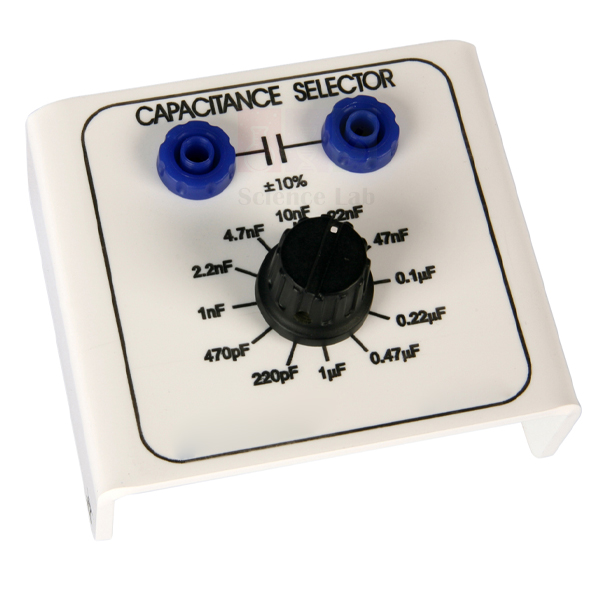
Capacitance Selector
The Capacitance Selector (Product Code: SLE/EAM/36) puts twelve non-electrolytic capacitors, from 220pF up to 1.0µF, behind a single rotary switch on an acrylic base. Instead of hunting for loose components, a student turns the knob to change the capacitance in a circuit and immediately sees the effect on timing, filtering or reactance. The unit is produced by Jain Scientific Equipments Pvt Ltd (ScienceLab), Ambala, for electronics and physics benches and fits naturally into an AC DC circuits experiment kit for senior school and college classes.
Specifications
| Parameter | Detail |
|---|---|
| Number of capacitors | Twelve |
| Capacitor type | Non-electrolytic |
| Picofarad values | 220pF, 470pF, 1000pF |
| Nanofarad values | 2.2nF, 4.7nF, 10nF, 22nF, 47nF |
| Microfarad values | 0.1µF, 0.22µF, 0.47µF, 1.0µF |
| Selection | Rotary switch |
| Base | Acrylic |
Typical Use
The spread of values — roughly doubling at each step from picofarads up to a microfarad — suits experiments where students change capacitance systematically and watch a waveform respond. Paired with a resistor and a signal generator, the selector lets a class measure RC time constants on an oscilloscope, see how a low-pass or high-pass filter’s cut-off shifts, or show capacitive reactance falling as frequency rises. Because the capacitors are non-electrolytic, they are not polarity-sensitive, so they can sit in AC circuits without the orientation worries that come with electrolytic parts.
Teachers find the single-knob design useful for demonstrations too: the same circuit can be shown at several capacitance values in a few seconds. Return the switch to the lowest value between groups, keep the acrylic base clean with a dry cloth, and check the voltage used in your circuit with us before connecting to higher-voltage sources.
Manufacturer
ScienceLab is the brand name used by Jain Scientific Equipments Private Limited, a manufacturer of teaching laboratory apparatus located in Ambala, Haryana. The company makes this selector for schools and colleges and supplies it across India and to international markets. Our company profile describes the business in more detail.
Related Electricity and Magnetism Equipment
Useful companions for RC timing, filter and reactance experiments:
- Resistance Selector — switch the R in an RC circuit as easily as the C
- Signal Generator and Amplifier — supplies the AC or square-wave input
- Oscilloscope Dual Trace — compare input and output waveforms side by side
- Capacitance Substitution Box — an alternative capacitance source for the same experiments
More components and meters are listed in the Electricity and Magnetism collection.
Frequently Asked Questions
Which capacitance values can be selected?
Twelve: 220pF, 470pF, 1000pF, 2.2nF, 4.7nF, 10nF, 22nF, 47nF, 0.1µF, 0.22µF, 0.47µF and 1.0µF.
Are the capacitors polarised?
No. They are non-electrolytic, so orientation in the circuit does not matter.
What is the voltage rating and tolerance?
These figures are not included in our current product listing. Please ask our team before using the unit with higher-voltage supplies.
How are circuit connections made?
The connection type is not specified in our product data; confirm it with us so you can order matching leads.
Is documentation of measured values available?
If your department needs a calibration certificate or test record, discuss it with us at the enquiry stage.
Can the selector be ordered in class quantities?
Yes. Tell us the number of benches you are equipping and the delivery location, and we will prepare an institutional quotation.
Request a Quote
To receive a quotation for the Capacitance Selector, reach us through the contact form or add it to the enquiry cart together with the resistors, meters and generators for your circuit.
Last updated: 24 September 2026
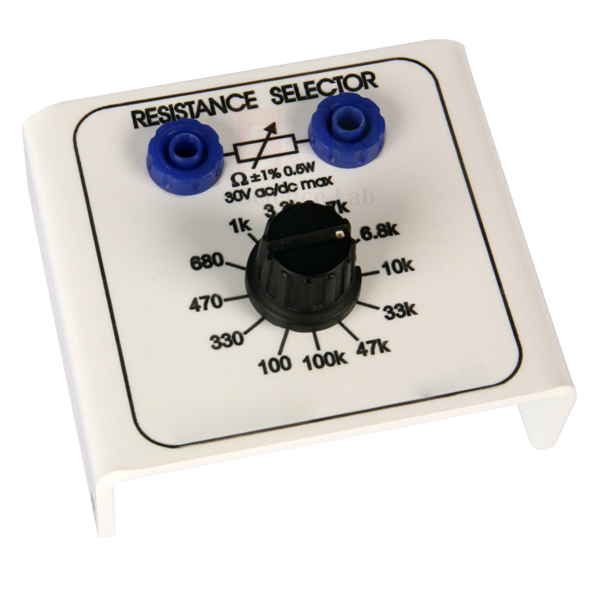
Resistance Selector
The Resistance Selector (Product Code: SLE/EAM/37) is a compact substitution unit: one rotary switch chooses between twelve fixed resistors, from 100Ω to 100kΩ, brought out to 4mm sockets. It saves students from sorting through colour-coded resistors when they want to try several values in the same circuit, and it lets a teacher change a load or bias resistor mid-demonstration with a single turn. Manufactured by Jain Scientific Equipments Pvt Ltd (ScienceLab) in Ambala, it sits comfortably among the electronic lab instruments that India’s schools, polytechnics and colleges use for circuit practicals.
Specifications
| Parameter | Detail |
|---|---|
| Type | Mini resistance substitution unit |
| Selection | Single rotary switch, twelve positions |
| Values | 100Ω, 330Ω, 470Ω, 680Ω, 1kΩ, 3.3kΩ, 4.7kΩ, 6.8kΩ, 10kΩ, 33kΩ, 47kΩ, 100kΩ |
| Tolerance | 5% (all values) |
| Power rating | 0.5W (all values) |
| Connections | 4mm sockets |
Typical Use
The values follow the familiar preferred-value pattern used in electronics, so students meet the same numbers they will later find on real circuit boards. A typical session uses the selector as a trial resistor: set a value, observe an LED’s brightness or a transistor’s collector current, step to the next position and compare. It is equally handy for plotting a load line, choosing the lower arm of a potential divider for a sensor, or setting the gain of an amplifier circuit kit without re-soldering anything.
Because every resistor is rated at 0.5W, the lowest settings deserve care when a higher supply voltage is connected — start on a high value and switch downwards while watching the current. For work that needs values between the twelve fixed steps, pair the selector with a decade box.
Manufacturer
Jain Scientific Equipments Private Limited, trading as ScienceLab, produces this selector at Ambala in Haryana. The company is a registered MSME enterprise (Udyam UDYAM-HR-01-0003714), and shipments to overseas buyers are handled under its DGFT Importer-Exporter Code AAECJ8618A. Visit our company profile for more about the organisation.
Related Electricity and Magnetism Equipment
Items commonly wired up alongside the Resistance Selector:
- Decade Resistance Box — fills in the values between the selector’s fixed steps
- Capacitance Selector — completes an adjustable RC pair for timing and filter work
- Resistance Substitution Box — another substitution option for circuit experiments
- Digital Multimeter — checks current and voltage at each setting
- Stackable Leads — 4mm plug leads to connect the sockets
For the wider range, visit the Electricity and Magnetism category page.
Frequently Asked Questions
How many resistance values does it offer?
Twelve, from 100Ω to 100kΩ, chosen with one rotary switch.
What tolerance and power rating do the resistors have?
All twelve are 5% tolerance and rated at 0.5W.
Can I get a value that is not on the list?
Not from this unit alone. Combine positions with other components, or use a decade resistance box when you need any whole-ohm value.
What kind of leads does it need?
Connections are made through 4mm sockets, so any standard 4mm plug lead will fit. Leads are not listed as part of the supply.
Is it suitable for mains-voltage circuits?
No. It is intended for low-voltage teaching circuits; check the current at each setting so the 0.5W rating is not exceeded.
Is a calibration certificate offered?
Ask our team when you enquire and we will advise what documentation can accompany your order.
Do you export the Resistance Selector?
Yes. We supply institutions in India and international markets; send the quantity and destination through our contact page.
Request a Quote
Add the Resistance Selector to your enquiry cart or write to us with your quantity, and we will respond with pricing and delivery details.
Last updated: 24 September 2026
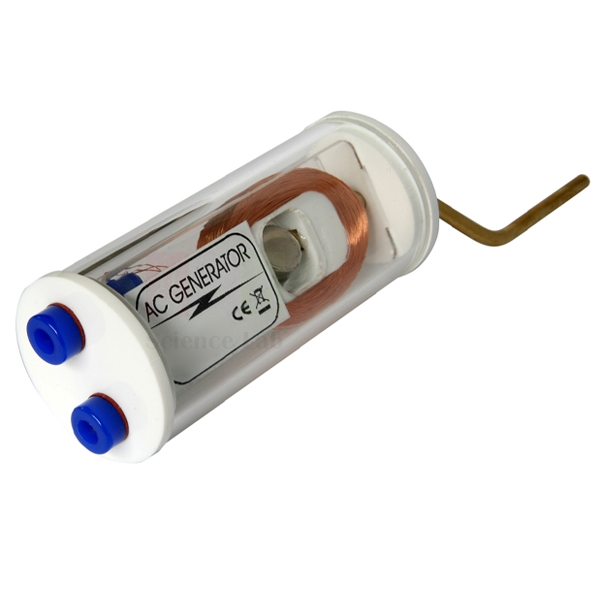
A.C. Generator
The A.C. Generator (Product Code: SLE/EAM/38) is a transparent, hand-held generator in which a permanent magnet spins inside a coil of wire, producing an alternating voltage at two 4mm sockets. It lets students investigate the same principle that powers a bicycle dynamo, with every moving part in view. Made by Jain Scientific Equipments Pvt Ltd (ScienceLab), Ambala, it is a straightforward piece of electromagnetic induction kit for India’s secondary schools and for physics departments abroad.
Specifications
| Parameter | Detail |
|---|---|
| Principle | Permanent magnet rotating inside a coil of wire |
| Drive | Hand-held, direct drive to the rotating magnet (no gearing) |
| Housing | Transparent, showing all the inner workings |
| Output | About 0.5V peak to peak, swinging from + to – each revolution; magnitude varies with speed |
| Waveform | Not a simple sine wave, because of the geometry of the mechanism |
| Output terminals | Two 4mm sockets |
| Display options | Centre-zero moving coil voltmeter or oscilloscope |
| Weight | 120g |
| Dimensions (L x W x H) | 150 x 55 x 55 |
Typical Use
Connected to a centre-zero moving coil voltmeter and turned slowly, the generator makes the needle swing one way and then the other on every revolution — a direct, visible answer to the question of what “alternating” means. Turning faster makes the swings larger, so students can link output magnitude to speed of rotation. Because the drive has no gearing, the magnet turns exactly as fast as the hand, which keeps that cause-and-effect relationship easy to follow.
For a more advanced physics demonstration kit, connect the sockets to an oscilloscope instead. The trace is not a textbook sine wave, and that is a teaching opportunity: with a PC oscilloscope the waveform can be stored and examined in detail, prompting discussion of how magnet and coil geometry shape the output of real generators. Since the peak-to-peak output is about 0.5V, choose a sensitive range on the meter or scope.
Manufacturer
This generator comes from Jain Scientific Equipments Private Limited, an apparatus maker in Ambala, Haryana, that uses ScienceLab as its trading name. The company produces electricity and magnetism teaching equipment for classrooms at home and abroad; read more on our company profile.
Related Electricity and Magnetism Equipment
Equipment that helps students read and extend the A.C. Generator’s output:
- Galvanometer, Centre Zero Universal Meter — a centre-zero meter to show the alternating swing
- Oscilloscope Dual Trace — displays the output waveform shape
- Demonstration Dynamo Model — a larger model for comparing generator designs
- Faraday’s Law Apparatus — explores the induction law behind the generator
- Stackable Leads — 4mm leads for the output sockets
Explore the whole Electricity and Magnetism range for more induction apparatus.
Frequently Asked Questions
How much voltage does the A.C. Generator produce?
About 0.5V peak to peak, with the magnitude rising and falling with the speed at which it is turned.
Why is the output not a pure sine wave?
The geometry of the magnet and coil mechanism shapes the waveform. Storing the trace on a PC oscilloscope lets students study that shape closely.
What do I need to display the output?
A centre-zero moving coil voltmeter or an oscilloscope, connected through the two 4mm sockets. Meters and leads are ordered separately.
Does it need batteries or mains power?
No. It is turned by hand, and the rotating magnet generates the output.
Can students see how it works?
Yes. The body is transparent, so the magnet, coil and direct drive are all visible.
What warranty applies?
Warranty terms are confirmed with each quotation; please contact us for details.
Can we buy a set for every lab bench?
Yes. Send the number of units and your delivery location and we will quote for supply within India or to international markets.
Request a Quote
For a price on the A.C. Generator, get in touch with our sales team, or collect it in the enquiry cart with the meters and leads you plan to use.
Last updated: 24 September 2026
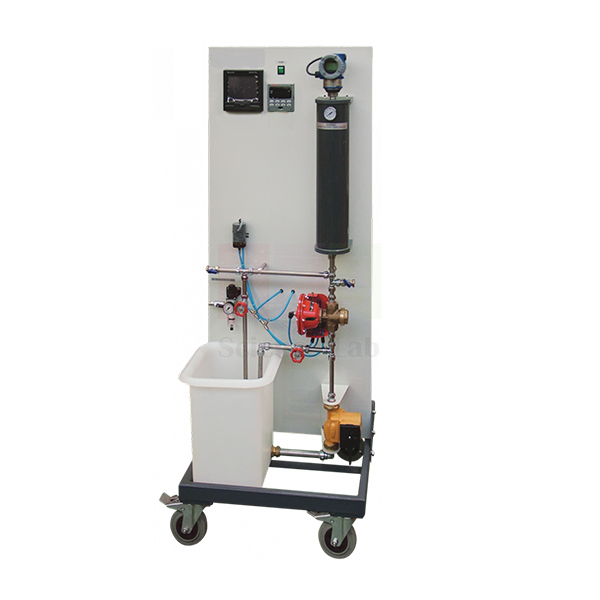
Pressure Process Training
Pressure Process Training (Product Code: SLE/EE/08) is a water-based pressure-control trainer used to teach closed-loop regulation with industrial-style instrumentation in engineering and instrumentation laboratories. Students set up an industrial controller with auto-tune that drives a pneumatic control valve through a current-to-pressure converter, while a gauge pressure transmitter feeds back the pressure in an accumulator. Jain Scientific Equipments Pvt Ltd (ScienceLab), an OEM manufacturer, builds the system at its own factory in Ambala, India.
Key Details
| Parameter | Detail |
|---|---|
| Reservoir | Holds the clean water used for experiments |
| Pump | Three-speed pump |
| Controller | Industrial controller with auto-tune |
| Final control element | Pneumatic control valve regulating the flow of water |
| Signal conversion | Current-to-pressure (I/P) converter |
| Process vessel | Pressure accumulator |
| Measurement | Gauge pressure transmitter measuring accumulator pressure and giving feedback to the controller |
| Recording | Two-channel chart recorder |
| Product code | SLE/EE/08 |
| Manufacturer | Jain Scientific Equipments Pvt Ltd (ScienceLab) — OEM |
| Country of origin | India (made in Ambala, Haryana) |
What Is the Pressure Process Trainer Used For?
Before an experiment, students fill the reservoir with clean water and prime the system. They then set the controller to regulate the flow of water through the pneumatic valve; as the valve opening changes, so does the pressure in the accumulator, which the pressure transmitter reports back to the controller to close the loop.
Because the trainer combines an industrial controller, an I/P converter and a pressure transmitter, it prepares learners for the loop-checking and tuning tasks they will meet on real plant. The two-channel chart recorder lets a class capture two signals together — for example setpoint and measured pressure — so manual tuning can be compared with the controller's auto-tune result. It is well suited to ITIs, polytechnics and colleges building up vocational training lab equipment for instrumentation courses.
OEM Manufacturer
Jain Scientific Equipments Private Limited (trading as ScienceLab) is the OEM for Pressure Process Training. The company assembles the complete trainer — reservoir, pump, valve, accumulator and instruments — at its own licensed factory in Saha, Ambala, Haryana, India. Buyers therefore receive their quotation, and any later request for replacement parts, from the manufacturer itself. More about the company is on the ScienceLab profile.
Related Control & Process Engineering Trainers
Pair Pressure Process Training with these trainers to cover the other common process variables.
- Process Trainer — temperature, level and pressure in one stirred-vessel system
- Coupled Tanks Apparatus — level and flow control driven by a variable-speed pump
- PLC Process — sequencing practice with solenoid valves, a float switch and level sensors
- Thermal Control Process Apparatus — temperature control with heater, fan and servo-driven vane
View the whole Control & Process Engineering Trainers range.
Frequently Asked Questions
What are the main parts of Pressure Process Training?
Pressure Process Training consists of a reservoir, a three-speed pump, an industrial controller with auto-tune, a pneumatic control valve, a pressure accumulator, a two-channel chart recorder, a current-to-pressure (I/P) converter and a gauge pressure transmitter.
How is pressure controlled in Pressure Process Training?
In Pressure Process Training, the controller regulates water flow through the pneumatic control valve, which alters the pressure in the accumulator. A gauge pressure transmitter measures that pressure and sends feedback to the controller, completing the control loop.
What do students do before running Pressure Process Training?
Before using Pressure Process Training, students fill the reservoir with clean water and prime the system. Once it is primed, they set the controller to regulate the flow of water and watch the accumulator pressure respond on the chart recorder.
Does Pressure Process Training need an air supply for the pneumatic valve?
Pressure Process Training uses a pneumatic control valve driven through an I/P converter, and pneumatic devices of this kind work from an air supply. The air requirement is not listed in the product details, so please confirm it with us before installation.
Who manufactures Pressure Process Training?
Pressure Process Training is manufactured by Jain Scientific Equipments Pvt Ltd (ScienceLab) as the OEM at its own licensed factory in Saha, Ambala, Haryana, India. The complete trainer is supplied factory-direct to institutions, dealers and importers.
What should a quotation request for Pressure Process Training include?
A quotation request for Pressure Process Training should state the number of units, the institution and delivery location, and any site details such as available utilities. Send it through our contact page and the manufacturer will reply directly.
Request a Quote
To price Pressure Process Training for your lab, contact us through the contact page or add the trainer to the enquiry cart. Your quotation comes directly from the manufacturer, Jain Scientific Equipments Pvt Ltd (ScienceLab).
Last updated: 24 September 2026
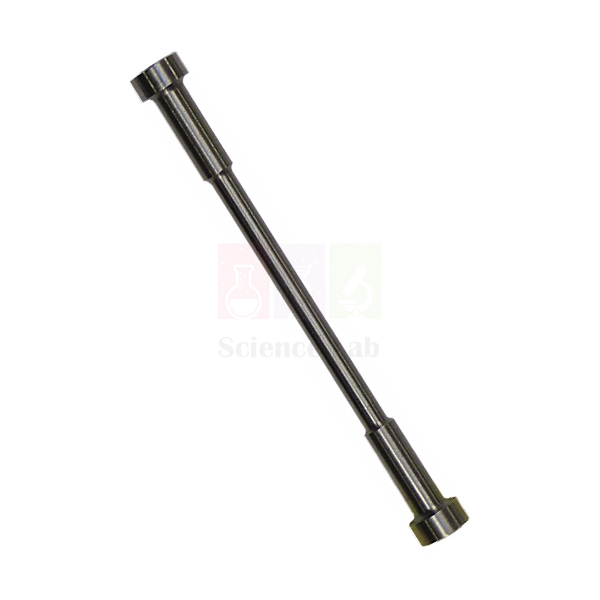
Specimen
Specimen (Product Code: SLE/ETP/01) is a long-style tensile test specimen made of 0.1% carbon steel, used for pull-to-failure tests on the Bench Top Tensile Testing Machine in engineering and materials science laboratories. It is intended for use with that machine in combination with its Extensometer, so students can record extension accurately as the load rises. It is supplied by Jain Scientific Equipments Pvt Ltd (ScienceLab), Ambala, India, to colleges building up their engineering lab equipment in India.
Specifications
| Parameter | Detail |
|---|---|
| Specimen style | Long style |
| Material | 0.1% carbon steel |
| For use with | Bench Top Tensile Testing Machine, in combination with the Extensometer |
| Test type | Tensile test |
| Product code | SLE/ETP/01 |
| Supplied by | Jain Scientific Equipments Pvt Ltd (ScienceLab), Ambala, India |
What Is the Carbon Steel Tensile Specimen Used For?
In a tensile test the specimen is clamped in the machine's grips and pulled steadily until it breaks. With the Extensometer attached, students log load against extension and turn the results into a stress–strain curve, from which they read the elastic modulus, yield or proof stress, ultimate tensile strength and elongation at fracture. Measuring the broken ends also gives the reduction of area.
A carbon content of 0.1% places this specimen among the low-carbon steels, which are ductile and usually show clear yielding, a long plastic region and visible necking before they fail. That makes it a good reference material: run it first so students recognise a ductile curve, then compare other materials against it. Record the specimen's dimensions before each test, and remember that every specimen is used once, as it is broken during the test.
What to Specify When Ordering
- The number of specimens — one for every tensile test planned
- The tensile machine and extensometer you will use, so we can confirm the Specimen suits your set-up
- Whether other test specimens are needed on the same quotation
Supplier
Jain Scientific Equipments Private Limited, which trades as ScienceLab, supplies the Specimen from Ambala, Haryana, to engineering colleges, polytechnics, training institutes and dealers in India and international markets. It can be quoted alongside the tensile testing apparatus it is used with.
Find out more about the company on our company profile.
Related Materials Testing and Properties Equipment
Machines and specimens used in the same tensile-testing work:
- Bench Top Tensile Testing Machine — the bench machine this Specimen is intended for.
- Tensile Tester Kit — a cased tester for introductory stretch-to-failure tests.
- Tensile strength testing machine — another machine for tensile strength work.
- Double Shear Test Specimens — copper specimens for shear-strength tests.
Browse the Materials Testing and Properties category for more apparatus.
Frequently Asked Questions
What material is the Specimen made of?
The Specimen (SLE/ETP/01) is made of 0.1% carbon steel, a low-carbon steel that is ductile, which makes it well suited to showing yielding, necking and elongation in a teaching-lab tensile test.
Which machine is the Specimen designed for?
The Specimen is intended for the Bench Top Tensile Testing Machine used in combination with the Extensometer. If you plan to use it on a different tensile tester, send us the machine details through the contact page so we can check suitability.
Can a Specimen be used more than once?
No. A Specimen is pulled until it fractures during a tensile test, so each one can only be used once. Order at least one Specimen for every test you plan, plus a few extra for practice runs.
What are the dimensions of the Specimen?
The Specimen is described as long style, but its exact dimensions are not listed on this page. Ask us through the contact page and share your machine's grip details so the right Specimen can be quoted.
Who supplies the Specimen?
The Specimen is supplied by Jain Scientific Equipments Pvt Ltd, trading as ScienceLab, from Ambala, Haryana, India, to engineering colleges, polytechnics, training institutes and dealers in India and international markets.
Can specimens be ordered in bulk?
Yes. ScienceLab quotes the Specimen in quantities to match a semester of tensile tests for colleges, training institutes and dealers. State the number of specimens and your delivery city or port when you send the enquiry.
Request a Quote
To get a price for the Specimen, send your quantity and machine details through our contact page, or add it to the enquiry cart with the tensile apparatus you need.
Last updated: 24 September 2026
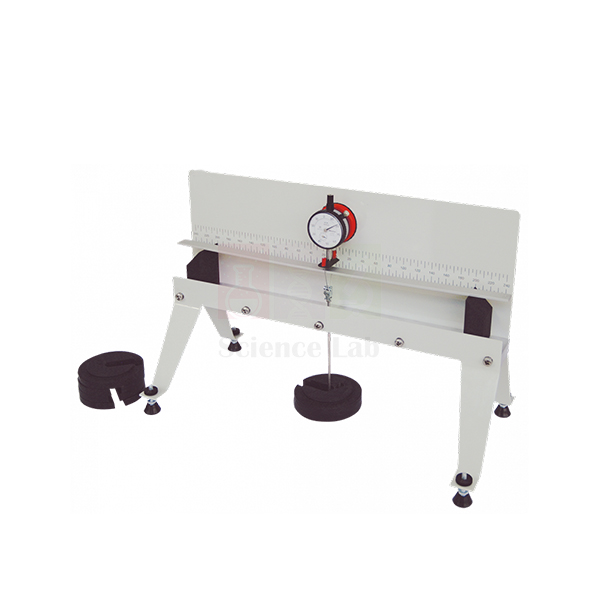
Stiffness - Bending and Torsion
Stiffness - Bending and Torsion (Product Code: SLE/ETP/02) is a compact, bench-mounted frame used to investigate how stiff beams of different materials and cross-sections are in bending — and, with optional kits, in torsion — in engineering and materials science labs. The standard kit pairs a rigid metal frame with two adjustable knife edges, weights, a magnetic dial gauge, a set of beams and a vernier gauge. It is made by Jain Scientific Equipments Pvt Ltd (ScienceLab), an OEM manufacturer, at its own factory in Ambala, India.
Specifications
| Parameter | Detail |
|---|---|
| Frame | Compact, bench-mounting rigid metal frame |
| Beam supports | Two adjustable knife edges acting as simple supports |
| Positioning | Linear scale on the back panel for accurate placing of the knife edges |
| Deflection measurement | Magnetic dial gauge |
| Loading | Weights, included in the kit |
| Test beams | Set of beams of different materials and cross-sections |
| Specimen measurement | Vernier gauge for measuring beam dimensions |
| Optional kits | Different beam fixings; torsional stiffness |
| Product code | SLE/ETP/02 |
| Manufacturer | Jain Scientific Equipments Pvt Ltd (ScienceLab) — OEM |
| Country of origin | India (made in Ambala, Haryana) |
What Is the Bending and Torsion Stiffness Apparatus Used For?
Students set the two knife edges to a chosen span using the linear scale, measure the width and depth of a beam with the vernier gauge, and rest the beam across the supports. Weights are then added step by step while the magnetic dial gauge records how far the beam deflects. Plotting load against deflection gives a straight line whose slope is the beam's bending stiffness.
Repeating the test with the other beams separates the two things that control stiffness: the material, through its elastic modulus, and the shape of the cross-section, through its second moment of area. Changing the span shows how quickly deflection grows as supports move apart. The optional kits take the same frame further, into other beam fixings and into twisting tests that measure torsional stiffness — core topics for mechanics lab equipment in India.
What to Specify When Ordering
- Whether you need the standard bending kit only, or the optional beam-fixings and torsional-stiffness kits as well
- The number of frames, based on how many student groups test at the same time
- Whether a calibration certificate for the dial gauge is needed — discuss this with us before ordering
OEM Manufacturer
Jain Scientific Equipments Private Limited, trading as ScienceLab, is the OEM that makes the Stiffness - Bending and Torsion apparatus at its own licensed factory at Saha, Ambala, Haryana, India. Engineering colleges, polytechnics, universities, dealers and importers buy it factory-direct, and questions about optional kits, spare beams or repeat orders go straight to the manufacturer.
For institutional and tender buyers who need vendor registration details: GSTIN 06AAECJ8618A1ZT, LEI 3358004HRD1JIVXKYX49. More about the company is on our company profile.
Related Materials Testing and Properties Equipment
Apparatus that extends beam-stiffness and torsion work:
- Youngs Modulus Apparatus — measures the elastic modulus that governs beam stiffness.
- Unsymmetrical Cantilever — extends bending studies to unsymmetrical sections.
- Torsion of Circular Sections — dedicated apparatus for twisting circular shafts.
- Bending Stress In a Beam — links beam bending to the stresses inside it.
See the full Materials Testing and Properties category for more apparatus.
Frequently Asked Questions
What comes in the standard Stiffness - Bending and Torsion kit?
The standard Stiffness - Bending and Torsion kit (SLE/ETP/02) includes a rigid metal bench frame with a linear scale, two adjustable knife edges, weights, a magnetic dial gauge, a set of beams of different materials and cross-sections, and a vernier gauge.
Can the apparatus test torsion as well as bending?
Yes, with an optional kit. The Stiffness - Bending and Torsion apparatus handles bending tests as standard, while optional additional kits allow investigations into torsional stiffness and into different beam fixings using the same frame.
How is beam deflection measured?
On the Stiffness - Bending and Torsion apparatus, beam deflection is read with the magnetic dial gauge supplied in the kit, while the linear scale on the back panel lets students place the knife-edge supports accurately.
Is a calibration certificate available for the dial gauge?
Whether a calibration certificate can be provided with the Stiffness - Bending and Torsion apparatus should be discussed with us before ordering. Please raise it through the contact page with your other requirements.
Who manufactures the Stiffness - Bending and Torsion apparatus?
The Stiffness - Bending and Torsion apparatus is manufactured by Jain Scientific Equipments Pvt Ltd (ScienceLab) as the OEM, at its own licensed factory in Saha, Ambala, Haryana, India, and supplied factory-direct to colleges, dealers and importers.
What should a quotation request include?
For the Stiffness - Bending and Torsion apparatus, tell us the number of frames, whether the optional beam-fixing and torsion kits are required, and the delivery city or port. ScienceLab supplies institutions in India and international markets.
Request a Quote
Quotations for the Stiffness - Bending and Torsion apparatus come direct from the manufacturer. Send your requirements through our contact page, or add the apparatus to the enquiry cart along with any related equipment.
Last updated: 24 September 2026
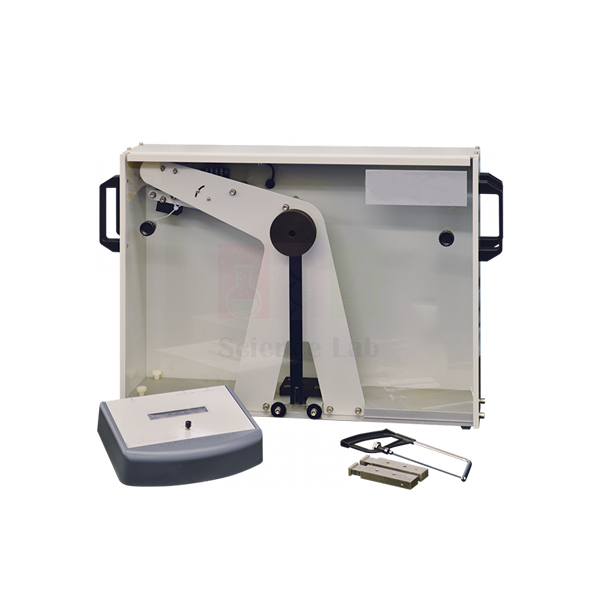
Energy Absorbed At Fracture
Energy Absorbed At Fracture (Product Code: SLE/ETP/03) is a small-scale, bench-mounted notched-bar impact tester used to measure how much energy a material absorbs as it breaks, in engineering and materials science teaching labs. A pendulum on low-friction bearings, an angular encoder at the pivot, an instrumentation unit and a power supply work together behind an interlocked guard, giving students a safe introduction to impact testing. It is made by Jain Scientific Equipments Pvt Ltd (ScienceLab), an OEM manufacturer, at its own factory in Ambala, India.
Key Details
| Parameter | Detail |
|---|---|
| Type | Small-scale, bench-mounting notched-bar impact tester |
| Main parts | Main unit, instrumentation unit and power supply |
| Pendulum | Supported in a rigid frame by low-friction bearings |
| Angle measurement | Angular encoder in the pivot measures the pendulum's position over its range of movement |
| Guarding | Fully enclosed, with an interlocked guard covering all moving parts |
| Levelling | Adjustable feet on the base |
| Investigations | Resistance of materials to crack propagation; principles of common impact testing techniques |
| Product code | SLE/ETP/03 |
| Manufacturer | Jain Scientific Equipments Pvt Ltd (ScienceLab) — OEM |
| Country of origin | India (made in Ambala, Haryana) |
What Is the Notched Bar Impact Tester Used For?
A notched bar is placed in the tester, the pendulum is raised and released, and it swings down to strike and break the specimen. The pendulum rises less on the far side than it would have with nothing in its path, and that shortfall in height is the energy the specimen soaked up as it fractured. The angular encoder tracks the pendulum's position throughout the swing, so the angles are measured electronically instead of being read from a pointer by eye.
Testing different materials, or the same material with different notches, shows why some parts fail in a tough, ductile way and others snap in a brittle manner — the practical question behind the impact tests used in industry. Level the frame with its adjustable feet before a session, keep the interlocked guard closed during every swing, and examine each fracture surface afterwards alongside the recorded energy.
What to Specify When Ordering
- The mains supply at your laboratory, so the power supply can be confirmed
- The notched specimens you plan to test — ask us which specimens suit the tester
- The number of testers needed for your student groups
OEM Manufacturer
ScienceLab is the trading name of Jain Scientific Equipments Private Limited, the OEM that produces the Energy Absorbed At Fracture tester at its own licensed factory at Saha, Ambala, Haryana, India. Engineering colleges, polytechnics, technical institutes, dealers and importers buy it directly from the maker rather than through a trading house.
Because the tester comes factory-direct, questions about specimens, spare parts or additional units are answered by the manufacturer — just ask us. Read more on our company profile.
Related Materials Testing and Properties Equipment
Other apparatus for studying how materials fail:
- Impact Testing Machine-Digital — a digital impact tester for further impact work.
- Computerised Izod Impact Tester — a computerised alternative for impact testing.
- Tensile Tester Kit — compares slow tensile failure with sudden impact failure.
- Rotating Fatigue Machine — shows failure under repeated alternating stress.
The Materials Testing and Properties category lists more engineering lab equipment.
Frequently Asked Questions
What does the Energy Absorbed At Fracture tester measure?
The Energy Absorbed At Fracture tester (SLE/ETP/03) measures the energy a notched specimen absorbs when a swinging pendulum breaks it. An angular encoder at the pivot tracks the pendulum's position so the energy absorbed can be found from its swing.
What is supplied with the Energy Absorbed At Fracture tester?
The Energy Absorbed At Fracture apparatus consists of a main unit with the pendulum in a rigid frame, an instrumentation unit and a power supply. Ask us through the contact page about suitable test specimens for your course.
Is the impact tester safe for student use?
The Energy Absorbed At Fracture tester is fully enclosed, with an interlocked guard covering all moving parts, making it a safe way to introduce impact testing. Students should still work under supervision and follow the lab's safety rules.
How is the tester levelled?
The Energy Absorbed At Fracture tester has adjustable feet on its base. Set the unit level on a firm bench before testing so the pendulum swings true and the readings from the angular encoder remain consistent.
Who manufactures the Energy Absorbed At Fracture tester?
The Energy Absorbed At Fracture tester is manufactured by Jain Scientific Equipments Pvt Ltd (ScienceLab) as the OEM, at its own licensed factory in Saha, Ambala, Haryana, India, and supplied factory-direct to colleges, dealers and importers.
Is a calibration certificate available?
Whether a calibration certificate can be supplied with the Energy Absorbed At Fracture tester should be discussed with us at the enquiry stage. Mention it in your request on the contact page along with your quantity.
Can ScienceLab quote the tester for export?
Yes. ScienceLab quotes the Energy Absorbed At Fracture tester direct from the manufacturer for institutions and dealers in India and international markets. Share the quantity, mains supply and delivery city or port through the contact page.
Request a Quote
Quotations for the Energy Absorbed At Fracture tester come straight from the manufacturer. Send your requirements through our contact page, or add it to the enquiry cart with other materials testing apparatus.
Last updated: 24 September 2026
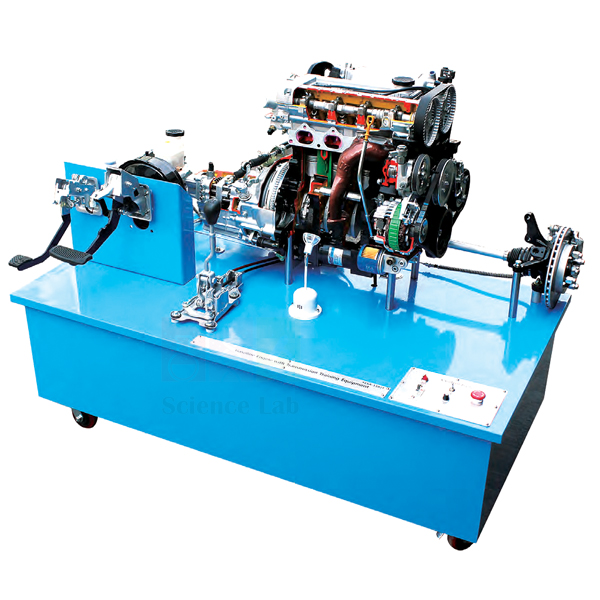
Automotive Power Train Training Equipment DOHC Gasoline
Automotive Power Train Training Equipment DOHC Gasoline (Product Code: SLE/ATE/01) is a sectioned, motor-driven power train trainer used to teach how a DOHC four-cylinder gasoline engine, FF manual transmission, clutch and brakes work together — engineering lab equipment in India for automobile, polytechnic and ITI courses. An educational model of the 1,800~2,000cc class, it lets students change gears as on a real vehicle while watching the cut internals. Its training stand and controls are made by Jain Scientific Equipments Pvt Ltd (ScienceLab), an OEM manufacturer, at its own factory in Ambala, India; the DOHC engine and transmission assemblies themselves are sourced production units, not made in Ambala.
Specifications
| Parameter | Detail |
|---|---|
| Engine | DOHC engine assembly, 4 cylinders (educational model for 1,800~2,000cc gasoline engine) |
| Transmission | FF-type manual, 5 forward and 1 reverse |
| Other assemblies | Clutch, brake system, drive shaft to the wheels |
| Drive motor | AC 220 V / 180 W |
| Controls and protection | Engine speed controller, emergency switch, safety fuse, light |
| Frame | Steel frame with heat-treatment painting |
| Wheels | 4 wheels with brakes |
| Sectioning | Precisely cut; each incised section painted a different colour, with brake structure and engine parts painted specifically |
| Weight | Approx. 250 kg |
| Size | Approx. 1,600 × 1,000 × 1,200 mm |
| Engine / assembly | Sourced production unit (as listed) |
| Product code | SLE/ATE/01 |
| Manufacturer | Jain Scientific Equipments Pvt Ltd (ScienceLab) — OEM |
| Country of origin | India (trainer built in Ambala, Haryana) |
Training contents covered on the unit:
- Replacing brake oil and removing air from the brake system
- Removing and refitting the cylinder head
- Replacing the timing belt and other belts, with belt tension adjustment
- Replacing brake disc and pads
- Removing and refitting the generator and starter motor
What Is the DOHC Power Train Trainer Used For?
Instructors use the trainer to explain the structure and operating principle of an FF manual transmission alongside the gasoline engine that drives it. Gear changes are made just as on a real vehicle, while the cut sections reveal the moving internals and the drive shaft shows the resulting wheel movement. On a DOHC engine, two overhead camshafts per cylinder head operate the intake and exhaust valves separately, so the exposed valve train and timing belt make a natural starting point for lessons on valve timing before students move on to the belt replacement exercise.
Workshop sessions usually rotate small groups through the five service tasks, which suits vocational training labs where each learner must practise hands-on procedures. Keep the emergency switch within reach of the instructor whenever the drive motor is running.
OEM Manufacturer
ScienceLab — the trading name of Jain Scientific Equipments Private Limited — is the OEM (original equipment manufacturer) of this DOHC power train trainer's training stand and control system, which are built at the company's own licensed factory at Saha, Ambala, Haryana, India. The DOHC engine and manual transmission assemblies mounted on the stand are sourced production units, not made in Ambala. The finished trainer is supplied factory-direct to engineering colleges, polytechnics, ITIs, dealers and importers, and every quotation comes straight from ScienceLab — ask us about spare parts or repeat orders. See the company profile.
Related Automotive Training Equipment
Trainers that extend the same power train syllabus:
- Automotive Power Train Training Equipment SOHC Gasoline — the single-camshaft counterpart for comparing valve-train layouts
- Clutch Structure Trainer Hydraulic Manual — a close-up study of the flywheel, pressure board and hydraulic clutch actuation
- Differential Gear — shows how driving torque is shared between the wheels after the gearbox
- Engine management system (MPI) — a stand for studying gasoline multipoint injection
- Automotive Engine Fault Diagnosis Simulator Auto Fault — a running gasoline engine stand for fault-finding once structure is understood
The complete line-up is in the Automotive Training Equipment category.
Frequently Asked Questions
Which engine does the Automotive Power Train Training Equipment DOHC Gasoline represent?
The Automotive Power Train Training Equipment DOHC Gasoline uses a DOHC four-cylinder engine assembly and is built as an educational model for the 1,800~2,000cc gasoline engine class, coupled to an FF-type manual transmission with 5 forward gears and 1 reverse.
How is movement produced on the DOHC gasoline power train trainer?
Movement on the DOHC gasoline power train trainer (SLE/ATE/01) comes from an AC 220 V / 180 W motor controlled by an engine speed controller, so internal engine movement and wheel rotation can be shown without running the engine on fuel.
What practical tasks can students carry out on the DOHC power train trainer?
Students using the Automotive Power Train Training Equipment DOHC Gasoline can practise brake oil replacement and air removal, cylinder head removal and refitting, timing belt and other belt replacement with tension adjustment, brake disc and pad replacement, and generator and starter motor removal and refitting.
How much floor space does the DOHC power train trainer need?
The DOHC gasoline power train trainer measures approximately 1,600 × 1,000 × 1,200 mm and weighs about 250 kg, so plan extra working room around it for student groups and a 220 V AC supply for its drive motor.
What safety provisions are fitted to the DOHC gasoline power train trainer?
The DOHC gasoline power train trainer is fitted with an emergency switch, a safety fuse and a light, mounted on a steel frame with heat-treatment painting that stands on four wheels with brakes. Keep the emergency switch within the instructor’s reach whenever the motor runs.
Who manufactures the Automotive Power Train Training Equipment DOHC Gasoline?
The training stand and control system of the Automotive Power Train Training Equipment DOHC Gasoline are manufactured by Jain Scientific Equipments Private Limited (ScienceLab) as the OEM, at its own licensed factory at Saha, Ambala, Haryana, India. The DOHC engine and transmission assemblies themselves are sourced production units, not made in Ambala.
What should an institutional quotation request for the DOHC power train trainer contain?
A quotation request for the DOHC gasoline power train trainer should state product code SLE/ATE/01, the quantity, the delivery address with site access details for a heavy unit, and any tender or vendor documents your institution needs. Documentation and warranty terms are confirmed in the quotation.
Request a Quote
For a quotation on the DOHC gasoline power train trainer, contact us through the contact page or add it to the enquiry cart. Quotes come direct from the manufacturer, for institutions across India and international markets.
Last updated: 24 September 2026