- Physics Lab Equipment
- Chemistry Lab Equipment
- Biology Lab Equipment
- Anatomical Lab Equipment
- Learning
- Educational Lab Equipment
- Magnets
- Agriculture
- Astronomy
- Earth Science
- Geography Lab Equipment
- Safety Lab Coat
- Laboratory
- Meteorological
- Electricity & Magnetism
- Heat
- School Lab Equipment
- Lab Glassware
- Science Lab Equipment
- Tvet Lab Equipment
- Robotics Kits Supplier and Manufacturer for Schools India
- Math Lab Equipment Manufacturers and Exporters in Ambala
- STEM Kits Manufacturers and Supplier India
- Engineering Lab Equipment
- Hospital Lab Equipment
- Water, Sanitation & Hygiene Supplies
- Cold Chain, Solar & Communication Equipment
- Nutrition
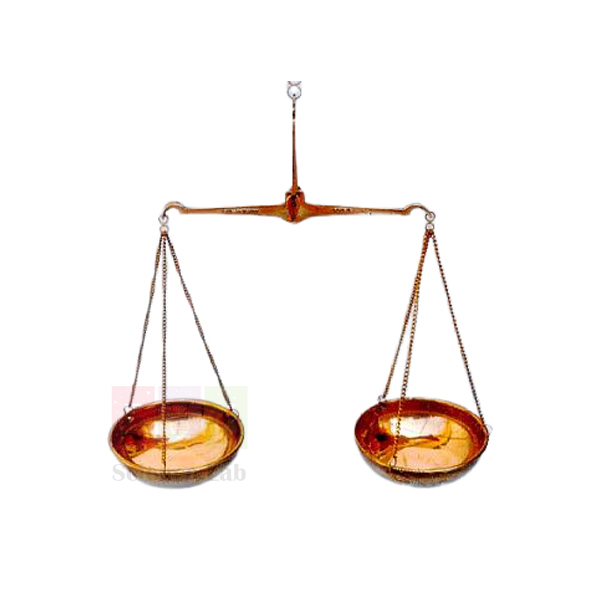
Balance Brass
Balance Brass (Product Code: SLE/LP/02) is a brass balance with a set of gram weights used to teach weight, standard units and the balancing of number equations in primary maths lessons. Besides weights from 50 g down to 1 g, it includes ten plastic cubes of 1 g each, so children can move from informal units to grams and see the equals sign as a balance. It is supplied by Jain Scientific Equipments Pvt Ltd (ScienceLab), Ambala, India.
Key Details
| Parameter | Detail |
|---|---|
| Balance | Brass balance |
| Weights | 50 g, 20 g, 10 g x 2, 5 g, 2 g x 2 and 1 g |
| Unit cubes | 10 plastic cubes of 1 g each |
| Included | Write-up with details of activities |
| Concept | Weight and number equations |
| Product code | SLE/LP/02 |
| Supplied by | Jain Scientific Equipments Pvt Ltd (ScienceLab), Ambala, India |
What Is the Brass Balance Used For?
Lessons usually begin with informal units: children balance a pencil or eraser against a handful of classroom objects and notice that different objects give different answers. That leads naturally to why standard units are needed, and the 1 g plastic cubes then introduce the gram as a unit everyone can agree on. Pupils estimate an object's weight first, then check the estimate on the balance.
The same balance turns arithmetic into something children can see. Placing the 50 g weight on one pan and 20 g, 10 g, 10 g, 5 g, 2 g, 2 g and 1 g on the other shows that both sides are equal, which is exactly what the equals sign means. Sums and differences follow: an object that balances 10 g and 2 g weighs 12 g, and one that needs 5 g added to match 20 g weighs 15 g. It is a practical addition to mathematics lab kits for primary schools.
Supplier
Balance Brass is supplied by Jain Scientific Equipments Private Limited, which trades as ScienceLab in Ambala, Haryana, to primary schools, maths-lab programmes and educational dealers. For school purchase files and vendor registration, the supplying company's details are CIN U29309HR2020PTC087597 and GSTIN 06AAECJ8618A1ZT. Company background is on the ScienceLab profile page.
Related Primary Maths Kits
Items that support weighing, measuring and equation work:
- Balance Mathematical — a number balance for equation work without weights.
- Dish Balance with Weight Number — an alternative balance for comparing masses.
- Volume Measuring Set — extends measurement lessons from weight to volume.
- Digit cards — for writing the number sentences that the balance shows.
Explore more kits in Primary.
Frequently Asked Questions
What comes with Balance Brass?
Balance Brass comes with a brass balance, weights of 50 g, 20 g, two of 10 g, 5 g, two of 2 g and 1 g, ten plastic cubes of 1 g each, and a write-up that details the classroom activities.
What are the 1 g plastic cubes used for?
The ten 1 g plastic cubes in Balance Brass let children count grams one by one, bridging the gap between informal units such as beads or erasers and the standard gram weights. They are useful for estimating and checking the weight of light objects.
How does Balance Brass teach the equals sign?
Balance Brass shows the equals sign as a state of balance: when both pans hold the same total weight, the beam is level. Children put different combinations of weights on each side to build and check number equations and to find sums and differences.
What is the maximum load of the balance?
Our listing for Balance Brass gives the weights supplied but does not state a maximum capacity or pan size. Please ask through the contact page before ordering if you plan to weigh heavier classroom objects, and we will confirm the details.
Who supplies Balance Brass?
Jain Scientific Equipments Pvt Ltd (ScienceLab), Ambala, India supplies Balance Brass to primary schools, maths labs and dealers, and prepares quotations for single sets or class quantities for India and international markets.
What do I need to send for a quotation?
For Balance Brass, send product code SLE/LP/02, the number of sets, your delivery location and any other primary maths kits you need. Use the contact page or the enquiry cart to submit the request.
Request a Quote
Ask for a quote on the contact page, or add Balance Brass to the enquiry cart alongside other measurement and number kits.
Last updated: 24 September 2026
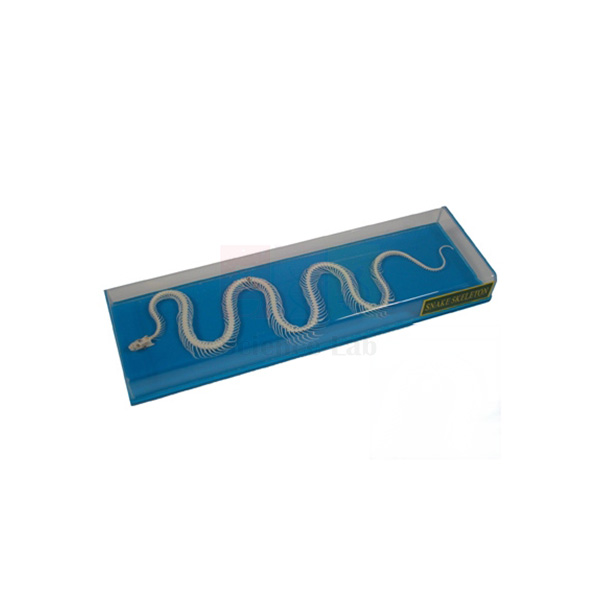
Snake Skeleton
Snake Skeleton (Product Code: SLE/EZ/07) is a natural-bone snake skeleton used to show how a limbless vertebrate is built in school zoology classrooms and college practicals. Mounted in a natural position on a base with an acrylic cover, it sits in a 300 x 98 x 30 mm case that displays the long chain of vertebrae and paired ribs. It is supplied by Jain Scientific Equipments Pvt Ltd (ScienceLab), Ambala, India, for biology labs that want real vertebrate specimens.
Specifications
| Parameter | Detail |
|---|---|
| Material | Natural bone |
| Posture | Mounted in natural position |
| Display | Base with an acrylic cover |
| Case size | 300 x 98 x 30 mm |
| Product code | SLE/EZ/07 |
| Supplied by | Jain Scientific Equipments Pvt Ltd (ScienceLab), Ambala, India |
What Is the Snake Skeleton Used For?
A snake's body is built almost entirely from one repeated unit: a vertebra with a pair of ribs. Seeing that pattern on a real specimen helps students understand how snakes move by bending the body in waves, and why they need no limbs to travel, climb or swim. The skull is worth a close look too, because the loosely joined jaw bones explain how a snake can swallow prey wider than its own head.
In evolution and classification lessons the snake skeleton is often set beside a lizard skeleton, so learners can discuss limb loss within the reptiles. It is a useful addition to school biology lab equipment in India for Class 9 to 12 and undergraduate zoology. Ask students to sketch a short section of the spine through the cover, using a hand lens to pick out where each rib meets its vertebra.
Supplier
ScienceLab is the trading name of Jain Scientific Equipments Private Limited, based in Ambala, Haryana. The company supplies this snake skeleton to schools, colleges, museums of teaching specimens and resellers, and can combine it with other skeletons and field equipment on one quotation for buyers in India and international markets. See the company profile for background.
Related Zoology Equipment
Specimens and tools that extend a lesson built around the snake skeleton:
- Lizard Skeleton — a limbed reptile for comparing girdles, limbs and tail.
- Pigeon Skeleton — a bird skeleton that shows a very different vertebrate body plan.
- Frog Skeleton — an amphibian with a short spine, useful as a contrast to the snake's long one.
- Hand Lens — for examining individual vertebrae, ribs and teeth through the cover.
Browse the Zoology category for more vertebrate specimens and animal-study equipment.
Frequently Asked Questions
Is the Snake Skeleton a real specimen?
Yes. The Snake Skeleton (SLE/EZ/07) is made of natural bone, mounted in a natural position on a base. Because it is a real animal, the exact length, curve and bone detail can vary slightly from one specimen to the next.
What are the case dimensions of the Snake Skeleton?
The Snake Skeleton comes in a case measuring 300 x 98 x 30 mm, with the bones on a base under an acrylic cover. The slim case fits easily on a lab bench or in a specimen cupboard.
Does the Snake Skeleton come with a label or key card?
The listing for the Snake Skeleton does not mention a key card or bone labels. If you need labelling for teaching, please ask through our contact page and we will confirm what is included before you order.
Can students count vertebrae on the Snake Skeleton?
Yes, students can count vertebrae and ribs on the Snake Skeleton through its acrylic cover, ideally over a short marked section with a hand lens. Handling the bones directly is not recommended, as the cover protects the delicate ribs.
How do I care for the Snake Skeleton?
Keep the Snake Skeleton in a dry place out of direct sunlight, and wipe the acrylic cover with a soft, dry cloth only. Do not use solvent-based cleaners on the cover, and avoid stacking heavy items on the case.
Can the Snake Skeleton be ordered with other vertebrate skeletons?
Yes. The Snake Skeleton can be quoted together with the lizard, frog, pigeon and bat skeletons in the same range, which suits a vertebrate-classes display. Tell us the quantity of each when you request a quotation.
Request a Quote
To price the Snake Skeleton, share the quantity and delivery location on our contact page, or list it with other specimens in the enquiry cart.
Last updated: 24 September 2026
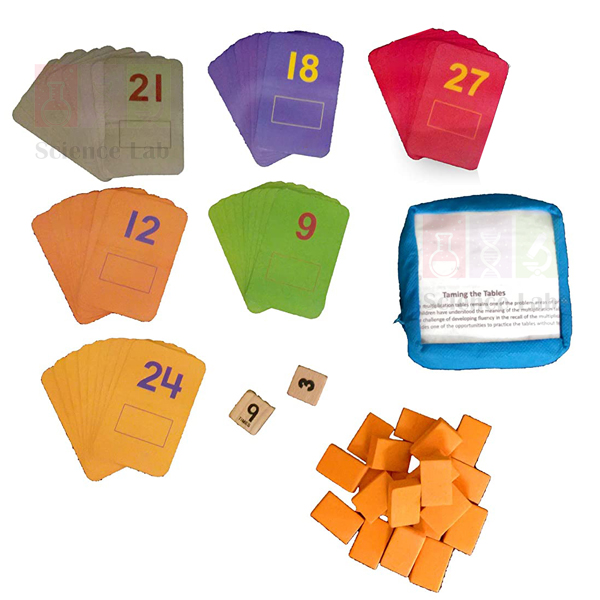
Taming The Tables
Taming The Tables (Product Code: SLE/LP/03) is a card-and-dice game used to make multiplication tables up to 9 automatic in primary maths classrooms. Teachers use it to move children from reciting tables to recalling facts quickly, with six card sets covering the tables of 3, 4, 6, 7, 8 and 9. It is supplied by Jain Scientific Equipments Pvt Ltd (ScienceLab), Ambala, India, alongside other mathematics lab kits for schools.
Key Details
| Parameter | Detail |
|---|---|
| Card sets | Six sets of cards for the multiplication tables of 3, 4, 6, 7, 8 and 9 |
| Dice | Two dice: a number dice and a times dice |
| Tokens | 20 rubber tokens |
| Activity guide | Write-up with details of the activities |
| Learning goal | Automatising multiplication tables up to 9 |
| Game levels | Can be played at different levels, depending on the challenge needed |
| Other concepts | Seeing patterns in multiplication tables; practising dodging tables |
| Product code | SLE/LP/03 |
| Supplied by | Jain Scientific Equipments Pvt Ltd (ScienceLab), Ambala, India |
What Is Taming The Tables Used For?
Knowing a table by chanting it from the start is not the same as knowing a single fact on demand. Rolling the number dice and the times dice produces a random pairing, so children cannot lean on the chanted sequence; they have to recall the product directly. Practising these “dodging” tables, where facts come out of order, is what turns slow counting-up into instant recall.
Because the six card sets are separate, a teacher can hand a beginner the table of 3 while a confident classmate works with mixed 7s and 8s, and raise the level as recall improves. Laying one card set out in order is also a good moment to look for patterns — for example, how the digits of each answer in the table of 9 add up to 9. The rubber tokens can be used to keep score, which keeps a small group engaged in a maths corner or as part of the lab equipment a school keeps for activity periods.
Supplier
Taming The Tables is supplied by Jain Scientific Equipments Private Limited, which trades under the ScienceLab name from Ambala, Haryana. Primary schools, maths-lab coordinators, tutoring centres and dealers in India and international markets can order it on its own or with other number-sense games from the same range. Company background is on the ScienceLab profile page.
Related Primary Maths Kits
Pair Taming The Tables with these aids for the rest of the multiplication sequence:
- Number Catchers I (3 to 10) — builds the skip counting that comes before table recall.
- Number Catchers II (11 to 15) — extends multiplication patterns to larger numbers.
- Place Value Board Multiplication — moves from single facts to multi-digit multiplication.
- Digit cards — further mental multiplication games with number cards.
Browse the full Primary range of maths learning kits.
Frequently Asked Questions
What is included in Taming The Tables?
Taming The Tables includes six sets of multiplication cards for the tables of 3, 4, 6, 7, 8 and 9, a number dice, a times dice and 20 rubber tokens, together with a write-up that describes the activities teachers can run with the kit.
Which multiplication tables does Taming The Tables cover?
Taming The Tables covers the multiplication tables of 3, 4, 6, 7, 8 and 9 through its six card sets. Its activities aim to make tables up to 9 automatic, with patterns across the tables explored along the way.
Can Taming The Tables be used with children at different levels?
Yes. Taming The Tables can be played at different levels depending on the challenge a child needs, so a teacher can start with a single table and later mix card sets for children who are ready for faster, out-of-order recall.
How should the Taming The Tables cards be stored?
Taming The Tables is easiest to use when each of the six card sets is kept bundled separately, with the dice and tokens in the same box, so a group can take out one table quickly. Keeping the cards dry and flat helps them last through repeated games.
Who supplies Taming The Tables?
Taming The Tables is supplied by Jain Scientific Equipments Pvt Ltd (ScienceLab) of Ambala, Haryana, India, to schools, maths labs, tutoring centres and dealers in India and international markets, either as single kits or together with other primary maths kits.
What information does a quotation for Taming The Tables need?
A quotation for Taming The Tables needs the number of kits, the delivery location and whether other primary maths kits should be added to the same order. Send these details through our contact page.
Request a Quote
To order Taming The Tables, send the number of kits and your delivery location through the contact page, or add it to the enquiry cart with other kits from the Primary range for a combined quotation.
Last updated: 24 September 2026
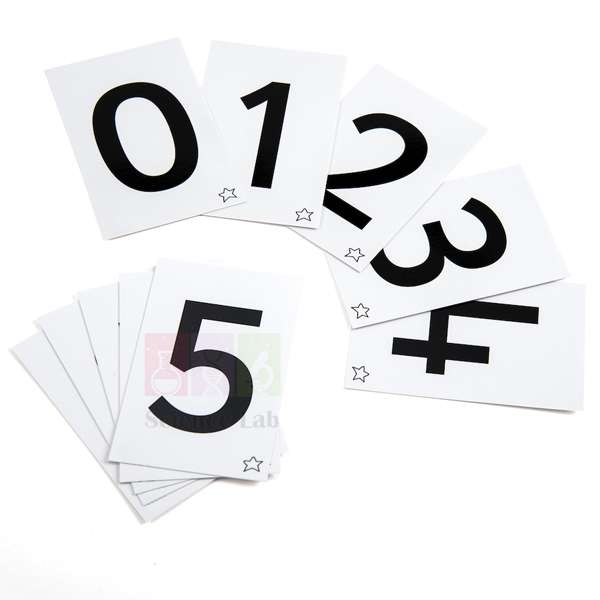
Digit cards
Digit cards (Product Code: SLE/LP/04) is a set of 108 cards used to build 3-digit and 4-digit numbers in place-value and mental-calculation games in primary classrooms. Designed for groups of 4 children aged 7 years and above, the games involve several strategies and can hold the interest of adults too. The set is supplied by Jain Scientific Equipments Pvt Ltd (ScienceLab), Ambala, India, a school lab equipment supplier serving India and international markets.
Key Details
| Parameter | Detail |
|---|---|
| Cards | 108 cards |
| Numbers built | 3-digit and 4-digit numbers, in a game context |
| Players | 4 children |
| Age | 7 years and above |
| Activity guide | Write-up with details of the activities |
| Game levels | Different levels depending on the challenge needed; involves multiple strategies and can also be enjoyed by adults |
| Concepts | Comparing numbers; forming the greatest and smallest numbers from given digits; reading and writing multi-digit numbers; expanding a number by place value; place value with addition and subtraction; mental addition, subtraction and multiplication |
| Product code | SLE/LP/04 |
| Supplied by | Jain Scientific Equipments Pvt Ltd (ScienceLab), Ambala, India |
What Are Digit Cards Used For?
One of the simplest activities asks children to take a handful of cards and arrange the digits into the greatest and then the smallest number possible. Reading the result aloud, writing it down and expanding it by place value shows at once whether a child understands that a digit's position, not just its face, decides its worth. Moving from 3-digit to 4-digit numbers raises the challenge once a group is ready.
The same cards support quick mental addition, subtraction and multiplication rounds. Because an answer can be reached in more than one way, players compare strategies and explain their thinking to each other, which is where much of the learning happens. A set can be kept in the maths corner alongside other educational lab equipment, ready for a group of four with very little preparation.
Supplier
Jain Scientific Equipments Private Limited supplies Digit cards under its ScienceLab trading name from Ambala in Haryana. Class teachers, school maths labs, learning centres and distributors order the set singly or in class quantities, usually together with other place-value materials. More about the company is on the company profile.
Related Primary Maths Kits
These aids lead into, or follow on from, place-value games with Digit cards:
- Number Card (101 cards) — number recognition from 0 to 100 before multi-digit work.
- Number Sticks — bundling tens and ones, the idea underneath place value.
- Game of Place Value — another game-based route into place value.
- Taming The Tables — table recall that speeds up the multiplication rounds.
See every kit in the Primary category.
Frequently Asked Questions
How many cards are in the Digit cards set?
The Digit cards set has 108 cards, enough to build 3-digit and 4-digit numbers during games for a group of 4 children. A write-up describing the activities is included with the set, so no extra preparation is needed.
What age is the Digit cards set suitable for?
The Digit cards set is intended for children aged 7 years and above, played in groups of 4. Because the games involve several strategies, older children and even adults can enjoy them, which makes one set useful across more than one class.
Which maths skills does Digit cards practise?
Digit cards practises place value, comparing numbers, forming the greatest and smallest numbers from given digits, reading and writing multi-digit numbers, expanding numbers, and mental addition, subtraction and multiplication, through games that can be pitched at different levels.
How many Digit cards sets does a class need?
Each Digit cards set serves a group of 4 children, so a class usually needs one set for every four pupils playing at the same time. Share your class size through the contact page and we will quote the matching number of sets.
Who supplies Digit cards?
Digit cards is supplied by Jain Scientific Equipments Pvt Ltd (ScienceLab), based in Ambala, Haryana, India. The company serves schools, maths labs and dealers in India and international markets, and can quote Digit cards together with other primary maths kits.
Request a Quote
Tell us how many groups of four will play and where the sets should be delivered through the contact page, or add Digit cards to the enquiry cart and request one quotation for your whole maths list.
Last updated: 24 September 2026
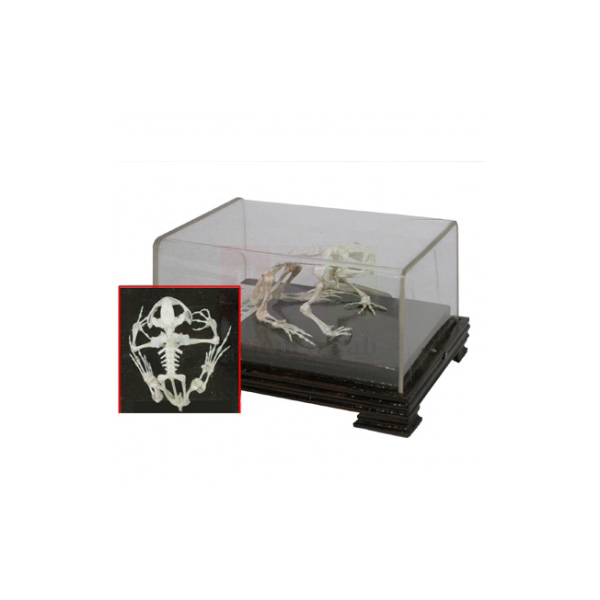
Frog Skeleton
Frog Skeleton (Product Code: SLE/EZ/08) is a mounted natural-bone frog skeleton used to teach amphibian anatomy in school biology rooms and undergraduate zoology practicals. It is popular for spotting exercises, where students identify bones and adaptations at a glance, and it rests on a base under an acrylic cover in a 155 x 115 x 82 mm case. It is supplied by Jain Scientific Equipments Pvt Ltd (ScienceLab), Ambala, India, as a real lab specimen for biology teaching.
Specifications
| Parameter | Detail |
|---|---|
| Specimen | Natural bone, mounted |
| Base and cover | On a base with an acrylic cover |
| Case size | 155 x 115 x 82 mm |
| Product code | SLE/EZ/08 |
| Supplied by | Jain Scientific Equipments Pvt Ltd (ScienceLab), Ambala, India |
What Is the Frog Skeleton Used For?
The frog is a classic type specimen in Indian zoology courses, and its skeleton shows clearly how the body is shaped for jumping. Students can trace the very short backbone ending in a rod-like urostyle, the long hind limbs, the broad, flat skull and the absence of true ribs. Comparing forelimb and hind limb bones also opens a discussion of how landing forces are absorbed.
Teachers use the skeleton for bone identification, labelled drawings and viva questions, and it pairs naturally with a frog dissection model where hands-on dissection is not practised. View it from the side as well as from above to see the limb girdles clearly. Keep it dry and out of strong sunlight, and clean only the acrylic cover with a soft cloth.
Supplier
This frog skeleton is supplied by Jain Scientific Equipments Private Limited, which trades as ScienceLab from Ambala, Haryana. Schools, colleges and universities can order it singly or as part of a set of vertebrate skeletons, with delivery across India and to international markets. Company details are on the company profile page.
Related Zoology Equipment
Useful companions for a frog anatomy practical:
- Frog Dissection Model — shows the internal organs that sit within the skeleton.
- Frog Dissection — a preserved specimen for demonstrating soft-tissue anatomy.
- Mi-Own Frog Model — another frog teaching aid from the same zoology range.
- Lizard Skeleton — a reptile skeleton for amphibian-versus-reptile comparisons.
More animal-study items are listed in the Zoology category.
Frequently Asked Questions
Is the Frog Skeleton made of real bone?
Yes. The Frog Skeleton (SLE/EZ/08) is natural bone, mounted on a base and protected by an acrylic cover. Being a real specimen, each piece can differ slightly in size and fine detail from the one pictured.
How big is the Frog Skeleton case?
The Frog Skeleton case measures 155 x 115 x 82 mm. The case lets students view the skeleton from several angles without opening the acrylic cover, which keeps the fine bones protected.
Is the Frog Skeleton suitable for zoology spotting practicals?
Yes. The Frog Skeleton suits spotting and viva sessions in school and undergraduate zoology, where students identify features such as the urostyle, girdles and limb bones. Place it at a numbered station with a question card for each feature.
Are the bones of the Frog Skeleton labelled?
The listing for the Frog Skeleton does not mention bone labels or a key card. If labelled specimens are required, ask us through the contact page and we will confirm what can be provided.
How should the Frog Skeleton be looked after?
Keep the Frog Skeleton in a dry cupboard away from heat and direct sunlight. Dust the acrylic cover with a soft, dry cloth, avoid solvent cleaners, and handle the case by its base rather than the cover.
Who supplies the Frog Skeleton?
The Frog Skeleton is supplied by Jain Scientific Equipments Pvt Ltd (ScienceLab), Ambala, Haryana, India. The company quotes schools, colleges, universities and dealers in India and international markets, and can add other vertebrate skeletons to the same quotation.
Request a Quote
Request a price for the Frog Skeleton by sending the quantity and delivery address through our contact page, or add it with related models to the enquiry cart.
Last updated: 24 September 2026
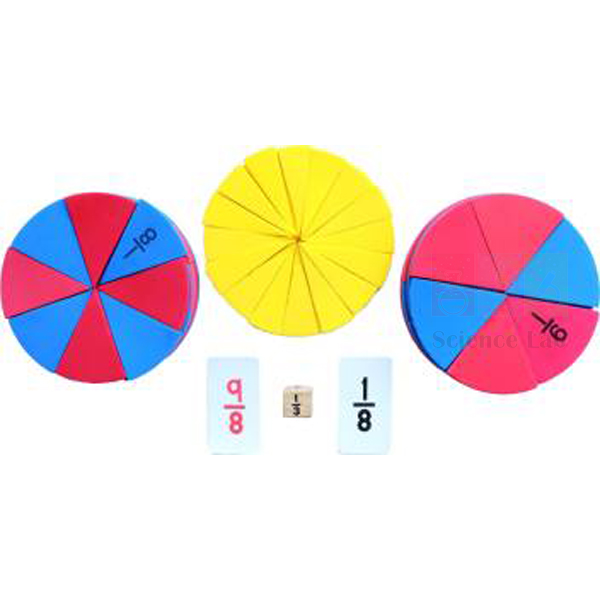
Fraction Kit
Fraction Kit (Product Code: SLE/LP/05) is a set of circular fraction cut-outs, fraction dice and fraction cards used to build fractional number sense through activities and games in primary maths. It suits up to 4 children aged 8–13 years and covers unit fractions from ½ down to 1/16, measured against one full-circle whole. The kit is supplied by Jain Scientific Equipments Pvt Ltd (ScienceLab), Ambala, India, whose mathematics lab kits serve both maths labs and class sets.
Specifications
| Parameter | Detail |
|---|---|
| Circular cut-outs | Two sets of five circular unit fraction cut-outs ranging from ½ to 1/8 |
| Further cut-outs | One set of unit fraction cut-outs from 1/12 to 1/16 |
| Whole | One whole — a full circle |
| Fraction cards | 5 unit fractions and 16 non-unit fractions |
| Fraction dice | Included, for games at different levels |
| Activity guide | Write-up with details of the activities |
| Group size and age | Up to 4 children, age 8–13 years |
| Suitable for | Maths labs and class kits |
| Product code | SLE/LP/05 |
| Supplied by | Jain Scientific Equipments Pvt Ltd (ScienceLab), Ambala, India |
What Is a Fraction Kit Used For?
Children lay the cut-outs on the full circle to see what ½, 1/3 or 1/8 of a whole actually looks like. They soon find that 2/4, 4/8 and 6/12 cover exactly the same area as ½, and that 2/6 and 4/12 match 1/3 — equivalence discovered by hand rather than by rule. Seeing that more pieces means smaller pieces makes the meaning of the denominator concrete, and building non-unit fractions from unit pieces leads naturally to proper, improper and mixed fractions.
The fraction dice and the cards (5 unit and 16 non-unit fractions) turn comparing and ordering into games that can be played at several levels. Older pupils in the 8–13 range move on to addition and subtraction of fractions based on quantity sense before learning the algorithm, and then to multiplication and division of fractions. As educational lab equipment, the kit works equally well as maths-lab stock or as a class kit issued to groups.
What to Specify When Ordering
- The number of kits — one Fraction Kit serves a group of up to 4 children.
- Whether the kits are for a maths lab or for class sets issued to groups.
- Whether you also want a Fraction Dice (Large) for whole-class games led from the front.
- The delivery location and any other primary maths kits to include on the same quotation.
Supplier
The Fraction Kit is supplied by Jain Scientific Equipments Private Limited — ScienceLab is its trading name — from Ambala, Haryana. Schools equipping several maths classrooms at once, teacher-training colleges and dealers in India and international markets order it as single kits or in bulk. The ScienceLab company profile has further details.
Related Primary Maths Kits
Useful companions for fraction lessons with the Fraction Kit:
- Fraction Dice (Large) — one large die per section for whole-class fraction games.
- Decimal Kit — the next step, linking decimal fractions to decimals.
- Non Magnetic Fraction Disc — another circular model for showing parts of a whole.
More number and fraction aids are listed under Primary.
Frequently Asked Questions
What is included in the Fraction Kit?
The Fraction Kit includes two sets of five circular unit fraction cut-outs from ½ to 1/8, one set from 1/12 to 1/16, one whole circle, fraction dice, and fraction cards covering 5 unit and 16 non-unit fractions, plus a write-up of activities.
What age group is the Fraction Kit for?
The Fraction Kit is intended for up to 4 children aged 8–13 years. Its games can be played at different levels, so the same kit supports first work on unit fractions as well as later work on operations with fractions.
Can the Fraction Kit show equivalent fractions?
Yes. With the Fraction Kit, children lay pieces over one another to show that 2/4, 4/8 and 6/12 are equivalent to ½, and that 2/6 and 4/12 are equivalent to 1/3, before they learn the rule for equivalent fractions.
Is the Fraction Kit suitable for a maths lab?
Yes. The Fraction Kit is described as appropriate both for maths labs and for class kits, so it can be kept as lab stock or issued to groups of up to 4 children during regular fraction lessons.
What material are the Fraction Kit cut-outs made of?
The material of the Fraction Kit cut-outs is not stated in the product description. Please ask through the contact page, and the quotation will confirm the material along with the full list of cut-outs, dice and cards supplied.
Who supplies the Fraction Kit?
The Fraction Kit is supplied by Jain Scientific Equipments Pvt Ltd (ScienceLab), Ambala, Haryana, India, to schools, colleges of education and dealers in India and international markets, in single units or class quantities for fraction teaching.
Request a Quote
Send the number of Fraction Kits you need, and whether a Fraction Dice (Large) should be added, through the contact page. You can also collect items in the enquiry cart and submit them together.
Last updated: 24 September 2026
993.jpg)
Fraction Dice (Large)
Fraction Dice (Large) (Product Code: SLE/LP/06) is a large fraction die used for whole-class activities on identifying, comparing and making common fractions in primary maths lessons. One die is intended per class section, and it drives the fractional number-sense games that are played with the Fraction Kit. It is supplied by Jain Scientific Equipments Pvt Ltd (ScienceLab), Ambala, India, as part of its educational lab equipment for schools.
Key Details
| Parameter | Detail |
|---|---|
| Quantity per class | 1 per section |
| Mode of use | Whole-class activities |
| Concepts | Identification and comparison of fractions; making and recognising different common fractions |
| Games | Games for fractional number sense, used with the Fraction Kit |
| Estimation | Judging how close a fraction is to the known fractions ½, 1/4 and 3/4 |
| Product code | SLE/LP/06 |
| Supplied by | Jain Scientific Equipments Pvt Ltd (ScienceLab), Ambala, India |
What Is the Fraction Dice (Large) Used For?
Because a single large die serves the whole section, the teacher can roll it at the front of the room and every child works with the same fraction at the same moment — naming it, comparing it with the previous roll, or deciding whether it lies closer to ½, 1/4 or 3/4. That shared focus makes it easy to see who has grasped the idea and who needs another example.
The estimation habit it builds, asking “is this nearer a half or three-quarters?”, gives children a feel for the size of a fraction before they calculate with it. During group time the die links to the Fraction Kit: groups make the rolled fraction with their kit pieces and check whether their estimate was right.
Supplier
Fraction Dice (Large) comes from Jain Scientific Equipments Private Limited, the company that trades as ScienceLab in Ambala, Haryana. It is supplied to primary schools, maths resource rooms and distributors in India and international markets, usually in the same order as the kits it supports. The ScienceLab profile explains more about the company.
Related Primary Maths Kits
Items that work alongside the large fraction die:
- Fraction Kit — the group kit whose games the large die is meant to support.
- Decimal Kit — carries fraction work on into tenths and hundredths.
- Fraction Dice — the fraction dice listed in the maths lab range.
- Non Magnetic Fraction Disc — a circular model for showing parts of a whole.
The complete Primary range lists other classroom maths kits.
Frequently Asked Questions
How many Fraction Dice (Large) does a school need?
Fraction Dice (Large) is intended as 1 per section, since it is used for whole-class activities. A school therefore usually orders one die for each class section that is being taught fractions at the same time.
What is the Fraction Dice (Large) used for?
The Fraction Dice (Large) is used to identify and compare fractions, to make and recognise different common fractions, and to estimate how close a fraction is to known fractions such as ½, 1/4 and 3/4 during whole-class games.
Can the Fraction Dice (Large) be used with the Fraction Kit?
Yes. The Fraction Dice (Large) is meant for games for fractional number sense played with the Fraction Kit, so a teacher can lead the whole class with the large die while groups work with their own kits.
Which fractions are marked on the Fraction Dice (Large)?
The fractions printed on the faces of the Fraction Dice (Large) are not listed in its description. Please ask through the contact page and we will confirm the face markings, size and material before you place an order.
Who supplies the Fraction Dice (Large)?
The Fraction Dice (Large) is supplied by Jain Scientific Equipments Pvt Ltd (ScienceLab) from Ambala, Haryana, India, to schools and dealers in India and international markets, either on its own or together with fraction kits for group work.
Request a Quote
Let us know how many class sections need a Fraction Dice (Large) through the contact page, or place it in the enquiry cart together with Fraction Kits for the groups in each class.
Last updated: 24 September 2026
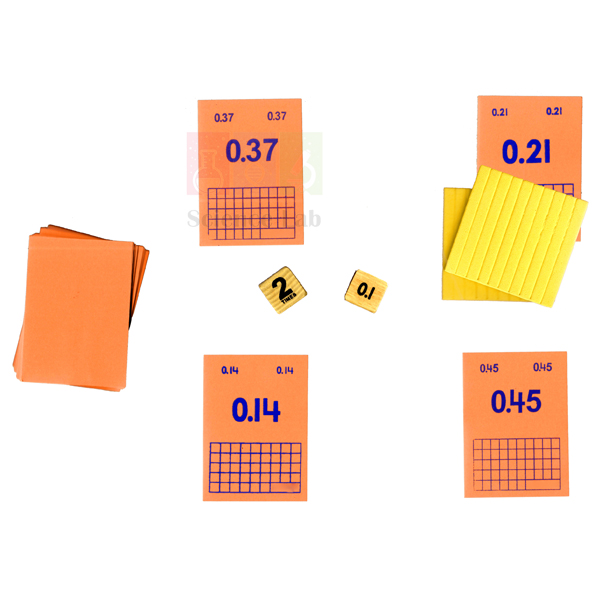
Decimal Kit
Decimal Kit (Product Code: SLE/LP/07) is a hands-on set of blocks, coloured cards and wooden dice used to help children understand and visualise decimals through their link with decimal fractions. One kit serves up to 4 children aged 9–13 years and holds 1 large cube, 20 plates, 20 rods and 20 small cubes for showing decimal place value as quantity. It is supplied by Jain Scientific Equipments Pvt Ltd (ScienceLab), Ambala, India, as educational lab equipment for maths labs and class kits.
Specifications
| Parameter | Detail |
|---|---|
| Blocks | 1 large cube, 20 plates, 20 rods, 20 small cubes |
| Cards | 3 sets of different coloured cards |
| Dice | 3 wooden dice: fraction dice marked 1/10 and 1/100, and a times dice marked 0–5 |
| Games | Multi-level games to consolidate the meaning of decimal notation |
| Activity guide | Write-up with details of the activities |
| Group size | 1 kit for 4 children |
| Age | 9–13 years |
| Suitable for | Maths labs and class kits |
| Product code | SLE/LP/07 |
| Supplied by | Jain Scientific Equipments Pvt Ltd (ScienceLab), Ambala, India |
What Is a Decimal Kit Used For?
Decimals often feel abstract because a decimal looks like an ordinary number with a dot placed in it. The Decimal Kit lets children see decimals as amounts: one block is chosen to stand for a whole, and the smaller pieces show what tenths and hundredths of it look like. Comparing and ordering decimals then becomes a matter of comparing real quantities rather than counting digits.
Because the kit builds on what children already know about fractions, they convert between decimal and fraction form as they work. The fraction dice marked 1/10 and 1/100, combined with the 0–5 times dice, generate numbers for addition and subtraction games, and the three coloured card sets let the teacher run the games at more than one level.
Supplier
Decimal Kit orders are handled by Jain Scientific Equipments Private Limited, which does business as ScienceLab from Ambala, Haryana. As a school laboratory equipment supplier in India, the company quotes single kits for a maths lab as well as class sets for schools, training institutes and dealers in India and international markets. Read more on the company profile.
Related Primary Maths Kits
These kits prepare for, or extend, decimal work:
- Fraction Kit — builds the fraction understanding the Decimal Kit relies on.
- Dienes Blocks Plastic — place-value blocks for whole numbers and decimals.
- Decimal Abacus — an abacus model of decimal place value.
- Fraction Dice (Large) — whole-class fraction games before moving to decimals.
Other number kits are grouped under Primary.
Frequently Asked Questions
What does the Decimal Kit contain?
The Decimal Kit contains 1 large cube, 20 plates, 20 rods and 20 small cubes, 3 sets of different coloured cards, and 3 wooden dice — fraction dice marked 1/10 and 1/100 and a times dice marked 0–5 — plus an activity write-up.
How many children can use one Decimal Kit?
One Decimal Kit is meant for 4 children working together, and it suits ages 9–13 years. For a full class, schools usually order one kit for every group of four, or keep a smaller number in the maths lab for groups to use in turn.
Which decimal topics does the Decimal Kit cover?
The Decimal Kit covers the introduction of decimals, comparison and ordering, converting decimals into fractions, decimal place value in terms of quantity, and addition and subtraction of decimal numbers, with games that consolidate the meaning of decimal notation.
Are the dice in the Decimal Kit made of wood?
Yes. The Decimal Kit includes 3 wooden dice: fraction dice marked 1/10 and 1/100 and a times dice marked 0–5. The material of the blocks is not stated, so ask us to confirm it in your quotation.
Who supplies the Decimal Kit?
The Decimal Kit is supplied by Jain Scientific Equipments Pvt Ltd (ScienceLab), Ambala, Haryana, India. Schools, maths labs and dealers in India and international markets can order it on its own or with the Fraction Kit and other primary maths kits.
Request a Quote
Share the number of groups of four in each class and your delivery address through the contact page, or add the Decimal Kit to the enquiry cart to receive a single quotation.
Last updated: 24 September 2026