- Physics Lab Equipment
- Chemistry Lab Equipment
- Biology Lab Equipment
- Anatomical Lab Equipment
- Learning
- Educational Lab Equipment
- Magnets
- Agriculture
- Astronomy
- Earth Science
- Geography Lab Equipment
- Safety Lab Coat
- Laboratory
- Meteorological
- Electricity & Magnetism
- Heat
- School Lab Equipment
- Lab Glassware
- Science Lab Equipment
- Tvet Lab Equipment
- Robotics Kits Supplier and Manufacturer for Schools India
- Math Lab Equipment Manufacturers and Exporters in Ambala
- STEM Kits Manufacturers and Supplier India
- Engineering Lab Equipment
- Hospital Lab Equipment
- Water, Sanitation & Hygiene Supplies
- Cold Chain, Solar & Communication Equipment
- Nutrition
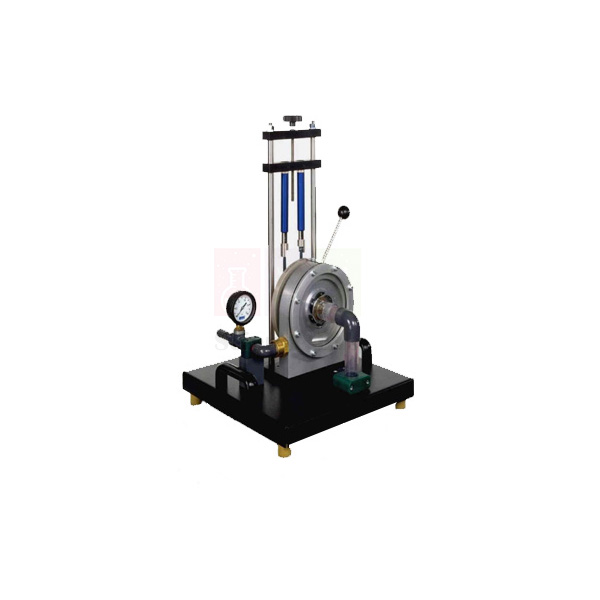
Demonstration Francis Turbine
Demonstration Francis Turbine (Product Code: SLE/MCE/44) is a small reaction water turbine used to study how guide vane setting, flow and speed affect turbine torque, power and efficiency in hydraulic machines laboratories. Rated at 350 W at 1500 rpm, it has a spiral housing, adjustable guide vanes, a band brake with spring balances and a non-contact speed sensor. It is made by Jain Scientific Equipments Pvt Ltd (ScienceLab), an OEM manufacturer, at its own factory in Ambala, India.
Specifications
| Parameter | Detail |
|---|---|
| Turbine type | Francis (reaction) turbine with spiral housing and adjustable guide vanes |
| Output | 350 W at 1500 rpm, 270 L/min, head approx. 15 m |
| Maximum speed | 3000 rpm |
| Rotor | 11 blades; 7 vanes |
| Medium diameter | 60 mm |
| Angle of attack | 0 to 20° |
| Torque measurement | Band brake read on spring balances, 0 to 9.81 Nm |
| Pressure measurement | Manometer at the turbine inlet, 0 to 4 bar absolute |
| Speed measurement | Non-contact speed sensor, 0 to 4000 rpm |
| Dimensions | 1000 x 800 x 1200 mm |
| Weight | 90 kg |
| Product code | SLE/MCE/44 |
| Manufacturer | Jain Scientific Equipments Pvt Ltd (ScienceLab) — OEM |
| Country of origin | India (made in Ambala, Haryana) |
What Is the Demonstration Francis Turbine Used For?
Francis turbines drive most medium-head hydropower stations, and this bench-scale version lets students follow the energy conversion step by step. Water enters through the spiral housing, is accelerated and turned by the adjustable guide vanes, and gives up both pressure and kinetic energy in the impeller — which is what makes it a reaction turbine rather than an impulse machine.
In a typical test the band brake is tightened in steps while students log spring balance forces, speed from the non-contact sensor and inlet pressure from the manometer. Torque times speed gives shaft power, and dividing by hydraulic power gives efficiency, so curves of power and efficiency against speed can be drawn for several guide vane angles between 0 and 20°. It is a compact choice among engineering lab equipment in India for hydraulic machines practicals where floor space is limited.
What to Specify When Ordering
- Your water supply arrangement: the rated output is quoted at 270 L/min and a head of approx. 15 m, so state whether a suitable pumped supply is already available.
- Number of turbines and whether other hydraulic machines are being ordered for the same laboratory.
- Delivery location in India or abroad, for packing and freight.
OEM Manufacturer
Jain Scientific Equipments Private Limited, trading as ScienceLab, is the OEM (original equipment manufacturer) of the Demonstration Francis Turbine. The turbine casing, guide vane mechanism, brake assembly and frame are made and assembled at the company's own licensed factory at Saha, Ambala, Haryana, India.
Colleges, dealers and importers therefore buy straight from the source, and later needs such as a replacement brake band or spring balance are handled by the same manufacturer — just ask us. Visit the ScienceLab company profile to learn more about the company.
Related Fluid Mechanics Equipment
Turbines and trainers that complement this unit in a hydraulic machines laboratory:
- Francis Turbine Trainer — a larger computer-linked Francis set with generator loading.
- Francis Turbine — a reaction turbine with a viewing window and draft tube.
- Demonstration Pelton Turbine — the impulse-turbine counterpart for side-by-side comparison.
- Pelton Turbine Test Rig — another band-brake turbine rig for performance tests.
See the Fluid Mechanics category for pumps, turbines and flow apparatus.
Frequently Asked Questions
What does the Demonstration Francis Turbine measure?
The Demonstration Francis Turbine measures torque through a band brake read on spring balances, rotational speed with a non-contact sensor and inlet water pressure with a manometer. From these, students calculate shaft power, hydraulic power and turbine efficiency.
What is the rated output of the Demonstration Francis Turbine?
The Demonstration Francis Turbine is rated at 350 W at 1500 rpm, with a flow of 270 L/min and a head of approximately 15 m. Its maximum speed is 3000 rpm.
How are the guide vanes adjusted?
The Demonstration Francis Turbine has adjustable guide vanes with an angle of attack from 0 to 20°. Changing the angle alters how the water is accelerated and directed onto the 11-blade rotor, so students can compare performance at several settings.
What are the measuring ranges?
The Demonstration Francis Turbine measures torque from 0 to 9.81 Nm, inlet pressure from 0 to 4 bar absolute and speed from 0 to 4000 rpm, which covers its full operating range up to the 3000 rpm maximum speed.
What water supply does the turbine need?
The Demonstration Francis Turbine delivers its rated 350 W at about 270 L/min and 15 m head. The supply arrangement to suit your laboratory should be confirmed at quotation, so please describe your set-up on the contact page.
Who manufactures the Demonstration Francis Turbine?
The Demonstration Francis Turbine is manufactured by Jain Scientific Equipments Pvt Ltd (ScienceLab), the OEM, at its own factory in Ambala, Haryana, India, and it is supplied factory-direct to institutions, dealers and importers.
Request a Quote
To receive a quotation for the Demonstration Francis Turbine (SLE/MCE/44), use the contact page or the enquiry cart, mentioning your water supply and delivery location. Quotations come directly from the manufacturer.
Last updated: 24 September 2026
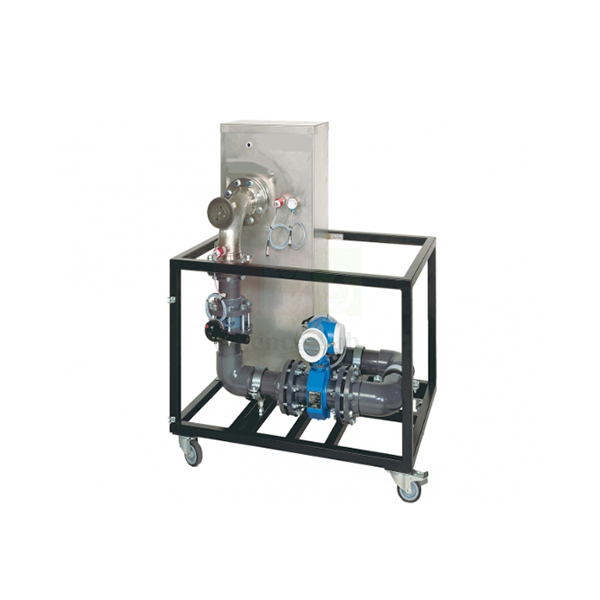
Axial Flow Pump Test Rig
Axial Flow Pump Test Rig (Product Code: SLE/MCE/45) is a pump trainer used to measure the operating behaviour of a propeller-type axial flow pump in hydraulic machines and fluid mechanics laboratories. Its 1000 W pump delivers up to 700 L/min at a maximum head of 1.75 m through a closed 160 L circuit with an electromagnetic flow meter. It is made by Jain Scientific Equipments Pvt Ltd (ScienceLab), an OEM manufacturer of vocational training lab equipment in India, at its own factory in Ambala.
Specifications
| Parameter | Detail |
|---|---|
| Pump type | Axial flow (propeller) pump, not self-priming |
| Pump output | 1000 W at 1000 rpm |
| Maximum flow rate | 700 L/min |
| Maximum head | 1.75 m |
| Tank | 160 L, closed water circuit independent of the mains water system |
| Flow measurement | Electromagnetic flow meter, 0 to 1200 L/min |
| Temperature measurement | Temperature sensor, 0 to 100 °C |
| Inlet pressure | ±1 bar |
| Outlet pressure | 0 to 0.6 bar |
| Power supply | 230 V, 50 Hz, 1 phase |
| Dimensions | 1110 x 800 x 1380 mm |
| Weight | Approx. 154 kg |
| Product code | SLE/MCE/45 |
| Manufacturer | Jain Scientific Equipments Pvt Ltd (ScienceLab) — OEM |
| Country of origin | India (made in Ambala, Haryana) |
What Is the Axial Flow Pump Test Rig Used For?
Where large volumes of water must be lifted only a short height — drainage systems, wastewater treatment plants and cooling water supply — engineers choose axial flow pumps. Unlike a centrifugal pump, the propeller builds pressure the way an aerofoil produces lift, with water passing straight through the impeller along the shaft axis. This rig lets students see how that design trades head for flow.
By logging inlet and outlet pressure together with electromagnetic flow readings at a series of operating points, students plot the head-flow characteristic and compare it with the steeper curves of centrifugal pumps. Because the pump is not self-priming, the propeller must stay covered by water: fill the 160 L tank before switching on and keep the level up during tests. The water temperature reading helps when calculating fluid properties for each run.
What to Specify When Ordering
- Electrical supply: the rig is specified for 230 V, 50 Hz, single phase.
- Installation space for the 1110 x 800 x 1380 mm frame, which weighs approx. 154 kg before the tank is filled.
- Number of rigs and delivery location, in India or overseas.
OEM Manufacturer
The Axial Flow Pump Test Rig comes from Jain Scientific Equipments Private Limited, which uses the brand name ScienceLab and is the OEM (original equipment manufacturer) of the rig. Frame, pipework, tank and instrument mounting are built at the company's own licensed factory at Saha, Ambala, Haryana, India. For institutional and tender buyers who need vendor registration details, the company's GSTIN is 06AAECJ8618A1ZT and its LEI is 3358004HRD1JIVXKYX49.
Buying factory-direct means the same manufacturer quotes, ships and answers later questions about spare sensors or pump parts — ask us whenever you need them. Engineering colleges, dealers and importers can read more on the ScienceLab company profile.
Related Fluid Mechanics Equipment
Pump trainers that help students compare different pump types:
- Axial Flow Pump Module — a modular axial pump unit that works with a common motive-power source.
- Variable Speed Series And Parallel Pumps — centrifugal pumps for contrasting head-flow curves.
- Computerized Gear Pump Test Rig — a positive displacement pump that delivers high head at low flow.
- Submersible Pump Test Rig — another variable-speed pump test set-up.
Browse the Fluid Mechanics category for the complete pump and turbine range.
Frequently Asked Questions
What is the maximum flow and head of the Axial Flow Pump Test Rig?
The Axial Flow Pump Test Rig delivers a maximum flow rate of 700 L/min and a maximum head of 1.75 m. Its pump output is 1000 W at 1000 rpm, typical of the high-flow, low-head duty axial pumps are chosen for.
Is the pump self-priming?
No. The pump in the Axial Flow Pump Test Rig is not self-priming, so the propeller must always be covered by water. Fill the 160 L tank of the closed circuit before starting and keep it filled while testing.
What does the rig measure?
The Axial Flow Pump Test Rig measures flow rate with an electromagnetic flow meter from 0 to 1200 L/min, water temperature from 0 to 100 °C, inlet pressure within ±1 bar and outlet pressure from 0 to 0.6 bar.
Does the rig need a mains water connection?
No. The Axial Flow Pump Test Rig runs on a closed water circuit with a 160 L tank, so it works independently of the building water system. It needs a 230 V, 50 Hz, single-phase electrical supply.
Where are axial flow pumps used in practice?
Axial flow pumps like the one on the Axial Flow Pump Test Rig are used where high flow rates and a small head are needed, typically in drainage systems, wastewater treatment plants and cooling water supply systems.
Who manufactures the Axial Flow Pump Test Rig?
The Axial Flow Pump Test Rig is manufactured by Jain Scientific Equipments Pvt Ltd (ScienceLab), the OEM, at its own factory in Ambala, Haryana, India. Quotations for institutions, dealers and importers come directly from the manufacturer.
Request a Quote
Request a quotation for the Axial Flow Pump Test Rig (SLE/MCE/45) on the contact page or add it to the enquiry cart. The manufacturer quotes directly, for laboratories in India and international markets.
Last updated: 24 September 2026
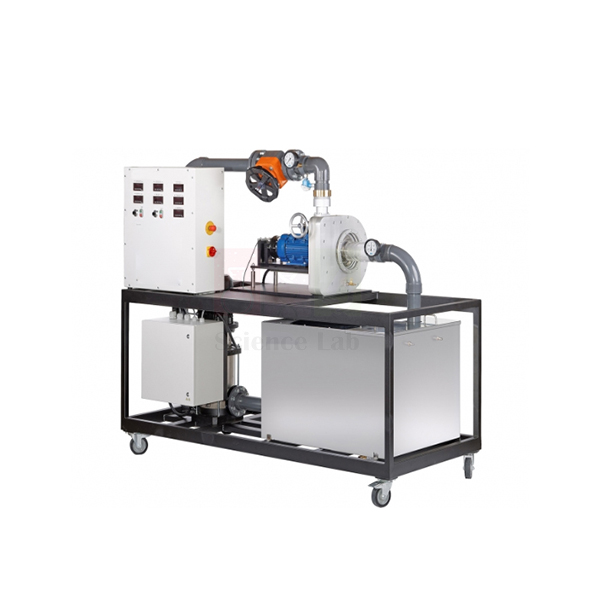
Francis Turbine Trainer
Francis Turbine Trainer (Product Code: SLE/MCE/46) is a floor-standing laboratory turbine test stand used to measure the performance of a Francis reaction turbine under generator load in university and technical institute hydropower labs. A multistage centrifugal pump with frequency-converter speed control feeds a 165 mm rotor with adjustable guide vanes, and all readings are shown digitally for further processing on a PC. It is made by Jain Scientific Equipments Pvt Ltd (ScienceLab), an OEM manufacturer, at its own factory in Ambala, India.
Specifications
| Parameter | Detail |
|---|---|
| Hydraulic power | 2.1 kW at 1500 rpm |
| Mechanical power | Approx. 1.4 kW at 1500 rpm |
| Rotor | 165 mm diameter, 8 blades, 8 guide vanes |
| Angle of attack | Adjustable, 0 to 23° |
| Operating area | Transparent, showing water flow, rotor and guide vanes |
| Supply pump | Multistage centrifugal pump, variable speed via frequency converter; head 42 m; max. flow rate 900 L/min |
| Inlet pressure control | Flow control valve |
| Tank | 550 L |
| Generator (load) | Asynchronous machine, 2.2 kW at 1440 rpm, 0 to 2200 W; pendulum bearing with force sensor for torque |
| Speed sensing | Inductive non-contact sensor on the generator shaft, 0 to 3000 rpm |
| Torque range | 0 to 20 Nm |
| Flow rate range | 0 to 1000 L/min |
| Temperature range | 0 to 100 °C |
| Turbine pressure sensors | Inlet and outlet; ranges listed as ±1 bar and 0 to 6 bar |
| Data | Digital display of measured values; can be processed further on a PC |
| Power consumption | 5.5 kW |
| Power supply | 400 V, 50 Hz, 3 phase (400 V, 60 Hz, 3 phase and 230 V, 60 Hz, 3 phase also listed) |
| Dimensions | 2350 x 1050 x 2050 mm |
| Weight | Approx. 580 kg |
| Product code | SLE/MCE/46 |
| Manufacturer | Jain Scientific Equipments Pvt Ltd (ScienceLab) — OEM |
| Country of origin | India (made in Ambala, Haryana) |
What Is the Francis Turbine Trainer Used For?
This trainer brings the working conditions of a small hydro set into the laboratory. The pump, running at a speed chosen on the frequency converter, supplies water at the required inlet pressure; the turbine drives an asynchronous machine working as a generator, whose pendulum-mounted housing and force sensor give torque directly. Speed, pressures, temperature and flow are all recorded by sensors.
Students change the guide vane setting between 0 and 23° to alter the angle of attack, flow cross-section and turbine output, then map torque, power and efficiency across the speed range to produce characteristic and hill-chart style curves. The transparent operating area makes the flow through the guide vanes and rotor visible while this happens. As lab equipment for technical institutes and universities with a hydropower or renewable energy syllabus, it supports project work as well as routine practicals.
What to Specify When Ordering
- Mains supply: 400 V, 50 Hz, 3 phase is the base specification; 400 V, 60 Hz, 3 phase and 230 V, 60 Hz, 3 phase are also listed.
- Space and floor loading for a 2350 x 1050 x 2050 mm unit of approx. 580 kg, plus water for the 550 L tank.
- Whether a PC and software are required for processing the measured values.
- Delivery location and site access for a unit of this size.
OEM Manufacturer
ScienceLab, the trading name of Jain Scientific Equipments Private Limited, is the OEM (original equipment manufacturer) of the Francis Turbine Trainer. The frame, turbine section, pipework and tank are fabricated and assembled at the company's own licensed factory at Saha, Ambala, Haryana, India, and the complete trainer is dispatched from there.
With a unit of this scale, a direct line to the maker matters: installation questions, spare sensors and repeat orders are handled by the manufacturer rather than a middleman — ask us. Universities, engineering institutes, dealers and importers in India and international markets are supplied factory-direct; see the ScienceLab company profile.
Related Fluid Mechanics Equipment
Other turbine and pump equipment for a hydraulic machines laboratory:
- Demonstration Francis Turbine — a compact 350 W Francis unit with band brake loading.
- Francis Turbine — a reaction turbine with viewing window and draft tube for guide vane studies.
- Pelton Turbine Test Rig — an impulse turbine for comparing turbine types.
- Variable Speed Series And Parallel Pumps — centrifugal pump behaviour, the supply side of the turbine circuit.
The Fluid Mechanics category lists the full range of turbines and pumps.
Frequently Asked Questions
How is the Francis Turbine Trainer loaded?
The Francis Turbine Trainer is loaded by an asynchronous machine used as a generator, rated 2.2 kW at 1440 rpm. Its pendulum bearing and force sensor measure torque from 0 to 20 Nm, and speed is read by an inductive non-contact sensor.
What power does the turbine develop?
The Francis Turbine Trainer is specified at 2.1 kW hydraulic power and approximately 1.4 kW mechanical power, both at 1500 rpm. Its 165 mm rotor has 8 blades, with 8 guide vanes adjustable from 0 to 23°.
Can the measurements be recorded on a PC?
Yes. The Francis Turbine Trainer displays its measured values digitally, and they can be processed further on a PC. Please confirm at quotation whether you need the computer and software included with the trainer.
What electrical supply does the trainer need?
The Francis Turbine Trainer is specified for 400 V, 50 Hz, 3 phase, with 400 V, 60 Hz, 3 phase and 230 V, 60 Hz, 3 phase also listed. Its power consumption is 5.5 kW, so a suitable three-phase connection is required.
How much space does the Francis Turbine Trainer need?
The Francis Turbine Trainer measures 2350 x 1050 x 2050 mm and weighs about 580 kg before its 550 L tank is filled, so plan a ground-floor laboratory position with adequate floor strength and access.
Who manufactures the Francis Turbine Trainer?
The Francis Turbine Trainer is manufactured by Jain Scientific Equipments Pvt Ltd (ScienceLab), the OEM, at its own factory in Ambala, Haryana, India, and quotations come directly from the manufacturer.
Request a Quote
Ask for a quotation on the Francis Turbine Trainer (SLE/MCE/46) through the contact page or add it to the enquiry cart, stating your power supply and delivery location. The manufacturer prepares every quotation directly.
Last updated: 24 September 2026
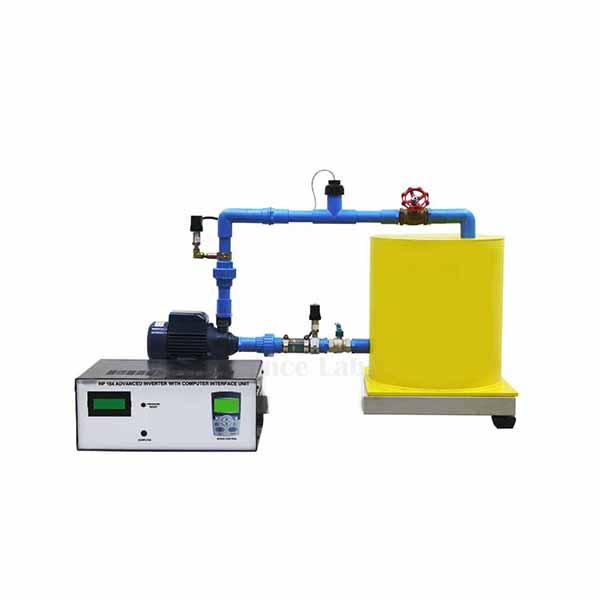
Computerized Gear Pump Test Rig
Computerized Gear Pump Test Rig (Product Code: SLE/MCE/47) is a bench-top positive displacement pump trainer used to measure gear pump flow, shaft power and efficiency with computer software in fluid mechanics laboratories. Its motor-driven gear pump has a clear acrylic pump head, runs at inverter-controlled speeds up to 1,800 rpm and circulates water from an acrylic reservoir on a stainless steel plinth. It is made by Jain Scientific Equipments Pvt Ltd (ScienceLab), an OEM manufacturer, at its own factory in Ambala, India.
Specifications
| Parameter | Detail |
|---|---|
| Pump type | Gear pump (positive displacement), two meshing gear wheels, no valves |
| Construction | Stainless steel plinth with water reservoir and pipework for continuous circulation; pump head and reservoir in clear acrylic |
| Speed control | Electronic inverter |
| Maximum flow rate | 6.5 L/min (typical) |
| Maximum head | 25 m |
| Maximum pump speed | 1,800 rpm |
| Motor | 250 W, 230 V, 1 phase |
| Parameters shown in software | Flow rate, motor shaft power, pump speed, pump efficiency, volumetric efficiency |
| Instrumentation | Sensor conditioning electronics with readings displayed on computer software |
| Dimensions | 670 x 590 x 750 mm |
| Weight | Approx. 50 kg |
| Product code | SLE/MCE/47 |
| Manufacturer | Jain Scientific Equipments Pvt Ltd (ScienceLab) — OEM |
| Country of origin | India (made in Ambala, Haryana) |
What Is the Gear Pump Test Rig Used For?
Gear pumps move oil in hydraulic power packs, lubrication systems and fuel transfer because they deliver a fixed volume per revolution and cope well with high-viscosity fluids. Inside this rig, one gear is driven and the other turns in mesh with it; liquid is carried round in the spaces between consecutive teeth and forced out as the teeth re-engage, all clearly visible through the acrylic pump head.
Students set a series of speeds on the inverter and follow the software as it logs flow rate, motor shaft power, pump speed and the two efficiencies at each operating point. The results show classic positive displacement behaviour: flow stays close to proportional to speed, while volumetric efficiency reveals how much liquid leaks back internally. It is compact engineering educational equipment in India's mechanical labs, and its output is noticeably smoother than a reciprocating pump's.
What to Specify When Ordering
- Whether a computer for the display software should be included, or will be provided by your laboratory.
- Electrical supply at the bench: 230 V, single phase for the 250 W motor.
- Number of rigs for the student groups in each practical session.
OEM Manufacturer
Jain Scientific Equipments Private Limited, which trades as ScienceLab, is the OEM (original equipment manufacturer) of the Computerized Gear Pump Test Rig. The stainless steel plinth, acrylic reservoir and pump head, and pipework are made and assembled at the company's own licensed factory at Saha, Ambala, Haryana, India.
Colleges, dealers and importers therefore get quotations, support and replacement acrylic parts from the manufacturer itself — ask us when you need them. Details of the company are on the ScienceLab company profile.
Related Fluid Mechanics Equipment
Other pump trainers for comparing positive displacement and rotodynamic machines:
- Computerized Reciprocating Pump Test Apparatus — a piston pump rig that shows the pulsating flow a gear pump avoids.
- Gear Pump — an oil gear pump for use with a positive displacement pump module.
- Vane Pump — a balanced vane pump, another fixed-displacement design.
- Axial Flow Pump Test Rig — a high-flow, low-head rotodynamic pump for contrast.
More pump and hydraulics trainers are in the Fluid Mechanics category.
Frequently Asked Questions
What does the Computerized Gear Pump Test Rig measure?
The Computerized Gear Pump Test Rig shows flow rate, motor shaft power, pump speed, pump efficiency and volumetric efficiency on its computer software, using sensor conditioning electronics built into the rig.
What is the maximum performance of the gear pump?
The Computerized Gear Pump Test Rig delivers a typical maximum flow rate of 6.5 L/min and a maximum head of 25 m, with a maximum pump speed of 1,800 rpm from its 250 W, 230 V single-phase motor.
Can students see the gears working?
Yes. On the Computerized Gear Pump Test Rig, both the pump head and the water reservoir are made from clear acrylic, so students can watch the meshing gears carry water around the casing while the rig is running.
Why does the gear pump have no valves?
The pump in the Computerized Gear Pump Test Rig is a positive displacement gear pump: liquid trapped between the teeth is carried round and pushed out as the gears mesh, so no valves are needed and it can deliver against high pressures.
Is a computer supplied with the rig?
The Computerized Gear Pump Test Rig displays its readings on computer software. Whether a computer is included in the supply should be confirmed at quotation, so please state your requirement on the contact page.
Who manufactures the Computerized Gear Pump Test Rig?
The Computerized Gear Pump Test Rig is manufactured by Jain Scientific Equipments Pvt Ltd (ScienceLab), the OEM, at its own factory in Ambala, Haryana, India, and is supplied factory-direct to colleges, dealers and importers.
Request a Quote
For a quotation on the Computerized Gear Pump Test Rig (SLE/MCE/47), write to us on the contact page or add it to the enquiry cart. The manufacturer quotes directly for laboratories in India and international markets.
Last updated: 24 September 2026
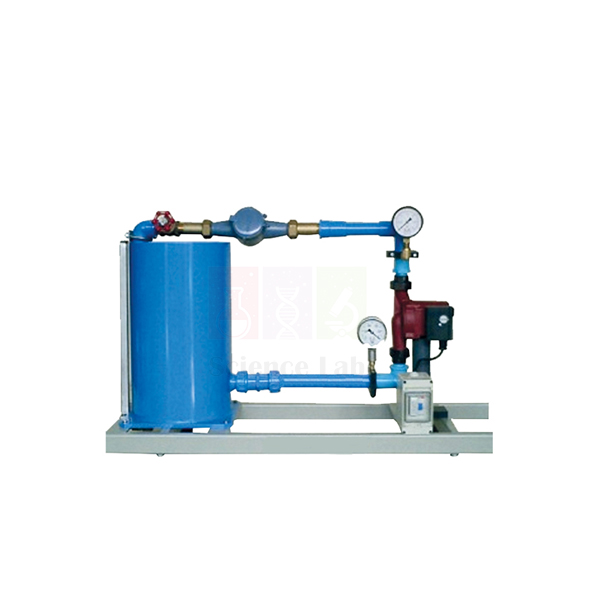
Submersible Pump Test Rig
Submersible Pump Test Rig (Product Code: SLE/MCE/48) is a variable-speed pump test set-up used to determine the head, flow and speed characteristics of a submersible pump in mechanical engineering and polytechnic laboratories. It handles up to 70 lpm and 7 m head, with a suction vacuum gauge, a delivery pressure gauge, a proximity-sensor RPM indicator and a measuring tank for timed flow readings. It is made by Jain Scientific Equipments Pvt Ltd (ScienceLab), an OEM manufacturer, at its own factory in Ambala, India.
Specifications
| Parameter | Detail |
|---|---|
| Pump | Self-priming submersible pump |
| Speed | Variable |
| Drive (as listed) | DC motor with thyristor-controlled DC drive; an asynchronous motor with frequency converter is also described — confirm the drive type at quotation |
| Maximum flow rate | 70 lpm |
| Maximum head | 7 m |
| Power rating | 0.75 kW |
| Head adjustment | Ball valve on the outlet side |
| Pressure measurement | Vacuum gauge/sensor on the suction line; pressure gauge/sensor on the delivery line |
| Speed measurement | RPM indicator with proximity sensor |
| Flow measurement | Measuring tank and stopwatch |
| Power supply | 230 V, 1 phase, 50 Hz |
| Dimensions | 1000 x 500 x 700 mm |
| Weight | Approx. 80 kg |
| Product code | SLE/MCE/48 |
| Manufacturer | Jain Scientific Equipments Pvt Ltd (ScienceLab) — OEM |
| Country of origin | India (made in Ambala, Haryana) |
What Is the Submersible Pump Test Rig Used For?
Submersible pumps are the workhorses of borewells, sumps and dewatering jobs, and engineers need to know how their delivery changes with head and speed. On this rig students close the outlet ball valve in steps to raise the head, and at each setting record suction vacuum, delivery pressure, pump speed and the time taken to fill a known volume in the measuring tank.
Repeating the series at several motor speeds produces a family of head-flow curves, and comparing them shows how flow and head scale with rotational speed. Total head is found by combining the delivery pressure and suction vacuum readings. For colleges building a pump laboratory in India, it is a practical, mid-sized piece of lab equipment for college practicals that runs on a single-phase supply.
What to Specify When Ordering
- The drive arrangement you require, since both a thyristor-controlled DC drive and a frequency converter are described for this rig.
- Whether you prefer gauges or electronic sensors for the suction and delivery pressure readings.
- Whether a stopwatch should be supplied for the measuring-tank flow readings.
- Quantity and delivery location.
OEM Manufacturer
The Submersible Pump Test Rig is produced by Jain Scientific Equipments Private Limited under its ScienceLab brand, and the company is the OEM (original equipment manufacturer) of the rig. The frame, tank, pipework and instrument panel are made and assembled at its own licensed factory at Saha, Ambala, Haryana, India.
Because the rig is configured by its maker, questions on the drive, gauges or sensors are answered first-hand, and spares or additional units can be requested from the same team — ask us. Engineering colleges, dealers and importers are supplied factory-direct; more on the ScienceLab company profile.
Related Fluid Mechanics Equipment
Other pump trainers and a timing aid for the same laboratory:
- Variable Speed Series And Parallel Pumps — centrifugal pumps run singly, in series and in parallel.
- Axial Flow Pump Test Rig — a high-flow, low-head pump for comparing characteristics.
- Multi Pump Test Rig — a three-head pump for studying counter pressure and flow.
- Bench Stopwatch — times the measuring tank fill for flow rate.
See the full Fluid Mechanics category for more pump test rigs.
Frequently Asked Questions
What does the Submersible Pump Test Rig measure?
The Submersible Pump Test Rig measures suction vacuum on the inlet line, delivery pressure on the outlet line and pump speed with a proximity-sensor RPM indicator, while flow rate is found with the measuring tank and a stopwatch.
What are the maximum flow and head?
The Submersible Pump Test Rig is rated for a maximum flow rate of 70 lpm and a maximum head of 7 m, with a power rating of 0.75 kW on a 230 V, single-phase, 50 Hz supply.
How is the pump speed varied?
The Submersible Pump Test Rig has a variable-speed drive. Its description lists a DC motor with a thyristor-controlled DC drive and also an asynchronous motor with a frequency converter, so please confirm the drive arrangement when you request a quotation.
How is the pump head changed during a test?
On the Submersible Pump Test Rig, a ball valve on the outlet side is used to adjust the head. Closing it in steps raises the delivery pressure and reduces flow, giving the points needed for a head-flow curve.
How big is the Submersible Pump Test Rig?
The Submersible Pump Test Rig measures 1000 x 500 x 700 mm and weighs about 80 kg, so it fits in a standard pump or hydraulics laboratory with access to a 230 V, single-phase socket.
Who manufactures the Submersible Pump Test Rig?
The Submersible Pump Test Rig is manufactured by Jain Scientific Equipments Pvt Ltd (ScienceLab), the OEM, at its own factory in Ambala, Haryana, India, and quotations come directly from the manufacturer.
Request a Quote
To get a quotation for the Submersible Pump Test Rig (SLE/MCE/48), send your requirements through the contact page or add it to the enquiry cart. The manufacturer quotes directly for buyers in India and international markets.
Last updated: 24 September 2026
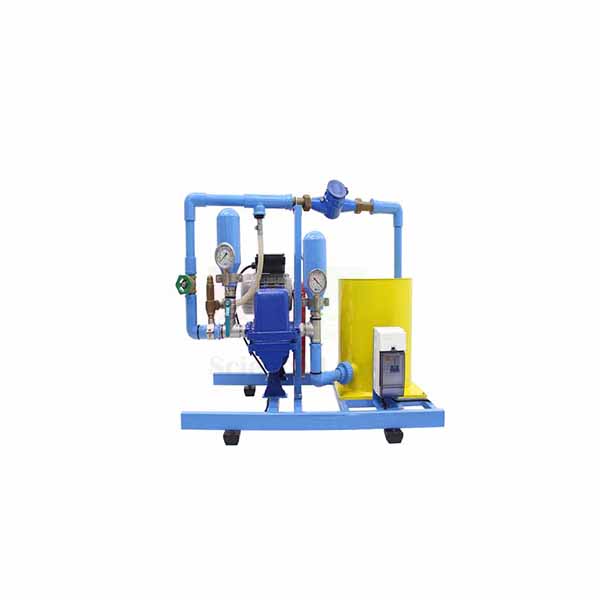
Computerized Reciprocating Pump Test Apparatus
Computerized Reciprocating Pump Test Apparatus (Product Code: SLE/MCE/49) is a piston pump test unit used to record p-V diagrams and pump characteristics on a PC in fluid mechanics and hydraulic machines laboratories. A variable-speed piston pump runs in a transparent housing on a closed water circuit, with an air vessel, a crank angle sensor and pressure sensors in the cylinder and at the outlet. It is made by Jain Scientific Equipments Pvt Ltd (ScienceLab), an OEM manufacturer, at its own factory in Ambala, India.
Specifications
| Parameter | Detail |
|---|---|
| Pump | Piston pump in a transparent housing, variable speed via frequency converter |
| Piston pump speed | 30 to 180 rpm |
| Maximum flow rate | 135 L/h |
| Maximum head | 40 m |
| Drive motor power | 180 W |
| Gear transmission ratio | 1:7.5 |
| Water circuit | Closed circuit with water tank and air vessel to damp pressure pulsation |
| Flow and head adjustment | Needle valve and overflow valve |
| Cylinder pressure | 0 to 5 bar |
| Outlet pressure | 0 to 5 bar |
| Crank angle | 0 to 360°, angle sensor on the piston rod |
| Flow rate measurement | 0.2 to 6 L/min |
| Data acquisition | Microprocessor-based measuring technique in a protective housing; values sent to a PC via USB and analysed with the software included |
| Power supply | 230 V, 50 Hz, 1 phase (230 V, 60 Hz, 1 phase and 120 V, 60 Hz, 1 phase also listed) |
| Dimensions | 670 x 590 x 740 mm |
| Weight | Approx. 49 kg |
| Product code | SLE/MCE/49 |
| Manufacturer | Jain Scientific Equipments Pvt Ltd (ScienceLab) — OEM |
| Country of origin | India (made in Ambala, Haryana) |
What Is the Reciprocating Pump Test Apparatus Used For?
Reciprocating pumps deliver high pressure at low flow — think of pressure washers, dosing systems and boiler feed — but their output comes in pulses. This apparatus makes the full pumping cycle measurable: the angle sensor on the piston rod gives the cylinder volume at every instant, and the cylinder pressure sensor records the matching pressure, so the software can draw the intake and discharge strokes as a p-V diagram.
Students watch the piston through the transparent housing, then use the needle and overflow valves to set different flow rates and heads and compare how the diagram changes. Comparing the pulsating cylinder pressure with the outlet pressure trace shows how the air vessel smooths the delivery. The USB link and included software make it a straightforward piece of computer-linked engineering lab equipment in India for both lab classes and project reports.
What to Specify When Ordering
- Mains supply: 230 V, 50 Hz is standard; 230 V, 60 Hz and 120 V, 60 Hz single-phase versions are also listed.
- Whether a PC should be supplied to run the included software, or your laboratory will provide one with a USB port.
- Quantity of units and the delivery location.
OEM Manufacturer
Jain Scientific Equipments Private Limited, the company behind the ScienceLab name, is the OEM (original equipment manufacturer) of the Computerized Reciprocating Pump Test Apparatus. It is registered as a private limited company under CIN U29309HR2020PTC087597, and the apparatus is assembled at premises covered by Factory Licence AMB-ONLINE-CHD-J-414 at 449, HSIIDC Industrial Area, Saha, Ambala, Haryana.
For buyers this means one accountable source: the maker quotes the unit, dispatches it and deals with any later need for sensors, seals or software help — simply ask us. Universities, polytechnics, dealers and importers in India and international markets are served factory-direct; see the ScienceLab company profile.
Related Fluid Mechanics Equipment
Pump trainers that pair well with p-V studies of a piston pump:
- Computerized Gear Pump Test Rig — a rotary positive displacement pump with a much smoother output.
- Multi Pump Test Rig — a three-head stroke-adjustable pump for flow and counter pressure tests.
- Submersible Pump Test Rig — a rotodynamic pump for contrasting head-flow behaviour.
- Variable Speed Series And Parallel Pumps — centrifugal pumps in single, series and parallel operation.
The Fluid Mechanics category has the rest of the pump and turbine range.
Frequently Asked Questions
How does the Computerized Reciprocating Pump Test Apparatus produce a p-V diagram?
The Computerized Reciprocating Pump Test Apparatus measures piston rod position with an angle sensor to find cylinder volume, and cylinder pressure with a separate sensor. Both are sent to a PC via USB, where the included software plots the p-V diagram.
What is the air vessel for?
On the Computerized Reciprocating Pump Test Apparatus, the air vessel damps the pulsating pressure curve produced by the piston pump. Comparing outlet pressure readings with this damping in action shows students why air vessels are fitted to reciprocating pump installations.
What are the pump's performance figures?
The Computerized Reciprocating Pump Test Apparatus has a piston pump speed of 30 to 180 rpm, a maximum flow rate of 135 L/h and a maximum head of 40 m, driven by a 180 W motor through a 1:7.5 gear transmission.
What are the measuring ranges?
The Computerized Reciprocating Pump Test Apparatus measures cylinder pressure from 0 to 5 bar, outlet pressure from 0 to 5 bar, crank angle from 0 to 360° and flow rate from 0.2 to 6 L/min.
Is software included?
Yes. The Computerized Reciprocating Pump Test Apparatus is supplied with software for analysing the measured values sent over USB. Whether a PC is included should be confirmed at quotation through the contact page.
Who manufactures the Computerized Reciprocating Pump Test Apparatus?
The Computerized Reciprocating Pump Test Apparatus is manufactured by Jain Scientific Equipments Pvt Ltd (ScienceLab), the OEM, at its own factory in Ambala, Haryana, India, and it is supplied factory-direct to institutions, dealers and importers.
Request a Quote
Send an enquiry for the Computerized Reciprocating Pump Test Apparatus (SLE/MCE/49) via the contact page, or add it to the enquiry cart with your preferred power supply. Quotations come directly from the manufacturer.
Last updated: 24 September 2026
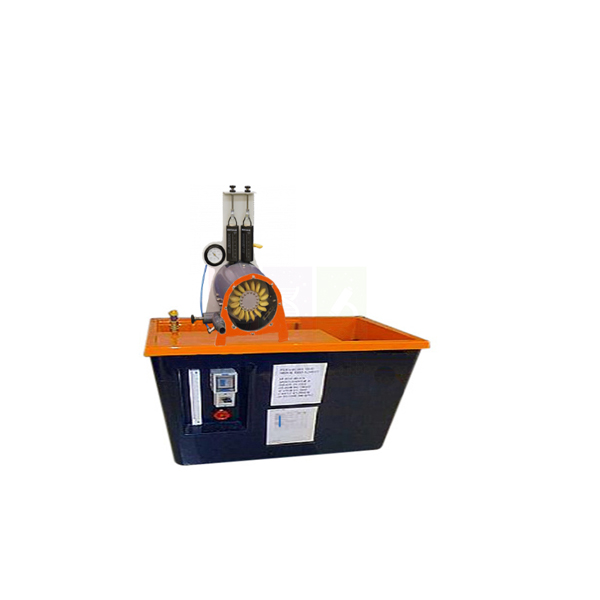
Pelton Turbine Test Rig
Pelton Turbine Test Rig (Product Code: SLE/MCE/50) is an impulse turbine test unit used to measure torque, speed and power of a Pelton wheel at different nozzle settings in hydraulic machines laboratories. A 123 mm wheel with 16 buckets turns under a transparent cover, driven by a needle-controlled nozzle and loaded by a band brake read on spring balances. It is made by Jain Scientific Equipments Pvt Ltd (ScienceLab), an OEM manufacturer of fluid mechanics lab equipment in India, at its own factory in Ambala.
Specifications
| Parameter | Detail |
|---|---|
| Turbine type | Pelton (impulse) wheel; jet deflected by approx. 180° in the buckets |
| Pelton wheel diameter | 123 mm |
| Number of buckets | 16 |
| Nozzle | Adjustable nozzle needle to change the cross-section and flow rate |
| Brake power | 10 W |
| Torque measurement | Band brake with spring balances; force balance range 0 to 20 N x 0.2 N |
| Speed | 0 to 2000 rpm, non-contact speed sensor |
| Pressure gauge range | 0 to 25 m H2O |
| Viewing | Transparent cover over the wheel and nozzle |
| Power required | 230 V, 50 Hz, 1 phase |
| Dimensions | 1000 x 800 x 1200 mm |
| Weight | Approx. 90 kg |
| Product code | SLE/MCE/50 |
| Manufacturer | Jain Scientific Equipments Pvt Ltd (ScienceLab) — OEM |
| Country of origin | India (made in Ambala, Haryana) |
What Is the Pelton Turbine Test Rig Used For?
Pelton wheels are chosen for high-head, low-flow hydro sites, and their operating principle is easy to see on this rig. The water jet is accelerated in the nozzle, strikes the buckets tangentially and is turned back by about 180°, handing its momentum to the wheel. Through the transparent cover students can watch the jet split in each bucket as the needle opens or closes the nozzle.
A standard test holds the nozzle setting constant while the band brake is tightened step by step; the spring balance difference gives brake force, the non-contact sensor gives speed, and the product of torque and speed gives brake power. Plotting power and torque against speed shows the peak near half the jet velocity, and repeating at other needle positions shows part-load behaviour. The 0.2 N resolution of the force balance helps students capture small changes at light load.
OEM Manufacturer
ScienceLab is how Jain Scientific Equipments Private Limited trades, and the company is the OEM (original equipment manufacturer) of the Pelton Turbine Test Rig. The wheel housing, nozzle assembly, brake arrangement and frame are made at its own licensed factory at Saha, Ambala, Haryana, India, and each rig leaves the factory ready for laboratory installation.
Institutions, dealers and importers buy direct from the manufacturer, so replacement brake bands, spring balances or a spare nozzle needle can be requested from the people who built the rig — just ask us. Find out more on the ScienceLab company profile.
Related Fluid Mechanics Equipment
Impulse and reaction turbine equipment that complements this rig:
- Impact of a Jet Apparatus — measures jet force on flat, curved and hemispherical targets, the theory behind Pelton buckets.
- Demonstration Pelton Turbine — a smaller Pelton unit for introductory demonstrations.
- Pelton Wheel (Turbine) — an impulse turbine with a variable spear jet and viewing window.
- Demonstration Francis Turbine — a reaction turbine for comparing the two turbine families.
Visit the Fluid Mechanics category for more turbines, pumps and flow apparatus.
Frequently Asked Questions
What does the Pelton Turbine Test Rig measure?
The Pelton Turbine Test Rig measures brake force on spring balances with a 0 to 20 N x 0.2 N range, wheel speed from 0 to 2000 rpm with a non-contact sensor, and water pressure on a 0 to 25 m H2O gauge.
How is the water flow to the wheel controlled?
On the Pelton Turbine Test Rig, the nozzle needle is adjusted to change the nozzle cross-section and therefore the flow rate. This lets students compare turbine performance at full and part flow with the same wheel.
What size is the Pelton wheel?
The Pelton Turbine Test Rig uses a Pelton wheel of 123 mm diameter with 16 buckets. The buckets deflect the water jet by approximately 180°, transferring the impulse of the jet to the wheel.
What is the brake power of the rig?
The Pelton Turbine Test Rig is specified with a brake power of 10 W. Brake power is calculated from the band brake torque, found from the spring balance readings, and the wheel speed measured by the non-contact sensor.
What supplies does the Pelton Turbine Test Rig need?
The Pelton Turbine Test Rig requires a 230 V, 50 Hz, single-phase power supply. The water supply arrangement for your laboratory should be confirmed at quotation, so describe your set-up on the contact page.
Who manufactures the Pelton Turbine Test Rig?
The Pelton Turbine Test Rig is manufactured by Jain Scientific Equipments Pvt Ltd (ScienceLab), the OEM, at its own factory in Ambala, Haryana, India, and quotations are issued directly by the manufacturer.
Request a Quote
Request a quotation for the Pelton Turbine Test Rig (SLE/MCE/50) through the contact page or the enquiry cart. The manufacturer quotes directly for single rigs and multi-unit laboratory orders in India and international markets.
Last updated: 24 September 2026
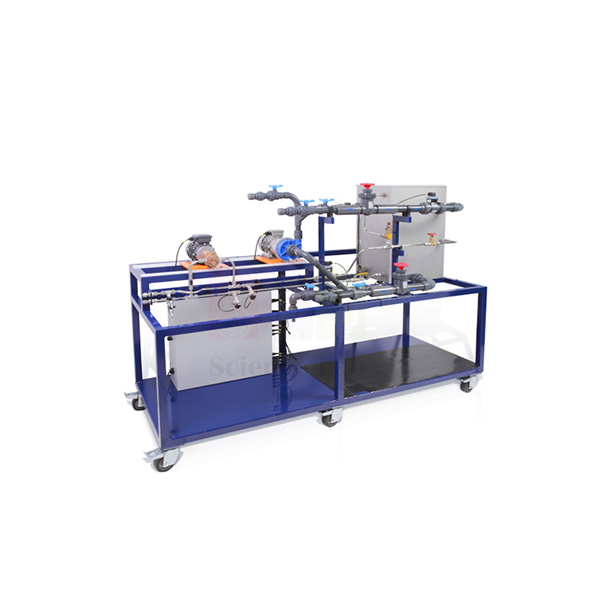
Multi Pump Test Rig
Multi Pump Test Rig (Product Code: SLE/MCE/51) is a pump trainer used to examine a three-head multi pump and the effect of counter pressure on flow rate and mixing ratio in fluid mechanics and process engineering laboratories. Each head has its own stroke adjustment and overflow valve, draws from a shared 60 L feed tank and delivers up to 18 L/h into a scaled measuring tank. It is made by Jain Scientific Equipments Pvt Ltd (ScienceLab), an OEM manufacturer, at its own factory in Ambala, India.
Specifications
| Parameter | Detail |
|---|---|
| Pump | Multi pump with 3 heads |
| Flow rate | 3 x 0 to 18 L/h |
| Stroke rate | 1 x 0 to 100 strokes/min, common to all 3 heads, set at the switch box |
| Stroke length | Individually adjustable for each head |
| Counter pressure | Three overflow valves, one per head; adjustable pressure range 2 to 6 bar |
| Maximum head | Approx. 10 m |
| Maximum suction head | Approx. 3 m |
| Delivery-side pressure | 3 x 0 to 10 bar |
| Intake-side pressure | 3 x -1 to 0 bar |
| Feed tank | 60 L (1 tank) |
| Flow measuring tank | 5 L volumetric tank with scale; level 3 x 0 to 20 cm |
| Power supply | 230 V, 50 Hz, 1 phase |
| Dimensions | 1250 x 500 x 950 mm |
| Weight | Approx. 90 kg |
| Product code | SLE/MCE/51 |
| Manufacturer | Jain Scientific Equipments Pvt Ltd (ScienceLab) — OEM |
| Country of origin | India (made in Ambala, Haryana) |
What Is the Multi Pump Test Rig Used For?
In water treatment, chemical dosing and food processing, several liquids often have to be pumped in a fixed proportion, and multi-head pumps sharing one drive are a common way to do it. This rig lets students test how well that proportion holds. Each head carries water from the feed tank into its own scaled tank, so the delivered volume of every head can be read at the same time.
Students first set a common stroke rate at the switch box and trim the stroke of each head to reach a chosen ratio. They then raise the counter pressure on one head with its overflow valve, watch the delivery and intake manometers, and see how its flow — and therefore the mixing ratio — drifts. As lab equipment for technical institutes, it gives students a clear, hands-on link between pump theory and real dosing practice.
What to Specify When Ordering
- Electrical supply: 230 V, 50 Hz, single phase.
- Floor or bench space for the 1250 x 500 x 950 mm unit, approx. 90 kg.
- Confirmation of the manometer arrangement on the intake and delivery sides for your syllabus.
- Number of rigs and delivery location.
OEM Manufacturer
Jain Scientific Equipments Private Limited, operating as ScienceLab, is the OEM (original equipment manufacturer) of the Multi Pump Test Rig. The frame, feed and measuring tanks, pipework and switch box installation are completed at the company's own licensed factory at Saha, Ambala, Haryana, India.
Since the rig is supplied by its maker, the same team handles your quotation, any later request for spare overflow valves or manometers, and repeat orders for extra benches — ask us. Colleges, training institutes, dealers and importers are supplied factory-direct; visit the ScienceLab company profile.
Related Fluid Mechanics Equipment
Other positive displacement and pump trainers, plus a simple volume check:
- Computerized Reciprocating Pump Test Apparatus — follows a single piston stroke on a p-V diagram.
- Computerized Gear Pump Test Rig — a rotary positive displacement pump with software-logged efficiencies.
- Submersible Pump Test Rig — a rotodynamic pump for contrasting flow behaviour.
- Glass Measuring Cylinder — for cross-checking small delivered volumes.
The Fluid Mechanics category lists every pump and hydraulics trainer in the range.
Frequently Asked Questions
What does the Multi Pump Test Rig demonstrate?
The Multi Pump Test Rig demonstrates how a pump with three heads behaves, and in particular how counter pressure set on each head affects its flow rate and the mixing ratio between the heads.
How are the three pump heads adjusted?
On the Multi Pump Test Rig, a common stroke rate of 0 to 100 strokes per minute is set for all three heads at the switch box, while the stroke of each head is adjusted individually. Three overflow valves set counter pressure between 2 and 6 bar.
How is the flow of each head measured?
Each head of the Multi Pump Test Rig delivers water from the 60 L feed tank into a tank with a scale, and the level readings of 0 to 20 cm give the volume pumped. Each head delivers from 0 to 18 L/h.
What pressure ranges do the manometers cover?
The Multi Pump Test Rig measures delivery-side pressure from 0 to 10 bar and intake-side pressure from -1 to 0 bar for each of its three heads, so students can relate flow changes directly to the pressures acting on each head.
What are the size and power requirements?
The Multi Pump Test Rig measures 1250 x 500 x 950 mm, weighs approximately 90 kg and runs on a 230 V, 50 Hz, single-phase supply. Its maximum head is approximately 10 m and maximum suction head approximately 3 m.
Who manufactures the Multi Pump Test Rig?
The Multi Pump Test Rig is manufactured by Jain Scientific Equipments Pvt Ltd (ScienceLab), the OEM, at its own factory in Ambala, Haryana, India, and it is supplied factory-direct with quotations from the manufacturer.
Request a Quote
For a quotation on the Multi Pump Test Rig (SLE/MCE/51), contact us through the contact page or add it to the enquiry cart. Quotations are issued directly by the manufacturer to institutions, dealers and importers.
Last updated: 24 September 2026