- Physics Lab Equipment
- Chemistry Lab Equipment
- Biology Lab Equipment
- Anatomical Lab Equipment
- Learning
- Educational Lab Equipment
- Magnets
- Agriculture
- Astronomy
- Earth Science
- Geography Lab Equipment
- Safety Lab Coat
- Laboratory
- Meteorological
- Electricity & Magnetism
- Heat
- School Lab Equipment
- Lab Glassware
- Science Lab Equipment
- Tvet Lab Equipment
- Robotics Kits Supplier and Manufacturer for Schools India
- Math Lab Equipment Manufacturers and Exporters in Ambala
- STEM Kits Manufacturers and Supplier India
- Engineering Lab Equipment
- Hospital Lab Equipment
- Water, Sanitation & Hygiene Supplies
- Cold Chain, Solar & Communication Equipment
- Nutrition

Bending Moment Apparatus
Bending Moment Apparatus (Product Code: SLE/MCE/23) is a hinged-beam test rig used to measure the shear force and bending moment at a beam section under different loads in strength of materials and structures laboratories. Its 1 m span teak wood beam is made of long and short sections joined by a hinge, and spring balances with adjusting screws measure the internal forces while a spirit level returns the beam to its original position. It is made by Jain Scientific Equipments Pvt Ltd (ScienceLab), an OEM manufacturer, at its own factory in Ambala, India.
Key Details
| Parameter | Detail |
|---|---|
| Beam | Teak wood; long and short sections connected by a hinge |
| Span | 1 m, with supports |
| Loading | Weight set with loading hangers |
| Bending moment measurement | Spring balance with adjusting screw, mounted at a fixed distance |
| Shear force measurement | Spring balance with adjustable screw, at the hinge section |
| Levelling | Spirit level to restore the loaded beam to its original position |
| Range of experiments | Shear force and bending moment for different loading conditions; influence line diagrams for bending moment and shear force |
| Documentation | Technical manual accompanies the unit |
| Product code | SLE/MCE/23 |
| Manufacturer | Jain Scientific Equipments Pvt Ltd (ScienceLab) — OEM |
| Country of origin | India (made in Ambala, Haryana) |
What Is the Bending Moment Apparatus Used For?
Shear force and bending moment diagrams are central to beam design, yet students rarely see those internal forces measured. Here the beam is divided at a section and bridged by a hinge, so the forces at that section have to be carried by the spring balance arrangements. After hanging loads at chosen positions, students turn the adjusting screw until the spirit level shows the beam back in its original position, read the spring balance and use the fixed lever distance to work out the bending moment; a similar reading at the hinge gives the shear force.
Comparing these measured values with hand calculations from statics confirms the theory for loads at different positions. Moving a single load step by step across the span and plotting the reading at the section builds the influence line diagram, a topic civil and mechanical students often find abstract on paper. With the technical manual guiding each experiment, it is practical engineering lab equipment for colleges and polytechnics in India.
OEM Manufacturer
The Bending Moment Apparatus is manufactured by ScienceLab as the OEM. Jain Scientific Equipments Private Limited, the registered company behind the ScienceLab brand, makes it at its own licensed factory at Saha, Ambala, Haryana, India, and supplies it factory-direct to engineering colleges, polytechnics, dealers and importers.
Ask us about repeat orders, additional loading hangers or spare spring balances; the manufacturer handles these requests itself. The ScienceLab company profile has more details.
Related Laboratory Equipment
Beam and structures apparatus that fits the same strength of materials syllabus:
- Bending Moments In a Beam — a further bending moment experiment for extra student groups.
- Equilibrium Of A Beam — support reactions and moments, the step before internal forces.
- Deflection of Beams and Cantilevers — how the same load cases bend a beam.
- Cantilever Beam Apparatus — moments on an L-shaped cantilever frame.
Browse General Products for more structures and mechanics equipment.
Frequently Asked Questions
What experiments can be done with the Bending Moment Apparatus?
The Bending Moment Apparatus is used to determine shear force and bending moment at a beam section for different loading conditions, and to draw influence line diagrams for bending moment and shear force by moving a load across the span.
What is the beam of the Bending Moment Apparatus made of?
The Bending Moment Apparatus uses a teak wood beam with a 1 m span on supports. The beam is made of long and short sections connected by a hinge, which is where the shear force is measured.
How are forces measured on the Bending Moment Apparatus?
The Bending Moment Apparatus measures bending moment with a spring balance and adjusting screw mounted at a fixed distance, and shear force with a spring balance and adjustable screw at the hinge section. A spirit level confirms the beam is restored to its original position.
Which weights are supplied with the Bending Moment Apparatus?
The Bending Moment Apparatus comes with a weight set and loading hangers, but the individual mass values are not stated in the product listing. Ask through our contact page and the quotation will list the weights included.
Does the Bending Moment Apparatus include instructions?
Yes. A technical manual accompanies the Bending Moment Apparatus, so staff can set up each shear force, bending moment and influence line experiment and guide students through the readings and calculations.
Who manufactures the Bending Moment Apparatus?
The Bending Moment Apparatus is manufactured by Jain Scientific Equipments Pvt Ltd (ScienceLab), the OEM, at its own licensed factory at Saha, Ambala, Haryana, India. Quotations for India and international markets come direct from the manufacturer.
Request a Quote
Ask for a quotation on the Bending Moment Apparatus (SLE/MCE/23) through our contact page, or add it to the enquiry cart with your quantity and delivery location. The manufacturer replies directly.
Last updated: 24 September 2026
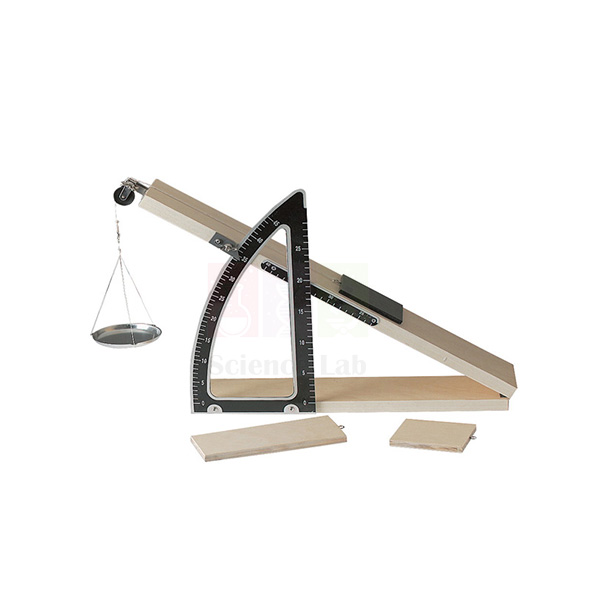
Friction Slide Apparatus
Friction Slide Apparatus (Product Code: SLE/MCE/24) is a bench-top inclined-plane apparatus used to measure the coefficient of friction between pairs of materials in mechanics and theory of machines laboratories. Its ground steel plane locks at any angle within ±45° on a protractor scale, and two composite slider trays let students compare aluminium, steel, nylon and brass surfaces. It is made by Jain Scientific Equipments Pvt Ltd (ScienceLab), an OEM manufacturer, at its own factory in Ambala, India.
Specifications
| Parameter | Detail |
|---|---|
| Construction | Compact bench-top unit with sturdy aluminium base plate, non-slip feet and central vertical pillar |
| Plane | Ground steel plane pivoting on the base |
| Angle range | Lockable at any angle between ±45° |
| Angle indication | Semi-circular protractor scale |
| Slider trays | Two composite trays: one with aluminium and steel faces, one with nylon and brass faces |
| Loading | Weight hanger with added weights; trays also accept additional weight |
| Cord guidance | Hanger cord passes over a pulley and bearing that reduce friction for accurate results |
| Product code | SLE/MCE/24 |
| Manufacturer | Jain Scientific Equipments Pvt Ltd (ScienceLab) — OEM |
| Country of origin | India (made in Ambala, Haryana) |
What Is the Friction Slide Apparatus Used For?
Each slider tray is tied to a weight hanger by a cord that runs over the pulley, and weights are added until the tray just begins to slide up the steel plane. The hanging load at that moment, compared with the tray's weight and the plane angle, gives the coefficient of static friction for that material pair. Loading extra weight into the tray shows students that friction force rises in proportion to the normal force.
Because the plane locks anywhere within ±45°, the same set-up doubles as an exercise in equilibrium of forces on an inclined plane apparatus, resolving weight into components along and normal to the surface. Keep the steel plane and tray faces clean and dry, start each trial from the same position and repeat readings to average out scatter. It is compact mechanics lab equipment in India that suits both engineering and senior physics classes.
What to Specify When Ordering
- Number of units for your student groups
- Weights for the hanger and trays — confirm with us what is included and what you need added
- Delivery destination in India or abroad
OEM Manufacturer
The Friction Slide Apparatus is made by Jain Scientific Equipments Private Limited, the company that trades as ScienceLab and acts as OEM (original equipment manufacturer) for its theory of machines range. Production takes place at its own licensed factory at Saha, Ambala, Haryana, India, and units go factory-direct to engineering colleges, polytechnics, schools, dealers and importers.
For institutional buyers completing vendor registration, the company's GSTIN is 06AAECJ8618A1ZT and its LEI is 3358004HRD1JIVXKYX49. Spare slider trays, cords or repeat sets can be requested from the manufacturer directly — ask us. More on the ScienceLab company profile.
Related Theory of Machines Equipment
These items widen a friction practical or continue the mechanics sequence:
- Static and Kinetic Friction Tester — a motor-driven tester that displays static and kinetic friction values.
- Inclined Plane Tester — another inclined-plane approach to friction measurement.
- Friction Demonstration Device (Tribometer) — a simple classroom demonstration of sliding friction.
- Hangers with Slotted Weights — for adding load to the hanger in steps.
See more in Theory of Machines.
Frequently Asked Questions
What does the Friction Slide Apparatus measure?
The Friction Slide Apparatus measures the coefficient of friction between a slider tray and a ground steel plane by finding the hanging load that just starts the tray moving. It also works as an exercise in equilibrium of forces on an incline.
Which materials can be compared on the Friction Slide Apparatus?
The Friction Slide Apparatus comes with two composite slider trays, one with aluminium and steel faces and one with nylon and brass faces. Each slides on the ground steel plane, so four material pairings can be compared in one practical.
What angles can the Friction Slide Apparatus plane be set to?
The steel plane of the Friction Slide Apparatus pivots on its base and can be locked at any angle between ±45°. The angle is read on a semi-circular protractor scale mounted on the unit.
How does the Friction Slide Apparatus keep results accurate?
The Friction Slide Apparatus runs the hanger cord over a pulley and bearing that reduce friction in the pulling system, so the hanging load reflects friction at the tray. Its aluminium base with non-slip feet keeps the unit steady on the bench.
Who manufactures the Friction Slide Apparatus?
The Friction Slide Apparatus is manufactured by Jain Scientific Equipments Pvt Ltd (ScienceLab), the OEM, at its own licensed factory in Saha, Ambala, Haryana, India. Quotations and after-sales questions go straight to the manufacturer.
Are weights included with the Friction Slide Apparatus?
The listing for the Friction Slide Apparatus confirms a weight hanger system but does not detail the weight set. Ask through the contact page and the quotation will state exactly which weights are supplied.
Request a Quote
Ask the manufacturer directly for a Friction Slide Apparatus quotation through the ScienceLab contact page, or add it to the enquiry cart. Mention quantity, any weights required and the delivery location.
Last updated: 24 September 2026
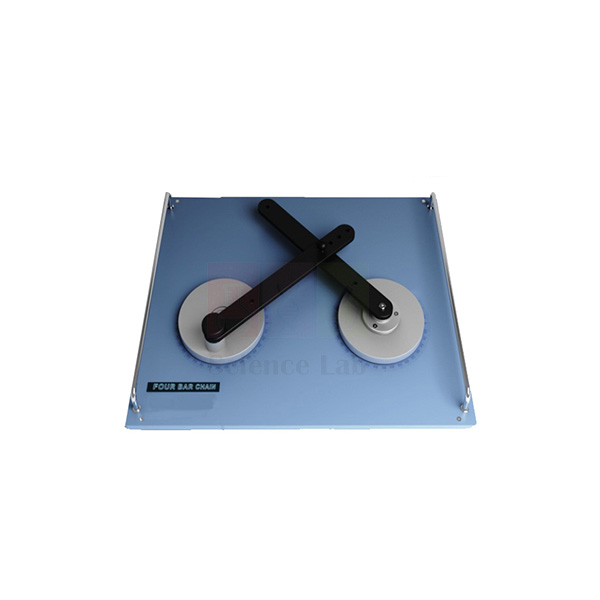
Four Bar Chain Apparatus
Four Bar Chain Apparatus (Product Code: SLE/MCE/25) is a kinematics teaching unit used to show how a four-bar linkage converts uniform continuous rotation into non-uniform rotation or oscillation, in theory of machines laboratories. Students reposition its pivot joints to change crank radius, oscillation radius and coupling length, then read input and output angles on built-in scales to compare crank-rocker, double rocker and double crank mechanisms. It is made by Jain Scientific Equipments Pvt Ltd (ScienceLab), an OEM manufacturer, at its own factory in Ambala, India.
Key Details
| Parameter | Detail |
|---|---|
| Mechanism | Four-bar linkage (four-joint link) with elements connected by pivot joints |
| Motion conversion | Uniform rotation into non-uniform rotation or oscillation; rotary into oscillating motion |
| Input side | Drive disk with crank and coupling; disc with angular scale for the exact input angle |
| Output side | Output disk with rocker; output angle read on its angle scale |
| Adjustments | Pivot positions vary crank radius, oscillation radius and coupling length; crank pin locates at different radii |
| Mechanisms studied | Crank-rocker, double rocker and double crank |
| Mounting | Elements on a base plate with an integrated angle scale |
| Handling | Two handles for easy carrying and stacking |
| Product code | SLE/MCE/25 |
| Manufacturer | Jain Scientific Equipments Pvt Ltd (ScienceLab) — OEM |
| Country of origin | India (made in Ambala, Haryana) |
What Is the Four Bar Chain Apparatus Used For?
Four-bar linkages sit inside windscreen wipers, rocking conveyors, pump jacks and countless machine mechanisms, and this unit lets students see exactly how one works. The class turns the drive disk in equal steps, notes the input angle on its scale and reads the matching output angle on the output disk. Plotting output against input reveals the non-uniform motion, the limits of oscillation and the dead-centre positions of the linkage.
Changing the pivot positions then shows how link proportions decide whether the linkage behaves as a crank-rocker, double rocker or double crank — the Grashof condition taught in lectures. Work gently near the extreme positions, tighten the pivots after each change and keep a sketch of every configuration with its readings. For departments sourcing mechanics lab equipment in India, it is a stackable, portable unit that serves several groups in turn.
OEM Manufacturer
Jain Scientific Equipments Private Limited, trading as ScienceLab, is the OEM (original equipment manufacturer) of the Four Bar Chain Apparatus. It is produced and assembled at the company's own licensed factory at Saha, Ambala, Haryana, India, and supplied factory-direct to engineering colleges, polytechnics, technical training institutes, dealers and importers.
Because you deal with the maker, questions about link parts, pivots or matching units for additional benches get answered at source — just ask us. See the ScienceLab profile for company details.
Related Theory of Machines Equipment
These units continue the kinematics topics that start with the four-bar chain:
- Cam Mechanism — another way to turn rotation into follower motion.
- Cam Analysis Machine — deeper study of cam and follower behaviour.
- Corollis Component of Acceleration Apparatus — takes link kinematics on to acceleration analysis.
- Gear Trainer Demonstrator — compares linkage motion with transmission through gears.
Browse the full Theory of Machines category.
Frequently Asked Questions
What does the Four Bar Chain Apparatus demonstrate?
The Four Bar Chain Apparatus demonstrates how a four-bar linkage converts uniform continuous rotation into non-uniform rotation or oscillation. Students measure input and output angles to see the motion relationship for different link arrangements.
Which mechanisms can be set up on the Four Bar Chain Apparatus?
The Four Bar Chain Apparatus can be arranged as a crank-rocker mechanism, a double rocker mechanism or a double crank. Moving the pivot joints changes crank radius, oscillation radius and coupling length to switch between them.
How are angles measured on the Four Bar Chain Apparatus?
On the Four Bar Chain Apparatus, the input angle is set with the drive disk and read on an angular scale, while the output angle is read on the scale of the output disk. Both scales are built into the unit.
Is the Four Bar Chain Apparatus easy to store and move?
Yes. The Four Bar Chain Apparatus has all elements mounted on a base plate with two handles, which make the unit easy to carry between benches and to stack when the practical is finished.
Who manufactures the Four Bar Chain Apparatus?
The Four Bar Chain Apparatus is manufactured by Jain Scientific Equipments Pvt Ltd (ScienceLab), the OEM, at its own licensed factory in Saha, Ambala, Haryana, India. Quotations and follow-up support come directly from the manufacturer.
What should a quotation request for the Four Bar Chain Apparatus include?
A quotation request for the Four Bar Chain Apparatus should state how many units you need, any other theory of machines items you are equipping at the same time, and the delivery location. Send it via the contact page.
Request a Quote
Quotations for the Four Bar Chain Apparatus come direct from the manufacturer. Use the ScienceLab contact page or the enquiry cart, and include quantity and delivery details.
Last updated: 24 September 2026
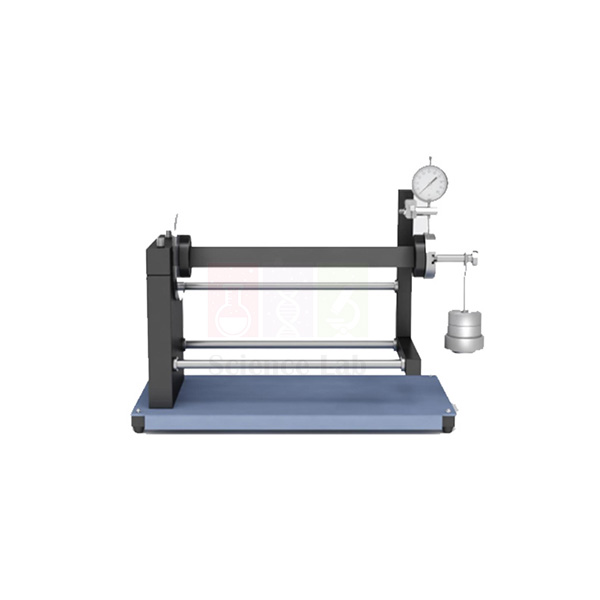
Cantilever Beam Apparatus
Cantilever Beam Apparatus (Product Code: SLE/MCE/26) is an L-shaped stainless steel frame used to study moments and the equilibrium of a loaded cantilever arm in engineering mechanics and structures laboratories. A graduated 75 cm horizontal arm carries a sliding slotted weight set from 100 g to 1 kg, while a 10 kg spring balance holds the arm horizontal under any load. It is made by Jain Scientific Equipments Pvt Ltd (ScienceLab), an OEM manufacturer, at its own factory in Ambala, India.
Specifications
| Parameter | Detail |
|---|---|
| Material | Stainless steel |
| Shape | L-type frame |
| Horizontal arm | 75 cm, graduated |
| Vertical arm | 20 cm |
| Spring balance | 10 kg capacity, keeps the horizontal leg horizontal under any load |
| Weight set | One sliding slotted weight set, 100 g to 1 kg |
| Display | Analog |
| Frequency | 50 Hz |
| Product code | SLE/MCE/26 |
| Manufacturer | Jain Scientific Equipments Pvt Ltd (ScienceLab) — OEM |
| Country of origin | India (made in Ambala, Haryana) |
What Is the Cantilever Beam Apparatus Used For?
Students hang slotted weights at chosen graduations along the 75 cm arm and adjust the spring balance until the arm is exactly horizontal again. Because the arm is level, the lever distances can be read straight from the graduations, and the spring balance reading gives the force needed to hold the loaded arm in equilibrium. Taking moments and comparing the calculated force with the balance reading verifies the principle of moments for a cantilever-type member.
Repeating the test with different weights and positions produces a set of readings for a graph of balance force against applied moment, which should form a straight line. The stainless steel frame stands up well to daily use in a teaching laboratory, and the simple analog reading suits first-year classes. It is a compact addition to mechanics lab equipment in India for civil, mechanical and polytechnic courses; always bring the arm back to horizontal before recording each reading.
OEM Manufacturer
ScienceLab is the OEM for the Cantilever Beam Apparatus. The frame is manufactured by Jain Scientific Equipments Private Limited, trading as ScienceLab, at its own licensed factory at Saha, Ambala, Haryana, India, and is supplied straight from the factory to schools, colleges, dealers and importers.
If you need replacement slotted weights or a spare spring balance later, contact the manufacturer and we will advise. The ScienceLab profile explains more about the company.
Related Laboratory Equipment
Items that support or extend cantilever and moment experiments:
- Bending Moment Apparatus — measures internal shear force and bending moment in a hinged beam.
- Deflection of Beams and Cantilevers — shows how far cantilevers bend under load.
- Force Meter/Spring Balance — an extra spring balance for force readings.
- Slotted Mass Hanger, 1kg — additional loading for more test points.
See the General Products category for further mechanics and structures apparatus.
Frequently Asked Questions
What is the Cantilever Beam Apparatus made of?
The Cantilever Beam Apparatus is an L-type frame made of stainless steel, with a graduated horizontal arm of 75 cm and a vertical arm of 20 cm, so load positions can be read directly from the arm.
What load range does the Cantilever Beam Apparatus cover?
The Cantilever Beam Apparatus comes with one sliding slotted weight set from 100 g to 1 kg for loading the arm, and a spring balance of 10 kg capacity that measures the force holding the arm horizontal.
What does the spring balance on the Cantilever Beam Apparatus do?
On the Cantilever Beam Apparatus, the 10 kg spring balance is used to bring the horizontal leg back to horizontal under any load. Its analog reading then gives the balancing force for the moment calculation.
Which experiments suit the Cantilever Beam Apparatus?
The Cantilever Beam Apparatus suits experiments on the principle of moments and the equilibrium of a loaded arm, where students vary weight and position along the graduated arm and compare the measured balancing force with calculation.
Who manufactures the Cantilever Beam Apparatus?
The Cantilever Beam Apparatus is manufactured by Jain Scientific Equipments Pvt Ltd (ScienceLab), the OEM, at its own licensed factory at Saha, Ambala, Haryana, India. Quotations and spare-part requests are handled directly by the manufacturer.
Can the Cantilever Beam Apparatus be ordered in bulk?
Yes, the Cantilever Beam Apparatus can be quoted for single laboratories or larger institutional and dealer orders in India and international markets. Send the quantity and destination through the contact page for a consolidated quotation.
Request a Quote
To get a price for the Cantilever Beam Apparatus (SLE/MCE/26), write to us through the contact page or add it to the enquiry cart. The quotation comes directly from the manufacturer in Ambala.
Last updated: 24 September 2026
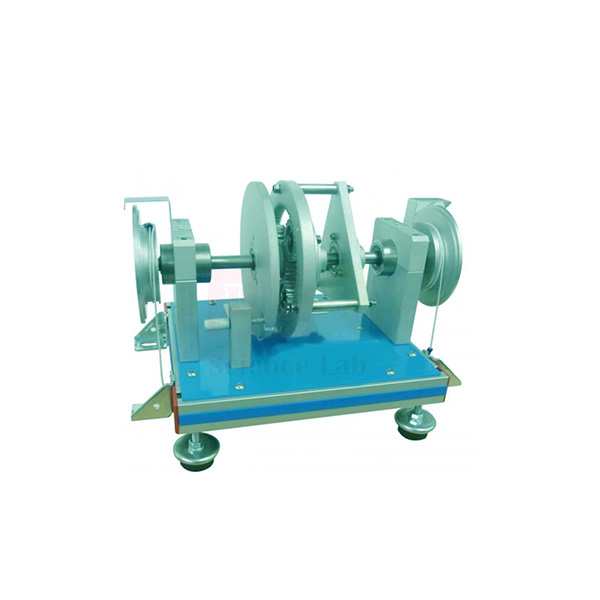
Gear Trainer Demonstrator
Gear Trainer Demonstrator (Product Code: SLE/MCE/27) is a sliding mesh gearbox demonstrator used to teach how gear ratios change speed and torque through a transmission, in automotive and theory of machines laboratories. It represents a typical three forward ratio and reverse sliding mesh box, with protractor pulleys on the input and output shafts so students can determine and verify velocity and torque ratios. It is made by Jain Scientific Equipments Pvt Ltd (ScienceLab), an OEM manufacturer, at its own factory in Ambala, India.
Key Details
| Parameter | Detail |
|---|---|
| Gearbox type | Sliding mesh |
| Ratios | Three forward ratios and reverse |
| Gears | Gear wheels of different sizes |
| Measurement | Pulleys fitted with protractors on the input and output shafts |
| Experiments | Determination and verification of velocity ratio and torque ratio |
| Use | Classroom demonstrations and student laboratory work |
| System expansion | Can be coupled to an Overdrive and Differential to represent a simple transmission system (these units are not listed as included) |
| Product code | SLE/MCE/27 |
| Manufacturer | Jain Scientific Equipments Pvt Ltd (ScienceLab) — OEM |
| Country of origin | India (made in Ambala, Haryana) |
What Is the Gear Trainer Demonstrator Used For?
The sliding mesh box is seldom found on modern cars and survives mainly on heavy commercial vehicles, yet its layout is the one from which most modern gearboxes were developed. That makes it the clearest starting point for students of automobile engineering and machine design. With each ratio engaged in turn, the class turns the input pulley through a measured angle, reads the output rotation on the second protractor and works out the velocity ratio.
Applying known loads at the pulleys then lets students compare torque ratio with velocity ratio and discuss losses between them. Counting teeth to predict each ratio before measuring it is a good check, and the reverse gear shows how an extra gear changes the direction of output rotation. The demonstrator works equally well at the front of a lecture room or on a practical bench, which makes it versatile engineering lab equipment for technical institutes.
What to Specify When Ordering
- Number of demonstrators for lecture and practical use
- Whether you also need an Overdrive and Differential to build a simple transmission — confirm availability with us
- Delivery destination in India or abroad
OEM Manufacturer
Jain Scientific Equipments Private Limited, which trades as ScienceLab, is the OEM (original equipment manufacturer) of the Gear Trainer Demonstrator. The gearbox, pulleys and frame are made and assembled at the company's own licensed factory at Saha, Ambala, Haryana, India, and the unit is supplied factory-direct to engineering colleges, ITIs, polytechnics, dealers and importers.
Buying from the manufacturer means that questions about gear wheels, protractor pulleys or matching units reach the people who build them — ask us whenever needed. Read about the company on the ScienceLab profile.
Related Theory of Machines Equipment
These items extend gear and transmission teaching:
- Gear Train Model — a spur-gear differential train built from two planetary trains.
- Vehicle Transmission 5 Speed Manual Gearbox — a full vehicle gearbox to compare with the sliding mesh layout.
- Differential Gear — the final-drive stage of a vehicle transmission.
- Gear Trains Kit — spur, bevel and worm gears for simple and compound train experiments.
See all items in Theory of Machines.
Frequently Asked Questions
What type of gearbox is the Gear Trainer Demonstrator?
The Gear Trainer Demonstrator represents a typical sliding mesh gearbox with three forward ratios and reverse. It uses gear wheels of different sizes, showing the basic layout from which most modern gearboxes have been developed.
How do students measure ratios on the Gear Trainer Demonstrator?
The Gear Trainer Demonstrator has pulleys fitted with protractors on its input and output shafts. Students rotate the input, read the output rotation on the second protractor and use these readings to determine and verify velocity and torque ratios.
Can the Gear Trainer Demonstrator be used in lectures?
Yes, the Gear Trainer Demonstrator is suited both to classroom demonstrations by the teacher and to hands-on use by students in the laboratory, so one unit can support theory lectures and practical sessions.
Can the Gear Trainer Demonstrator connect to other transmission units?
The Gear Trainer Demonstrator can be coupled to an Overdrive and Differential to represent a simple transmission system. These units are not listed as part of the demonstrator, so ask us about them when you request a quotation.
Who manufactures the Gear Trainer Demonstrator?
The Gear Trainer Demonstrator is manufactured by Jain Scientific Equipments Pvt Ltd (ScienceLab), the OEM, at its own licensed factory in Saha, Ambala, Haryana, India. Buyers receive quotations and after-sales answers directly from the manufacturer.
Does ScienceLab supply the Gear Trainer Demonstrator for export?
Yes, ScienceLab supplies the Gear Trainer Demonstrator to institutions and dealers in India and international markets. Share quantity and destination through the contact page and the manufacturer will prepare a quotation.
Request a Quote
Request a Gear Trainer Demonstrator quotation direct from the manufacturer through the ScienceLab contact page, or add it to the enquiry cart. Mention whether you also need the Overdrive and Differential.
Last updated: 24 September 2026
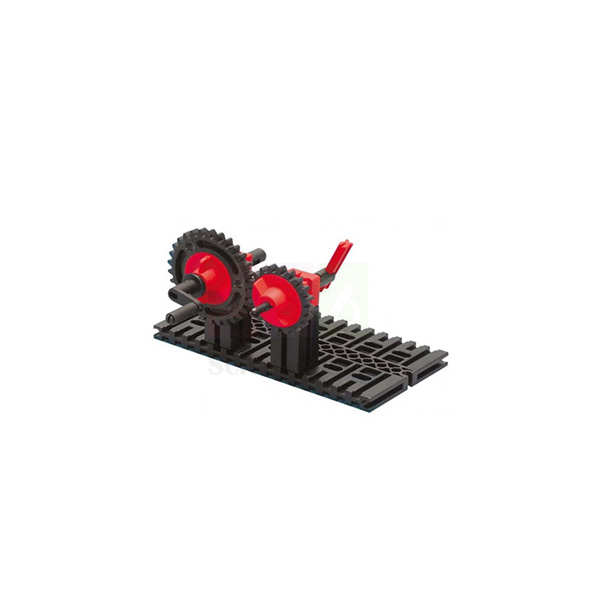
Gear Train Model
Gear Train Model (Product Code: SLE/MCE/28) is a mechanism model used to demonstrate a differential gear train built entirely from spur gears, in theory of machines and automobile engineering laboratories. It combines two planetary gear trains whose sun gears are coaxial, so students can hold either wheel and watch how the remaining gears keep turning. It is made by Jain Scientific Equipments Pvt Ltd (ScienceLab), an OEM manufacturer, at its own factory in Ambala, India.
Key Details
| Parameter | Detail |
|---|---|
| Mechanism | Differential gear train |
| Gear type | All spur gears |
| Arrangement | Combination of two planetary gear trains with coaxial sun gears |
| Both wheels free | With the mechanism driven, all spur gears run |
| Right wheel held | Right sun gear becomes fixed; the other gears still rotate |
| Left wheel held | Left sun gear becomes fixed; the other gears still rotate |
| Application shown | Situations that require two controllable inputs |
| Product code | SLE/MCE/28 |
| Manufacturer | Jain Scientific Equipments Pvt Ltd (ScienceLab) — OEM |
| Country of origin | India (made in Ambala, Haryana) |
What Is the Gear Train Model Used For?
A differential lets two outputs turn at different speeds from one input, which is why a vehicle's wheels can take a corner without scrubbing. Textbook diagrams can make this hard to picture; this model shows the same function with spur gears only, arranged as two planetary trains sharing a common axis. Holding one wheel fixes its sun gear, and students can watch the other gears keep turning and relate what they see to the kinematic equations of planetary trains.
A good exercise is to drive the model slowly, count output turns with one wheel held and then the other, and compare the results with calculated values. The model also illustrates mechanisms that need two controllable inputs, a topic that links theory of machines with robotics and control. Handle it at low speed and keep fingers clear of meshing gears. It is well suited as engineering lab equipment for demonstration tables and student practicals alike.
OEM Manufacturer
The Gear Train Model is manufactured by Jain Scientific Equipments Private Limited (CIN U29309HR2020PTC087597), which trades as ScienceLab and is the OEM (original equipment manufacturer) of this model. Production takes place at the company's licensed factory at 449, HSIIDC Industrial Area, Saha, Ambala, Haryana (Factory Licence AMB-ONLINE-CHD-J-414).
Colleges, training institutes, dealers and importers buy it factory-direct, so quotations, repeat orders and questions about replacement gears are handled by the manufacturer — ask us. More background is on the ScienceLab company profile.
Related Theory of Machines Equipment
Pair the model with these items when teaching gear trains and transmissions:
- Gear Trainer Demonstrator — a sliding mesh gearbox for velocity and torque ratio work.
- Cut Model Of Planetary Gear System — a sectioned planetary set for comparing gear layouts.
- Differential Gear — relates the model to a real vehicle differential.
- Internal Gear Pinion Drive — shows internal gearing of the kind used in ring gears.
Explore more in Theory of Machines.
Frequently Asked Questions
What mechanism does the Gear Train Model show?
The Gear Train Model shows a differential gear train in which all the gears are spur gears. It is built as a combination of two planetary gear trains whose two sun gears are coaxial, demonstrating differential action without bevel-gear complexity.
What happens when one wheel of the Gear Train Model is held?
When the right wheel of the Gear Train Model is held, the right sun gear becomes fixed while the other gears can still rotate; holding the left wheel fixes the left sun gear in the same way. With both wheels free, all spur gears run.
Where is the principle of the Gear Train Model applied?
The Gear Train Model illustrates mechanisms for situations that require two controllable inputs, as well as the familiar vehicle differential. Students can link its behaviour to planetary gear train theory covered in theory of machines courses.
Who manufactures the Gear Train Model?
The Gear Train Model is manufactured by Jain Scientific Equipments Pvt Ltd (ScienceLab), the OEM, at its own licensed factory in Saha, Ambala, Haryana, India. Quotations and after-sales support come directly from the manufacturer.
Is the Gear Train Model suitable for classroom demonstration?
Yes, the Gear Train Model is a demonstration mechanism that a teacher can operate in front of a class or students can study at a practical bench. Run it at low speed so everyone can follow the motion of each gear.
What should a quotation request for the Gear Train Model include?
A quotation request for the Gear Train Model should state the quantity, any related theory of machines items you are ordering and the delivery location. Send it through the contact page and the manufacturer will respond.
Request a Quote
Quotations for the Gear Train Model come direct from the manufacturer. Contact us through the ScienceLab contact page or add the model to the enquiry cart with your quantity and delivery details.
Last updated: 24 September 2026
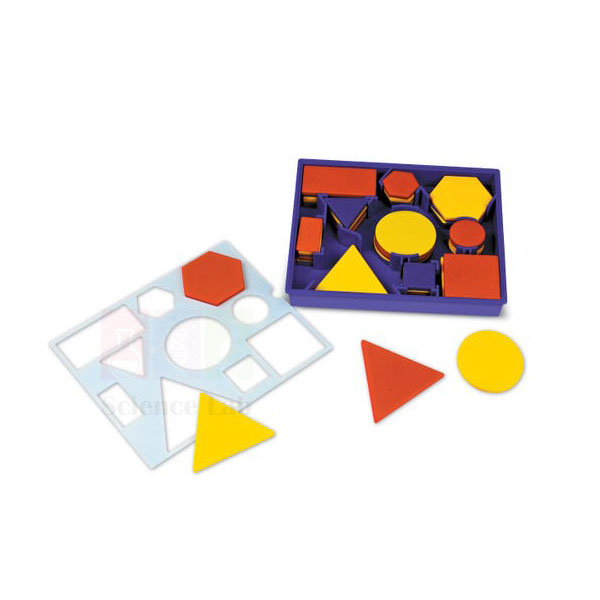
Attribute Blocks Desk Set
Attribute Blocks Desk Set (Product Code: SLE/LMS/01) is a sixty-piece set of plastic attribute blocks used to teach shapes, sorting, patterns, size and counting in primary and middle school maths lessons. The blocks come in five shapes, two sizes, two thicknesses and three colours, packed in a storage tray whose shape sorter doubles as a tracing template. Part of our mathematics lab kits for India and abroad, it is made by Jain Scientific Equipments Pvt Ltd (ScienceLab), an OEM manufacturer, at its own factory in Ambala, India.
Specifications
| Parameter | Detail |
|---|---|
| Pieces | Sixty |
| Attributes | Five shapes, two sizes, two thicknesses, three colours |
| Material | Plastic |
| Storage | Tray with shape sorter that can be used for tracing |
| Teaching focus | Shapes, sorting, patterns, size and counting |
| Product code | SLE/LMS/01 |
| Manufacturer | Jain Scientific Equipments Pvt Ltd (ScienceLab) — OEM |
| Country of origin | India (made in Ambala, Haryana) |
What Is the Attribute Blocks Desk Set Used For?
Each block differs from the others in four attributes, shape, size, thickness and colour, and with sixty pieces every combination appears exactly once, which makes the set well suited to logical sorting. Children group blocks by one attribute and then by two, build "one-difference" trains where each block changes in only one way from the last, and describe pieces precisely, such as "the thick, large, red one". The same blocks support counting, comparing sizes and repeating patterns.
The shape sorter in the storage tray gives every piece a place to go, so packing away becomes a matching task in itself, and pupils can trace the sorter openings to draw shapes in their notebooks. For group work, split the blocks between tables and ask each group to invent a sorting rule for the others to guess. Wipe the plastic blocks with a damp cloth to keep them clean between classes.
OEM Manufacturer
Jain Scientific Equipments Private Limited, trading as ScienceLab, is the OEM (original equipment manufacturer) of the Attribute Blocks Desk Set and produces it at its licensed factory at Saha, Ambala, Haryana. Schools, teacher-training institutes, dealers and importers in India and international markets order it factory-direct, often as part of a complete mathematics lab, and every quotation comes straight from the manufacturer. Ask us about replacement pieces or repeat orders for sets already in use. See our company profile.
Related Middle School Learning Aids
Manipulatives that extend sorting, pattern and counting work:
- Attribute Blocks — the maths lab version to compare
- Sorting Ring — for Venn-style sorting of the blocks
- Plastic Pattern Blocks — for pattern and tiling activities
- Linking Cubes — for counting and early measurement
- Blocks (50Pcs) — snap-on cubes from the same range
Browse the Middle School category, or the wider Maths Lab Equipment range.
Frequently Asked Questions
How many pieces are in the Attribute Blocks Desk Set?
The Attribute Blocks Desk Set (SLE/LMS/01) has sixty plastic blocks covering five shapes, two sizes, two thicknesses and three colours. Five times two times two times three gives sixty, so each combination of attributes appears once in the set.
What is the storage tray of the desk set for?
The Attribute Blocks Desk Set comes in a storage tray with a shape sorter. Pupils return each block to its matching opening when packing up, and the sorter can also be used as a template for tracing shapes onto paper.
Which shapes and colours are in the Attribute Blocks Desk Set?
The Attribute Blocks Desk Set includes five shapes in three colours, but the listing does not name them. If your lesson plan needs particular shapes or colours, ask us through the contact page to confirm the exact set before ordering.
Which maths skills do attribute blocks support?
The Attribute Blocks Desk Set is used to teach shapes, sorting, patterns, size and counting. Classifying by several attributes also builds logical reasoning and precise mathematical vocabulary, which helps pupils later with sets, Venn diagrams and data handling.
Who manufactures the Attribute Blocks Desk Set?
Jain Scientific Equipments Pvt Ltd (ScienceLab) manufactures the Attribute Blocks Desk Set as the OEM at its licensed factory at Saha, Ambala, Haryana, India. Schools, dealers and importers in India and international markets can order it direct from the manufacturer.
What should a quotation request for the desk set include?
A quotation request for the Attribute Blocks Desk Set should give product code SLE/LMS/01, the number of desk sets (for example one per group of pupils), your delivery location and any other maths manipulatives you want quoted with it.
Request a Quote
Quotations for the Attribute Blocks Desk Set come direct from the manufacturer: send the number of sets and delivery details through our contact page, or add it to the enquiry cart with other maths lab items.
Last updated: 24 September 2026
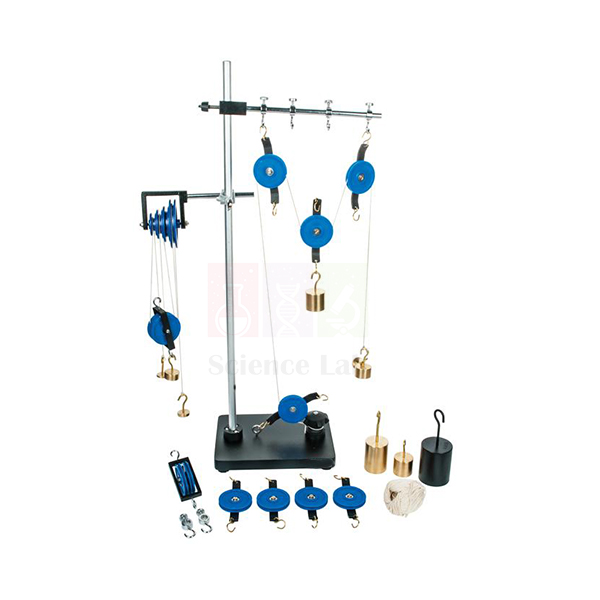
Pulley Demonstration Set
Pulley Demonstration Set (Product Code: SLE/MCE/29) is a free-standing pulley rig used to demonstrate mechanical advantage, velocity ratio and efficiency with fixed and movable pulleys in school and college mechanics laboratories. Physics teachers and engineering instructors use it to build anything from a single pulley to quadruple-sheave systems on three 81 cm steel rods, loaded with brass slotted masses. It is made by Jain Scientific Equipments Pvt Ltd (ScienceLab), an OEM manufacturer, at its own factory in Ambala, India, as a complete pulley system lab set in one order.
Specifications
| Parameter | Detail |
|---|---|
| Overall height | 32 inches (approx. 81 cm) |
| Base | Wooden base 81 x 20 cm (7.8 inches wide), fitted with 2 sockets, a capstan and an eye hook |
| Rods | 3 steel rods, 12.5 mm diameter, 81 cm long |
| Pulleys | 8 single, 2 triple tandem, 2 quadruple |
| Rod fittings | 8 collars with hook; 3 right-angled clamps |
| Wheel and axle | 1 |
| Tool | 1 tommy bar for tightening the vertical rods |
| Cord | 4 rolls |
| Slotted brass mass set | 2 x 10 g, 2 x 20 g, 2 x 50 g, 4 x 100 g, 4 x 200 g, 1 x 500 g |
| Brass weight hangers | 5 x 50 g, 1 x 20 g, 1 x 10 g |
| Product code | SLE/MCE/29 |
| Manufacturer | Jain Scientific Equipments Pvt Ltd (ScienceLab) — OEM |
| Country of origin | India (made in Ambala, Haryana) |
What Is the Pulley Demonstration Set Used For?
Collars with hooks slide onto the horizontal rod to carry the pulleys, and the right-angled clamps hold that rod across the vertical rods. A brass weight hanger carries the load, and slotted masses are added on the effort side until the load just rises. Comparing load with effort gives the mechanical advantage; measuring how far the effort and the load travel gives the velocity ratio, and the two together give the efficiency of the arrangement.
Because the kit contains single, triple tandem and quadruple pulleys plus a wheel and axle, one set covers the whole progression from a simple fixed pulley to block-and-tackle systems and other simple machines, making it practical mechanics lab equipment in India for beginner and advanced classes alike. The base also carries a capstan and an eye hook for cord arrangements. Before loading, tighten the vertical rods with the tommy bar, keep the cord running squarely in each groove and add masses gently so that swinging does not upset the readings.
What to Specify When Ordering
- Number of complete sets needed for your student groups
- Extra cord rolls, if classes re-string the pulleys often (4 rolls come with each set)
- Additional slotted brass masses or weight hangers beyond the standard assortment
- Spare single, triple tandem or quadruple pulleys for replacement
- Delivery location in India or abroad
OEM Manufacturer
ScienceLab is the OEM behind this Pulley Demonstration Set. Jain Scientific Equipments Private Limited, which trades as ScienceLab, makes it at its own licensed factory at Saha, Ambala, Haryana, India, instead of buying it in from a trader. Schools, colleges, laboratory dealers and importers therefore order factory-direct from the team that assembles the rods, pulleys and base.
For replacement pulleys, cord or masses on sets already in service, ask us and the manufacturer will advise on what can be supplied. More about the company is on the ScienceLab company profile.
Related Theory of Machines Equipment
These items are used alongside the pulley set when a class works through simple machines, forces and power transmission:
- Force Meter/Spring Balance — reads the effort directly instead of balancing it with slotted masses.
- Slotted Mass Hanger, 1kg — carries heavier loads on multi-pulley arrangements.
- Balance Demonstration Fulcrum/Lever — lets students compare lever advantage with pulley systems.
- Gear Train Model — the next step: velocity ratio in gear drives.
- Friction Slide Apparatus — explains the friction losses that keep real pulley efficiency below the ideal.
Browse the full Theory of Machines range for more mechanisms and demonstration apparatus.
Frequently Asked Questions
What is included in the Pulley Demonstration Set?
The Pulley Demonstration Set includes 8 single, 2 triple tandem and 2 quadruple pulleys, a wooden base 81 x 20 cm, three steel rods, 8 collars with hook, 3 right-angled clamps, a wheel and axle, a tommy bar, 4 rolls of cord, a slotted brass mass set and brass weight hangers.
How big is the Pulley Demonstration Set?
The Pulley Demonstration Set stands 32 inches (about 81 cm) high on a wooden base 81 cm long and 7.8 inches (about 20 cm) wide. Its three steel rods are 12.5 mm in diameter and 81 cm long, giving a compact frame for a teacher's demonstration bench.
Which masses come with the Pulley Demonstration Set?
The Pulley Demonstration Set comes with slotted brass masses of 2 x 10 g, 2 x 20 g, 2 x 50 g, 4 x 100 g, 4 x 200 g and 1 x 500 g, plus brass weight hangers of 5 x 50 g, 1 x 20 g and 1 x 10 g for building up loads and efforts.
Which topics can students study with the Pulley Demonstration Set?
With the Pulley Demonstration Set, students study fixed and movable pulleys, block-and-tackle systems, mechanical advantage, velocity ratio, efficiency and the wheel and axle. The mix of single, triple tandem and quadruple pulleys lets one kit serve both beginner and advanced mechanics classes.
Who manufactures the Pulley Demonstration Set?
The Pulley Demonstration Set is manufactured by Jain Scientific Equipments Pvt Ltd (ScienceLab), the OEM, at its own licensed factory at Saha, Ambala, Haryana, India. Orders, quotations and spare-part requests are handled directly by the manufacturer rather than through a reseller.
Can I get replacement pulleys or cord for the Pulley Demonstration Set later?
You can ask for replacement pulleys, cord rolls or slotted masses for an existing Pulley Demonstration Set through our contact page. Tell us which parts and how many you need, and the manufacturer will confirm what can be supplied.
What should a quotation request for the Pulley Demonstration Set include?
For a Pulley Demonstration Set quotation, state the number of sets, any extra masses, cord or spare pulleys, and the delivery location in India or abroad. Institutions equipping several laboratories can ask for one consolidated quotation for bulk supply.
Request a Quote
To get a price for the Pulley Demonstration Set (SLE/MCE/29), send your requirement through our contact form or add the item to the enquiry cart. The quotation comes straight from the manufacturer, whether you need one set for a school or several for a college mechanics laboratory.
Last updated: 24 September 2026